


Samuel Eisenstadt was a prolific author and an active academic entrepreneur in various fields, including law, linguistics, and history. However, unlike Radhabinod Pal, he never achieved national, let alone international, fame. In 1950s Israel, he gained a degree of public notoriety for being a “red professor” – that is, a communist academic – but, generally speaking, he was a relatively obscure figure during his lifetime, and now he is almost totally forgotten.Footnote 1 A few scholars have mentioned his works, mainly because of his activity during the first decades of the twentieth century as one of the leaders of the movement for the revival of Jewish law, but there are no comprehensive studies of his life, which was far more eventful than Pal’s, or of his thought.Footnote 2
Life and Works
Eisenstadt was born in 1886 in Borisov, a small provincial town in the western part of the Russian Empire (today’s Belarus). He came from a wealthy family on his mother’s side. His father, who ran a vocational school, was involved in socialist political activity as one of the founders of the Russian Zionist workers’ party Po‘aley Tsiyon. In 1903, the young Eisenstadt, too, joined this party. During the 1905 Russian Revolution, he took part in anti-government activities in Warsaw. He left Russia at the end of that year, moving to Switzerland to study law at the University of Bern.Footnote 3
During the first decade of the twentieth century, this university, the largest in Switzerland, hosted approximately 700 Russian students, about 40 percent of its student population at the time. Of these, more than half were Jewish. Most of the Jewish-Russian students studied medicine or philosophy. Only a few of them studied law because, as foreigners, they could not stay and practice law in Switzerland after graduation and because there were restrictions on the practice of law by Jews in the Russian Empire. Russian students were attracted to Bern because admission requirements for foreign students were lax. They were not required to present a high school diploma and could instead gain admission by passing an entry exam. Russian-Jewish students were also attracted to Bern because two Jewish professors were teaching there. One was Ludwig Stein, a professor of philosophy, who counted among his former students future communist luminaries such as Rosa Luxemburg. The other Jewish professor, Naum Reichesberg, who taught statistics and economics, was active in socialist circles and was famous for his work on workers’ rights.Footnote 4
Eisenstadt spent four years in Bern, between 1906 and 1910. In 1908, while vacationing in Russia, he was arrested by the Tsarist police for revolutionary activities. Upon release from prison, he returned to Switzerland and, in 1910, graduated with a doctorate in law. The topic of his doctoral dissertation was the procedure of the Jewish courts in Palestine until the end of the Talmudic period.Footnote 5
Following graduation, Eisenstadt returned to Russia, moving between various cities in the Empire. At first, he lived in Odessa, a hub of Zionist activities. There, he taught Jewish law at the Odessa Rabbinical Seminary, founded by a rabbi and scholar, Chaim Tchernowitz. Eisenstadt taught this subject using a “progressive socialist” approach, which appealed to his students but not to the conservative leaders of the Seminary, and this may have been the reason he only taught there for a brief period. During his time in Odessa, Eisenstadt also edited a short-lived Zionist student magazine.Footnote 6
Between 1915 and 1925, Eisenstadt lived in Moscow. Until the First World War, Moscow was not a major Jewish cultural center. However, following the 1917 Bolshevik Revolution, the Jewish population of Moscow swelled, and the city became a focal point for Jewish and Zionist educational and cultural initiatives. Eisenstadt was involved in many of them, including establishing the scholarly society for the study of Jewish Law mentioned in Chapter 2. He also found work as the head of the Hebrew-Jewish Department in what is now the Russian State Library. Between 1923 and 1925, Eisenstadt also headed the National Minorities Department of the USSR Museum of the Revolution.Footnote 7 According to his unpublished autobiography, during his Moscow years, he was arrested twice for Zionist activity and was under constant surveillance by the Soviet State Security Service, the GPU.Footnote 8 Eisenstadt left the USSR in 1925, moving to Mandatory Palestine. His decision to immigrate may have been related to growing political harassment by the GPU.Footnote 9
In Palestine, Eisenstadt served as the secretary of the Hebrew Language Committee (va‘ad ha-lashon ha-‘ivrit), an organization devoted to promoting the use of Hebrew by coining new words and publishing bulletins and dictionaries to assist in reviving Hebrew as a spoken language. Eisenstadt worked as the secretary of the Committee until it became an official government body (the Academy of the Hebrew Language) in 1953. Between 1933 and 1943, he was also the founder and director of the Labor Movement Archive and Museum (now the Lavon Institute for Labor Movement Research). His law-related activities during the period of the British Mandate in Palestine included editing a legal periodical that appeared sporadically between 1927 and 1933 (Ha-Mishpat); teaching courses on Jewish law at the British-run legal education institution, the Jerusalem Law Classes; and co-founding the Tel Aviv School of Law and Economics. Here, Eisenstadt taught courses on Roman law and Jewish family law. In addition, although he was not a licensed lawyer, he worked as a consultant on Jewish family law.Footnote 10
One particularly interesting aspect of Eisenstadt’s life was his growing affiliation with communism. He was a lifelong socialist. His family history, one would assume, would preclude any sympathy for communism since his brother, who lived in the USSR, fell victim to the Stalinist terror wave of the late 1930s.Footnote 11 Despite this, Eisenstadt drifted further toward the Left during the early 1940s, following a spat with the leading Zionist-socialist party in Palestine, MAPAI, which led to his resignation from the position of the manager of the Labor Movement Archive. The path from a more centrist socialist political affiliation to communism was not uncommon at the time, often under the influence of the victory of the Red Army during the Second World War.Footnote 12 In Eisenstadt’s case, the influence of his first wife, Roza, may have also played a role since she was described as “the real communist in the family.”Footnote 13
Beginning in the 1940s, Eisenstadt became involved in a variety of communist-affiliated political and educational activities in Palestine and, subsequently, the State of Israel. He became a member of the USSR Friendship League and, later, also a member of similar friendship associations with countries such as China and Cuba. He published a short-lived communist-affiliated magazine (Likud) in the late 1940s. He translated and published the constitutions of the USSR and East European states and other Soviet or Russian works, including a translation to Hebrew of Stalin’s biography. In 1950, he began teaching a course on socialist law in the USSR and Eastern Europe at the Tel Aviv School. He established Marxist adult educational centers in both Tel Aviv (“The House of Science and Culture – A Center for Marxist Education,” which operated from his apartment) and Haifa (the “Socialist University Classes”), where he delivered Marxist-influenced lectures on legal topics and Jewish history. He served as a member of the Israeli Central Committee of the communist-affiliated branch of the World Peace Movement and as a member of the Global Council of the World Peace Movement. He also served in various positions in communist-affiliated organizations such as the Israeli Union of Democratic Lawyers (and the International Association of Democratic Lawyers) and other Israeli fringe organizations of the 1950s, such as the Union for the Defense of Democratic Rights, the League of Human and Civil Rights, and the Central Committee for the Defense of the Arab Minority.Footnote 14
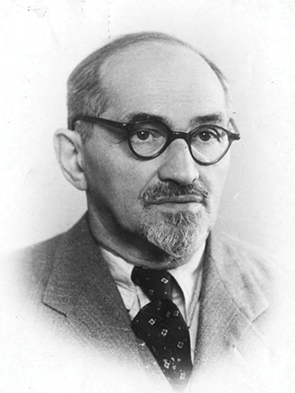
Eisenstadt’s status as a “red professor,” and perhaps his blind infatuation with figures such as Lenin, whom he physically resembled (short, bald, and sporting a goatee, see Figure 4.1), aroused public resentment. Following the Suez Crisis, students at the Tel Aviv School published a petition condemning Eisenstadt’s support for Nasser and for the Soviet repression of the 1956 Hungarian Revolution. They also criticized the course he taught on Soviet and East European law at the Tel Aviv School.Footnote 15
In the early 1960s, perhaps due to the growing anti-Zionism of Soviet Bloc countries or perhaps because the influence of his first wife, Roza, was no longer keenly felt (she died in 1957), Eisenstadt gradually abandoned communism. In 1963, he left a meeting of the World Peace Council in protest because of an anti-Israeli decision. In 1964, he publicly condemned anti-semitic caricatures published in the Soviet press.Footnote 16 In 1965, the Israeli Communist Party split as the Soviet Union gradually aligned with the Arab side of the Arab–Israeli conflict, leading Eisenstadt to become more critical of the Soviet policies.Footnote 17 His final break with communism came following the Six-Day War, when, describing himself as an “old communist,” he published a letter criticizing the Soviet Bloc for its anti-semitic approach and its support of the Arab cause.Footnote 18 Thus, while, in the 1950s, Eisenstadt had celebrated the victories of the Red Army during the Second World War, his 1967 book on the history of the revival of the Hebrew language was dedicated to “our victorious [Israeli] army.”Footnote 19 Another late-life shift occurred in the linguistic realm. Eisenstadt was a lifelong champion of the Hebrew language, but during his later years, he published several works in Yiddish. One of his last major projects before he passed away in 1970 was to edit an autobiography, in Yiddish, of an obscure Jewish-American actress.Footnote 20
Eisenstadt was a wide-ranging intellectual entrepreneur. He taught courses at many academic and non-academic venues. He established several legal and popular education institutions, including the Tel Aviv School of Law and Economics, which ultimately became Tel Aviv University.Footnote 21 He was a central player in the revival of the Hebrew language in Palestine, a prolific writer, editor, translator, and publisher of several (short-lived) journals.Footnote 22 He wrote works on Jewish law, the Hebrew language, the history of Jewish socialism in Hebrew and Yiddish, several biographical works, and even dabbled in children’s stories.Footnote 23 Most of his works were written in Hebrew and Yiddish, although there were also publications in Russian, German, and English.Footnote 24
In the legal realm, his oeuvre included a translation of one of the parts of the Justinian Code, a textbook on Roman law based on his lectures at the Tel Aviv School, as well as an extensive bibliography of works on Jewish law in several languages listing approximately 4,500 works.Footnote 25 He also published many law-related articles in various journals. Eisenstadt’s estate included several additional unpublished works on law, such as a historical dictionary of Jewish legal terms and writings on family law, socialist law, and the history of workers in Greco-Roman Palestine.Footnote 26
Ideas
Western Jurisprudential Influences
Eisenstadt wrote works on comparative law, Roman law, and Jewish law. He did not publish works dealing exclusively with jurisprudence. However, jurisprudence was certainly an important aspect of his scholarship. There were two main jurisprudential sources of inspiration for his works: the German Historical School and Marxist legal theory. In addition, it seems that he was also influenced by the notion of living law that was popular in early twentieth-century Central European legal scholarship.
The ideas of the Historical School shaped Eisenstadt’s views on law as a student and young legal scholar in the 1900s and 1910s.Footnote 27 Several key notions of this jurisprudential approach influenced Eisenstadt’s work, including the premise that history is essential for the study of law and the idea that law is a reflection of national culture (or “the spirit of the people”). The agenda and activities of Historical School scholars also served Eisenstadt as a model for how modern Jewish law scholars should operate.
One example of the importance of history for Eisenstadt can be found in a 1914 book review that he wrote on a pioneering doctrinal work on Jewish law, Principles of Jewish Law, written by another Russian-Jewish legal scholar, Asher Gulak. Eisenstadt criticized Gulak for assuming that Jewish law was a timeless, static entity. Gulak, Eisenstadt argued, ignored the historical development of Jewish law. The specific rules of this legal system were not merely a reflection of some timeless essence but were influenced by the particular environments encountered by the Jews in their various diaspora communities.Footnote 28 A 1917 article by Eisenstadt repeated familiar Historical School themes, such as the idea that the origins of law are to be found in the ancient customs of the people. Legislation, said Eisenstadt, was always merely an articulation of the “hidden law” that previously existed as a “social truth.”Footnote 29 Ancient Jewish national customs could be found in popular ballads, riddles, proverbs, and myths. They could also be discovered by comparing the law of ancient Israel to that of other ancient nations and to the laws of contemporary nomadic nations.Footnote 30
The belief that law was a reflection of the spirit of the people was also central to Eisenstadt’s description of the history of Jewish law.Footnote 31 Law, he said, mirrored the spirit of the race – and, in the case of Jewish law, the spirit of the “Semitic race.”Footnote 32 The way Eisenstadt reconciled the static and the dynamic aspects of Jewish law was to say that, while the principles of the Torah of Moses were timeless, the specific details of the commandments of Jewish law changed with every generation; thus, adherence to the “spirit” of Jewish law could be reconciled with the fact that this law changed as history progressed.Footnote 33 Eisenstadt also sought to emulate the research agenda of the German scholars associated with the Historical School: the academic collection and study of historical legal materials, their systematization, and their subsequent use as the basis for national codification (the historical–dogmatic approach) inspired Eisenstadt’s vision for the scholarly study of Jewish law.
Alongside the influence of the Historical School, Eisenstadt’s thought also reflected Marxist legal ideas. Marxist legal theory had already appeared in his first law-related article, a Yiddish piece published in 1908 in a New York journal, while he was still a law student (see Figure 4.2).
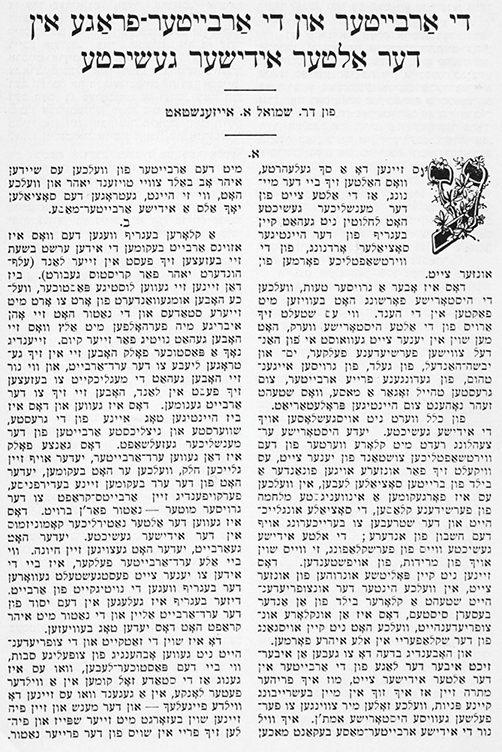
The topic of this article was the history of labor relations and labor law in ancient Jewish society. Here, Eisenstadt offered a reading of biblical history using a class-struggle perspective (and also compared early biblical Jewish society, which he claimed was classless, to ancient Hindu society, which was divided into castes).Footnote 34
In a 1923 article published in the USSR, Eisenstadt described Second Temple legal disputes between the Pharisees and the Sadducees, and between the Hillelite and the Shammaite schools of interpretation, as reflecting the nature of law as “an instrument of oppression in the hand of the ruling aristocracy.”Footnote 35 Later, in 1926, he published a book in Yiddish on the biblical prophets. In this book, he offered what many would see as an anachronistic, “secular” view of the prophets (admittedly quite common among Jewish and Zionist thinkers during that period), portraying them as “social activist[s] and political fighter[s],” who only used religious language because religion was the mode for social critique at the time, but were, in fact, “social thinkers,” “pioneering leaders and spokesmen for the village and city masses,” “tribunes of the people,” protesting at the corruption of the “ruling classes” or the “landowning class.” According to Eisenstadt, the prophets sought to rally against the “poverty and destitution” of the “victimized masses,” offering a “progressive” and “utopian” vision of “social justice and equality.” The prophets, argued Eisenstadt, took this stance in the name of a “revolutionary social idea.”Footnote 36
Eisenstadt returned to the topic of ancient Jewish labor law in a 1937 article entitled “The Hebrew Worker During the Period of the Mishnah.” Here, he provided a class-based Marxist-inspired history of the Jewish people. Eisenstadt described the biblical prophets as the ones “who first discovered the contradiction between the poverty and deprivation of the masses, and the luxurious life of the rulers.” Such “exploitation” of the “popular masses,” he said, also occurred during the period of Persian rule in Palestine. Later, the Sadducees, whom he described as a “conservative political party,” blocked the development of “social legislation,” found in embryonic form in Mosaic law, and the Pharisees, “party of the people,” sought to “give a role to the working masses in the legislative process of the state.” Some “urban intellectuals” also joined the “party of the artisans and peasants,” seeking to “heal their moral consciousness, and purify their lives with hard work.” During this period, laws to “safeguard the rights of the working community” were enacted, creating comprehensive labor legislation based on “social equity” – the first labor legislation ever created, according to Eisenstadt.Footnote 37 In a later lecture, delivered in 1948, Eisenstadt described the biblical prophets as defenders of “the rights of the working people, bearing the vision of world peace and the fraternity of nations,” and again stated that the Pharisees fought to safeguard “the rights of the working masses.”Footnote 38
In a popular lecture delivered in 1951, Eisenstadt told his listeners that, in regimes based on “class exploitation,” law serves as a “weapon of the ruling class to oppress the exploited classes,” but that socialist law is “a weapon of the working class … to impose the dictatorship of the proletariat in order to vanquish capitalism and create a society free of exploitation.”Footnote 39 In the 1950s, he also produced a fully fledged Marxist description of the history of Jewish family law, offering a “historical-sociological analysis” of the development of ancient Jewish family law based on the assumption that there was a defined sequence to the development of social–legal relationships and that no nation is free to circumvent any of the stages of that evolutionary scheme. In his analysis, he linked economic needs to family law rules regarding polygamy, dowry, family property, and inheritance. He noted the rise of a class-based society during the period of biblical judges and kings, discussing economic tensions, social ruptures, and the political subjugation of farmers by the kingly urban elite, and arguing, again, that class tensions led to the appearance of prophets – depicted by him as “social equality warriors and defenders of the rights of the farmers.”Footnote 40 Another example of Eisenstadt’s Marxist approach to the history of Jewish family law can be found in a 1962 article that he published in an East German history journal, in which he compared Jewish and Roman family and inheritance law.Footnote 41
Marxist influence was also found in Eisenstadt’s works on Roman law. One can see this influence in his 1953 textbook on the topic, which was based, he declared, on a social and historical approach to the study of Roman law – one that saw the development of this law as stemming from the conditions of the Roman economy and from a class struggle that stood at the basis of the Roman regime of slavery. In this book, Eisenstadt claimed, for example, that major changes in Roman law were the result of economic and political conditions: massive slave revolts that occurred in the territories ruled by Rome in the period between the first century BC and the first century AD.Footnote 42
Finally, Eisenstadt’s works echoed the ideas of the German Free Law Movement.Footnote 43 In Chapter 2, I mentioned the impact of Free Law ideas on Dikshtein’s thought. One can also see echoes of free law ideas, and especially the contrast between dry formal law and “living law,” in Eisenstadt’s works. In one of his first articles, written in Moscow in 1910, he said that Jewish law “should be filled up by the content of life and should nourish life with its spirit.”Footnote 44 In another early article published in 1911, Eisenstadt provided a survey of Jewish legal history. Throughout the article, Eisenstadt talked about “life” or “social life” as determining the nature of law and modifying it. In this twenty-page article, the term “life” appeared in various permutations no less than forty times. Eisenstadt talked about Jewish law as being a “social science, a science of life,” about oral Jewish law as a law that “flows and changes” with the flow of life. Here is how he poetically described the characteristics of legal discourse in the Talmud:
The most sophisticated creation of Jewish law is the Talmud. It does not contain terse rules, dry paragraphs, or skeletal legal structures that do not speak to the heart or to logic. We see in the Talmud Jewish law at the time of its creation; we hear the debate as it bubbles and roars in the study hall, full of the storm of the senses and the exaltation of logic; every legal question is discussed passionately; the clear skies of the east are reflected in the debate, and it is adorned with the beautiful flowers of legend (aggadah). Before our eyes, a mighty battle unfolds; the sages fight with the tactics of developed logic and immense sharpness; they twist and turn, trespassing boundaries, soaring to the skies and descending to the depths of the idea they are debating, and finally, one of them appears with the crown of victory upon his head, his eyes shining. All the people see that his approach is true and just, and the matter is resolved.Footnote 45
Apologetics: The Superiority of Jewish Law
Eisenstadt claimed that, unlike previous scholars of Jewish law, he would not engage in an apologetic defense of this legal system. When surveying the literature on Jewish law in Europe from the Renaissance onward, he criticized eighteenth-century works for being apologetic and thus attempting to hide the “objective truth” regarding Jewish law.Footnote 46 However, in practice, Eisenstadt often actively sought to show the superiority of Jewish law. In his unpublished autobiography, he explicitly discussed this problem. Describing the very first courses he taught on Jewish law (at the Odessa Rabbinical Seminary), he noted that he was torn between his commitment to objective scientific critique and his “fervent love for our national heritage.”Footnote 47
Eisenstadt’s urge to demonstrate the superiority of Jewish law was frequently found in those works of his in which he compared Jewish to Roman law. For example, in an article published in 1929, using a series of binary opposites, Eisenstadt claimed that Roman law was based primarily on power and the need to govern. In contrast, Jewish law was based on morality and the desire for absolute good. Roman law was based on action, and Jewish law was based on emotions. Roman law sought to serve the ruling citizens of Rome, many of whom were soldiers. At the center of Jewish law, in contrast, stood weak persons – the child, the orphan, the foreigner, the alien. Roman law was individualist, and Jewish law was collectivist. The purpose of Roman law was to protect the Roman conquerors, whereas the purpose of Jewish law was to maintain peace and justice. Roman law was based on external imposition and, therefore, did not require widespread learning of its rules. In contrast, Jewish law maintained itself through an extensive system of grassroots learning in Talmudic academies.Footnote 48
Eisenstadt repeated these dichotomies in a 1937 article. Jewish law, he said, was based on “justice, peace, and equality between all humans,” while Roman law was based on the desire for “personal benefit, power, and control.” Roman law, he explained, was modified by the morality of Jewish law following the Christianization of the Roman Empire; and, in subsequent centuries, there were repeated attempts to synthesize Jewish morality with Roman law. For example, Hugo Grotius undertook such an endeavor in the early modern period, with the creation of modern international law – whose goal, according to Eisenstadt, was to subdue the human urge to fight and dominate other persons. However, modern international law could not prevent global conflicts of the type that the world was witnessing in the 1930s. Only Jewish law could redeem the world from such conflicts.Footnote 49
Finally, on the jurisprudential level, Eisenstadt argued for the superiority of Jewish law based on the nature of Jewish law texts and Jewish legal education. In a 1941 article, he contrasted the modern sovereign legislator, who “prevents freedom of opinion and silences opposing voices,” with Jewish law, which he described as a “truly popular law.” Because of its popular nature, Jewish law texts did not present a unitary façade: they contained evidence of the debates surrounding the rules of Jewish law. In the Talmud, for example, readers were exposed to the differing opinions of the rabbis and could decide for themselves if a certain rule was correct.Footnote 50 Eisenstadt also compared the Jewish model of legal education favorably with the model found in Western universities. In a 1913 article, Eisenstadt discussed the Jewish study hall (beyt midrash) and said that it represented a popular and non-hierarchical model of legal education that was not geared toward practical ends but toward pure learning. As such, it was superior to the Western model.Footnote 51
Evolutionary Schemes, Social Hierarchies, Democracy
Non-Western law was generally seen by nineteenth- and early twentieth-century Western legal thinkers as representing a lower rung on the evolutionary ladder of the development of law. One reason for this depiction was that non-Western law was understood as being closely tied to religion. Henry Maine, for example, described Hindu law in his book Ancient Law as a law based on ancient codes, which could not be reformed because of the sanctity of religion.Footnote 52
Eisenstadt, both because of his apologetic approach to Jewish law and also because he was a lifelong secular socialist, sought to distance Jewish law from Jewish religion. He did acknowledge that, originally, law and religion were intermingled since law was seen as emanating from God.Footnote 53 He also conceded that Jewish law was based on the idea of heavenly justice.Footnote 54 However, the religious nature of Jewish law was not part of its essence. Jewish law, he proclaimed in an early article, was a secular law that was only “hidden” in religious texts because of the Jewish Exile.Footnote 55 In an article on the distinction between public and private Jewish law, he noted the religious nature of Jewish law but then explained that public law wore a “religious mask” during the Jewish Exile, Jewish religion merely being a “receptacle” for law. Because Jewish religion had a “social and national aspect,” he claimed, it did not distort public law but, rather, preserved it until such time as its secular nature could be revealed.Footnote 56 Another aspect of Eisenstadt’s ambivalent attitude to the religious nature of Jewish law can be found in his book on the biblical prophets. Here, he argued that the prophets were actually secular social reformers who used the language of religion only because that was the convention during biblical times.Footnote 57
Just like Pal, Eisenstadt, too, devoted much effort to justifying the inegalitarian nature of the legal system he was studying. One major expression of this inegalitarianism was found in the existence of slavery. In a 1917 article, Eisenstadt observed that, while slaves did exist in ancient Israel and were treated as property, they were not seen as similar to animals or movable property, as was the case in other ancient legal systems. Among nomadic peoples, such as the early Israelites, he said, the difference between slaves and masters was not great, and there was no chasm of class difference, such as that which existed in more economically advanced nations. Slaves and masters herded the flocks together, and slaves were not subjected to hard labor. For example, they were not involved in building city walls like slaves in urban societies. Slaves were considered members of the family and were able to inherit the property of a childless master.Footnote 58
In a long article published in 1927, Eisenstadt compared the attitudes of Roman and Jewish law to slavery. He remarked that slavery existed in Roman law and was not initially regarded by Roman lawyers as problematic. However, with the rise of Christianity, Roman lawyers began to see slavery as opposed to natural law. All men, they came to believe, were born free; and, therefore, slavery became a problem to be justified. Jewish law did not have the same problem because, while Jewish law did recognize slavery, the recognition was “limited.”Footnote 59 Roman law’s initial attitude to slavery was the result of the fact that the Roman Empire was a huge state artificially composed of a conglomerate of occupied countries and nations, which could not survive without mass enslavement under harsh conditions. In contrast, the agrarian residents of Palestine had no opportunity or desire for conquest or the enslavement of war prisoners, and their main occupation – farming – was carried out by themselves or by tenants and hired hands. Jewish law recognized slavery, then, but the rules that governed it were far more lenient than those of Roman law. Thus, while Roman citizens could become slaves (and then lose their citizenship), Jews could not become lifelong slaves (and, if foreigners enslaved them, they had to be redeemed); slaves who were treated harshly by their owners were emancipated, unlike Roman slaves; and, although slaves could inherit the property of their childless master, the master could not inherit the property of the emancipated slave.Footnote 60
One point on which Roman law was more liberal than Jewish law, to modern eyes, was that of the status of the children of slaves. Roman law declared that the child of a free man and a female slave was free, while Jewish law declared that this child was a slave. The harsher norms of Jewish law, explained Eisenstadt, were the result of the fact that foreign slaves were common in Rome, which thus became “an international nation.” In contrast, Jews in Palestine waged constant wars against the influx of foreign slaves and, therefore, were less lenient toward the offspring of mixed couples.Footnote 61
Eisenstadt also dealt extensively with the status of women in Jewish law. He taught family law at the Tel Aviv School of Law and Economics, and his wife was a member of various feminist organizations in 1950s Israel. Thus, it is not surprising that the topic concerned him, and his works on the legal status of women ranged widely. They included articles dealing with ancient Jewish family law, the legal position of women in the ancient city of Ugarit, and the status of women in contemporary Israel. However, Eisenstadt was not merely a scholar interested in describing family law. When the Israeli Parliament debated the Israeli Women’s Equal Rights Law of 1951, Eisenstadt prepared a long memorandum criticizing the law for not being radical enough.Footnote 62 He also called for extensive reforms in Jewish family law, which the State of Israel applied in litigation between Jewish litigants and which tended to discriminate against women. Noting the conservative nature of this area of law, he advocated for creating a codification committee to reform it.Footnote 63
When discussing the status of women in Jewish law, Eisenstadt often adopted a critical tone. For example, he said that polygamy, recognized by Jewish law in the biblical period but also later (for example, in the major sixteenth-century codification of Jewish law by Rabbi Joseph Karo), was a norm that was left over from the “primitive period” of Jewish law and that it should be formally abolished to ensure equal rights for women.Footnote 64 However, while, in some of his writings, Eisenstadt was critical of the attitude of Jewish law to women, one can also find evidence to the contrary. For example, in an article he published in English in 1948, Eisenstadt attempted to prove that Jewish law did not discriminate against women. In discussing law during the era of the biblical patriarchs, he noted that daughters and widows inherited an equal portion of the inheritance to that of men but that this rule did not apply when women married outside the family. This exception, he explained, was justified in order not to divide family property. He then stressed that, in this scenario, the women would be compensated for their lost share of the family property. Later, the protection of widows was guaranteed by a marriage contract containing provisions promising a minimum sum of fixed compensation for the wife in the case of divorce or the husband’s death. In addition, daughters, too, were entitled to alimony upon the death of their father.Footnote 65
A final aspect of Eisenstadt’s apologetic attitude was found in his attempt to depict Jewish law as inherently democratic. Jewish law, he said, was not a product of rulers or kings. It was “popular [and] democratic … the people were the creator of law” – or, more specifically, the prophets, who were the “tribunes of Israel” and personified the needs of the people.Footnote 66 Elsewhere, Eisenstadt discussed the history of the Council of Four Lands, a Jewish representative body that existed in early-modern Poland, describing it as being, in fact, a Jewish parliament.Footnote 67
Collectivism
In his 1953 textbook on Roman law, Eisenstadt devoted several pages to comparing Roman and Jewish law. Roman law, he said, was the law of a society of masters who owned both men and property, and their ownership was based on the notion that the individual right of private property had no limits. In contrast, the rules of property and inheritance in Jewish law were based on the idea of collective ownership, and the notion of individual property was undeveloped and limited.Footnote 68 The collectivist nature of Jewish law was also expressed in specific legal doctrines such as the jubilee year rule, the seven-year agricultural sabbatical cycle, and in rules pertaining to labor law, charity, levirate marriage, and quasi-contract.Footnote 69
In 1957, Eisenstadt published an article comparing the notion of the legal persons in Jewish and Roman law, claiming that this notion did not exist in ancient Roman law and only appeared later, in medieval and modern times. This, he claimed, was because the idea of a legal person required both a conception of property that did not focus solely on private property and also a recognition that abstract, bodiless entities can exist. Neither of these ideas, said Eisenstadt, was present in ancient Roman law, which was based on the premise of the absolute individual property rights of the head of the household, the paterfamilias, and on a polytheistic religion whose many gods took on bodily forms. In contrast, property in Jewish villages in Palestine until the end of the Second Temple period was held in common. Communal religious groups sharing their property, such as the Essenes, were also widespread. In addition, abstract thinking, which rejected corporeality, was also common among Jews, and this outlook was evident not solely in the theological realm but in the legal sphere too. Ancient manifestations of this approach included, for example, the collective liability of biblical towns and tribes, while later expressions were found in the appearance of local and central religious and charitable endowments.Footnote 70
The individualism–collectivism contrast was also noted by Eisenstadt in an article in which he remarked that Roman law protected private property, unlike Jewish law (and other oriental legal systems), which saw individuals (and their property) as an indivisible part of the collective.Footnote 71 One qualification regarding the binary dichotomy between individualist Roman law and collectivist Jewish law that Eisenstadt did make, however, was that he noted how the Ten Commandments reflected a regime of private property.Footnote 72
Eisenstadt’s Unique Jurisprudential Ideas
Eisenstadt was not a deep jurisprudential thinker. Nevertheless, his scholarship contains several interesting ideas, three of which I will mention here.
Nationalist and Marxist Legal Theory Combined
Eisenstadt saw no problem in combining the nationalist legal ideas of the Historical School with Marxist legal theory. This is less surprising than it perhaps seems. First, Marx himself was a student of Friedrich Carl von Savigny, the founder of the Historical School.Footnote 73 Marxist legal theory, therefore, may be seen as indebted to, and in part shaped by, the principles of this intellectual tradition. Second, 1920s Soviet policy, to which Eisenstadt was exposed while living in Moscow, encouraged and celebrated the creation and propagation of the national cultures of the nations that were living under Soviet rule rather than attempting to erase them. Lenin and Stalin, in particular, argued for national self-determination (within the confines of a unitary central Soviet state, of course). This policy led to the promotion of national languages (Yiddish, in the case of the Jews).Footnote 74 It also had implications in the legal sphere. In the early 1920s, for example, there were attempts to integrate Shari‘a courts in Central Asia into the Soviet legal system and to “harmonize” Islamic law and Soviet legislation.Footnote 75 Thus, Eisenstadt’s desire to study and use Jewish law would not have been seen by him as being in contradiction to his socialist and, later, communist beliefs.
A Non-Western Model of Legal Education
In Jewish law, Eisenstadt found a unique concept of legal education that differed significantly from the Western concept. In an article published in 1913, Eisenstadt compared European universities to the “typically oriental” Jewish study hall. The Orient, he claimed, seeks spiritual development. It strives for harmony between religious and moral values and social needs, while the West seeks cultural conquest and technical development, and its universities are, therefore, places for the training of a professional and practical elite (medical doctors, lawyers, teachers, architects, and so on). Eisenstadt then contrasted Western universities with the Jewish study hall, which he characterized as a gathering place for those unsatisfied by mere territorial conquest or technical advancement. Unlike the Western university, he argued, the Jewish study hall is not a training ground for the sons of the upper classes of society – it is a popular institution open to all. There are no teachers and students, as everyone is both student and teacher simultaneously; everyone seeks an eternal living truth, where the boundaries between individuals blur in the noise of “enthusiastic debate.” The Zionists of Palestine, he noted, had already established vocational schools. However, this was not enough. This oriental model of legal education embodied in the study hall should, he argued, be resurrected in Jerusalem, and “the great Hebrew worldview,” frozen and enslaved in Europe to foreign cultures, should be revived, creating a new generation of Jewish youth imbued with both “tradition and life.”Footnote 76 In his 1950s book on Roman law, Eisenstadt repeated these ideas about the unique nature of Jewish legal education. He observed that one of the major differences between Roman and Jewish law was that, unlike the Romans, the Jews did not view law as the exclusive domain of rulers and specialists only. Jewish law was a topic that all members of society were supposed to study.Footnote 77
A Non-Western Genealogy of International Law
Finally, Eisenstadt offered an interesting argument about the antiquity of international law (echoing the ideas of other interwar Jewish law scholars who will be discussed in Chapter 6). As early as 1918, Eisenstadt argued that international law was not invented in the early modern period – one could already discern the rules of international law in the biblical period.Footnote 78 In 1926, he wrote an article attacking the common view that international law was created in Europe. The discovery of ancient Near Eastern texts by Western archaeologists, he said, revealed that international law was not born in Europe in the early modern era and should not only be associated with thinkers such as Hugo Grotius. The Bible and texts from Egypt, Babylonia, and the Hittite Empire indicated that international law existed in the ancient Near East. The generalization and abstraction that are hallmarks of modern international law were missing, but the idea itself could be found in literary myths, in diplomatic letters between ancient kings, and in specific treaties. Eisenstadt then offered an extended analysis of the Bible and the descriptions it contains of various international practices from the age of the Patriarchs and later biblical periods, identifying parallels with modern international law in areas such as international boundary-setting, negotiations, allegiances, treaties, the status of diplomatic envoys, and rules governing wars.Footnote 79 Eisenstadt also contrasted international treaties of the ancient Near East that were based on realist considerations – the need to show political strength and to accommodate the violence of the bigger powers of the region – with the ideas of the biblical prophetic movement, which, as it gained strength in ancient Israel, fostered a new approach to international law that was based on public morality.Footnote 80
Another facet of Eisenstadt’s argument about the antiquity of Jewish international law appeared in his book The Prophets, published in Yiddish in 1926. Eisenstadt described biblical prophets as “outspoken, principled opponents of war and bloodshed” who opposed the “reactionary” nature of war and were “internationalists” in their outlook. According to his reading, the prophets “sharply criticized the never-ending militarization of the great powers [of the ancient biblical world] and sought to show the ineffectuality of physical power in international conflict,” determined to expose “international injustice.”Footnote 81
In his discussions of international law, Eisenstadt voiced ideas that are somewhat comparable to the ideas of contemporary TWAIL (Third World Approaches to International Law) scholars. The proponents of TWAIL argue that international law is a system that was created by Europeans in the early modern period to legitimize and sustain the plunder and subjugation perpetrated by Western great powers on the Third World. TWAIL scholarship emerged in the late 1990s, but the scholars associated with it acknowledge that it had precursors. However, they place these precursors in the period of decolonization immediately after the Second World War.Footnote 82 Eisenstadt’s discussion (as well as that of the scholars that will be discussed in Chapter 6) shows that similar ideas about the non-Western origins of international law antedated the end of the Second World War.
Conclusion
Eisenstadt’s life and thought were undeniably exceptional. No other thinker associated with the idea of reviving Jewish law combined a passion for cultural nationalism with a political commitment to communism. Nevertheless, in many other respects, Eisenstadt’s views were similar to those of a larger cohort of early twentieth-century Zionist legal thinkers. The influence of the German Historical School, the assertion of Jewish law’s superiority over Western legal systems, and the apologetic attempts to justify the more problematic aspects of this ancient legal system were all traits that were shared by many of Eisenstadt’s fellow Jewish legal scholars working in the Diaspora, in Mandatory Palestine, and Israel. Can we also compare Eisenstadt to contemporary Indian legal scholars such as Pal? This is the question that I will now explore.

 Open access