Surrogate end points represent, in the best case, preliminary steps in the causal chain leading to relevant clinical and patient outcomes such as mortality or morbidity. They are measured in lieu of the actual outcome of interest and are typically biochemical markers, physiological parameters, or subclinical end points that are not generally perceived directly by patients, but are nevertheless correlated with clinically relevant end points (e.g., high blood pressure is associated with a higher risk of stroke, high LDL cholesterol is a risk factor for myocardial infarction, the CD4 cell count is associated with AIDS-related morbidity and mortality). Surrogate outcomes are used not only in trials of pharmaceuticals, but also in studies of other clinical technologies. In addition, parameters with an intermediary character are also used in the field of community and public health interventions.
Their use in assessing the benefits of health technologies, however, is problematic. In the past, reliance on surrogate outcomes has led to false conclusions concerning the effects of technologies on the relevant health outcomes (Reference Bucher, Guyatt, Cook, Holbrook and McAlister4;Reference Fleming and de Mets11). In many situations, relying on the strong correlation observed between surrogate and relevant end points to spread an intervention has had fatal consequences (i.e., positive effects on the surrogate, but increased mortality with the intervention in question). These issues have been already raised 30 years ago, as the World Health Organization study on the prevention of myocardial infarction with clofibrate rebuted the expectations put in this strategy—which were founded in its cholesterol lowering effect—by showing that mortality was higher in the clofibrate group than in the placebo group (7).
A classic example of the potential for fatal consequences when relying on surrogates is the case of class I anti-arrhythmic drugs: these drugs increase mortality although they suppress ventricular arrhythmias, which on their own are associated with higher mortality after myocardial infarction (Reference Bucher, Guyatt, Cook, Holbrook and McAlister4). Some drugs have been removed from the market after increased mortality or morbidity was observed in association with their use, contrary to the expectations that had been raised by the observation of positive effects on a surrogate end point (Reference Bucher, Guyatt, Cook, Holbrook and McAlister4;Reference Psaty, Weiss and Furberg29). However, in other occasions reliance on surrogates has led to the withholding of effective therapies. For example, beta blockers—due to their bradycardic effect—were considered for many years to be contraindicated in patients with heart failure, because—following pathophysiological reasoning—a reduction in heart rate was thought to have deleterious effects in these patients. These agents, however, turned to have a beneficial effect by reducing all-cause mortality in patients with chronic heart failure (Reference Heidenreich, Lee and Massie15;22).
Although these—and other—previous experiences have shown the risks of basing technology assessment on surrogate outcomes, claims for the potential benefits—for example, faster access to effective innovations—of relying more on these type of parameters are recurrent. For example, the “accelerated approval procedure” of the US Food and Drug Administration introduced in 1993 the possibility to base approval assessments of drugs for life-threatening conditions currently lacking of treatment options on surrogate end points (12). In a recent international symposium organized by the German Federal Ministry of Health to debate the assessment of cost-effectiveness—with gathered among others participants from academia and industry—the issue of the potential role of surrogate outcome parameters in the assessment of health technologies was raised (Reference Antes, Jöckel, Kohlmann, Raspe and Wasem1). More recently, a Working Group on Surrogate Outcomes has been established under the auspices of the international society for Health Technology Assessment (HTAi) with the aim of encouraging the debate about the issue of surrogate outcomes use in HTA (16).
In light of these debates, it seems relevant to get an overview of the actual handling of the issue of surrogate outcomes in the international HTA community.
The aim of our study was thus to assess the role currently assigned to surrogate outcomes in the field of HTA by reviewing institutional methodological guidance and by estimating the actual use of surrogate end points in international HTA reports.
METHODS
We followed two different methodological approaches for addressing the above-mentioned aim: a document review and the analysis of a random sample of HTA reports.
Document Review
We searched for documents describing the general methods recommended and followed by HTA institutions in the conduction of their assessments (i.e., in the elaboration of their HTA reports). We included two types of institutions for this review, both of them publicly funded:
• HTA agencies which are members of the International Network of Agencies for HTA (International Network of Agencies for Health Technology Assessment, INAHTA) and
• Institutions undertaking assessments in connection with pharmaceuticals' regulation (i.e., reimbursement and pricing), without INAHTA membership.
Documents were included if they had been made available to the public and were written in English, French, German, Portuguese, or Spanish. General methodological guidance published by these institutions was retrieved through the institutional Web sites. To identify relevant documents we scanned the publication lists and performed an additional search using the institutional Web sites' search engine targeting at agencies' methodological work on the issue of surrogate outcomes.
We analyzed the relevant documents and extracted the passages dealing with the selection of outcome parameters in general and with the use of surrogate outcomes in particular. The statements were compared and summarized in a narrative way.
Random Sample of HTA Reports
For the purpose of this part of the project, we considered the HTA reports gathered in the HTA database (www.crd.york.ac.uk/crdweb/Home.aspx?DB=HTA). To be eligible for our survey, reports had to be finished—i.e., documents described as “(ongoing) project” were excluded—and written in English, French, German, Portuguese, or Spanish.
We drew a representative random sample stratified by country of origin and by publication year (before 2000, between 2000 and 2004, after 2004). The sample size was set at 5 percent of the eligible reports for convenience. Random numbers were generated with statistical software (SAS®).
Documents were excluded from the final sample of HTA reports if they had to be purchased for a fee or if they did not report a technology assessment (e.g., guidelines, methods reports).
To assess what kind of outcomes had been used in the assessment, we analyzed research questions, methods and results sections as well as—if available—the evidence tables displaying information extracted from studies included in the HTA reports. We classified the types of outcome parameter used in the HTA reports according to the following definitions:
• Clinical Relevant End Point: “A characteristic or variable that reflects how a patient feels, functions, or survives” (3). It includes end points measurable or verifiable by thirds such as death or morbidity (i.e., hard end points) as well as subjective end points such as symptoms, quality of life, performance, etc. (i.e., so-called patient reported outcomes).
• Surrogate End Point: Measurable parameters which are based on epidemiologic, pathophysiologic, therapeutic, or other scientific evidence and which are expected to predict a clinical relevant end point (3). A surrogate end point represents an intermediary stage in the causal chain leading to the clinical relevant outcome. According to the framework proposed by Fryback und Thornbury (Reference Fryback and Thornbury13) for the assessment of diagnostic technologies, we consider test characteristics (sensitivity, specificity, etc.) to be also surrogate parameters.
In addition, we evaluated whether a prospective definition of the outcome parameter to be considered in the assessment had been reported in the documents. We also analyzed whether only effectiveness outcomes had been considered or if the report also indicated safety assessment as an additional end point.
We provide descriptive statistics of the frequencies of the different outcomes.
RESULTS
Recommendations from Assessment Institutions
A total of fifty-six institutions were scanned (see Supplementary Table 1, which can be viewed online at www.journals.cambridge.org/thc, for the complete list), including both INAHTA members and nonmembers.
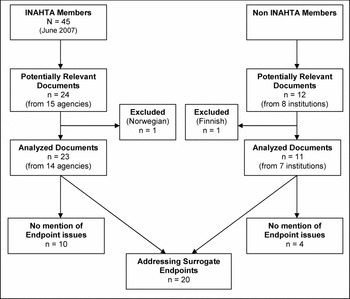
At the time we performed our document search (June 2007), INAHTA counted 45 member institutions. We identified a total of twenty-four relevant documents from fifteen agencies. The documents had been published between 1995 and 2007. One document was excluded, because it was only available in Norwegian. The German Institute for Quality and Efficiency in Healthcare published an updated version of its general methods paper in 2008—during the term of our project—which we included instead of the one identified trough our search and dating from 2006.
We scanned eleven further nonmember institutions of INAHTA. This search line yielded twelve further relevant methodological guidelines published by eight institutions between 1999 and 2006. One of the documents was, however, excluded because it was only available in Finnish. Figure 1 depicts the document selection process.
Pool of methodological guidelines from HTA institutions.

Overall, the problematic of surrogate end points and outcome selection was addressed in twenty of the analyzed methodological documents at least to some extent, although the depth and breadth with which the issue was addressed varied considerably across documents. The complete pool of documents and references included in this part of the study as well as the extracted passages related to the issue of surrogates is available in Supplementary Table 2, which can be viewed online at www.journals.cambridge.org/thc.
The documents analyzed witness a general consensus among HTA institutions regarding the type of outcome parameter which are to be taken into account when assessing health technologies, namely those considered to be directly relevant for patients. Mortality, morbidity, symptomatology, quality of life, as well as adverse and undesirable effects are consistently mentioned as the outcomes needed to perform a reliable assessment of a health technology. In many of the documents, these were termed as being “definitive” or “final” outcomes, enhancing their conceptual opposition to the intermediary, indirect and short-termed character associated with surrogate outcomes. There seems to be a broad consensus that information on these kinds of outcomes (i.e., final) is the one required for an appropriate weighting of the good and harm associated with the application of an intervention.
Only a few institutions provided an elaborated definition of the concept of “surrogate” outcome or end point—these being very similar and partly literally the same (see Table 1). Common to all these definitions is that surrogates outcomes are physiologic parameters, biomarkers, or physical signs measured instead of a relevant end point.
Definitions of Surrogate Outcomes Proposed in HTA Methodological Guidelines

Whereas all the agencies underline that clinical or patient relevant outcomes are to be given priority in HTA, many of them declare in their methodological guidance that a surrogate outcome parameter could be considered acceptable in exceptional situations, provided that the validity of the surrogate outcome has been proven (2;5;Reference Cleemput, Crott, Vrijens, Huybrechts, Van Wilder and Ramaekers6;14;17;21;24;26–28). In the view of some agencies, in some situations, evidence of effects on surrogate outcomes could be combined with other evidence in pharmacoeconomic modeling to simulate final outcomes (5;Reference Cleemput, Crott, Vrijens, Huybrechts, Van Wilder and Ramaekers6;14;27;28). The validity of a surrogate is considered to be given if a set of conditions has been fulfilled. These conditions can be summarized as follows (5;17;21;24;28): There is a statistical association between the surrogate and the relevant end point; The association between the surrogate and the relevant end point is plausible from a biological and pathophysiological point of view; The association is strong and consistent across studies; and There is evidence from randomized controlled trials that improvements in the surrogate has led to improvements in the final outcome.
In addition, one agency—the German Institute for Quality and Efficiency in Health Care (IQWiG)—describes situations in which a surrogate can not be considered to be valid, namely when an intervention: shows an effect on the surrogate but not on the patient relevant end point, shows an effect on the patient relevant end point but not on the surrogate, and shows inconsistent effects on surrogate and patient-relevant end points (17).
Another institution—the Australian Pharmaceutical Benefits Committee (PBAC), which assesses evidence submitted by manufacturers, requires the submission of systematic review(s) showing the biological and epidemiological relationship between surrogate and final outcome, systematic review(s) of RCTs of other interventions showing that a positive effect on the proposed surrogate leads to a positive effect on the final outcome as well as a reasoning on why the relationship between surrogate and final outcome observed with other interventions would apply to the proposed intervention (2).
None of the documents includes a list or catalog of surrogate parameters considered to be generally acceptable or well established for different conditions. However, the PBAC guidelines suggest that left ventricular ejection fraction and viral load can be considered to be established for survival after myocardial infarction and cure for viral hepatitis, respectively (2).
Use of Surrogate Outcomes in HTA Reports
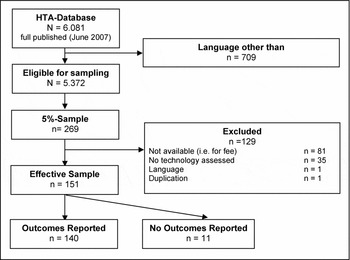
A total of 118 reports had to be excluded from our original 5 percent sampling for different reasons. Main reasons for exclusion were that the report was not available or because it was addressing a methodological issue and not a health technology (see Figure 2). Thus, we analyzed a final effective sample of 151 reports, which represents 2.8 percent of the eligible HTA reports. Although the reports covered different types of technologies, the majority dealt with the assessment of medical and surgical interventions (52 percent), followed by drugs (32.5 percent).
HTA reports sampling from the HTA database (available at http://www.crd.york.ac.uk/crdweb/Home.aspx?DB=HTA).

Overall, an explicit prospective description of the outcome parameters upon which the assessment would be based was present in less than half of the HTAs (i.e., no mention of relevant outcomes in the research or methods sections was found). Thus, in 55 percent of the assessments, we extracted the outcome parameters used from the results section or from evidence tables. Eleven of the reports did not contain any information on the outcomes considered in the assessment of the technology, and were subsequently not further taken into account. These HTAs were both lacking a prospective definition of the outcome parameters upon which the assessment would have been based and in addition reported that no evidence was found. Because no studies were included in the assessment and subsequently no results were reported (i.e., no evidence tables were shown in the report), we could not obtain any information on the assessment outcomes.
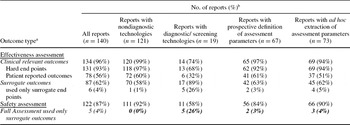
Surrogate outcomes had been considered and/or extracted and reported in 62 percent (87 of 140) of the reports. As shown in Table 2, the role of clinically relevant outcomes was, however, much more prominent. Almost all reports assessed effectiveness upon patient relevant parameters, either hard outcomes (e.g., mortality, incidence of morbid events) or outcomes reported by patients. In addition, the majority of HTAs reported to also address the safety of the technology taking into account any kind of potential adverse effects. In general, surrogate outcome parameters were more frequently used in the assessment of diagnostic and screening technologies than in other types of technologies.
Results of HTA Reports Survey

aDefinitions according to methods section.
bMultiple mentions possible,% rounded.
HTA, health technology assessment.
Only one of the documents addressing therapeutical interventions reported to assess effectiveness of the technology in question based on evidence on a surrogate parameter, although the full assessment also considered safety and thus it was not solely based in surrogate outcomes. This was a report from an appraisal of the National Institute for Health and Clinical Excellence (NICE) on antivirals for the treatment of hepatitis C that assessed effectiveness upon viral load. However, the document acknowledged the need for further research on relevant outcomes such as survival and health-related quality of life (25). The appraisal was based on a more comprehensive report in whose methods section other outcomes such as morality, morbidity, or health-related quality of life had been defined as the relevant parameters for the assessment of this technology (Reference Shepherd, Jones and Hartwell31).
Overall, only five reports used exclusively surrogate parameters for the full assessment of the target technology. None of these reports assessed a therapeutical intervention. One of the reports assessed the effectiveness of strategies to increase women participation in breast cancer screening. This report analyzed exclusively screening uptake rates (Reference Sarria-Santamera and Timoner-Aguilera30). The other four HTAs assessed diagnostic technologies and extracted and/or reported to have considered only detection rates and/or test characteristics such as specificity or sensitivity (Reference Dretzke, Cummins, Sandercock and Fry-Smith9;Reference Makni, St-Hilaire, Robb, Larouche and Blancquaert19;Reference Mundy and Merlin23;Reference Stürzlinger, Fröschl and Genser32). Three of them addressed the potential for replacing a diagnostic method by another one with different degrees of similarity. One of them aimed at assessing the replacement of the current laboratory method for neonatal screening by tandem-mass spectrometry (Reference Makni, St-Hilaire, Robb, Larouche and Blancquaert19). Another report assessed the potential for replacement of magnetic resonance imaging (MRI) in the stroke diagnostic chain by ultrafast MRI (Reference Mundy and Merlin23). Finally, another HTA addressed optical coherence tomography as potential substitute for fluorescein angiography in the diagnostic work-up of age-related macular degeneration (Reference Stürzlinger, Fröschl and Genser32).
DISCUSSION
Our results indicate that HTA institutions are cautious regarding the use of surrogate outcome parameters in their assessments. According to their methodological guidelines, nonsurrogate parameters are considered the first choice in HTA. These parameters should allow a more reliable and comprehensive assessment of the tandem effectiveness-safety. At the same time, there seems to be a common place among these agencies that, at least theoretically, surrogate outcomes could be used as the main source of evidence for the assessment in well-grounded situations. Our results show that in practice these situations can be considered exceptional. Only 1 percent of reports assessing a therapeutic technology based their assessment of effectiveness exclusively on surrogate parameters and none of them based the full assessment on such parameters. This is not surprising because, according to the agencies' method papers, surrogate outcomes would only be accepted when there is ample evidence of its validity to reflect relevant effects of the technology. The evidence required to accept the validity of surrogate outcomes includes results from randomized controlled trials and from systematic reviews which show a consistent relationship between the surrogate and the final outcome which holds for the technology in question (Reference Mangiapane and Velasco Garrido20). Current works regarding the use of surrogate parameters in HTA also underline the preference for patient-relevant outcomes and the need to thoroughly assess the evidence and the uncertainties regarding the relationship between surrogate and final outcome (Reference Elston and Taylor10;33).
The use of surrogate outcomes was much more common in the field of assessment of diagnostic technologies. Eighty-nine percent of HTAs on diagnostic technologies reported surrogates as compared to 58 percent of the reports assessing therapeutical technologies. Around 25 percent of reports on diagnostic technologies based the assessment solely on these kind of outcomes—for example, on tests characteristics. The reason for this discrepancy between diagnostic and therapeutic technologies is probably the fact, that restricting the assessment to tests characteristics is more often considered acceptable. Often the replacement of a diagnostic technology by another one has no other consequences for the patient than the ones derived from different accuracy. In the case of a well established diagnostic workup and therapeutic management chain, the assessment of a diagnostic technology which aims at replacing an existing one can be limited to the accuracy parameters if the new technology raises no safety concerns. That can be the case when two different laboratory procedures for analyzing a blood sample are compared or when different image processing procedures for the same imaging technique are under comparison.
To our knowledge this is the first comprehensive review on how HTA agencies and related institutions are handling the issue of surrogate outcomes in their assessments. Recently, a working group established by the Australian Pharmaceutical Benefits Advisory Committee has published a framework for evaluating the use of surrogate outcomes in submissions for coverage of pharmaceuticals (33). In addition to a review of the methodological scientific literature, the Australian report provided a comparison of the guidance on the surrogate issue of only two institutions (the English NICE and the Canadian Agency for Drugs and Technologies in Health). Our review of agencies' guidance—although it excluded two documents because of language reasons—is broader, thus allowing for a more complete international comparison (see Supplementary Table 2).
In the winter issue of this journal, a survey on the use of surrogate outcomes in HTA reports appeared, which, however, only included reports published within the United Kingdom HTA Program and was limited to cost-effectiveness models (Reference Elston and Taylor10). Our survey was planned to be representative of the universe of HTA reports contained in the HTA database. Because of time and financial constraints in the project, we had to exclude reports that were not available through the Internet or that required to be purchased from the publishing institution. This resulted in a reduction of our original sample, which on the one side results in loss of statistical precision and on the other side also affects the representativeness of the sample. Reports from the United States were underrepresented in the effective sample. Only 9 percent of the reports in our definitive sample are from the United States, whereas these account for 24 percent of the reports contained in the HTA database. Similarly, older HTA reports are underepresented in our sample (i.e., reports published before the year 2000 account for 17 percent of the HTA database but only for 9 percent of our sample). Nevertheless, unlike previous surveys of HTA reports (Reference Draborg, Gyrd-Hansen, Poulsen and Horder8;Reference Elston and Taylor10;Reference Lavis, Wilson and Grimshaw18), our sampling was not restricted to a specific group of countries or agencies and is, thus, representative to a considerable extent.
Another limitation of our survey is that it did not include reports from most of the institutions involved in decision-making processes for coverage and pricing of pharmaceuticals. At the time of our sampling, the HTA database included reports from agencies with a membership by the INAHTA as well as from other ones. However, only the reports of one of the institutions involved in assessments in connection with pharmaceuticals' regulation are included in this database (i.e., of the English NICE). Assessment reports from other such agencies, for which we analyzed their methodology guidances, were not included in our survey. To our knowledge, these assessments are usually not public and are not gathered in any common database and, thus, are difficult to retrieve. In the light of the methodological recommendations of these agencies regarding the use of surrogate outcomes, we believe that the exclusion of their assessment reports from our survey, however, does not have major consequences for our results.
All in all, our study suggests that the role of surrogate outcomes in HTA is very limited, both from a theoretical point of view and from the observed practice of HTA institutions.
SUPPLEMENTARY MATERIALS
Supplementary Tables 1 and 2 (www.journals.cambridge.org/thc)
CONTACT INFORMATION
Marcial Velasco-Garrido, MPH (marcial.velasco@tu-berlin.de), Research Assistant, Health Care Management (Dir. Prof. Reinhard Busse) H80, Technische Universität Berlin, Strasse des 17. Juni, 135, Berlin, 10623, Germany
Sandra Mangiapane, PhD, MSc (smangiapane@kbv.de), Research Associate, Central Research Institute of Ambulatory Health Care in Germany, Herbert-Lewin-Platz 3, Berlin, 10623, Germany