1 Introduction
Financial literacy has become an important topic in Germany. The reasons for this are manifold, but one important factor is the recent reform of the public pension system that transformed a monolithic system into a multi-pillar system with increased individual responsibility to provide privately for retirement.Footnote 1 The German public pension system covers all private and public employees, i.e., about 85% of the workforce.Footnote 2 It is organized as a pay-as-you-go system and currently provides for about 90% of retirement income. Until the recent reforms, the German pension system was famous for its generosity. However, in light of demographic changes that will cause a steep increase in the old-age dependency ratio in the coming years, fundamental changes have been deemed necessary to ensure the sustainability of the system. After basic adjustments in 1992 and 1998, in 2001, to bridge the gap that arises in retirement income, the so-called Riester scheme – a state-subsidized, but voluntarily funded pillar – was introduced.
Every person who may be affected by the prospective decrease of first-pillar pensions is eligible for Riester subsidies.Footnote 3 The scheme is particularly generous for individuals with low income and families with children, who can obtain subsidies of well over 90% of their contribution. Despite this, Riester scheme participation among low-income households is low (Bucher-Koenen, Reference Bucher-Koenen2010). More than 70% of the poorest households do not own any kind of supplementary private pensions, whereas this is the case in just 20% of the households in the higher-income quartiles. Because low-income households show some of the lowest levels of financial literacy, we might ask whether more than financial incentives are needed to encourage the poorest households with the least financial knowledge to save.
A second reason for the public discussion of financial literacy in Germany is the rapid development of financial markets with complex products that are available to everyone. Individuals are able to buy products they may not understand, and most demonstrate an inability to judge the quality of financial advice they receive about such products. This topic seems particularly important in light of the 2007/2008 financial crisis. While the majority of households did not suffer financial losses due to the crisis, it has caused major insecurity among private households with respect to their investment strategies.Footnote 4 Changes in consumer protection are currently under discussion.Footnote 5
The objective of our study is threefold. First, we use SAVE, a survey of German households, to provide an overview of the level of financial literacy as measured by three questions on financial literacy that have been used in surveys around the world. We identify groups that exhibit low financial knowledge and we link financial knowledge to retirement planning behavior. Together with an analysis of traits unique to the German population, this can improve understanding of how financial knowledge is acquired and its impact on decision making in German households.
Second, we compare financial literacy in East and West Germany. The unique recent history of German unification gives us the opportunity to investigate differences in financial literacy between two regions with distinct economic structures and among individuals with different experiences with financial decision making. Third, we address the problem of causality between financial literacy and planning. We use an instrumental variables (IV) approach and exploit variation in financial knowledge at the regional level to estimate the effect of financial literacy on retirement planning.
Our paper is organized as follows: Section 2 provides an overview of the data set. Section 3 describes the empirical work. Some brief conclusions are provided in section 4.
2 SAVE dataset
SAVE is a representative German household panel designed to improve understanding of saving behavior. It has been conducted by the Mannheim Research Institute for the Economics of Aging since 2001. We use the cross-section from 2009 – collected during the early summer – for the analysis in this paper. SAVE is a household surveyFootnote 6 in which one randomly chosen person who has information on household finances responds to all questions in paper and pencil format. The individual completing the questionnaire is not necessarily the household head. Individuals in the sample received €20 in cash with the cover letter, independent of their participation in the survey. This procedure has been used in previous years of the survey, and due to the high stability of the panel, few households keep the money without participating.
Three financial literacy questions were included in SAVE 2007, 2008, and 2009.Footnote 7 Those questions in the 2009 survey were changed slightly from earlier versions to allow for cross-country comparison. The share of missing answers on these questions is between 2.5% and 3.3% of the sample (N=1,117) for each of the three questions. We drop observations for which one or more answers are missing, leaving us with 1,059 observations.Footnote 8 Table A1, describing the socioeconomic details of the households in the sample, is contained in the data appendix.Footnote 9
3 Empirical evidence
3.1 How much do individuals know?
The three questions on financial literacy used in this study were first developed by Lusardi and Mitchell (Reference Lusardi, Mitchell, Lusardi and Mitchell2011) for the 2004 American Health and Retirement Study (HRS). The exact wording is as follows:
1. Understanding of Interest Rate (Numeracy).
Suppose you had €100 in a savings account and the interest rate was 2% per year. After 5 years, how much do you think you would have in the account if you left the money to grow: more than €102, exactly €102, less than €102? Do not know/Refusal.
2. Understanding of Inflation.
Imagine that the interest rate on your savings account was 1% per year and inflation was 2% per year. After 1 year, would you be able to buy more than, exactly the same as, or less than today with the money in this account? Do not know/Refusal.
3. Understanding of Risk Diversification.
Do you think that the following statement is true or false? Buying a single company stock usually provides a safer return than a stock mutual fund. Do not know/Refusal.
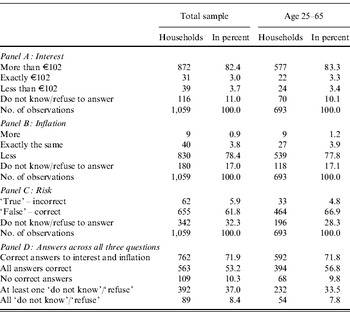
The answers to the first question (interest) are displayed in Table 1 (Panel A) below. Of the total sample, 82% of respondents correctly answered that they would have more than €102 in the account. Around 7% gave incorrect answers. About 11% said they did not know the answer or did not want to answer this question.Footnote 10 Because compound interest calculation is part of German school curricula, it is not surprising that most respondents can answer this question correctly.
The answers to question 2 (inflation) are shown in Table 1 (Panel B). More than 78% of participants correctly responded that the purchasing power of their savings will decrease. Around 5% did not correctly answer this question; the majority of these individuals answered that the purchasing power of their money will stay the same (3.8%). The share of households who answer ‘do not know’ (17%) is higher than the share who incorrectly answer the interest question. To answer this question correctly, individuals need a basic understanding of inflation and its impact on purchasing power. The German Bundesbank has long followed a very conservative inflationary policy, and apart from a few inflationary periods in the 1970s and early 1980s, inflation has stayed well below 2% in most years. Moreover, in the German Democratic Republic (GDR), inflation did not officially exist, as prices for almost all consumer goods were fixed by state plans, and this makes it difficult to evaluate the East German experience with inflation before unification. All in all, while exposure to recent periods of high inflation is limited in the German population, the collective experience of hyperinflation in the early 1920s is still present.
Answers to the financial literacy questions
This table shows summary statistics for the performance of German respondents on all three financial literacy questions. In particular, it displays the frequency and the proportion of households who were able to give correct answers to the interest (Panel A), inflation (Panel B), and risk diversification (Panel C) questions. Overall performance on all three questions is summarized in Panel D. The frequency and proportion of households who gave correct answers to the interest and the inflation question, who were able to answer all three questions, who were unable to answer any of the questions, who gave at least one ‘do not know’ response, and who answered ‘do not know’ to all three questions are reported.

Source: Authors' calculations on the basis of SAVE 2009; data are weighted.
Table 1 (Panel C) shows the answers given to the third question (risk diversification). It was correctly answered by 62% of respondents; 6% incorrectly responded that the statement is true; and around one-third stated that they do not know the answer. The knowledge of stock market risk diversification is not part of most German school curricula, and so an understanding of risk would have to come through economic or financial education or investment experience. In the GDR no security markets existed (see Sauter, Reference Sauter2009), and so East Germans were not able to acquire stock market experience prior to reunification in 1990. And until recently, stock market capitalization in West Germany was rather low compared to other European countries or the US (Guiso et al., Reference Guiso, Haliassos and Jappelli2003). During the 1990s, deregulation and centralization of the stock market, with the much-publicized privatization of large state-owned German companies Deutsche Post and Deutsche Telekom, led to many middle-income households buying stocks for the first time, known as the beginning of the ‘Volksaktie’.Footnote 11 Still, at the end of 2008, on average, only around 23% of households in East and West Germany held equity (Bucher-Koenen and Ziegelmeyer, Reference Bucher-Koenen and Ziegelmeyer2011).
The overall performance of respondents is summarized in Table 1 (Panel D). The inflation and interest questions were correctly answered by a majority of respondents (72%). However, only slightly more than half of respondents (53%) were able to give correct answers to all three questions. About 10% of respondents do not know the answer to any of the questions (i.e., they responded incorrectly or ‘do not know’). Furthermore, 37% of households surveyed stated that they do not know the answer to at least one of the questions, and 8.4% responded ‘do not know’ for all three questions.
Table 1 also shows responses of individuals aged 25–65. The performance of the reduced sample is very similar with regard to the interest and inflation questions: About 72% were able to give correct answers to these two questions. Correct responses to the risk question are slightly higher among 25–65 year olds, with about 67% answering correctly. The proportion of those answering all three questions correctly is 57%.
3.2 Who knows the least?
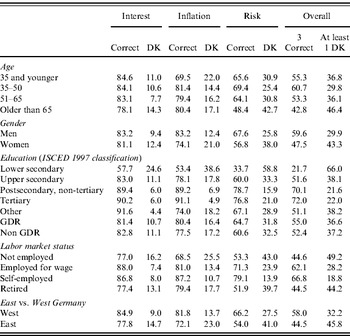
In the following section we examine characteristics of households that display low levels of financial literacy. Table 2 shows the answers to the financial literacy questions across different socioeconomic characteristics.
Financial literacy and socioeconomic variables (N=1,059)
This table shows financial literacy across different socioeconomic variables. The first six columns show the percentage of correct and the percentage of ‘do not know’ (DK) answers to each financial literacy question (interest, inflation, risk). The last two columns display summary performance on the financial literacy task, i.e., the percentage of respondents with three correct answers and the percentage of respondents with at least one ‘do not know’ response.

Source: Authors' calculations on the basis of SAVE 2009; data are weighted.
Age. Overall, we find a hump-shaped pattern of financial literacy with age.Footnote 12 However, an analysis of responses to individual questions reveals a more diverse picture: correct answers to the interest question decline with age; correct answers to the inflation question increase with age; and correct answers to the risk question are hump-shaped over the life cycle.Footnote 13
Gender. We find that women perform significantly worse than men. Almost 60% of male respondents correctly answered all questions compared to 47.5% of female respondents (significant at the 1% level). However, it is notable that women did not give more incorrect answers than men but stated ‘do not know’ much more often. Fewer than 30% of male respondents and more than 43% of female respondents had at least one ‘do not know’ response.Footnote 14 Surprisingly, the gender disparity persists when we consider individuals' roles in financial decisions.Footnote 15 Even female respondents who are single and decide about financial issues by themselves or who decide jointly with their partner know significantly less than respective male respondents. Among women, single decision makers without a partner have a significantly lower probability of answering all three questions correctly than do those deciding with a partner.
Education. Financial literacy is highly correlated with education and the gradient is rather steep. Table 2 shows answers across International Standard Classification of Education (ISCED) levels. Only 22% of respondents with lower secondary education (the lowest level of education that a person in Germany can obtain due to compulsory schooling regulation) could correctly answer all questions compared to more than half of respondents who completed upper-secondary education and 70% of respondents with higher educational degrees (tertiary and non-tertiary postsecondary education).Footnote 16
Labor market status. Individuals without employment (students, unemployed, homemakers) and retired individuals have significantly lower financial literacy than those employed for a wage or salary or self-employed. Only about 45% of respondents not in the labor force were able to give three correct answers, while 62% of those employed for wage or salary and 67% of self-employed respondents could do so.
East vs. West Germany.Footnote 17 Individuals currently living in West Germany are significantly more likely to have answered all three financial literacy questions correctly, with 58% doing so, compared to individuals in East Germany, with 45% giving three correct responses.Footnote 18 Individuals in East Germany were substantially more likely to report ‘do not know’. There is no difference in the percentages of incorrect answers between East and West.
In summary, our bi-variate analysis reveals the same pattern of financial illiteracy across socioeconomic groups as previous studies.Footnote 19 Most of the individuals who report not knowing the answers actually appear to recognize their illiteracy.
3.3 Financial literacy in East and West Germany
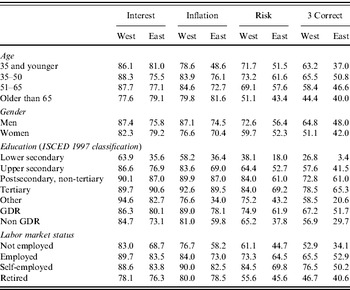
Even 20 years after unification there are still substantial differences between East and West Germany. Various studies examine differences in, for example, income and wealth (Fuchs-Schündeln et al., Reference Fuchs-Schündeln, Krüger and Sommer2009), precautionary savings (Fuchs-Schündeln and Schündeln, Reference Fuchs-Schündeln and Schündeln2005), and stock market participation (Sauter, Reference Sauter2009). In a cross-country study, Jappelli (Reference Jappelli2010) finds that financial literacy slowly improves with economic development. Thus, the questions asked in this section are How large are the differences in financial literacy between East and West Germany? and Are the levels of financial knowledge across socioeconomic characteristics different in the East and West? The relationship between various socio-demographic variables and financial literacy within and across the two German regions are shown in Table 3.
Financial literacy in East and West Germany (N=1,059)
This table displays the proportion of households who correctly answer the interest, inflation, and risk question, respectively, in East and West Germany. The last two columns display the percentage of respondents with three correct answers in East and West Germany.

Source: Authors' calculations on the basis of SAVE 2009; data are weighted.
Age. Within both East and West Germany, we find a hump-shaped pattern of financial literacy with age. In West Germany the 65+ age group has a significantly lower probability of giving three correct answers than the other age groups.Footnote 20 In East Germany, even though we find a hump-shaped pattern of financial literacy with age, the differences between age groups are not significant. Comparing levels of financial literacy within the age classes reveals that East Germans who are younger than 66 are significantly less likely to give three correct answers compared to their West German counterparts. However, among elderly individuals (age 65+) there is no significant difference in the level of financial literacy between East and West: respondents know equally little.
Gender. The analysis of gender differences in East and West Germany reveals that women (men) in the West are significantly more likely to answer all financial literacy questions correctly compared to women (men) in the East. Among respondents in the West there is a strong gender difference: 65% of men and only 52% of women living in West Germany gave three correct answers (significant at 1%). However, among respondents living in East Germany, there is no significant gender difference. On average, 42% of the women and 48% of the men gave three correct answers.Footnote 21
Education. When comparing financial literacy across ISCED levels in East and West Germany we find the same pattern as reported earlier in the paper: Individuals with the highest education levels were more likely to give three correct answers. One rather striking result from East Germany is that among respondents who had obtained lower-secondary education, only 4% were able to answer all financial literacy questions correctly. The comparison between East and West reveals that the gap in financial literacy is the largest for those with the lowest educational attainment: respondents with the lowest levels of education in the East know substantially less than their counterparts in the West.
In addition to their current residence, we have information on whether respondents obtained their educational degree in the GDR, i.e., the communist part of Germany before unification (see Table 2 ‘GDR’ vs. ‘non-GDR’). One would expect to find that individuals educated in the GDR have lower financial literacy than individuals who were educated either in the East after 1990 or in the West. Our results show no significant differences between respondents with GDR and non-GDR education. Given that there are substantial differences in the level of knowledge when differentiating by current residence, it is rather surprising that there are no differences between individuals with a GDR education and individuals with other educational degrees.Footnote 22
Migration between East and West. We can use the information on GDR or non-GDR education in combination with the information on current residence to construct an indicator for migration between East and West. Comparing levels of financial knowledge of individuals who migrated from East to West with those living in the East reveals that in particular those who moved West (i.e., have a GDR education and live in the West) demonstrate higher knowledge than those living in the East, irrespective of GDR or non-GDR education. They have even slightly higher levels of financial literacy than their counterparts in the West (significant at 10%). This might be due to a selection effect – more capable individuals looked for job opportunities in West Germany after unification – or to learning from their new peers in the West. However, among the population in the East – surprisingly – respondents who obtained their education during the GDR regime are significantly (at 1%) more likely to have given three correct answers than individuals living in the East with a non-GDR education.Footnote 23
Labor market status. The pattern of financial literacy as it relates to labor market status in East and West Germany is very similar to the pattern found for united Germany, i.e., there is a significant difference in the probability of answering all questions correctly between individuals in and out of the labor force. Respondents who are not employed, employed for wage or salary, and self-employed in the West have significantly higher financial literacy than individuals living in the East with the same labor market status. There are no significant differences for retired persons between the two regions.
In summary, we find that respondents residing in West Germany are more likely to have answered all three questions correctly than individuals in East Germany. We do find some slightly differing patterns of financial literacy within East and West Germany.Footnote 24
3.4 Does financial literacy matter for retirement planning?
In this section, we turn to the question of whether financial literacy matters for retirement planning. Previous research has shown that planning affects wealth accumulation (Ameriks et al., Reference Ameriks, Caplin and Leahy2003; Lusardi, Reference Lusardi and Aaron1999; Lusardi and Mitchell, Reference Lusardi and Mitchell2007). We measure retirement planning with a simple question with wording similar to the question in the 2004 HRS:
Have you and your partner ever tried to find out how much you would have to save today to reach a certain standard of living at old-age? Yes/No.
This question is only asked of respondent households in which at least one partner is not fully retired. Thus, the following analyses are based on a sample of 677 non-retired households.Footnote 25 Overall, just one-quarter of those surveyed (25.3%) responded that they have done some retirement planning. The majority of households (74.7%) have never tried to find out how much they should save to reach a certain standard of living in retirement. Thus, the share of planners in Germany seems rather low. However, given that the German public pension system has been – and for many individuals still is – rather generous, the low level of retirement planning among German households is not so surprising. But given the pension reforms mentioned above, households are increasingly in charge of their financial well-being during retirement, and therefore some planning – in particular of younger individuals who will be fully affected by reductions in their pension income – will be required.Footnote 26
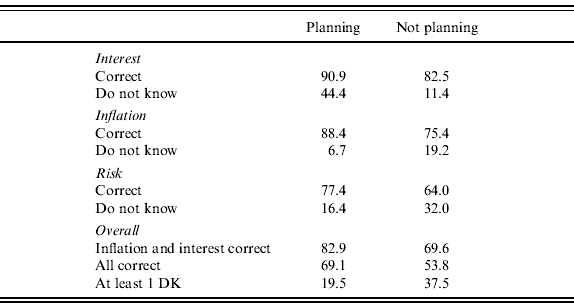
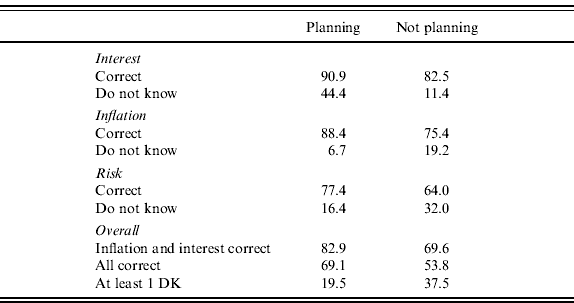
Financial planning and financial literacy are positively correlated: Table 4 shows that households who have planned for retirement are more likely to give correct answers to all three financial literacy questions compared to households who have not planned. Overall, about 70% of the planners answered all three questions correctly vs. only 54% of the non-planners. The non-planners are about twice as likely as the planners to have responded ‘do not know’ to at least one question.
Retirement planning and financial literacy (N=677)
This table shows the proportion of households who correctly answer and who do not know the answer to the respective financial literacy questions across planning and not planning for retirement. Only households who have not yet retired are included in the sample.
Source: Authors' calculations on the basis of SAVE 2009; data are weighted.
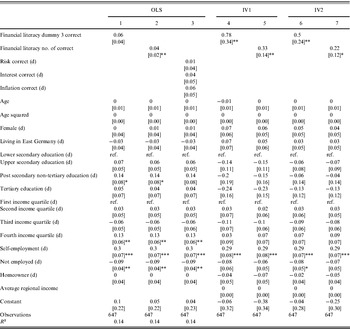
In order to simultaneously examine the relationship between retirement planning, financial literacy, and socioeconomic characteristics we conduct multivariate analyses. As a first step, we implement a simple linear regression. The dependent variable is a dummy that indicates whether households have planned for retirement. Financial literacy is measured in three different ways: first, using a dummy variable equal to one if the respondent is able to answer all three financial literacy questions correctly, second, using a variable – financial literacy score – counting the number of total correct answers (with values between 0 and 3), and third, using dummy variables for answering each question correctly. In addition, we control for differences between men and women, residence in East or West Germany, income, education, age, marital status, number of children in the household, and homeownership. We also include a dummy variable if a person is out of the labor force and a dummy variable for self-employment. The results of the linear regression are shown in Table 5.Footnote 27 In the first specification, financial literacy has a positive relationship to retirement planning (p=0.117). However, when we use the financial literacy score, the effect of financial literacy on planning becomes significant at 5% and sizeable: answering one additional question correctly increases the probability of planning by 4 percentage points. When looking at the effect of correctly answering each question, in column 3, we do not find that the single dummies are statistically significant.
Multivariate analysis of retirement planning
This table reports OLS and IV estimates of the effect of financial literacy and several control variables on retirement planning. In columns 4 and 5 financial literacy has been instrumented using voting shares for FDP and PDS/dieLinke. Columns 6 and 7 use parental financial education and voting shares for FDP and PDS/die Linke as an alternative set of instruments. ‘d’ indicates a dummy variable. ‘ref.’ indicates the omitted category. Coefficients and standard errors are calculated using five imputed data sets and combined according to Rubin's Rule (Rubin, Reference Rubin1996). Standard errors in the IV specifications are clustered at the regional level. Further control variables in all specifications are the number of children and dummy variables for marital status, i.e., dummies for single, divorced, and widowed respondents.

Source: Authors' calculations on the basis of SAVE 2009;
* ,significant at 10%; **, significant at 5%; ***, significant at 1%.
Gender does not seem to have any significant effect on retirement planning, nor does marital status or the number of children in the household. We do not find significant differences in retirement planning between age groups, and there are no large differences in planning across education. Propensity to plan for retirement increases with income. In particular, individuals at the top of the income distribution are more likely to have calculated saving and investment needs than individuals at the bottom. Not surprisingly, the self-employed are more likely to have made a plan for retirement.
The Ordinary Least Squares (OLS) estimates may be biased for various reasons. First, it may be that it is planning that affects financial literacy rather than the other way around: Those who have planned have acquired financial literacy, and our estimates are biased upward. Second, there might be an omitted variable bias due to missing information on ability or motivation to think about financial topics. This will bias our estimates upward. Third, there can be measurement error in the financial literacy variables that can bias the estimates downward.Footnote 28 Overall, the bias in the OLS estimation could be positive or negative.
In order to address these potential problems, we resort to IV estimation. We use exposure to financial knowledge of others in the same region as an instrument for financial literacy. Our first assumption is that individuals who are exposed to financially knowledgeable people become more financially knowledgeable themselves. Our second assumption is that the financial knowledge of others is beyond the control of the respondent. We proxy for financial knowledge of others by using political attitudes at the regional level. Kaustia and Torstila (Reference Kaustia and Torstila2010) find that political attitude plays an important role in financial decision making. In particular, left-wing voters are found to have lower stock market participation compared to right-wing voters. This is due to a different ‘taste for assets’, which is found to be independent of other preference parameters, like risk attitude. Van Rooij et al. (Reference Van Rooij, Lusardi and Alessie2011) show that those who do not participate in the stock market are less financially literate than those who do participate. Thus, if left-wing voters have a lower likelihood of participating in asset markets, they are also less likely to be financially knowledgeable compared to right-wing voters. Therefore, the exposure to financially knowledgeable individuals in regions with a high share of left-wing voters is lower than in regions with a high share of right-wing voters. We use voting shares for the libertarian party and voting shares for the leftist party in the 2005 national election at the administrative district level as instruments for financial literacy.Footnote 29
The libertarian party Freie Demokratische Partei (FDP) in Germany strongly favors free markets and individual responsibility. On a left−right scale, FDP would be positioned to the right of the median voter. We expect individuals who support the FDP to be more financially knowledgeable. Nationwide the FDP achieved 9.8% of the votes in the national election in 2005. The share of votes in the administrative districts ranged from 5.2% to 17.9%. In contrast, the Partei des Demokratischen Sozialismus (PDS/dieLinke) is clearly a left-wing party. Therefore, we expect individuals supporting this party to display lower levels of financial knowledge, i.e., there should be a negative relationship between the voting share for PDS/dieLinke and financial literacy in the region. PDS/dieLinke obtained 8.7% of the votes in the 2005 national elections. The share of votes for PDS/dieLinke in the various administrative districts ranged from 2.1% to 32.7%.Footnote 30
The preference for certain parties in the administrative districts is likely to be correlated with economic prosperity and other regional differences. For example, FDP is known to be the party of the self-employed and wealthier segments of the population, whereas PDS/dieLinke is more popular in regions where the level of unemployment is high. In order to take into account economic conditions at the regional level, we include average income in the districts according to the national accounts of the German states (Länder) in the first- and second-stage regressions.
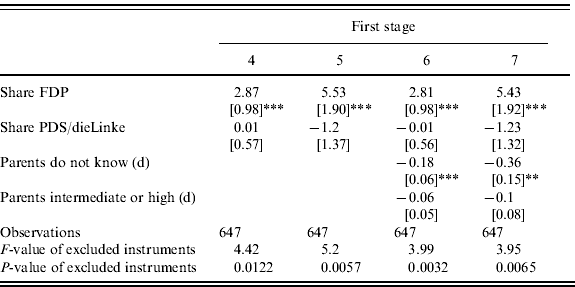
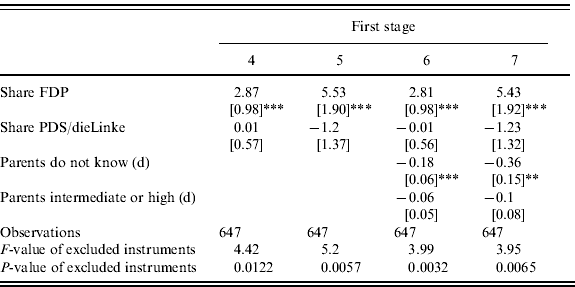
The results of the first stage regression are reported in Table 6. We again use two alternative measures of financial literacy. In both specifications there is a strong, positive, and highly significant relationship between the share of voters for FDP in the region and individuals' financial literacy. However, the share of voters for PDS/dieLinke is not statistically significant. The F-values of the excluded instruments are 4.42 (Prob>F=0.0122) in specification 4 and 5.2 (Prob>F=0.0057) in specification 5, respectively. Thus, the instruments are jointly significant in both specifications. We are aware of the rather low F-values of our instruments. However, the small sample size (N=647) made it difficult to find a set of instruments with high predictive power.
First-stage regressions
This table reports estimates of the first-stage regressions of financial literacy on all the control variables used in the OLS regressions and the share of voters for FDP and PDS/dieLinke in the region. They are numbered corresponding to the second-stage regressions in Table 5. In specification 4 and 5 we use the share of voters for FDP and PDS/dieLinke in the region as instruments. In specification 6 and 7 we use financial education of parents as additional instruments. ‘d’ indicates a dummy variable. Additional controls are income quartiles, indicators for not being employed or being self-employed, gender, living in East Germany, age and age squared, marital status, number of children, homeownership, and education, as specified previously. Average regional income is included as control. Coefficients and standard errors are calculated using five imputed data sets and combined according to Rubin's Rule (Rubin, Reference Rubin1996). Standard errors are clustered at the regional level.
Source: Authors' calculations on the basis of SAVE 2009;
* Significant at 10%; **significant at 5%; ***significant at 1%.
The results of the IV regressions are reported in Table 5 (specifications 4 and 5). We cluster standard errors at the regional level. Our results indicate that financial literacy continues to have a positive and significant effect on financial planning for retirement. The exogeneity tests are rejected, indicating that our instruments are relevant. The results of Hansen's J statistics show that over-identification restrictions are not rejected.Footnote 31 It is worth noting that the IV estimates of financial literacy on planning are larger than the OLS estimates in all specifications. We argued above that the overall direction of the bias in the OLS regressions was undetermined ex ante because of the various potential biases pointing in different directions. However, the paper by Alessie et al. (Reference Alessie, van Rooij and Lusardi2011) shows that the measurement error might be large. Thus, it is not surprising that our IV estimates of financial literacy show a larger effect on planning than the OLS estimates. We are aware that our instruments are potentially weak and, in the following section, we perform a few robustness checks using an alternative set of instruments.
3.5 Alternative explanations and robustness of results
One concern about the validity of our instrument is that political attitude itself is directly related to retirement planning. However, we do not use personal political attitude as an instrument for financial literacy, rather we use the voting share within the region. Personal political attitude is independent of the political preference of individuals within the region as voting is a very private issue in Germany.
A subtler argument against the validity of our instrument is that there might be an inherent positive correlation between respondent political attitude and regional voting shares, because the probability to select a person with certain political preferences into the sample increases with the voting share of this party.Footnote 32 We do not think that this is a problem in our case, because both FDP and PDS/dieLinke are relatively small parties. They are generally not the strongest party in any of the regions.Footnote 33
Moreover, it could be that individuals plan (or do not plan) for retirement because they expect that FDP (PDS/dieLinke) will be in power in the future and thus individual responsibility (state responsibility) for retirement income will be high. However, neither FDP nor PDS/dieLinke are currently in a position to fundamentally reform the pension system. Thus, we think it is plausible to assume no direct effect of voting shares for those two parties on individuals' retirement planning.
Aware of the difficulty of finding a source of exogenous variation for financial literacy, in the new wave of SAVE (SAVE 2010), we have collected information on additional variables that are potential instruments for financial literacy. Van Rooij et al. (Reference Van Rooij, Lusardi and Alessie2011) and Alessie et al. (Reference Alessie, van Rooij and Lusardi2011) have used information on the financial knowledge of others, such as siblings and parents. With SAVE 2010 we collected information on financial knowledge of respondents' parents.Footnote 34 Since SAVE is a panel, we have merged that information into SAVE 2009. In specifications 6 and 7 in Table 5, we report IV estimates to which we have added the financial knowledge of parents to our original set of instruments. Respondents who report not knowing their parents' level of financial knowledge have significantly lower financial knowledge. This is similar to the findings by Alessie et al. (Reference Alessie, van Rooij and Lusardi2011) . The F-value of the excluded instruments is 3.99 (specification 6) and 3.95 (specification 7). The instruments are jointly significant. Also, the Hansen's J statistics show that over-identification restrictions are not rejected. Including these additional instruments does not change our results fundamentally. We still find a positive and statistically significant effect of financial literacy on retirement planning.
4 Summary and conclusions
The level of financial literacy is moderate in Germany. Seventy-two percent of the respondents in our sample were able to correctly answer two simple questions on interest and inflation. Slightly more than half of respondents were capable of answering all three questions correctly. Thirty-seven percent were not able to answer at least one of the questions and accordingly reported ‘do not know’. Women are less likely to have given correct answers than men. Individuals with lower educational degrees and those out of the labor force also gave fewer correct answers. Overall, there is a hump-shaped pattern of financial literacy over the life cycle. Respondents in East Germany have substantially lower levels of knowledge than respondents in the West – even when controlling for differences in socioeconomic background. Financial literacy has an important effect on planning for retirement. In light of the recent pension reforms in Germany and increasing individual responsibility, this is an important finding. If individuals with lower financial knowledge are less likely to plan for retirement, they will be less likely to be aware and take steps to fill the gap in retirement income that will result from the recent reforms. This may have dramatic effects, particularly on the retirement security of individuals in East Germany, because state pensions will be lower due to interrupted employment histories. Financial literacy is particularly low among East Germans with low education and low income. Thus, more targeted efforts and programs many be needed if these groups are to improve their understanding of financial matters and take the appropriate steps to secure adequate retirement savings.
Appendix
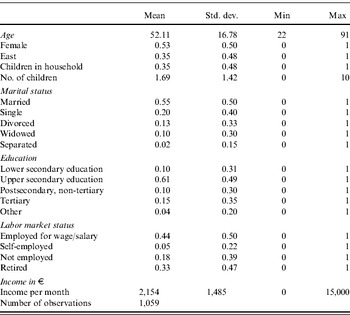
Summary statistics
This table contains summary statistics for our sample. The data are imputed and weighted.