


I. INTRODUCTION
The paper aims to investigate how Arthur Pigou came to adopt the reasoning essentially based on the working of the IS-LM model and to admit that money wage cuts are neutral to employment under the liquidity trap. He came to concede this during the controversy with John Maynard Keynes that took place in the late 1930s. Since Pigou’s concession concerned the behavior of a certain theoretical model, I will discuss how this model was used and analyzed by the participants of the debate and will highlight how these different approaches to model analysis played out in contributing to Pigou’s concession. The discussion as a whole proposes the thesis that this debate was concluded when one form of model analysis replaced another; specifically, when mathematical analysis replaced verbal logical analysis.
Although there are many studies mentioning this controversy between Keynes and Pigou,Footnote 1 the following two works made important contributions to the understanding of this episode. First, Gerhard Ambrosi (Reference Ambrosi2003) devoted several chapters to a discussion of this controversy and interpreted that the crucial issue underlying it was a difference in the assumption regarding people’s savings behavior. The author argued, therefore, that the controversy concerned how Pigou and Keynes viewed differently people’s real-world behavior. Second, Nahid Aslanbeigui and Guy Oakes (Reference Aslanbeigui and Oakes2007) contended that this was essentially warfare between revolutionary economists and those who opposed them, and chronicled how Keynes employed all the resources available to win this war. My argument differs from both of these studies in its interpretation of what was at issue in the controversy. My focus is not on a substantial issue concerning the real-world behavior, as in Ambrosi’s analysis, and neither is it on the exclusively sociological motives of the participants of the debate, as in Aslanbeigui and Oakes’s narrative. I will highlight the subtle shift that occurred in the way Pigou discussed his model during this controversy. The model that was analyzed did not change, but the way that it was analyzed did change.
In the introductory chapter of The World in Model (2012), Mary Morgan paints a picture of an increasing reliance, since the 1930s, upon case-based reasoning using specific models, which has replaced the verbal expression of general economic laws. To illuminate the accompanying epistemological shift, she introduces a distinction between models as objects to enquire into and models as objects with which to enquire; that is, a distinction between, on the one hand, the investigation of the behavior of a model itself and, on the other, the use of a model to draw inferences about reality. Morgan’s first function of model reasoning—the model as an object to inquire into—is of particular relevance for the current paper. This is because, as I will argue below, the underlying crucial question in the controversy between Keynes and Pigou was not the substantial one of whether the behavior of a model corresponds with the real world, but rather a more preliminary issue concerning how the abstract world embodied in a model should behave. To put it another way by using the analogy of models as laboratory experiments (which Morgan set out in the same chapter), the debate did not hinge on the significance of a particular experiment for the understanding of more general phenomena; it turned, rather, on the right method of conducting an experiment in the first place. What settled the debate was neither theoretical insight (in the sense of a new insight not hitherto noticed) nor empirical accuracy (in the sense of correspondence with the world perceived statistically or some other way). As my narrative will indicate, it was the establishment of agreement on how to analyze the model at hand that contributed to the settlement of the debate.
In this paper, section II presents what was the surface issue of the controversy and traces back Pigou’s theoretical interest in money wage adjustment that eventually set up the controversy with Keynes in 1937. Section III discusses Pigou’s Reference Pigou1937Economic Journal article, focusing particularly on his economic model. Section IV analyzes critical comment drawn from three primary directions: Keynes (as an opponent in the debate), Nicholas Kaldor (as an outside critic with a sharper analytical skill), and Robertson (as a neutral observer with regard to this particular theoretical point). I point out the difference between Keynes’s initial response and Kaldor’s analytical criticism, noting that it was the latter that came to dominate the views of all four participants in the debate (including even Pigou’s). Section V turns to the interesting fact that, subsequent to this debate, Pigou came to rely extensively on multiple equation models, and I offer some evidence that substantiates this link between the earlier debate and his later research practice. Section VI presents the so-called ‘Pigou effect’ as arising out of this earlier debate. In conclusion, I highlight the importance of mathematical model analysis for the assessment of the entire episode.
II. PIGOU’S THEORETICAL INTEREST IN MONEY WAGE ADJUSTMENT
The surface issue in the controversy between Pigou and Keynes concerned the question of whether changes in money wages can mitigate unemployment in times of recession. The background to this particular issue can be traced back well before the great crash of 1929. As a loyal disciple of Marshall, Pigou was committed to wage flexibility (Pigou Reference Pigou1999a, Reference Pigou1999b, et al.). After WWI, however, this commitment came into tension with the estimation that average wages remained excessively high in the face of an unemployment rate that stood at around 10% in Britain throughout the 1920s (Pigou Reference Pigou1927).Footnote 2 Commenting on this situation in an Economic Journal article, Pigou did not mention the General Strike of 1926, although there can be little doubt that this unprecedented event in trade union activism would have made a strong impression on all economists of the day. Pigou did, however, attribute the intensified resistance on the part of the workers to the strengthening of their bargaining power as a consequence of social legislation such as state unemployment insurance, which was expanded after the First World War. Nevertheless, he did not call for a return to pre-war economic and political conditions in order to recover a more flexible labor market. Thus, when interviewed by the Macmillan Committee in 1930,Footnote 3 he insisted that “I would not be prepared to scrap unemployment insurance” (Pigou 1931, p. 49).
Pigou’s point in emphasizing money wage rigidity appears to have been that it was an unexpected phenomenon. Indeed, in the early twenties, he had evidently not anticipated such an anomaly, endorsing the return to the gold standard thus: “I do not deny … that dear money is unpleasant or that it adversely affects the immediate interest of the Government as a borrower, of industries and businesses, and even of wage-earners. But in the situation in which we are, these things must be endured” (Pigou Reference Pigou1920, p. 10). Pigou thus warned that the return to the gold standard would entail strong deflationary pressure and, therefore, inflict a certain amount of unemployment, while implicitly presuming this economic dislocation would be only temporary; what was more problematic to him, as he later realized, was the consequence of a wage rigidity that thwarted the expected course of long-run conversion to low unemployment.Footnote 4
Subsequently, Pigou was particularly concerned with the specific issue of how money wage adjustment could have contained unemployment in the 1920s. The Theory of Unemployment (1999c) is the most notable example of this new interest. Here, he applied elaborate mathematical formulas to make a quantitative estimate for the elasticity of aggregate labor demand. He put it substantially above unity, suggesting that money wage reductions would have been highly effective in the twenties.
Keynes’s castigation of Pigou in The General Theory (1936) should be read in this context. In a letter he wrote to Dennis Robertson after reading Pigou’s book, Keynes criticized the latter’s single-mindedness. Pigou, he wrote, “arbitrarily takes two items, namely employment and real wages, out of a complex, but presumably determinate system and then treats them, without proof or enquiry, as being analytic functions of one another. But they are not independent variables.”Footnote 5 Keynes’s discussion of money wages in The General Theory reflected his opposition to Pigou’s treatment. In Chapter 16, Keynes presented the modern economic equivalent to “the fate of Midas.” In a competitive monetary economy, interest rates cannot fall below a certain minimum level, and the capital stock multiplies rapidly to the extent that the marginal efficiency of capital remains constantly below the level of the interest rate. Consequently, firms find the current level of employment unprofitable and cut down the number of workers employed. This downward movement continues until investment reaches zero because there is no countervailing effect entailed in such a process. This was not merely a theoretical possibility for Keynes. He viewed the post-war economic stagnation as partly a reflection of this long-term downward trend (Keynes 1936, p. 219).
A corresponding argument was also made in Chapter 19 of The General Theory, where Keynes discusses the effects of money wage changes on employment and proposes what is now called the “Keynes effect”; that is, the decreased liquidity preference and lower interest rate that follow from a decline in money wages. Keynes here argued further that this is the only channel through which money wage adjustment can affect employment, thus implying that a money wage reduction is neutral to the level of employment under the condition where the interest rate is already on the lower bound, or the liquidity trap. With this argument, Keynes made a serious challenge to the view that the competitive economy would automatically achieve full employment.Footnote 6 The following year, Pigou struck back with a new theoretical argument, which is the starting point of the controversy between Pigou and Keynes.
III. PIGOU’S MODEL IN HIS 1937 ARTICLE
While not explicitly mentioning Keynes,Footnote 7 one of the claims advanced in Pigou’s Reference Pigou1937 article was obviously intended to counter Keynes’s challenge of the effectiveness of money wage changes in recessions when not accompanied by interest-rate reductions. Pigou insisted that money wage adjustment had a direct impact on employment rather than through the indirect agency of interest-rate reductions. He wrote: “a money wage cut is not simply a piece of ritual that enables the real cause of employment expansion—a fall in the rate of money interest to take effect” (Pigou Reference Pigou1937, p. 411). This claim was supported by what he called “a simplified model,” explaining that “no advance in this field can be made without one [i.e., a model]” (Pigou Reference Pigou1937, p. 406). Only an economic model, Pigou was suggesting, allowed the economist to ‘observe’ the interaction between important variables: in this case, the interest rate, money wages, and employment. But Pigou was careful to note that the “results reached in this article are, of course, only demonstrated for the model in relation to which I have discussed them, not for the actual world” (Pigou Reference Pigou1937, p. 422). In other words, he recognized that a model is a self-contained object and that there is no guarantee of its correspondence with the real world.
This was not Pigou’s first use of the word ‘model’; it had appeared in the preface to The Theory of Unemployment in 1933 and a few other occasions before 1937.Footnote 8 Indeed, the use of models and mathematics was anything but a new method in his research practice. In the preface to the above book, he defended the presentation of economic ideas in mathematical formulas in a direct manner. What he opposed here was Marshall’s indirect mathematical use in which an economist builds her argument by using mathematics but expresses it in common, verbal language. To Pigou, overt use of mathematics is more productive because readers can directly know what kind of reasoning is behind the conclusion. Therefore, while Pigou’s research practice had been firmly embedded in the Marshallian tradition, he was even more dependent than Marshall on mathematics.
It should be noted, however, that, in contrast to Pigou’s prior ‘models,’ the one in the 1937 article has a distinct feature. This concerns the number of endogenous variables in the model. Mathematical formulas in his earlier The Theory of Unemployment were concerned with the estimation of a single value (i.e., elasticity of labor demand) from other, already known, statistical figures. But the model in the 1937 article was a system simultaneously determining two endogenous variables (the interest rate and employment). In this sense, this Economic Journal article constituted a departure from Pigou’s earlier theoretical repertoire. What circumstances might have contributed to his taking this step? We have evidence to suggest that Pigou had contact with the early IS-LM model, which, of course, contains the same two endogenous variables. The IS-LM model was, at this time, in the process of making its way through such occasions as the Econometric Society symposium at Oxford in September 1936. In his letter to Keynes of December 1936, Robertson tells Keynes that he has discussed Roy Harrod’s “Econometrica article”Footnote 9 with Pigou. Harrod’s January 1937 article in Econometrica was based on his presentation at the above symposium, and was one of the earliest published attempts to impose a simple mathematical formula on Keynes’s argument in The General Theory, together with the more well-known Hicks’s 1937 article that was published later in the same journal.Footnote 10 We may, therefore, surmise that Pigou was aware of the contemporary trend towards models containing two endogenous variables within economics and recognized the need to catch up with it.Footnote 11
Nevertheless, it is evident that the model set out in Pigou’s Reference Pigou1937 article was not intended to represent Keynes’s ideas, unlike Harrod’s and other early versions of the IS-LM model. For instance, the former model did not adopt such aggregate variables as investment and savings; neither did it use Keynes’s concepts such as liquidity preference or marginal efficiency of capital. Pigou’s Reference Pigou1937 model was built on a set of traditional, microeconomic ideas.Footnote 12 The model consisted of the following two equations (symbols have been altered into ones more intuitive to modern readers).
 $$(1 + r)w = {{M(r)V(r,x)} \over {F(x)}}F'(x)$$
 $$r = \rho $$
The first equation signifies the equality of marginal costs, (1 + r)w (where r is the interest rate and w money wages), with the nominal value of marginal products,  ${{M(r)V(r,x)} \over {F(x)}}$ (where M(r)V(r, x) is money income, F(x) real income, and x employment). The money income part of this equation is based on the traditional equation-of-exchange with the new twist of making money supply and income velocity functions of the interest rate and employment. In this setting, money supply is not perfectly exogenous, but it depends on the willingness of the banking system to lend money (and the higher the interest rate, the more willing they are to do so), and, on the other hand, a change in income velocity is interpreted as the result of people’s investment decision on how much of their assets they wish to hold in the form of non-interest-bearing cash; therefore, the higher the interest rate, the less they would do so and the higher the income velocity. Thus, money income as a whole is defined as positively correlated with the interest rate; or, for M(r)V(r, x), both
 ${{dM} \over {dr}}$ and
 ${{\partial V} \over {\partial r}}$ are positive.Footnote 13 The second equation of the model was a simplified classical savings theory under the assumption of a stationary (no-new-investment) state, in which the time preference rate determines the level of interest rate, such that r = ρ (r is the interest rate, ρ is the time preference rate).Footnote 14 In sum, this model as a whole constituted a new method for Pigou in that it involved two endogenous variables but, at the same time, the theories behind it were very conventional.
Pigou then took a particular approach to analyze the above two equations: he did so with verbal logic rather than with mathematical manipulation. Pigou used argument by contradiction in order to derive the conclusion that money wage reductions increase employment. The argument is as follows. If money wages are cut and employment does not change, the latter will leave the time preference rate unchanged and, therefore, will keep the interest rate at the old level. The same level of the interest rate will leave money income unchanged; however, this will keep prices at the old level. Therefore, the decline of money wages, assumed in the first instance, must lead to a decline of real wages and employment must increase. The initial two assumptions are contradictory to one another, and this leads to a conclusion that if money wages are cut, employment must change (and is more likely to increase than decrease).
What was important for him was that this logical conclusion does not require an interest rate reduction. However, Pigou seems to have supposed that the model cannot by itself determine the level of the interest rate: “What will happen to the rate of interest and the volume of money income depend [sic], of course, on the detailed circumstances” (Pigou Reference Pigou1937, p. 410). Therefore, he relied on a separate argument, claiming that the interest rate will go through a complex movement after money wages are cut.Footnote 15 Pigou set out a model and used it, but he did so with intricate verbal logic and he abandoned it when he turned to what he really wanted to argue.
One aspect of Pigou’s Reference Pigou1937 article is particularly crucial to my interpretation of his controversy with Keynes, and some scholars, such as Gerhard Ambrosi, offer a different interpretation of such a controversy. The key question is whether Pigou supposed the time preference rate to be a constant or a variable dependent on real income (or employment, which is positively correlated with real income in his model). Ambrosi (Reference Ambrosi2003) argues that Pigou assumed that the time preference rate was a constant; an interpretation that is indeed tempting because it renders Pigou’s conclusion as to the neutrality of the interest rate to employment compatible with his model. Nevertheless, certain sentences in Pigou’s article suggest quite the opposite; for example: “But neither, so long as employment, and, therefore, real income is unaltered, can ρ be any different” (Pigou Reference Pigou1937, p. 409, where ρ is the rate of time preference). This could be naturally translated thus: if real income is altered, the time preference rate will be different. In addition, further evidence suggests Pigou would have considered the time preference rate as a variable dependent on real income instead of a constant. To begin with, he had argued in his earlier Economics of Stationary States that a time preference rate would be lower with a higher real income (Pigou Reference Pigou1999d, p. 171).Footnote 16 Furthermore, in a letter sent to Keynes after the publication of the 1937 Economic Journal article, Pigou explained that in the article, “I don’t assume or make any assumption which implies that money income is fixed” (Moggridge Reference Moggridge1973b, p. 256). In his model, money income depends on the interest rate, and the interest rate in turn is determined by the time preference rate; a constant time preference would be exactly an assumption that implies fixed money income. Finally, Pigou had no scruple in admitting, in his eventual concession in the 1938 article, that an increase in real income is associated with a fall in the time preference rate, and he did so without much discussion, as we will see below.Footnote 17 Therefore, there appears to be more reasonable grounds for the interpretation that Pigou supposed the time preference rate and, therefore, savings to be dependent on real income. When we return to this issue in the discussion of Robertson’s assessment of Pigou’s article, it will be more cogent to suppose that Pigou did not realize the behavior of his model crucially turned on the assumption on the time preference rate.
In any case, and as we shall now see, Nicholas Kaldor quickly intervened to show that there was an incompatibility between an assumption that Kaldor supposed Pigou had made—savings being dependent on real income—and Pigou’s conclusion. Kaldor’s analytical argument successfully changed the way the participants of this debate perceived Pigou’s argument.
IV. RESPONSES BY KEYNES, KALDOR, AND ROBERTSON
Keynes’s and Kaldor’s separate articles appeared in response to Pigou’s Reference Pigou1937 article in the following issue of the Economic Journal. The story behind these publications has been well documented by Moggridge (1973b, pp. 234–268). Keynes had read Pigou’s paper and prepared a response to it already by the time he wrote to his assistant editor at the Economic Journal, Austin Robinson, on August 7, 1937. At this point, Keynes’s criticism concerned the characteristics of the money supply function in Pigou’s model. He asserted that Pigou stated at one point that money supply was a function of the interest rate only, but, at another point, abandoned this idea and assumed money supply to be dependent on money income only.Footnote 18 Referring to Bertrand Russell’s dictum that “from two inconsistent propositions any proposition can be made to follow” (Moggridge Reference Moggridge1973b, p. 235), Keynes described Pigou’s conclusion as logically derived from two inconsistent assumptions and, hence, invalid. Just as had Pigou in his 1937 article, Keynes relied on verbal logic to interpret the model.
Pigou’s article had appeared in the September issue of the Economic Journal, and by the end of that month, Kaldor had submitted his criticism to Keynes in his capacity as editor. Kaldor, then a lecturer at the London School of Economics and aware of Hicks’s IS-LM diagram, centered his criticism on the saving function of Pigou’s model.Footnote 19 Kaldor turned Pigou’s second equation, r = ρ, which he called the “old-fashioned savings-function in disguise,” into a form more suitable to express what variables aggregate savings depend on: S = Ψ(r,x) = 0 (where x is employment, positively correlated with real income). Kaldor then identified the conditions required for Pigou’s conclusion that a money wage reduction involves an increase in employment without accompanying a reduction in the interest rate; and one such condition was that  ${{\partial S} \over {\partial x}}$ = 0; i.e., savings remain constant even with a change of real income. On the other hand, if
 ${{\partial S} \over {\partial x}}$ is positive (i.e., savings increase as real income rises or vice versa), then Pigou’s conclusion no longer holds. Kaldor took it that Pigou was assuming the second case, thus claiming that Pigou’s conclusion was incompatible with his assumptions. A money wage cut leads to an increase in employment only insofar as it entails an interest-rate reduction; a money wage cut, Kaldor wrote, “is indeed such a piece of ritual” (Kaldor Reference Kaldor1937, p. 753).
Kaldor’s article elicited the immediate approval of two economists, Keynes and Robertson. In the course of the correspondence that followed Kaldor’s submission, Keynes told Kaldor that he believed that Pigou was assuming that savings do not depend on real income: “My belief is that the assumption that Pigou is fundamentally making is that the whole of yesterday’s income will be spent today . . . [Pigou] is tacitly denying, as you [i.e., Kaldor] point out, that saving is a function of real income” (Moggridge Reference Moggridge1973b, p. 241). Now Keynes asserted that Pigou’s saving function did not depend on real income, even though Kaldor’s claim was that Pigou was assuming savings depend on real income and that this assumption conflicted with his conclusion. Whether he arrived at this belief as a result of reading Kaldor’s article is, of course, not clear, but it should be noted that Keynes had not discussed Pigou’s assumptions about savings or the time preference rate in the earlier version of his criticisms. In any case, it is certain that Keynes supported the basic framework of Kaldor’s criticism, despite the difference between the assumptions these two economists respectively assigned to Pigou’s saving function.
After Keynes had consulted with him, Robertson sent notes to both Keynes and Pigou. In the note sent to Keynes, he stated his agreement with Kaldor’s claim that the interest rate must be smaller when money wages are lower and employment higher in the new position if savings are partly a function of real income. Robertson also noted that the assumption that savings are partly a positive function of real income is reasonable and in line with what he called ‘classical doctrine’: that “saving depends on the power as well as the will to save” (Moggridge Reference Moggridge1973b, p. 253). In his view, Pigou would not deny this assumption, and Pigou probably did not discuss the interest rate in connection with this interaction of savings, the interest rate, and real income. Robertson wrote, “I think he has not explicitly recognised its consequences [i.e., of savings being a function of real income] in this context” (Moggridge Reference Moggridge1973b, p. 253). Indeed, Pigou told Keynes that his 1937 article had originally contained “a good deal” of separate argument on the interest rate (Moggridge Reference Moggridge1973b, p. 257), and it is, therefore, likely that Pigou did not originally intend his model to explain the movement of the interest rate.
The final version of Keynes’s article, which appeared in the December issue of the journal, contained the point concerning the saving function but also dealt with the issue related to the money supply function, which had been the main topic of the earlier version. Before it was published, Keynes had met with opposition from Kaldor, Robertson, and Pigou, who each separately told Keynes in correspondence that this criticism was based on a misrepresentation of Pigou’s argument.Footnote 20 Even so, Keynes insisted on maintaining this criticism in his article. The correspondence with Pigou reveals one reason he thought this point was so important. Keynes wrote Pigou, “I am concerned to dispute precisely what you re-affirm in your letter under reply. That is to say, I maintain that, if there is a cut in wages, unemployment being unchanged, there is a ground for a change in money income” (Moggridge Reference Moggridge1973b, p. 257, emphasis in original). In the previous letter, Pigou had reiterated a remark originally made in his 1937 article: that “if a cut in wages leaves employment unchanged, money income has no ground for change” (Moggridge Reference Moggridge1973b, p. 256, emphasis in original). Obviously, Keynes was criticizing but one step in Pigou’s explanation of the working of his entire model behavior; but, on the other hand, Kaldor and Robertson, who rejected this criticism as founded on a misunderstanding, were concerned with the behavior of the model as a whole, of which many other step-by-step verbal explanations are possible.Footnote 21 In any case, as editor of the journal, Keynes had the final say on which article should be published: his two-page article was published in the December issue, together with Kaldor’s nine-page article.Footnote 22
V. PIGOU’S RETRACTION AND ILLUMINATION
Kaldor’s paper was analytical and assertive, and highlighted with mathematical reasoning the inconsistency in Pigou’s model. Apparently, this was enough to convince Keynes and Robertson of the overall validity of Kaldor’s criticism. However, it was not so for Pigou, at least according to his letter to Keynes (Moggridge Reference Moggridge1973b, p. 266). After reading Kaldor’s article, his first response was to prepare a long paper intended to counter the criticism. It was only after David Champernowne, a former student of Keynes at Cambridge and lecturer at LSE at this time, approached Pigou and read his draft that he changed his mind. Richard Kahn, in fact, wrote to Keynes that he had “been keeping Champ. carefully briefed” on the affair (Moggridge Reference Moggridge1973b, p. 265), and this leads Aslanbeigui and Oakes (Reference Aslanbeigui and Oakes2007) to suggest that Champernowne approached Pigou on Richard Kahn’s request. An early pioneer of the modeling of The General Theory, Champernowne was mathematically inclined and well-disposed toward Keynes’s work. His much-neglected 1936 article in the Review of Economic Studies set out a diagrammatic treatment essentially similar to Hicks’s IS-LM model. However, as opposed to the single diagram of Hicks’ 1937 article, Champernowne set out three diagrams, representing, respectively, the labor market, the commodity market (savings and investment), and the money market. In this article, Champernowne (1936, p. 216) also pointed to the divergence between Keynesian and classical theory other than the short-period case, later described as ‘the liquidity trap.’ Thus, Champernowne was perfectly capable of discerning the problem at the center of the dispute over Pigou’s Reference Pigou1937 article, and of expressing it in mathematical terms. Following Champernowne’s approach, Pigou submitted a relatively short article to Keynes, which was published in the March issue of the Economic Journal, and in which he acknowledged Champernowne’s assistance in helping him to understand Kaldor’s article.Footnote 23
It is important that we carefully examine what Pigou wrote in this reply because it is the most likely place to find some justification (implicit or otherwise) of his concession to Kaldor’s criticism. To begin with, it is notable that here Pigou relied more overtly on mathematics than had Kaldor in his article. Pigou admitted that if employment were to increase, the interest rate needs to fall at the same time. Then, in order to show that a money wage cut involves a fall in the interest rate, Pigou differentiated one equation of the model to ascertain whether the sign of a certain derivative is positive or negative. The equation was the first of the two-equations system mentioned above: 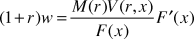 $(1 + r)w = {{M(r)V(r,x)} \over {F(x)}}F'(x)$. Pigou performed the differentiation of it with respect to the interest rate r and obtained the following equation by assuming
 ${{\partial V} \over {\partial x}}$ is negligible (Pigou Reference Pigou1938, p. 137):
 ${d \over {dr}}(1 + r)w = {{dx} \over {dr}}{d \over {dx}}\left( {{{F'} \over F}} \right) \cdot M \cdot V + {{F'} \over F} \cdot M' \cdot V + {{F'} \over F} \cdot M \cdot {{\partialV} \over {\partialr}}$
The right-hand side is positive, and Pigou asserted that  ${{dw} \over {dr}}$ is likely to take the same sign as
 ${d \over {dr}}(1 + r)w$;Footnote 24 therefore,
 ${{dw} \over {dr}}$ is also positive. This extensive use of differential calculus contrasts even with Kaldor’s analytical argument in his 1937 article. Pigou thus appears to justify his concession of Kaldor’s argument by showing the transparency of the reasoning process involved in it.
The practice of so analyzing models with differential calculus would become dominant in Pigou’s later book, Employment and Equilibrium (1941). Beyond this surface similarity, archival evidence also suggests a link between the controversy in 1937–38 and the 1941 book. In the Robertson papers archived in Trinity College, Cambridge, UK, several undated letters between Robertson and Pigou are filed with a title sheet “Exchanges between ACP and DHR about ‘Employment and Equilibrium’” (Robertson Papers C7/1). One of the topics they dealt with in this exchange was as follows. In the first letter in the bundle, Robertson complained about Pigou’s claim that the interest rate is necessarily lower when money wages are lower, and wrote, “I was ready to accept this conclusion for the world of your interchange with Kaldor, in which ‘investment’ was ruled out: I have a strong resistance to accepting it for a world in which ‘investment’ is possible.” Robertson added that this conclusion would not hold under the additional assumption that investment is partly a function of employment in the consumption industry,Footnote 25 not a sole function of the interest rate, as Pigou assumed in that work. In the second letter in the folder, Pigou admitted this possibility but noted that it might entail unstable equilibrium. In this exchange of letters, Robertson thus implied that this book was connected with the exchange with Kaldor in 1937–38, while Pigou was here concerned with the purely mathematical issue of stable equilibrium.
In fact, Employment and Equilibrium offers several models based on different assumptions, and the tables in the appendix meticulously show each sign of the derivative. This mechanical method of economic analysis enabled Pigou to pass on a substantial part of his work to his assistant: “The tables in the Appendix have been worked out and very carefully checked by Mrs. Glauert” (Pigou Reference Pigou1941, p. vii). According to Champernowne’s letter to a current Pigou scholar (Collard Reference Collard2002, p. xxx, n1), Mrs. Glauert was Pigou’s typist and had a good command of mathematics. This clearly shows that the mathematical analysis applied in this book could be handled by someone not deeply versed in the economic theory behind it. There is, of course, no doubt that Pigou analyzed the important aspects of model behavior himself. However, the division of labor involved in this book confirms an additional virtue of the laboratory experiment analogy for models, mentioned in the introduction of this paper: people with different skill sets can work together by performing different parts of the work—in this case, theory and model analysis. This was possible because model analysis was, at least partly, an independent, autonomous task.
The reviewers of the 1941 work caught the importance of the new method. In his review of the work, Kaldor praised Pigou’s method, which he had partly helped him to develop:
[Pigou’s] technique . . . enables anyone who has once mastered it to pass easily from assumptions to results and to reduce differences in results to differences in assumptions; and [it] makes possible such a choice of assumptions that they can easily be judged on empirical grounds (Kaldor Reference Kaldor1941, p. 459).
The young Paul Samuelson, reviewing the book in the American Economic Review, was more concise: “With respect to methodology, it is almost ideal” (Samuelson Reference Samuelson1941, p. 545). These two reviews clearly show the positive opinion of contemporary economic theoreticians. Especially, Kaldor’s review specified the virtue of Pigou’s method: its transparency in proceeding from assumptions to conclusions.
What made Pigou change his mind and accept Kaldor’s criticism? The evidence discussed in this section appears to suggest that mathematical analysis of his model convinced Pigou of the right model behavior and the connection between money wages, the interest rate, and employment in the model. This view makes Pigou’s extensive and almost mechanical use of differential calculus in his later work more understandable because this can be explained by the strong impact Kaldor’s paper would have had upon Pigou. Even if the connection between the controversy and Pigou’s later work was not as direct as I am inclined to believe, it was certainly true that Pigou was much more certain about the behavior of variables in his model in his 1938 concession article and that Pigou’s Employment and Equilibrium is within that trajectory of his theoretical development. In any case, Pigou’s acceptance of Kaldor’s criticism and acknowledgement of Champernowne’s help would clearly indicate what reason was behind his decision to retract his earlier conclusion: that he was convinced of their mathematical analysis.
VI. THE PIGOU EFFECT: A SHIFT OF PRESENTATION METHOD
So much for our discussion of the 1937–38 controversy; I now turn to one of the later ramifications of this debate. This ramification concerns the so-called ‘Pigou effect,’ the final destination in Pigou’s quest for a theory that approves the effectiveness of money wage flexibility under any circumstances, or even under the liquidity trap. As I have discussed above, Pigou’s such attempt of the late 1930s was unsuccessful. In the 1941 book, he made a further attempt and this eventually came to secure currency under the term ‘Pigou effect.’ Here, too, I note the importance of models, in this case by highlighting unequal effects of different presentations of the same theory.
In one chapter of Employment and Equilibrium, Pigou discussed the theory for which Don Patinkin later coined the term ‘Pigou effect.’ In the setting of this chapter, people save money not only for future consumption but also for the sake of savings itself. The latter motive was referred to as an “amenity”; more specifically, people save because of the “sense of power, sense of security and so on” (Pigou Reference Pigou1941, p. 126). People’s savings thus depend on this amenity value of savings as well as the time preference rate. Pigou’s idea here was that if the real value of people’s assets increases in times of general price decline, this amenity motive of savings will decrease and people become less inclined to save. Therefore, even if the interest rate is already on the lower bound, general price declines can still activate self-correction of the economy by stimulating consumption.
In the first edition of Employment and Equilibrium, Pigou was rather cautious as to how strong this effect might be. Keynes’s long-term stagnation scenario, which Pigou described as a “vision of the Day of Judgment,” was, he admitted, an alternative possibility because it cannot be definitely claimed that the amenity value will decrease with a price decline to a sufficient degree to bring the economy back to full employment. Interestingly, Pigou later became more confident as to his own theory. He concluded an article of 1943 in the Economic Journal by asserting that, “provided that wage-earners adopt a competitive wage policy,” a stationary state with full employment “is always possible; indeed it is the goal to which, granted this proviso, the economic system necessarily tends” (Pigou Reference Pigou1943, p. 350).
Pigou’s more assertive attitude here can be explained simply in terms of the consequence of a different way of formulating his theory. In this 1943 article, he simply presented a modified saving function, rather than offering an intricate theoretical argument with many arbitrary hypotheses, as he had done in Employment and Equilibrium.Footnote 26 The new saving function was:  $S = f(C,x,r,T)$, where C is capital stock, T the real value of money stock, and
 ${{\partial f} \over {\partial \tau }} < 0$, so that a general price decline causes T to increase and savings to decrease; and he added, “f(C,x,r,T) can assume a nil value, if T is sufficiently large, for no matter what values of C and x and r” (Pigou Reference Pigou1943, p. 350). A new way of theorization provided an heuristic benefit. With the earlier reasoning with arbitrary assumptions, he had not been certain whether the amenity motive of savings would decrease sufficiently to activate the effect. But, by the time of the 1943 article, he was able to draw on an internal argument that if the real value of money stock becomes sufficiently large, savings will necessarily be brought to nil.
This new theorization would later be adopted by Patinkin (1948, p. 547). According to Rubin (Reference Rubin2005), Patinkin constructed his 1948 article in the American Economic Review, which gave currency to the term ‘Pigou effect,’ by way of discussion with Milton Friedman and British economist Alexander Henderson. These two economists thought that the effect Pigou noted in 1941 and 1943 was strong enough to bring the economy out of the liquidity trap. Henderson wrote to Patinkin, “It cannot be true of any net cash holder that there is any limit short of bliss to his consumption as all prices fall towards zero” (quoted in Rubin Reference Rubin2005, p. 52). These economists thus subscribed to Pigou’s argument in exactly the same way Pigou himself did, by supposing that there is no saturation in consumption due to the expansion of real assets. Patinkin, who was sympathetic to the interventionist Keynesian approach to recessions, attempted to exert control over this argument by asserting that the effect is not strong or quick enough in the short run. Thus, Pigou’s Reference Pigou1943 article had a stronger impact on later generations than his 1941 book.
VII. CONCLUSION
In this paper, I have discussed an important undercurrent running through the 1937–38 controversy between Pigou and Keynes: the proper way to interpret a model. Pigou was strongly influenced by high unemployment in the 1920s and went on in the next decade to set out mathematical theories, or models, to claim that money wage adjustment is highly effective to reduce unemployment. Partly catalyzed by Harrod’s 1937 paper, Pigou attempted to use a model that was different from his earlier theoretical methods in one crucial respect: the number of endogenous variables in the system. There is reason to believe that he could not properly follow the interaction between the three variables in that system: the above two endogenous variables and one exogenous one (money wages). It is evident that Pigou later became more confident about the behavior of the same model and also similar ones after the intervention of Kaldor’s mathematical analysis. Kaldor’s model analysis also won the approval of Keynes and Robertson. To interpret these economists’ attitudes toward model analysis, Morgan’s distinction between models as objects to enquire into and models as objects with which to enquire is indeed illuminating. My narrative suggests that analysis of model behavior in itself could have a significant impact on economists’ research practice.
It is also interesting to see Keynes’s response to Pigou, especially the way it shifted between different drafts. After reading Kaldor’s paper, Keynes added a criticism concerning the reality of Pigou’s assumption on savings, and, in order to do so, he assigned to Pigou an opposite assumption to the one that Kaldor had done. Keynes thus contradicted part of Kaldor’s criticisms in order to attack Pigou on a substantial issue of whether savings depend on real income. Put another way, Keynes here moved out of Morgan’s first function of model reasoning and returned to a more traditional form of economic controversy—an argument about the correspondence between a verbal statement and reality. But what is particularly fascinating here is that it is clear that, for the other three economists, Keynes’s argument was not convincing. For whatever reasons they failed to accept Keynes’s argument, it is also clear that Keynes did not address Pigou’s model as a whole, discussing only individual assumptions that he asserted were used in the model.
In this episode, simply laying out a system of equations did not achieve the full potential of model reasoning. Kaldor’s intervention was crucial in determining how the model came to be discussed in this debate. It made the behavior of the model, rather than just the structure of the model, transparent and indisputable in the eyes of other scholars. In other words, Kaldor’s mathematical analysis of the model turned Pigou’s model into Bruno Latour’s ‘immutable mobile’ in the full sense of that notion; that is, it enabled the knowledge of the behavior of the model to transfer from the mind of one economist to the mind of another without changing its form.Footnote 27 Thus, one can argue that, self-evident as it may sound, model reasoning as a scientific tool or as a way to convince other scholars was able to reach a higher capability with the proper use of mathematics.
The current study has sought to offer a different perspective to this relatively well-known controversy. My approach was to be sensitive to economists’ specific attitudes to theoretical methods. I differ with Ambrosi (Reference Ambrosi2003) in that this study was not exclusively concerned with the content of theoretical ideas, but it also took heed of their discussion on model analysis, such as Robertson’s claiming that Pigou failed to consider the interaction of multiple variables. Accordingly, I relocated the central issue of the controversy: for Ambrosi, it was the difference of assumptions regarding savings, while my interpretation is that it was the difference between verbal and mathematical ways of model analysis. I also differ with Aslanbeigui and Oakes (Reference Aslanbeigui and Oakes2007); my concern was how the debate proceeded at the micro level by the economists who understood the substantial issue, not what was at stake for the whole community of economists during the making of Keynes’s revolution. Hostility was probably there, but it was more concealed and between the lines, at least as far as the economists I dealt with are concerned.



