


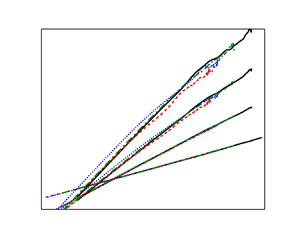

1. Introduction
Investigating the turbulent small-scale properties that are related to the dissipative scale in the energy cascade, such as velocity gradients, dissipation rate and dissipation scale, is of great interest to both the engineering and environmental communities. These quantities play an important role in turbulence modelling by providing the foundation for modelling subgrid stresses and closures for the transport equation of the dissipation rate (Antonia, Kim & Browne Reference Antonia, Kim and Browne1991; Sreenivasan & Antonia Reference Sreenivasan and Antonia1997). The standard paradigm of small-scale universality proposed by Kolmogorov (Reference Kolmogorov1941) is that while the large-scale turbulent motions are non-universal, an increasing degree of universality is imparted to small scales with increasing separation between the large and small scales.
Local isotropy was introduced by Kolmogorov (Reference Kolmogorov1941) to describe the universality of the small scales of turbulent motions. This paradigm is a cornerstone of universal self-similarity, which assumes complete independence of the small-scale structure from large-scale structures (Kolmogorov Reference Kolmogorov1941; Mestayer Reference Mestayer1982). Since Kolmogorov postulated the universality of small scales, many experiments and direct numerical simulations (DNS) of incompressible turbulence have verified the universal small-scale properties for locally isotropic incompressible flows. Hamlington et al. (Reference Hamlington, Krasnov, Boeck and Schumacher2012) performed DNS of incompressible channel flows with friction Reynolds number Reτ = 180, 381 and 590, and found that in the locally isotropic region, the local dissipation scale and dissipation-rate moments behave similarly to those of isotropic flows. Djenidi et al. (Reference Djenidi, Antonia, Talluru and Abe2017) found that in the locally isotropic region of incompressible wall-bounded flows, the moments of small-scale statistics for wall-bounded flows, such as the skewness (S) and flatness (F) of velocity gradients, remain approximately constant with increasing wall distance ζ + and Taylor Reynolds number Reλ, where  $R{e_\lambda } = \rho {u_{rms}}\lambda /\mu$ with λ the Taylor microscale, ρ the density, μ the dynamic viscosity,
 $\lambda = {u_{rms}}/{\overline {{{(\partial u^{\prime}/\partial x)}^2}} ^{1/2}}$ and
 ${u_{rms}} = \sqrt {\overline {{{u^{\prime}}^2}} }$ (Djenidi et al. Reference Djenidi, Antonia, Talluru and Abe2017), viz.
 \begin{equation}{S_{\partial u^{\prime}/\partial x}} = \frac{{\overline {{{(\partial u^{\prime}/\partial x)}^3}} }}{{{{\overline {{{(\partial u^{\prime}/\partial x)}^2}} }^{3/2}}}} = \textrm{const}\textrm{.},\quad {F_{\partial u^{\prime}/\partial x}} = \frac{{\overline {{{(\partial u^{\prime}/\partial x)}^4}} }}{{{{\overline {{{(\partial u^{\prime}/\partial x)}^2}} }^2}}} = \textrm{const}\textrm{.},\end{equation}
with  $u^{\prime}$ and x denoting the streamwise velocity fluctuation and streamwise coordinate, respectively. These findings indicate that in the locally isotropic region of incompressible wall-bounded flows, the turbulent small-scale quantities in all cases exhibit universal behaviour, which is independent of Reynolds number and ζ +. By studying homogeneously isotropic turbulence, turbulent shear flows and thermal convection, Schumacher et al. (Reference Schumacher, Scheel, Krasnov, Donzis, Yakhot and Sreenivasan2014) showed that probability density functions (PDFs) of velocity gradients and moments of dissipation obey the universality of small scales for different flows even at moderate Reynolds numbers. Furthermore, Boschung et al. (Reference Boschung, Hennig, Gauding, Pitsch and Peters2016) examined structure functions in the dissipative range, and reported Reynolds-number-independent structure function and universal scaling for local-dissipation-rate moments for incompressible, locally isotropic flows. Schumacher (Reference Schumacher2001) reported increasing derivative moments of streamwise velocity with Reλ for orders n > 4 in incompressible, homogeneous shear flows. Similar results for small-scale statistics of incompressible flows were reported by Kim & Antonia (Reference Kim and Antonia1993), Sreenivasan & Antonia (Reference Sreenivasan and Antonia1997), Antonia et al. (Reference Antonia, Tang, Djenidi and Danaila2015) and Elsing & Marusic (Reference Elsing and Marusic2010). With regard to compressible flows with high Mach number, Huang, Coleman & Bradshaw (Reference Huang, Coleman and Bradshaw1995) showed that the dissipation rate induced by the dilatation and viscous fluctuations is very small, implying the similarity of turbulent dissipation between compressible and incompressible flows.
Transcritical wall-bounded turbulence at supercritical pressure conditions with intense density fluctuations are encountered in many technical applications. The thermodynamic properties of fluids at supercritical pressures differ from those at subcritical conditions. In particular, at supercritical pressures, the transitioning from the liquid-like phase to gas-like phase as the temperature increases, which is called ‘transcritical conditions’, can occur without the formation of the interface (Simeoni et al. Reference Simeoni, Bryk, Gorelli, Krisch, Ruocco, Santoro and Scopigno2010; Bolmatov, Brazhkin & Trachenko Reference Bolmatov, Brazhkin and Trachenko2013; Simeski & Ihme Reference Simeski and Ihme2023). Thermodynamic and transport properties, including density, viscosity, specific heat capacity and thermal conductivity, vary significantly across the Widom line as the increasing temperature, thereby introducing significant real-fluid thermodynamic effects (Simeoni et al. Reference Simeoni, Bryk, Gorelli, Krisch, Ruocco, Santoro and Scopigno2010; Bolmatov et al. Reference Bolmatov, Brazhkin and Trachenko2013; Ma, Yang & Ihme Reference Ma, Yang and Ihme2018; Guo, Yang & Ihme Reference Guo, Yang and Ihme2022; Li et al. Reference Li, Guo, Bai and Ihme2023). It has been confirmed that real-fluid thermodynamic effects which are induced by strong variations in thermal properties considerably change the large-scale structures of wall-bounded turbulence (Patel et al. Reference Patel, Peeters, Boersma and Pecnik2015; Ma et al. Reference Ma, Yang and Ihme2018; Kawai Reference Kawai2019; Kim, Hickey & Scalo Reference Kim, Hickey and Scalo2019; Guo et al. Reference Guo, Yang and Ihme2022; Li et al. Reference Li, Guo, Bai and Ihme2023). Sciacovelli, Cinnella & Grasso (Reference Sciacovelli, Cinnella and Grasso2017) carried out systematic DNS investigations to study small-scale structures of isotropic turbulence of high-pressure dense fluids which have similar physical properties to transcritical fluids, their analysis showed a weakening of compressive structures and an enhancement of expanding ones. They reported that the dense gas temperature variations are negligible due to the decoupling of dynamic and thermal effects, and the fluid viscosity exhibits a smaller root-mean square (r.m.s.) than perfect gas, suggesting the structures considered in their work are mainly related to the genuine compressibility and shocklet. Furthermore, the dissipation rate of transcritical flows, which is dominated by the dissipative range, behaves quite similarly to that of high-Ma compressible flows, with the fluctuating thermal properties contributing insignificantly to the dissipation rate (Li et al. Reference Li, Guo, Bai and Ihme2023). These raise some important questions to be addressed. Will real-fluid effects invalidate the universality of the small-scale dynamics? What are the effects of variable thermodynamic properties on the small-scale dynamics? Current efforts have not yet provided evidence for the universality of small-scale statistics at transcritical conditions with strong variations of thermal properties. To the best of our knowledge, there has been no prior discussion about turbulent small-scale characteristics at high-pressure transcritical conditions in the scientific literature. A study utilizing high-resolution DNS data in an effort to examine the small-scale universality at transcritical conditions can therefore provide the theoretical framework for developing scaling laws and turbulence models to improve their accuracy and generalization.
To address these issues, the present work examines the statistics related to the small-scale properties in transcritical channel flows utilizing DNS data. The Reτ currently considered in this study ranges between 300 and 1370. As in Hamlington et al. (Reference Hamlington, Krasnov, Boeck and Schumacher2012), Schumacher et al. (Reference Schumacher, Scheel, Krasnov, Donzis, Yakhot and Sreenivasan2014) and Djenidi et al. (Reference Djenidi, Antonia, Talluru and Abe2017) for incompressible flows, we focus on the moments of the velocity gradients and the dissipation rate, to investigate the scalings for statistics associated with the small-scale properties. The main objective of this study is to examine the hypothesis of the consistency of these small-scale quantities between transcritical and incompressible flows, and to interpret the modulations on the turbulent statistics and intermittency related to the small-scale properties by variable thermodynamic property arising from real-fluid conditions.
The remainder of this paper is organized as follows. Section 2 presents our DNS database, which includes details of the overall computational set-up and cases. Section 3 presents results and the associated interpretations. Finally, § 4 offers conclusions.
2. Direct numerical simulations
2.1. Problem formulation
The database used for the present analysis was obtained from DNS of a straight turbulent channel of transcritical nitrogen (Ma et al. Reference Ma, Yang and Ihme2018; Guo et al. Reference Guo, Yang and Ihme2022; Li et al. Reference Li, Guo, Bai and Ihme2023). For the broader use of the transcritical DNS database by the turbulence and combustion community, we have made this database open-access on https://blastnet.github.io/index.html (Chung et al. Reference Chung, Jung, Chen and Ihme2022). The flow has a reduced bulk pressure (defined as pr = p/pc with pc the critical pressure) of 1.14, with the temperatures for the hot wall and the cold wall kept spatially and temporally constant. The size of the flow domain is Lx (streamwise, x) × 2Ly (wall normal, y) × Lz (spanwise, z), with Lx/Ly = 2 ${\rm \pi}$, Lz/Ly = 4
 ${\rm \pi}$/3, and the channel height measuring 2Ly = 9 × 10⁻⁵ m. The spatial coordinate is defined over 0 ≤ x ≤ Lx, −Ly ≤ y ≤ Ly and 0 ≤ z ≤ Lz. We use ζ to denote the wall distance.
The fully conservative, compressible continuity, momentum and total energy equations are solved. The Peng–Robinson (PR) equation of state (EoS) (Peng & Robinson Reference Peng and Robinson1976) and Chung's transport-property model (Chung et al. Reference Chung, Ajlan, Lee and Starling1988) are employed to describe the thermodynamics of the working fluid. These models have been used in past DNS studies on turbulence of transcritical fluids (Miller, Harstad & Bellan Reference Miller, Harstad and Bellan2001; Ma et al. Reference Ma, Yang and Ihme2018; Kim et al. Reference Kim, Hickey and Scalo2019; Toki, Teramoto & Okamoto Reference Toki, Teramoto and Okamoto2020; Guo et al. Reference Guo, Yang and Ihme2022; Li et al. Reference Li, Guo, Bai and Ihme2023). In Appendix A, we discuss the EoS and the transport-property model in more detail. Further information of the DNS configurations, numerical methodology and validations can be found in Ma et al. (Reference Ma, Yang and Ihme2018) and Guo et al. (Reference Guo, Yang and Ihme2022). As summarized in table 1, the current database is composed of four transcritical cases, TR3, TR1.9, TR1.4 and TR1 (where TR denotes the temperature ratio between the hot wall and the cold wall) with a reduced temperature of Tr ,cold = T/Tc = 0.79 at the cold wall. These conditions are selected to examine the real-fluid effects induced by thermal property changes under substantial heat transfer conditions on the small-scale turbulent statistics. For all cases, the Mach number is less than 0.16, indicating that the configurations in all cases correspond to the low-speed flow regime. Across the majority of the channel, the spatial resolution is  $\mathrm{\Delta }x = (2.4\sim 4)\bar{\eta }$,
 $\mathrm{\Delta }y = (0.4\sim 3.2)\bar{\eta }$,
 $\mathrm{\Delta }z = (1.6\sim 3)\bar{\eta }$ with
 $\bar{\eta }$ being the mean Kolmogorov length scale,
 $\bar{\eta } = {[{(\bar{\mu }/\bar{\rho })^3}\bar{\rho }/\bar{\varepsilon }]^{1/4}}$ , where μ is the dynamic viscosity, ρ is the density and
 $\varepsilon$ is the dissipation rate of turbulent kinetic energy,
 $\varepsilon = {\tau ^{\prime}_{ij}}(\partial {u^{\prime}_i}/\partial {x_j})$ and
 ${\tau _{ij}}$ the viscous stress tensor. Expressed in wall units, these conditions correspond to
 $\mathrm{\Delta }{x^ + } = 4.9\sim 8$,
 $\mathrm{\Delta }{z^ + } = 3.26\sim 6.8$,
 $\mathrm{\Delta }{y^ + } = 0.29\sim 0.47$ at the cold wall and
 $\mathrm{\Delta }{y^ + } = 0.2\sim 1$ at the hot wall.
Summary of cases and conditions, with the subscripts hot and cold indicating the values at the hot wall and the cold wall. Here, pr = p/pc, Tr = T/Tc, ρr = ρ/ρc are reduced pressure, temperature and density, respectively.

2.2. Cases set-up and grid resolutions
Seeking the statistically accurate small-scale velocity moments requires finer resolutions and longer integration time, here we briefly review the typical resolutions in the literatures that considered velocity-derivative skewness, flatness and high-order moments. van de Water & Herweijer (Reference van de Water and Herweijer1999) measured the high-order structure functions for incompressible turbulence (with the order n up to 20), characteristic parameters of their isotropic flows are  $R{e_\lambda } < 810$ with the spatial resolution evaluated by
 ${l_p}/\eta$ (lp is the probe length) being
 ${l_p}/\eta \approx 2$. The scaling exponents of nth order passive scalar structure functions (n ≤ 8) in incompressible flows were examined by Lepore & Mydlarski (Reference Lepore and Mydlarski2012),
 $R{e_\lambda }$ considered in their study was 370 with the spatial resolution being Δx = 3.25η. Schumacher (Reference Schumacher2001) carried out DNS investigations of incompressible homogeneous shear flows with
 $R{e_\lambda }$ from 59 up to 99 to compare the high-order small-scale statistics (n < 8), the grid spacing in the y-direction is
 $\mathrm{\Delta }y = (0.5\sim 1.6)\eta$. Pumir, Xu & Siggia (Reference Pumir, Xu and Siggia2016) used DNS to calculate high-order moments of velocity gradients in the incompressible channel flow at Reτ ≈ 1000, the gird in wall units is
 $\mathrm{\Delta }{x^ + } = \mathrm{\Delta }{z^ + } = 15.7$. In the DNS examinations on local dissipation scale and high-order dissipation moments of incompressible channel flows conducted by Hamlington et al. (Reference Hamlington, Krasnov, Boeck and Schumacher2012), Reτ of their cases is 180, 381 and 590 with the resolution
 $\mathrm{\Delta }{x^ + } = 1.8\sim 4.4$,
 $\mathrm{\Delta }y_{max}^ += 0.55\sim 0.91$,
 $\mathrm{\Delta }{z^ + } = 1.8\sim 2.2$. Analysis of small-scale dynamics for compressible isotropic flows was conducted by Sciacovelli et al. (Reference Sciacovelli, Cinnella and Grasso2017), using a grid spacing of
 $\mathrm{\Delta }x \approx 2.3\eta$. Hence, the resolutions in the present work are comparable to those employed in prior studies on turbulent velocity gradients, dissipation rate and their moments (van de Water & Herweijer Reference van de Water and Herweijer1999; Schumacher Reference Schumacher2001; Hamlington et al. Reference Hamlington, Krasnov, Boeck and Schumacher2012; Lepore & Mydlarski Reference Lepore and Mydlarski2012; Pumir et al. Reference Pumir, Xu and Siggia2016). Further evidence to examine the small-scale grid convergency and ensure that the dissipative scale is sufficiently resolved can be found in Appendix B. To obtain converged results for statistical moments, we average over homogeneous directions and time using data in 20 flow-through times, where one flow-through time is defined as
 ${L_x}/\overline {{u_b}}$, with
 $\overline {{u_b}}$ being the bulk velocity.
2.3. Overview of the fluctuating thermodynamic properties
Figure 1 shows the plots for r.m.s. quantities of thermodynamic and transport properties (i.e. density, constant-pressure specific heat capacity, dynamic viscosity and thermal conductivity) in the present transcritical cases. Significant fluctuations of thermodynamic and transport properties can be found, especially near the hot wall. The density fluctuations (i.e.  ${\rho _{rms}}$) reach 40 % of the mean value (figure 2a), while
 ${c_{p,rms}}$ is most significant and its maximum exceeds 100 % of the mean value (figure 2b). The fluctuations of transport properties (i.e.
 ${\mu _{rms}}$ and
 ${\lambda _{rms}}$) also reach 30 % of the mean value (figure 2c,d). To address the influences of the real-fluid thermodynamic effects on transcritical turbulence, here we compare the thermal-property fluctuations with those in the previous studies on compressible flows. For supersonic turbulent boundary layers, ρrms is small compared with
 $\bar{\rho }$ (Bradshaw Reference Bradshaw1977), which is known as Morkovin's hypothesis. Generally,
 ${\rho _{rms}}/\bar{\rho }$ in supersonic compressible flows does not exceed 10 % (Coleman, Kim & Moser Reference Coleman, Kim and Moser1995; Huang et al. Reference Huang, Coleman and Bradshaw1995; Zhang et al. Reference Zhang, Bi, Hussain, Li and She2012, Reference Zhang, Wan, Liu, Sun and Lu2022). However, the density fluctuations
 ${\rho _{rms}}/\bar{\rho }$ in the present transcritical cases exceed the level of hypersonic flows for ideal gas with Mach number Ma = 11.93 (Duan, Beekman & Martin Reference Duan, Beekman and Martin2011), indicating that compressibility induced by real-fluid thermodynamic effects is significant to change turbulent structures. As shown in figure 2(b–d), for transcritical cases, cp and transport properties also exhibit very large fluctuations (the r.m.s. in cp is most significant and even reaches the mean value), which can definitely result in noticeable impacts on momentum and scalar statistics. In contrast, supersonic flows generally use the thermal-property models for ideal gas, thus the fluctuations of cp, μ and λ are quite weak and influence turbulence dynamics negligibly. In summary, the real-fluid thermodynamic effects at high-pressure transcritical conditions induce appreciable fluctuations of thermodynamic and transport properties, Morkovin's hypothesis is invalid and the resultant turbulent dynamics may deviate significantly from incompressible flows and supersonic flows.
Plots for r.m.s. quantities of thermodynamic and transport properties for all cases: (a) ρ; (b) cp; (c) dynamic viscosity μ; (d) thermal conductivity λ. All results of the r.m.s. quantities are normalized by the Reynolds-averaged mean quantities.

Examinations of the local isotropy along the wall-normal direction for TR3: (a) the turbulence-invariant map which shows I 1 as a function of I 2 for the anisotropic tensor of Reynolds stress aij near the hot wall (red line and symbols) and the cold wall (blue line and symbols); (b) verification of local isotropy of second order moments by examining Ai from (3.2), with the dashed lines denoting the ±20 % boundaries of local isotropy (Ai = 1); (c) verification of local isotropy of third-order moments (see (3.3)); (d) verification of local isotropy of fourth-order moments (see (3.4)).

We note that for all cases, the Mach number is less than 0.16, indicating that the configurations in all cases correspond to the low-speed flow regime. Moreover, the pressure change in the channels is very small (the instantaneous p/pc changes by less than 0.5 % within the whole channel). Hence the dominant effects in the transcritical cases are the significantly variable properties induced by the temperature variations present at low Mach numbers.
3. Results and discussions
In this section we begin showing the small-scale quantities and examine the effects of variable thermodynamic properties at real-fluid conditions on these statistics using the established transcritical DNS database. For the following discussions, the Reynolds average for a variable Z is denoted as  $\bar{Z}$ and the Favre average is denoted by
 $\tilde{Z} = \overline {\rho Z} /\bar{\rho }$. Their fluctuations are defined as
 $Z^{\prime}$ and
 $Z^{\prime\prime}$, respectively.
3.1. Examinations of local isotropy
Near the wall, the flow is highly anisotropic due to wall effects, the flow quantities are sensitive to the boundary conditions and thus the universality of small-scale quantities can hardly be observed. Therefore, examining the results in the locally isotropic region is effective for evaluating the universality of statistics in the presence of the real-fluid effects since the wall effects have been largely eliminated. We begin with examining the validity of local isotropy of small-scale statistics. Provided that the flow is locally isotropic, the even moments of velocity gradient should obey the following relations (Taylor Reference Taylor1935; Jiang et al. Reference Jiang, Hu, Cheng and Zhou2022):
 \begin{equation}\overline {{{\left( {\frac{{\partial u^{\prime}}}{{\partial x}}} \right)}^2}} = \overline {{{\left( {\frac{{\partial v^{\prime}}}{{\partial y}}} \right)}^2}} = \overline {{{\left( {\frac{{\partial w^{\prime}}}{{\partial z}}} \right)}^2}} = \frac{1}{2}\overline {{{\left( {\frac{{\partial {u^{\prime}_i}}}{{\partial {x_j}}}} \right)}^2}} ,\end{equation}
with i ≠ j and no summation on i and j. Thus, the local isotropy of the second-order moments of velocity gradients indicates
 \begin{gather}{A_1} = {{\overline {{{\left( {\frac{{\partial u^{\prime}}}{{\partial x}}} \right)}^2}} } / {\overline {{{\left( {\frac{{\partial v^{\prime}}}{{\partial y}}} \right)}^2}} }} = 1,\quad {A_2} = {{\overline {{{\left( {\frac{{\partial u^{\prime}}}{{\partial x}}} \right)}^2}} } / {\overline {{{\left( {\frac{{\partial w^{\prime}}}{{\partial z}}} \right)}^2}} }} = 1,\end{gather}
 \begin{gather}{A_3} = 2{{\overline {{{\left( {\frac{{\partial u^{\prime}}}{{\partial x}}} \right)}^2}} } / {\overline {{{\left( {\frac{{\partial u^{\prime}}}{{\partial y}}} \right)}^2}} }} = 1,\quad {A_4} = 2{{\overline {{{\left( {\frac{{\partial u^{\prime}}}{{\partial x}}} \right)}^2}} } / {\overline {{{\left( {\frac{{\partial u^{\prime}}}{{\partial z}}} \right)}^2}} }} = 1,\end{gather}
 \begin{gather}{A_5} = 2{{\overline {{{\left( {\frac{{\partial u^{\prime}}}{{\partial x}}} \right)}^2}} } / {\overline {{{\left( {\frac{{\partial v^{\prime}}}{{\partial x}}} \right)}^2}} }} = 1,\quad {A_6} = 2{{\overline {{{\left( {\frac{{\partial u^{\prime}}}{{\partial x}}} \right)}^2}} } / {\overline {{{\left( {\frac{{\partial v^{\prime}}}{{\partial z}}} \right)}^2}} }} = 1,\end{gather}
 \begin{gather}{A_7} = 2{{\overline {{{\left( {\frac{{\partial u^{\prime}}}{{\partial x}}} \right)}^2}} } / {\overline {{{\left( {\frac{{\partial w^{\prime}}}{{\partial x}}} \right)}^2}} }} = 1,\quad {A_8} = 2{{\overline {{{\left( {\frac{{\partial u^{\prime}}}{{\partial x}}} \right)}^2}} } / {\overline {{{\left( {\frac{{\partial w^{\prime}}}{{\partial y}}} \right)}^2}} }} = 1.\end{gather}
According to Tang et al. (Reference Tang, Antonia, A, Djenidi, Abe, Zhou, Danaila and Zhou2015), the local isotropy of the third-order and fourth-order moments of the velocity gradient leads to
 \begin{gather}{S_{\partial u^{\prime}/\partial x}} = {S_{\partial v^{\prime}/\partial y}} = {S_{\partial w^{\prime}/\partial z}},\end{gather}
 \begin{gather}{F_{\partial u^{\prime}/\partial x}} = {F_{\partial v^{\prime}/\partial y}} = {F_{\partial w^{\prime}/\partial z}}.\end{gather}
Figure 2 examines the local isotropy of the small-scale statistics along the wall-normal direction. In figure 2(a), we show the Lumley triangle, which examines the non-zero invariants I 1 and I 2 of the anisotropic part of the Reynolds stress tensor  ${a_{ij}} = \overline {{u^{\prime}_i}{u^{\prime}_j}} /\overline {{u^{\prime}_k}{u^{\prime}_k}} - {\delta _{ij}}/3$, with
 ${I_1} = \sqrt {{a_{ij}}{a_{ji}}/6}$ and
 ${I_2} = {(1/6{a_{ij}}{a_{jk}}{a_{ki}})^{1/3}}$. As in Lumley & Newman (Reference Lumley and Newman1977), the triangle corresponds to I 1 = I 2, I 1 = −I 2 and
 ${I_1} = \sqrt {2I_2^3 + 1/27}$. As the distance to the wall increases, the variants approach I 1 = 0 and I 2 = 0 which corresponds to the isotropic condition, as indicated by the arrow, implying that the departure from isotropy becomes smaller. Figure 2(b) shows the wall-normal distribution of Ai for TR3. The results confirm that at 0.3 < ζ/Ly < 1 near both walls, Ai shows a gradual convergence towards unity and lies within the ±20 % boundaries of local isotropy (indicated by the dashed lines), which suggests that the local isotropy hypothesis within this wall-normal range (0.3 < ζ/Ly < 1) is approximately valid. The results for other cases are similar to those of TR3 and are not shown here for brevity. Figure 2(c) shows the skewness of the velocity gradient components according to (3.3). It can be seen that at ζ/Ly > 0.25 near both walls, all distributions exhibit a region where the magnitudes of the velocity-derivative skewness are approximately consistent. Figure 2(d) compares the distributions of
 ${F_{\partial u^{\prime}/\partial x}}$,
 ${F_{\partial v^{\prime}/\partial y}}$ and
 ${F_{\partial w^{\prime}/\partial z}}$, showing that the local isotropy condition (3.4) is satisfied reasonably well when ζ/Ly > 0.3. Thus, we can determine the ζ/Ly range of locally isotropic region as 0.3 < ζ/Ly < 1 near both walls. According to this, table 2 shows ζ/Ly, ζ + and ζ* of the start point of the locally isotropic region (LIR) of the channel for all cases.
Here, ζ/Ly, ζ + and ζ* of the start point of the locally isotropic region for all cases, where  ${\zeta ^ + } = \sqrt {{\rho _w}{\tau _w}} \zeta /{\mu _w}$ and
 ${\zeta ^\ast } = \sqrt {\bar{\rho }{\tau _w}} \zeta /\bar{\mu }$ are wall units and semilocal wall units, respectively, and
 ${\tau _w}$ is the wall shear stress.

3.2. Small-scale universality: velocity gradients and dissipation rate
Figure 3 shows PDFs of the longitudinal two-point velocity increments  $\mathrm{\Delta }u^{\prime} = u^{\prime}(x + r,y,z) - u^{\prime}(x,y,z)$ at different wall-normal positions for all cases. We find that the PDFs of the longitudinal velocity increments pass through a transition from super-Gaussian to nearly Gaussian (or slightly sub-Gaussian) behaviour as the two-point distance increases (see figure 3a–d), suggesting intermittency at the small scales. In figure 3(a), it can be seen that all PDF profiles are quite consistent; although the PDFs are close to exponential decay, there are still slight discrepancies among all cases at the tail of the PDF profiles. In the following section, we will address the significance of these tails on the high-order moments of velocity gradients. In the near-wall layer (as shown in figure 3b), the discrepancies between different cases are more obvious, which is attributed to the anisotropic nature of the flow near the wall.
Profiles for PDFs of longitudinal velocity increments  $\mathrm{\Delta }u^{\prime} = u^{\prime}(x + r,y,z) - u^{\prime}(x,y,z)$ near both walls for different cases: (a) r =Δx at ζ* = 300 in the LIR, where Δx is the streamwise grid spacing; (b) r =Δx at ζ* = 10; (c) r = 20Δx at ζ* = 300; (d) r = 100Δx at ζ* = 300. The x-axis is rescaled by the r.m.s. of velocity increments. The blue curves indicate cold wall profiles, the red curves correspond to hot wall profiles and black dashed lines denote the Gaussian distribution.

We display the PDFs of local dissipation scale rd and local dissipation rate  $\varepsilon /\bar{\varepsilon }$ near the cold wall and the hot wall in figure 4. The local dissipation scale, rd, is determined such that
 $\bar{\rho }{(\mathrm{\Delta }u^{\prime})_{{r_d}}}{r_d}/\bar{\mu } = 1$ (Schumacher Reference Schumacher2007; Hamlington et al. Reference Hamlington, Krasnov, Boeck and Schumacher2012), with
 ${(\mathrm{\Delta }u^{\prime})_{{r_d}}}$ the streamwise velocity-fluctuation increments over the streamwise distance rd. Thus, the PDFs of local dissipation scale can formally be written as
 $P[{r_d}|0.9 \le \bar{\rho }{(\mathrm{\Delta }u^{\prime})_{{r_d}}}r/\bar{\mu } \le 1.1]$ (Hamlington et al. Reference Hamlington, Krasnov, Boeck and Schumacher2012). It should be noted that the Kolmogorov scale,
 $\bar{\eta } = {[{(\bar{\mu }/\bar{\rho })^3}\bar{\rho }/\bar{\varepsilon }]^{1/4}}$, only results from the dimensional analysis and may contain the length scales at the dissipative range and the inertial range. According to Hamlington et al. (Reference Hamlington, Krasnov, Boeck and Schumacher2012), including only values of rd in the above definition of local dissipation scale can ensure the isolation of the flow structures occurring at the cutoff of dissipative range and inertial range. Knowledge of the PDFs of the local dissipation scales, given in figure 4, provides evidence of the similarity of the characteristic length scale at the dissipative range for transcritical flows. Figure 4(a) shows
 $\textrm{PDF}({r_d})$ at ζ* = 300 for all cases. It can be seen that there are only small differences in
 $\textrm{PDF}({r_d}/\overline {{r_d}} )$ among cases, suggesting that
 $\textrm{PDF}({r_d}/\overline {{r_d}} )$ in the LIR of the channel is insensitive to the real-fluid variable-property effects. Similar observations can be made from figure 4(b), showing that the PDFs of dissipation rate,
 $\textrm{PDF}(\varepsilon /\bar{\varepsilon })$ approximately follows the log-normal distribution for
 $0.1 < \varepsilon /\bar{\varepsilon } < 2$, but deviates from the log-normal distribution for the extreme events at the tail. In the locally isotropic region, despite the different levels of density and viscosity fluctuations in the flows, the PDFs of the dissipation rate have similar profiles; our observations support the consistency of the local dissipation scale for transcritical cases.
The PDFs of (a) local dissipation scales and (b) dissipation rate in the LIR (at  ${\zeta ^\ast } = 300$) of the channel for different cases: blue lines, cold wall profiles; red lines, hot wall profiles; black line, the log-normal fitting
 $\textrm{PD}{\textrm{F}_{\varepsilon /\bar{\varepsilon }}} = {y_0} + (A/(\sqrt {2{\rm \pi} } (\varepsilon /\bar{\varepsilon })\sigma ))\,\textrm{exp}[ - {(\textrm{ln}((\varepsilon /\bar{\varepsilon })/{x_c}))^2}/2{\sigma ^2}]$ with y 0 = −0.00436, xc = 0.682, σ = 1.232, A = 1.102.

Results of the second-order structure function (S 2) of  $u^{\prime}$ for the LIR of the channel give similar insights into the small-scale flow structures. Figure 5 presents the longitudinal structure functions of fluctuating streamwise velocity
 ${S_2} = \overline {{{[u^{\prime}(x + r,y,z) - u^{\prime}(x,y,z)]}^2}}$ as a function of the streamwise spatial increment in the LIR of the channel for TR3. There is reasonable collapse of the distributions in the dissipative range with
 $r < 20\bar{\eta }$. In the LIR of the channel, the inertial region of S 2 normalized by the mean dissipation rate (see figure 5a) and that normalized by the local dissipation rate (considering intermittency, see figure 5b) have not yet been observed in either case due to the Reynolds number not being sufficiently large. In the dissipative range, according to Kolmogorov's first similarity hypothesis, the viscosity and dissipation rate dominate the structure function. A simple dimensional analysis yields the expression of the second-order structure function
 \begin{equation}{S_2} = {C_2}\left( {\frac{{\bar{\rho }{{\bar{\varepsilon }}_0}}}{{\bar{\mu }}}} \right){r^2},\end{equation}
with C 2 the second-order structure function coefficient, and  ${\varepsilon _0} = \varepsilon /\rho$. Equation (3.5) indicates that the second-order structure function for transcritical flows is consistent with that of the incompressible flows given in Pope (Reference Pope2000). In summary, despite the small discrepancies at the tail of the
 $\partial u^{\prime}/\partial x$-PDF profiles, the low-order structure functions of
 $u^{\prime}$ for all cases have the same scaling in the dissipative range.
Second-order structure functions of  $u^{\prime}$ (
 ${S_2} = \overline {{{[u^{\prime}(x + r,y,z) - u^{\prime}(x,y,z)]}^2}}$) as a function of streamwise spatial increment in the LIR of the channel for TR3: (a) S 2 rescaled by the mean dissipation rate
 ${\bar{\varepsilon }_0}$; (b) S 2 rescaled by local dissipation rate (ε 0 averaged over the streamwise two-point distance).

3.3. Real-fluid effects on moments of small-scale statistics
The moments of the velocity gradients and dissipation rate play an important role for characterizing the small-scale dynamics. The nth-order moments of turbulent statistics can be written as
 \begin{equation}{M_n}(Z) = \frac{{\overline {{Z^n}} }}{{{{(\overline {{Z^2}} )}^{n/2}}}},\end{equation}
with Z denoting any flow quantity. Figure 6(a,b) shows the variations of the skewness of the velocity gradient ( $Z = \partial u^{\prime}/\partial x$, n = 3 in (3.6)) and the flatness of the velocity gradient (
 $Z = \partial u^{\prime}/\partial x$, n = 4 in (3.6)) as a function of ζ* for all cases. It can be seen that
 ${M_3}(\partial u^{\prime}/\partial x)$ (i.e.
 ${S_{\partial u^{\prime}/\partial x}}$) and
 ${M_4}(\partial u^{\prime}/\partial x)$ (i.e.
 ${F_{\partial u^{\prime}/\partial x}}$) away from the wall are nearly constant. Distributions of
 ${S_{\partial u^{\prime}/\partial x}}$ or
 ${F_{\partial u^{\prime}/\partial x}}$ are qualitatively similar for all the wall flows, with minor quantitative variations. As the distance to the wall increases,
 ${S_{\partial u^{\prime}/\partial x}}$ decreases, reaches a minimum, increases and finally forms a plateau in the outer region of the flow. This behaviour is also consistent with that of incompressible flows with moderate and high Reτ reported in Djenidi et al. (Reference Djenidi, Antonia, Talluru and Abe2017). We can also observe the characteristic behaviour of
 ${F_{\partial u^{\prime}/\partial x}}$ for all transcritical cases, it is found that
 ${F_{\partial u^{\prime}/\partial x}}$ approaches a constant, which is independent of the thermal property changes. In Appendix C, we examine the results based on density-weighted velocity fluctuations, and confirm that the results of density-weighted velocity-fluctuation derivatives are consistent with the Reynolds-averaged results.
Moments of fluctuating streamwise velocity gradients (see (3.6)) in different cases: (a)  $Z = \partial u^{\prime}/\partial x$, n = 3 (skewness) as a function of ζ*; (b)
 $Z = \partial u^{\prime}/\partial x$, n = 4 (flatness) as a function of ζ*; (c)
 $Z = \partial u^{\prime}/\partial x$, n = 3 (skewness) as a function of semilocal Taylor Reynolds number
 $Re_\lambda ^\ast $; (d)
 $Z = \partial u^{\prime}/\partial x$, n = 4 (flatness) as a function of
 $Re_\lambda ^\ast $. In (c) and (d), open symbols represent the results in the LIR of the channel whereas solid symbols indicate the near-wall layers; blue, near the cold wall for TR3; red, near the hot wall for TR3; black, near the cold wall for TR1.9; pink, near the hot wall for TR1.9; purple, near the cold wall for TR1.4; green, near the hot wall for TR1.4; grey, TR1.

We make two additional remarks here. First, the data from Abe, Antonia & Kawamura (Reference Abe, Antonia and Kawamura2009) showed that the plateau of the velocity gradient skewness did not occur for Reτ = 180, while this plateau can be clearly observed in the LIR of the channel when Reτ reaches 590 for incompressible flows (Vreman & Kuerten, Reference Vreman and Kuerten2014). Our results also indicate that at transcritical conditions, the plateau where  ${S_{\partial u^{\prime}/\partial x}}$ and
 ${F_{\partial u^{\prime}/\partial x}}$ remain constant definitely exists when Reτ exceeds 300 (i.e. the lowest Reτ in the present study); this supports that
 ${S_{\partial u^{\prime}/\partial x}}$ and
 ${F_{\partial u^{\prime}/\partial x}}$ in the LIR of the channel are independent of ζ* when Reτ exceeds 300, which is approximately consistent with the Reτ threshold for
 ${S_{\partial u^{\prime}/\partial x}} = \textrm{const}\textrm{.}$ and
 ${F_{\partial u^{\prime}/\partial x}} = \textrm{const}\textrm{.}$ for incompressible turbulence. Second, in the LIR of the channel, the level of agreement of
 ${S_{\partial u^{\prime}/\partial x}}$ and
 ${F_{\partial u^{\prime}/\partial x}}$ between the present study and the previous studies on incompressible channel flows (Abe et al. Reference Abe, Antonia and Kawamura2009; Vreman & Kuerten Reference Vreman and Kuerten2014; Tang et al. Reference Tang, Antonia, A, Djenidi, Abe, Zhou, Danaila and Zhou2015; Antonia et al. Reference Antonia, Djenidi, Danaila and Tang2017; Tang et al. Reference Tang, Antonia, Djenidi and Zhou2019) is relatively poor. Abe et al. (Reference Abe, Antonia and Kawamura2009) reported that
 ${S_{\partial u^{\prime}/\partial x}} ={-} 0.6$ in the outer layer for Reτ = 395 and 640 (comparable magnitude with the present study) while
 ${S_{\partial u^{\prime}/\partial x}}$ remains less than −0.5 according to Vreman & Kuerten (Reference Vreman and Kuerten2014). Xu, Antonia & Rajagopalan (Reference Xu, Antonia and Rajagopalan2001) found that
 ${S_{\partial u^{\prime}/\partial x}}$ and
 ${F_{\partial u^{\prime}/\partial x}}$ remain −0.53 and 10 at Reλ > 200–300 in the outer layer of incompressible plane jet and circular jet. The current transcritical cases suggest that
 ${S_{\partial u^{\prime}/\partial x}}$ and
 ${F_{\partial u^{\prime}/\partial x}}$ converge at similar Reτ and Reλ compared with incompressible flows (i.e. Reτ = 300–600 or Reλ = 200–300). However, the corresponding values of the
 ${S_{\partial u^{\prime}/\partial x}}$ and
 ${F_{\partial u^{\prime}/\partial x}}$ plateau (
 ${S_{\partial u^{\prime}/\partial x}} ={-} 0.25$ and
 ${F_{\partial u^{\prime}/\partial x}} = 4$) are different from those of incompressible flows, which means that the discrepancies between transcritical flows and incompressible flows are mainly associated with the effects of real-fluid property variations, while the Reynolds number effect contributes only minimally. Note that even for TR1 for which the two walls have the same temperature and heat, transfer is weak, although the boundary condition is similar to that of incompressible flows, the small-scale statistics still differ from the incompressible flows. The small pressure fluctuations in the flow also lead to large thermal property changes, leading to
 $Re_\lambda ^\ast $ varying from 700 at the wall to 1000 at the centreline and thus turbulence dynamics depart significantly from incompressible flows. This may explain the differences of the
 ${S_{\partial u^{\prime}/\partial x}}$ and
 ${F_{\partial u^{\prime}/\partial x}}$ profiles between TR1 and incompressible flows studied in the prior studies (Abe et al. Reference Abe, Antonia and Kawamura2009; Vreman & Kuerten Reference Vreman and Kuerten2014; Tang et al. Reference Tang, Antonia, A, Djenidi, Abe, Zhou, Danaila and Zhou2015; Antonia et al. Reference Antonia, Djenidi, Danaila and Tang2017; Tang et al. Reference Tang, Antonia, Djenidi and Zhou2019).
Next we assess the behaviour of  ${S_{\partial u^{\prime}/\partial x}}$ and
 ${F_{\partial u^{\prime}/\partial x}}$ in terms of Taylor Reynolds number (see figure 6c,d;
 $Re_\lambda ^\ast= \bar{\rho }u^{\prime}\lambda /\bar{\mu }$ is semilocal Taylor Reynolds number defined based on the local density and viscosity along the wall-normal direction). In the context of K41 (Kolmogorov Reference Kolmogorov1941), both S and F in incompressible flows are approximately independent of Reλ; whereas in K62 (Kolmogorov Reference Kolmogorov1962; Obukhov Reference Obukhov1962), S and F are expected to increase with increasing Reλ. To clearly distinguish the profiles in the LIR of the channel, we use different symbols to identify different wall-normal positions in the channels. Figure 6(c,d) shows that the universality of skewness and flatness of fluctuating streamwise velocity gradients with
 $Re_\lambda ^\ast $ in the locally isotropic region (see the open symbols) manifests primarily. Moreover, in all cases,
 ${S_{\partial u^{\prime}/\partial x}}$ in the LIR is nearly independent of
 $Re_\lambda ^\ast $, providing support for K41 at transcritical conditions;
 ${S_{\partial u^{\prime}/\partial x}}$ becomes constant when
 $Re_\lambda ^\ast \; > 150$ (as shown in figure 6c). These conclusions bear analogies with those for incompressible flows in which
 ${S_{\partial u^{\prime}/\partial x}}$ becomes independent of
 $R{e_\lambda }$ when
 $R{e_\lambda }\; > 100$ for jet flows (Tang et al. Reference Tang, Antonia, Djenidi and Zhou2019) and when
 $R{e_\lambda } > 150$ for wall-bounded flows (Djenidi et al. Reference Djenidi, Antonia, Talluru and Abe2017) (note that
 $R{e_\lambda } \equiv Re_\lambda ^\ast $ for incompressible flows). With regard to
 ${F_{\partial u^{\prime}/\partial x}}$, we find that in the LIR of the channel for transcritical flows,
 ${F_{\partial u^{\prime}/\partial x}}$ remains approximately constant for
 $100 < Re_\lambda ^\ast \; < 300$ (see the open symbols in figure 6d). For incompressible flows, results of isotropic flows and jet flows (van Atta & Antonia Reference Van Atta and Antonia1980; Kerr Reference Kerr1985; Sreenivasan & Antonia Reference Sreenivasan and Antonia1997) show that
 ${F_{\partial u^{\prime}/\partial x}}$ varies slightly with
 $R{e_\lambda }$ when
 $R{e_\lambda }\; < 100$, and then increases monotonically with
 $R{e_\lambda }$ for
 $R{e_\lambda } \in ({10^2},{10^3})$. However, Djenidi et al. (Reference Djenidi, Antonia, Talluru and Abe2017) pointed out that the plateau of F occurs when
 $R{e_\lambda }$ reaches 100–500 in wall-bounded flows. According to the above discussions,
 ${F_{\partial u^{\prime}/\partial x}}$ for transcritical wall-bounded flows also exhibits consistency with the incompressible wall flows.
According to K41 and K62, the consistency of the small-scale statistics for incompressible cases is only valid for sufficiently large Reynolds numbers. From the results of figures 3–6, we conclude that the moments of the velocity gradients with order n ≤ 4 follow the universal behaviours (thought to exist only at very high Reynolds numbers) in the presence of real-fluid thermodynamic property variations even at relatively moderate Reynolds numbers.
In figure 7, we show the moments of the local dissipation rate  $\overline {{\varepsilon ^n}} /{\bar{\varepsilon }^n}$ as a function of ζ* in the LIR for transcritical channel flows. The dissipation moments
 $\overline {{\varepsilon ^n}} /{\bar{\varepsilon }^n}$ reflect the variations in the smallest dissipative scale, particularly for high n (Hamlington et al. Reference Hamlington, Krasnov, Boeck and Schumacher2012). Similar to the results for incompressible channel flows (Hamlington et al. Reference Hamlington, Krasnov, Boeck and Schumacher2012), the low-order moments of ε remain constant in the locally isotropic region (see figure 7a). In contrast, the high-order dissipation rate moments (n = 3) obey different behaviours (see figure 7b); the interesting point is that the high-order dissipation rate moments do not collapse in the LIR of the channel. The variable-property effects on high-order small-scale statistical moments will be elaborated on in the following section.
Variations of local dissipation rate moments  $\overline {{\varepsilon ^n}} /{\bar{\varepsilon }^n}$ as functions of ζ* for different cases: (a) n = 2; (b) n = 3.

3.4. Real-fluid effects on small-scale high-order statistical moments
Our analysis shows that low-order moments of small-scale statistics such as dissipative length scale, dissipation rate and the velocity gradient have universal behaviours at transcritical conditions. However, the high-order moments of small-scale statistics in transcritical flows are sensitive to real-fluid property variations. To clarify the modulations of these effects on the moments of velocity gradients and dissipation rate, we consider the following budget equation for local dissipation rate at transcritical conditions (Li et al. Reference Li, Guo, Bai and Ihme2023):
 \begin{align} \varepsilon & = \underbrace{{\bar{\mu }\dfrac{{\partial {u^{\prime}_i}}}{{\partial {x_j}}}\left( {\dfrac{{\partial {u^{\prime}_i}}}{{\partial {x_j}}} + \dfrac{{\partial {u^{\prime}_j}}}{{\partial {x_i}}}} \right)}}_{{{\varepsilon _I}}}\underbrace{{ - \dfrac{2}{3}\bar{\mu }{{(\boldsymbol{\nabla }\boldsymbol{\cdot }\boldsymbol{u^{\prime}})}^2}}}_{{{\varepsilon _{II}}}} \nonumber \\ & \quad + \underbrace{{\mu ^{\prime}\dfrac{{\partial {u^{\prime}_i}}}{{\partial {x_j}}}\left( {\dfrac{{\partial {{\bar{u}}_i}}}{{\partial {x_j}}} + \dfrac{{\partial {{\bar{u}}_j}}}{{\partial {x_i}}} - \dfrac{2}{3}\dfrac{{\partial {{\bar{u}}_k}}}{{\partial {x_k}}}{\delta_{ij}}} \right)}}_{{{\varepsilon _{III}}}} + \underbrace{{\dfrac{{\partial {u^{\prime}_i}}}{{\partial {x_j}}}\left[ {\mu^{\prime}\left( {\dfrac{{\partial {u^{\prime}_i}}}{{\partial {x_j}}} + \dfrac{{\partial {u^{\prime}_j}}}{{\partial {x_i}}} - \dfrac{2}{3}\dfrac{{\partial {u^{\prime}_k}}}{{\partial {x_k}}}{\delta_{ij}}} \right)} \right]}}_{{{\varepsilon _{IV}}}}, \end{align}
where εI is the solenoidal term composed of the mean viscosity and the enstrophy, εII denotes the dilatational term related to the fluctuating velocity divergence, εIII and εIV are budgets related to the fluctuations of viscosity. In our previous study (Li et al. Reference Li, Guo, Bai and Ihme2023), we found that turbulent dissipation is dominated by the solenoidal term, which means that the dissipation rate is primarily generated by vorticity and the contributions from thermal property fluctuations are negligible. For incompressible flows, we can expect εII = εIII = εIV = 0 and thus ε = εI. In the LIR of the channel, (3.1) is valid so that
 \begin{equation}\bar{\varepsilon } = 15\bar{\mu }\overline {{{\left( {\frac{{\partial u^{\prime}}}{{\partial x}}} \right)}^2}} .\end{equation}
According to (3.8), we can establish the relation between the dissipation rate moments and velocity gradient moments,
 \begin{equation}\frac{{\overline {{\varepsilon ^n}} }}{{{{\bar{\varepsilon }}^n}}} = \frac{{\overline {{{15}^n}{{\bar{\mu }}^n}{{\left( {\dfrac{{\partial u^{\prime}}}{{\partial x}}} \right)}^{2n}}} }}{{{{15}^n}{{\overline {\bar{\mu }{{\left( {\dfrac{{\partial u^{\prime}}}{{\partial x}}} \right)}^2}} }^n}}} = \frac{{\overline {{{\left( {\dfrac{{\partial u^{\prime}}}{{\partial x}}} \right)}^{2n}}} }}{{{{\overline {{{\left( {\dfrac{{\partial u^{\prime}}}{{\partial x}}} \right)}^2}} }^n}}} = {M_{2n}}\left( {\frac{{\partial u^{\prime}}}{{\partial x}}} \right).\end{equation}
Equations (3.9) shows that the skewness and flatness of velocity gradients are associated with the local dissipation rate moments in the LIR for channel flows. As discussed above, the PDFs of the longitudinal velocity gradient distribute similarly in the locally isotropic region of the channel, leading to the universal profiles of low-order dissipation rate moments, as shown in figure 7(a). However, as in Belin, Maurer & Willaime (Reference Belin, Maurer and Willaime1997), the discrepancy at the exponential-decaying low-probability tails can contribute significantly to high-order moments, resulting in the substantial discrepancies of high-order moments for different conditions. Figure 8 further shows the high-order structure functions. In figure 8(a), we first examine the profiles of the rescaled longitudinal structure function of the streamwise velocity  ${S_{2n}}(r)/{r^{2n}}\;(n \le 4)$. The plateau of
 ${S_{2n}}(r)/{r^{2n}}$ at small-scale is visible, thus it follows
 ${S_{2n}}(r) \sim {r^{2n}}$ in the dissipative range. In light of the definition of
 ${S_{2n}}(r)$, we have the following relation in the dissipative range:
 \begin{equation}\frac{{{S_2}}}{{{r^2}}} = \overline {{{\left( {\frac{{\partial u^{\prime}}}{{\partial x}}} \right)}^2}} ,\quad \frac{{{S_{2n}}}}{{{r^{2n}}}} = \overline {{{\left( {\frac{{\partial u^{\prime}}}{{\partial x}}} \right)}^{2n}}} ,\end{equation}
Variable-property effects on small-scale high-order statistics: (a) the longitudinal structure functions of the streamwise velocity  ${S_{2n}}(r)/{r^{2n}} = \overline {{{(\mathrm{\Delta }u^{\prime})}^{2n}}} /{r^{2n}}\;(n \le 4)$ rescaled by
 ${({u_{\tau ,cold}}/{L_x})^{ - 2n}}$ at the channel centreline of TR3. The horizontal lines are defined by the converged value of the corresponding curves; (b) rescaled longitudinal structure function of the streamwise velocity
 ${S_{2n}}(r)/{(u_\tau ^\ast )^{2n}}$ at the channel centreline in TR1 (solid lines) and TR3 (dashed lines), with S 2n rescaled by
 $u_\tau ^\ast $ at the centreline of TR3; (c) PDFs of local dissipation rate moment
 ${\varepsilon ^2}/{\bar{\varepsilon }^2}$ at ζ* = 300 near the hot wall for all cases.

and thus,
 \begin{equation}{M_{2n}}\left( {\frac{{\partial u^{\prime}}}{{\partial x}}} \right) = \frac{{\overline {{{\left( {\dfrac{{\partial u^{\prime}}}{{\partial x}}} \right)}^{2n}}} }}{{{{\overline {{{\left( {\dfrac{{\partial u^{\prime}}}{{\partial x}}} \right)}^2}} }^n}}} = \frac{{{S_{2n}}}}{{S_2^n}} = \frac{{{C_{2n}}{{\left( {\dfrac{{\bar{\rho }\overline {{\varepsilon_0}} }}{{\bar{\mu }}}} \right)}^n}{r^{2n}}}}{{C_2^n{{\left( {\dfrac{{\bar{\rho }\overline {{\varepsilon_0}} }}{{\bar{\mu }}}} \right)}^n}{r^{2n}}}}.\end{equation}
Equation (3.11) yields
 \begin{equation}{M_{2n}}\left( {\frac{{\partial u^{\prime}}}{{\partial x}}} \right) = \frac{{{S_{2n}}}}{{S_2^n}} = \frac{{{C_{2n}}}}{{C_2^n}}.\end{equation}
Equation (3.11) indicates that the moments of the velocity gradient are determined by the structure functions in the dissipative range. Figure 8(b) gives the rescaled longitudinal structure function of the streamwise velocity  ${S_{2n}}(r)/{(u_\tau ^\ast )^{2n}}$ at the channel centreline for TR1 and TR3. It is evident that as the order of the structure function (n) increases, the structure functions with the same order for different cases cannot collapse in the dissipative range, even though they still have the same scaling exponent with r. According to (3.12), the inconsistency of
 ${S_{2n}}/S_2^n$ between TR3 and TR1 indicates that the high-order structure function coefficient C 2n varies due to the variable-property effects in the channels (it is worth noting that in the context of incompressible turbulence, the structure function coefficient for a certain order is a constant), which essentially leads to the discrepancy of high-order moments of velocity gradient and dissipation rate in the LIR at transcritical conditions. Figure 8(c) shows PDFs of moments of local dissipation rate at ζ* = 300 near the hot wall for different cases. The PDFs of high-order dissipation rate for all cases cannot collapse, suggesting that the high-order moments of small-scale quantities are strongly sensitive to changes in thermal properties. Recalling that the PDF profiles of
 $\partial u^{\prime}/\partial x$ do not collapse at the tail, we expect that the rare events with high velocity gradients and turbulent dissipation contribute significantly to the discrepancies of high-order moments of dissipation rate between different cases.
3.5. Real-fluid effects on the scalings for small-scale statistics
This section examines the real-fluid effects on the scalings for small-scale statistics, including the structure function and dissipation rate moments. According to Kolmogorov's second hypothesis, Sn is independent of the viscosity in the inertial range (Kolmogorov Reference Kolmogorov1941; Pope Reference Pope2000), and hence dimensional analysis yields
 \begin{equation}{S_n}\sim {r^{{\zeta _n}}}.\end{equation}
Several models have been proposed for the intermittency factor ζn for locally isotropic flows at incompressible conditions, such as the refined similarity hypothesis (K62) (Kolmogorov Reference Kolmogorov1962; Obukhov Reference Obukhov1962),
 \begin{equation}{\zeta _n} = \frac{1}{3}n\left[ {1 - \frac{1}{6}\mu (n - 3)} \right],\quad \mu = 0.25,\end{equation}
and the universal scaling law (SL94) (She & Leveque Reference She and Leveque1994)
 \begin{equation}{\zeta _n} = \frac{n}{9} + 2\left[ {1 - {{\left( {\frac{2}{3}} \right)}^{n/3}}} \right].\end{equation}
Equations (3.14) and (3.15) were developed by considering the intermittency of the dissipation rate at high Reynolds number. Benzi et al. (Reference Benzi, Ciliberto, Tripiccione, Baudet, Massaioli and Succi1993) reported on the existence of an extended self-similarity (ESS) that holds for high and low Reynolds numbers, which is characterized by the universal scaling exponents of the structure functions with the independence of the Reynolds number. The ESS reads (Benzi et al. Reference Benzi, Ciliberto, Tripiccione, Baudet, Massaioli and Succi1993)
 \begin{equation}\overline {{{|{u^{\prime}(x + r,y,z) - u^{\prime}(x,y,z)} |}^n}} \propto {(|{{S_3}} |)^{{\zeta _n}}}.\end{equation}
Obviously  $\overline {{{|{u^{\prime}(x + r,y,z) - u^{\prime}(x,y,z)} |}^n}} = {S_n}$ when n is even. Since the Reτ and Reλ considered in our study are relatively moderate, we use the ESS hypothesis to study the scaling for intermittency. Figure 9 shows plots of S 2, S 4, S 6 and S 8 as a function of the third-order structure function at the centreline for all conditions. For n = 2 and 4 (figure 9a,b), the results of all cases collapse onto a single profile which exhibits reasonably good agreement with the power law, even if no inertial range is established. Furthermore, self-similarity extends far beyond the inertial range deep into the dissipation range. We note that ζn in the LIR of the channel is insensitive to the wall-normal location (not shown here for brevity). These results show that the ESS exists at transcritical conditions for low-order structure functions. As n increases (see n = 6 and n = 8 shown in figure 9c,d), the profiles for Sn cannot collapse, suggesting that the ESS can hardly be applied for high-order structure functions and ζn becomes dependent on the real-fluid variable-property effects.
Plots of longitudinal structure functions of streamwise velocity (S 2, S 4, S 6 and S 8) as a function of |S 3| at the centreline of the channel for all cases.

In table 3, we show the fitted value of ζn for n = 2–8 at transcritical conditions based on ESS, along with the coefficients of determination. The values of ζn are determined by fitting the data in the region of |S 3| < 20, in which the structure functions closely follow the exponential law. The coefficients of determination (R 2) are higher than 0.99, implying the accuracy of the fitted results. To gain more insights into the real-fluid variable-property effects on the intermittency, we present ζn based on ESS computed for n = 2–8 at transcritical conditions in figure 10, with the predictions of ζn by K62 (Kolmogorov Reference Kolmogorov1962), SL94 (She & Leveque Reference She and Leveque1994) and incompressible ESS model (Benzi et al. Reference Benzi, Ciliberto, Tripiccione, Baudet, Massaioli and Succi1993) included. It is shown that ζn in the locally isotropic region of transcritical flows is higher than that of incompressible flows. Moreover, the noticeable difference is observed between ζn at transcritical conditions and that obtained by ESS for incompressible flow, implying again that the turbulent intermittency is largely affected by the real-fluid variable-property effects at transcritical conditions. Evidently, the modulations on intermittency are more significant for the higher-order structure functions.
The fitted ζn based on ESS for n = 2–8 in all transcritical flows.

Scaling exponents ζn based on ESS computed for n = 2–8 at transcritical conditions for different cases. For comparison, the predictions of ζn by K62 (Kolmogorov Reference Kolmogorov1962), SL94 (She & Leveque Reference She and Leveque1994), incompressible ESS (Benzi et al. Reference Benzi, Ciliberto, Tripiccione, Baudet, Massaioli and Succi1993) and the experimental results of ζn in the locally isotropic flow for incompressible condition (the blue line, She & Leveque Reference She and Leveque1994) are also demonstrated.

The underlying mechanisms for intermittent behaviour are substantiated by means of visualizing the structures related to the rare events. Instantaneous isosurfaces of wall-normal velocity fluctuations as well as corresponding flooded contours of density in the locally isotropic region near the cold wall for TR1.9 and TR1.4 are shown in figure 11. The isosurfaces of wall-normal velocity fluctuations with  $v^{\prime\prime} = 2.5$ m s−1 and
 $v^{\prime\prime} = 1.2$ m s−1 are associated with the rare structures with ρ > 680 kg m−3 for TR1.9, corresponding to the mean density value in the buffer layer. This implies clear ejection events from the near-wall layers as the near-wall turbulence lifts up the dense fluid in the buffer layer into the locally isotropic region with lower density. However, for TR1.4 with lower density ratio, such high-density rare structures from the near-wall layer are not obvious. This implies attenuated ejection motion of the rare structures with decreasing real-fluid thermodynamic effects in the channel. Evidently, these wall-normal coherent motions lead to significant mixing in the channel, resulting in effective momentum and energy transport between the near-wall layer and locally isotropic region. The comparison between the flow structures of TR1.9 and TR1.4 leads us to conclude that the ejection motions and turbulent mixing in the channel are enhanced as the increasing real-fluid effects. Since the ejected fluids from the near-wall layer have much lower density and tend to have higher velocity, their mixing with the core results in significant velocity increments in the locally isotropic layer and creates extreme events for high velocity gradients. This is a unique characteristic of transcritical wall-bounded flows which explains the extreme, rare events for high velocity gradients displayed in figure 3. Thus, the real-fluid variable-property effects play a first-order role in modulating the PDFs of higher-order structure functions and dissipation rate by introducing extreme, rare events for high velocity gradients; consequently, the higher-order structure function and its intermittency behave differently from those for incompressible flows.
Isosurfaces of wall-normal velocity fluctuation coloured by the instantaneous density in the locally isotropic region near the cold wall, with  $v^{\prime\prime} = 1.2$ m s−1 in (a,c) and
 $v^{\prime\prime} = 2.5$ m s−1 in (b,d); here (a,b) TR1.9 and (c,d) TR1.4.

To provide more quantitative insights into the high-order moments of small-scale quantities, we compare the global Re dependence of local dissipation rate moments for different flows in figure 12. The global Re is defined as  $Re = {\rho _w}U^{\prime}{L_y}/{\mu _w}$ with
 $U^{\prime}$ the r.m.s. of fluctuation velocity,
 $U^{\prime} = {\overline {({{u^{\prime}}^2} + {{v^{\prime}}^2} + {{w^{\prime}}^2})} ^{1/2}}$ and Ly the half-height of the channel (Hamlington et al. Reference Hamlington, Krasnov, Boeck and Schumacher2012; Schumacher et al. Reference Schumacher, Scheel, Krasnov, Donzis, Yakhot and Sreenivasan2014). Note that here the dissipation rate moments and Re are obtained by averaging the data over the whole LIR in the channel (Hamlington et al. Reference Hamlington, Krasnov, Boeck and Schumacher2012; Schumacher et al. Reference Schumacher, Scheel, Krasnov, Donzis, Yakhot and Sreenivasan2014). The scaling relation for the moments of the energy dissipation rate was derived from a theory for incompressible homogeneous and isotropic turbulence (Yakhot & Sreenivasan Reference Yakhot and Sreenivasan2005; Yakhot Reference Yakhot2006). It is given by
 \begin{equation}\overline {{\varepsilon ^n}} \propto R{e^{{d_n}}},\quad {d_n} = n + \frac{{{\theta _{4n}}}}{{{\theta _{4n}} - {\theta _{4n + 1}} - 1}}.\end{equation}
Scaling of dissipation rate moments against global Re for n = 2–4 in all cases (i.e. TR3 hot wall, TR3 cold wall, TR1.9 hot wall, TR1.9 cold wall, TR1.4 hot wall, TR1.4 cold wall and TR1). Here,  $Re = {\rho _w}U^{\prime}{L_y}/{\mu _w}$ with
 $U^{\prime}$ the r.m.s. of fluctuation velocity,
 $U^{\prime} = {\overline {({{u^{\prime}}^2} + {{v^{\prime}}^2} + {{w^{\prime}}^2})} ^{1/2}}$ and Ly the half-height of the channel. The results of dissipation rate moments and Re are obtained by averaging the data within the whole LIR in the channel. Each symbol represents a separate flow case.

Here, θn is the inertial-range scaling exponent of the nth-order moment of the velocity increment  $\mathrm{\Delta }u^{\prime}$. The error bar of 90 % confidence limits is also estimated and shown in figure 12 following a moving-block bootstrap method (Garcia, Jackson & Garcia Reference Garcia, Jackson and Garcia2005; Hamlington et al. Reference Hamlington, Krasnov, Boeck and Schumacher2012). The normalized dissipation moments are calculated in each snapshot over x–z planes, and the block sizes used to estimate the error bar are equal to one flow-through time, which is defined as
 ${L_x}/\overline {{u_b}}$ with
 $\overline {{u_b}}$ being the bulk velocity. The interesting point is that despite the different levels of density and viscosity fluctuations in the flows, the nth-order dissipation rate moments for all cases follow the same scaling law (
 $\overline {{\varepsilon ^n}} /{\bar{\varepsilon }^n}\sim R{e^{{d_n}}}$), strongly suggesting that the high-order energy dissipation statistics vary universally with Re at transcritical conditions. By fitting the scaling laws for each n (see dashed lines in figure 12), we find that the scaling exponents for the dissipation rate moments are d 2 = 0.104, d 3 = 0.622 and d 4 = 1.237. Calculations of these exponents for incompressible homogeneously isotropic turbulence were shown to give d 2 = 0.152, d 3 = 0.476 and d 4 = 0.978 (Yakhot Reference Yakhot2006; Schumacher Reference Schumacher2007); Hamlington et al. (Reference Hamlington, Krasnov, Boeck and Schumacher2012) reported that the local dissipation rate for incompressible channel flows follows the same scaling as that for isotropic flows. Our results show that although the dissipation rate moments at transcritical conditions collapse to the same scaling, the scaling exponents are different from those for incompressible channel flows and isotropic flows. For lower values of n (such as n = 2), the small-scale moments remain nearly constants in the LIR of the channel, thus the scaling exponents of dissipation rate moments for transcritical flows are lower than those predicted by the incompressible isotropic turbulence theory (Yakhot Reference Yakhot2006; Schumacher Reference Schumacher2007); as n increases (e.g. n = 3 and 4), the variable-property effects start to influence the dissipation rate moments and thus dn exceeds those for incompressible flows.
4. Conclusions
According to incompressible turbulence theory, small-scale quantities such as dissipation rate, local dissipation scale and velocity gradients should have universal behaviours. In this work, we study effects of real-fluid property variations on small-scale characteristics of transcritical wall-bounded turbulence to investigate if the universality of the small-scale dynamics in incompressible turbulence can be extended to transcritical flow regimes. Our main conclusions are summarized as follows.
In the LIR of the channel, the longitudinal velocity gradient and dissipation rate have universal PDF distributions at moderate Reynolds number. There are only small differences at the tail of PDFs of local dissipation length scale and dissipation rate for different cases. These results strongly suggest that the universal behaviour for low-order statistics of small-scale quantities also extends to transcritical flows. This universality persists for all transcritical cases considered in the present study and only vanishes in the near-wall region with strong anisotropy. In addition, we can also observe the characteristic behaviours of skewness and flatness of velocity gradient in all transcritical cases. It is found that in the LIR of the channel,  ${S_{\partial u^{\prime}/\partial x}}$ and
 ${F_{\partial u^{\prime}/\partial x}}$ in all cases approach the constant value of −0.25 and 4, respectively. With regard to the
 ${S_{\partial u^{\prime}/\partial x}}$-
 $Re_\lambda ^\ast $ and
 ${F_{\partial u^{\prime}/\partial x}}$-
 $Re_\lambda ^\ast $ relations, we find that
 ${S_{\partial u^{\prime}/\partial x}}$ and
 ${F_{\partial u^{\prime}/\partial x}}$ profiles behave universally in the locally isotropic region for all transcritical cases;
 ${S_{\partial u^{\prime}/\partial x}}$ and
 ${F_{\partial u^{\prime}/\partial x}}$ in the LIR are independent of
 $Re_\lambda ^\ast $, providing support for K41 at transcritical conditions and exhibiting consistency with incompressible wall-bounded flows.
In contrast, the high-order moments of dissipation rate and velocity gradients in the LIR for all channel flow cases do not collapse. This inconsistency of high-order statistics among transcritical cases originates from intermittent, rare events indicated by the scattered tail of the velocity-derivative PDF profiles and the varying higher-order structure function coefficient. The traditional models of intermittency, such as K62 and SL94, are invalid at transcritical conditions. The intermittency factor for lower-order structure functions at transcritical conditions follows the ESS, while the higher-order structure functions and their intermittency behave differently from those for incompressible flows. The real-fluid thermodynamic properties enhance the momentum and energy transport induced by the ejection motion from the buffer layer, modulating the PDFs of higher-order structure functions and dissipation rate by introducing the extreme, rare events for high velocity gradients. The dissipation rate moments in all transcritical flows follow a universal scaling with Re, but the scaling exponents are different from those in incompressible flows, as demonstrated in the present study by the Re-scaling of the moments of local dissipation rate.
Results of the present work are helpful for establishing further evidence for the universality of small-scale turbulent statistics in the presence of strongly varying thermodynamic conditions. Since we have shown the consistency of small-scale quantities between the transcritical flows and incompressible flows, there is also considerable merit in developing universal scaling laws and parameterizations of small-scale quantities for transcritical flows in the context of incompressible, low-Reynolds-number turbulence.
Acknowledgements
We thank Dr S. Tang from Shenzhen Graduate School, Harbin Institute of Technology and Dr J. Guo from Lawrence Livermore National Laboratory for their helpful recommendations.
Funding
F.L. is funded by China Postdoctoral Science Foundation, grant no. 2023M742845 and National Funded Postdoctoral Research Project, grant no. GZB20230978. W.Z. is funded by National Natural Science Foundation of China, grant no. 92152301. M.I. is funded by the US Department of Energy Office of Science with Award DE-SC0022222.
Declaration of interests
The authors report no conflict of interest.
Appendix A. Governing equations and equation of state for DNS
The DNS database used in this study consists of the channel flow with two isothermal walls which have been conducted in our prior studies (Ma et al. Reference Ma, Yang and Ihme2018; Guo et al. Reference Guo, Yang and Ihme2022; Li et al. Reference Li, Guo, Bai and Ihme2023). The governing equations of mass, momentum and total energy for a fully compressible flow are solved in conservative form,
 \begin{gather}\frac{{\partial \rho }}{{\partial t}} + \frac{{\partial (\rho {u_i})}}{{\partial {x_i}}} = 0,\end{gather}
 \begin{gather}\frac{{\partial (\rho {u_i})}}{{\partial t}} + \frac{{\partial (\rho {u_i}{u_j})}}{{\partial {x_j}}} ={-} \frac{{\partial p}}{{\partial {x_i}}} + \frac{{\partial {\tau _{ij}}}}{{\partial {x_j}}} + {f_i},\end{gather}
 \begin{gather}\frac{{\partial (\rho E)}}{{\partial t}} + \frac{\partial }{{\partial {x_j}}}[{u_j}(\rho E + p)] = \frac{\partial }{{\partial {x_j}}}({u_i}{\tau _{ij}} - {q_j}) + {u_i}{f_i},\end{gather}
where ui = (u, v, w) denotes the streamwise, wall-normal and spanwise components of the velocity, t is the time, p is the pressure, E is the total energy per unit mass, fi is the ith component of the body force vector which acts as a streamwise-homogeneous pressure gradient to impose a prescribed bulk streamwise momentum. Following Huang et al. (Reference Huang, Coleman and Bradshaw1995) which focused on the compressible, isothermal channel flows, fi is given as
 \begin{equation}{f_i} ={-} \frac{{\sum {\tau _w}}}{{2{L_y}}}\frac{{\bar{\rho }}}{{{\rho _0}}}{\delta _{1i}},\end{equation}
where ρ 0 is the volume-averaged density and δij is the Kronecker delta operator. The viscous stress tensor τij and heat flux vector qi are given as
 \begin{gather}{\tau _{ij}} = \mu \left( {\frac{{\partial {u_i}}}{{\partial {x_j}}} + \frac{{\partial {u_j}}}{{\partial {x_i}}}} \right) - \frac{2}{3}\mu \frac{{\partial {u_k}}}{{\partial {x_k}}}{\delta _{ij}},\end{gather}
 \begin{gather}{q_i} ={-} \lambda \frac{{\partial T}}{{\partial {x_i}}},\end{gather}
with λ is the thermal conductivity. According to Miller et al. (Reference Miller, Harstad and Bellan2001), Ma et al. (Reference Ma, Yang and Ihme2018), Kim et al. (Reference Kim, Hickey and Scalo2019) and Guo et al. (Reference Guo, Yang and Ihme2022), the PR equation (Peng & Robinson Reference Peng and Robinson1976) can be employed as the EoS to calculate the physical properties of N2 at high-pressure transcritical conditions because of its high accuracy in predicting thermodynamic variables in the vicinity of the critical point. The PR EoS reads
 \begin{gather}p = \frac{{\rho RT}}{{1 - b\rho }} - \frac{{{\rho ^2}a}}{{1 + 2b\rho - {b^2}{\rho ^2}}}, \end{gather}
 \begin{gather}a = 0.457236\frac{{{R^2}T_c^2}}{{{p_c}}}{\left[ {1 + c\left( {1 - \sqrt {\frac{T}{{{T_c}}}} } \right)} \right]^2},\end{gather}
 \begin{gather}b = 0.077796\frac{{R{T_c}}}{{{p_c}}},\end{gather}
with
 \begin{equation}c = 0.37464 + 1.54226\omega - 0.26992{\omega ^2},\end{equation}
and with ω = 0.0372 being the acentric factor. For N2, b = 8.58 × 10⁻⁴ and c = 0.432. The internal energy E and enthalpy h are expressed as
 \begin{gather}E = {E_0}(T) + \int_0^\rho {\left[ {\frac{p}{{{\rho^2}}} - \frac{T}{{{\rho^2}}}{{\left( {\frac{{\partial p}}{{\partial T}}} \right)}_\rho }} \right]\textrm{d}\rho } ,\end{gather}
 \begin{gather}h = E + \frac{p}{\rho },\end{gather}
where E 0(T) is the reference internal energy for ideal gas. Many studies have verified the accuracy of the PR EoS at high-pressure transcritical conditions (Miller et al. Reference Miller, Harstad and Bellan2001; Hickey et al. Reference Hickey, Ma, Ihme and Thakur2013; Sengupta et al. Reference Sengupta, Nemati, Boersma and Pecnik2017; Kim et al. Reference Kim, Hickey and Scalo2019). The transport properties (viscosity μ and thermal conductivity λ) are evaluated by Chung's model for high-pressure fluids (Chung et al. Reference Chung, Ajlan, Lee and Starling1988; Congiunti, Bruno & Giacomazzi Reference Congiunti, Bruno and Giacomazzi2003; Hickey et al. Reference Hickey, Ma, Ihme and Thakur2013). The accuracy of these models for predicting transport properties of transcritical fluids in DNS studies has been examined in the literature (Congiunti et al. Reference Congiunti, Bruno and Giacomazzi2003; Hickey et al. Reference Hickey, Ma, Ihme and Thakur2013; Ma et al. Reference Ma, Yang and Ihme2018; Kim et al. Reference Kim, Hickey and Scalo2019; Toki et al. Reference Toki, Teramoto and Okamoto2020; Guo et al. Reference Guo, Yang and Ihme2022; Li et al. Reference Li, Guo, Bai and Ihme2023). The dynamic viscosity μ (in units of P) is computed as (Chung et al. Reference Chung, Ajlan, Lee and Starling1988; Poling, Prausnitz & O'Connell Reference Poling, Prausnitz and O'Connell2001; Kim et al. Reference Kim, Hickey and Scalo2019)
 \begin{gather}\mu = {\mu _k} + {\mu _p},\end{gather}
 \begin{gather}{\mu _k} = {\mu _0}\left( {\frac{1}{{{G_2}}} + {A_6}Y} \right),\end{gather}
 \begin{gather}{\mu _p} = \left[ {36.344 \times {{10}^{ - 6}}\frac{{{{({M_w}{T_c})}^{1/2}}}}{{V_c^{2/3}}}} \right]{A_7}{Y^2}{G_2}\,\textrm{exp}\left( {{A_8} + \frac{{{A_9}}}{{{T^\ast }}} + \frac{{{A_{10}}}}{{{T^{{\ast} 2}}}}} \right), \end{gather}
 \begin{gather}{\mu _0} = ({4.0785 \times {{10}^{ - 5}}} )\frac{{{{({{M_w}T} )}^{1/2}}}}{{V_c^{2/3}{\varOmega ^\ast }}}{F_c}, \end{gather}
 \begin{gather}{F_c} = 1 - 0.2756\omega + 0.059035\mu _r^4 + \kappa, \end{gather}
 \begin{gather}{\varOmega ^\ast } = \frac{A}{{{T^{{\ast} B}}}} + \frac{C}{{{\rm exp} ({D{T^\ast }} )}} + \frac{E}{{{\rm exp} ({F{T^\ast }} )}} + G{T^{{\ast} B}}\sin ({S{T^{{\ast} W}} - H} ),\end{gather}
 \begin{gather}{T^\ast } = 1.2593T/{T_c}, \end{gather}
 \begin{gather}{G_2} = \frac{{{A_1}[1 - \textrm{exp}( - {A_4}Y)]/Y + {A_2}{G_1}\,\textrm{exp}({A_5}Y) + {A_3}{G_1}}}{{{A_1}{A_4} + {A_2} + {A_3}}},\end{gather}
 \begin{gather}{G_1} = \frac{{1 - 0.5Y}}{{{{(1 - Y)}^3}}},\end{gather}
 \begin{gather}Y = \frac{1}{6}\rho {V_c},\end{gather}
 \begin{gather}{A_i} = {a_{0,i}} + {a_{1,i}}\omega + {a_{2,i}}\mu _r^4 + {a_{3,i}}\kappa ,\end{gather}
 \begin{gather}{\mu _r} = 131.3\frac{\chi }{{{{({V_c}{T_c})}^{1/2}}}},\end{gather}
where Mw is the molecular weight in g mol−1, T is the temperature in K, Vc is the critical volume in cm3 mol−1, μ 0 is the low-pressure gas viscosity in P,  $\varOmega $* is the reduced collision integral which depends on the intermolecular potential, Fc is a factor to account for molecular structure and polar effects, χ is a dimensionless dipole moment of molecules, ω is the acentric factor and κ is a correction factor for hydrogen-bonding effect of associating substances such as alcohols, acids and water. For non-polar gases such as N2, only the two first terms in (A18) are used since the other two terms become zero. The thermal conductivity (in W m−1 K−1) is developed by the following approach (Chung et al. Reference Chung, Ajlan, Lee and Starling1988; Poling et al. Reference Poling, Prausnitz and O'Connell2001; Kim et al. Reference Kim, Hickey and Scalo2019):
 \begin{gather}\lambda = {\lambda _k} + {\lambda _p},\end{gather}
 \begin{gather}{\lambda _k} = {\lambda _0}\left( {\frac{1}{{{H_2}}} + {B_6}Y} \right),\end{gather}
 \begin{gather}{\lambda _0} = 31.2\frac{{{\mu _0}}}{{{M^{\prime}_w}}}\psi, \end{gather}
 \begin{gather}{\lambda _p} = \left[ {3.586 \times {{10}^{ - 3}}\frac{{{{({T_c}/{M^{\prime}_w})}^{1/2}}}}{{V_c^{2/3}}}} \right]{B_7}{Y^2}T_r^{1/2}{H_2}, \end{gather}
 \begin{gather}\psi = 1 + \alpha \frac{{0.215 + 0.28288\alpha - 1.061\beta + 0.26665Z}}{{0.6366 + \beta Z + 1.061\alpha \beta }},\end{gather}
 \begin{gather}{H_2} = \frac{{{B_1}[1 - \textrm{exp}( - {B_4}Y)]/Y + {B_2}{G_1}\,\textrm{exp}({B_5}Y) + {B_3}{G_1}}}{{{B_1}{B_4} + {B_2} + {B_3}}},\end{gather}
 \begin{gather}{B_i} = {b_{0,i}} + {b_{1,i}}\omega + {b_{2,i}}\mu _r^4 + {b_{3,i}}\kappa ,\end{gather}
 \begin{gather}\alpha = \frac{{{C_v}}}{R} - \frac{3}{2},\end{gather}
 \begin{gather}\beta = 0.7862 - 0.7109\omega + 1.3168{\omega ^2},\end{gather}
 \begin{gather}Z = 2 + 10.5T_r^2,\end{gather}
where  ${M^{\prime}_w}$ is the molecular weight in kg mol−1,
 ${M^{\prime}_w} = {M_w}/{10^3}$, T is the temperature in K, Vc is the critical volume in cm3 mol−1, μ 0 is the low-pressure gas viscosity shown in (A16) while here its unit is Pa s. The values of the coefficients in (A13)–(A34) can be found in Poling et al. (Reference Poling, Prausnitz and O'Connell2001).
Figure 13 shows the thermodynamic and transport properties as a function of temperature obtained in the present DNS. As seen, the PR EoS performs well in capturing the near-Widom-line gradient in ρ as well as in capturing the quantitative density values for the present thermodynamic conditions (pr = 1.14,  $T \in [100\;\textrm{K,}\;300\;\textrm{K}]$). The comparisons with NIST data show that the mean relative error of PR EoS and Chung's model are within 1 % for pr = 1.14,
 $T \in [100\;\textrm{K,}\;300\;\textrm{K]}$. Furthermore, Peng & Robinson (Reference Peng and Robinson1976) reported the r.m.s. error less than 1.25 % in predicting enthalpy at transcritical conditions that are comparable to those used in our investigation; the errors of similar level were also reported by Congiunti et al. (Reference Congiunti, Bruno and Giacomazzi2003) and Hickey et al. (Reference Hickey, Ma, Ihme and Thakur2013) for predicting ρ of high-pressure transcritical fluids. For transport properties, the agreement between Chung's model and experimental values is quite good and the mean relative errors are usually below 5 % for pr < 2 (Poling et al. Reference Poling, Prausnitz and O'Connell2001); and the accuracy of Chung's model for predicting λ and μ of transcritical fluids has also been verified in Congiunti et al. (Reference Congiunti, Bruno and Giacomazzi2003). Particularly, the possibility of calculating thermal properties with a single method with several common expressions makes the method by Chung's model the most effective in terms of computational times and accuracy for computational fluid dynamics (Congiunti et al. Reference Congiunti, Bruno and Giacomazzi2003). However, we note that the present models exhibit deviations of the order of 5 %–10 % from the NIST data for ρ, μ and λ at 100–110 K. In summary, our validations and past studies generally confirm the accuracy of the models of thermal properties employed in the present study.
The thermodynamic and transport properties as a function of temperature obtained in the present DNS, with the comparisons with NIST data (pr = 1.14 for N2) included: (a) density ρ, computed profiles are provided for various commonly-used equations of state, including PR model (used in present work), ideal gas model, Soave–Redlich–Kwong (SRK) model and the perturbed chain statistical associating fluid theory (PC-SAFT); (b) dynamic viscosity μ; (c) thermal conductivity λ; (d) enthalpy difference h − hT =100 K, with hT =100 K the enthalpy at T = 100 K; (e) internal energy difference h − hT =100 K, with hT =100 K the internal energy at T = 100 K; (f) speed of sound c.

Appendix B. The grid resolutions
As part of the set-up of the channel DNS used in the current investigation, Ma et al. (Reference Ma, Yang and Ihme2018) performed a grid convergence study for case TR3 and evaluated the results. In Appendix B we show additional grid resolution studies for skewness, kurtosis and higher-order moments of velocity gradient. Two grid resolutions for TR3 and TR1 are used in this grid convergence study: a ‘regular grid’ that is the same as used in the current study with N x × N y × N z = 384 × 256 × 384 for a total of 37.7  $\times 10^{6}$ control volumes and a ‘fine grid’, with Nx × Ny × Nz = 543 × 356 × 543 for a total of 105
 ${\times}\, 10^{6}$ control volumes. Plots of
 ${S_{\partial u^{\prime}/\partial x}}$,
 ${F_{\partial u^{\prime}/\partial x}}$ and higher-order structure functions of grid refinement results for TR3 and TR1 are given in figures 14 and 15 to demonstrate the grid resolutions. The results of skewness and kurtosis of velocity gradient are consistent between different grids to within 3 %. For the results of higher-order structure functions at the channel centreline shown here, no significant difference is seen among the different grids, thus confirming adequate grid convergence. From the totality of these findings presented for grid convergence, we conclude that the computational grid used for the current simulations satisfies the requirements to be of DNS resolution for small-scale velocity statistics with the order lower than 8.
Plots of (a)  ${S_{\partial u^{\prime}/\partial x}}$ and (b)
 ${F_{\partial u^{\prime}/\partial x}}$ of grid refinement results for TR3 and TR1. For clarity, the results near the TR3 cold wall in (b) are multiplied by 2. Lines, the current grid Nx × Ny × Nz = 384 × 256 × 384; symbols, the fine grid Nx × Ny × Nz = 543 × 356 × 543.

The structure functions of the streamwise velocity fluctuations rescaled by  ${u_{\tau ,cold}}/{L_x}$ at the channel centreline for (a) TR3 and (b) TR1. Solid lines, the current grid Nx × Ny × Nz = 384 × 256 × 384; dashed lines, the fine grid Nx × Ny × Nz = 543 × 356 × 543.

As presented in figures 16–19, to ensure that the relevant small scales are sufficiently resolved, we show the streamwise and spanwise energy spectra for momentum (Eρuu) and temperature (ETT) as a function of streamwise wavenumber kx and spanwise kz using the mesh with Nx × Ny × Nz = 384 × 256 × 384. If the small-scales are under-resolved, the energy spectra will usually increase towards the grid cutoff (Ma et al. Reference Ma, Yang and Ihme2018; Kim et al. Reference Kim, Hickey and Scalo2019; Guo et al. Reference Guo, Yang and Ihme2022). All profiles roll off rapidly, with no build-up of spectra occurring at high wavenumbers, providing evidence of the adequacy of the resolution of the small scale for both the hydrodynamic and thermodynamic quantities. Furthermore, figures 20 and 21 show the one-dimensional dissipation spectra of momentum fluctuations and temperature fluctuations,
 \begin{gather}{D_{\rho uu}}(k) = 2\frac{{\bar{\mu }}}{{\bar{\rho }}}{k^2}{E_{\rho uu}}{\bar{\rho }^{ - 1}}u_\tau ^{{\ast}{-} 2}L_x^{ - 1},\end{gather}
 \begin{gather}{D_{TT}}(k) = 2\frac{{\bar{\mu }}}{{\bar{\rho }}}{k^2}{E_{TT}}T_\tau ^{{\ast}{-} 2}L_x^{ - 1},\end{gather}
here the plots for TR3 and TR1 are shown to assess the resolution of the small-scales for the largest and smallest density changes across all cases. For both momentum and enthalpy, at least three decades of dissipation spectra can be resolved. The peak of dissipation spectra (and the premultiplied spectra) is visible at all wall-normal locations. At the dissipative scale of dissipation spectra in figures 20 and 21, the build-up of the curves appears quite minimal, which is consistent with the energy spectra observed in Kim et al. (Reference Kim, Hickey and Scalo2019). These results support the well-resolvedness of the dissipative scale required for calculating the results of small-scale moments in this study.
Streamwise energy spectra Eρuu ,x versus streamwise wavenumber kx. Here, Eρuu ,x has been normalized by the mean density  $\bar{\rho }$ and the semilocal friction velocity
 $u_\tau ^\ast $. Solid lines indicate the cold wall profiles while dashed lines indicate the hot wall profiles.

Spanwise energy spectra Eρuu,z versus spanwise wavenumber kz. Here Eρuu,z has been normalized by the mean density  $\bar{\rho }$ and the semilocal friction velocity
 $u_\tau ^\ast $. Lines as in figure 16.

Streamwise temperature spectra ETT ,x versus streamwise wavenumber kx. Here, ETT ,x is normalized by the mean density  $\bar{\rho }$ and the semilocal friction temperature
 $T_\tau ^\ast $. Lines as in figure 16.

Spanwise temperature spectra ETT ,z versus spanwise wavenumber kz. Here ETT ,z is normalized by the mean density  $\bar{\rho }$ and the semilocal friction temperature
 $T_\tau ^\ast $. Lines as in figure 16.

Plots of dissipation spectra for streamwise momentum and temperature fluctuations versus wavenumber for TR3. Lines as in figure 16.

Plots of dissipation spectra for streamwise momentum and temperature fluctuations versus wavenumber for TR1. Lines as in figure 16.

Here we address the sensitivity of small-scale statistics on the number of statistical samples. As presented in § 2.2, we average over homogeneous directions and time using data in 20 flow-through times to obtain the statistics, with one flow-through time being  ${L_x}/\overline {{u_b}}$. That corresponds to ~50 time slices for calculating the statistics. To examine the effects of samples number on small-scale statistics, we show the sensitivity of PDFs of velocity gradient on the number of samples for TR3 in figure 22. Converged results for PDFs of velocity gradient can be obtained when averaging over 50 time slices, implying the small-scale results are not affected by the samples number and the statistical noises.
Sensitivity of PDFs of streamwise velocity gradient on the number of statistical samples. Blue lines, ζ* = 100 near the cold wall for TR3; red lines, ζ* = 100 near the hot wall for TR3.

Appendix C. Moments of density-weighted velocity gradients
Results of fluctuating velocity gradient shown in figure 6 are based on Reynolds-averaged velocity fluctuations, which are typically encountered in the past studies on incompressible turbulence (Kim & Antonia, Reference Kim and Antonia1993; Sreenivasan & Antonia, Reference Sreenivasan and Antonia1997; Schumacher et al. Reference Schumacher, Scheel, Krasnov, Donzis, Yakhot and Sreenivasan2014; Antonia et al. Reference Antonia, Tang, Djenidi and Danaila2015; Djenidi et al. Reference Djenidi, Antonia, Talluru and Abe2017). In figure 23, we assess the skewness and flatness of derivatives of density-weighted velocity fluctuations  $\sqrt \rho u^{\prime}$ (
 $Z\textrm{ } = \partial (\sqrt \rho u^{\prime})/\partial x$ in (3.6)) taking account of the influences of density variations on fluctuating velocity (Patel et al. Reference Patel, Peeters, Boersma and Pecnik2015; Hirai, Pecnik & Kawai Reference Hirai, Pecnik and Kawai2021). The results show that the behaviours of the moments of
 $\partial (\sqrt \rho u^{\prime})/\partial x$ agree with our previous results based on Reynolds-averaged velocity fluctuations. The comparisons of
 ${S_{\partial (\sqrt \rho u^{\prime})/\partial x}}$ and
 ${F_{\partial (\sqrt \rho u^{\prime})/\partial x}}$ for all channel flow cases also show a good collapse in the LIR, suggesting that employing density-weighted velocity fluctuations does not affect the validity of the conclusions; the plateau of
 ${S_{\partial (\sqrt \rho u^{\prime})/\partial x}}$ and
 ${F_{\partial (\sqrt \rho u^{\prime})/\partial x}}$ occurs in the LIR with
 ${S_{\partial (\sqrt \rho u^{\prime})/\partial x}} ={-} 0.25$ and
 ${F_{\partial (\sqrt \rho u^{\prime})/\partial x}} = 4$, which bears striking analogies with the Reynolds-averaged results. Compared with the results in figure 5(a,b), the collapse in the LIR for
 ${S_{\partial (\sqrt \rho u^{\prime})/\partial x}}$ and
 ${F_{\partial (\sqrt \rho u^{\prime})/\partial x}}$ becomes more prominent because the effects of density variations on the statistics are partially eliminated.
Moments of density-weighted velocity gradients  $\partial (\sqrt \rho u^{\prime})/\partial x$ in all cases: (a) S of
 $\partial (\sqrt \rho u^{\prime})/\partial x$, (b) F of
 $\partial (\sqrt \rho u^{\prime})/\partial x$.



