INTRODUCTION
Dry forests are considered among the world's most endangered tropical ecosystems (Janzen Reference Janzen and Wilson1988). Yet, little is known about the structure and dynamics of tropical dry forests compared to those of tropical moist forests. The survival of tropical dry forest ecosystems is undermined by two broad classes of threats: loss of forest cover and degradation. While forest cover loss consists of episodic events of conversion of forest to alternative land-uses such as agriculture and development, forest degradation is manifest in a chronic gradual manner in forest remnants and is often rampant even within protected forests (Liu et al. Reference Liu, Linderman, Ouyang, An, Yang and Zhang2001). One process associated with forest degradation is the creation of edges, the effects of which are a well-known and important threat to forest ecosystems (Gascon et al. Reference Gascon, Williamson and Da Fonseca2000).
Since roads are clearings and form a distinct edge with the surrounding forest, their impacts can include increased tree mortality via microclimatic change (Kapos Reference Kapos1989; Williams-Linera Reference Williams-Linera1990), mechanical damage (Chen et al. Reference Chen, Franklin and Spies1992) and high infestation rates by pathogens (Dickie & Reich Reference Dickie and Reich2005) resulting from edge creation. Although considerable research has addressed edge-related increases in tree mortality in tropical moist forest ecosystems, these effects are poorly understood in dry forests, which due to their strong seasonality may be particularly susceptible to alterations in microclimate (Kapos Reference Kapos1989; Williams-Linera Reference Williams-Linera1990). The primary objective of this study was to assess the effects of the creation and maintenance of roads on tree death (defined as the ratio of dead trees to live trees) and tree community composition change in a tropical dry forest which is protected from loss of forest cover.
Facilitation of exotic plant invasion is also well documented among the varied effects of roads and other linear forest clearings and openings (see for example Lugo & Gucinski Reference Lugo and Gucinski2000; Honnay et al. Reference Honnay, Verheyen and Hermy2008). Specifically, roads have been shown to act as conduits of exotic plants (Gelbard & Belnap Reference Gelbard and Belnap2003). Fragmented seasonal forests are particularly prone to colonization by invasive plants (Fensham et al. Reference Fensham, Fairfax and Cannell1994; Laurance Reference Laurance, Laurance and Bierregaard1997), as such disturbance may promote exotic plant invasion (Davis et al. Reference Davis, Grime and Thompson2000). In the fragmented seasonal dry forests of southern India, intensive habitat management together with forest biomass harvest by local and indigenous communities (Silori & Mishra Reference Silori and Mishra2001) and fire (Kodandapani et al. Reference Kodandapani, Cochrane and Sukumar2004), appear to have facilitated invasion by exotic plants, including the Neotropical shrub Lantana camara Linn. (Verbenaceae; hereafter Lantana). Lantana is widespread, and particularly abundant along roads and other clearings where it grows in dense thickets (often exceeding 5 kg m−2 dry weight, and comprising over 75% of the understorey biomass; A. E. Prasad & M. D. Madhusudan, unpublished data 2007; Appendix 1, see Supplementary material at URL http://www.ncl.ac.uk/icef/EC_Supplement.htm). Although in these tropical dry deciduous forests, exotic plants such as Lantana grow in close association with clearings such as roads, and roads may be at least partially responsible for these invasions, very little is known about whether such road-related invasion is associated with tree community change. My second objective was to determine whether tree death and community composition change were associated with the presence of Lantana along roads.
First, in order to test whether proximity to roads increases tree death and alters tree community composition, I compared tree death and extant tree community composition between roadsides and forest interiors. Based on studies that have shown the distinct effects of clearings on tree mortality (Esseen Reference Esseen1994; Ferreira & Laurance Reference Ferreira and Laurance1997; Harper et al. Reference Harper, Macdonald, Burton, Chen, Brosofske, Saunders, Euskirchen, Roberts, Jaiteh and Esseen2005), I predicted that there would be greater tree death near roads and roadsides than in forest interiors. Further, since a rise in tree mortality can fundamentally alter forest composition and diversity (Hubbell & Foster Reference Hubbell, Foster and Soulé1986), I predicted that the composition of the tree community should vary systematically between roads and forest interiors. Second, in order to determine whether road-related exotic plant invasion is associated with these tree community changes, I compared tree death and tree community composition between roads bordered by exotic understorey (dominated by Lantana) and those bordered by native forest understorey. While Lantana is known to have serious adverse impacts on native vegetation (see Gentle & Duggin Reference Gentle and Duggin1997; Sharma & Raghubanshi Reference Sharma and Raghubanshi2007), these impacts are on forest understorey species and tree regeneration, and the nature of its impacts on adult trees is relatively unknown. Therefore, in keeping with the adverse effects of Lantana on other vegetation strata, I predicted that Lantana-invaded forest would be associated with greater tree death and, accordingly, different forest tree composition than forest with native understorey. I conducted this study in Bandipur Tiger Reserve (BTR), a protected tropical dry deciduous forest in the Western Ghats biodiversity hotspot in southern India (Myers et al. Reference Myers, Mittermeier, Mittermeier, Da Fonseca and Kent2000), where an existing natural experiment allowed me to test my predictions under a fully factorial combination of treatments.
METHODS
Study area
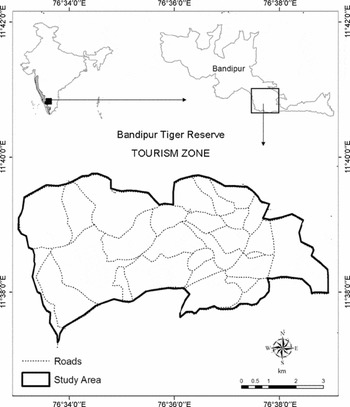
BTR (880 km2; 11°57′ N, 76°12′ E–11°35′ N, 76°51′ E) in the Western Ghats of southern India (Fig. 1) has temperatures ranging from 10° to 35°C and has an average annual rainfall of 800–1600 mm, most of which occurs during the monsoon season (June–October). BTR is predominantly tropical deciduous forest dominated by Anogeissus latifolia, Tectona grandis and Terminalia spp. (Prasad & Sharatchandra Reference Prasad and Sharatchandra1984). The native understorey consists mainly of the tall grass Themeda cymbaria, along with shrubs such as Helicteres isora, Holorrhaena pubescens, Zizyphus spp. and Grewia spp. BTR and adjacent forests have been invaded by several exotic plants, such as Lantana, Chromalaena odorata and Parthenium hysterophorus (Murali & Sidappa Shetty Reference Murali and Sidappa Shetty2001), the occurrence of which is thought to be associated with anthropogenic disturbances (Silori & Mishra Reference Silori and Mishra2001; Kodandapani et al. Reference Kodandapani, Cochrane and Sukumar2004).
Diagrammatic map and location of the tourism zone of the Bandipur Tiger Reserve.

Protected dry forests across the Western Ghats landscape, including BTR, are intensively managed for wildlife tourism and biodiversity conservation via small-scale forest clearing for the construction and maintenance of roads, waterholes and firebreaks. The study area (32 km2) coincided with the assigned tourism area located in the south-eastern part of BTR. It has 72 km of roads, some of which are tourism roads, others being management roads (Fig. 1). Tourism roads are bordered by view-lines, which are clearings that run along both sides of roads and increase visibility for viewing wildlife, and are 30–40 m wide (wide roads). View-lines are maintained by cutting and burning understorey vegetation at least once a year, but sometimes more often depending upon how quickly the clearing is overgrown by Lantana; trees are left standing. Management roads are not bordered by view-line clearings and are 10–12 m wide (narrow roads). While most roads and clearings are bordered by Lantana, others have native understorey (Appendix 1, see Supplementary material at URL http://www.ncl.ac.uk/icef/EC_Supplement.htm). Thus, management practices in BTR that maintain roads and view-lines, along with variation in understorey, offer an experimental set up within which to document tree death and tree community composition with respect to road, road width and road-associated exotic plants. Comparisons of tree death and tree community composition between roadside and forest interior were nested within comparisons across factorial combinations of understorey type (two levels, namely native and exotic) and road width (two levels, namely wide and narrow).
Data collection
Within this factorial experimental design, I counted trees in paired plots (road and interior, i.e. 50 m distant from the road) at 10 random locations in each of the factorial combinations of road width and understorey type (narrow-narrow, wide-native, narrow-exotic, wide-exotic). If view-lines were present (wide roads) then road plots were located within them; where view-lines did not border roads (narrow roads), road plots were placed immediately adjacent to the road within the edge. In each plot (10 m radius; n = 80 plots overall) I noted the total number and species of trees (>15 cm girth at breast height) and the number of dead trees (including snags, stumps and fallen trees). I used bark, leaf and flower characteristics to identify tree species. Dead trees without bark, or with damaged bark, for example by fire, could not be identified; consequently the species of 47 out of 573 sampled trees (approximately 8%) could not be determined. Data collection occurred between October 2006 and January 2007.
Statistical analyses
For tree death, I first tested for systematic variation in overall tree density across factors using a generalized linear model (GLM) with Poisson distribution (log-link) because these are count data (McCullagh & Nelder Reference McCullagh and Nelder1989). Since overall tree density varied systematically across factors, I used the ratio of dead to live trees per plot as a measure of tree death. This ratio was the response variable in a GLM for testing the effects of road, road width and understorey type on tree death. To neutralize inherent under-dispersion in these data (Φ = 0.24), I used a quasi-likelihood distribution for this GLM (McCullagh & Nelder Reference McCullagh and Nelder1989; Crawley Reference Crawley2007). Additive effects of road (location), understorey type, road width, and road width × understorey type interaction on tree death were analysed sequentially. All analyses using generalized linear models were conducted in R 2.6.1 (R Core Development Team 2007).
For tree community composition, I first used a non-metric multi-dimensional scaling (NMDS) ordination to visualize compositional differences between tree communities in the various factorial treatment combinations. I used Bray-Curtis dissimilarity indices to estimate differences in composition of live trees between all pairs of plots. To determine whether compositional dissimilarities in live tree communities varied systematically among the different levels of road (location), road width and understorey type, I used an analysis of similarities (ANOSIM). ANOSIM is analogous to the parametric analysis of variance, and tests for similarities or differences between groups of community samples (defined a priori) using permutation/randomization methods on a similarity/dissimilarity matrix (Primer-E 2001). A similarity or dissimilarity matrix consists of similarity/dissimilarity (distance) indices (such as Bray-Curtis or Euclidean) for all pairs of data points, distributed across all factors, in the community samples. The present ANOSIM would show whether location with respect to road, road width and understorey type were associated with compositional differences in the extant tree community. Finally, I used similarity percentage (SIMPER) to determine what species contributed to the compositional dissimilarity between groups or factors and whether certain species contributed disproportionately. I used PRIMER 5 software for the NMDS and ANOSIM.
RESULTS
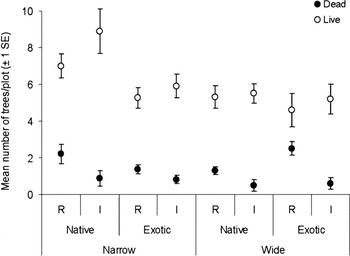
I counted a total of 573 trees from 51 species during sampling. Total tree density (individuals per plot) ranged from 3 to 17, and live tree density varied between 1 and 16. Seventy per cent of plots (56 out of 80) contained at least one dead tree. The highest live tree density occurred in plots away from narrow roads, bordered by native understorey, whereas the highest dead tree density, which also coincided with the lowest live tree density, occurred in roadside plots associated with wide roads and exotic (Lantana-dominated) understorey (Fig. 2)
Mean density of live (○) and dead trees (●), measured by number of individuals in paired roadside (R) and interior (I; 50 m distant from road) 10 m radius plots, distributed across factorial combinations of road width (narrow and wide) and understorey type (native and exotic).

Tree death
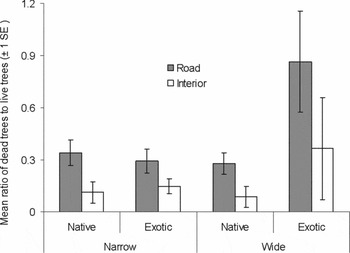
Variation in tree death (ratio of dead to live trees per plot) was best explained by location with respect to road (F1,78 = 5.75, p < 0.02; Fig. 3) with road plots (0.44 ± 0.08 SE) having 145% greater tree death than interior plots (0.18 ± 0.08 SE). The main effect of road width on tree death was not significant (F1,77 = 2.5, p = 0.11). Further, although plots associated with exotic understorey (0.41 ± 0.11) had over twice as much tree death as plots associated with native understorey (0.20 ± 0.04), the relationship between tree death and understorey was not significant (F1,76 = 3.74, p = 0.056). However, the interaction between road width and understorey type was significant (F1,73 = 3.94, p = 0.05).
Mean tree death (ratio of dead to live trees per 10 m radius plot, n = 80) in tree communities near roads (road) and 50 m distant from roads (interior), distributed across factorial combinations of road width (narrow and wide) and understorey type (native and exotic), Bandipur Tiger Reserve.

Tree community composition
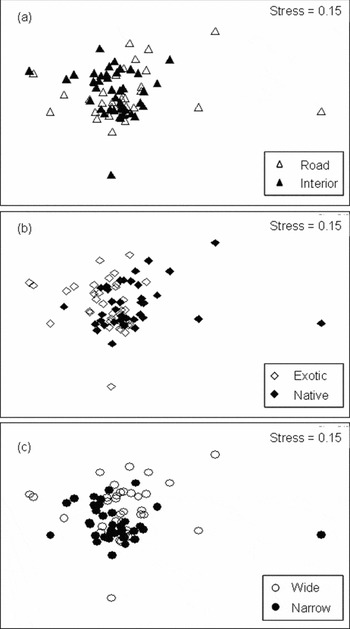
Plots did not differ in composition of extant tree community between roadsides and interior forest (Fig. 4a). The ANOSIM showed that plot location (road versus interior) did not influence extant tree community composition (Global R = 0.009, p = 0.22). However, NMDS and ANOSIM showed that plots with Lantana had a significantly different composition of live trees relative to plots with native understorey (Global R = 0.135, p = 0.001; Fig. 4b). SIMPER showed that plots with native understorey had within-group dissimilarity of 37.6%, while those with Lantana understorey had average within-group dissimilarity of 40.1%. However, average dissimilarity between native and exotic understorey groups was 62.7%. While Anogeissus latifolia and Terminalia alata were more abundant in plots with native understorey, Tectona grandis and Phyllanthus emblica were more abundant in plots with Lantana. Similarly, plots associated with different road widths also differed significantly in composition (Global R = 0.152, p = 0.001; Fig. 4c). Plots associated with narrow roads were 43.6% dissimilar within group, and those associated with wide roads were 34.4% dissimilar within group, while plots were 62.7% dissimilar between narrow and wide road groups. Plots associated with wide roads had relatively lower representation of A. latifolia, T. grandis, T. alata and P. emblica, four species which explain over 50% of the dissimilarity.
Non-metric multidimensional scaling (MDS) plots comparing species composition of extant tree community in two levels each of three factors: (a) plots located near roads (road) and distant from them (interior), data pooled across road width and understorey type; (b) plots associated with native versus exotic understorey, data pooled across road width and proximity to road; (c) plots associated with wide and narrow roads, data pooled understorey type as well as proximity to road.

DISCUSSION
Tree death
Roads and their view-lines appear to be strongly contributing to increased tree death in these endangered ecosystems (sensu Janzen Reference Janzen and Wilson1988), with tree death within and along roads being two and a half times greater than that away from them. A variety of forest ecosystems also show greater tree mortality in association with clearings compared to interiors (temperate forest, Chen et al. Reference Chen, Franklin and Spies1992; boreal forest, Esseen Reference Esseen1994; tropical rainforest, Ferreira & Laurance Reference Ferreira and Laurance1997). Such clearing-related increases in tree mortality are likely to result in greater numbers of dead trees (and greater tree death) as documented by this study. While the negative impacts of clearings on trees are not novel in a global context, the implications for disturbed and fragmented tracts of forest, particularly insular patches of forest which are protected for biodiversity conservation, are especially serious. This dataset highlights that even management for conservation and tourism can have adverse effects on tree communities, which in turn may affect various animal taxa (for example invertebrates, Klein Reference Klein1989; mammals, Stevens & Husband Reference Stevens and Husband1998; birds, Laurance & Gomez Reference Laurance and Gomez2005). These indirect effects are in addition to the potential direct effects of roads on natural systems and species (Forman & Alexander Reference Forman and Alexander1998). Further, by acting as corridors or agents for dispersal, providing suitable environmental conditions and holding reservoirs of propagules for future episodes of invasion, roads may promote exotic species invasions (Parendes & Jones Reference Parendes and Jones2000) which have their own ecological fallout (Levine et al. Reference Levine, Vila, D'Antonio, Grigulis and Lavorel2003).
The occurrence of the highest dead tree density, together with the lowest live tree density in plots associated with an exotic understorey (Fig. 2), in addition to the 100% higher tree death in plots associated with exotic understorey compared to plots associated with native understorey (Fig. 3), clearly shows that here greater tree death is associated with the presence of exotic plants. These data highlight an association which cannot be interpreted as a causal mechanism. It is known that canopy gaps, which could arise due to clearing or tree death, promote Lantana (Fensham et al. Reference Fensham, Fairfax and Cannell1994; Day et al. Reference Day, Wiley, Playford and Zalucki2003). Thus, it is likely that forests where tree death due to roads and other perturbations is higher could be more ‘invasible’ by Lantana compared to forest with intact tree communities, resulting in the association indicated by this dataset. However, whether this association between tree death and exotic plants in turn leads to exotic plant-induced tree death remains to be investigated.
Tree community composition
Long-term anthropogenic forest disturbance is known to result in tree community composition change (Whitmore & Burslem Reference Whitmore, Burslem, Newbery, Prins and Brown1998). However, this dataset does not indicate that proximity to road influences composition of the extant tree community since communities both adjacent to and distant from roads had similar composition (Fig. 4a). The lack of evidence for roads altering tree community composition may be owing to several reasons, of which I discuss two. Firstly, many roads in the study area have probably existed for several decades since these forests began to be exploited for game and timber. It is unclear as to what time scale is required for composition changes to manifest, and whether the last few decades during which roads have existed suffice to precipitate community composition differences. Long-term studies on tree communities, such as those in Neotropical forests (see Condit Reference Condit1995; Laurance et al. Reference Laurance, Lovejoy, Vasconcelos, Bruna, Didham, Stouffer, Gascon, Bierregaard, Laurance and Sampaio2002), particularly those that monitor individual trees and the environmental and anthropogenic processes that they are exposed to, are essential in order to further understand mechanisms of tree community change in these dry forests. Secondly, it is also possible that a spatial separation of 40–50 m between road and interior plots was insufficient for community composition changes to be apparent. However, since the density of roads in the study area was very high (72 km of roads for a 32 km2 area; 2.25 km. km−2), a distance of >50 m from one road was, in several places, <50 m from another. Consequently, I could not compare composition in roadside plots with that in plots further than 50 m from roads. Comparison of tree composition between plots further from roads may elucidate the effects of distance from roads on composition.
Although road width was not associated with increased tree death, it was associated with significant differences in community composition of live trees, with wide roads having fewer individuals of the four dominant species, namely A. latifolia, T. grandis, T. spp. and P. emblica, than plots associated with narrow roads. The difference appears to be owing to changes in the abundance of dominant species rather than replacement or loss of species. The data also showed that Lantana was associated with changes in tree species composition. P. emblica and T. grandis were more abundant in invaded forest, while A. latifolia and T. spp. were more abundant in Lantana-free forest. Yet, I cannot conclude that Lantana causes tree composition change. As in the case of tree death, existing differences in tree community composition resulting from factors such as varying fire and management histories, as well as differential herbivory in the regeneration stage, could render these communities differently ‘invasible’ by Lantana. Given that we currently know very little about the ecology of these tree species, the mechanistic underpinnings of differences in composition associated with wide roads and exotic understorey remain unclear.
Conservation and management implications
These data highlight that tropical dry forest tree communities are linked to the creation and maintenance of roads. Furthermore, even management for conservation and tourism can be interwoven with patterns of forest degradation. Thus, in addition to other potential drivers of degradation, such as anthropogenic pressures for forest-biomass and fire, the creation and maintenance of roads within protected forest islands could be detrimental to these endangered forest ecosystems.
Although roads are essential for management, conservation and monitoring, as well as tourism, the creation and maintenance of roads and other clearings must be minimized, and when necessary, must be only as small as needed (Lugo & Gucinski Reference Lugo and Gucinski2000). Moreover, management planning and implementation for the protection of dry forests, in India and elsewhere, must be based on sound science, and concomitant with rigorous monitoring. Additionally, there is an urgent need to better understand impacts of exotic plant invasions, particularly in edges bordering roads and other clearings, together with mechanisms of impacts and methods to combat them.
Trees largely determine forest architecture and microclimate, and hence changes in tree community dynamics may strongly affect other forest species (Klein Reference Klein1989) and ecological processes (Didham et al. Reference Didham, Ghazoul, Stork and Davis1996). The dry forests of the Western Ghats are critical habitat for globally important populations of endangered species such as the tiger Panthera tigris (Wikramanayake et al. Reference Wikramanayake, Dinerstein, Robinson, Karanth, Rabinowitz, Olson, Mathew, Hedao, Conner, Hemley and Bolze1998), gaur Bos gaurus and Asian elephant Elephas maximus. Thus, the long-term protection and conservation of these dry forest habitats is crucial not only for the forests themselves, but for a range of wildlife whose survival is closely tied to them. Understanding the drivers of tree community change, and forest degradation in general, is critical to the conservation of tropical dry forest ecosystems and their biodiversity.
ACKNOWLEDGEMENTS
I thank the Karnataka Forest Department for extending valuable logistic support. This work was funded by Save the Tiger Fund (National Fish and Wildlife Foundation, Washington DC, USA), and the Rufford Maurice-Laing Foundation (UK). I thank K. Murthy and J. K. Madha for invaluable assistance in data collection. I also thank S. Bagchi for help with study design and analyses. Discussions with M. D. Madhusudan, C. Mishra and W. M. Shields helped in preparing the manuscript, and three anonymous referees provided comments to improve an earlier draft.