





Impact statement
Bio-based actuators are an emerging field spanning both scientific research and design practice, with applications in soft robotics (Hua et al. Reference Hua, Zhao and Du2025) and shape-changing interfaces (Sturdee and Alexander Reference Sturdee and Alexander2018) in Biological Human–Computer Interaction (Bio-HCI) (Pataranutaporn et al. Reference Pataranutaporn, Ingalls and Finn2018). They combine material design, fabrication methods and environmental considerations by embracing the properties of bio-based and living materials (Pataranutaporn et al. Reference Pataranutaporn, Vujic, Kong, Maes and Sra2020). This research documents eight years of open documentation from Fabricademy course’s network of labs, showing how learners adopt and adapt biobotics (term used in this article to describe bio-based actuators). This article highlights trends and persistent barriers, such as tacit knowledge, heterogeneous documentation and uneven access to resources. The outcomes include insights and variables regarding the fabrication of biobotics, different aspects of accessibility in biobased shape-changing interfaces and discusses how biodesign challenges current soft robotics practices. By fostering multidisciplinarity between biodesign and soft robotics, the study contributes to the adoption of bio-based soft actuators within design research. More broadly, it explores how open documentation can facilitate the transfer of material knowledge beyond tacit learning, supporting a shifting educational landscape aimed at enabling global and distributed learning communities.
Introduction
Bio-based soft robotics is emerging at the intersection of three ongoing shifts: the rise of soft and organic robotics, the emergence of biodesign as a materially and ecologically oriented design paradigm and the turn within HCI toward sustainability and more-than-human perspectives. Soft robotics has expanded from engineering and biomedicine into creative practice and education, enabled by accessible digital fabrication tools and novel material developments beyond traditional robotic systems. (Hartmann et al. Reference Hartmann, Baumgartner, Kaltenbrunner, Hartmann, Baumgartner and Kaltenbrunner2020; Hua et al. Reference Hua, Zhao and Du2025; Xie et al. Reference Xie, Han, Dai, Zhang, Xiao, Huang, Cao, Zhong, Huang, Xie, Han, Dai, Zhang, Xiao, Huang, Cao, Zhong and Huang2025). In parallel, biodesign and Sustainable HCI (DiSalvo et al. Reference DiSalvo, Sengers and Brynjarsdóttir2010) foreground materials, living systems and ecological relations as central design concerns, positioning biomaterials as active agents in shaping interaction, experience and sustainability. Within this evolving landscape, Biological Human-Computer-Interaction (Bio-HCI) introduces biological materials for interaction design; however, the intersection of bio-based materials and soft actuators remains nascent and fragmented. (Bell et al. Reference Bell, Alistar and Buechley2026; Nicolae et al. Reference Nicolae, Lefez, Roudaut, Huron, Steimle and Teyssier2024a; Pataranutaporn et al. Reference Pataranutaporn, Ingalls and Finn2018; Zhu et al. Reference Zhu, Bell, Song, Vega, Nittala, Alistar, Buechley and Kao2025).
Recent developments in bioengineering and materials science have introduced biodegradable scaffolds (Xie et al. Reference Xie, Han, Dai, Zhang, Xiao, Huang, Cao, Zhong, Huang, Xie, Han, Dai, Zhang, Xiao, Huang, Cao, Zhong and Huang2025), transient electronics (Kim et al. Reference Kim, Shin, Lee and Kang2026) and bio-based soft robotics based on hydrogels and other biopolymers (Sun et al. Reference Sun, Williamson, Sukhnandan, Majidi, Yao, Feinberg, Webster-Wood, Sun, Williamson, Sukhnandan, Majidi, Webster-Wood and Feinberg2023), enabled by accessible digital fabrication methods such as 3D printing (Hardman et al. Reference Hardman, Hughes, Thuruthel, Gilday and Iida2021). These advances have extended experimentation beyond engineering into creative practice, design research and education, where biomaterials, as active design agents, evoke sensorial, responsive, more-than-human and ecological interactions explored within Bio-HCI (Guridi et al. Reference Guridi, Iannacchero and Pouta2024; Koelle et al. Reference Koelle, Nicolae, Nittala, Teyssier and Steimle2022; Lazaro Vasquez et al. Reference Lazaro Vasquez, Ofer, Wu, West, Alistar and Devendorf2022, Reference Lazaro Vasquez, Arduini, Sandry, Golla, Devendorf and Alistar2026; Nicolae et al. Reference Nicolae, Roussel, Koelle, Huron, Steimle and Teyssier2023, Reference Nicolae, Roussel, Koelle, Lefez, Roudaut, Nittala, Huron, Teyssier and Steimle2024b). Despite this growing interest, bio-based actuators remain an emerging area that requires further research. In particular, there is limited understanding of how these systems are learned, developed and documented; which opportunities and tensions they introduce; what interaction qualities they offer; and how biodesign may reframe soft robotics within design education. This paper addresses this gap by investigating how bio-based soft actuators, here termed biobotics, are learned, adapted and documented within distributed lab-based educational settings. The study is guided by the following research questions:
-
RQ1: What techniques and variables characterize the design and fabrication of bio-based pneumatic soft actuators (biobotics) within a distributed design-education program?
-
RQ2: How does open documentation shape the adoption, diffusion, remixing and reproducibility of biobotics across cohorts and laboratories?
-
RQ3: What challenges and opportunities do biodesign-driven approaches provide for reframing soft robotics within design education?
Using Fabricademy as a longitudinal case study, the research analyses eight years of open participant documentation from the Soft Robotics module and final projects. It examines material recipes, fabrication methods and reported challenges to identify recurring patterns that influence adoption, including tacit knowledge, material constraints and documentation quality. Two final projects illustrate how participants reference, adapt and evolve prior open documentation and how practices travel within the archive. The findings show that while adoption fluctuates, engagement is growing, and the documentation quality is a denominator of reproducibility and iteration.
Building on these findings, the research argues that integrating biodesign can reorient soft robotics in design education from a technology-centric topic toward material, ecological and documentation-centered practices. The paper first positions biobotics within the context of soft robotics and Bio-HCI research and then presents a longitudinal qualitative analysis of documentation and highlights the iterative development between two case studies. Finally, it discusses challenges, documentation practices and methodological implications, as well as opportunities for reframing soft robotics through biodesign.
Background
Soft robotics has emerged at the intersection of materials science and engineering as a subfield that uses compliant materials (Majidi Reference Majidi2014) and biomimetic design principles (Chen et al. Reference Chen, Chen, Jung, Kim, Lo Preti, Laschi, Ren, Sitti, Full and Yang2025) to realize behaviors that are difficult to achieve with rigid robotic systems. Soft robotics find various applications in industrial automation, collaborative robots (cobots) (Taesi et al. Reference Taesi, Aggogeri and Pellegrini2023), biomedicine, healthcare and rehabilitation (Ashuri et al. Reference Ashuri, Armani, Jalilzadeh Hamidi, Reasnor, Ahmadi and Iqbal2020), deep-sea and environmental exploration (Li et al. Reference Li, Wong, Shih, Guo, Wang, Liu, Wang, Liu, Yan, Wu, Yu, Chen, Liang, Xue, Wang, He, Wen, Tolley, Zhang, Laschi and Li2023) and wearable or implantable devices (van Oosterhout et al. Reference van Oosterhout, Robertson and Paik2026; Yin et al. Reference Yin, Yao, Song, Heng, Ma, Han and Gao2024), where human-and more than human-computer interaction can be made safer, biocompatible and adaptable. The predominant materials used for soft robotics include silicone elastomers, textiles, liquid crystals, hydrogels, shape memory alloys and polymers (Khanam et al. Reference Khanam, Jeong, Mutlu and Aziz2025; Roh et al. Reference Roh, Lee, Lim, Gong, Hwang, Kang, Kim, Cho, Kwon, Kang, Han and Ko2024).
Most recent work explores bio-derived polymers (Kim et al. Reference Kim, Park and Yoon2022), such as cellulose (Chen et al. Reference Chen, Sun, Biehl and Zhang2022), chitosan, alginates (Sun et al. Reference Sun, Williamson, Sukhnandan, Majidi, Yao, Feinberg, Webster-Wood, Sun, Williamson, Sukhnandan, Majidi, Webster-Wood and Feinberg2023), gelatin (Baumgartner et al. Reference Baumgartner, Hartmann, Drack, Preninger, Wirthl, Gerstmayr, Lehner, Mao, Pruckner, Demchyshyn, Reiter, Strobel, Stockinger, Schiller, Kimeswenger, Greibich, Buchberger, Bradt, Hild, Bauer and Kaltenbrunner2020; Hardman et al. Reference Hardman, Hughes, Thuruthel, Gilday and Iida2021) as actuator substrates that are both biocompatible, supporting applications in biomedicine, implantable devices and environmental sensing and more sustainable, mitigating reliance on petrochemical-based polymers by introducing renewable, lower-impact and abundant material systems for such applications (Hartmann et al. Reference Hartmann, Baumgartner, Kaltenbrunner, Hartmann, Baumgartner and Kaltenbrunner2020). Soft robotics can be actuated via a wide range of technologies including pneumatics, hydraulics, fluidics, liquid crystals, shape memory alloys and passively, using the hygroscopic properties of materials and produced through fabrication methods such as molding, laser etching, 3d printing and 4d printing (Dong et al. Reference Dong, Luo, Zhao, Qiao, Li, Yi, Yang, J. Oropeza, Shihao Hu, Xu and Zeng2022; Rus and Tolley Reference Rus and Tolley2015; Wang et al. Reference Wang, Wang, Mushtaq and Wei2024).
In parallel with these technological advances, soft robotics is increasingly present in education, from K–12 to university-level programs (Cayetano-Jimenez et al. Reference Cayetano-Jimenez, Martinez-Rios, Bustamante-Bello, Ramirez-Mendoza and Ramirez-Montoya2024), supported by the growth of knowledge sharing, interdisciplinary communities (Holland et al. Reference Holland, Park, Polygerinos, Bennett and Walsh2014, Reference Holland, Berndt, Herman and Walsh2018; Shtarbanov Reference Shtarbanov2021) that lower technical barriers and make soft-actuator design and fabrication accessible to non-specialist learners and educators. Within these educational settings and particularly in short-term workshops, pneumatic and fluidic actuation is the most commonly adopted mechanism, due to its relative simplicity and compatibility with low-cost fabrication tools.
According to Giordano et al. (Reference Giordano, Murali Babu and Mazzolai2023), “soft robotics may represent a technology that can serve humanity and the planet by addressing global challenges and environmental degradation through targeted productive applications” (p. 2), but “they must incorporate key features such as sustainable materials and manufacturing and environment-friendly design principles, implementing a cradle-to-cradle (C2C) approach that will help minimize the carbon footprint of the new automation era” (p. 3). The use of bio-based materials is one aspect of this complex equation, alongside the democratization of fabrication tools, multidisciplinarity, easier access to laboratories and open documentation – forming the context of this study.
Biodesign in HCI
Over the past decade, biodesign has emerged as a design paradigm at the intersection of nature, science and creativity (Myers Reference Myers2012) redefining materials, living systems and biological processes as active design agents. Within design and HCI, this evolution has supported a broader turn toward ecological concerns, more-than-human perspectives and regenerative material practices, where making is entangled with environmental, ethical and societal questions rather than purely technical problem solving (Laurell Thorslund and Leifler Reference Laurell Thorslund and Leifler2025). In this context, materials move beyond functional and aesthetic roles to shape design processes, relationships and ecological interactions fostering systemic design. A range of theories reflect this transition, such as Growing Design (Camere and Karana Reference Camere and Karana2018), Material Driven Design (Karana et al. Reference Karana, Barati, Rognoli and Zeeuw van der Laan2015), Material Tinkering (Parisi et al. Reference Parisi, Rognoli and Sonneveld2017), Living Interaction Design (Rognoli et al. Reference Rognoli, Albergati, Pollini and Langella2025), More-Than-Human Design (Wakkary Reference Wakkary2021), facilitating frameworks, taxonomies, practice-based approaches and manifestos to define the field. Practice-based communities and academia further contribute through open “cook books” (Bell et al. Reference Bell, Friedman-Gerlicz and Buechley2025; “Bioplastic Cook Book” 2018; Kääriäinen et al. Reference Kääriäinen, Tervinen, Vuorinen and Riutta2020; KickStart Your Myco-Culture – Open Source Practices from FabTextiles Lab’ 2019; Lazaro Vasquez et al. Reference Lazaro Vasquez, Ofer, Wu, West, Alistar and Devendorf2022; “The secrets of bioplastic” 2017), enabling the dissemination of knowledge and sustainability-oriented innovation grounded in biomaterial-design practices to novice learners and practitioners.
Blevis’ places sustainability as a central design concern and articulates five overarching principles for Sustainable Interaction Design (SID): linking invention & disposal, promoting renewal & reuse, promoting quality & equality, decoupling ownership & identity and using natural models & reflection (Blevis Reference Blevis2007). In HCI, efforts toward sustainable interaction have given rise to dedicated groups and frameworks. Sustainable HCI (SHCI) maps genres and axes of work, addressing the multiple dimensions of sustainability and the tensions between behavior-change, infrastructural and systemic approaches (DiSalvo et al. Reference DiSalvo, Sengers and Brynjarsdóttir2010). Ecological HCI (EHCI) shifts toward nature-centric design, integrating interactive technologies with ecological systems, recognizing interdependencies and moving beyond anthropocentrism toward more-than-human perspectives. (Lu et al. Reference Lu, Danielescu, Iyer, Lopes and Yao2024a). Sustainability in HCI is operationalized through research on end-of-life electronics, recyclability, waste reduction, energy harvesting, transient electronics and functional degradation. These efforts foreground materiality and temporality coinciding with the material turns in design towards bio-based and biological materials positioning them as a key component of the emerging sustainable HCI landscape.
Within this space, Biological HCI (Bio-HCI) initially framed biological materials, intermediate platforms and interactions with users as key components (Pataranutaporn et al. Reference Pataranutaporn, Ingalls and Finn2018). More recent work has expanded this lens to integrating biomaterials across a broad range of interactive applications, including sustainable tangible interfaces, interactive surfaces (Bell et al. Reference Bell, Wu, Campo Woytuk, Lazaro Vasquez, Alistar and Buechley2024, Reference Bell, Alistar and Buechley2026; Nicolae Reference Nicolae2025; Nicolae et al. Reference Nicolae, Roussel, Koelle, Huron, Steimle and Teyssier2023). Further work demonstrates biomaterial-based wearables (Zhu et al. Reference Zhu, Bell, Song, Vega, Nittala, Alistar, Buechley and Kao2025) and dynamic interfaces, edible food experiences (Shintake et al. Reference Shintake, Sonar, Piskarev, Paik and Floreano2017) and sustainable prototyping approaches for e-textiles (Zhu Reference Zhu2025), soft sensors and shape-changing artifacts (Den Teuling et al. Reference Den Teuling, Winters and Bruns2024; Nicolae et al. Reference Nicolae, Lefez, Roudaut, Huron, Steimle and Teyssier2024a; Yao et al. Reference Yao, Ou, Cheng, Steiner, Wang, Wang and Ishii2015).
Within this trajectory, bio-based morphing interfaces are emerging, ranging from passive systems, benefiting from the inherent properties of biomaterials – such as hygroscopic behavior, heat responsiveness and degradation (Den Teuling et al. Reference Den Teuling, Winters and Bruns2024; Lazaro Vasquez et al. Reference Lazaro Vasquez, Arduini, Sandry, Golla, Devendorf and Alistar2026; Lu et al. Reference Lu, Yi, Gan, Huang, Zhang, Yang, Shen and Yao2024b) – to using the properties of living biological cells (Yao et al. Reference Yao, Ou, Cheng, Steiner, Wang, Wang and Ishii2015), extending the applications of material-driven design. Bio-based actuators go beyond sustainability: as active design agents, they shape new forms of interaction, introduce new sensations, temporalities and redefine our relationship with technology.
Bio-based actuators and biobotics
In bioengineering, bio-based actuators and interfaces are described using a range of terms such as biohybrid robots, biobots, biorobotics, biological robots, living actuators, biointerfaces or bioactuators, each reflecting different disciplinary assumptions and application domains, without a shared definitional framework (Webster-Wood et al. Reference Webster-Wood, Akkus, Gurkan, Chiel and Quinn2017). These terms generally refer to engineered systems combining living biological components, such as cells, tissues or organisms, with artificial structures, most often within biomedicine, microscale robotics, drug delivery or environmental sensing contexts (Garmroudi et al. Reference Garmroudi, Tushar, Liu and Lin.d.; He et al. Reference He, Liu, Li, Ye, Wu and Song2025).
In HCI, shape-changing interfaces is a broader category of computational systems whose physical form can dynamically reconfigure as both input and output. This study is focused on the Elastics and Inflatables category according to Sturdee’s and Alexander’s (Sturdee and Alexander Reference Sturdee and Alexander2018) for interfaces with reversible transformations of volume and form.
The role of biomaterials within shape-changing interfaces has recently emerged, yet without a specific terminology. Related work names these systems as morphing artifacts, devices, interfaces (Jain et al. Reference Jain, Lu and Yao2021; Lu et al. Reference Lu, Yu, Yi, Ding, Mi and Yao2023, Reference Lu, Yi, Gan, Huang, Zhang, Yang, Shen and Yao2024b), biohybrid devices (Nicolae et al. Reference Nicolae, Roussel, Koelle, Huron, Steimle and Teyssier2023) or biomaterial based soft robotics (Helinska Reference Helinska2025). These studies investigate how biomaterials can be integrated into shape-changing systems to enable actuation, responsiveness and environmental interaction. They further explore their material properties, fabrication methods and design implications across experimental and applied contexts.
This paper proposes the term biobotics to refer to bio-based inflatable actuators, a hybrid material system (Parisi et al. Reference Parisi, Ferraro, Rognoli, Nimkulrat and Groth2024) at the confluence of biomaterials with pneumatic actuation to produce shape-change and surface movement. They are developed through material-driven design approaches and molding or casting fabrication techniques, situated within design practice. The term seeks to distinguish these artifacts from biological and biohybrid robotics, which predominantly integrate living tissues or cells with engineered systems for biomedical or developmental biology purposes (Menciassi et al. Reference Menciassi, Takeuchi and Kamm2020). Within the broader taxonomy of shape-changing interfaces, biobotics belongs to the category of elastics and inflatables, with the specificity that bio-derived materials act as the primary design driver. The term has been in use within the Fabricademy program since 2018 and is proposed here as a designerly concept naming a material-driven practice in which bio-based materials are shaped through molding and casting to function as soft actuators. While not restricted to any single actuation mechanism, this study focuses on pneumatic actuation as the most accessible form within short-term educational contexts (Cayetano-Jimenez et al. Reference Cayetano-Jimenez, Martinez-Rios, Bustamante-Bello, Ramirez-Mendoza and Ramirez-Montoya2024), acknowledging that future research may extend the term to other actuation types.
Recent design research has started to explore bio-based materials as substrates for soft actuation outside of engineering or biomedical frameworks, resulting in a small but growing body of fabrication-oriented work that overlaps with what biobotics aims to define. Nicolae (Nicolae et al. Reference Nicolae, Lefez, Roudaut, Huron, Steimle and Teyssier2024a) introduces SoftBiomorph, a fabrication framework for alginate-based shape-changing interfaces, that combines a set of material synthesis processes for achieving different mechanical properties with crafting-based assembly techniques that functionalize these properties into different types of shape-change, demonstrated through several application cases. Peng (Peng et al. Reference Peng, Miyatake, Peng, Lu, Yang and Yao2025) presents Biotube, a method for fabricating hollow tubular alginate structures and demonstrates their potential through case studies of biodegradable transient devices. Ge (Ge et al. Reference Ge, Lu, Gao, Yang, Hester, Cheng and Luo2025) proposes BioGem, replicating a specific actuator type with gelatin, while Helinska (Helinska Reference Helinska2025) provides an empirical comparison of different biopolymer, silicone and vinyl actuator properties, identifying opportunities and challenges.
Together, these studies indicate the nascent emergence of bio-based actuators in design as viable media for tangible interaction, while revealing a series of challenges. First, material-driven design remains heavily dependent on tacit knowledge, with fabrication processes adapted case by case, limited reproducibility and lack of documentation. Second, projects replace petrochemical-based silicones with biodegradable materials to reproduce existing actuator paradigms (Ge et al. Reference Ge, Lu, Gao, Yang, Hester, Cheng and Luo2025), with the risk to obscure the aliveness, mechanical fragility and inherent biomaterials properties. As a result, sustainability can be associated as a trade-off in durability, precision or scalability, leaving limited space to explore new interaction possibilities enabled by these materials. Finally, due to the relative novelty of bio-based actuators in design research, the adoption and diffusion of these techniques within educational and laboratory settings remain unexplored. This opens a space for reflection and iterative improvement by understanding how experimental practices are documented, how they travel across contexts within distributed lab-based education and where their limitations lie. Building on this body of work, this study conducts a longitudinal analysis of Fabricademy’s open repository of participant documentation, extracting a set of variables and insights that shape fabrication practices within Fab Lab contexts. It further discusses the role of biodesign in reframing soft robotics education and critically reflects on the role of open documentation in distributed lab-based learning.
Context and methods
This research originated in 2018 through an industry collaboration led by the first author at FabTextiles Lab to propose and prototype sustainable inflatable wearables. Experimentation with bio-based actuation during this project motivated the continued development of these techniques within Fabricademy.
Fabricademy program structure
Fabricademy is a hybrid, distributed educational program at the intersection of textiles, digital fabrication and biology, offering training in textile and material innovation, including biodesign, additive manufacturing, 3D modeling, parametric design, wearable technologies, electronics production and digital crafts. Co-founded by the first author in 2016, it is delivered through a global network of textile fabrication laboratories that combine online global lectures and reviews with hands-on, lab-based training and open documentation (Pistofidou et al. Reference Pistofidou, Raspanti and Simonelli2016b).
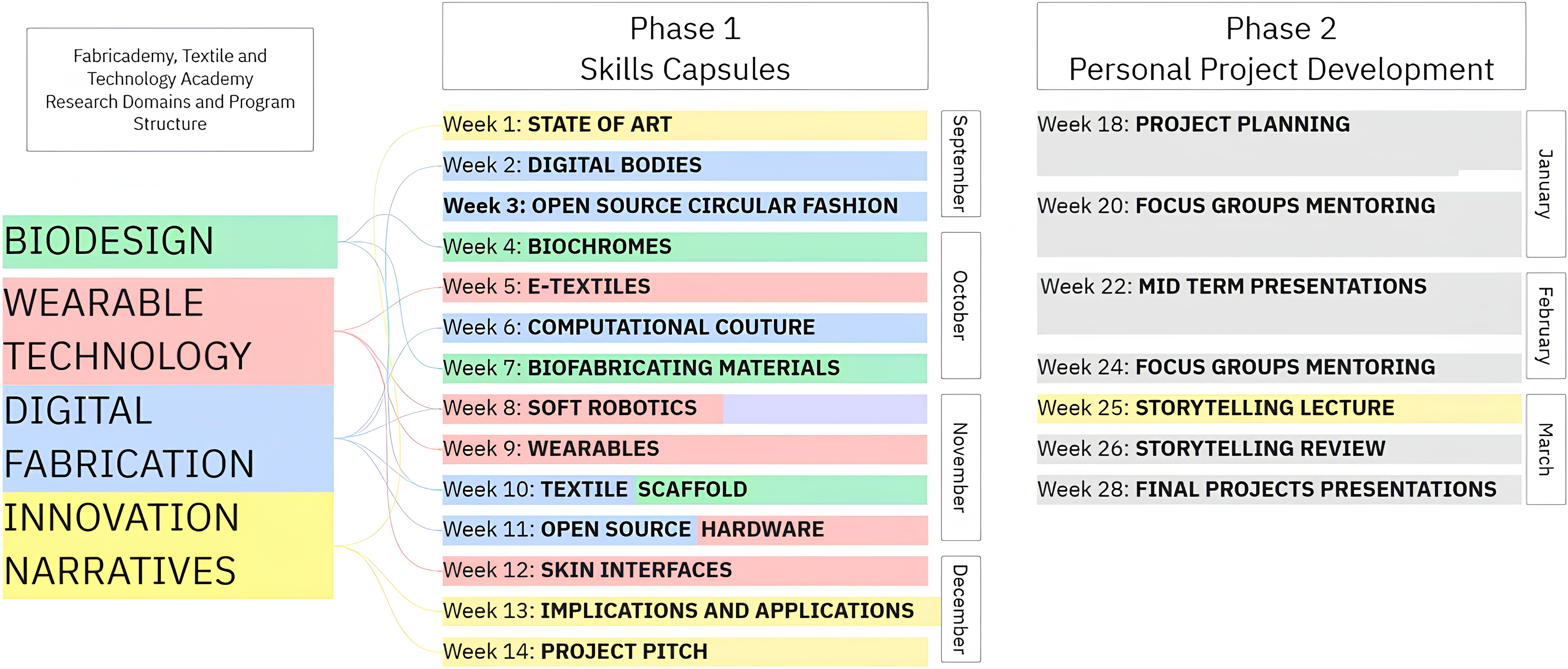
The program is modular and stackable, allowing participants to enroll in individual weekly modules or the full six-month course. It is structured in two phases. The first phase, known as Skills Capsules, consists of weekly modules organized around four thematic domains: sustainability, digital fabrication, wearable technologies and innovation narratives. In the sustainability domain, participants acquire skills in circular design, natural and bacterial dyeing, basic chemistry and biology, living materials and recycling. The digital fabrication domain provides training in fab lab machinery, 3D modeling, parametric design and open hardware. The wearable technologies domain includes e-textiles, programming, interaction design, embedded design and assistive technologies. Innovation narratives is an overarching transversal domain that includes the introductory module, implications and applications and storytelling. The modules in the first phase are sequenced to alternate between domains while progressively increasing in difficulty within each domain. In the second phase, known as Personal Project Development, participants develop an individual project that builds on the techniques from the first-phase modules, conducting research, deepening selected skills and extending them into concrete applications. Figure 1 below provides an overview of the program structure.
Fabricademy, textile and technology academy, thematic domains and program structure. Pistofidou A.

Figure 1. Long description
A visual diagram showing on the left side the thematic domains of the Fabricademy course: Biodesign, Wearable Technology, Digital Fabrication and Innovation narratives. In the middle the first phase of the course with the titles of each of the 14 weeks connected to the thematic domains. On the right side, the second phase of the course, personal project development, with the titles of the bi-weekly modules.
Within this structure, the Biofabricating Materials module introduces biodesign principles and practices, ranging from crafted biopolymers to living systems through material tinkering (Parisi et al. Reference Parisi, Rognoli and Sonneveld2017), while the Soft Robotics module introduces biomimetic principles, assistive technologies, soft actuators and related fabrication techniques. The two modules address distinct themes and are not formally linked in the curriculum. While the Soft Robotics module predominantly focuses on fabrication methods based on heat-transfer vinyl and molding and casting techniques using silicones, a shift toward bio-based solutions has emerged, driven by considerations of sustainability, low cost, material availability in remote locations and the potential of material research.
Learning within Fabricademy follows a gradual release-of-responsibility approach (Webb et al. Reference Webb, Massey, Goggans and Flajole2019), moving from instructor-guided demonstrations toward independent experimentation. Grounded in constructionist theories of maker education (Korhonen et al. Reference Korhonen, Kangas and Salo2022; Papert and Harel Reference Papert and Hareln.d.), situated learning pedagogies (Lave and Wenger Reference Lave and Wenger1991) and responsible innovation (Thomas et al. Reference Thomas, Pistofidou, Troxler and Kohtala2024), the program emphasizes learning-by-doing, open-source collaboration and material-driven design. Participants contribute their work to a shared documentation archive, which in this study serves as empirical material for analyzing the development and adoption of fabrication practices (Pistofidou et al. Reference Pistofidou, Raspanti and Simonelli2016a). The first author’s practitioner–researcher role within this environment constitutes an action research setting for design research (Villari Reference Villari, Rodgers and Yee2023), where techniques are introduced, iterated and observed through participant documentation across cohorts. To analyze these adoption trajectories, this study conducts a mixed-methods longitudinal corpus analysis (Gerken Reference Gerken2011; Kjaerup et al. Reference Kjaerup, Skov, Nielsen, Kjeldskov, Gerken and Reiterer2021) of the open archive, examining adoption trends, case studies and fabrication practices intersecting biomaterials and soft robotics.
Longitudinal analysis
This study adopts a longitudinal perspective by examining changes across cohorts over time. The quantitative analysis provides an exploratory overview of patterns of occurrence and fluctuations in engagement, in line with similar approaches in HCI research (Gerken Reference Gerken2011; Kjaerup et al. Reference Kjaerup, Skov, Nielsen, Kjeldskov, Gerken and Reiterer2021). Biomaterial adoption during the soft-robotics week was quantified across eight Fabricademy cohorts (2019–2026). A custom Python script was used to search participants’ soft-robotics module archives for keywords commonly used within Fabricademy documentation to indicate the use of bio-based materials. The keywords included are: “biosilicone”, “bio-silicone”, “biobased”, “bio-based”, “bioplastic”, “gelatine”, “gelatin”, “alginate”, “hydrogel”, “bio-bot”, “biomaterial”, “bio material”, “seaweed”, “bio-inflatable”, “bioinflatable” and “bioactuator”. These terms reflect biopolymers and program-specific material descriptors from the Biofabricating Materials module and the Soft Robotics module, capturing how material experimentation is described within the program’s documentation. The script initially extracts all uniform resource locators (URLs) and creates a list, reporting any that are missing. The missing URLs are then added manually. A second script processes each URL to identify repositories containing the keywords and generates an excel file with the corresponding links. Each link is then reviewed manually to exclude those that do not meet the inclusion criteria of showing evidence of prototyping.
Project selection & coding
A twofold qualitative analysis was conducted on participant and final-project documentation. First, final projects were reviewed to identify cases in which biobotics techniques were implemented in applications within the human-computer interaction field. Based on this review, two final projects were selected for in-depth case study, using criteria of sustained biobotics experimentation and sufficient documentation of application contexts. These projects were selected for their extensive documentation, iterative experimentation and frequent citation by other participants. Their role in the development of biobotics is central in Fabricademy: techniques are refined and contextualized around them and their documentation illustrates how the open repository functions as institutional memory: a shared knowledge base that subsequent cohorts can use to pick up, adapt and extend prior work, enabling fork-like, iterative development of biobotics practices over time. Second, a coded collection of bio-based soft-robotics experiments was compiled from the soft robotics module, focusing on the weekly module experimentation that used bio-based materials to fabricate inflatables and soft actuators. Of the 45 projects involving hands-on biobotics prototyping during the soft-robotics module, 32 met the inclusion criteria based on sufficient documentation of processes, results or explicitly documented failures; semicompleted projects lacking documentation of sealing and inflation steps were excluded. The remaining 13 entries did not document the completed process until inflation of the biobotic.
Participants who conducted multiple distinct experiments are represented by more than one entry in the dataset, while cases in which multiple participants worked in the same laboratory and documented the same process of an instructor-led demonstration were merged into a single entry to avoid duplication. From the 32 eligible projects, 21 coded entries constitute the qualitative dataset used in this analysis after merging the group documentation.
The coded projects were treated as a corpus of situated fabrication experiments and reviewed to identify recurring fabrication elements, including recipes, mold types, geometries, preparation processes, sealing techniques and reported failures. For each project the following attributes were registered to build the dataset: (1) project number, (2) participant name, (3)image (4)year, (5) biopolymer, (6) recipe, (7) mold type, (8) sealing technique, (9) tube connection, (10) reflections and (11) explicit references to other participants’ work. To enable comparison across projects, material recipes documented in different formats and measurement units were standardized and expressed as ratios (biopolymer : plasticizer : solvent). The dataset was then reviewed and coded for basic elements related to fabrication, material use and referencing practices. These codes were organized in a comparative table, which allowed recurring patterns across projects and cohorts to be identified.
Results
For each year, the number of participants experimenting with bio-based materials during the soft-robotics module was counted and normalized by cohort size, summarizing the percentage of biobotics-related projects per year and the year-over-year change as presented in Table 1. In total, 293 participant archives were analyzed, of which 95 matched the keyword search criteria. Among these, 45 projects (15.4% of the total dataset) included documented prototyping and met the inclusion criteria.
Longitudinal view of documented biobotics prototype projects in Fabricademy’s participant archive (2019–2026)

Table 1. Long description
A table with columns for each year, from 2019 to 2026 and rows of total archives number, keyword match, prototype evidence, percentage of biobotics-related entries, and year over year change percentages.
The table above shows the percentage of documented biobotics prototyping projects across Fabricademy cohorts from 2019 to 2026. The data reveal a fluctuating pattern, with an initial increase between 2019 and 2020, followed by a sharp drop in 2021 coinciding with limited accessibility to labs due to COVID-related restrictions, followed by intermittent peaks and declines across cohorts.
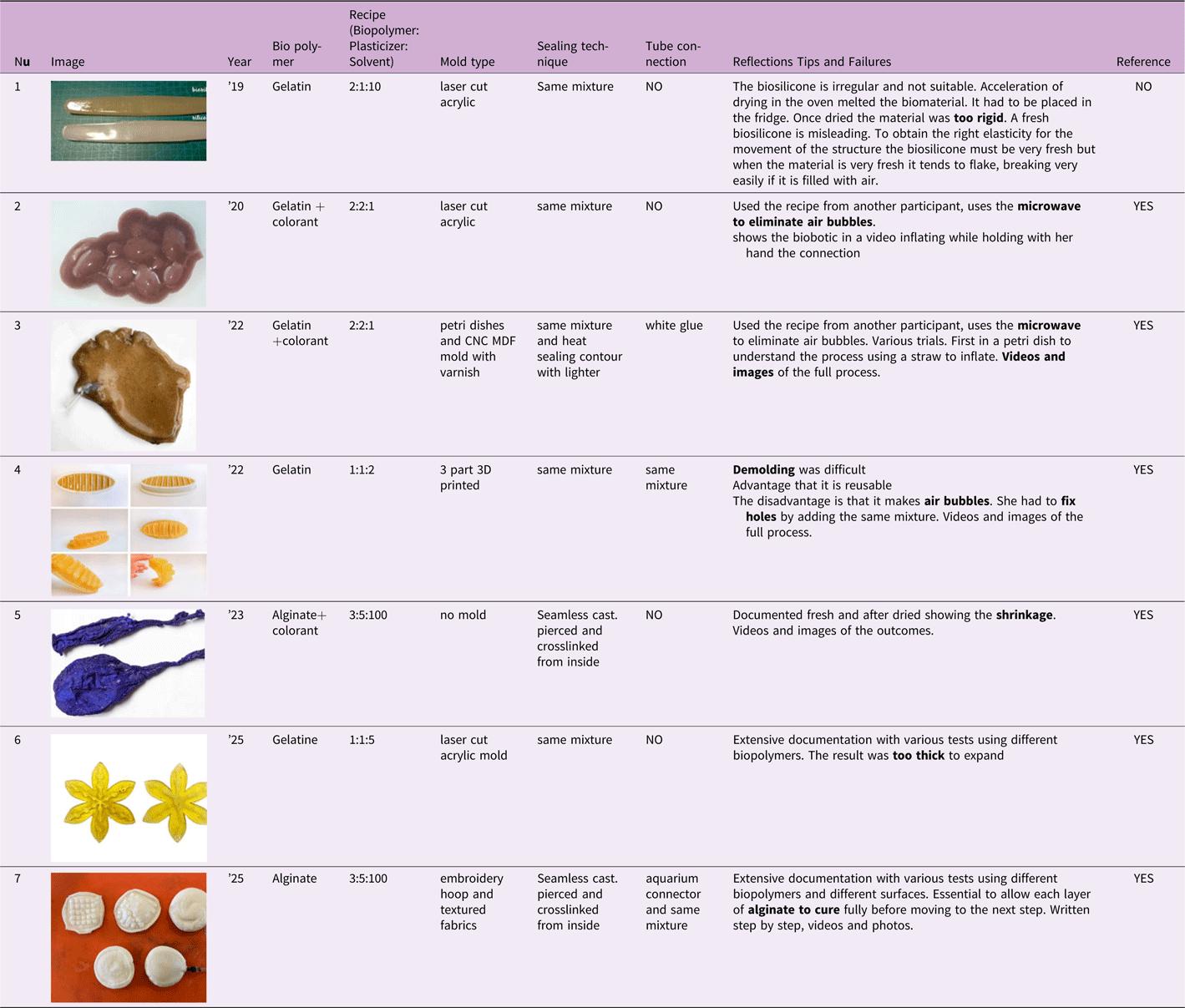
Among the 45 participants who experimented with prototyping biobotics, 13 did not complete the fabrication process or its documentation. While most participants have documented material preparation, mold fabrication, casting and unmolding, projects often stopped before sealing and inflating the actuator, thus were excluded. Since some labs conducted the process as a group activity, the entries have been merged into a single entry, resulting finally in 21 entries. Each entry includes data on biopolymer choice, recipe ratios, mold type, tube sealing technique, reflections and references to other participants’ work, which are presented in detail in Appendix A. Since all the projects presented in the archive only consider pneumatic actuation, the analysis did not include specific coding of actuation mechanisms, which constitutes a limitation and a potential direction for future research within this field. Below, Table 2 presents a sample of coded entries that reflects the diversity of polymer recipes, fabrication approaches and documented reflections, illustrating active experimentation with biobotics and a range of challenges, tactics, failures and successes.
A selection of recipes, tools, fabrication techniques, references and tips/failures in Biobotics across the Fabricademy course archive (2019–2026)

Table 2. Long description
A table including seven entries of the most representative archive documentation on biobotics with images.
Patterns in biobotic fabrication practices across the archive
Across Fabricademy cohorts, the fabrication of pneumatic biobotics generally follows a recurring workflow as documented in the Soft Robotics module. The process begins with preparing a biopolymer mixture (for example, gelatin or alginate with plasticizer and water), followed by casting it into a mold and demoulding once the material has gelled or dried. The actuator is then fitted with a connection tube, sealed and finally inflated to test motion. This sequence is present across projects, while variations appear at each stage: material recipes, mold designs, sealing techniques, tube connections and documentation practices.
These techniques offer opportunities such as low-cost, accessible biopolymer recipes, alongside challenges related to fragility, shrinkage, demoulding difficulties, tacit knowledge, drying times and a mismatch between biomaterial temporalities and conventional soft-robotics design practices that rely on standard, off-the-shelf silicone materials. The following analysis examines how choices at each of these stages shape the behavior and reproducibility of biobotic systems.
Material recipes:
The dataset includes 14 gelatine-based and 7 alginate-based recipes with documented results. For gelatine, the 2:2:1 (n = 5) and the 1:1:2 ratio (n = 3) are most frequently used, yet both are associated with fabrication issues such as air bubbles and foaming. For alginate-based recipes the range is 3g of alginate with 5–10g of glycerin in 100ml of water, with over half of entries (n = 4) reporting shrinkage and shape loss after drying. Nonetheless, most experiments (n = 5) achieve actuation (inflation) while the material is still hydrated. Compared to traditional silicone-based soft robotics, there is a similarity regarding air bubbles, often mitigated using a vacuum chamber. However, silicone is an industrial material with defined shore hardness and curing times provided in datasheets, whereas biopolymers are subject to preparation time and continue to transform during drying. The findings also suggest that accelerating the drying process is essential: materials with low melting points (gelatin) can utilize air drying, such as ventilators, whereas dehydrators can be used for materials with higher melting point (alginate, cellulose, e.t.c). As a result, recipes alone are insufficient to guarantee reproducibility, since fabrication decisions must adapt to changing material states.
Molds:
A range of mold types is documented for gelatine-based casts, including 3D-printed (n = 5), laser-cut acrylic (n = 4), petri dishes (n = 2), plastic trays (n = 2) and one varnished medium density fiberboard (MDF) mold. Most 3D-printed molds are downloaded from Thingiverse (Thingiverse.com n.d.) or the SoftRobotics toolkit (Holland et al. Reference Holland, Park, Polygerinos, Bennett and Walsh2014), while labs reuse molds from previous years for demonstrations. Participants using 3D-printed molds often report difficulties with demolding and tearing, especially when the chamber geometries are dense and fine. Laser-cut acrylic molds appear to function better, aside from issues regarding the final thickness. For alginate-based casts, two approaches are documented: embroidery hoops with fabric (n = 4) and moldless surface pouring (n = 3), both resulting in successful samples. There are multiple advantages to using fabric in an embroidery hoop, a technique introduced by the first author in the last decade. It is highly accessible, low cost, reusable and requires no fabrication time. It also enables the exploration of different textile substrates that provide texture, pattern, function and aesthetic qualities. Finally, sharing recipes becomes more precise when the hoop diameter is standardized and the hoops are easy to hang for drying.
Sealing techniques:
For gelatine-based sealing, most participants use the same mixture as glue (n = 9), with fewer entries using two-step casting with a stencil, heat sealing or a combination of methods. Across all approaches, sealing failures, such as air leakage or holes, are mentioned, which also occur in silicone-based soft-robotic prototyping. For alginate-based systems, two fabrication methods are presented. The first involves piercing the cast to remove the uncured interior, followed by injecting CaCl2. The second uses a two-step casting process with CaCl2-impregnated paper as a stencil to form internal channels; both appear functional. Seamless single-cast geometries are relatively uncommon in silicone-based soft robotics, aside from emerging silicone 3D-printing approaches.
Tube connection:
The tube connection stage is the least documented, yet critical for biobotic functionality. Most participants use silicone tubing as a temporal connection for the inflation, while fewer use a needle or an aquarium connector. Sealing is rarely described in detail, as the participants only test the inflation temporarily and do not spend time to create an airtight connection. One entry mentions the use of cable ties, while the alginate single-cast fabrication one uses the same mixture for sealing. One participant describes a “mistake” where the alginate leaked and formed a continuous long tube, resembling a “tail”. Creating sealed connections between different materials is a recurring difficulty in rapid prototyping. This lack of attention reflects the educational context of rapid prototyping over long-term performance. As a result, pneumatic actuation remains the only explored actuation type.
Documentation:
Across the archive the quality and format of the documentation vary significantly across participants, with most including visual documentation such as photos, videos and final outcomes, while omitting critical stages such as sealing and drying. Although thirteen participants document the drying stage, only seven explicitly comment on deformation or shrinkage, and inflation tests are typically conducted while the material is still fresh rather than fully dried. In addition, the process of sealing the connection between the biobotic and the tube is rarely documented.
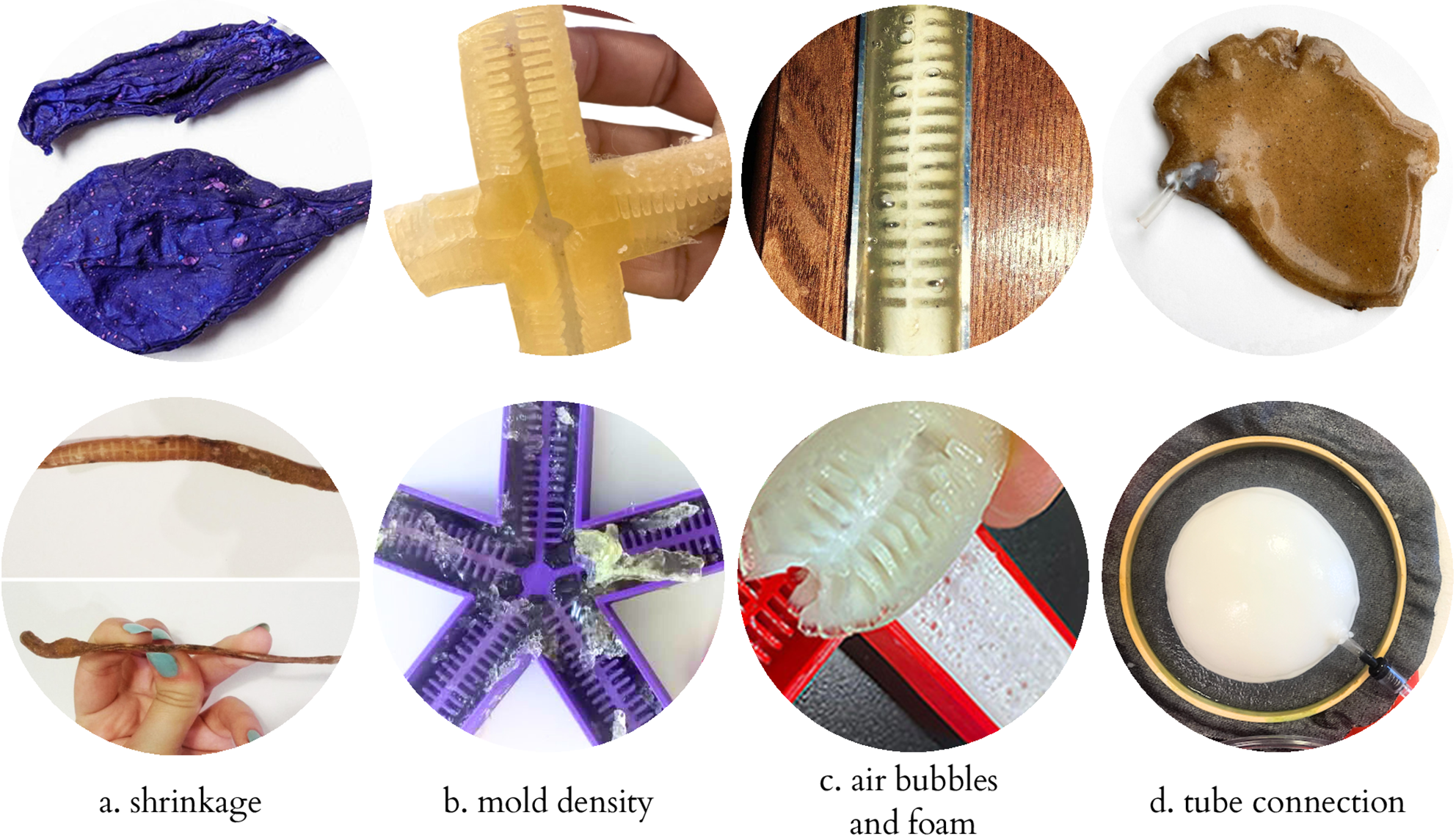
The majority of the coded entries (67%, n = 14 of 21) reference the work of other participants, most often citing the final projects presented in this paper as case studies. Participants consult recipes and step-by-step fabrication processes, and after 2024 the majority explicitly refer to the video tutorial produced in one of the final projects. This suggests that peer-produced visual and procedural documentation functions as a medium for knowledge transfer, while also producing selective and filtered representations of practice. The archive thus takes on the role of a troubleshooting forum. Figure 2 below shows selected documented challenges.
Challenges of biobotics fabrication from Fabricademy’s participant archive (2019–2026).

Figure 2. Long description
An image showing eight examples of biobotics prototype failures.The images show shrinkage, mold density demolding failures, air bubbles and foam recipe issues and tube connection failures.
Final projects: applications and referencing practices
Across entries, the fabrication of pneumatic biobotics emerges as an exploratory trial-and-error practice, shaped by continuous negotiation with matter. While several steps of silicone-based soft robotics are similar, the tacit knowledge and nature of the material design lead to different workflow needs, which in turn create a situated material practice dominated by embodied troubleshooting.
These recurring observations in the fabrication of biobotics can be understood as design parameters that inform the design process, rather than treated as failures. Even after fabrication, materials continue to evolve through drying and deformation, signaling a different temporality from silicone-based soft robotics, where material properties are comparatively stable and predefined. In this sense, in biobotics, the material conditions not only the actuator’s lifespan, but also its fabrication process and modes of use.
This section analyzes two case studies in which participants developed biobotic systems iteratively during the personal project phase of the program over a period of approximately two months. While the one-week soft robotics module enables the exploration and testing of the technique, the final projects support sustained experimentation, troubleshooting, refinement of fabrication strategies and the development of applications. These longer-term projects provide deeper insight into how participants negotiate the temporal and material constraints of biobotic fabrication and complement the broader corpus analysis which captures patterns across all documented projects.
The two selected projects demonstrate applications of biobotics within creative contexts, including costume performance and interactive installation, while also illustrating how fabrication knowledge is iteratively refined through open documentation. In the first case, the participant documents seven iterations before reaching a functional outcome. The second project explicitly builds upon this work, extending the technique through cross-cohort referencing and adaptation. Together, these cases provide insight into how the archive supports the iterative development and circulation of biobotic fabrication practices over time, while also showing how biodesign approaches reshape temporal and material relations in soft robotics.
Dar A Luz – Gabriela Lotaif-2020–2021
“Dar A Luz” as shown in Figure 3, is a wearable biobotic costume for dance performance that acts as a second skin swelling and contracting with the performer’s movement and body temperature narrating body-organs relationships associated with gestation and body fluids. The project was developed combining digital pattern making, bio-based composite of alginate and hemp fibers and alginate-based biobotic. The participant conducted experimentation with biopolymers to obtain certain elasticity, natural dyes to achieve different skin pigmentations and a set of fabrication techniques for biobotics. Her extensive documentation includes material recipes, step-by-step processes and iterative fabrication techniques.
Dar A Luz by Gabriela Lotaif, Fabricademy in Barcelona, FabTextiles, IaaC, Fab Lab Barcelona, 2020–2021. An image showing the final project of Gabriela Lotaif, a woman performer wearing the alginate based biobotic dress.

Figure 3. Long description
An image showing the final project of Gabriela Lotaif, a woman performer wearing the alginate based biobotic dress
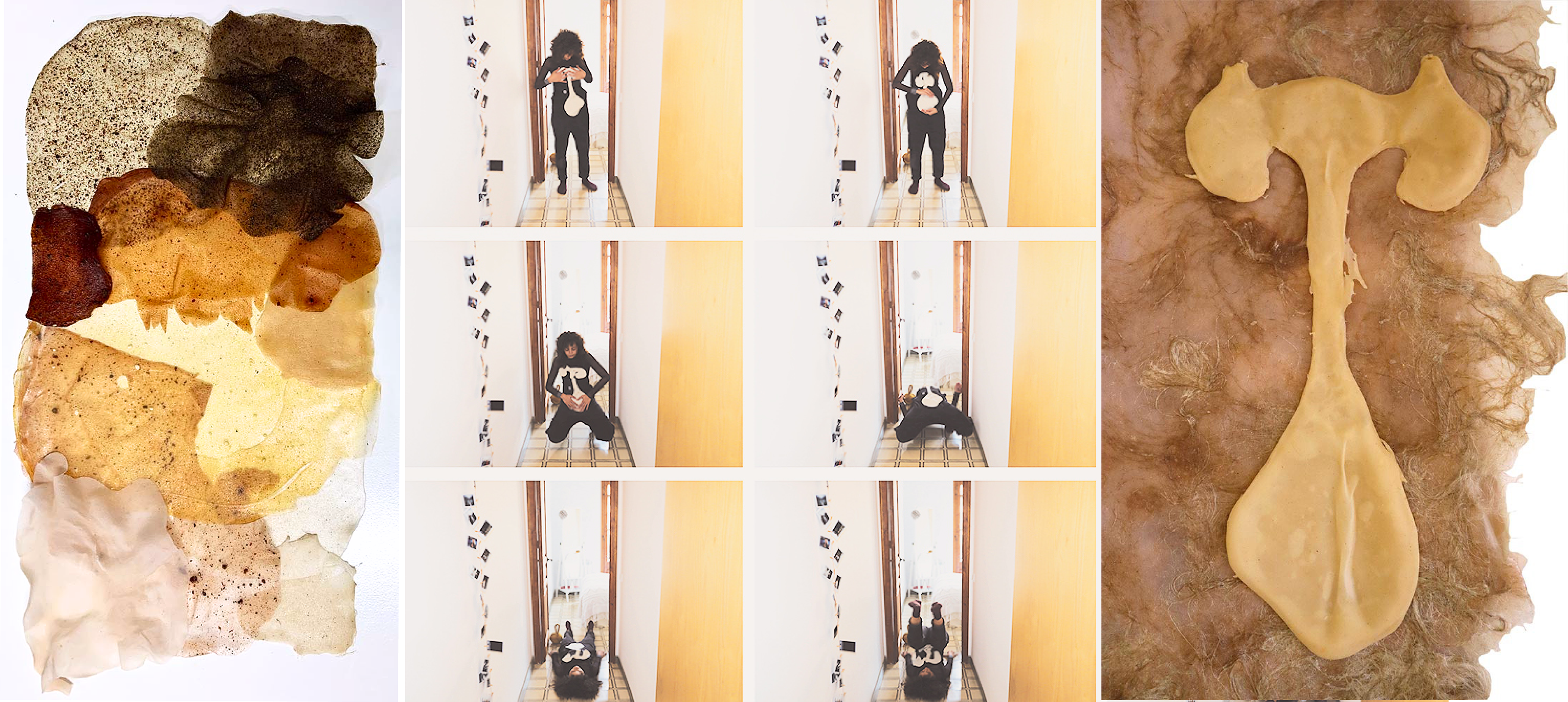
The project’s documentation includes the concept, inspiration, references and detailed technical development of the costume components as shown in Figure 4. The biobotic element, referred to as bioflaskin, is first explored through recipe testing with different biopolymers. After selecting alginate and the desired elasticity, the research focuses on developing a skin-like color palette using natural dyes and food-waste additives. She later documents six iterative fabrication experiments, comparing alternative techniques for the biobotic elements, each recorded through recipes, step-by-step instructions, photos and videos. She concludes with a set of self- and local-instructor-defined fabrication rules regarding mold materials, shrinkage and drying, reflects on the material aesthetics and conducts research for its body placement.
Dar a Luz by Gabriela Lotaif. Fabricademy Barcelona, FabTextiles, IaaC, Fab Lab Barcelona, 2020–2021. Project development. Image left: Skin pigmentation studies. Center: Embodied movement experimentation Right: Pattern making.

Figure 4. Long description
A composition of three images. On the left an image showing different alginate based bioleathers in different skin colors, part of the skin pigmentation research. In the middle a series of snapshots of a performer in a corridor dancing with the biobotics as part of the pattern finding exploration. On the right, the alginate based biobotic showing the pattern over the alginate-hemp biocomposite that form the rest of the fabric of the pattern.
The participant developed a single-cast fabrication approach for biobotic inflatables in which the cast polymer is first crosslinked with CaCl2, then pierced and emptied, and finally crosslinked from the inside by injecting CaCl2. This process eliminates the need for sealing or bonding the edges, reducing leakage failures. She created a complex outline shape mold using papertape and obtained a single air chamber without internal channels. The participant also explored hollow alginate tubes as both functional connectors for the biobotic system and representations of human veins. This line of experimentation, referred to as Veinginate in the open archive, produced an alginate-based tube, but was not further developed due to COVID-19–related constraints. As the projects’ focus has been the costume and performance design, less attention was given to the development of controlled actuation and tube-connection solutions.
“Rehumanizing sensing” – Hala Amer, 2023-24
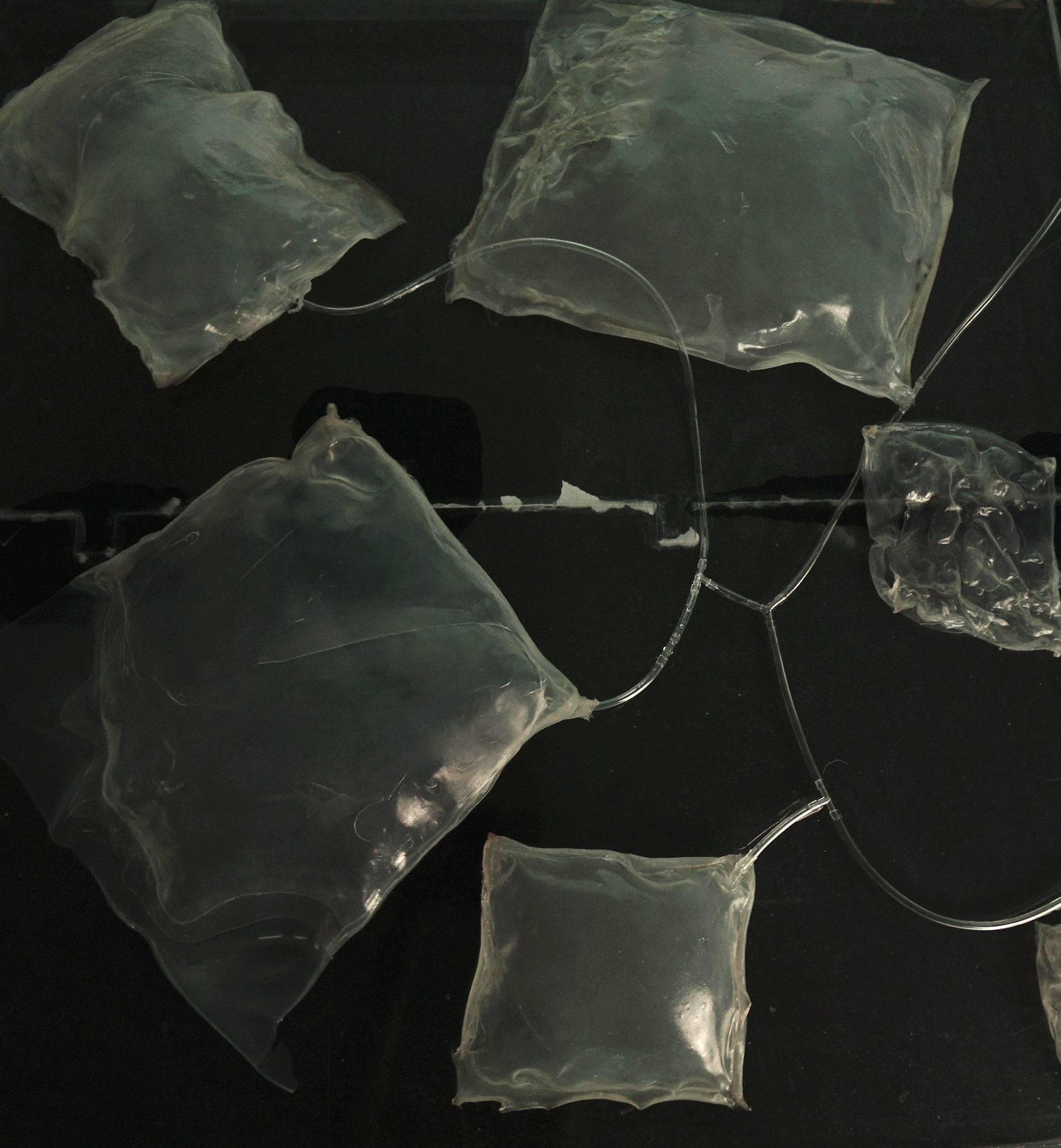
“Rehumanizing sensing” as shown in Figure 5, is an interactive installation that combines a pre-trained AI model with bio-bots, using the visitors as the trigger for actuation. Facial expressions captured from visitors are translated by the AI model into bioinflatable movements. The objective of the installation is to act as a portal between different communities and to celebrate the similarities and differences and re-empathize with each other’s humanity. It also looks into biases in emotion recognition research and AI training, situating the project within broader discussions of decolonizing design.
“Rehumanizing sensing” by Hala Amer. Fabricademy in Barcelona, FabTextiles, IaaC, Fab Lab Barcelona, 2023–2024.

Figure 5. Long description
A dark image, with black background and the translucent biobotic pouches.
The biobotic actuators developed in “Rehumanizing sensing” build iteratively on the open documentation of “Dar A Luz,” reusing its material recipes and single-cast fabrication approach. The participant documents: “Working with this Gabriela’s technique I found an updated alternate method that helped create stronger bonds in the outer layers, thicker outer layers, and less leaks. The technique included updating the whole process from prepping the alginate to drying and inflating it.”
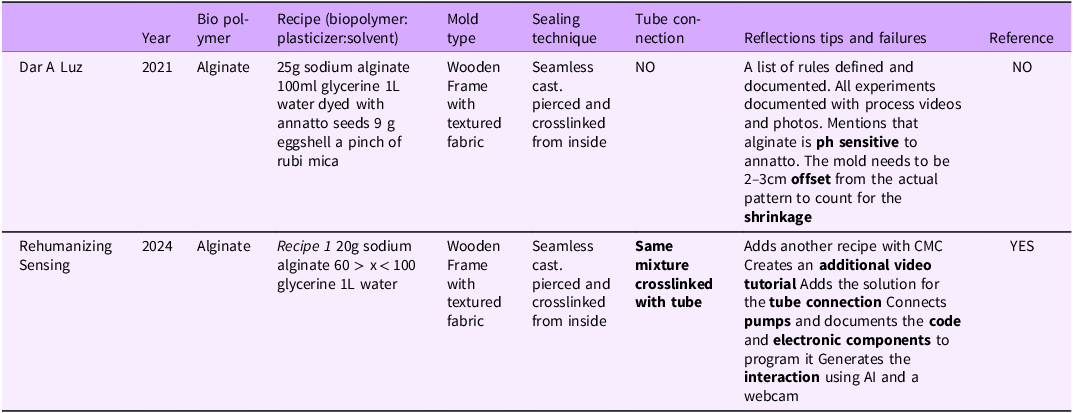
The project advances previous work by contributing with a step-by-step video tutorial, a documented solution for sealing silicone tubing using aquarium accessories, the integration of the air-pump actuation and accompanying schematics, code and demonstrations of the interaction. In addition, it introduces an alternative material recipe based on carboxymethyl cellulose (CMC). The differences between the two projects is summarized below, in Table 3.
Iterative development between Dar A Luz Project 2021 and Rehumanizing Sensing 2024

Table 3. Long description
A table using the same fields as table 2, showing how one participant referenced and further iterates the biobotic research and each contirbutions
Discussion
This study reveals the potential of biodesign adoption within the emerging field of soft robotics opening pathways to respond to Giordano´s concerns (Giordano et al. Reference Giordano, Murali Babu and Mazzolai2023) and new perspectives to robotics. It does it through a longitudinal analysis of a corpus of documented introductory explorations and two in depth case studies of sustained development and cross-referencing. Here, biodesign refers to the use of bio-based materials such as alginate, gelatin and cellulose within fabrication processes and material-driven design practices, yet actuated to exhibit life-like behaviors including transformation, degradation, responsiveness and temporality. The study therefore positions bio-based soft actuators as part of a broader biodesign discourse that investigates how biological materials and processes reshape design, fabrication and interaction. Although distinct from living systems, these approaches share methodological concerns regarding variability, growth, environmental responsiveness and situated material practice. Based on the opportunities and tensions revealed in the analysis, the discussion is organized around three themes: (1) accessibility of bio-based actuators in design education, (2) reframing soft robotics through biodesign, (3) living archives as distributed knowledge infrastructures.
Accessibility of bio-based actuators in design education
The archive reveals that the adoption and advancement of biobotics is not solely driven by their novelty or positioning as an emerging research domain. Instead, their uptake is associated with different forms of accessibility, including the availability of material resources, fabrication infrastructure and alternative ways of understanding and engaging with robotics.
Biopolymers are more accessible, inexpensive and abundant, as they can often be foraged or derived from waste resources (Baumgartner et al. Reference Baumgartner, Hartmann, Drack, Preninger, Wirthl, Gerstmayr, Lehner, Mao, Pruckner, Demchyshyn, Reiter, Strobel, Stockinger, Schiller, Kimeswenger, Greibich, Buchberger, Bradt, Hild, Bauer and Kaltenbrunner2020; Hartmann et al. Reference Hartmann, Baumgartner, Kaltenbrunner, Hartmann, Baumgartner and Kaltenbrunner2020) suggesting a form of environmental leapfrogging in which practitioners adopt locally sourced materials instead of relying on more resource-intensive imported supplies, such as petrochemical elastomers. Across Fabricademy nodes, laboratories in Suriname, Kenya and Rwanda engaged with biobotics because these ingredients were locally available and affordable, positioning them as practical and sustainable alternatives rather than experimental novelties (Perkins Reference Perkins2003; Wood et al. Reference Wood, Redfern and Verran2022).
Moreover, the fabrication processes can be carried out using kitchen-scale tools and domestic equipment rather than specialized industrial machinery. These cases demonstrate that bio-based soft robotics can enable experimentation in under-resourced laboratories or home-based settings, increasing infrastructural accessibility and resonating with discussions of accessible, distributed forms of production in personal fabrication. (Diniz Reference Diniz2023; Ihls and Pollini Reference Ihls and Pollini2025; Kohtala and Sampsa Reference Kohtala and Sampsa2015).
Finally, for several learners, soft robotics initially appeared overly technological, mechanically oriented and disconnected from their existing practices or sustainability values. Introducing bio-based approaches to soft robotics shifted the epistemic perspective of the field toward material tinkering and ecological interaction, broadening participation by creating entry points for learners with backgrounds in textiles, craft, design and environmental practices.
Therefore, integrating bio-based, material-driven approaches into soft robotics not only supports accessible and low-cost tools and materials, but most notably encourages learners to approach robotics through a biodesign lens shaping who can participate in robotics and which forms of knowledge are recognized within the field (Ackermann Reference Ackermann2001; Buechley and Eisenberg Reference Buechley and Eisenberg2008). The following section expands on this shift, on the role of biodesign approaches in reframing robotics within design education.
Reframing soft robotics through biodesign (“biobotics”)
Biobotics, as presented in this study, belong within the broader field of bio-based shape-changing interfaces, demonstrating that the combination of material formulations, geometry and mechanical actuation can create responsiveness, deformation and movement. Although this study focuses on systems designed with products of biology (Borst et al. Reference Borst, Congdon, Lee and Parker2020) within a growing design approach (Camere and Karana Reference Camere and Karana2018), using living organisms as part of the design process (Keune Reference Keune2021), the resulting systems behave as if they were metabolically responsive. From this perspective, biobotics can be situated as transitional entities: neither living nor strictly inert.
This signals an epistemic and cultural shift in how robotics are perceived. While soft robotics already challenges dominant imaginaries of robots as durable, rigid and machine-like engineering paradigms through biomimetic principles and compliant materials, the integration of biodesign extends this challenge by introducing material agency, material-driven form generation, lifecycle thinking and practices of care into robotic systems. Biodesign then becomes an active contributor to robotic behavior, where form emerges through the constraints and affordances of matter, systems are conceived across phases of growth, use and decay and engagement is reconfigured as ongoing maintenance and care rather than functional performance. This supports the integration of biomaterials and interactive technologies through the coupling of computational geometry and material properties to encode behavior, pointing toward broader possibilities for developing transient and environmentally responsive systems within biodesign and robotics.
These material practices also shape how robotic systems are perceived by foregrounding “material agency” (Ingold Reference Ingold2013) and inviting experiential characterization through sensorial, interpretative, affective and performative dimensions (Camera and Karana Reference Camera and Karana2018). In the case study Dar a Luz, the biobotic can be interpreted as a human organ through its feminine, natural and fragile aspect. Its sensorial softness and translucence, combined with an affective sense of ambiguity, provoke a dual interpretation: on one side, pointing toward emerging developments in biohybrid soft robotics employing living muscle tissues and on the other, echoing ancient practices in which animal bladders served as waterskins, musical instruments and children’s toys, as portrayed in Joseph Wright of Derby’s “Two Boys with a Bladder,“(Wright of Derby 1767). Similarly, in the case study of Rehumanizing Sensing, at an affective level, it evokes breathing, pulsing or swelling, creating a tension between attraction and repulsion that shapes user interaction. These experiential affordances open a temporal and cultural bridge between contemporary technologies and alchemical cosmologies, where the boundaries between the artificial and the living are fluid and biotechnology is part of the vernacular (Hénaff Reference Hénaff2023; Lauri Reference Lauri2021; Santanera Reference Santanera2020).
From an educational perspective, biodesign challenges current practices in soft robotics by dissolving disciplinary boundaries between engineering, material science, biology and design, and their implications for education provide a fertile ground for further exploration. This interdisciplinary convergence reflects the principles of the Medici Effect, where innovation emerges at intersections of diverse fields and modes of thinking (Lee et al. Reference Lee, Cortes, Di Benedetto, Herrmann, Hughes, Kim, Park and Lan2024). It expands existing approaches to robotics pedagogy by positioning material tinkering and biodesign practices as legitimate ways of engaging with robotics, allowing emergent behaviors and applications to emerge directly through material design. Following material tinkering methods, learners engage in iterative experimentation, observation, adaptation and failure as integral parts of an open-ended learning process, developing transversal competencies aligned with the GreenComp framework, including critical thinking, adaptability and problem-solving (Bianchi et al. Reference Bianchi, Pisiotis and Giraldez2022). This suggests a shift from designing interactive systems toward designing for systems variability, temporal change and environmental dependency.
Living archives as distributed knowledge infrastructures
Open documentation and community-shared resources play a central role in establishing common workflows, vocabularies and entry points for newcomers in distributed and hybrid learning contexts. They enable lifelong and peer-to-peer learning while fostering iterative development, the circulation of emerging practices and worldwide collaboration across distributed communities of practice (Wenger Reference Wenger1998), while reflecting broader notions of commons-based peer production (Benkler Reference Benkler2006).
Recent literature frames living archives as participatory and evolving infrastructures for knowledge transmission rather than static repositories (Hostert et al. Reference Hostert, Gordon, McDermott, Murteza and Kim2025; Willcocks Reference Willcocks2021). In this context, the Fabricademy archive can be understood as a socio-technical infrastructure where documentation, learning and community maintenance become entangled forms of care (Toombs et al. Reference Toombs, Bardzell and Bardzell2015). This resonates with maker education research that frames documentation as a means of making learning visible and supporting peer learning in project-based environments (Gauntlett Reference Gauntlett2018; Mino Reference Mino2014). In this sense, the archive mediates between local, practice-based knowledge and a broader distributed community, by partially externalizing tacit, situated and embodied forms of knowledge (Lave and Wenger Reference Lave and Wenger1991; Polanyi Reference Polanyi1966; Sinha et al. Reference Sinha, Date and Chandrasekharan2021; Vaughan Reference Vaughan2017).
However, high variability in documentation quality, partial implementation and recurring technical challenges limit improvement, resulting in repeated experimentation rather than progression. Documentation often takes the form of lab notes and does not achieve to externalize the detail needed for learners to anticipate and mitigate failures. This reflects a broader difficulty within practice-based learning in codifying experiential and embodied knowledge into transferable instructions (Bofylatos and Boukouvala Reference Bofylatos and Boukouvala2023; Schon Reference Schon1983). As a result, experimentation often needs to be mediated by local instructors who carry tacit knowledge and by continuously updating the program’s educational materials.
These gaps point to the need for shared templates that move beyond a set or instructions or a material recipe, toward multimodal forms of documentation that connect recipes, mold geometries, sealing methods and testing protocols with video tutorials, illustrations, images and lab notes. Similar approaches have been developed through toolkits or documentation frameworks, yet this study reveals that the visual documentation found in final projects – such as videos, tutorials, photographs and diagrams – functions as boundary objects that externalize aspects of tacit and embodied fabrication knowledge (Bowker and Star Reference Bowker and Star1999; Vaughan et al. Reference Vaughan, Stanton, Iwan, Yuille, Mullett, Carlin, Thom and Miles2013).
Across biodesign, diverse frameworks for documenting experiments offer complementary perspectives: from experiential characterization methods that shift biomaterial documentation away from purely technical parameters toward sensorial, interpretive, affective and performative dimensions (Camera and Karana Reference Camera and Karana2018), to teaching resources and pedagogical frameworks that guide how biomaterial experiments are recorded for educational contexts (Bogers and Edens Reference Bogers and Edens2021; Ward Reference Ward2024). Glossaries, card sets, grammars and journaling approaches further support common vocabularies and more comparable reporting practices. At the same time, according to (Parisi et al. Reference Parisi, Rognoli and Sonneveld2017), material tinkering operates as an exploratory rather than instructional activity, where knowledge emerges through situated experimentation rather than through linear instructional processes alone.
These findings resonate with calls within biodesign and soft robotics communities to support knowledge-sharing through shared infrastructures, tools, methods and material knowledge. They can be read through Blevis’ principle of decoupling ownership and identity in Sustainable Interaction Design, which advocates the sharing and circulation of resources for maximal use (Blevis Reference Blevis2007). Although documentation alone cannot replace situated guidance, it can be enriched, curated and collectively mediated so that living archives become scaffolds for teachable, reproducible and extensible resources that support ongoing reflection and participation across distributed communities of practice (Kelty Reference Kelty2008; Schon Reference Schon1983).
Limitations
This study has several limitations. Although Fabricademy operates across distributed laboratories, the dataset remains relatively small and reflects the practices of a specific educational program rather than the broader landscape of bio-based actuators in design and HCI. The analysis relies on participant-generated documentation, which varies in quality and completeness, meaning that some learning processes or technical decisions may not be fully captured.
The final projects focus on short-term projects, and the long-term durability, deformation or ageing behavior of the biobotics were not examined. Adoption patterns were analyzed through qualitative observation rather than controlled experimentation, so outcomes may also be influenced by teaching approaches, local laboratory conditions and participant backgrounds. In addition, this work focuses on pneumatic bio-based actuators, and the findings may not directly transfer to other actuation systems.
Conclusion
This paper presents a longitudinal analysis of Fabricademy participants’ open documentation between 2019 and 2026, focusing on projects in which bio-based actuators (biobotics) were prototyped in a distributed, lab-driven educational context. The study examines how sustainable materials, material-driven design and soft robotics intersect in both final projects and the one-week soft-robotics module, in order to understand how biobotic fabrication techniques are adopted, adapted and documented over time. Findings indicate that final projects showcase applications in Bio-HCI contexts and function as shared templates for future cohorts, positioning the archive as an informal yet dynamic means of updating the curriculum and a living archive for collective knowledge transfer. At the same time, the coded dataset from weekly experiments reveals heterogeneous experimentation practices and inconsistent documentation quality, limiting reproducibility and iterative refinement over cohorts. Drawing on the extracted recipes, mold types, fabrication techniques and reported challenges, the paper presents the variables and fabrication insights for biobotics and discusses the role of biodesign in shifting soft robotics design education. More broadly, the study points to the role of open documentation as a boundary object within material-driven pedagogies, extending tacit and embodied knowledge through diverse formats to enhance accessibility and support distributed learning environments.
Supplementary material
The supplementary material for this article can be found at https://doi.org/10.1017/S2977905726100924.
Data availability statement
The data that support the findings of this study are openly available in the Fabricademy Class Archive at https://class.textile-academy.org/ under Fabricademy’s licence: Attribution-NonCommercial-ShareAlike 4.0 International. The python script developed is publicly available https://framagit.org/GDurrens/find-fabacademy-textiles-projects.
Acknowledgements
The author would like to thank her supervisor Isabel Ordoñez Pizarro and co-supervisor Oscar Tomico for their support. The author also thanks the Fabricademy community for their creativity, collaborative spirit and continued contributions to open innovation through shared documentation and experimentation.
Author contributions
Pistofidou, A.: Conceptualization (lead), Methodology (lead), Validation (lead), Formal analysis (lead), Investigation (lead), Resources (lead), Data curation (lead), Writing – original draft (lead), Writing – review & editing (lead), Visualization (lead), Project administration (lead). Tomico, O.: Writing – review & editing (supporting).
Financial support
This research received no specific grant from any funding agency in the public, commercial or not-for-profit sectors. The author is currently conducting her PhD at Programme in Educational Innovation and Intervention jointly offered by the University of Vic – Central University of Catalonia and Mondragon University at Elisava, Barcelona School of Design Engineering.
Competing interests
None.
AI disclosure
AI-based tools (ChatGPT) were used only to support language editing and clarity; no AI was involved in the conceptualization, analysis or development of the research.
Ethical standards
This study uses publicly available archival documentation from the Fabricademy Class Archive and does not involve direct interaction with human participants, sensitive personal data or animal experiments. Under the applicable ethical guidelines, this type of secondary analysis does not require formal ethics committee review and complies with COPE standards.




 Open access

