The British Journal of Political Science is an independent journal, whose policy is set by its editorial board. It is committed to no methodological orthodoxy over and above the normal canons of scholarship: clear and consistent use of words, logical and mathematical validity, and the use of appropriate evidence to substantiate empirical statements. Contributions are invited in all fields of political science and political theory, except the history of political thought. Innovative and authoritative work addressed to problems of general significance to students of politics will be published whatever the period(s) or place(s) drawn upon for evidence.
BJPolS Editorial Policy
This elegant statement, which proclaims a mission as well as a policy, appeared on the inside cover of the first issue of the British Journal of Political Science in January 1971. It has remained there unchanged ever since, except for the addition of a single sentence beginning in 2006. (The new sentence is also significant, and I will say more about it below.) In the first of four essays commemorating the fortieth anniversary of the journal, Robert Goodin highlights the characteristic announced by the Policy’s third sentence – the BJPolS is a generalist journal that invites contributions ‘in all fields of political science and political theory’ (with one explicit and important exception, the history of political thought).Footnote 1 I will draw my text from the first sentence: ‘The British Journal of Political Science is an independent journal, whose policy is set by its editorial board’ [emphasis added].Footnote 2
The two qualities of being generalist and independent are most remarkable in their combination. Of all the generalist journals with which it competes for prestige in either the United States or Britain, the BJPolS is the only one that is independent. Each of the others is the creature of a professional society – the American Political Science Review of the American Political Science Association (APSA); Political Studies of APSA’s British counterpart, the Political Studies Association (PSA); the American Journal of Political Science of the Midwest Political Science Association, which is the largest American regional group; and the Journal of Politics of the Southern Political Science Association, another large American regional group.Footnote 3
Sponsorship by a large association is a tremendous advantage. Apart from financial subsidies, official journals usually enjoy the benefit of individual subscriptions tied to dues, with resulting circulation to all members of the society. Believing that articles in an official journal will therefore be widely noticed, authors are more likely to offer it their best work. If the editors exercise reasonably good judgement, the official journal will soon earn a reputation for quality. Readers become even more likely to attend to its contents, and authors become ever more desirous of gaining the status and emoluments that come from publishing in a ‘top-rated’ outlet. The journal is thus sustained by a virtuous cycle, limited only by the number of articles it can accommodate and authors’ discouragement at the high rate of rejection – which itself drives the journal’s prestige still higher.
For the BJPolS to have attained the status of a peer against privileged competitors stands as a remarkable accomplishment. How can this success be explained, and how can it be maintained? I suggest that, like skilled practitioners of judo, editors of the BJPolS have found ways to turn the sponsored journals’ strength into a weakness. They have exploited the discretion conferred by independence to adopt policies and practices that official journals could not or would not employ, or to which they turned only late in the game, after the BJPolS had already secured its position by blazing the trail.
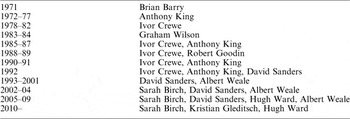
The first strength that the BJPolS derives from its independence is the remarkable continuity and unity of its editors. Four patterns are evident in its history – the constant location of editors at one university, long periods of service, gradual transitions during which new editors work with experienced predecessors, and reliance (from 1985 onwards) on a team, rather than a single chief. Although the BJPolS is not a publication of the University of Essex and its editorial board has always included members from many other universities, its editors have always been members of the Government Department at Essex. Except for Brian Barry, Graham Wilson and Robert Goodin, who relinquished their editorships after brief terms upon leaving Essex, editors have served for long, usually overlapping terms (see Table 1). For eighteen of the first twenty-one years, either Anthony King or Ivor Crewe, or sometimes both, led the journal. After a transitional year in 1992, when David Sanders joined Crewe and King, Sanders and Albert Weale were editors for seventeen years, through 2009. The next transition to a new team began in 2002, when Sarah Birch joined Sanders and Weale, followed by Hugh Ward in 2005 and Kristian Gleditsch in 2010, the year after Sanders and Weale stepped down.
Editors of the British Journal of Political ScienceFootnote *

* Years are for publication dates.
In contrast, editors of association-based journals usually serve for fixed, limited terms (five years at the APSR, three years at the AJPS). Whether mandatory turnover serves to share burdens or glory, it results in regular moves to new institutional homes. Often, the change of editors at official journals is accompanied by an editorial statement signalling a change in policy. In a sharp distinction, the BJPolS has never published an editor’s statement.
Continuity and unity at the BJPolS have also been promoted by the editorial board. Whereas the boards of official journals are often chosen to represent varied constituencies among the membership, the board of the BJPolS is self-perpetuating, choosing new members by co-option. Although only a few members at any time are members of the Department of Government at the University of Essex, many others are part of a widespread Essex network of former members of the department, past visitors and scholarly collaborators.
Anchoring a journal at one university could easily invite parochialism and stagnation. Fortunately, the BJPolS has benefited from, as well as greatly contributed to, the intellectual vitality of the Essex Department of Government, which has earned an eminent place among politics departments in Britain and Europe. In that setting, continuity and unity have meant coherence and consistency of editorial policy at a high level of excellence.
As political scientists are inclined to do, I have been pointing to structural factors that help account for the success of the BJPolS. The value of these conditions consisted only in providing scope and support for the initiative, energy and discernment of exceptionally able editors. Their good judgement has been demonstrated not just in decisions about individual articles, but also and more fundamentally in strategic choices that have enabled the BJPolS to thrive while competing in two environments simultaneously – at home in Britain versus Political Studies, and in the global political science community, which over the past forty years mainly meant taking on the top American journals. In both contests, the independence of the BJPolS gave latitude for the acumen of its editors; but in Britain, they also benefited from old-fashioned fortuna in the form of three strategic errors on the part of the official journal.
Outflanking political studies
As its title signals, the founders of Political Studies chose not to identify the journal with the scientific study of politics. Indeed, in his note introducing the inaugural issue in 1953, the first editor, Wilfred Harrison, put scare quotes around ‘political scientists’ in his one and only reference to them – which was to ask for contributions by more than just that suspect breed.Footnote 4 During its first two decades and longer, the pages of Political Studies were dominated by traditionalist articles on political theory. By excluding the history of political thought in their own Editorial Policy, the leaders of the BJPolS ceded that area of strength to the official journal while staking out a claim to the territory Political Studies had left vacant on the modernizing side of the discipline.
Just five years after the launch of the BJPolS, in a rebellion led by Brian Barry and other members of the new journal’s Editorial Board, the PSA Executive forced out the last of the traditionalist editors of Political Studies, F. F. Ridley, and installed in his place L. J. Sharpe.Footnote 5 Sharpe promptly announced the restoration of an editorial board, decreed that all articles would be evaluated by two ‘assessors’, and required abstracts. He called for less political theory, more applications of fundamental concepts to contemporary phenomena, and a shift to original empirical research.Footnote 6
With the triumph of modernizers at Political Studies, the BJPolS might easily have been eclipsed, rather like a protest party that withers away after a major party adopts its key policies. Among British political scientists, the PSA’s journal soon achieved near-parity with the BJPolS, but surprisingly did not consistently surpass it. A review of contents from the late 1970s onwards shows the same cast of prominent scholars in Britain writing for both outlets. It would be hard to claim that either enjoyed a quality advantage among those contributors, judging by the articles in each with which I am familiar. Surveys of British political scientists show the two journals receiving similar ratings. In 1993, a study by Norris and Crewe found Political Studies rated just above the BJPolS; in 2009, the survey by McLean et al. reported the rankings reversed, but again the two were not far apart.Footnote 7
How did the BJPolS avoid succumbing to the organizational advantages of Political Studies once the latter gave up being stodgy? Part of the answer no doubt lies in the ability of BJPolS editors to exploit their independence in ways that I will describe below. But a big part of the explanation, I would suggest, is that the BJPolS has been buoyed by its superior standing among political scientists in the United States, which is still the centre of gravity for the profession worldwide. Although the two publications compete on near-level terms in Britain, across the Atlantic, there is no comparison. Reputational surveys of American political scientists consistently find the BJPolS rated far above Political Studies. For example, in the McLean et al. study, the BJPolS is ranked fourth among ninety-two journals (behind only the APSR, AJPS and Journal of Politics); Political Studies is ranked forty-ninth.Footnote 8 What accounts for the vastly higher standing of the BJPolS in the United States? The answer, I suggest, lies in two seemingly contradictory facts.
First, the founders of Political Studies, echoing the name of the sponsoring PSA, chose not to appropriate the word ‘British’ for their journal’s title, leaving it to be claimed by the Essex-based upstart – over the strenuous objections of PSA leaders.Footnote 9 Members of the BJPolS Editorial Board sometimes worry that the journal’s name is a drawback. That may be true in one respect, to the extent that potential contributors and readers mistakenly infer that it deals exclusively or primarily with politics in Britain. On the whole, however, the name confers a huge advantage in the United States. Most American political scientists who have not been directly involved with the British Journal of Political Science assume that it is the official publication of the British counterpart of the APSA. They therefore believe it must be the flagship journal of political science in Britain, just as the APSR is recognized as the flagship journal in the United States. This misconception confers instant prestige, given Britain’s heritage of intellectual leadership and its contemporary position as the home of the second largest community of political scientists in the English-speaking world.
Of course, a positive image based only on a mistaken impression would not have lasted, but there was a second factor contributing to the journal’s transatlantic standing. From the beginning, the editors of the BJPolS sought to broaden the base and enhance the quality of their journal by reaching out to leading political scientists in the United States. The six members of the original Editorial Board included two Americans, Fred Greenstein and Donald Stokes. That proportion has been maintained – the Board today consists of twenty-one members based in Britain, thirteen in the United States and six in other countries. BJPolS editors have always been receptive to articles by American authors; indeed, they have often reached out proactively to encourage Americans to submit papers to the journal. Contributors to the first two volumes included Douglas Rae, John C. Wahlke, Kenneth Prewitt, Norman Nie, Hugh Heclo, Theodore Marmor and Nelson Polsby. Throughout its forty-year history, the BJPolS has regularly published articles by established and emerging American scholars.
In contrast, despite having abjured the word ‘British’ in their title, editors of Political Studies proceeded to act for decades as if the journal were of, by and for British scholars almost exclusively. For thirty-five years, there were no Americans on the Editorial Board. Finally, in 1988, incoming editor Jack Hayward called for a deliberate attempt to involve ‘foreign academics’ as authors and as members of the board.Footnote 10 Shortly afterwards, Samuel Patterson (then the editor of the APSR) joined the board; seven years later, Suzanne Berger was added.Footnote 11 Not until the turn of the century did Political Studies move vigorously to broaden its appeal. In 2000, with Patrick Dunleavy as editor, the board was re-styled the ‘International Advisory Board’ and structured by regions, with seven members based in North America.Footnote 12 At that time, Political Studies also adopted the in-text style of referencing and permitted either British or American spelling (thus, the BJPolS is currently the traditionalist in matters of style, if not substance). After 2006, the Board was no longer explicitly regionalized, but the new editors, Matthew Festenstein and Martin Smith, stated a desire to publish more articles on Africa, Asia and the Americas.Footnote 13 From 2008 onwards, the policy seems to have had an impact, with an increasing number of contributors from the United States. In its fifty-five years until then, however, the PSA’s journal seldom published articles by Americans, and the few that did appear were mostly about politics in Britain. The recent change may ultimately succeed in raising the visibility and standing of Political Studies in the United States, but if so, its editors will have to overcome not only the weaknesses of the title, but also climb out from the hole dug during a half-century of exclusionism.
Capitalizing on independence
That editors of Political Studies would for such a long period prefer British authors is hardly surprising. They are accountable to an association comprised almost entirely of British academics, whose individual careers depend on having articles accepted in reputable journals. That constituency naturally would begrudge giving up scarce space in their own publication to Americans who have plenty of outlets in the United States. Yet the resulting de facto discrimination was collectively damaging, as Political Studies failed to attain visibility and prestige in North America commensurate with its standing in Britain. In contrast, editors of the BJPolS took advantage of their independence from membership pressures to reach out across the Atlantic, with striking success.
The freedom to avoid becoming an outlet for a membership constituency is but one example of how leaders of the BJPolS have turned independence into a source of strength. Autonomy enabled them to make other choices that have helped the BJPolS compete not only against Political Studies but also in its underdog battle with the leading generalist journals sponsored by professional associations in the United States. All of the official journals are subject to unrelenting distributive pressures from members and their representatives – to give more authors the ability to publish more articles representing more subfields and special-interest groups. These pressures result in characteristic responses that BJPolS editors have had greater ability not only to avoid but also to turn to the journal’s advantage by staking out areas of distinctive competence through receptivity to certain contributions that are less feasible for official journals.
Modernizing ‘Theory’
One of the odder features of our discipline – in contrast to economics, psychology or the natural sciences – is the identification of ‘theory’ with thinkers and ideas that are variously pre-scientific, non-scientific or anti-scientific – closer kin to the humanities than to the social sciences. Most politics departments include faculty members who produce writings on ‘theory’ so defined – historical or textual analyses of the great political philosophers; arguments that are primarily normative or even ideological; and studies focused on (and often heavily laden with advocacy for) historically oppressed or under-represented groups. As we saw with the ‘Perestroika’ movement in the United States, official publications perceived as not fairly representing these (and other) interests can come under sustained attack. Even before that rebellion (and the resulting launch of Perspectives on Politics), the American Political Science Review reserved space in most issues for an article or two on traditional political theory. In 2003–08, even the hard-nosed AJPS followed suit, with one or more articles on the history of political thought appearing in most issues. At the more ideological end of the theory spectrum, the editors of Political Studies in 2006 appealed for more contributions on feminism and radical political theory.Footnote 14
Far from reflecting a lack of concern with normative questions, the decision by founders of the BJPolS to exclude articles on ‘the history of political thought’ freed the Journal to develop a distinctive competence in ‘theory’ of a different kind – contemporary, analytical, closely intertwined with empirical research and focused on central issues in democratic theory and practice. The Journal’s interest in such ideas has been signalled and promoted by editors whose own work exemplifies this type of scholarship – Brian Barry, Robert Goodin, Albert Weale and Hugh Ward. Also contributing to the reputation of the BJPolS as a receptive outlet for contributions in this vein has been a series of notable review articles on topics and authors in political economy and positive political theory.Footnote 15
Accepting Longer Articles
Membership pressure to maximize the number of articles accepted naturally leads editors of official journals to insist upon strict page limits. For many years, APSR policy restricted manuscripts to just thirty double-spaced pages. Although no one advocates publishing prolix papers, rigid upper bounds on the length of articles favour certain research methods and discourage or exclude others. Authors of formal and statistical analyses economize on space, not only because they manipulate symbols, but also because they can easily slough off proofs and methodological details into appendices available on request or on-line. The much-criticized over-representation of mathematical and statistical research in the APSR and AJPS may well have resulted as much from page-length policies as from editors’ biases. Historical-institutionalists in the United States launched their own journal in 1986 (Studies in American Political Development) in part to escape the page-length restrictions of the main American journals, which could never accommodate the ‘thick’ description needed for their best work. Similarly, area specialists and non-quantitative comparativists increasingly turned to edited volumes or specialized journals that allow space for contextual information and detailed case studies. In response to these developments and eventually to the Perestroika rebellion, the APSR gradually liberalized its policy: in 1996, the incoming editor Ada Finifter applied the thirty-page limit only to a paper’s text, with up to fifteen additional pages permitted for notes, references, tables, figures and appendices; the next year, she omitted any mention of the thirty-page ceiling on text, so the forty-five page ceiling applied inclusively. In 2002, Finifter’s successor, Lee Sigelman, changed the page limit from a hard ‘must’ to a soft ‘should’ and announced that he would interpret the policy with flexibility to accommodate different styles of scholarship.Footnote 16
The quick rise of the BJPolS to a well-regarded position in the discipline resulted in part from its having stolen a march on the APSR with respect to restrictions on length. Although the BJPolS has guidelines for manuscript length similar to those of other major generalist journals (5,000 to 12,000 words), the editors have frequently exploited their independence to permit or even encourage submission of longer articles. Rather than use this discretion to favour traditionalist styles of scholarship, they opened the way for lengthier studies consistent with the journal’s theoretical preoccupations. To take an example from personal experience, the editors have been receptive to ‘analytic narratives’ inspired by Riker’s challenge to democratic theory.Footnote 17 Their flexibility also made it possible to publish especially ambitious papers, as opposed to the ‘minimum publishable units’ that strict page limits promote. The most frequently downloaded article in the history of the BJPolS, George Tsebelis’s initial statement of his ‘veto players’ theory, occupied thirty-seven pages in print – 70 per cent more than the average of the other four papers in the same issue.Footnote 18 Over the years, the BJPolS has published many other notable articles that were even longer.
Relaxing Bans on Dual Submission
No one who labours as an unpaid referee wants to review a manuscript that other volunteers are scrutinizing for a second journal. All major journals, including the BJPolS, ban ‘dual submissions’, interpreted as the simultaneous offering of essentially the same article to more than one refereed journal. However, under the usual pressure to spread around the scarce good of page space, some journals define ‘dual submission’ in more draconian fashion. Here is the current policy of the American Political Science Review:
[A]uthors should not submit articles containing tables, figures, or substantial amounts of text that already have been published or are forthcoming in other places, or which are included in other manuscripts submitted for review to book publishers or periodicals (including online journals) or otherwise committed … The APSR also does not consider papers that … duplicate or overlap with parts of larger manuscripts submitted to other publishers (including publishers of both books and periodicals). Submission of manuscripts substantially similar to those submitted or published elsewhere, or to part of a book or other larger work, is also strongly discouraged.Footnote 19
Interpreted strictly, such a policy would bar articles that have not been submitted to another journal, but that may soon appear in books, either as a chapter in an edited volume or as part of a larger work by the author(s). For example, an author who has presented a version of an article to a conference may want the paper to appear in a volume of conference proceedings out of gratitude or obligation to the organizers. Unfortunately, chapters in such volumes usually get noticed by far fewer potential readers than articles in major journals. Similarly, authors often want to preview or test their main arguments in a prominent journal before publishing them as part of a book. Besides giving the author an opportunity for feedback, the journal article offers readers (especially students) a more concise and accessible version of important themes from the book. I would submit that both sorts of book–journal ‘dual submissions’ are a service not only to authors, but also to readers and the profession. They can also enhance the reputation of a journal. Judging by the number of notable BJPolS articles that were soon followed by important books, I would infer that the journal has benefited from a sensible interpretation of ‘dual submission’.Footnote 20
Editing Actively
Given the unceasing desire of scholars to have their papers published, the toughest part of any editor’s job is rejecting manuscripts, but that burden falls with special weight on editors of official journals, because their supplicant authors are typically association members. Given such pressure, the path of least resistance for an editor is to avoid encouraging the submission of any particular manuscript for fear of signalling potential favouritism, and to apply as much as possible a mechanical rule that essentially lets referees bear the main burden of decision making – for example, accepting papers if and only if they receive unanimous approval from referees.
I hesitate to generalize about whether editors of official journals have adopted a passive approach to an admittedly difficult job, but I do know that BJPolS editors have used their organizational independence to edit actively, both by encouraging certain submissions and by exercising discretion in deciding how much to depend on referees’ reports. BJPolS editors have regularly conducted scouting expeditions to annual meetings of the APSA, PSA, and no doubt other associations in order to identify promising papers and encourage their authors to offer them to the journal.Footnote 21
The second aspect of active editing was proclaimed in the one and only addition to the BJPolS Editorial Policy, beginning in 2006:
The Editors reserve the right to decline articles if, according to their own judgement, they are inconsistent with editorial policy.
In 2002, Lee Sigelman had issued a similar declaration for the APSR:
I am not necessarily requiring a paper to receive positive recommendations from three reviewers to qualify for publication in the APSR… Sometimes a paper that receives two genuinely enthusiastic reviews and one decidedly negative one may be more interesting and important than a competent paper that has nothing seriously ‘wrong’ with it. As Editor, I am trying to diversify the APSR’s portfolio by investing in some ‘speculative’ or ‘growth’ stocks along with the normal ‘blue chips,’ i.e., by being open to work that is new, different, and perhaps too controversial or too far outside the mainstream to receive unanimously positive reviews.Footnote 22
In making editorial discretion an explicit policy, the BJPolS thus (for a change) followed rather than led the APSR. However, the BJPolS in 2006 was merely reaffirming its longstanding practice, whereas Sigelman was inaugurating a new post-Perestroika era. Moreover, it is noteworthy that the APSR editor did not reserve the right to reject articles that received three solidly favourable reviews, whereas such a policy is implied by the BJPolS statement.
The challenge of maintaining excellence
Given the impact of rapidly changing technology on scholarly journals, it may be rash to forecast the next four years, let alone the next forty. As a late adopter, and often non-adopter, of new devices, I am reluctant to say anything about developments concerning which I am, for the most part, blissfully ignorant. One can imagine scenarios in which on-line publishing fundamentally transforms the ecology to which the BJPolS has adapted so well over the past four decades. For example, the tied-sale advantage of association journals could diminish drastically as academics rely more on institutional rather than individual subscriptions, scan tables of contents that arrive via email in-boxes rather than through snail mail and read articles from nearly any reputable journal with equal ease on-line rather than attend most to the few publications they receive in print versions. On the one hand, this change could help level the playing field between the BJPolS and its generalist competitors among the official journals. On the other hand, the same changes in technology-driven habits could accelerate the ongoing shift in scholars’ attention away from all generalist journals, including the BJPolS, as they focus more and more on the proliferating specialized journals. Moreover, most of the weaknesses in the official journals’ practices that enabled the independent BJPolS to compete so successfully resulted from pressures on the former to distribute widely a fixed number of print pages. As journals move away from print altogether, material constraints on the number of pages that can be ‘published’ dissolve. This development could lead to an even more drastic change: bypassing time-consuming editorial and refereeing processes in favour of direct ratings by readers, such as now occur on many blogs and consumer-oriented websites.Footnote 23 If so, the BJPolS could lose much of the benefit it has gained from its greatest asset – the independence, ability, energy and judgement of its editors.
Working against this vision (or spectre) of a brave new world are two fundamental forces that suggest that the competitive environment of the BJPolS may not change quite so drastically. The first is the law of the twenty-four hour day. After transactional efficiencies of electronic search and access are fully realized, scholars will still have a limited number of hours to devote to reading. They will continue to need guidance on how to allocate their most precious resources – time and attention. I will stick my neck out and suggest that the imprimatur of publication in a top refereed journal will remain one of the best signals that an article is worth the investment of one’s working hours and mental effort. The second is the law of inertia. As long as politics departments and university appointments and promotions committees regard acceptance by top-rated generalist journals as a crucial validation, ambitious scholars will continue to offer their best papers to those journals. The self-perpetuating cycle is not unbreakable, but it does produce a strong inertial force.Footnote 24
On the assumption that there will thus remain a future for highly selective, refereed publications like the BJPolS, what strategy should the editors and Editorial Board follow so that the journal can maintain or even enhance the success of its first forty years? At the risk of pontificating, I will venture to offer several pieces of advice.
Stick with a Successful Strategy
I see no reason why most or all elements of the winning formula analysed above should not continue to pay dividends for decades to come. These include preserving the independence of the journal, entrusting it to an editorial team at Essex (as long as the Government Department there remains both collegial and excellent), and promoting expertise and continuity through long terms and gradual transitions. The name ‘British Journal of Political Science’ is a huge asset and should not be changed. The editors should continue to exploit their independence by accepting, on a highly selective basis, unusually long manuscripts or articles that might be part of a forthcoming book. I especially recommend a continued practice of editing actively. As the number of papers submitted rises and the acceptance rate falls, it would be all too easy for editors to consider only what comes in over the transom, and to rely on unanimous positive votes by referees as the necessary and sufficient condition for accepting papers. Under passive editing of that sort, the BJPolS could quickly subside into an outlet for good but unexciting normal science. Fortunately, as noted above, the editors have already given the strongest possible signal that they intend to exercise their own judgement about rejecting articles. I would also urge them to continue the practice of scouting out and encouraging submission of papers that appear to fit the journal’s distinctive themes and standards of excellence. Outside of Britain, the BJPolS must continue to ‘try harder’ in order to compete with both association-based and specialized journals.
Nevertheless, in a changing intellectual environment, a strategy that consists only of ‘more of the same’ will not suffice. I therefore suggest three additional recommendations, two that are negative, about pitfalls to avoid, and one that is positive, about what I see as the best path to excellence for an independent generalist journal.
Beware the American Peril
As I observed earlier, receptivity to American contributors has been a key reason for the success of the BJPolS over its first forty years. I would not for a moment suggest that the journal start, as a matter of course, turning away articles submitted by American scholars. Nevertheless, the sheer number of American political scientists, combined with the high standing of the BJPolS among them, presents a danger. Eager to publish in a ‘top four’ generalist journal, more and more Americans may be expected to send manuscripts to the BJPolS. As in the past, some of these will be excellent papers well suited to the journal’s distinctive themes and strengths. However, because the ranking of the BJPolS in the United States is just below the top three generalist journals based in the United States, too many of these papers may be second-tier – rejected (or expected to be rejected) by the APSR, AJPS or JOP. Moreover, because so many American scholars specialize in American politics, many of their papers will be about American politics. The exceptionalism (or peculiarity) of the American political system makes too much work on the United States of little relevance elsewhere. Yet because many Americanists are well trained methodologically, their papers frequently satisfy the standards of normal science. To guard against publishing work of this sort – respectable, but unexciting and of relatively narrow interest – the editors should continue to insist on their own discretion, even in the face of favourable referees’ reports. Better yet, referees should be primed about the high standards and distinctive expectations of the BJPolS, so that they will refrain from recommending papers that are merely satisfactory.
Avoid the Subfield Distraction
In the United States, American politics is generally regarded as one of four main subfields in political science, along with comparative politics, international relations and political theory. This is an egregiously insular notion. American political scientists classify the study of any country other than their own as part of comparative politics, within which scholars who are ‘only’ country or area specialists tend to get lower status – but people who study only American politics suffer no opprobrium (though they may deserve it). In this light, the American (or Americanist) peril that I have just described is a special case of a wider problem for any generalist journal – the temptations to delegate editorial decisions to specialist referees and to demonstrate ‘generalist’ bona fides by publishing roughly proportionate shares of articles that cater separately to a series of coteries. Official journals are especially vulnerable to this weakness, because they are subject to distributive pressures from subfield interest groups. The recent practice at both the APSR and the AJPS of allowing authors to suggest possible referees for their own papers both aggravates and illustrates this tendency. Referees drawn from such nominations are more likely to recommend publishing papers that would not interest readers outside the charmed circle.
A second source of the subfield distraction is worry about losing readers, articles, citations and prestige to specialist journals. The proliferation of specialized outlets is, of course, one of the major trends in academic publishing over the past several decades. In political science, most specialist journals have not thus far achieved overall reputational ratings as high as the top generalist journals, mainly because only specialists are familiar with them.Footnote 25 They fare much better, however, in metrics based on citation counts. For example, using one citation-based measure from 2003–04, Giles and Garand found that specialist publications in international relations held three of the top five spots among political science journals.Footnote 26 The BJPolS ranked only twenty-fourth out of eighty-nine journals on their list, but was nevertheless fourth among generalist publications (behind the APSR, AJPS and JOP, which respectively ranked third, fourth and twentieth). Twenty specialist journals had higher citation scores than the BJPolS.
How should a generalist journal respond to the threat posed by specialist competitors? One response is to try to ensure that the journal remains of interest to specialist scholars by paying close attention to the number of papers it receives and publishes in various subfields, and if necessary to follow an affirmative-action programme designed to increase the numbers in under-represented areas. An obvious danger here is that articles benefiting from compensatory policies may be relatively less strong. If so, specialists will continue to devote their reading time and their best work to outlets devoted only to their own subfield. However, I would emphasize a more fundamental objection to such a strategy: it is premised on a distributive conception of the generalist journal as offering ‘something for everyone’. A higher aspiration would be to aim for a unifying conception of generalism that ideally offers ‘everything for everyone’. In the words of the BJPolS Editorial Policy (with emphasis added), the goal is to publish ‘innovative and authoritative work addressed to problems of general significance to students of politics … whatever the period(s) or place(s) drawn upon for evidence’. How can such an aspiration be pursued in an age of specialization?
Combat Specialization with Integrative Theory
One strategy for combating specialist journals is to seek out articles that cross subfield lines by dealing with problems that are at the intersection of two or more specialties or with issues on which one subsystem affects another. For example, a study examining how domestic politics influences foreign policy in the United States and Britain could be of interest both to international relations scholars and to country specialists. It would certainly be appropriate for a generalist journal like the BJPolS, and its author might well prefer to publish there, compared with a specialist journal, in order to have a better chance of reaching all potential audiences for his or her work. In my view, however, generalism as the intersection of subfields should take second place to a better way of identifying research problems that are of ‘general significance to students of politics’. Political science is, and will remain, an integrated discipline to the extent that its practitioners are united by theories dealing with overarching concepts and themes. These include the formation of states, the management and reduction of violent conflict, the functions of government, the exercise and distribution of power, the role of leadership and the development and improvement of democracy.
There is no one theory that deals with all these concerns to the satisfaction of all political scientists, and several different theoretical veins can be traced through the pages of the BJPolS over the past forty years. As a closing illustration, I will point to one that has been especially prominent – the line of thought that addresses central questions of politics using models drawn from economics and following the lead of such seminal thinkers as Arrow, Black, Downs, Olson, Hirschman and Riker. The BJPolS has hardly been alone among journals in publishing many articles in this political economy tradition. However, too many papers in other journals (though not all, of course) get caught up in abstract theory (or theorems) that become divorced from political reality or in rigorous econometric tests that lose sight of bigger questions.
The hallmark of BJPolS papers is that they connect analytical models simultaneously to the empirical reality of politics and to the enduring normative goals that motivate and give meaning to our study of politics. It may be that the comparative advantage of the BJPolS in achieving that triadic synthesis stems from the influence in British higher education of the Philosophy, Politics and Economics combination. Whatever the source of this distinctive strength, economic models need not always be a crucial component. While I doubt that the economic approach to politics is a spent force, even economists are coming to recognize the shortcomings of relying entirely on rational-choice models. A key task for editors in the years to come will be to identify new and emerging theoretical underpinnings for a vital science of politics. Some of them may come from unaccustomed sources, such as the psychology of cognition and emotions, neuroscience and biology. Regardless of where the theoretical inspiration originates, the aspiration should be to continue to meld theoretical analysis, empirical grounding and normative concerns.
All of this advice is easy to offer, but undoubtedly hard to practise. When difficult decisions arise, as they inevitably will, I suggest that the editors turn for inspiration to the Journal’s Editorial Policy. Its principles should continue to serve the BJPolS well for at least another forty years.