Introduction
According to Hamilton (Reference HAMILTON2002) the consumption of animal protein worldwide is expected to increase by 60%, and production and consumption of poultry in particular is consistently increasing in the world. Moreover, Costa (Reference COSTA2009) reported that consumer demands for chicken meat have been growing steadily over the last few decades. FAO (Reference FAO2011) reported that the human population benefits greatly from poultry meat and eggs. Moreover, poultry meat and egg production is the most environmentally efficient animal protein production system (Van der Sluis, Reference VAN DER SLUIS2007).
One of the reasons for the industrialisation of chicken production in developed countries is the use of concentrated feeds (Gura, Reference GURA2008). However, Branckaert et al. (Reference BRANCKAERT, GAVIRIA, JALLADE and SEIDERS2000) reported that this development is constrained in developing countries, which are not self-sufficient in cereal production. Various scholars have reported that chicken productivity in most African countries, including Ethiopia, is poor. Poultry producers in Ethiopia complain about the high cost and quality of poultry feeds on the market. Thus, issues with feed are the main limiting factors contributing to the reduced productivity of birds seen in this country.
With the increased production of animal proteins, there is also an increased demand for feed, particularly for ingredients that are high in protein and energy. Protein and energy feeds contribute more than 90% of all of the required nutrients for poultry rations. However, these major poultry ingredients have been facing market competition with human food demands in Ethiopia. Similarly, Gura (Reference GURA2008) reported that the competition between food, feed, and agro-fuels is expected to only further increase the prices of poultry feeds, forcing poultry producers to look for alternative and locally available feed sources.
Ethiopia has many types of feed resources which can be used as ingredients in feeds to substitute/replace the conventional ingredients used in the diets of chickens. However, stakeholders of chicken production in Ethiopia have limited access to information that enables them to utilize alternative feed resources. Of these, food safety is the most important concern regarding the recycling of animal protein meals back through animals as feed ingredients (Clarke, Reference CLARKE2010). Therefore, reviewing the available feed resources and chicken production situation in the country is milestone to improving chicken production in Ethiopia. Additionally, reviewing the results seen using non-conventional feedstuffs and delivering information on these alternatives to chicken producers in Ethiopia would greatly assist in improving the production of poultry in this country.
Based on this outlined background, the objectives of this paper were to review feed resources for chicken production, describe the availability and possibility of using alternative feed resources and for improved chicken production and to make this data available to chicken producers in Ethiopia
Poultry production in Ethiopia
Poultry production can be described not only as the production of meat and eggs, but also the distribution and retailing of these products. Based on its level of biosecurity and the birds or their products marketed, the poultry production sector is classified into four areas: industrial, commercial, medium commercial and village chicken productions systems (Rushton et al., Reference RUSHTON, VISCARRA, GUERNE BLEICH and MCLEOD2004). Poultry production in developing countries is often described as a scavenging/ village system (Kitalyi, Reference KITALYI1998). Sonaiya and Swan (Reference SONAIYA and SWAN2004) reported also that in sub-Saharan Africa, 85% of the poultry sector is managed using village production systems. Around 98% of chicken production in Ethiopia is traditionally managed (FAO, Reference FAO2008).
Although traditional practices continue to dominate domestic poultry production in Ethiopia; there has been a shift to industrial production to exploit mainly urban markets (FAO, Reference FAO2008). Poultry production systems are outlined under the social and physical environmental conditions of Ethiopia (Alemu, 1995). ILCA (1993) reported that chicken populations in Ethiopia are around 56.5 million; however, this number has been reduced to 34.2 million (CSA, 2007). Similarly, FAO (Reference FAO2008) reported that the Ethiopian poultry population has declined by 64% over the last 50 years, while the average number of chickens per household has declined by 37% over the last 20 years. Although, there has been an increase in the number of exotic breeds of chickens (2%) in the national poultry population (CSA, 2005), about 99% of the annual poultry meat and egg production comes from indigenous chickens kept under traditional/ scavenging management systems (FAO, Reference FAO2008).
Gura (Reference GURA2008) reported that over the past few decades, high-bred chickens together with factory farms have been introduced into developing countries like Ethiopia. However, these are usually considered as unproductive and backward. Indigenous chickens are characterised by low production performances, with the mean annual egg production of indigenous chickens being estimated at around 60 small eggs with thick shells and a deep yellow yolk colour (Alemu and Tadelle, 1997) and average body weight gain by male birds at around 1.5 kg per 24 weeks of age (Forsido, Reference FORSIDO1986). Estimated egg and poultry meat per capita consumption (in the mid 1990s) was 57 eggs and about 2.85 kg (ILCA, 1993), respectively in Ethiopia. The current Ethiopian per capita egg and poultry meat consumption has been declining (2003) by 0.12 for poultry meat and 0.14 for eggs (USAID, Reference USAID2006) in the face of population growth.
Chicken production and consumption is increasing worldwide. According to Zafar et al. (Reference ZAFAR, IDREES and AHMED2005), all over the world white meat consumption has increased during the last few decades. Abedullah et al. (2007) reported that the major contribution of poultry consumption for improving per capita nutrients level is well documented. The main reason that poultry meat is preferred by consumers is due to its low price, lack of cultural obstacles, nutritional qualities and various health issues (Magdelaine et al., Reference MAGDELAINE, SPIESS and VALCESCHINI2008). Moreover, Popkin (Reference POPKIN2009) reported that there are major nutritional benefits to consuming some red meat and some white meat. A suitable feed source is the main factor for poultry production.
Poultry feed resources
Poultry feed resources can be described as that of any ingredient, which is eaten by poultry and has nutritional value. The nutritional contribution of an ingredient can be expressed as energy, protein or micronutrients for birds. However, poultry feed may be described as that containing all the necessary nutrients for birds to remain healthy and productive. The quantity of each required nutrient varies depending on the species of bird, age, productive state, environmental conditions and disease status. Most of the available feed resources in Ethiopia can be divided into two main categories; conventional and non-conventional feed resources. Conventional feed sources are those traditionally used and they are facing competition with human foods in Ethiopia. Whereas, non-conventional feed sources are not commonly and traditionally used as chicken feeds (Younas and Yaqoob, Reference YOUNAS and YAQOOB2005).
Gura (Reference GURA2008) stated that the recent feed price increment may upset many of the plans to further develop industrial livestock/poultry production. The same author added that the competition between food, feed and agro-fuels is expected to only further increase feed prices. Therefore, pressure on the next alternative, i.e. locally available feed sources, is very likely to improve costs of poultry feeds.
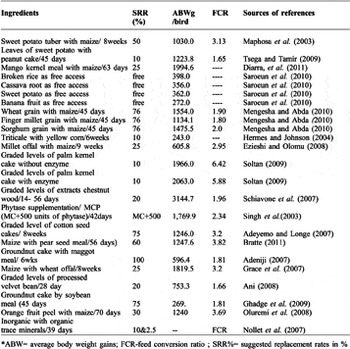
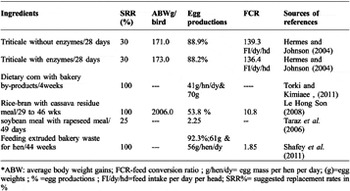
Replaceable poultry feed ingredients, suggested inclusion rates and effects on birds are shown in Tables 1 and 2.
Poultry feed ingredients, suggested replacement rates (SRR) and effects on broilers.

*ABW= average body weight gains; FCR-feed conversion ratio ; SRR%= suggested replacement rates in %
Consequently, the FAO (Reference FAO2009) reported that smallholders, if not protected, may be among those who will suffer most from price increases in local feed sources. Therefore, considerable efforts are being made to utilise more diverse local sources of feed ingredients, in particular protein materials, in many developing countries.
Different scholars across the world are advising that the smallholder poultry producers need to replace or substitute conventional feed sources with non-conventional ones. However, while replacing alternative ingredients, equivalency of nutritional values, costs and side effects on birds must be assessed and considered. Some ingredients may be toxic for birds when added at levels higher than recommendations. Gradual replacement or substitution of one type of feed or ingredient with another is always advised to adapt birds to such new feeds.
Poultry feed ingredients, suggested replacement rates (SRR) and effects on layers.

*ABW: average body weight gains; FCR-feed conversion ratio ; g/hen/dy= egg mass per hen per day; (g)=egg weights ; % =egg productions ; FI/dy/hd=feed intake per day per head; SRR%= suggested replacement rates in %
The aim when replacing ingredients is always not to affect the performance of birds. Moreover, the trend in poultry production and the poultry feed source situation is required for the country.
Feed resources and poultry production
Feed is the most important input for poultry production, and the availability of low-priced, high-quality feeds is critical for the expansion of the poultry industry (FAO, Reference FAO2003a). Moreover, Ravindran and Blair (Reference RAVINDRAN and BLAIR1992) stated that the survival of the poultry industry in most developing countries, in the future will undoubtedly, depend on the ability of poultry industry to compete with humans for the available food supply. The increasing cost and decreasing supply of traditional feedstuffs are expected to limit the future expansion of poultry production. This situation highlights the urgent need to improve the utilisation of the wide range of alternative feedstuffs available in these countries. Increments in the poultry industry have a profound effect on the demand for feed and raw materials. However, the four traditional feed ingredients; maize, soybean meal, fishmeal and meat meal cannot meet the demands. Therefore, exploring the usefulness of locally available, alternative feedstuffs in feed formulations is required. Generally, poultry feed ingredients can be categorized as energy, protein or micronutrient (mineral and vitamin) source feedstuffs.
Protein source feeds
Sources of protein feeds for poultry can be from plants, animals and synthetics (amino acids). Protein feeds from animal sources are mostly classed as quality proteins and they can also be taken from diversified sources. Further research is required on these alternative sources in order to fully exploit the opportunities that may be available. Considerable efforts must be made to utilise more diverse local sources of feed ingredients, in particular quality protein materials in this country. On the other hand, low quality protein source feeds for poultry are mostly from plants.
Generally, a high energy to protein ratio is needed to optimize the use of protein feeds in poultry production. The requirements for crude protein and the availability of amino acids are different for various production types and ages of chicken.
Food processing by-products are one of the sources of poultry feed ingredients in Ethiopia. The demand for quality meat is increasing due to the high income of individuals. This has inspired the government to promote abattoirs to facilitate the production of high quality meat in order to meet this demand. Since Ethiopia has large populations of livestock with good annual off take rates, the potential for the production of livestock by products in the country is enormous. Moreover, Crickenbergera and Carawan (Reference CRICKENBERGERA and CARAWAN1996) stated that offering by-products for use in animal feed is an economical and environmentally sound way for food processors to reduce waste discharges and cut waste management costs.
The yields of slaughtered animals can vary from 55 to 60% (Becker, Reference BECKER2004) of live weight, depending on the species of animal and food value placed on them. By-products such as blood and bone meal are ingredients with high protein contents are needed in the manufacturing of poultry and pig feeds. They are used as a source of protein in these feeds. However, maintaining food safety and avoiding disease transmission are the most important concerns with recycling such animal protein meals.
Poor quality poultry feeds from plant sources with low protein contents have always been one of the limiting factors in the poultry industry in Ethiopia. The promotion of the production of livestock by products will assist in promoting the poultry industry, which in turn will contribute to the economy. Moreover, the promotion of processing and the utilisation of livestock by-products will increase returns for abattoir and meat plant businesses.
Fishmeal provides a good source of quality protein for monogastrics and an excellent source of protein for ruminants. According to FAO (Reference FAO2003b) reports, the current annual total fish production potential in Ethiopia is estimated to be 51,481 tonnes. Based on reports from FAO (Reference FAO2010) that fishmeal is a commercial product made from any whole fish or shellfish, and
the bones and offal of the processed fish, Ethiopia can produce more fishmeal from this huge potential of fishery resources.
Insects, fly larvae, earthworms, termites, bees, snails, and skimmed milk powder are other sources of protein for chicken feeds. In addition to the aforementioned animal protein sources, there are also plant protein sources that can be used as a replacement for the conventional ingredients of poultry feeds. Furthermore, Yelm (Reference YELM1998) reported that by mixing leaves, sawdust, scraps, yard manure, and a handful of worms, a year-round organic protein source for the flock can be achieved. For the efficient utilisation of protein feeds by birds, information is also required for energy sources and their nutritional values.
Energy source feeds
Inadequate supply, inflated prices and diversion towards using cereal grains for bio-fuel production, particularly maize, has led to a constant search for alternative energy sources for poultry and other non-ruminant species (Chauynarong et al., 2009). The same author reported that there is a need to exploit cheaper energy sources, and to replace expensive cereals used in livestock production. Such alternative source feeds may relieve the food-feed competition in the future. Millets, maize, wheat, sorghum, bran, hulls, screenings, cassava, sweet potatoes, yams, mango seed kernel meal, cane molasses, breadfruit meal, banana and plantain meal, sweet potato tuber meal, cassava peel meal and cassava root meal are some of the energy source feeds available.
Iyayi and Aderolu (Reference IYAYI and ADEROLU2004) reported that, by fermenting agro-industrial by-products, improvements in the nutrient composition for layers can be attained. On average, some of these nutritional improvements were for crude-protein (62%), energy biodegradability (9.7%) and for a reduction in fibre (37.25%) in the feed ingredients. According to Engberg et al. (Reference ENGBERG, HAMMERSHØJ, JOHANSEN, ABOUSEKKEN, STEENFELDT and JENSEN2009), the use of fermented feed increased performance parameter such as egg weight and egg shell weight and shell stiffness. Moreover, Zafar et al. (Reference ZAFAR, IDREES and AHMED2005) reported that apple by-products are a cost effective yet equally good feed adjunct when combined with maize for broiler chicks. Through the process of fermentation and using other treating mechanisms, the availability of energy for birds should be improved. Looking for non-conventional feeds and other food processing by-products is the current responsibility of the stakeholders involved in poultry production, which can reduce competition for cereal grains.
Although scavenging birds have an opportunity to meet their micronutrient requirements, minerals and vitamins are often additionally provided from organic and non-organic materials such as limestone, snail shells, insects, fruits and fresh green materials.
Non-conventional feed sources for poultry and food processing by-products
Since prices for cereal grains are increasingly alarmingly in Ethiopia, it would not be affordable for poultry producers to feed their birds such grains. Therefore, non-conventional feed sources and food processing by-products need to be investigated and utilised to ensure poultry production is sustainable in this country. According to Preston (Reference PRESTON1992), the feasibility of using non-cereal grain feed resources as the basis for intensive poultry production is increasing slowly. He added that sugar cane and African oil palm offer the best prospective materials as the basis for sustainable intensive livestock production including poultry. Moreover, Clevenger (Reference CLEVENGER1990) reported that the biomass produced from food processing has a high nutritive value for animal feed and could be put to better use.
Cruz (Reference CRUZ1997) reported that all processed hatchery feeds and enrichment additives are currently imported into the Philippines. According to UNEP (2009) reports, food waste used to be well-utilised as animal feed, in order to alleviate the environmental burden from food waste. Moreover, Ussery (Reference USSERY2010) reported that fortunately, the natural feeds available via backyard enterprises are similar to those that chickens would eat in the wild, i.e. green plants, wild seeds and animal foods, such as earthworms and insects - all fresher and more nutritious than feed materials available commercially. All non-conventional feed sources and food processing by-products of a country must be assessed and utilised. To improve the availability of nutrients for birds, feed additives may be required. However, some additives (by themselves) have additional nutritional value (e.g. amino acids) and others are without nutritive value (e.g. enzymes). The latter group influences the nutritive value of a diet indirectly by improving the palatability of the diet, availability of ingredients, feed conversion and a healthy balance of the digestive tracts micro flora.
The availability of feed is the key factor that limits poultry production. The feed problem for poultry production in Ethiopia is not only the price and availability, but also their low quality. Therefore, the need to adapt feed additives that improve poultry feed utilization in the world may be another important issue to address. Chen et al. (Reference CHEN, LU and HAN1997) reports that China has abundant feed resources but these are often of poor quality and are therefore poorly utilised by poultry. Enhanced utilisation of feed is one of the more effective and one of the more promising approaches to solve the problem of feed deficiency in poultry (Chen et al., Reference CHEN, LU and HAN1997).
According to Officer (Reference OFFICER2000), feed enzyme supplementation has increased dramatically all over the world, but predominantly in pig and poultry diets. The same author stated that feed enzymes are increasingly seen as ‘environmentally responsible’ alternatives to certain growth hormones and antibiotics. Similarly, Marquardt (Reference MARQUARDT2000) reported that the use of enzymes as supplements in feeds for poultry has expanded dramatically. Consequently, Fernando et al. (2008) reported that performance parameters such as egg production, egg mass and feed conversion by egg mass and egg dozen were better for those birds fed diets added with enzymes. In contrary to this, Brenes et al. (Reference BRENES, GUENTER, MARQUARDT and ROTTER1993) reported that enzyme supplementation had a beneficial effect on weight gain and feed intake but not on egg production and other egg characteristics.
The reasons why feed additives improve the performance of birds is not clearly known, but Broz and Ward (Reference BROZ and WARD2007) stated that the potential exists for vitamins and feed enzymes to counteract certain metabolic disorders. Moreover, these authors indicated that feed challenges in poultry production and the use of enzymes to counteract these adverse effects in feed are well implemented by the feed industry.
Zhang and Aggrey (Reference ZHANG and AGGREY2003) reported that there is a genetic variation for feed utilisation efficiency in meat-type chickens. The same author reported that selection for improved feed conversion efficiency (FCR) makes birds deposit less retained energy as fats; rather they convert more energy and nitrogen into body proteins. However, Marks (Reference MARKS1991) stated that the feed efficiency difference between genetically diverse stocks of chickens, from hatch to market age is small. Therefore, all stakeholders of poultry production should consider feed additives and other ingredients to improve the chicken productivity in the country. In addition to the aforementioned gaps that should be filled to improving poultry production of a country, reassessments of stakeholders’ responsibility and the policy at hand may be needed.
Stakeholders and policy considerations for improved chicken production
Most of the stakeholders in the poultry industry in developing countries lack comprehensive policy guidelines. This can be a major constraint to ensuring the proper implementation of rules and regulations pertaining to sustainable poultry production. Policy makers should supply the necessary information about the real scenarios of poultry production in their country. To keep the sustainability of poultry production, breed improvements, feed supply and health should be supported by incentives and, if necessary, subsidised by the government.
Although Ethiopia has always required hard currency, it is better to reduce oilseed grain exportation, allowing for further processing in this country to get oil seedcake meal for birds. Moreover, the initiation and incentives for investments in agriculture should consider poultry feed production and processing in Ethiopia. Co-ordination of feed production, processing and supply with other comprehensive approaches such as productive breeding and medication must be supported by policies for improved chicken production. This competitive sector to supply animal proteins for fast growing demand in the country should be appreciated and valued. Generally, specialisation in feed, breed improvements, medication and marketing of chicken production should be encouraged.
Conclusions and recommendations
Chickens are the only species that can be expected to be found in every poor household, serving as protein food sources and an income in Ethiopia. Moreover, chicken production is a progressively growing sector, supplying protein foods to people worldwide. However, chicken flock size per household and the per capita consumption of egg and poultry meat in the country is declining. Moreover, transforming traditional chicken production systems is lagging behind, which may contribute to the declining consumption of egg and poultry meat per capita, contrary to that of the rest of the world.
Issues with feed are the main factors contributing to the low performance of chicken production in Ethiopia. Moreover, the recent feed price increment may upset many of the plans for further development of poultry productions in Ethiopia. The competition between food and feed is expected to only further increase the feed prices, forcing producers to look for alternative and locally available feed sources.
Therefore, emphasis should be given to looking for alternative feedstuffs and other ingredients for chicken feed, to improve productivity. For improved chicken production, a strategic plan of feed resource utilisation and improved management in general is urgently required.