INTRODUCTION
Heritage is a human construct. In a broad conceptual framing, cultural heritage is the result of humankind's interactions with their environment and one another. The outcome of these processes is reflected in a number of forms and is generally divided within two typologies of tangible (built environment, sites, landscapes, objects, and artifacts) and intangible cultural heritage (language, folklore, skills and customs, folklore, skills, and customs).1
See Pearson and Sullivan, 1995; Tunbridge and Ashworth, Dissonant Heritage; Spennemann “‘Preserving the Past for the Future.’”
Pearson and Sullivan, 1995; Murtagh, Keeping Time.
Subjective valuation, revaluation, and ultimately prioritization occur consciously and subconsciously on a continual basis. As with all values, cultural heritage values are variable between communities as well as between socioeconomic layers within a community. Moreover, values are mutable qualities that change both in intensity of conviction and in general over time, and thereby create a semifluid state in heritage valuations.3
Lockwood and Spennemann, 2001.
HERITAGE AND STRATEGIC FORESIGHT
The field of futures studies researches the medium- to long-term future of societies and their setting, the physical world, encompassing the mechanisms as well as the driving forces of change. Because the future is neither predictable nor predetermined, but will be influenced by the choices we make in the present, a subset of future studies is concerned with foresight. The research direction of strategic foresight, defined as “the ability to create and maintain high-quality forward views and to use the insights arising in organizationally useful ways”4
Slaughter, Futures for the Third Millennium, p. 281.
Given that by its nature, cultural heritage management is an intensely retrospective discipline, it is not very surprising that future studies have been rare in the discipline. Even front-end technologies such as space exploration received (and in many cases still receive) mainly retrospective assessments only once it was (almost) too late.5
Butowsky, Man in Space; Campbell, Assessing and Managing Human Space Heritage; Spennemann, “The Naval Heritage of Project Apollo”; Spennemann and Kosmer, “Heritage Sites of the US Space Program.”
Barclay and Brooks, “In Situ Preservation”; Gorman “The Cultural Landscape”; and Gorman, “The Archaeology of Orbital Space.”
Fewer, “Towards an LSMR and MSMR”; Rogers, “Safeguarding Tranquility Base”; Spennemann, “The Ethics of Treading on Neil Armstrong's Footsteps”; Spennemann, “Out of This World”; Spennemann and Murphy, “Technological Heritage on Mars.”
By starting a discussion on the future of robotic heritage and by looking at the question of how we might manage heritage sites created by future AI-imbued robots, the anthropocentric paradigm of heritage management that has recently been challenged.8
Spennemann, “On the Cultural Heritage of Robots”; Spennemann, “Of Great Apes and Robots.”
This article first summarizes the nature of hominid artifacts and then expands the discussion to explore the status of pongid-generated artifacts. Conceptually, this is just a logical extension of the anthropocentric concept of heritage, as we are, after all, assessing the heritage potential of artifacts and sites created by our closest physical ancestors. The second part of the paper will consider the future heritage management of artifacts created by AI-imbued robots—whom we could, and should, consider to be our intellectual children.
Hominid archaeology is seen by most practitioners as a means of understanding who we are and how we came to be the humans we are at present. Despite often-conflicting interpretation and robust debate, archaeological excavations are considered a means to research aspects ranging from an investigation of tool production and manipulative skills9
For example, Young, “Evolution of the Human Hand.”
For example, Haynes, “Archeological Methods.”
For example, Wyn, “Archaeology and Cognitive Evolution.”
See Lebel et al., “Comparative Morphology and Paleobiology” and critique by deGusta, “Comparative Skeletal Pathology.”
Ovchinnikov et al., “Molecular Analysis of Neanderthal DNA.”

Monophyletic relationship between humans and the great apes.
Furthermore, with technological innovation running at an ever-faster rate, advances in robotic development, on the technological (consider RoboCup14
For example, Kitano et al., RoboCup.
Fox, Sitompul, and van Schaik, “Intelligent Tool Use in Wild.”
NEC, Child Care Robot; NEC, PaReRo 2005; and NEC, PaReRo 2003.
Krichmar et al., “Characterizing Functional Hippocampal Pathways.”
See the 2004 World Robotics survey by the United Nations Economic Commission for Europe (UNECE) (http://www.unece.org/press/pr2004/04robots_index.htm).
Thus, AI-aided applications are already all-pervasive in modern life. As these AI-imbued robots become ever more powerful (in terms of intellectual computing power), in the near to medium-term future they could very well generate a set of artifacts that are derived from human-independent reasoning. Applying the precautionary principle,19
See Sandin et al., “Five Charges Against the Precautionary Principle” for concept.
But see Spennemann, “Preserving the Past for the Future” for a critique of the underlying notion of stewardship in cultural heritage management.
DEFINITIONS
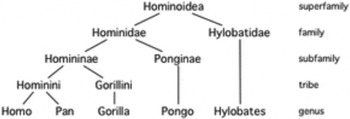
It is understood that a recent reclassification of the human and pongid family tree based on genetics has seen a reclassification of the interrelationship (see Figure 1), with the family Hominidae now including all great apes. Orangutans belong to the subfamily Ponginae, and all others belong to Homininae. At the tribe level, gorillas split out into Gorillini, whereas chimpanzees and humans are combined into Hominini,21
Goodman et al., “Primate Evolution at the DNA Level.”
For the purposes of this article, the traditional anthropological, and effectively anthropocentric, definition model is used that places all great apes into one group, irrespective of actual monophyletic genetic closeness to humans (as shown in Figure 1).
For the purposes of this article, three terms need to be defined and clarified:
Pongid includes all species deemed to belong to the (former) pongid lineages as traditionally understood by anthropologists. This includes the modern species of gorilla (Gorilla gorilla; Gorilla beringei), orangutan (Pongo abelii; Pongo pygmaeus), and chimpanzee (Pan troglodytes; Pan paniscus).
Hominid includes all species deemed to belong to the hominid lineages as traditionally understood by anthropologists. This includes Homo sapiens—us—as all other species of the genus Homo (i.e., Homo erectus, H. neanderthalensis, etc.).
Robotid is a term specifically coined for this paper, to sit alongside the previously mentioned terms. It extends to all variants of robots where the machines have some degree of ability for independent decision-making based on AI algorithms.
Although the evolutionary processes for all lineages are of course continuing, all available evidence for the processes for the pongid and hominid lineages rest in the past. Conversely, most evolutionary processes for robotid lineages will take place in the immediate and medium-term future.
HUMAN-CREATED ARTIFACTS
One early scientific definition for the dichotomy between animals and humans was the axiom that humans used tools, whereas animals did not. Benjamin Franklin most prominently expressed it when he commented, “man is a tool-making animal.”22
Boswell, Life of Samuel Johnson, entry, April 7, 1778.
Marx, Das Kapital, p. 194.
That definition, which soon became more generalized to encompass mere tool use, could be sustained for almost 200 years24
For example, Oakley, Man the Toolmaker; Reed, “New Light on the Origins of Man.”
Riedman et al., The transmission of individually distinctive foraging strategies.
See salient work by Jenkins “Cultural Transmission of Song Patterns.”
If the use of tools did not suffice as a discriminant feature, it was necessary to return to the initial dichotomy of the manufacture of tools. However, as is discussed in the following section in more detail, studies of primate behavior showed that primates, too, were able to make tools. This occurred not only in laboratory settings but also in their natural environments. Thus, the level of separation had to be raised a further notch. The manufacture of tools that defined humankind was the manufacture of tool not for simple task, but to create a tool to make a tool to carry out a task. It was this major cognitive step that defined the new boundary.
The ancestry of human tool use and manufacture has long been debated. Early hominid use of unmodified flake tools (flakes struck by percussion flaking of a pebble core), labeled the Oldowan Industrial Complex, goes back 2.5 million years ago (Ma).28
Ambrose, “Paleolithic Technology and Human Evolution”; Panger et al., “Older than the Oldowan.”
Panger et al., 2002.
To meet the raised cognitive test previously outlined, however, we have to wait 1.5 million years with the advent of large core tool technologies of the Acheulean Industrial Complex, where humans reduced a pebble to shape it into a tool.30
ANIMAL-CREATED ARTIFACTS
There is little need to comment in any detail on the curating of human-created artifacts. There is a plethora of publications and manuals written for museums and archives dealing with the curating of archaeological materials, artworks, textiles, photographs, paper-based items, and so forth.
Although tool use among animals has long been observed, such as the Woodpecker Finch using twigs to extract larvae from decaying wood31
For example, Tebbich and Bshary, “Cognitive Abilities Related to Tool Use.”
Krützen et al., “Cultural Transmission of Tool Use in Bottlenose Dolphins.”
For example, Chappell and Kacelnik, “Tool Selectivity in a Non-Primate.”
Primate-Created Tools in Natural Environments
Tool use among great apes has been documented in captivity for gorillas,34
Fontain, Moisson, and Wickings, “Observations of Spontaneous Tool Making”; Boysen et al., “Tool Use in Captive Gorillas.”
Celli, Hirata, and Tomonaga, “Socioecological Influences on Tool Use in Captive Chimpanzees”; Herzfeld and Lestel, “Knot Tying in Great Apes.”
Gold, “Ladder Use and Clubbing by a Bonobo”; Herzfeld and Lestel, “Knot Tying in Great Apes.”
O'Malley and McGrew, “Oral Tool Use by Captive Orangutans (Pongo pygmaeus)”; Herzfeld and Lestel, “Knot Tying in Great Apes.”
Beck, Animal Tool Behavior; van Schaik, Deaner, and Merrill, “The Conditions for Tool Use in Primates.”
Visalberghi, Fragaszy, and Savage-Rumbaugh, “Performance in a Tool-Using Task.”
Whiten et al., “Cultures in Chimpanzees”; Miller, “Tool Study Supports Chimp Culture.”
Fox et al., “Intelligent Tool Use in Wild Sumatran Orangutans”; van Schaik, Fox and Fechtman, “Individual Variation”; van Schaik et al., “Orangutan Cultures and the Evolution of Material Culture.”
Breuer, Ndoundou-Hockemba, and Fishloc, “First Observation of Tool Use in Wild Gorillas.”
In addition, research has attributed some level of culture at least to chimpanzees inasmuch as they exhibit traditions of grooming, calling, and tool use that suggest intergenerational learning and differentiation by one group from another.43
Whiten et al., “Cultures in Chimpanzees”; Vogel, “Chimps in the Wild.”
Chimpanzees in the Taï Forest in the Ivory Coast collect stones and use them as nutcracking implements. A scatter of stone flakes is gradually formed around specified sites where unmovable anvils exist. The hammer stones were of varied raw materials, some of which were transported to the nutcracking site from source locations of up to 2 km away. Some assemblages have been excavated by archaeologists and studied for their similarities with early hominid sites.44
Mercader, Panger, and Boesch, “Excavation of a Chimpanzee Stone Tool Site.”
Mercader, Panger, and Boesch, Chimpanzee-Produced Stone Assemblages.
Schick et al., “Continuing Investigations into Stone Tool-Making.”
Primate-Created Tools in Human-Controlled Environments
The debate on human consciousness and learning has also created a debate that has looked at the ability of great apes to learn and perform cognitive tasks under controlled laboratory conditions. A number of pongids in captivity have been taught how to use and flake stone tools.
The pioneering study was carried out in 1971 by Richard Wright who demonstrated to a 5½-year-old captive male orangutan, Abang, how to use a stone tool to cut a string that kept shut a box with food. The orangutan could copy the action after 9 demonstrations and 12 trial event exposures. Subsequent trial events all resulted in success. In the continuation of the experiment, Wright demonstrated to the orangutan how to strike a stone flake off a core. After six demonstrations and seven trial events the orangutan succeeded in striking a chip off the core, which he repeated in the following attempt. After another demonstration, the orangutan managed to copy that skill and strike off flakes in the following three trial events. After the last attempt Abang proceeded to use the flake to open the box. Filming of the orangutan 10 days after the last event showed that he was able to strike flakes and cut the string of his own accord.48
The study carried was pioneering in its scope, but in the final summation it only demonstrated that a orangutan had the imitative capacity to learn to make tools and put them to a (predefined) use. The study, as Wright himself counselled, was not designed to test intuitive problem solving.The experimental setup was repeated by Nick Toth and Kathy Schick starting in 1991; they carried out a series of experiments with a 9-year-old Bonobo (Pan paniscus), Kanzi. Striking flakes off a core and using them to cut string and keep shut a food reward box was briefly demonstrated. Kanzi soon acquired the skill to carry out the task, continually improving his abilities to flake. In view of the long-term experiment, Toth and Schick demonstrated that the Bonobo carried out an innovation. Kanzi found that throwing the hammer stone at the core provided better results, possibly because of the larger force exerted in that way. The longitudinal study, to which another Bonobo has been added, has yielded a large number of tools that could be analyzed in a fashion akin to human stone tools.49
Toth, Schick, and Sema. “A Technological Comparison”; Schick and Toth, Making Silent Stones Speak; Schick et al., “Continuing Investigations into Stone Tool-Making.”
The important observation made by the researchers was that Kanzi was able, over 3 years of observation, to improve his skill at producing flakes,50
Schick et al., “Continuing Investigations into Stone Tool-Making.”
Curating Animal-Created Artifacts
Commencing with the curiosity cabinets of the sixteenth century, there is a long tradition in collecting human artifacts with a range of institutions worldwide. Common to all major museums and archives is that they have a collections policy grounded in the ethical management and curating items long term to ensure that they do not deteriorate.51
Although environmental decay is less a problem for stone tools, they too can be affected by natural disasters affecting the storage facility. The case of the artifact storage of the Australian National University, destroyed in January 2003 as part of the Canberra bush fires is a case in point.
The excavation at the Tai Forest sites by Mercader and coworkers52
Mercader, Panger, and Boesch, “Excavation of a Chimpanzee Stone Tool Site.”
At present the research into chimpanzee generated sites is limited; the full variation within the tool manufacturing process is unknown, neither is there a full understanding of how common such sites are. Both are of requirements for the assessment of these within the concept of cultural heritage management. This then raises the question of how the material, both from the excavations and experiments previously mentioned, is being curated. The artifacts derived from these excavations at the Tai Forest sites are curated at the researcher's academic institution. The artifacts created by the orangutan Abang in Wright's pioneering study of 1971 are still in the researcher's possession53
Wright, E-mail to the author.
The underlying questions about how these artifacts should be valued, and how these values should be assessed, are addressed later in the article.
ARTIFICIAL INTELLIGENCE-CREATED ARTIFACTS
New developments in AI have seen the gradual development of computing algorithms that can out-think grandmasters at the game of chess,54
Called “Deep Blue”; Pollack et al., “Three Generations.”
Jacob, Composing With Genetic Algorithms; Widmer, “Machine Discoveries.”
Called Legobots. Pollack et al., “Three Generations.”
For example, Chou, “The Growing Role of IT in Transportation.”
For example, Keane and Nair, “Problem Solving Environments in Aerospace Design.”
Gage, “UGV HISTORY 101.”
Cf. Thornberg and Cycon, “Sikorsky Aircraft's Unmanned Aerial Vehicle.”
Cf. Granlund et al., The WITAS Unmanned Aerial Vehicle Project.
At the same time, new research is looking at the concept of genetic algorithms63
Genetic algorithms are a class of evolutionary algorithms that use techniques inspired by evolutionary biology (e.g., inheritance, mutation, natural selection, and recombination).
See Watson, Ficici, and Pollack, “Embodied Evolution” for an example of evolutionary robotics.
Elshaw, Lewis, and Wermter, Incorporating Reactive Learning Behaviour.
If we ignore the emergence of robot-generated sites from the consideration of this paper,66
See Spennemann, “‘Preserving the Past for the Future.’”
Issues Of Curating
At present, no robots are included in national lists of cultural heritage items protected from export or destruction. Some museums (Smithsonian, Massachusetts Institute of Technology [MIT]) are collecting items of the information age, but none of this has been particularly systematic.
Most research relating to robotics and AI is carried out by academics in a wide range of universities as well as by scientists in commercial settings (such as Sony, NEC, or Honda). The commercial realities of the modern world, with the development of intellectual property in inventions, mean that many of the intermediate stages will be held in-house without formal collection and curating processes, apart from standard academic or laboratory diligence. Even where universities have set up museums of technology (such as MIT), there is no guarantee that the significant items created by university staff will eventually be handed to the museum for curating.67
See Spennemann, “‘Preserving the Past for the Future.’”
Some scholarly research on the matter has commenced, at least in the realm of computers, as is evidenced by the journals IEEE Annals of the History of Computing as well as Iterations: A journal of Software History and the work carried out by the Charles Babbage Institute at the University of Minnesota.68
Charles Babbage Institute, University of Minnesota, available at http://www.cbi.umn.edu.
Cf. Spicer, “The IBM 1620 Restoration Project.”
Cf. Burba and Frana, “Researching the History of Software”; Schlombs, “Digital Archives for the History of Software.”
CULTURE: A WORKABLE DICHOTOMY?
Having considered aspects of material culture of hominid, pongid, and robotid design and some issues related to curating, it is now time to tie the discussion back to the question of cultural heritage management. Before considering the question of how the cultural heritage values of these three sets of artifacts are assessed (see the following text) it is necessary to establish whether there is a fundamental difference between these three typologies of artifacts, and if so, where the dichotomous line can be placed. Since heritage management and evaluation, as well as the whole concept of ethics per se is a human construct, it is inevitable that the considerations presented later in the article will be rooted in human constructs themselves. One of the major concepts that influences the discussion is that of culture.
As tool use, and later tool manufacture became untenable as a dichotomy between humans and the great apes (and other animals), anthropologists have tended to position the key dichotomy at the concept of ‘culture.’ Culture has been regarded as an eminently human trait based on the “cognitive and learning mechanisms by means of which such information is transmitted.”71
Cf. Boesch and Tomasello, “Chimpanzee and Human Cultures.”
Bates and Plog, Cultural Anthropology, p. 7.
The definition of culture among ecologists is based on the assumption that any animal behavior that is not uniform across all members of the species but varies in circumscribed geographic areas and that cannot be explained either environmentally or genetically, must be learned behavior transmitted within a subpopulation.74
Boesch and Tomasello, “Chimpanzee and Human Cultures.”
Boyd and Richerson, “Why Culture Is Common but Cultural Evolution Is Rare.”
See Krützen et al., “Cultural Transmission of Tool Use in Bottlenose Dolphins.”
Rendell and Whitehead, “Culture in Whales and Dolphins.”
Culture Among the Great Apes
Setting aside the literature on culture and dialect among song birds, as well as the growing number of studies on cetaceans, the main body of work on animal ‘culture’ looked at the great apes—mainly because of their evolutionary proximity to humans. The key difference between the great apes and other animals also rests in the fact that primates are the only animals other than humans where multiple behavioral elements have been observed.
Several studies have been carried out to investigate the nature of culture among chimpanzees78
Boesch and Tomasello, “Chimpanzee and Human Cultures”; Whiten et al., “Cultures in Chimpanzees.”
van Schaik, Fox, and Fechtman, “Individual Variation”; van Schaik et al., “Orangutan Cultures and the Evolution of Material Culture”; van Schaik and Pradhan, “A Model for Tool-Use Traditions in Primates.”
Boesch and Boesch, “Optimisation of Nut-Cracking”; Boesch and Boesch, “Mental Map in Wild Chimpanzees”; Boesch and Boesch, “Tool Use and Tool Making in Wild Chimpanzees”; Boesch and Tomasello, “Chimpanzee and Human Cultures”; Sugiyama and Koman, “Tool-Using and Tool-Making Behaviour.”
Boesch and Tomasello, “Chimpanzee and Human Cultures.”
The study of the captive Bonobo Kanzi showed that an individual Bonobo could learn experientially, innovate on techniques, and improve his skills to create useful flakes.82
van Schick, Deaner, and Merrill, “The Conditions for Tool Use in Primates.”
Observations among chimpanzee populations have shown that intergenerational transmission of skills and cultural practices occurs but also that some tool use is invented yet dies out again without being adopted by most of the group. For this, group dynamics and the social standing of the inventor were held responsible. The key difference rests in the fact that among human innovators the role of (formalized) teachers able to vocalize instructions must be considered. This is absent in the chimpanzee world where imitators may exist but where the imitation may take on its own expressions.83
Boesch and Tomasello, “Chimpanzee and Human Cultures.”
Human culture provides ample evidence of the ratchet effect, whereby the plane of knowledge and thus learning complexity is raised from generation to generation and where the next generation can critically interpret the cumulative results of the previous generations. This is largely absent among the chimpanzee populations. But as Boesch and Tomasello84
Boesch and Tomasello, “Chimpanzee and Human Cultures.”
If we accept that culture is, essentially, a process where “information or behavior is acquired from conspecifics through some form of social learning,” and where this learning is reinforced through intergenerational emulation (among the great apes) and emulation and organized instruction (among humans), culture is no longer a valid measure and the dichotomy between animal and human must be placed at a different level.86
The ability of humans to transcend their own physical needs and to express themselves in a self-reflective and self-aware way appears a logical dichotomy. Placing the dichotomy of human, and by implication, of prehuman, at a level of psychological development, determines the psychological thresholds that must be recognizable in the archaeological and paleontological record. Three main incisions that separate us from the great apes come to mind:
1) Overcoming the fear of fire, demonstrable certainly because approximately 800 ka (Goren-Inbar, “Evidence of Hominin Control”), but possibly as much as 1.6 Ma (Bellomo, “Methods of Determining Early Hominid Behavioral Activities; Wrangham, “The Raw and the Stolen”).
2) Overcoming the fear of open water, demonstrable because approximately >800 ka by the colonisation of a Homo erectus to Flores, which was always cut off from the Sunda Shelf (cf. Bednarik, “Seafaring in the Pleistocene.”).
3) An understanding of the concept of mortality and of afterlife, because approximately 90 ka as evidenced by Neanderthal burials (cf Pettitt, “The Neanderthal Dead” for review). There are some indications that caching of the dead may have occurred from 200–300 ka onwards (see Pettitt, “The Neanderthal Dead” for discussion).
Culture Among Robots
The current discussion of culture among robots falls into three spheres: literary imagination; technological innovation; and technologically-informed conceptualization. All are relevant as they inform and influence each other.
Created in 1920 by the Czech playwright Karel Čapek for his play R.U.R. (Rosumovi Umělí Roboti [Rossum's Universal Robots]), the term robot87
Robot is a contraction from the Czech robota meaning drudgery or servitude; and robotnik meaning peasant or serf. Karel Čapek credited his brother, the painter Josef Čapek, with the actual creation of the word.
Asimov, “Liar!”
In his 1942 short story Runaround Asimov first explicitly introduced his three laws of robotics (Asimov, “Runaround”), to which in 1985 he added a fourth which underpins the previous three (and hence is referred to as the zeroeth law of robotics) (Asimov, Robots and Empire).
0) A robot may not injure humanity or, through inaction, allow humanity to come to harm.
1) A robot may not injure a human being or, through inaction, allow a human being to come to harm.
2) A robot must obey orders given it by human beings except where such orders would conflict with the First Law.
3) A robot must protect its own existence as long as such protection does not conflict with the First or Second Law.
Asimov's laws of robotics assume the supremacy of humans, even though in earlier films (such as Metropolis) and plays (such R.U.R.) that is not given and the view is much darker. As Bartneck90
Bartneck, “From Fiction to Science.”
Substantial work has been carried out on the design requirements and concepts of socially interactive robots91
See Fong, Nourbakhsh, and Dautenhahn, “A Survey of Socially Interactive Robots.”
Cf Dautenhahn et al., What is a Robot Companion.
[NEC created a] Behavior model [that] designs the robot character through the design of consistent behavior patterns based on the given character. For example, a robot can be designed by specifying his “likes” and “dislikes” such as “he loves dancing but astrology” [sic] “selfish and independent,” or “passive and obedient.” Based on the specified interests, tastes, and characters of the robot, he evaluates each human-robot interaction, such as ‘fun’ or ‘boring.’ The collected evaluation results are used to define the next action, spontaneous behavior, and reaction to a questions by the user.93
NEC, PaReRo 2003.
Although there is much talk about a robot culture, exercise care to avoid confusing the concepts. The Japanese electronics companies are proponents of a robot culture conceptualized in the same way as we would talk about a good food and dining culture (i.e., still focused on the human element).94
Cf. Japan Times, “New Osaka Shop to Promote ‘Robot Culture.’”
Although the current commercial work imitates selected subsets of human behavior, based on human concepts and values, little consideration has been given to the values robots themselves may hold and, ultimately, the concept of robot culture.
The prerequisites for robots to develop culture in human terms would be for them to develop independent, critical, and self-reflective thought—in essence that a robot would gain consciousness and, ideally, self-awareness. The traditional key test for AI to have come of age, has always been the Turing Test.95
To answer the question whether machines can think, he proposed a variation of the imitation game96The imitation game sees a male and a female in one room and an interrogator (whose sex is irrelevant) trying to ascertain the gender of either person A or B. This is effected through a series of questions to which the respondents provide typed answers (to avoid identification via voice or hand writing). The object for the target person is to answer correctly but confuse the interrogator, while the second person in the room will try to provide helpful answers to the interrogator.
See Saygin “Turing Test: 50 Years Later” for a discussion of the literature on the Turing Test.
See Saygin “Turing Test: 50 Years Later.”
From the perspective of cultural heritage management, it is crucial to define what the term culture should encompass. If the human concept of consciousness, is used, the development of a robot culture is a very long way off.100
For example, Manuel, “Creating a Robot Culture.”
There are already examples where robots learn from each other and optimize strategies of collaboration based on their situation.101
For example Alonso, “Learning in Multi-Agent Systems.”
Cervone et al., Combining Machine Learning With Evolutionary Computation.
At present there is no tangible manifestation of robot culture in the form of artifacts along those produced by the great apes either in captivity or in their natural setting. The closest such developments are the improved technological designs in the car and aircraft industry (see above).
JUDGED BY WHOSE VALUES?
Because cultural heritage and values in general are both human constructs, the values that underpin and circumscribe what people define as heritage are subjective, individual, or communal but purely human projections onto an essentially value-free animate or inanimate world. The central figure in the valuations is the individual, and the central generation is the present one.103
Spennemann, “Your Solution, Their Problem.”
As de Waal104
de Waal, “Cultural Primatology Comes of Age.”
If we take the ecological definition of culture as the basis of our considerations, and thus regard human culture with its psychological complexities merely as an extremely well-developed set of cultural traits, the artifacts generated by the great apes are regarded as material culture. As such then they must be researched and evaluated to address regional and subregional variation, all of which can give evidence on the development of tool traditions among the early hominids105
Boesch and Tomasello, “Chimpanzee and Human Cultures.”
When considering the values projected onto pongid, hominid and robotid artifacts we have to consider the capabilities of the creators to exert value judgements, as well as our own contemporary human values that we are projecting on the moveable cultural heritage resources.
Hominid Values
Most modern humans value the past in one form or another. We are, of course, uninformed about how the early hominids valued their artifacts once they were no longer used. Thus, the concept of hominid values must be constructed based on how we value(d) the artifacts of our more distant past. Bandi106
Bandi, “Der Topfknick.”
Although the discovery of Herculaneum and Pompeii was of significance for Renaissance art, it was only with the positivist frame of mind that humans began to seriously value the objects of their ancient past—and to collect them.107
Cf. Taylor, The Taste of Angels, for survey of collecting.
Pearson and Sullivan, “Looking After Heritage Places”; Murtagh, Keeping Time, Spennemann, “Your Solution, Their Problem”; World Heritage Center, The World Heritage List.
Pongid Values
The excavation at the Tai Forest sites has broadened the perception of archaeology from an anthropocentric discipline. It now also encompasses the behavior and tool use of chimpanzees. Although Mercader and colleagues109
Mercader, Panger, and Boesch, “Excavation of a Chimpanzee Stone Tool Site”; Mercader, Panger, and Boesch, Chimpanzee-Produced Stone Assemblages.
Cf. Bower, “Wild Chimps Rocked On.”
What needs to be considered, however, is the extent of the conundrum of having to manage pongid heritage. Certainly, pongid heritage is in museum collections. Although some humans may value this heritage, it is self-evident that the pongid creators of this heritage do not value the items once they are removed from their sites to museums. Moreover, as far as can be ascertained, no studies have been carried out that consider the extent of pongid reuse of an artifact in the natural setting, or on the reuse, or habitual use, of successful flakes created by Kanzi and the second Bonobo Panbanisha.
Robotid Values
As humanity's values change in response to the new intellectual challenges posed by the increased capabilities of AI-derived robots, it is necessary to adjust the perceptions of heritage. Ultimately, consider that the present definition of cultural heritage must be flexible enough to include the actions of human-designed, but AI thinking robots in the not-so-distant future. Until such time that self-aware robots make their own decisions on the products of their own making, custodial decisions must be made for them. Heritage managers must consider whether to stand accused by future generations that the opportunity to collect robotid artifacts and intermediate milestone artifacts slipped by.
OUTLOOK
As the article has shown, the issue of managing nonhuman cultural heritage of our close relatives among the great apes, and well as among our intellectual and technological children among the robots is quite real. By focusing on the biological concept, regarding culture as a behavior acquired from conspecifics through some from of social learning, the concept of cultural heritage management can expand from the hominid sphere to include aspects of pongid and robotid culture. Although pongids do not seem to value the cultural artifacts they have created, hominids should value them as they provide an insight into possible manifestations of their past. Although the tangible manifestation of robotid culture does not exist at present, the development of genetic algorithms with group learning ability, as well as the development of robotid technologies, suggest that this is not too far off.
The difference between pongid and robotid cultural heritage rests in the fact that robots, once self-awareness has been reached, can to develop their own value sets and thus make their own decisions regarding the management of cultural heritage. Until such time, however, hominids, as intellectual parents, must act as custodians and protect the manifestations of emergent robotic heritage.
The article has raised some serious issues relating to our construction of heritage and how that may apply to artifacts created by robots capable of (semi)independent thought through improved AI algorithms. Although some issues appear quite futuristic in concept, always remember that the technological developments are progressing at an ever-accelerating pace. The fact remains that it is only a matter of time before the question arises: What is the nature and future of the earth's robotic heritage? The implications of the matter must be seriously considered, lest by future generations accuse preceding generations of not protecting the emerging heritage when there was an opportunity. The precautionary principle should apply in this case.
Cultural heritage managers have traditionally drawn a line in the sand and confined their activities, as well as their conceptual thinking to the human-derived world. With the winds of change blowing, both in terms of behavioral research into our closest relatives among the great apes, and in terms of the increasing developments in AI and its robotic applications, that line in the sand is becoming increasingly blurred. The day will dawn when it is obliterated altogether. Will we be ready for it?
Want to Comment on this Article? Go to www.culturalproperty.org/forum/