Even before the COVID-19 pandemic began in March 2020, online courses were growing in importance and relevance, with more students taking online classes (Seaman, Allen, and Seaman Reference Seaman, Allen and Seaman2018, 3) and more faculty teaching online classes (King and Alperstein Reference King and Alperstein2014, 46). When the pandemic forced most college courses online, faculty members were introduced to new teaching techniques, forced to communicate through sometimes unfamiliar mediums, and experienced what often was a mutually traumatic experience along with their students.
Political scientists immediately engaged in introspection and assessment of the way these shared pandemic experiences influenced their pedagogy. Research and reflections drew attention to troubling pandemic outcomes such as faculty and student well-being (Greaves Reference Greaves, Smith and Hornsby2021; Grussendorf Reference Grussendorf and Lantis2022) and exacerbation of inequities in access for both students and campuses to technology and resources (Ba Reference Ba2021; Leonard Reference Leonard and Lantis2022; Rosen Reference Rosen and Lantis2022). Yet, this research also highlighted positive transformations as faculty members reevaluated their learning priorities (Roberts Reference Roberts2021; Taylor Reference Taylor and Lantis2022) and connections between political science’s foundational work and students’ lived experiences (Enia Reference Enia and Lantis2022; Lantis Reference Lantis2022); found creative ways to promote student engagement (Glazier Reference Glazier2021); and embraced an ethic of care (Ba Reference Ba2021; Hutchison Reference Hutchison2021; Martel et al. Reference Martel, Rourke, Wade and Watters2021).Footnote 1
Yet, what might be the long-term impacts on teaching in our field of political science as a result of these pandemic-influenced teaching changes? Are the dramatic pedagogical shifts described in teacher-scholars’ largely reflective and campus-specific accounts capable of triggering a disciplinary-wide shift in our approach to teaching? Furthermore, going forward, how many political science professors, faced with pressure to reembrace the status quo, will be capable of sustaining pedagogical approaches grounded in engagement, connected to lived experiences, and prioritizing an ethic of care?
We designed a multimethod study to better understand not only political science instructors’ experiences teaching during the pandemic but also their own expectations for the long-term effects of the pandemic on their teaching. This study surveyed political science faculty using both forced-choice and open-ended questions and also collected qualitative data through a series of focus groups. What long-lasting effects might emerge as a result of political science faculty members’ experiences with emergency remote online teaching during the pandemic? We found reasons for optimism as well as cause for concern.
THE CHALLENGES AND OPPORTUNITIES OF TEACHING DURING A PANDEMIC
The COVID-19 pandemic that began in March 2020 presented several challenges and opportunities for political science instructors. We expect that some of these challenges and opportunities will have long-term consequences for the field. In particular, we tested three hypotheses.
First, we expect that being introduced to online teaching during the COVID-19 pandemic will lead to a more negative view of online teaching (Hypothesis 1). Even under non-pandemic conditions, preparing a new online class or teaching a fully online class requires a major upfront investment of time (Bacow et al. Reference Bacow, Bowen, Guthrie, Long and Lack2012; Conceição Reference Conceição2006; Green, Alejandro, and Brown Reference Green, Alejandro and Brown2009). Moreover, online students tend to expect a high degree of responsiveness from faculty members (Hiltz, Kim, and Shea Reference Hiltz, Kim and Shea2007), adding even more to the online workload (Wingo, Ivankova, and Moss Reference Wingo, Ivankova and Moss2017).
Although previous literature indicates that experience teaching online tends to make faculty more supportive of online teaching (Shea, Pickett, and Li Reference Shea, Pickett and Li2005; Ulmer, Watson, and Derby Reference Ulmer, Watson and Derby2007), these previous studies were not conducted during a pandemic. In particular, given that faculty report relying heavily on past online experience to successfully transition pandemic courses (Akbaba Reference Akbaba and Lantis2022; Grussendorf Reference Grussendorf and Lantis2022; Sweet-Cushman Reference Sweet-Cushman2021), we expect that those who moved online for the first time as a result of the pandemic will hold a more negative view toward online teaching. This introduction to online teaching under less-than-ideal circumstances may have long-term consequences for online higher education. Because many of these faculty members did not choose to teach online, were not prepared and trained for it, and their students also did not opt into online courses, it is more likely that they will have a negative response to online teaching and will not want to participate in the future.
Second, for many faculty members, the COVID-19 pandemic brought into sharp focus what it is like to teach students who are in crisis. Suddenly, our entire classes were filled by students dealing with various levels of trauma and crisis. Under these conditions, we expect to find that teaching during the COVID-19 pandemic will lead to more empathetic teaching (Hypothesis 2).
The pandemic situation led many faculty members to adopt positions of flexibility and accommodation in their policies and grading and to make themselves more available to their students as they witnessed the crises that their students were going through. What is unique about a pandemic is that everyone is in crisis, including the professors, so it may be easier—as well as more important—to be compassionate (Meluch and Hannah Reference Meluch, Hannah, Herron and Douglas2021). However, every semester, some of our students will experience personal crises that are at least as disruptive as COVID-19. They lose jobs, their family members become sick and even die, and they have overwhelming caregiving responsibilities. The experience of going through a pandemic with our students and making adjustments to accommodate them could make faculty members more empathetic in the future.
Third, the political challenges posed by the COVID-19 pandemic are uniquely interesting for political scientists and our students. The problems we are experiencing in our lives during the pandemic often were political concerns that we could bring into the classroom. Thus, we expect to see faculty members teaching during the COVID-19 pandemic making more use of current events (Hypothesis 3).
Indeed, many faculty members reported doing just that. Ba (Reference Ba2021) described adjusting the final exam in his “Introduction to International Relations” course from a short-answer and multiple-choice format to a long essay that specifically addressed how IR theories could make sense of the COVID-19 pandemic and its implications for world politics. Sun (Reference Sun2020) involved students in thinking creatively about adjusting their course on civic engagement to engage with the local community—creating a “walk with us” program to encourage people to exercise during quarantine. These creative ways of bringing current events into the political science classroom may or may not be pandemic-specific. Because the field of political science is known for its topical relevance (Kingsbury Reference Kingsbury2021), we expect the pandemic may have provided a key opportunity for greater current-events teaching application.
METHODS
To test these three hypotheses and to better understand how political science instructors’ view the pandemic affecting their teaching for the long term, we designed a multimethod study. In the first stage, we deployed a survey as part of the American Political Science Association (APSA) annual membership survey. Our portion of the survey had 28 questions that included both forced-choice and open-ended questions. The survey was in the field from May 20 to June 28, 2021. The full survey was distributed to 10,442 people, with our questions about COVID-19 and teaching randomly assigned to 2,115 people. Our survey questions received approximately 308 responses (with some variation by question) for a response rate of 14.5%. Question wording and summary statistics are in online appendix A1 and descriptive statistics about the sample population are in online appendix A2. Of importance is the unique nature of the sample. Because the sample population was APSA members, it overrepresents PhD-granting institutions and faculty members who either are tenured or on the tenure track (The Chronicle of Higher Education 2021). This is likely because the expense of belonging to APSA is beyond the means of many contingent and community college faculty. We attempted to compensate for this skewed sample by inviting community college professors, contingent faculty, doctoral students, and faculty members teaching at institutions located outside of the United States to participate in our focus groups.
To test our first hypothesis, we used a summary measure of negative views of online teaching, which was constructed using seven attitudinal questions with a five-point Likert scale of agreement for response options (variable construction and summary statistics are in online appendix A1). We measured empathy through a question about how often a faculty member meets with students one on one to discuss personal problems and their current-event usage through a question about how often they use current events in their teaching. Question wording and descriptive statistics for these and all independent variables are in online appendix A1.
We also examined responses to two open-ended questions: (1) “If you would like, please tell us more about how your attitude to online teaching has changed since the COVID-19 pandemic began (around March 15, 2020)”; and (2) “Please tell us about what you think is the most important way that the COVID-19 pandemic has changed your teaching for the long term (that is, beyond the structural change to online learning in the short term, how will the pandemic affect your teaching going forward?).” We refer to the first open-ended question as attitude change and the second as long-term change. The open-ended responses were coded by both authors. The codebook was developed by the authors using a combination of inductive and deductive methods (see online appendix A2). A subset of approximately 30% of the sample was coded by both researchers as a reliability test. For attitude change, agreement was 92% and Cohen’s Kappa was 0.88. For long-term change, agreement was 95% and Cohen’s Kappa was 0.88.
In addition to the survey data, we conducted five focus groups in November and December of 2021. Participants were recruited through political science listservs, Twitter, and APSA newsletters. Each focus group contained five members (total N = 25) from various institutional types, gender and ethnic backgrounds, and academic ranks. We purposefully sought a more diverse set of focus-group participants to offset the skew in the APSA-member respondents. Respondents received a $25 gift card to the restaurant of their choice for participating. Focus groups lasted about one hour and were held virtually via Zoom. Researchers took notes during the focus groups and analyzed the Zoom transcripts afterwards to identify themes and to examine more closely trends identified by the survey data. The focus-group protocol is described in online appendix A3.
RESULTS
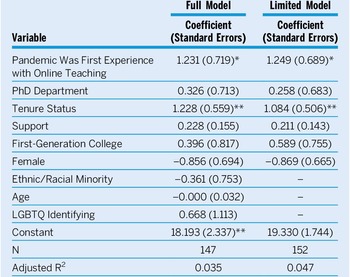
Our first hypothesis examines how being introduced to online teaching during the early semesters of the pandemic affected views of online teaching. We modeled negative views of online courses while controlling for whether the respondent was new to teaching online as a result of the COVID-19 pandemic; a dummy variable for whether they were at a PhD-granting institution; an ordered variable accounting for tenure status (i.e., not on the tenure track, on the tenure track, or tenured); and demographic variables for gender, race, first-generation status, age, and LGBTQ identity. We also included a combined measure of support that accounts for how supported respondents felt during COVID-19 by their department, their university, and APSA, with higher numbers indicating more support. With a continuous dependent variable, we used an OLS model with results for both full and limited models, with the same substantive results, in table 1. Replication data are available for the limited models, which exclude variables that could be used to identify respondents (Glazier and Strachan Reference Glazier and Strachan2023).
Regression Model of Negative Views of Online Teaching; Positive Coefficients Are Associated with Negative Views

Notes: **p<0.05, *p<0.1.
The results of the model show that being new to teaching online during COVID-19 and having more advanced tenure status were the only significant predictors of a negative attitude toward online education. The finding that being introduced to online teaching through the emergency remote learning necessitated by the pandemic was a significant contributing factor to a negative view of online teaching was both intuitive and supportive of Hypothesis 1. Of course, there are many other factors that can influence the online teaching experience—from technology support to class size to the number of new course preps to the personal caregiving burden.
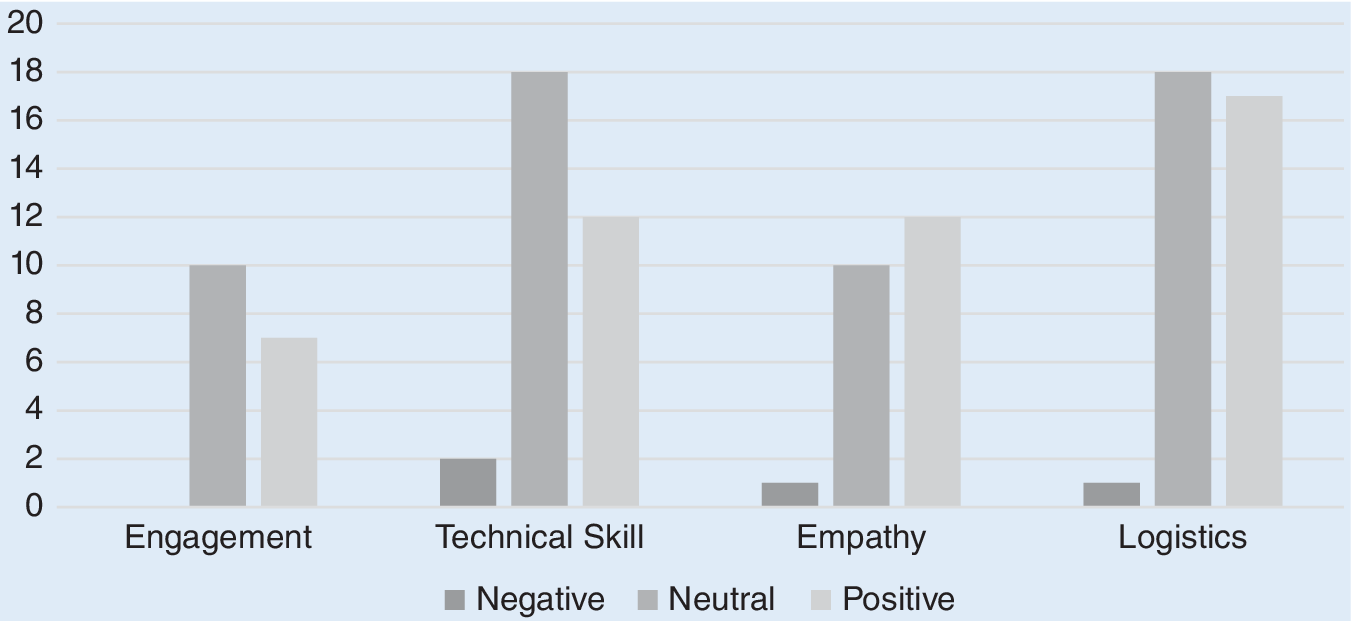
We discuss the open-ended responses to better understand the experiences of respondents during the early semesters of the pandemic, for good and for bad. For instance, in coding the open-ended responses to the question that asked respondents to indicate the most important way that the COVID-19 pandemic has changed their teaching for the long term, we found four categories of responses that occurred most frequently: engagement (i.e., incorporating pedagogy highlighting interactive and experiential learning); technical skill (i.e., learning new platforms and technologies); empathy (i.e., embracing efforts to accommodate difficult circumstances); and logistics (e.g., adjusting assignment content and/or due dates and applying new teaching approaches to work around logistical challenges).
Figure 1 illustrates the breakdown of these responses by valence (i.e., whether the response was negative, neutral, or positive). The highest number of positive responses were related to logistics—for instance, one respondent indicated that they would continue to rely on “more clearly designed and specified assignments, more flipping the classroom (e.g., prerecorded lectures, with pass/fail embedded ‘quizzes’ where students ask questions followed by discussion and activities) when we are live.” Another respondent stated the following:
Content of Open-Ended Comments on How Your Attitude Toward Teaching Has Changed Since the Pandemic Started, by Valance

I think the shift to a different teaching modality made it necessary to be more explicit with myself and with students about the day-to-day mechanics and expectations of the class, because we were all on unfamiliar ground, and I think this greater degree of reflectiveness and explicitness is something that I will continue to pursue after COVID too, rather than expect that students will all basically know what a college class is and how it is supposed to work.
The category with the highest percentage of positive responses was empathy, as in this response from the instructor who wrote: “It has made me more aware that many of my students have challenges that I do not know about which affect their performance.” Although there were few strictly negative responses, most were in the neutral category and included responses that provided both a positive and negative comment. For example, this respondent, who talked about the pros and cons of learning new technical skills through the online medium, as follows: “It taught me Teams, but I am not sure I will use it again.”
“It has made me more aware that many of my students have challenges that I do not know about which affect their performance.”
Focus-group data further reinforce the statistical findings in the models, showing that those faculty members who had experience teaching online had the easiest transition. Indeed, those who described the most ease with the transition were an instructor at a regional public university—historically serving many nontraditional students via distance education—and two community college professors who had long incorporated online courses into their rotation. One professor noted that the most significant difficulty was not adapting to online teaching but rather helping students who had not signed up for online learning because they either preferred face-to-face instruction or lacked Internet access. In addition, one graduate student with extensive online teaching experience indicated that it was far more difficult to assist professors who had never taught online than it was to quickly modify their own courses. Experience was clearly a key indicator of how quickly and comfortably professors were able to adapt in the midst of the pandemic.
Although most political science instructors we interviewed relayed both positive and negative teaching experiences during the pandemic, they overwhelmingly focused on explaining how their experiences would positively affect their pedagogy in the long run and how they were adapting what they learned online for the in-person classroom. Consider, for instance, this respondent’s comment: “It has made me very much aware of the power and utility of ‘break-out sessions’ in Zoom or Webex. When I return to campus in the fall, I will need to figure out how to use this type of teaching strategy in the physical classroom.”
Our second hypothesis specifically examined empathy in teaching. There are many possible ways to measure empathy. We examined empathy through a question about how often instructors talk one on one with students about their personal problems. We asked them how often they did this both before and during the pandemic, with response options of “never,” “rarely,” “sometimes,” and “often” (coded 1 to 4). We found that the mean for all respondents before the pandemic was 2.73 but during the pandemic it was significantly higher at 3.00. Additionally, the mean for women before the pandemic (2.90) was significantly higher than for men before the pandemic (2.62), and it continued to be higher during the pandemic (3.18 compared to 2.88). These means over time, presented in table 2, are supportive of Hypothesis 2.
Mean Values for How Often Respondents Meet with Students One on One to Discuss Personal Problems, Coded from Never (1) to Often (4), by Gender and Time

Note: The differences between men and women in table 2 are statistically significant, as are all differences comparing before and during COVID-19.
The open-ended comments showed a similar number and percentage of men (N=18, 24%) and women (N=15, 30%) who mentioned empathy in their open-ended responses. However, the focus groups revealed that women were the most likely to not only describe informal ways that they made it easier for students to share personal problems that might affect their performance but also to share systematic strategies for identifying and responding to individual needs. One instructor, for example, explained how the pandemic underscored the importance of trauma-informed pedagogy. She described how insights gleaned from a pre-semester survey could address not only students’ pandemic-related struggles but also issues that first-generation and at-risk students regularly experience (e.g., limited access to basic needs or technology). She concluded: “A pre-course survey should not just be something that we do when there is a COVID-19 pandemic but something that we always do!” The importance of understanding students’ limitations was underscored by international faculty members who participated in our focus groups. They compensated for their students’ limited access to computers by shifting interactions with students to social media apps (e.g., WhatsApp and Slack) that they could access on their smartphones. They were able to accommodate their students only because they fully understood their limited access to computers and laptops—insights that US political scientists are less likely to have without seeking input through a pre-semester survey.
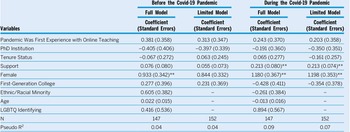
We looked more closely at how talking one on one with students changed from before to during the pandemic by running two ordered logit models. For each, we included whether the faculty member was new to teaching online during COVID-19; a dummy variable if they were at a PhD-granting institution; an ordered control for tenure status; a measure of how supported they felt; and demographic variables for age, gender, race, first-generation status, and LGBTQ identity.
These models, presented side by side in table 3 (with both full and limited models), reveal two important findings between the two periods. First, as indicated by previous results, women were more likely in both periods to have one-on-one conversations with students about their personal problems. Second, before COVID-19, the support measure was not a significant predictor of whether respondents have these types of conversations; however, during COVID-19, there was a significant positive relationship between feeling supported and having one-on-one conversations with students. This finding indicates that support from institutions is one key factor that enables faculty members to be there for students and to extend the empathy that can be so critical to their success.
This finding indicates that support from institutions is one key factor that enables faculty members to be there for students and to extend the empathy that can be so critical to their success.
Ordered Logistic Models Predicting Talking One on One with Students, Before and During the COVID-19 Pandemic

Notes: **p<0.05, *p<0.1.
Empathy was a major theme in our focus-group discussions. Even those professors who described juggling their own pandemic-related burdens—especially caregiving and technology struggles—indicated that their experiences resulted in “reverse empathy” from students. Most focus-group participants shared that their willingness to be authentic with students enhanced rapport and engagement in their courses. Ironically, focus-group participants with childcare burdens or heavy teaching loads were no less apt to report being empathetic to students—and were more vocal about appreciating students’ capacity to extend grace to and understanding of their own difficult circumstances during the pandemic. Ideally, institutions will find creative ways to mirror the empathy and support that students extended to the most overwhelmed faculty members during the pandemic.
Our third hypothesis was that political science instructors would be more likely to discuss current events in their classes during the pandemic compared to before the pandemic. We thought this might be the case because the events associated with the pandemic were so politically meaningful and personally relevant. We asked respondents how often they bring up current events in class lectures and discussions—both before and during the pandemic—with response options of “never,” “rarely,” “sometimes,” and “often” (coded 1 to 4). The mean is quite high in both cases and almost exactly the same: 3.691 before and 3.696 during the pandemic. It may be that there is a “ceiling effect” at play here—political science professors already are giving all of the class time that they are willing to devote to current-events discussion.
The focus-group discussions revealed additional complexities that instructors consider when incorporating potentially divisive current events in the classroom. Several participants expressed concern about teaching online or hybrid courses in a polarized political environment. They were concerned that recordings of their lectures and their students’ contributions to class discussion could be taken out of context and used against them in the future. Several indicated that they had changed their typical course rotation to avoid teaching those about women and politics or about racial and class-based inequality in an online format. One participant explained this choice by noting: “We [she and her women and politics students] talk about things like sexual assault…about a lot of things that are very delicate, and online just did not seem right.” Another expressed concern not only about her students’ privacy but also that she and her campus could be accused of teaching so-called divisive content connected to concerns about critical-race and critical-feminist theory.
These types of concerns may discourage discussion of current events despite the way the pandemic highlighted the connection among politics, public policy, and students’ lived experiences–and may explain the lack of significant change between periods.
CONCLUSION
The COVID-19 pandemic is a moment of crisis for higher education and for political science. Although this moment is challenging in ways that we never imagined, the data from our study indicate that there is reason for hope. Most political scientists are learning from their pandemic teaching experiences. The empathy and understanding that we are fostering with our students now can create a more positive, rapport-filled learning environment in the future (Glazier Reference Glazier2021).
However, there is reason for caution as well. The empathy burdens of the pandemic are not distributed equally, with women carrying a heavier load than men. We also discovered just how important institutional support can be, enabling both men and women to be the type of empathetic faculty members that students need. Given that our sample is skewed toward faculty who are at better-resourced institutions and are in less-precarious employment situations than many in higher education, we imagined that this support would make an even more significant difference for a more representative sample.
In many ways, these recommendations are likely to generalize across academic disciplines. Given that professors who fared better during the pandemic had experience teaching online, departments should ensure that all faculty—not only junior or contingent faculty or those from demographic groups disproportionately called on to provide department service—are well prepared to teach online. Incentives should include not only professional development and assistance with technical skills but also a flexible array of incentives that might include smaller class sizes, additional compensation, and release time (Gümrükçü Reference Gümrükçü2022).
Institutionalizing student-focused care with appropriate staff and programs is an essential step in sustaining the well-being of faculty members, which in turn enables them to be a resource for students.Footnote 2 This support is especially important in male-dominated disciplines such as political science, in which the burden of supporting students often disproportionately falls on a smaller percentage of women faculty (Dionne Reference Dionne2019), who we know have been harder impacted professionally by COVID-19 (Kim and Patterson Reference Kim and Patterson2021; Shalaby, Allam, and Buttorff Reference Shalaby, Allam and Buttorff2021). Especially given that the burden of supporting students falls disproportionately on women, institutions should attempt to minimize damage to caregiving faculty members by modifying retention, tenure, and promotion criteria and/or by stopping the tenure clock for assistant professors who faced the daunting task of transitioning to online teaching for the first time in the midst of a pandemic (Sotto-Santiago et al. Reference Sotto-Santiago, Dilly, O’Leary, Craven, Kara, Brown, Kressel, Rohr-Kirchgraber and DiMeglio2021).
The pandemic not only heightened the connection between foundational political science work and current events; it also exacerbated existing inequity in higher education. Therefore, institutional support also must extend to protecting academic freedom to ensure that faculty members feel safe enough to continue offering courses that address equity and inclusion—and that students are comfortable to authentically engage in class discussion and activities.
…institutional support also must extend to protecting academic freedom to ensure that faculty members feel safe enough to continue offering courses that address equity and inclusion—and that students are comfortable to authentically engage in class discussion and activities.
Hence, although instructors, on average, view positives in the new technical skills they have learned, there were many comments lamenting what has been lost. One respondent said that teaching during the pandemic led to “value face-to-face instruction even more than I did before.” Moreover, teaching during the pandemic fundamentally has taken a toll on faculty members. We witnessed this in open-ended comments such as the following: “I feel I have far less emotional energy, enthusiasm, motivation, and creativity to put into my teaching than I used to. I am burnt out. I cannot continue to perform at this level without breaking my heart or my brain or both.”
Although the data used in this study are not representative of all political science instructors, the multimethod approach we used provides valuable insights into how the COVID-19 pandemic is changing political science teaching for the long run. One major change is the increased use of the online medium. Although the abrupt change to emergency remote learning in the early semesters of the pandemic was challenging—especially for those faculty members who had not taught online before—many see positives in their pandemic teaching experiences. As one survey respondent explained when asked about the long-term impact of the pandemic: “The structural change to online learning *is* the impact….It creates new possibilities for engagement and flexibility….” By better understanding how political scientists are teaching during this pandemic and going forward, we can be prepared to ask for and provide better institutional support as described herein. Despite the resilience and optimism displayed by many of our respondents, we believe that faculty members and students both need greater support.
ACKNOWLEDGMENTS
The authors thank APSA for its support provided for this research through a Small Research Grant awarded to Rebecca Glazier in 2020 and for its assistance in distributing the survey.
DATA AVAILABILITY STATEMENT
Research documentation and data that support the findings of this study are openly available at the PS: Political Science & Politics Harvard Dataverse at https://doi.org/10.7910/DVN/KUNQGF.
Supplementary Materials
To view supplementary material for this article, please visit http://doi.org/10.1017/S1049096522001391.
CONFLICTS OF INTEREST
The authors declare that there are no ethical issues or conflicts of interest in this research.