Introduction
Language production entails a series of successive cognitive processes. In general, there is a consensus among the existing theories that the phonemic segment plays a fundamental role in the stage of phonological retrieval and encoding in language production (e.g., Dell, Reference Dell1986; Levelt, Roelofs & Meyer, Reference Levelt, Roelofs and Meyer1999; Rapp & Goldrick, Reference Rapp and Goldrick2000) and previous research on Indo-European languages such as Dutch and English have shown support for this view. However, recent research has shown that the role of the phoneme segment may not be applicable to all languages. For example, studies have shown that the syllable serves as the phonological preparation unit in language production in Chinese (J.-Y. Chen, Chen & Dell, Reference Chen, Chen and Dell2002; T.-M. Chen & Chen, Reference Chen and Chen2013; O’Seaghdha, Chen & Chen, Reference O’Seaghdha, Chen and Chen2010; You, Zhang & Verdonschot, Reference You, Zhang and Verdonschot2012), and that the CV (consonant + vowel) mora is selected as the phonological preparation unit in Japanese (Kureta, Fushimi & Tatsumi, Reference Kureta, Fushimi and Tatsumi2006; Verdonschot, Kiyama, Tamaoka, Kinoshita, La Heij & Schiller, Reference Verdonschot, Kiyama, Tamaoka, Kinoshita, La Heij and Schiller2011). As a result, native Dutch, Chinese, and Japanese speakers may select different units in phonological retrieval and encoding during spoken word production (i.e., the phoneme for Dutch, the syllable for Chinese, and the CV mora for Japanese). Given the above cross-linguistic differences, a natural question to ask is: for people who are learning their second language (L2), particularly those whose two languages have different phonological preparation units, does their native language (L1) influence the selection of the phonological preparation unit in the L2? In the following sections, we first introduce the paradigm that was used in our study to investigate the phonological preparation unit in spoken word production. We then discuss the cross-linguistic differences and previous literature about the influence of L1 on L2 phonological processing. The introduction of the present study is presented subsequently.
The Form Preparation Paradigm
A form preparation task, also called the implicit priming paradigm, has been frequently used to investigate the phonological preparation unit in spoken word production in adults’ native language (J.-Y. Chen et al., Reference Chen, Chen and Dell2002; T.-M. Chen & Chen, Reference Chen and Chen2013; Cholin, Schiller & Levelt, Reference Cholin, Schiller and Levelt2004; Kureta et al., Reference Kureta, Fushimi and Tatsumi2006; Meyer, Reference Meyer1990, Reference Meyer1991; O’Seaghdha et al., Reference O’Seaghdha, Chen and Chen2010). The task involves an associate learning session and a naming session. In the associate learning session, participants memorize some prompt-response word pairs (e.g., night-day, wet-dew, and bread-dough). After the participants indicate that they have memorized all the pairs, a naming session is conducted immediately. In the naming session, lists of prompts are presented. For each list, a set of prompt words appears in a random order and the participants are required to say the corresponding response word as quickly and accurately as possible (e.g., when the word night is presented, participants need to say the word day). The critical manipulation is the context of the list: in the heterogeneous context, the response words do not share any phonological units systematically in common (e.g., three response words are day, sea, pie); in the homogeneous context, the response words share the same ingredient (e.g., the initial phoneme is always /d/ for day, dew and dough). If the shared ingredient is the phonological preparation unit in the target language, the foreknowledge of the ingredient allows the participants to prepare their production in advance, thus facilitating their naming latency in the homogeneous list.
Research using the form preparation task suggests that phonological preparation units differ across languages (Chen et al., Reference Chen, Chen and Dell2002; Kureta et al., Reference Kureta, Fushimi and Tatsumi2006; Meyer, Reference Meyer1990, Reference Meyer1991; O’Seaghdha et al., Reference O’Seaghdha, Chen and Chen2010). Native speakers of alphabetic languages such as Dutch (Meyer, Reference Meyer1990, Reference Meyer1991) and English (O’Seaghdha et al., Reference O’Seaghdha, Chen and Chen2010) select phonemic segment as the preparation unit in spoken word production. Native Mandarin speakers benefit from the same initial syllable but not from the same initial phoneme (Chen et al., Reference Chen, Chen and Dell2002; O’Seaghdha et al., Reference O’Seaghdha, Chen and Chen2010), suggesting that the primary preparation unit is the syllable instead of the phoneme in Mandarin. Native Japanese speakers benefit from the same initial CV (consonant-vowel) mora but not the same phonemic segment (Kureta et al., Reference Kureta, Fushimi and Tatsumi2006), suggesting that the CV mora may be the preparation unit in Japanese.
A limitation of the traditional associative word naming task is that the orthographic information is explicitly represented in the learning session and naming session. Li, Wang, and Idsardi (Reference Li, Wang and Idsardi2015) showed that orthographic cues might encourage speakers to choose the preparation unit that is more compatible with the orthography used in the task. For native Mandarin speakers, the onset was selected as the preparation unit when the materials were presented in Pinyin, a phonetic system that uses the Latin alphabet to transcribe the pronunciation of Chinese characters. However, when the stimuli were presented in Chinese characters, a morphosyllabic writing system, the participants did not show the same pattern of onset facilitation. Kureta, Fushimi, Sakuma, and Tatsumi (Reference Kureta, Fushimi, Sakuma and Tatsumi2015) showed a similar pattern with Japanese speakers who demonstrated significant phoneme facilitation when participants learned materials in romaji (i.e., a phonetic system to write Japanese using the Latin alphabet). However, this phoneme preparation effect was not shown when materials were presented in an auditory task. The above results suggested that presenting visual materials in an alphabetic writing system may encourage speakers to prepare spoken production in smaller units (i.e., the phoneme). Alario, Perre, Castel, and Ziegler (Reference Alario, Perre, Castel and Ziegler2007) suggested that the associative learning session may encourage speakers to use orthographic codes to facilitate memorization and hence speed up the following naming session. As a result, similar to Alario et al. (Reference Alario, Perre, Castel and Ziegler2007), we decided to adopt a simple picture naming task with the form preparation paradigm in order to avoid the influence of orthographic cues. Chen and Chen (Reference Chen and Chen2013) adopted a simple picture naming task with the form preparation paradigm to investigate the role of onset and syllable segment in phonological preparation in Mandarin Chinese. Participants were required to name a list of pictures whose names may share the same onset, the same initial syllable segment or nothing systematically in common. A significant facilitation was only shown in the same syllable segment condition, suggesting that syllable segment instead of onset is the phonological preparation unit in speaking Mandarin Chinese even when no orthographic cues were provided.
The role of rhyme in phonological preparation
Few studies have employed the form preparation paradigm to examine the role of later components of a word (e.g., rhyme or the second syllable of a disyllabic word) in preparing spoken word production. Meyer (Reference Meyer1991) showed that fore-knowledge of the later components of a word did not benefit native Dutch speakers in a form preparation task, presumably because the processing of phonological units is sequential. However, Li et al. (Reference Li, Wang and Idsardi2015) found that native Mandarin speakers showed significant rhyme interference effect with Pinyin cues in an associative naming task with form preparation paradigm. A potential explanation of this interference effect is that lexical competition occurred between the response item and its rhyme neighbors. The contrast between these two studies may be related to the different linguistic features between Dutch and Mandarin Chinese, the simple syllable structure of Chinese may make it easier to activate the lexical information of rhyme neighbors. Therefore, the second goal of the present study was to examine the role of the later component (i.e., rhyme) in phonological preparation of spoken English word production.
It is likely that rhyme would not lead to any phonological preparation effect in English, just as with what has been shown in Dutch. However, it is also possible that a rhyme interference effect would be shown as a result of competition due to different onsets. According to the parallel-then-sequential model proposed by O’Seaghdha and colleagues (see O’Seaghdha & Marin, Reference O’Seaghdha and Marin2000 for a detailed review), all the segments of the target words are activated in a parallel fashion, but are assembled sequentially. As a result, when a list of spoken words share the same rhyme, the shared rhyme may reactivate the previous trial when participants need to produce the target of the current trial, so that the different onsets compete with each other when speakers assign or assemble the phonological units sequentially. Using a continuous repetition procedure without orthographic input, O’Seaghdha and Marin (Reference O’Seaghdha and Marin2000, Exp. 4) revealed that repeatedly producing word pairs that shared the same rhyme (e.g., glory-story-glory-story-. . .) led to an interference effect and the effect was modulated by frequency (i.e., larger interference for high frequency words). Since all the segments were retrieved in a parallel fashion, the rhyme information sent feedback and activated other rhyme neighbors (e.g., glory) when the assignment of segments of the current trial (e.g., story) was initiated. The different onsets (i.e., gl- and st-) then led to competition and thus the interference effect. Although Sevald and Dell (Reference Sevald and Dell1994) showed a facilitative effect when participants kept producing end-related words using the same continuous repetition procedure, O’Seaghdha and Marin (Reference O’Seaghdha and Marin2000) explained that the difference might be due to the fact that Sevald and Dell used less naturalistic materials and their participants were more extensively practiced, so that segmental retrieval and assignment required less time than normal activation of the phonological units.
Repeating rhyme neighbors in an English reading task may also lead to an interference effect due to lexical competition as proposed by Lukatela and Turvey (Reference Lukatela and Turvey1996). In that study, native English speakers named a target word (e.g., nose) slower when its prime shared the target's rhyme (e.g., hose) compared to the neutral condition when the prime did not share any phonological information with the target (e.g., dish). Lukatela and Turvey explained this effect as a result of the prime inhibiting the pre-activation of the target at the lexical level. Li et al. (Reference Li, Wang and Idsardi2015) also used the lexical competition hypothesis to explain their rhyme inhibition effect in native Chinese speakers using the associative word naming task. In their study, Pinyin served as orthographic cues to encourage speakers to attend to the sub-syllabic units, including the rhyme unit, given that it is explicitly represented. Producing a Pinyin trial pre-inhibited its rhyme neighbors, including the next trial, thus interference occurred.
In summary, limited research has been conducted to investigate the role of rhyme in phonological preparation in English. Although different results have been shown in the continuous repetition task, there was a consensus in the previous literature that language production entails a sequential segmental assignment process (Meyer, Reference Meyer1991; O’Seaghdha & Marin, Reference O’Seaghdha and Marin2000; Sevald & Dell, Reference Sevald and Dell1994). If parallel activation occurs prior to the sequential segmental assignment, a rhyme interference effect may occur. If the phonological activation is strictly sequential, then it is more likely that shared rhyme would not show any form preparation effect in English, just like the case of Dutch. In addition, lexical competition between rhyme neighbors may also contribute to the rhyme interference effect.
The influence of L1 on L2 phonological processing
Very limited research has investigated the phonological preparation unit in the L2 when speakers’ L1 and L2 have different phonological preparation units. As far as we know, the only study that has investigated this issue was Verdonschot, Nakayama, Zhang, Tamaoka, and Schiller (Reference Verdonschot, Nakayama, Zhang, Tamaoka and Schiller2013). In a masked primed visual word naming task, Chinese ESLs (native Chinese speakers who speak English as a Second Language) with high English proficiency showed significant onset facilitation in English. Namely, when the visual prime (e.g., bark) shared the same phoneme onset with the visual target (e.g., BENCH), Chinese ESLs showed a significantly faster response when naming the visual word BENCH compared with a control condition (e.g., when the prime is dark, a word which does not share any phonological unit with the target word). These results suggest that, like native English speakers, highly proficient Chinese ESLs assemble phonological information phoneme by phoneme. However, a limitation of this study is that, in a visual word-naming task, orthographic processing is involved in phonological retrieval and encoding. It remains unclear what the phonological preparation unit would be in the L2 when orthographic information is not present, such as in a conceptually driven production task (e.g., picture naming), and the present study aims to fill this gap.
Although limited research has investigated the influence of the L1 on the phonological preparation unit in the L2, previous literature has shown rich evidence on cross-language transfer of phonological awareness (Chen, Xu, Nguyen, Hong & Wang, Reference Chen, Xu, Nguyen, Hong and Wang2010; Cisero & Royer, Reference Cisero and Royer1995; Dickinson, McCabe Clark-Chiarelli & Wolf, Reference Dickinson, McCabe, Clark-Chiarelli and Wolf2004; Durgunoğlu, Nagy & Hancin-Bhatt, Reference Durgunoğlu, Nagy and Hancin-Bhatt1993). Phonological awareness entails the ability to detect and manipulate phonological units within a word, such as phonemes (e.g., /s/ in the word skip /skɪp/), onsets (e.g., /sk/ in skip), rhymes (e.g., /ɪp/ in skip), or whole syllables (e.g., /skɪp/) (Gillon, 2004). Turning back to the literature about cross-language transfer of phonological awareness, it has been shown that first-grade Spanish-speaking children who showed better phonological awareness in Spanish also performed better in English tasks that tapped into phonological awareness (Durgunoğlu et al., Reference Durgunoğlu, Nagy and Hancin-Bhatt1993). Furthermore, Wang, Perfetti, and Liu (Reference Wang, Perfetti and Liu2005) showed that cross-language transfer of phonological awareness occurs even between languages that have different writing systems. For 8-year-old Chinese–English bilingual children, their onset and rhyme awareness in Chinese were both correlated with their English onset and rhyme skills. In summary, previous literature suggests that the sensitivity and ability to manipulate certain phonological units (e.g., onset, rhyme and phoneme) in the L1 could be transferred to the L2. The present study investigates whether the transfer of phonological awareness also applies to phonological preparation in spoken word production. If the native Chinese speakers transfer their phonological preparation unit in Chinese to their spoken word production in English, they may select syllable as their phonological preparation unit in English. Conversely, if the native Chinese speakers do not transfer their phonological preparation unit in L1 to L2, they may perform like native English speakers and use phoneme as the preparation unit.
A third possibility is that Chinese ESLs may initially use syllable as the phonological preparation unit but change it to phoneme after some practice. Jared and Kroll (Reference Jared and Kroll2001) suggest that recent language experience influences bilingual speakers’ performance on spoken word production, although their work was not focused on the phonological preparation unit. In their study, English–French and French–English bilinguals were asked to name written English words with or without French enemies (i.e., an orthographically-driven naming task). A French enemy of an English word is a French word (e.g., FAIT) that shares the same word-body with the English words (e.g., BAIT) but is pronounced differently (e.g., -AIT is pronounced with a short /e/ in French). Participants’ naming latencies were influenced by whether they had read French words recently: the French–English bilinguals who were more dominant in French showed a significantly stronger inhibition in naming English words with French enemies after a French reading session compared to their performance prior to the reading session. In the present study, we employed a block design in the form preparation task and the participants were asked to repeat the response items. Based on Jared and Kroll's work, it is possible that Chinese ESLs would shift their mental orientation to phoneme in the later blocks after some recent practice with English L2.
The Present Study
The present study consists of two picture naming experiments. In the first experiment, a group of native Chinese speakers were asked to complete a simple picture naming task in Chinese. The goals of Experiment 1 were 1) to replicate the results of Chen and Chen (Reference Chen and Chen2013), which showed that the phoneme onset was not the preparation unit in Chinese, 2) to investigate the role of rhyme in speaking Chinese when no orthographic cues are provided, and 3) to compare with Experiment 2 which was conducted in English on native English speakers to address the cross-linguistic differences. We predicted that no onset effect would be presented in Experiment 1, as Chen and Chen (Reference Chen and Chen2013) suggested. With regards to the rhyme effect, one prediction is that no rhyme effect would be presented, since previous literature has suggested that later components may not contribute to phonological preparation (Meyer, Reference Meyer1991). Another possibility is that a rhyme interference effect could be shown, considering that native Chinese speakers have shown rhyme inhibition when the items were presented in Pinyin in Li et al. (Reference Li, Wang and Idsardi2015). In the picture naming task, although there were no Pinyin cues available to encourage participants to attend to the sub-syllabic units, there were no character cues to encourage them to attend to the syllabic unit either. Therefore, there is still a possibility that repetition of rhyming words in the present study may lead to an interference effect, as a result of lexical competition between the response item and its rhyme neighbors as suggested by Li et al. (Reference Li, Wang and Idsardi2015).
In Experiment 2, an English simple picture naming task using the form preparation paradigm was administered among Chinese ESLs and native English speakers. As mentioned earlier, there are advantages to conducting a simple picture naming task instead of the traditional associative naming task: first, the absence of explicit orthographic information can help to avoid the influence of orthographic cues; second, the absence of associative learning session can help reduce the possibility that participants adopt orthographic strategies to facilitate memorization. The critical conditions in both Experiments 1 and 2 were whether the target names (i.e., the name of pictures) shared the same onset, same rhyme, or nothing systematically in common.
The purpose of the Experiment 2 was to address two questions. Firstly, we wanted to compare Chinese ESL speakers and native English speakers on whether they select onset phoneme as the preparation unit. Secondly, we wanted to investigate the role of the rhyme in preparing language production in English among the Chinese ESL and native English speakers. Given that phoneme onset has been shown not to be the preparation unit in Chinese in previous research (e.g., T.-M. Chen & Chen, Reference Chen and Chen2013), and if the preparation unit in the L1 affects the selection of preparation unit in the L2, then the Chinese ESLs would not benefit from the fore-knowledge of the onset in the English picture naming task, in contrast to native English speakers, where onset facilitation is expected. If the preparation unit only depends on the linguistic features of a target language but not on the speaker's L1 experience, both groups would show significant onset facilitation. If the preparation unit could be influenced by recent language experience, the Chinese ESLs may only show onset facilitation in later blocks whereas native English speakers would show it in all blocks.
Concerning our second goal about the rhyme effect, if phonological preparation in English is similar to preparation in Dutch, native English speakers would not show any significant rhyme effect, in accordance with Meyer (Reference Meyer1991). An alternative hypothesis is that an interference effect would be shown due to onset competition (see O’Seaghdha & Marin, Reference O’Seaghdha and Marin2000), perhaps with additional contribution from lexical competition. For Chinese ESLs, if the Experiment 1 on Chinese L1 does not show a rhyme effect, then it is likely that the ESLs would not show such an effect in English either due to language transfer. They may also show a rhyme interference effect due to a joint contribution from phonological and lexical competition.
Experiment 1: Form preparation in Chinese
This experiment used a simple picture naming task with the form preparation paradigm where the critical variable for manipulation was Context, that is, whether the name of the pictures in a list shared the same onset, rhyme or neither (heterogeneous). The same items were used in both the same onset and same rhyme conditions with three lists in the same onset, same rhyme and the heterogeneous conditions, respectively. The heterogeneous condition served as a control condition (See Appendix A for all stimuli for each list). We expected to replicate the results found in previous literature (Chen & Chen, Reference Chen and Chen2013) where participants failed to show a facilitative effect in the same onset condition. We also expected to see a null effect in the same rhyme condition considering that speakers may retrieve and encode the syllable as an integral unit (Chen et al., Reference Chen, Chen and Dell2002; Chen & Chen, Reference Chen and Chen2013; O’Seaghdha et al., Reference O’Seaghdha, Chen and Chen2010), and that there were no orthographic cues (e.g., Pinyin) to encourage speakers to attend to the rhyme unit. An alternative prediction is that a rhyme interference effect might be shown, similar to the finding with Pinyin as the stimuli in Li et al. (Reference Li, Wang and Idsardi2015).
Participants
Participants consisted of 16 native Mandarin-speaking students with normal or corrected-to-normal vision from a Mid-Atlantic university. There were 8 females and 8 males, whose ages ranged from 23 to 27 years (M = 23.9, SD = 1.49). Their average length of staying in the U.S. was 2.1 years (SD = 1.3). All of the ESLs began learning English at 9 or 10 years old, and all of them have taken TOEFL (Test of English as a Foreign Language), with an average score of 99 out of 120 (SD = 4.7).
Design and materials
In the form preparation task, participants were presented with nine picture items. For the onset session, the target items consisted of three sets of three monosyllables with the onsets /p/, /ʂ/, or /t/. For example, in the /p/ set, the three monosyllables were /pəŋ2/ (meaning: awning), /pu3/ (meaning: music score), and /pa
 4/ (meaning: bubble) (the number denotes tone) that only shared the same onset but had a different rhyme. By shuffling the combinations of the nine items, three sets of three monosyllabic words with the rhymes /əŋ2/, /u3/, and /a
4/ were formed for the rhyme session. For example, in the /əŋ2/ set, the three monosyllables were /pəŋ2/ (meaning: awning), /ʂəŋ2/ (meaning: rope), and /təŋ2/ (meaning: pain). These items shared the same rhyme but differed in onset.
For the same onset session, each participant was required to complete a simple picture naming task for six lists. The primary manipulation, Context, was whether the target names (i.e., the names of pictures) were homogeneous (sharing the same onset) or heterogeneous (sharing nothing systematically in common; the control condition). Three lists were homogenous, and the other three were heterogeneous (See Appendix A for all stimuli for each list). Each list had three presentation Blocks, and in each block, each item was presented four times (Repetitions) in a random order. Therefore, in each list, each picture was presented 12 times in total. Both the Sequence of contexts (i.e., whether participants received the homogeneous list or heterogeneous list first from each pair of lists), the sequence of the onset and rhyme sessions, and the order of the three list-pairs was counterbalanced across participants in each language group. In total, each participant received 216 trials (3 blocks × 2 contexts × 3 onsets × 3 items × 4 repetitions). Sequence was treated as a between-subjects factor.
For the rhyme session, the design was the same as that for the onset session, except that the items in a homogeneous list shared the same rhyme rather than the same onset (See Appendix A for all stimuli including each homogeneous list and heterogeneous list). All participants were asked to complete both the onset and rhyme sessions. The interval between the two sessions was about five minutes, and participants were informed at the end of the first session that another session was to follow and that all the requirements for the second session were the same as for the first session. The sequence of the onset and rhyme session was coded as OR in the subsequent analyses and was treated as a between-subjects factor.
Procedure
First, each participant was presented with nine cards, each of which had one picture printed on it. Participants were asked to provide a monosyllabic name for each picture, and were then corrected if the names they provided were not the same as the target name. Correction typically occurred on one to three items out of nine. A practice of the test session was then given to help participants become familiar with the paradigm and to confirm that they would use the target names. In the practice session, the nine pictures were presented on a computer screen in a randomized order, and the participants were asked to say the corresponding name as quickly and accurately as possible. Only after participants’ performance suggested that they were familiar with the procedure and the materials (i.e., being able to provide the correct answer of each item within 1,500ms) did the formal testing session begin. Both the practice and the formal test were implemented using DMDX software (Forster & Forster, 2003). For each list, after the three item pairs were shown to the participants, none of the participants needed extra time to be familiarized with the pictures before testing began. During the test session, each trial began with a 200ms, 1000-HZ warning tone and a cross (‘+’) fixation presented at the center of the screen. After the offset of the tone, the picture appeared 600ms later at the center of the screen for 1,000ms or until a response was provided. Participants were instructed to name each target picture aloud as quickly and accurately as possible. An AUDIO TECHNICA ATR-20 microphone was used as the voice key of the DMDX program to record participants’ reaction time while participants’ responses were recorded via a voice recorder. After each successive trial, the following trial began 200ms after a response was given, or after 1,500ms if no response was given. During the experiment, the first author sat behind the participants and scored their naming accuracy.
Results and discussion
Response time (RT) analyses were based on correct trials only (approximately 1% of the trials were incorrect and were deleted). Approximately 2% of the RT data was removed because the response failed to trigger the voice key or because hesitation or disfluency errors occurred. RTs that fell above or below 2.5 standard deviations away from the mean RT were also removed. In total, 4.8% of the RT data was removed, while the remaining RT data was log-transformed to improve normality. Analyses were carried out in R, an open source programming environment for statistical computing (R Development Core Team, 2008) with the lme4 package (Bates, Maechler, Bolker & Walker, 2013) and lmerTest package (Kuznetsova, Brockhoff & Christensen, 2013) for linear mixed effects modeling (LLM, GLMM). We reported analyses of the onset session and rhyme session separately in order to make the model more concise.
For the onset session, Context, OR (i.e., the sequence of onset and rhyme session), Block and Sequence (coded as Seq for brevity in R) were entered in the model as fixed effects whereas Participant and Item were entered as random slopes with Context serving as the intercept. The original mixed effect model entered in R for analysis of RT was “LogRT ~ Block * Seq * OR * Context+ (1 + Context|Participant) + (1 + Context|Item)”. The interaction terms were removed one at a time until we found the model with the best goodness-of-fit using the Chi-square test. Onset was not included as a fixed effect because it had already been embedded as an element in each item (i.e., each item had its own onset) and Item had been included as a random slope. Therefore, we decided to collapse onsets and to investigate the overall Context effect.
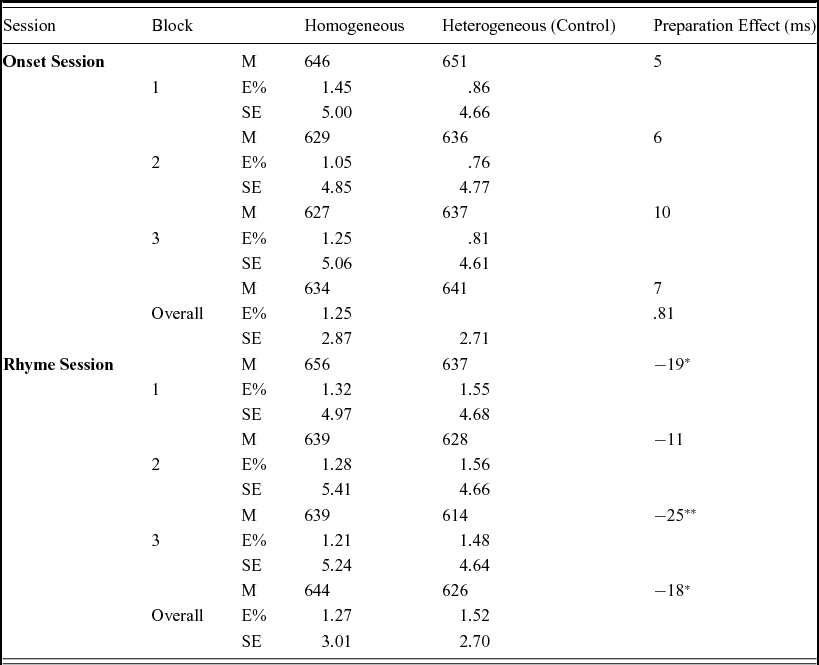
Likewise, for the rhyme session, Context, Block, OR and Sequence were entered in the model as fixed effects whereas Participant and Item were entered as random slopes with Context serving as the random intercept in the models. An analysis of accuracy rate in both sessions followed a similar procedure with the generalized linear (binomial) mixed-effects regression, but failed to show significant results. Also, the interaction terms were removed one at a time until we found the model with the best goodness-of-fit. See the upper part of Table 1 for summaries of the descriptive data of the onset session, and the bottom part for the rhyme session.
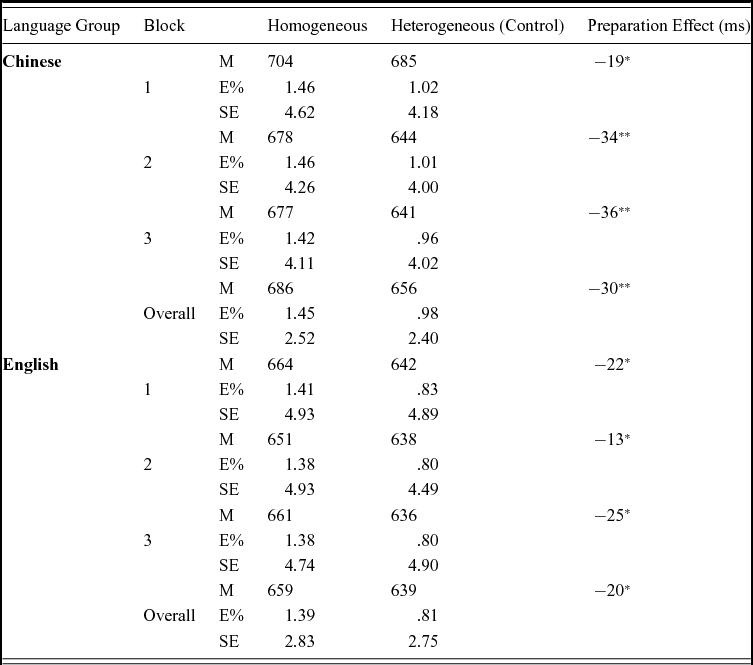
Descriptive data of participants’ performance in Experiment 1 with mean reaction time (M), error rates (E%), standard errors (SE), and preparation effects

Note. * p < .05; **p< .01
The onset session
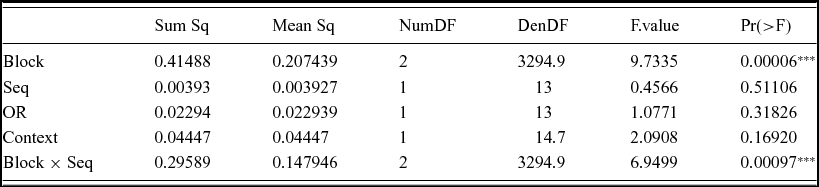
The main effect of Context did not reach significance (F (1, 14.7) = 2.0908, p = .16902) and also did not show a significant interaction with any other variables (ps> .10). As a result, the insignificant interaction terms have been removed. Participants also showed a significant Block main effect (F (2, 3294.9) = 9.7335, p < .001), indicating a possible practice effect that occurred over the course of the experiment considering that the RTs were faster in later blocks (Block 1: 649ms; Block 2: 632ms; Block 3: 632ms). See Table 2 for the full results.
Results of the ANOVA approach to linear mixed-effect model analysis of RT of the onset session in Experiment 1

Note. ***: p < .001
The rhyme session
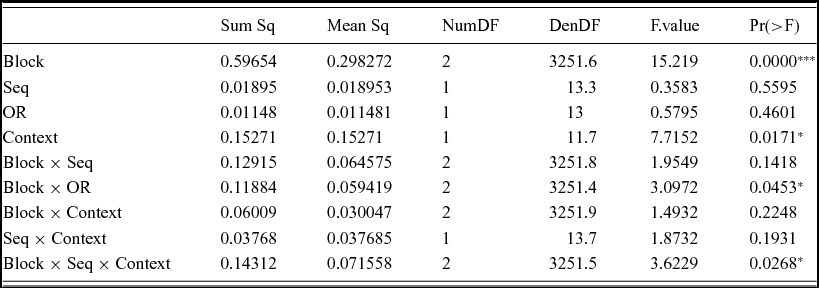
A significant rhyme interference effect was shown (F (1, 11.7) = 7.7152, p = .017) and as in the onset session, Context did not show significant interaction with any other variables (ps> .10). There was a significant Block × Seq × Context three-way interaction (F (2, 3251.5) = 3.6229, p = .02681), as well as a rhyme interference effect that was shown in all Block × Seq combinations with different effect sizes. Similar to the onset session, a significant Block main effect was shown (F (2, 3251.6) = 15.219, p < .001) since the RTs were faster in later blocks (Block 1: 647ms; Block 2: 633ms; Block 3:627ms). See Table 3 for the full results.
Results of the ANOVA approach to linear mixed-effect model analysis of RT of the rhyme session in Experiment 1

Note. *: p < .05; ***: p < .001.
Consistent with previous literature (Chen & Chen, Reference Chen and Chen2013), native Chinese speakers did not benefit from the fore-knowledge of the onsets of words during picture naming, suggesting that the phoneme onset is not their phonological preparation unit. A significant rhyme interference effect was shown. It is possible that lexical competition could be the reason for this interference effect, this interference effect is in line with the lexical competition hypothesis proposed in Lukatela and Turvey (Reference Lukatela and Turvey1996) and the finding in the Pinyin condition in Li et al. (Reference Li, Wang and Idsardi2015) that used the form preparation paradigm. In the present study, naming a target picture (e.g., /pəŋ2/, meaning awning) may pre-inhibit its lexicalized rhyme neighbors. In particular, the item of the next trial (e.g., /təŋ2/, meaning pain) was pre-inhibited. Thus, it took longer time for the participants to name the next trial (i.e., /təŋ2/). Note that Lukatela and Turvey (Reference Lukatela and Turvey1996) employed reading materials that started with orthographic input instead of a conceptually driven production task. Li et al. (Reference Li, Wang and Idsardi2015) employed an associative naming task that also involved orthographic processing. Therefore, further investigation is needed to examine whether lexical competition or pre-inhibition explanation is applicable to the interference effect shown in the picture naming task in the present study.
Another interpretation of the rhyme interference effect is phonological competition as a result of different onsets, according to the parallel-then-sequential model. For example, the shared rhyme may activate /pəŋ2/ when participants needed to produce /təŋ2/, so that /t/ and /p/ competed when speakers assigned or assembled the phonological units sequentially. Given that no onset effect was shown in Experiment 1, it is likely that a larger unit than onset (e.g., syllable) was retrieved as an integral unit in language production. Therefore, we suggest that it is more likely that lexical competition rather than phonological competition led to the rhyme interference effect. At least, the lexical competition could be a stronger effect than the phonological competition. Importantly, the rhyme interference effect was shown in our study in a simple picture naming task without orthographic cues, suggesting that this effect is not an artifact but an intrinsic property in Chinese word production. However, given the different results shown and different methodology used in the previous studies about the effect of rhyme repetition in language production (Lukatela & Turvey, Reference Lukatela and Turvey1996; O’Seaghdha & Marin, Reference O’Seaghdha and Marin2000; Sevald & Dell, Reference Sevald and Dell1994), future research is called for to conduct in-depth investigation about the mechanism underlying rhyme effect across different languages.
Experiment 2: Form preparation in English
Experiment 2 aimed to investigate the phonological preparation unit in English among Chinese ESLs and native English speakers. If the preparation unit in the L1 affects the selection of the preparation unit in the L2, Chinese ESLs would not show an onset facilitation effect while native English speakers would. If the preparation unit only depends on the linguistic features of the target language but not on speakers’ L1 experience, both groups should show significant onset facilitation. If the preparation unit is influenced by recent language experience, Chinese ESLs may show onset facilitation only in later blocks. For native English speakers, if the rhyme unit functions similarly to Dutch, they may not show any rhyme effect. However, it is also possible that lexical competition between rhyme neighbors and phonological competition between the different onsets of rhyme neighbors may jointly lead to a rhyme interference effect. For Chinese ESL speakers, they may show a rhyme interference effect if their L1 has an influence.
Participants
Participants consisted of two Language Groups, including 16 native Mandarin-speaking students (Chinese ESL group) who were proficient in English and 16 native English speakers (native English group) with normal or corrected-to-normal vision from a Mid-Atlantic university. The Chinese ESL speakers were from the same subject pool as those in Experiment 1. For the native English Language Group, there were 12 females and 4 males, whose ages ranged from 21 to 29 years (M = 23.0, SD = 3.89). For the Chinese ESL Group, there were 6 females and 10 males, whose ages ranged from 21 to 28 years (M = 24.6, SD = 2.19). For the Chinese ESLs, their average length of stay in the U.S. was 2.3 years (SD = 1.6). All of the ESLs began learning English at age 9 or 10, and all of them had completed the Test of English as a Foreign Language (TOEFL), with an average score of 102 out of 120 (SD = 4.4). The Boston Naming Test (BNT) (Kaplan, Goodglass & Weintraub, 1983) was also conducted as an objective measure of their English proficiency. Participants were asked to name sixty pictures with varying difficulty in terms of word frequency, and the number of corrected answers was recorded as an index of their English proficiency, labeled as their English Proficiency Score. The average score on the BNT was 23.8 (SD = 1.5).
Design and materials
In the form preparation task, participants were presented with nine picture items. For the onset session, the target items consisted of three sets of three monosyllables with the onsets, /d/, /b/, or /s/. For example, in the /b/ set, the three monosyllables were / beɪ/ (bay), / bʌk/ (buck), and /boʊ/ (bow), that only shared the same onset but each had a different rhyme. By shuffling the combinations of the nine items, three sets of three monosyllabic words with the rhymes /eɪ/, /ʌk/, and /oʊ/ were formed for the rhyme session. For example, in the /ʌk/ set, the three monosyllable words were /dʌk/ (duck), /bʌk/ (buck) and /sʌk/ (suck) with these items sharing the same rhyme but differing in onset. All the words were monosyllables without consonant clusters in the onset position because we wanted to ensure that the structure of the words was as similar as possible to the Chinese words in Experiment 1. This control can ensure that the form preparation effect, if one is found, is not unique to English words whose structures are illegal in Chinese (e.g., onset consonant clusters). See Appendix B for all the lists for both onset and rhyme sessions. The design of both sessions was the same as those in Experiment 1.
Procedure
The procedure was the same as that in Experiment 1.
Results and discussion
The procedure of data cleaning was same as the one used in Experiment 1. For the Chinese ESL group, 4.0% of the RT data was removed in total including incorrect answers (approximately 1%); failing to trigger the voice key, hesitation, or disfluency errors (1.2%); or RTs that were more than 2.5 standard deviations from the mean (1.8%). Similar to the Chinese ESL group, 4.3% of the native English speaking RT data was removed. Approximately 1% of data loss was due to incorrect answers; 1.5% was due to failing to trigger the voice key, hesitations, or disfluency errors; and 1.5% due to the RT being more than 2.5 standard deviations away from the mean. The remaining RTs were log-transformed to improve normality.
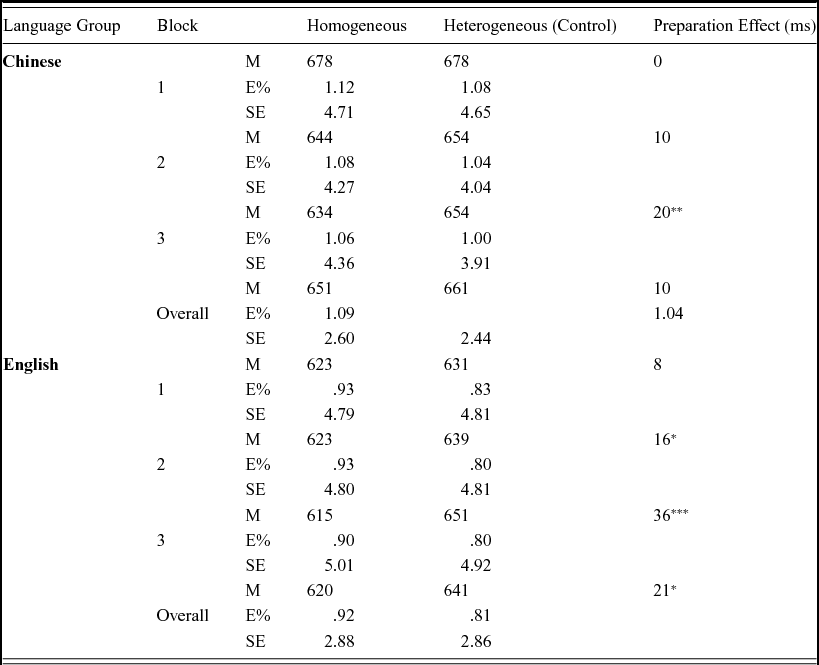
The procedure of data analysis was the same as that used in Experiment 1. For each session, the results of each Language Group were reported separately, and Proficiency (i.e., the BNT score, coded as Pro in R for brevity) was entered as a subject-level covariate for the Chinese ESL group. As a result, the original model including this covariate was “LogRT ~ Block * Seq * OR * Context+ (1 + Context|Participant) + (1 + Context*Pro|Item)” for the Chinese ESL group. Similarly to Experiment 1, the insignificant interaction terms were removed to find the model with the best goodness-of-fit. Next, we ran a new model in which the data of the two language groups were included, and Language Group (coded as Lang in R for brevity) was treated as a new fixed effect in the model. Since we did not measure native English speakers’ proficiency with the BNT, the Pro variable was not included in this model. See Table 4 for summaries of the descriptive data of the onset session, and Table 5 for the rhyme session.
Descriptive data of participants’ performance in the Onset Session of Experiment 2 with mean reaction time (M), error rates (E%), standard errors (SE), and preparation effects

Note. * p < .05; ** p < .01; *** p < .001
Descriptive data of participants’ performance in the Rhyme Session of Experiment 2 with mean reaction time (M), error rates (E%), standard errors (SE), and preparation effects

Note. * p < .05; ** p < .01.
The onset session
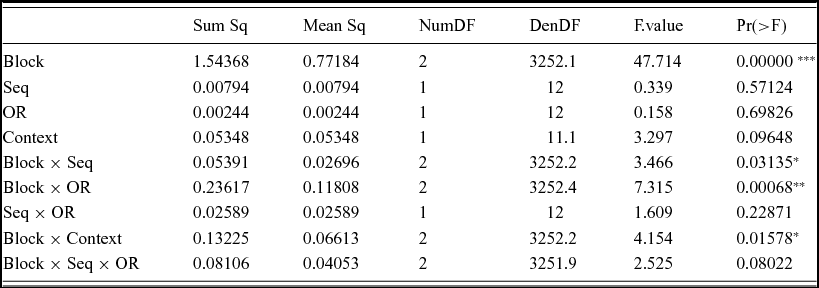
For the Chinese ESL group, the main effect of Context failed to reach significance (F (1, 11.1) = 3.297, p = .09648) and Context also did not show a significant interaction with Sequence or OR (ps > .10). However, Context did show a significant interaction with Block (F (2, 3252.2) = 4.154, p = .01578). In Block 1, the difference between the two contexts was 0ms; in Block two, participants showed a 9ms facilitation effect in the homogeneous context; in Block 3, participants showed 20ms facilitation in the same homogeneous context. Post-hoc analysis suggested that the effect of Context was only significant in Block 3 (p = .004), while it was not significant in the 1st (p = .841) or 2nd block (p = .286). A significant Block main effect was also found (F (2, 3252.1) = 47.714, p < .001), possibly due to a practice effect given that the RT showed a trend of being faster in the later blocks (Block 1: 678 ms; Block 2: 649 ms; Block 3: 644 ms). See Table 6 for the full results.
Results of the ANOVA approach to linear mixed-effect model analysis of RT of the onset session in Chinese ESL group

Note. *: p < .05; ***: p < .001.
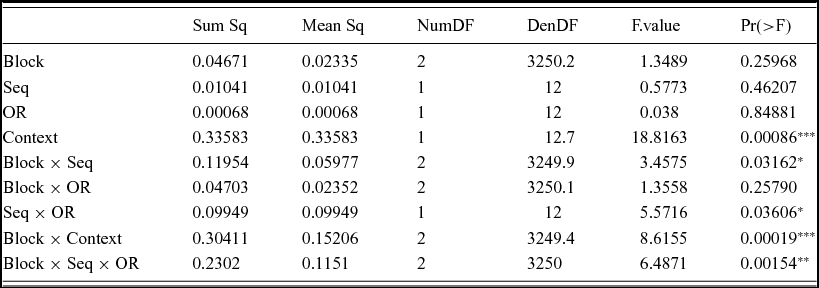
For the native English group, the main effect of Context was significant showing an onset facilitation effect (F (1, 12.7) = 18.8163, p < .001). All other main effects failed to reach significance. Context did not show a significant interaction with Sequence or OR (ps > .10). However, Context did show a significant interaction with Block (F (2, 3249.4) = 8.6155, p < .001). Although participants showed facilitation in all blocks, the effect size was larger in later blocks (Block 1: 8ms; Block 2: 16ms; Block 3: 36ms). The facilitation in Block 1 did not reach significance (p = .126), but reached significance in Block 2 (p = .016) and Block 3 (p < .001). See Table 7 for the full results.
Results of the ANOVA approach to linear mixed-effect model analysis of RT of the onset session in native English group

Note. *: p < .05; **: p < .01; ***: p < .001.
After the two groups were combined, the critical result is the interaction between Language Group and Context or any three-way or four-way interactions that involve these two variables. Unfortunately, the combined model did not show a significant Lang × Context interaction (F (1, 23.8) = 2.4766, p = .128). Lastly, there were no significant three-way or four-way interactions that involved these two variables. The absence of the interaction may be due to the significant onset facilitation in Block 3 of the Chinese ESL group.
In summary, native English speakers showed a trend of facilitation at the very beginning (i.e., Block 1), and the effect reached significance in Block 2 and Block 3. Chinese ESLs did not show a trend of onset facilitation at the beginning (i.e., Block 1), but began to exhibit a trend of facilitation starting from the second block and reached significant onset facilitation in the third block. The above contrasts suggest that native English speakers benefit from the fore-knowledge of the phoneme very quickly in a naming task. On the other hand, Chinese ESLs do not routinely prepare spoken word production in small units (i.e., onset); however, they become attuned to onsets after practice in producing monosyllabic English words. This result suggests that the selection of phonological preparation unit in the L2 might be related to recent language experience.
The rhyme session
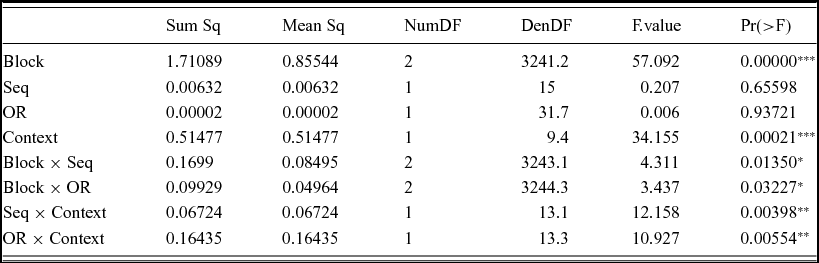
The Chinese ESL group showed a significant Context main effect (F (1, 9.4) = 34.155, p < .001), but it was in the direction of an interference effect from the homogeneous condition. Context also interacted significantly with Sequence and OR (F (1, 13.1) = 12.158, p = .00398 for Context and Sequence; F (1, 13.3) = 10.927, p = .00554 for Context and OR) where they showed significant interference effects for all combinations (ps < .05). In the Context and Sequence interaction, participants showed greater interference when they received the homogeneous lists first (37ms interference) compared to the smaller interference effect when the heterogeneous lists were given first (22ms interference), a difference of 15ms. This interaction may be the result of a practice effect considering that participants tended to react faster in the lists given later. For comparison in the Context and OR interaction, participants showed a larger interference effect when the onset session was given first (34ms interference) compared to when the rhyme session was given first (25ms interference), a difference of 9ms. It is possible that participants who received the onset session first may be more aware of the manipulation of the materials (i.e., homogeneous vs. heterogeneous Context). As a result, by the time they received the rhyme session, it was easier for them to be influenced by the manipulation, thus resulting in a larger Context effect. A Block main effect was also found (F (2, 3241.2) = 57.092, p < .001), possibly due to a practice effect where participants showed faster RTs in later blocks (Block 1: 694ms; Block 2:661ms; Block 3: 659ms). See Table 8 for the full results.
Results of the ANOVA approach to linear mixed-effect model analysis of RT of the rhyme session in Chinese ESL group

Note. *: p < .05; **: p < .01; ***: p < .001.
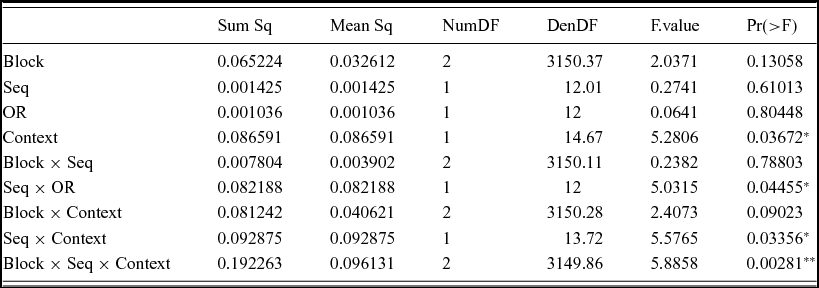
The native English group also showed a significant rhyme interference effect (F (1, 14.67) = 5.2806, p = .03672) and Context showed a significant interaction with Sequence (F (1, 13.72) = 5.5765, p = .03356). The participants showed a significantly larger interference effect when they received the heterogeneous lists first (33ms interference effect) compared to when they received the homogeneous lists first (7ms interference), for a total difference of 26ms. It is possible that this interaction is due to a fatigue effect. There was also a complicated Block × Sequence × Context three-way interaction. See Table 9 for the full results. When the two language groups were entered into the regression model, the interaction between Language Group and Context was not significant (F (1, 23.6) = 2.226, p = .149) since both groups showed a rhyme interference effect.
Results of the ANOVA approach to linear mixed-effect model analysis of RT of the rhyme session in native English group

Note. *: p < .05; **: p < .01.
The rhyme interference effect was similar to the effect found in Experiment 1. We suggest that this interference effect can be interpreted in the same way using the lexical and phonological competition hypotheses. For lexical competition, the activation of a trial (e.g., buck) inhibited the pre-activation of its rhyme neighbors, namely the following trials (e.g., suck). For phonological competition, the parallel retrieval of segments made the repetition reactivate the previous trial (e.g., buck) when speakers were producing the current trial (e.g., suck), and then onset competition (e.g., /b/ vs. /s/) occurs due to the sequential assignment of phoneme segments. Unlike Experiment 1 in which no onset effect was shown, both Chinese ESLs and native English speakers showed onset facilitation to some extent in Experiment 2, suggesting that onsets and rhymes may be processed separately in English. Therefore, it is likely that lexical competition and phonological competition have jointly contributed to the rhyme inhibition in Experiment 2. For Chinese ESLs, although Context showed significant interactions with other variables (i.e., Sequence and OR), the difference between the two sequences or the two ORs was just the size of the interference effect. In both sequences (i.e., homogeneous first or heterogeneous first) and ORs (i.e., onset first or rhyme first), Chinese ESLs showed significant rhyme interference. Therefore, we believed that the interference effect was an intrinsic property but not a practice or fatigue effect resulting from other factors (e.g., Sequence).
General discussion
The present study used picture naming tasks with the form preparation paradigm to investigate the phonological preparation unit in ESL learners. In Experiment 1, native Chinese speakers did not show an onset facilitation main effect or in any other situations (i.e., no interaction with any other variables, including Block, Sequence, and OR) when speaking in their native language, but did show a significant rhyme interference effect. Furthermore, compared to native English speakers in Experiment 2, proficient Chinese ESLs showed no onset facilitation until the third block, whereas native English speakers benefited from the foreknowledge of the onset in all blocks. Similar to the interference effect in Experiment 1 with Chinese L1, both groups demonstrated a rhyme interference effect in Experiment 2 with English.
Onset Facilitation
Consistent with previous research (Damian & Bowers, Reference Damian and Bowers2003; Jacobs & Dell, Reference Jacobs and Dell2014; O’Seaghdha et al., Reference O’Seaghdha, Chen and Chen2010), native English speakers showed significant onset facilitation in a picture naming task when no orthographic cues were presented. Previous literature concerning the phonological preparation unit in the Chinese language using the form preparation paradigm, either with or without the associate learning session, consistently suggested that onset is not selected as the preparation unit in Chinese even with repetitions (i.e., no Block × Context interaction) (Chen et al., Reference Chen, Chen and Dell2002; Chen & Chen, Reference Chen and Chen2013; O’Seaghdha et al., Reference O’Seaghdha, Chen and Chen2010), except when Pinyin served as the orthographic cue (Li et al., Reference Li, Wang and Idsardi2015). These results were replicated in Experiment 1 in the present study; the onset facilitation was not found in a simple picture naming task. The onset facilitation for Chinese ESL participants in the Block 3 of Experiment 2 is most likely due to the repetition of English words in which the onset unit is inherently the phonological preparation unit in English. Note that the significant onset facilitation among Chinese ESLs may not be just a simple repetition effect. When speaking in their native language, native Chinese speakers failed to show onset facilitation even in the third block in Experiment 1, similar to those findings in previous studies (e.g., O’Seaghdha et al., Reference O’Seaghdha, Chen and Chen2010). It appears that the repetition of Chinese words that shared the same onset did not make the native Chinese speakers change their mental orientation from the large to the small unit. However, the recent repetition of English words made Chinese ESLs mentally orient to the small phonological unit (i.e., phoneme onset). We suggest that the intrinsic features of the target language play an important role in ESL production, and that ESL learners are able to gradually attune to such features.
Using the masked priming paradigm, Verdonschot et al. (Reference Verdonschot, Nakayama, Zhang, Tamaoka and Schiller2013) claimed that highly proficient Chinese ESLs select the phoneme when preparing spoken word production in their L2 – English. By contrast, using the implicit priming paradigm, our study suggested that Chinese ESLs may require more time in order to select the phoneme onset as the phonological preparation unit in English as an L2, particularly when compared to native English speakers. While we cannot be sure from the present study, it is possible that the difference between the findings of Verdonschot et al. and the present study may be a result of task differences since Verdonschot et al. was based on visual word naming while the present study employed a picture naming paradigm. Previous findings from Li et al. (Reference Li, Wang and Idsardi2015) and Kureta et al. (Reference Kureta, Fushimi, Sakuma and Tatsumi2015) suggest that orthographic cues may affect the selection of phonological preparation unit. With this in mind, it is possible that the orthographic information that was explicitly represented in Verdonschot et al. may have made it easier for Chinese ESLs to attend to the onset as a unit of speech planning.
Rhyme interference
Li et al. (Reference Li, Wang and Idsardi2015) showed a rhyme interference effect in an associative naming task using Pinyin stimuli, our study showed a similar effect from a conceptually driven picture naming task. However, Li et al. (Reference Li, Wang and Idsardi2015) found that rhyme interference occurred when Pinyin served as an orthographic cue but not when characters served as the cue. An explanation is that the character cues encourage speakers to attend more on the whole syllable, whereas Pinyin cues emphasize more on sub-syllabic units, such as rhyme, which made it easier to activate rhyme neighbors. The findings of the present study suggest that the rhyme interference effect might be an intrinsic property of Chinese but not an artifact simply due to the presence of Pinyin orthographic cues. Inclusion of the participant's primary morpho-syllabic orthography (i.e., the Chinese character) from their native language may remove this effect, since the character orthography emphasizes syllable as an integral unit.
With the native English-speaking group, we found a significant rhyme interference effect, and the effect size of the two groups did not show significant difference. This finding contrasts with Meyer (Reference Meyer1991), where native Dutch speakers did not show any significant result in the rhyme condition despite English and Dutch having very similar linguistic features. As an example of this similarity, both languages employ an alphabetic orthography and consonant clusters are legal and frequent in both languages. These aspects of Dutch and English contrast with Chinese, whose primary orthography is morphosyllabic and the structure of the language is based on a majority of open syllables with no consonant clusters. We suggest that lexical and phonological competition may jointly contribute to the rhyme inhibition effect in the present study. It is also possible that the discrepancy between the present study and Meyer (Reference Meyer1991) is an artifact of the difference in task demands. While the present study used a simple picture naming task, an associative naming task that required associative learning of five sets of words was employed in Meyer (Reference Meyer1991). Therefore, it is possible that the associative learning task in Meyer (Reference Meyer1991) helped reduce the effect of lexical competition or phonological competition given that associative naming tasks can be more cognitively demanding than simple picture naming. As a result, if lexical competition is the cause for rhyme inhibition, the associative naming task may have allowed the participants to have better lexical access so that the inhibition of pre-activated trials due to lexical competition might be very much reduced. Likewise, if phonological competition is the cause for rhyme inhibition, the associative naming task might be so cognitively demanding that reactivation of rhyme neighbors/previous trials was not realized (i.e., speakers do not have sufficient cognitive resources to reactivate rhyme neighbors). Clearly, more studies are needed to investigate the rhyme interference effect in different tasks with different languages.
Lastly, Chinese ESLs also showed a significant rhyme interference effect in their L2. Since the Chinese ESL showed the same effect both in their L1 and L2, it is difficult to determine whether the effect was a result of the influence of their L1 or the properties associated with the English L2. We suggest that it is likely that these two sources of influence jointly contribute to the rhyme interference in L2. Future research with different methodologies and populations is needed to better tease them apart.
Limitations and future directions
One limitation of the present study is that only monosyllables with CV and CVC structures were selected as both Chinese and English stimuli. It is unclear whether Chinese ESLs would plan spoken words in phoneme onsets when producing disyllabic words, particularly compound words where the syllable is the salient unit. It is also unclear whether the onset facilitation that was found in the present study represents the role of an onset or a phoneme. Since the stimuli for the present study were selected in order to match sounds and structures that exist in the phonetic inventory of the participants’ native language (i.e., Chinese), no consonant clusters were selected. Since onsets can refer to either the initial phoneme or the initial consonant cluster, future research needs to include words in English that have consonant clusters as onsets. Another limitation concerns the Chinese ESL group's English language proficiency. In the present study, we treated Proficiency (i.e., the BNT score) as a covariate. Future research could examine Chinese ESL bilinguals with both high and low proficiency English skills in order to determine whether or not language proficiency impacts the selection of the phonological preparation unit in L2. Finally, as mentioned earlier, it remains unclear why there was a rhyme interference effect found in native English speakers in the present study but not in native Dutch speakers in Meyer (Reference Meyer1991), despite English and Dutch sharing many linguistic features. We speculated that this could be a result of task differences, so future research is still necessary to have direct comparisons between the two languages using different experimental paradigms.
Conclusion
The present study showed that native Chinese speakers do not select the onset as the phonological preparation unit in their L1. While the present study shows that Chinese ESL speakers initially do not attend to onsets as the phonological preparation unit, they do tend to select the onset as the phonological preparation unit in their L2 after several repetitions when producing English words. This finding suggests that their choice of phonological preparation unit may be influenced by recent language experiences. Repeatedly producing monosyllabic words with the same rhyme may result in an interference effect, likely due to a joint contribution of lexical and phonological competition in language production; however, this interference effect may be dependent on the task demands, which necessitates future research.
Appendix A: All the lists in Experiment 1
The onset section:
-
Homogeneous condition
-
List 1: /pəŋ2/ (awning), /pu3/ (music score), /pa
 4/ (bubble)
-
List 2: /ʂəŋ2/ (rope), /ʂu3/ (rat), /ʂa
4/ (whistle) -
List 3: /təŋ2/ (pain), /tu3/ (soil), /ta
4/ (cover)
-
-
Heterogeneous condition
-
List 1: /ʂəŋ2/ (rope), /pu3/ (music score), /ta
4/ (cover) -
List 2: /pəŋ2/ (awning), /tu3/ (soil), /ʂa
4/ (whistle) -
List 3: /təŋ2/ (pain), /ʂu3/ (rat), /pa
4/ (bubble)
-
The rhyme section:
-
Homogeneous condition
-
List 1: /pəŋ2/ (awning), /ʂəŋ2/ (rope), /təŋ2/ (pain)
-
List 2: /pu3/ (music score), /ʂu3/ (rat), /tu3/ (soil)
-
List 3: /pa
4/ (bubble), /ʂa
4/ (whistle), /ta
4/ (cover)
-
-
Heterogeneous condition
-
List 1: /ʂəŋ2/ (rope), /tu3/ (soil), /pa
4/ (bubble) -
List 2: /təŋ2/ (pain), /pu3/ (music score), /ʂa
4/ (whistle) -
List 3: /pəŋ2/ (awning), /ʂu3/ (rat), /ta
4/ (cover)
-
Appendix B: All the lists in Experiment 2
The onset section:
-
Homogeneous condition
-
List 1: day, duck, dough
-
List 2: bay, buck, bow
-
List 3: say, suck, sew
-
-
Heterogeneous condition
-
List 1: day, bow, suck
-
List 2: duck, bay, sew
-
List 3: dough, buck, say
-
The rhyme section:
-
Homogeneous condition
-
List 1: day, bay, say
-
List 2: duck, buck, suck
-
List 3: dough, bow, sew
-
-
Heterogeneous condition
-
List 1: day, buck, sew
-
List 2: duck, bow, say
-
List 3: dough, bay, suck
-