Introduction
The importance of women's health during pregnancy and after birth for fetal and infant development is well established. Women's physical health in pregnancy is associated with the health of the infant and reduced risk of later adult-onset diseases such as the metabolic syndrome and cardiovascular disease (Lau et al. Reference Lau, Rogers, Desai and Ros2011). Women's mental health is also important. Stress and anxiety during pregnancy are associated with preterm labour, poor infant outcomes, and greater cognitive, behavioural and interpersonal problems in young children (Glasheen et al. Reference Glasheen, Richardson and Fabio2010). Similarly, depression in pregnancy and after birth can have an adverse impact on women, their children and their relationships (World Health Organization, 2016). This has led to an international call for the integration of maternal mental health into maternal and child health programmes (Rahman et al. Reference Rahman, Surkan, Cayetano, Rwagatare and Dickson2013).
Research examining the impact of postpartum mental health on child development has predominantly focused on depression (Rahman et al. Reference Rahman, Surkan, Cayetano, Rwagatare and Dickson2013) and shows that postpartum depression is associated with reduced maternal sensitivity to their infant, poorer infant attachment and developmental outcomes, particularly for boys (Sharp et al. Reference Sharp, Hay, Pawlby, Schmücker, Allen and Kumar1995; Ramchandani et al. Reference Ramchandani, Stein, Evans and O'Connor2005). However, it is clear that women can suffer from a range of mental illnesses, including post-traumatic stress disorder (PTSD) following a traumatic birth. Meta-analyses show PTSD after birth affects 3.1% of all postpartum women and 15.7% of women in high-risk groups such as those with severe complications in pregnancy (Grekin & O'Hara, Reference Grekin and O'Hara2014). This means that in the European Union and the USA approximately 153 000 and 118 000 women, respectively, may be affected every year (Eurostat Statistics Explained, 2015; Martin et al. Reference Martin, Hamilton, Osterman, Curtin and Mathews2015). Symptoms of PTSD include re-experiencing, avoidance and emotional numbing, hyperarousal, and negative cognitions and mood (American Psychiatric Association, 2013).
The impact of traumatic birth and postpartum PTSD symptoms on infants’ development is unclear because research in this area is scarce (McKenzie-McHarg et al. Reference McKenzie-McHarg, Ayers, Ford, Horsch, Jomeen, Sawyer, Stramrood, Thomson and Slade2015). However, there are a number of ways in which PTSD might affect the mother–baby relationship and have a negative impact on infant development. For example, if women associate their baby with the traumatic events during birth then this might lead to women avoiding contact with the infant. Moreover, symptoms of emotional numbing may result in women being emotionally unavailable to their infants, which could influence the type of attachment the infant develops to the mother. Conversely, symptoms of hyperarousal and intrusion might lead to angry or intrusive parenting. PTSD is also highly co-morbid with depression (Ayers et al. Reference Ayers, Bond, Bertullies and Wijma2016), which has been shown to affect maternal sensitivity and be associated with poorer development in children.
There is some evidence to support the impact of PTSD on parenting. A series of case studies published by Ballard et al. (Reference Ballard, Stanley and Brockington1995) illustrates one mother avoiding all contact with her baby and another becoming aggressive towards her older child (Ballard et al. Reference Ballard, Stanley and Brockington1995). Similarly, Moleman et al. (Reference Moleman, van der Hart and van der Kolk1992) presented the cases of three women with postpartum PTSD (i.e. ‘partus stress reaction’), who all failed to meaningfully attach to their children. Further, qualitative studies show some women suffering from PTSD symptoms to report difficulties bonding with their infant and/or breastfeeding (Beck & Watson, Reference Beck and Watson2008; Elmir et al. Reference Elmir, Schmied, Wilkes and Jackson2010; Fenech & Thomson, Reference Fenech and Thomson2014), both of which may have long-term health implications for infants (Horta et al. Reference Horta, Bahl, Martines and Victora2007; Ip et al. Reference Ip, Chung, Raman, Chew, Magula, DeVine, Trikalinos and Lau2007). However, evidence from quantitative studies is mixed and available studies have been based on small or self-selected samples. For example, an online survey of 152 parents (126 women and 26 men) found that symptoms of PTSD and depression were associated with a poorer parent–baby bond (Parfitt & Ayers, Reference Parfitt and Ayers2009). However, another study of 64 couples recruited from birth registers at a UK hospital found no association between PTSD symptoms and the mother–baby bond, although there were small correlations between PTSD symptoms and an unfavourable father–baby bond (Ayers et al. Reference Ayers, Wright and Wells2007).
Thus there are plausible reasons why PTSD might affect the mother–baby relationship and infant development, although evidence is limited in terms of scope and methodological rigor. The long-term impact of PTSD on the infant's development is an area where very little research is available. To date, only one longitudinal study of 42 couples has been published that examined infant development in relation to parents’ mental health, including postpartum PTSD. This study found maternal postpartum PTSD to be associated with poorer cognitive development in infants at 17 months of age, as measured by the Bayley Scales (Parfitt et al. Reference Parfitt, Pike and Ayers2014). In contrast, less optimal language development was associated with maternal depression in pregnancy. This study also found that parents’ ratings of their infant's temperament 3 months after birth were strongly associated with all child development outcomes. The strengths of this study include using a variety of measures to assess parents’ mental health and assessing child development by means of observational data. However, the study is limited in terms of sample size and representativeness. It is therefore difficult to know whether the results are generalizable. Moreover, little is known about whether subgroups of children are particularly vulnerable to develop problems when their mothers have suffered from postpartum PTSD. Results from the study mentioned above (Parfitt et al. Reference Parfitt, Pike and Ayers2014) indicate that children with difficult temperament might be especially at risk. In addition, according to the literature from postpartum depression (Sharp et al. Reference Sharp, Hay, Pawlby, Schmücker, Allen and Kumar1995; Ramchandani et al. Reference Ramchandani, Stein, Evans and O'Connor2005), also male sex might represent a potential moderator.
To summarize, it is likely that maternal postpartum PTSD – an important women's health issue – will have an adverse impact on child development. However, conclusions about such impact remain tentative because of the limited evidence available. McKenzie-McHarg et al. (Reference McKenzie-McHarg, Ayers, Ford, Horsch, Jomeen, Sawyer, Stramrood, Thomson and Slade2015) therefore have called for prospective studies with large, representative samples to establish the extent and nature of the impact of PTSD following childbirth on infants. The present study aimed to address this by examining the impact of maternal postpartum PTSD on four important areas of child development (i.e. gross motor, fine motor, communication and social–emotional development) in a large, population-based cohort study of women up to 2 years postpartum. Moreover, we investigate the role of potential confounding factors such as maternal depression and preterm birth and examine whether the association between postpartum PTSD and child development varies according to potential moderators such as the infant's sex and temperament.
Method
Design and study population
The Akershus Birth Cohort (ABC) study is a prospective cohort study which targeted all women scheduled to give birth at Akershus University Hospital, Norway, which serves approximately 350 000 people from both urban and rural areas. Recruitment took place from November 2008 to April 2010. Women were recruited for the study during their routine fetal ultrasound examination, which is performed at 17 weeks gestation, and were asked to complete questionnaires at 17 weeks gestation, 32 weeks gestation, 8 weeks postpartum and 2 years postpartum. Of the eligible women, 80% (n = 3752) agreed to participate and returned the first questionnaire. The number of eligible women dropped somewhat during the study time because some women had moved or were withdrawn from the study due to severe birth complications. Response rates were 81% (2936 out of 3621), 79% (2217 out of 2806) and 73% (1480 out of 2019), respectively. Detailed information regarding participation and drop out in the longitudinal design is provided in a study flowchart (see online Supplementary material 1).
For the present study, we used questionnaire data from 8 weeks and 2 years postpartum as well as data obtained from the hospital's birth record. Data for the birth record were electronically recorded by the hospital's staff, including sociodemographic and medical information about the mother, the delivery and the child. Birth record data were not registered for eight participating women; thus, 1472 women were included in the analyses. As less than 50% of the original participants were included in the current sample, we performed attrition analyses. More specifically, we included relevant sociodemographic and mental health variables (i.e. maternal age, education and symptoms of depression, anxiety and general PTSD symptoms) assessed at 17 weeks of gestation and the hospital's birth record simultaneously as predictors of drop-out within 2 years postpartum in multiple logistic regression analyses. The results showed that women with higher education [odds ratio (OR) 0.57, 95% confidence interval (CI) 0.50–0.65, p < 0.001] and older age (OR 0.97, 95% CI 0.96–0.99, p < 0.001) were less likely to drop out of the study, whereas women with symptoms of depression (OR 1.05, 95% CI 1.02–1.07, p < 0.001) were somewhat more likely to drop out. Symptoms of anxiety and PTSD were not significantly related to drop out (p > 0.05). Further information regarding the characteristics of the cohort as a whole (n = 3752) compared with the final sample (n = 1472) can be found in online Supplementary material 2.
The ABC study obtained ethical approval from the Regional Committees for Medical and Health Research Ethics (approval number S-08013a), and all participants provided written informed consent.
Measurement
Child development
At 2 years of age, four domains of child development were assessed by means of the Ages & Stages Questionnaire (ASQ-3) and the Ages & Stages Questionnaire – social–emotional (ASQ:SE). Using the ASQ-3, mothers reported on their children's gross motor (focuses on arm, body and leg movements), fine motor (pertains to hand and finger movements) and communication development (covers babbling, vocalizing, listening and understanding) (Squires et al. Reference Squires, Twombly, Bricker and Potter2009). The scale consists of six items per domain, and items were coded ‘10’ (yes), ‘5’ (sometimes) or ‘0’ (not yet); depending on whether or not a child is able to perform a certain task. Hence, scores may range from 0 to 60 in each domain. Internal consistency was α = 0.79 for communication development, and α = 0.59 and α = 0.44 for gross and fine motor development, respectively.
In addition, using the ASQ:SE, mothers reported on their children's social–emotional competence (e.g. self-regulation, compliance, interaction with people). The ASQ:SE questions are rated on a three-point scale indicating if the child performs a behaviour ‘most of the time’ (0), ‘sometimes’ (5), or ‘never or rarely’ (10) (Squires et al. Reference Squires, Bricker and Twombly2005). An additional check box allows for stating if a behaviour is of concern to the parents; checked concerns score five additional points. Scores for each domain are totalled into an overall score: high total scores indicate possible developmental problems, while low scores suggest competent social–emotional behaviour. With 26 questions to be answered, scores range from 0 to 390. The ASQ:SE scoring pattern is the opposite of the ASQ-3 on which low scores indicate the absence of skills. Reliability was α = 0.51.
PTSD symptoms following childbirth
The Impact of Event Scale (Horowitz et al. Reference Horowitz, Wilner and Alvarez1979) was used to measure PTSD symptoms at 8 weeks postpartum. The instrument is a self-rating scale that measures symptoms of intrusion (seven items) and avoidance (eight items). The scale has four response categories with the following weightings: 0 = not at all, 1 = rarely, 3 = sometimes, and 5 = often. Sum scores of the overall scale were computed (range 0–75), where higher scores reflect a higher degree of post-traumatic stress. The Impact of Event Scale has been validated in postpartum women (Olde et al. Reference Olde, Kleber, van der Hart and Pop2006) and can be used as a continuous or categorical measure, with scores over 19 reflecting clinically significant distress, and scores over 34 indicating that PTSD is likely to be present (Neal et al. Reference Neal, Busuttil, Rollins, Herepath, Strike and Turnbul1994). Reliability in the present study was α = 0.85.
Maternal mental health and demographic factors
Symptoms of depression during the past week were measured using the Edinburgh Postnatal Depression Scale (Cox et al. Reference Cox, Holden and Sagovsky1987) at 8 weeks postpartum. The Edinburgh Postnatal Depression Scale is a 10-item self-rating scale designed to identify postnatal depression. The scale has four response categories ranging from 0 to 3; thus, the total scores can range from 0 to 30. Higher scores reflect higher levels of depression, and reliability was α = 0.85.
Also at 8 weeks postpartum, the 10-item anxiety scale of the Hopkins Symptom Check List was used to evaluate anxiety symptoms during the previous week. This scale has not been specifically validated for use in the perinatal population. However, a Norwegian study of n = 1794 mothers, that used the Hopkins Symptom Check List, yielded comparable results for both postpartum and non-postpartum mothers (Eberhard-Gran et al. Reference Eberhard-Gran, Tambs, Opjordsmoen, Skrondal and Eskild2003). The scale has four response categories ranging from 1 to 4. Consequently, total scores range from 10 to 40, with higher scores indicating higher levels of anxiety (Nettelbladt et al. Reference Nettelbladt, Hansson, Stefansson, Borgquist and Nordstrom1993). Reliability was α = 0.78.
Age at delivery and maternal education were obtained from the hospital's birth records. Educational level was coded as ‘1’ (more than 12 years of education; i.e. higher education) and ‘0’ (12 or fewer years of education; i.e. primary and secondary education).
Child factors
Information regarding child sex was retrieved from the hospital's birth record. Moreover, using the birth records, the birth was categorized as either term or preterm birth (born more than 3 weeks before the expected birth date; Tucker & McGuire, Reference Tucker and McGuire2004). If this information was unavailable, gestational age was computed based on the first day of the woman's last menstruation.
At 8 weeks postpartum, infant temperament was measured with a 10-item adapted version of the ‘fussy/difficult’ subscale of the Infant Characteristics Questionnaire (Bates et al. Reference Bates, Freeland and Lounsbury1979). This scale assesses infant difficultness as perceived by the primary caregiver. Mothers rated their infants’ usual mood and temperament on a seven-point rating scale, with higher scores reflecting greater infant difficultness. Reliability was α = 0.83.
Current child health problems were assessed at child age 2 years and based on maternal report. Each health problem was treated as a dichotomous variable depending on whether or not it was present. Potential child health problems were: (1) impaired hearing; (2) impaired vision; (3) eczema; (4) asthma; (5) respiratory syncytial virus; (6) bronchiolitis; (7) urinary tract infection; (8) recurring ear infection; (9) food allergy/intolerance; (10) insufficient weight gain; (11) excessive weight gain; (12) nutritional deficiencies; (13) diabetes; (14) injuries or accidents; (15) others. Child health problems were then coded as ‘0’ (no health problem), ‘1’ (one health problem) or ‘2’ (two or more health problems).
Statistical analysis
PTSD symptoms following childbirth were correlated with all four domains of child development at 2 years postpartum. Domains that were significantly correlated with PTSD symptoms were entered into linear regression analyses. In the multiple regression analyses, we adjusted for potential confounders, i.e. maternal mental health and demographic factors as well as relevant child factors. In order to examine whether the influence of maternal mental health on child development was moderated by child sex, we conducted interaction analyses where maternal mental health, the child's sex and the interaction term of these variables were included simultaneously in linear regression analyses predicting child development. Moreover, interactions between maternal mental health and child difficult temperament were tested in the same manner. Interaction terms that were significantly associated with child development were also entered in the multiple regression analyses including all potential confounders. As standard statistical techniques assume normal sampling distributions, we used bootstrapping to estimate standard errors in all analyses, as such standard errors are robust to deviations from normality (Efron & Tibshirani, Reference Efron and Tibshirani1993). More specifically, bias corrected and accelerated bootstrap standard errors, based on 5000 bootstrap samples, were estimated. Missing values on the psychometric scales were substituted with the mean of each case if the number of missing items was ⩽ 20%; otherwise, they were excluded from the analyses. Among the 1472 participating women, the proportion of missing data for the variables included in the study varied from 0.3% for social–emotional development, infant temperament as well as PTSD, depression, and anxiety symptoms to 1.2% for fine motor development. The statistical package IBM SPSS 23 (USA) was used for all analyses.
Results
Demographic and clinical characteristics of the sample
The children's mean birth weight was 3545 (s.d. = 533) g, and there were fewer girls (48%) than boys. The mean gestation period was 39.9 weeks, and 6% of the children were born premature. Mean maternal age at birth was 31.7 (s.d. = 4.5) years. The vast majority (98%) was either married or living with a partner, and a majority of the sample (73%) had an educational level beyond high school. Of the mothers, 52% reported that this was their first pregnancy.
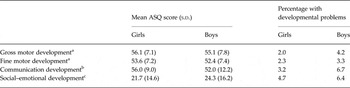
Table 1 shows the distribution of the ASQ-3 and ASQ:SE scores. Boys had more developmental problems than girls in all domains of child development, particularly in the domain of communication.
Distribution of ASQ scores among girls and boys

ASQ, Ages & Stages Questionnaire; s.d., standard deviation; ASQ:SE, Ages & Stages Questionnaire – social–emotional.
a ASQ cut-off for problems in gross motor and fine motor development ⩽35.
b ASQ cut-off for problems in communication development ⩽25.
c ASQ:SE cut-off for problems in social–emotional development ⩾51.
PTSD symptoms and child development
At 8 weeks postpartum, 6.6% of women had clinically significant distress (scores above 19 on the Impact of Event Scale) and 1.9% had probable PTSD (scores above 34). The average score for PTSD symptoms following childbirth was 7.02 (s.d. = 8.38). Mean scores for the subscales intrusion and avoidance were 4.40 (s.d. = 4.97) and 2.54 (s.d. = 4.11), respectively.
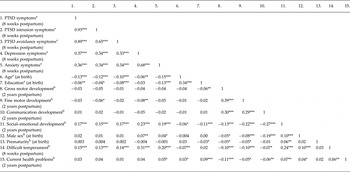
Table 2 shows correlations between PTSD symptoms, child development and all other variables included in the study. It can be seen that PTSD symptoms were significantly related to problems in the children's social–emotional development (r = 0.17). PTSD symptoms were not associated with the other developmental domains, i.e. gross motor, fine motor and communication development. Similar correlational patterns were found when examining intrusion and avoidance symptoms separately, although there was a small significant association (r = −0.06) between intrusion symptoms and fine motor development, indicating that intrusion symptoms were related to less favourable development in this area.
Correlation matrix involving all variables included in the study

PTSD, Post-traumatic stress disorder.
a Maternal factors.
b Child factors.
* p < 0.05, ** p < 0.01, *** p < 0.001.
Symptoms of depression and anxiety were strongly associated with each other (r = 0.68), and both were also clearly associated with PTSD symptoms following childbirth (r = 0.37 and r = 0.36, respectively). Moreover, symptoms of depression and anxiety were significantly related to the children's social–emotional development (r = 0.23 and r = 0.19, respectively). Similarly, as with PTSD intrusion symptoms, there was a small significant association (r = −0.08) between depressive symptoms and fine motor development (Table 2).
All measures of maternal mental health, i.e. symptoms of postpartum PTSD, depression and anxiety, were associated with maternal ratings of the infant having a difficult temperament 8 weeks postpartum, though we found the largest association with symptoms of depression (r = 0.31) (see Table 2).
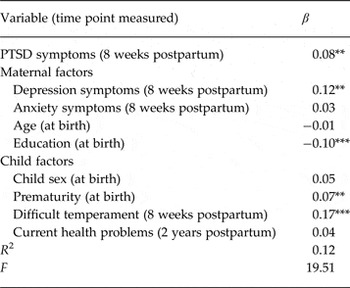
A multivariate regression model of PTSD symptoms and social–emotional development, adjusted for maternal mental health and relevant child factors, is shown in Table 3. It can be seen that the prospective effect of PTSD symptoms on social–emotional development at 2 years of age remained statistically significant (ß = 0.08) after adjustment for confounders. Social–emotional development was also significantly associated with symptoms of depression, ratings of a difficult infant temperament 8 weeks postpartum, being born prematurely, and current child health problems (see Table 3).
Multiple regression analyses of PTSD symptoms and social–emotional development at 2 years postpartum

PTSD, Post-traumatic stress disorder.
** p < 0.01, *** p < 0.001.
We also conducted a multivariate regression analysis with PTSD intrusion symptoms as predictor and fine motor development as outcome, as they were significantly correlated in the bivariate analyses (see Table 2). However, after adjusting for confounders, this association was not significant any more (β = −0.02, p > 0.05).
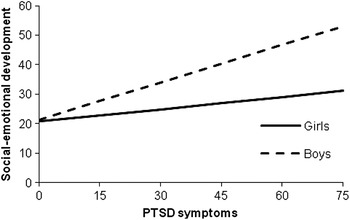
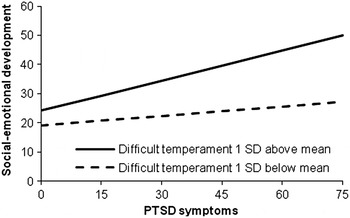
Finally, we examined whether sex of the child moderated the association between maternal PTSD symptoms and child social–emotional development. Analyses showed a significant interaction effect (ß = 0.26, p < 0.01) and a graphical representation of the interaction is depicted in Fig. 1. The figure shows that girls and boys of mothers with no postpartum PTSD symptoms had similar levels of social–emotional development. However, with increasing maternal PTSD symptom load, boys had increasingly higher levels of social–emotional problems, whereas girls’ levels of social–emotional problems increased at a slower rate with an increasing number of PTSD symptoms. Similar results were obtained when examining interaction effects with difficult temperament (see Fig. 2). Also here, a significant interaction effect emerged (ß = 0.23, p < 0.01), indicating that the association between postpartum PTSD symptoms and problems in child social–emotional development was stronger among children with a difficult temperament, compared with children with a less difficult temperament. Both interaction effects remained statistically significant when entered in the multiple regression analyses including all confounders (ß = 0.25, p < 0.01 for child sex and ß = 0.21, p < 0.05 for difficult temperament). No interactions were found for symptoms of depression or anxiety with child sex or difficult infant temperament.
Interaction between child sex and maternal post-traumatic stress disorder (PTSD) symptoms 8 weeks postpartum on problems in social–emotional development at 2 years of age.

Interaction between children's difficult temperament and maternal post-traumatic stress disorder (PTSD) symptoms 8 weeks postpartum on problems in social–emotional development at 2 years of age. SD, Standard deviation.

Discussion
Summary and interpretation of results
Postpartum mental health is a central women's health issue – not only for the mother but also for the well-being and the development of her child. Previous research on the impact of postpartum mental health has mainly focused on the role of postpartum depression. With regard to postpartum PTSD, however, research on childhood outcomes has been lacking. Given this context, the present study fills an important gap. The results showed that postpartum PTSD symptoms had a small predictive relationship with poor child social–emotional development 2 years later. This relationship remained significant even when adjusting for confounders such as maternal depression and anxiety and infant temperament. As we have accounted for above, postpartum PTSD symptoms may make an impact in a variety of ways. Symptoms of intrusion might lead to irritable or intrusive parenting, whereas avoidance symptoms might lead to women avoiding contact with their children, and emotional numbing might lead to mothers being emotionally unavailable. Differentiating PTSD symptoms into intrusion and avoidance symptoms, there was no considerable difference as of effect size in our sample. This suggests that symptoms of intrusions and avoidance do not differ in the extent of the impact on the child's social–emotional development. Other measured domains of child development showed no significant relationship with postpartum PTSD symptoms. We only found a small significant effect between intrusion symptoms and fine motor development but this effect disappeared once confounding factors were controlled for.
Infant difficult temperament was also related to all three measures of maternal mental health. These results are consistent with the study by Parfitt et al. (Reference Parfitt, Pike and Ayers2014) who found that infant difficult temperament had small to medium associations with maternal depression, anxiety and PTSD (Parfitt et al. Reference Parfitt, Pike and Ayers2014). However, it is difficult to determine the direction of causality between ratings of infant difficult temperament and maternal mental health. On the one hand, women's ratings of their infant's temperament may be affected by her mental health problems. On the other hand, a difficult infant might put more strain on women and increase their mental health problems.
In this study, early infant temperament also played a pivotal role in the development of social–emotional development problems. We found both a direct effect from infant difficultness to social–emotional development problems 2 years later, as well as a moderating effect. Maternal PTSD symptoms had a greater adverse effect on child social–emotional development, if the mothers rated their infants as having a difficult temperament 8 weeks postpartum. This finding is consistent with Parfitt et al. (Reference Parfitt, Pike and Ayers2014) who found that the largest prediction for infant developmental outcomes was afforded by parental perceptions of their infant's characteristics.
In addition, we found an interesting interaction effect with child sex, namely that for boys, maternal PTSD symptoms 8 weeks postpartum had a greater negative effect on social–emotional development at 2 years of age, compared with girls. The finding that boys are more vulnerable to poor developmental outcomes has been shown to be the case for postpartum depression as well (Sharp et al. Reference Sharp, Hay, Pawlby, Schmücker, Allen and Kumar1995; Ramchandani et al. Reference Ramchandani, Stein, Evans and O'Connor2005), but to our knowledge this is the first time that is has been examined in relation to PTSD symptoms. Because boys are generally developmentally delayed compared with girls, they need to a greater degree of help from a sensitive caregiver to regulate their emotions (Sharp et al. Reference Sharp, Hay, Pawlby, Schmücker, Allen and Kumar1995). As a result, they might be specifically vulnerable to adverse parental influences (Ramchandani et al. Reference Ramchandani, Stein, Evans and O'Connor2005).
Strengths and limitations
To our knowledge, this is the first large-scale, population-based study to investigate the longitudinal impact of postpartum PTSD symptoms on child development. Moreover, the inclusion of relevant confounders and the use of adequate statistical techniques, such as bootstrapping, to handle non-normal sampling distributions are strengths of the study. Still, some potential limitations are worth discussing. The fact that only Norwegian-speaking women were included resulted in a relatively homogeneous, mainly Caucasian sample. Furthermore, as we have shown previously, there is reason to believe that there is a slight social gradient associated with participation in the study (Garthus-Niegel et al. Reference Garthus-Niegel, Ayers, von Soest, Torgersen and Eberhard-Gran2014a , Reference Garthus-Niegel, von Soest, Knoph, Simonsen, Torgersen and Eberhard-Gran b ). Likewise, the somewhat selective attrition during the longitudinal course of the study, as demonstrated by attrition analyses, is an additional threat to the representativeness of the sample. However, it is important to bear in mind that selection bias does not necessarily influence the results when associations between variables are investigated (Nilsen et al. Reference Nilsen, Vollset, Gjessing, Skjaerven, Melve, Schreuder, Alsaker, Haug, Daltveit and Magnus2009).
Although we found significant associations between postpartum PTSD symptoms and social–emotional development at child age 2 years, the effects were only modest, as reflected in the relatively small size of the standardized regression coefficient. Consequently, caution is needed when recommending intervention. Still, we regard our results as clinically significant since we could show that postpartum PTSD symptoms were prospectively associated with poor social–emotional development over a long period of time. Also, effect sizes were not much larger for depression, for which there is an extensive literature underlining the importance for child development (Stein et al. Reference Stein, Pearson, Goodman, Rapa, Rahman, McCallum, Howard and Pariante2014).
Even though we used one of few recommended universal screening tools qualified to investigate children's development in infancy (Squires et al. Reference Squires, Bricker and Twombly2005, Reference Squires, Twombly, Bricker and Potter2009), internal consistency was somewhat low when assessing communication, fine motor and social–emotional development. However, these three measures cover broad domains of development, and items assessing such constructs tend to correlate less highly than item collections reflecting a narrow, more tightly defined construct, in turn leading to lower reliability estimates. Further, as all data were based on mothers’ reports only, parts of the relationship between maternal PTSD symptoms and child development may be due to a common method bias. For instance, mothers with mental health problems may be more inclined to report PTSD symptoms as well as developmental child problems. However, that the association between PTSD symptoms and child development holds when controlling for symptoms of depression and anxiety, makes this explanation less likely. Still, in addition to mothers’ reports, future studies should assess child development with independent observers and via standardized observation procedures (e.g. using the Bayley Scales of Infant and Toddler Development; Bayley, Reference Bayley2006). Further, since the quality of mother–child bonding may be also relevant for child development, it would be of interest to assess this factor as well (e.g. using the standardized Strange Situation Procedure; Ainsworth et al. Reference Ainsworth, Blehar, Waters and Wal2015).
Conclusions
Postpartum PTSD is highly likely to make an impact on women and their infants (Nicholls & Ayers, Reference Nicholls and Ayers2007) through a variety of mechanisms. Examining four different domains of child development we found a prospective impact of postpartum PTSD symptoms on children's social–emotional development at 2 years of age. The size of the association was comparable with that of postpartum depression with children's social–emotional development. In clinical practice the focus of postnatal care therefore ought to expand beyond depression and include postpartum PTSD as well. Further, our findings suggest that both boys and children with an early difficult temperament (as rated by their mother) may be particularly vulnerable to experience social–emotional development problems when their mothers suffer from postpartum PTSD symptoms. However, as this is the first large-scale study that studied the prospective impact of postpartum PTSD symptoms on childhood development, additional studies are needed to replicate these findings and to further investigate the mechanisms at work.
Supplementary material
The supplementary material for this article can be found at http://dx.doi.org/10.1017/S003329171600235X
Acknowledgements
This research received no specific grant from any funding agency, commercial or not-for-profit sectors. The authors thank the women who volunteered their time to participate in this study. We also thank Tone Breines Simonsen, Wenche Leithe and Ishtiaq Khushi for assistance with data collection.
Declaration of Interest
None.