Within contemporary political science, local elections are the perennial bridesmaids of behavioral research. While municipal contests are more numerous than any other type of election, academic interest in the factors that motivate local participation and voting behavior pales in comparison to the attention given to national politics. Case studies of individual elections in a small subset of larger American cities do exist, but within the local politics literature, few studies argue for a general theory of local voting behavior (but see Kaufmann Reference Kaufmann2004; Oliver and Ha Reference Oliver and Ha2007). Even in those cases that do, insufficient data exist to rigorously test or replicate these results on a large scale.
The dearth of research on local politics likely stems from a number of different factors. Public interest in local politics and turnout levels in local elections are notoriously—though not uniformly—low. From this point of view, if voters do not care about the nature of their local representatives, then the lack of scholarly attention to such low-salience political events seems rational. More important, however, is that available data on local elections are extraordinarily difficult to obtain. There is no American National Election Study (ANES) equivalent for local elections, and, as such, researchers interested in municipal politics must engage in intensive data-collection efforts that, even at their best, often fall short of social science ideals. Finally, much of the conventional wisdom pertaining to municipal elections embodies the old adage that “all politics are local,” where “local” implies idiosyncratic in terms of the particular characteristics of any given city. The presumption that voter behavior across cities is too context-specific to allow for generalization undermines the perceived value of large-N, multi-city studies.
Regardless of these obstacles—which are both perceived and real—cities remain the nation's foremost venues for the study of political behavior in the context of significant racial and ethnic diversity. And, in a rapidly diversifying nation, studies of local elections constitute an important opportunity to foretell the future of American state and national politics. In spite of Barack Obama's historic victory in a majority white nation, one cannot simply conclude that U.S. national politics are now “post-racial.” As local elections research has noted, it is not unusual for disparate groups (racial minorities and white liberals) to rally around the first groundbreaking racial or ethnic minority candidate, especially if the candidate aims to overturn an unpopular, ideologically conservative regime. This kind of broad-based electoral coalition is quite common in local politics when excluded groups see the potential for a “first of its kind” minority leader, assuming that sufficient numbers of racial minorities and racially tolerant whites can be mobilized (Browning, Marshall, and Tabb Reference Browning, Marshall and Tabb1984; Kaufmann Reference Kaufmann2004; Pettigrew Reference Pettigrew and Hahn1971; Sonenshein Reference Sonenshein1993;). However, the notable interracial and interethnic cooperation that enable these historic elections is not typically sustainable. As racial diversity in cities increases, so too does the diversity of the candidate pool. Coalitions of the “excluded” are founded on the shared goals of political inclusion, but when the group-specific interests of blacks, Latinos, Asians, and white liberals diverge, interracial conflicts of interest place enormous strains on these coalitions (Carmichael and Hamilton Reference Carmichael and Hamilton1967; Kaufmann Reference Kaufmann2007). As many studies of local, racial, and ethnic politics note, competition and conflict among racial and ethnic minority groups has become commonplace.
Contemporary research on U.S. voting behavior typically places partisanship at its core. As Campbell et al. (Reference Campbell, Converse, Miller and Stokes1960) argue in The American Voter, individuals identify with political parties in much the same way they do with other social groups—ethnic, racial, or religious. From the authors' perspective, however, political identities are more influential than other group identities in the context of elections, because they are the most proximate. Written about presidential elections during a time when candidate diversity was virtually nonexistent, the basic insights from The American Voter continue to inform many of our fundamental theories of political behavior. In the context of national and state elections, the notion that partisanship trumps most other factors in terms of explanatory power remains largely intact. As the nation becomes more racially diverse, however, party attachments will likely become less reliable predictors of voting behavior. What we know about local politics in the context of a racially heterogeneous electorate and an increasingly diverse pool of political candidates is that party attachments are but one of many social identities that inform political decision making (Kaufmann Reference Kaufmann2004; Liu Reference Liu2001; Liu and Vanderleeuw Reference Liu and Vanderleeuw2001).Footnote 1 Sometimes voters are predictably partisan in their choices, and in other instances, they are not. This concept of the variable importance of party identification within diverse electorates is derived from the collective wisdom of city-level election case studies. And while there is considerable piecemeal evidence that racial group interests are often salient voting considerations in racially diverse communities, this topic of inquiry has been seriously understudied. Local elections are the preeminent venue to study the relationship between demographic change, increasing racial diversity, and voter choice. What we learn about local politics today will provide much-needed insight into state and national politics in the future.
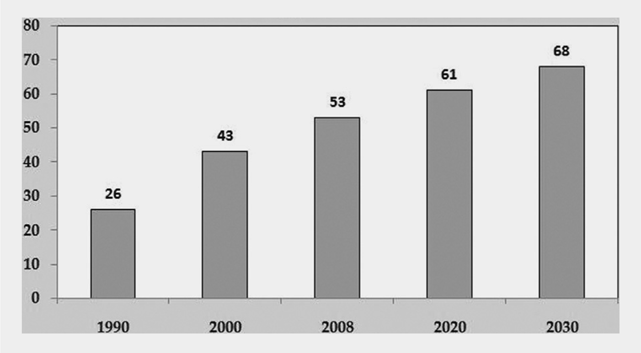
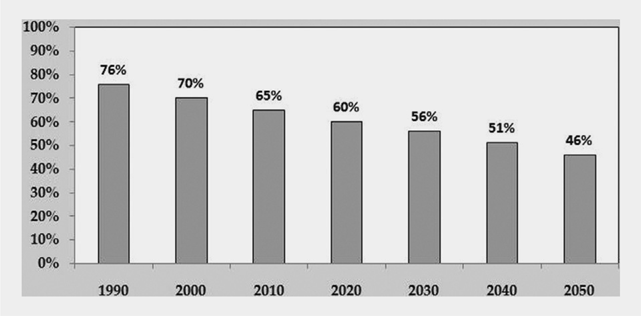
Census projections all point to the growing racial and ethnic diversity of the nation. According to census estimates from 2008, 53 of the largest 100 cities in the United States are majority minority. By 2030, this number is estimated to rise to 68 (see figure 1). According to national population estimates, in 2010, 65% of all Americans are non-Hispanic whites, and this number is projected to drop to 46% by 2050 (see figure 2). Even considering the possible error associated with long-range population estimation, the implications of these data are clear. The United States will become considerably more racially diverse over the ensuing four decades to the point that non-Hispanic whites will constitute a minority of the population. Eventually, this group will constitute a minority of the electorate as well. The types of candidates that run for national office will likely mirror this growing population diversity, and when they do, the possibility that racial and ethnic group interests will compete with party attachments as primary voting cues seems ever more certain.
Past and Projected Number of Majority Minority Cities for the 100 Largest U.S. Cities

Non-Hispanic White Population Projections for United States, 1990–2050

Not so long ago, cities were viewed as premier laboratories of democracy; in fact, seminal works on democracy and power were based on city-level observations (Dahl Reference Dahl1961; Hunter Reference Hunter1953). Somewhere between the 1961 publication of Robert Dahl's Who Governs? and today, city politics lost its cachet as a top-tier subject for understanding democracy. Given the profound demographic changes that have and will continue to occur in the nation, however, the time seems ripe for a renewed focus on the politics of American cities. Studies of race, ethnicity, and city politics have shown us that context matters. To gain a full understanding of American political behavior in the context of racial diversity, we need to invest in data collection efforts that include large and varied samples of municipalities. Serious study of city politics should allow for the systematic exploration of biracial and multiracial coalition formation and answer important questions about the contextual factors that incite intergroup conflict and exacerbate racialized voting behavior. Such research should also identify the conditions that facilitate interracial cooperation and enhance the political voice of traditionally marginalized groups. The future of American national politics is happening right now in U.S. cities, and it is time for students of American political behavior to sit up and take notice.