In his 1995 novel Flughunde (published in English as The Karnau Tapes), Marcel Beyer crafts a rich acoustic map of the Third Reich.Footnote 1 The plot intertwines a fictional tale of a sound archivist (Hermann Karnau) with recorded events that took place within the highest echelons of the Nazi Party during the Second World War. It culminates in the bunker where Adolf Hitler and Joseph Goebbels spent the final months of the war, both ultimately committing suicide on the eve of German defeat. While Flughunde is part of a continued German fascination with what happened in the Führerbunker, these infamous party leaders are not the central protagonists.Footnote 2 Instead, the action unfolds through the eyes of two narrators, both connected to Nazi propaganda minister Joseph Goebbels (1897–1945): Karnau, Goebbels's sound engineer, who is entrusted into the minister's inner circle as the novel progresses; and Goebbels's eldest daughter, Helga. Beyer's narrative strategy thus places recording technologies and Nazi acoustics at the centre of the plot, while the work as a whole testifies to the continued signification of wartime sounds in the post-war period.
Karnau in particular has attracted the attention of scholars interested in the connection between sound and memory in post-war Germany.Footnote 3 His character is directly involved in orchestrating and capturing the soundscape of the Third Reich, epitomizing a prominent line of media theory that connects the development of media technologies to military strategies.Footnote 4 For a journal issue dedicated to tape, Karnau might be the more obvious of Beyer's protagonists on which to focus. Not only does this character actively collect and record sounds, but his struggle transitioning from the gramophone to tape recorders is a point of dramatic significance in the plot – a literary manifestation of the distinction between the two recording technologies, and further evidence in support of challenging the ‘phonographic regime’.Footnote 5
Yet Beyer's second protagonist, Helga Goebbels, is equally significant for understanding the memorial power that sonic traces of the Third Reich hold in post-war Germany. She is an astute listener who frequently navigates through experiences of the late wartime years by decoding her acoustic surroundings. Many of her passages are quizzical, arguably similar in vein to Franz Kafka's Der Bau (The Burrow, published 1931), which Brian Kane has recently used to develop an ontology of acousmatic sound.Footnote 6 In both novels sound is underdetermined, as these characters attempt to decipher and ascribe meaning to their acoustic environments provoke anxiety and discomfort.Footnote 7 Unlike the ambiguous protagonist of Der Bau, however, most of Beyer's sources are not unknown: the gigantic Nazi rallies and specific political speeches from the wartime years are some of the most indexical sonic markers of the Third Reich.Footnote 8 These sounds have been pored over in scholarship and public debates about the Third Reich, becoming over-determined signifiers of Germany's Nazi past. In contrast, by deliberately obfuscating episodes of German history that have saturated representations of the Third Reich in post-war Germany, Beyer prompts the reader to engage with this problematic period of Germany's past in unconventional ways. This is how Beyer presents Joseph Goebbels's famous declaration of total war from 1943 – the focus of this article.Footnote 9
In what follows I trace manipulations of Goebbels's speech in three post-war German works, revealing how the original uses of tape in the Third Reich became a central part of its capacity for enacting memorial labour in the post-war period. Discussions of the Second World War and the Holocaust in post-war Germany have relied on political discourse and psychoanalytical language – two fields that have come to dominate memory studies.Footnote 10 The material properties of tape, by contrast, encourage under-determined configurations of the past. These manifest as both direct physical manipulations of sounds recorded on tape, and conceptual fantasies triggered by tape's uses during the Third Reich. In the final movement of Requiem für einen jungen Dichter (1967–9),Footnote 11 West German composer Bernd Alois Zimmermann (1918–70) sets a pre-recorded tape montage of political speeches above acoustic choral lines. His sources include Joseph Goebbels's famous interrogation: ‘I ask you, do you want total war?’ (‘Wollt ihr den totalen Krieg?’) followed by a terrifying ‘yes’ from the thousands-strong crowd. East German composer Georg Katzer (b. 1935) uses this same line in two purely electroacoustic works he developed to mark commemorative events: Aide Mémoire (1983), for the fiftieth anniversary of the 1933 Nazi Machtergreifung (Seizure of Power); and Mein 1989 (My 1989, 1990), commissioned for a music festival celebrating the Autumn Revolutions. Zimmermann and Katzer use the techniques of musique concrète to provocatively juxtapose the Nazi past alongside Germany's seemingly sanitized present. Such jarring responses to the Third Reich resonate with the presentation of Goebbels's speech in Beyer's novel.
These examples span three critical stages of public debate about memories of the Nazi past in post-war Germany. As Zimmermann was developing the Requiem, West Germans were engaged in the first discussions of national culpability and guilt about the Holocaust. Almost two decades later, Katzer presented challenges to official narratives of the past in two different East German contexts. Aide Mémoire is a provocative critique of antifascist discourse promoted in the GDR, while Mein 1989 offers a far from euphoric response to the Autumn Revolutions of 1989. Finally, Beyer's Karnau Tapes exposes the resurgence of debates about public remembrance of the Nazi past in post-reunification Germany. The sonic link between these pieces thus offers new threads across an intellectual terrain that is typically divided along geopolitical lines.Footnote 12 But more than Goebbels's voice unites these pieces. Tape not only gave each of these artists access to this speech, but also enabled specific modes of memory work that are connected to its uses during the Second World War. In Gramophone, Film, Typewriter, Friedrich Kittler describes how tape performed two intertwined functions in Nazi Germany. On the home front it was crucial for the synchronized transmission of Nazi propaganda, while in combat it encrypted messages for the German military.Footnote 13 Reconfigured as artistic possibilities in the post-war period, these entwined wartime tasks have memorial implications for artist and audience alike. Each artist I discuss engages with these recorded documents in a way that encrypts their nation's history, triggering an acousmatic engagement that reconfigures deterministic readings of the Nazi past in post-war Germany. Tape facilitates a mode of memorial labour – what in German is known as Gedächtnisarbeit (memory work) – that does not ignore the uncomfortable realities of the wartime years, but instead engages the listener in the discomfort of Germany's post-war memorial predicament.
Stalingrad in German memory
Geoffrey Winthrop-Young describes Friedrich Kittler (1943–2011) as a ‘Stalingrad Child’. The moniker illustrates the significant effect that national defeat at Stalingrad in 1943 had on German society, while also suggesting a personal motivation for Kittler's lifelong preoccupation with the military origins of media technologies and mass entertainment.Footnote 14 Stalingrad was the trigger for Goebbels's total war speech. Delivered on 18 February 1943, before a packed crowd at the Berliner Sportpalast (a stadium that held fourteen thousand people), the entire rally was broadcast twice on national radio. His text was subsequently reprinted in newspapers and widely distributed pamphlets, and the final minutes were excerpted in the weekly newsreel shown before features and movie theatres.Footnote 15 To those alive during the wartime years, this speech, and this voice, were instantly recognizable.
The multimedia dissemination of Goebbels's message capitalized on Gleichschaltung, the synchronization of national media that had taken place when the National Socialists seized power. Studies by Carolyn Birdsall, Brian Currid, and Ansgar Diller, among others, have documented how the radio was a centrepiece of Nazi propaganda, regarded as the technology with which to reach the largest number of citizens.Footnote 16 Broadcasts of mass rallies and political speeches began to synchronize a distinctive and militarized national soundscape across different media formats from 1933 onwards. After war broke out in 1939, listeners heard updates via Sondermeldungen (special broadcasts), which delivered news from the high commander of the Wehrmacht (the German Army during the Third Reich). These recordings transformed the experience of the Second World War for those on the home front, giving an immediacy to the battlefield that had not been possible prior to the invention of recording technologies. Frank Trommler argues that the Second World War was ‘omnipresent in people's existence through its acoustic reproduction’ on radio and in newsreels.Footnote 17 Recordings were nevertheless carefully stylized, making the techniques of montage central to Nazi propaganda. Newsreels (the Deutsche Wochenschau) were edited to present only German victories, and framed with music that evoked a feeling of triumph.Footnote 18 The rousing arpeggiations of Franz Liszt's symphonic poem Les Préludes (1854) announced reports from the Wehrmacht in radio broadcasts and weekly newsreels.Footnote 19 This work was not broadcast on radio stations in either East or West Germany after the war because of its symbolic appropriation in the Third Reich.Footnote 20
Birdsall's analysis of Sondermeldungen reveals that there had been some subtle markers of diminishing German victories prior to Goebbels's total war speech. At the beginning of the war, Sondermeldungen were staples of the airwaves: scheduled programmes were frequently interrupted to announce German military advances.Footnote 21 But as the Wehrmacht experienced a string of defeats beginning in 1941, reports from the battlefield became less frequent. The extent of German losses was kept vague, and information about Stalingrad was deliberately withheld from the German public.Footnote 22 For many civilians, learning about Stalingrad was the first time they realized German victory was not a foregone conclusion.
Unwilling to acknowledge the Wehrmacht’s increased precarity, Goebbels used Stalingrad to advocate for a renewed commitment to the war effort. His total war speech outlined how the nation should cease any activities that would not benefit the military, and be prepared to sacrifice in the present to ensure German victory in the future. The final section was the most calculated part of his delivery, where he articulated a ten-step programme for national mobilization. Each point was punctuated with the rhetorical question: ‘I ask you, do you want total war?’ Willy Schumann (1927–95), describes this episode in depth in his memoir about growing up in the Third Reich:
I remember [Goebbels's speech] well, some of the phrases even verbatim, because it was broadcast at prime time on all radio stations. I reacted with similar excitement as the mass audience did in the Sportpalast. Goebbels announced a program of total mobilization consisting of ten points. After each new measure, he shouted a question at a carefully selected audience: Ich frage Euch: wollt Ihr den totalen Krieg? ‘I ask you: do you want total war?’ With every answer the spectators were pulled out of their seats and roared their approval.Footnote 23
Schumann's reflection provides anecdotal evidence of the efficacy of both Goebbels's rhetorical strategies and propaganda tactics. His comment that he remembers the speech so vividly – ‘some phrases even verbatim’ – because of its transmission over the radio draws attention to the importance of synchronized, repeated transmissions for creating the conditions of total war.Footnote 24 Focusing on the tape specifically, rather than Goebbels's voice more abstractly, emphasizes how the recording – both its content and its material – encapsulates the ideal synchronization of battlefield and home front that lay behind the principle of total war.
Splicing Nazi broadcasts in post-war Germany
Music and sound have been recurring tropes in public debates about the Third Reich.Footnote 25 In the 1960s, ‘collective silence’ became a popular metaphor to describe the lack of discussion of the Holocaust in West Germany. Psychologists Alexander and Margarete Mitscherlich and philosopher Theodor W. Adorno were at the forefront of the first wave of public debates about the Third Reich, urging West German citizens to belatedly confront their involvement in the Nazi regime.Footnote 26 Subsequent national debates about the Third Reich are often reduced to the term Vergangenheitsbewältigung, or ‘Coming to Terms with the Past’. Reunification triggered another wave of public remembrance and reconciliation, as prominent West German intellectuals encouraged their East German counterparts to denounce their nation's official rhetoric of ‘antifascism’ and belatedly address their culpability for the Third Reich.Footnote 27 By incorporating sound documents from the Third Reich into their works, Zimmermann, Katzer, and Beyer transform these popular metaphors into literal engagements with historical sounds. Their shift exposes the over-determinism inherent in the discourse of Vergangenheitsbewältigung in post-war Germany, where loaded terms have become placeholders for a sustained engagement with the lingering legacies of the Nazi past.Footnote 28
Acousmatic sound is characteristically under-determined because sound and source are detached, a situation that is endemic to recording technologies more broadly.Footnote 29 The genre of musique concrète, for example, is founded on the separation of sound and source. Its pioneer, Pierre Schaeffer, welcomed the potential of recordings for excising sounds from their original contexts and facilitating their transformation into abstract sound materials for use in musical works. He summarized this process with remarkable simplicity in his earliest experiments with musique concrète: to compose you need only ‘repeat the same sonic fragment. There is not an event any more. There is music.’Footnote 30 During the late 1940s, Schaeffer categorized recorded sources by their abstract sonic qualities rather than their original contexts.Footnote 31 While reduced listening is a problematic ideal, these archival instincts expose the inevitable distance and delay when storing sound on media. Even though Schaeffer used discs for these early experiments, these concerns resonate with the uses of tape in the examples that follow, both as a medium for storing sound and as a material that facilitates encryption.Footnote 32 Unlike text-based archival practices, navigating a sound archive typically requires the user to translate from one medium (a summary of contents) to another (sonic experiences). Indeed, without such written cues, information about the sounds stored on a recording may only be available through playback. This is the situation Karnau faces at the end of Flughunde: the meticulous archivist finds a series of unmarked discs in his recording collection in the early years of reunification. Upon listening, he acoustically relives and deciphers how Goebbels's children were poisoned at the end of the Second World War.Footnote 33 The recording's limited capacity to transmit information in advance facilitates a greater immediacy between sound and memory at the moment of playback.
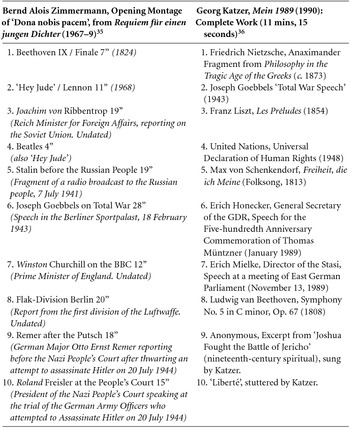
There are parallels between this imaginary scenario and the experience a listener faces when hearing the tape collages in the final movement of B.A. Zimmermann's Requiem für einen jungen Dichter and Georg Katzer's Mein 1989. In both works, Goebbels's voice is heard amid a panoply of historically loaded sound fragments that are impossible to decipher without taking the collage apart and tracing each individual fragment. Building on previous analyses that have performed this task, the sources of each work are summarized in Table 1.Footnote 34 Connections between the two pieces extend far beyond Goebbels: Zimmermann and Katzer also use political speeches as a general category, incorporate music with overt military associations, and sample recordings of the Austro-Germanic canon that had been ascribed symbolic functions in the Third Reich. In addition, they present the music and voices that made up Nazi radio broadcasts alongside recordings that pre- and post-date the wartime years. For Zimmermann in particular, these chronological manipulations resonate with his concept of spherical time – the simultaneity of past and present that marks the lived experience of time – which also preoccupied him in his previous large-scale project, Die Soldaten (premiered in 1965).Footnote 37 The act of splicing tape and temporally reconfiguring such instantly recognizable events presents a direct challenge to a dominant strand of post-war historiography that attempted to excise the Third Reich from national history.Footnote 38
Overview of tape materials used in Bernd Alois Zimmermann's ‘Dona Nobis Pacem’, from Requiem für einen jungen Dichter (1967–9) and Georg Katzer's Mein 1989 (1990).

35Overview based on Zimmermann's own outline of the work drawn up when he was conceptualizing the tape montage (BAZA 1.62.52.15), supplemented by the text synopsis provided with the Wergo CD recording of the piece (p. 60). Information that Zimmermann did not provide in his handwritten summary marked in italics.
36Rudolf Frisius provides a basic summary of Katzer's sources in ‘Stimmen der Medien’, which I supplement with additional information here.
Though they share specific recordings, Zimmermann and Katzer had different ways of engaging with tape in their compositional processes. Zimmermann developed his piece in copious sketches in the late 1960s, while Katzer, working on equipment used primarily for the production of Hörspiele (Radio Plays) in the early 1980s, opted for the immediate physical manipulation of his recorded materials, leaving no scores for his musique concrète works.Footnote 39 Both approaches nevertheless resonate with Kittler's claim that ‘our writing tools are working on our thoughts’.Footnote 40 Zimmermann's performing forces are vast. The Requiem is scored for Speaker, Soprano and Baritone soloists, three choirs, electronic sounds, orchestra, jazz-combo, and organ.Footnote 41 Alistair Williams observes that his mode of visual representation changes according to his scoring. Sections of the work that use tape are represented in absolute time; those with live performers in conventional notation.Footnote 42 Sketches for the work further accentuate these contrasts. Zimmermann worked out his pre-recorded tape montages on graph paper, charting splice lengths and orders to the second.Footnote 43 The montage at the opening of ‘Dona nobis pacem’ was further outlined in writing: he summarized each fragment in order of presentation, noting the length of each excerpt (these markings are included in Table 1). This compositional process exposes the tensions inherent in the musical representation of spherical time. While spherical time foregrounds experience over chronology, expressing the experience in music requires an intense engagement with, and ordering of, linear time.
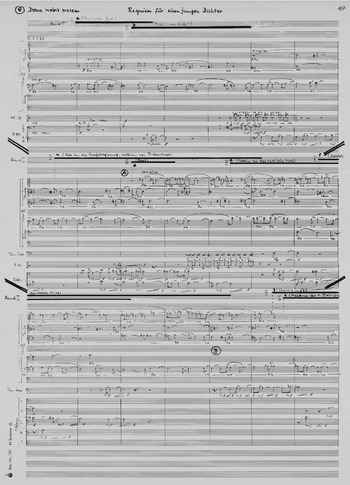
Zimmermann's pre-calculations are tempered in the published score, seen in the first page of the final movement, ‘Dona nobis pacem’ (‘Grant us Peace’, opening shown in Ex. 1). This movement juxtaposes his two main sound worlds, lining up the tape montage that includes Goebbels's speech (marked as ‘Band Komplex I’, or loudspeaker group 1) with choral declamations of the Latin text. The entrance of each source from the pre-recorded montage is labelled, but all are presented in the same manner, establishing visual similarities between the disparate arrays of recordings. Reducing these montages to thick black lines even emulates the qualities of magnetic tape itself. While Schaeffer might have welcomed this visual parallel to acousmatic reduction, works of musique concrète often achieve their fullest effects through dissociation: either through a belated discovery of what the source is, or in recognizing a sound and then tracing its distortion. Initial reactions to Zimmermann's Requiem capture such attempts to decode Zimmermann's vast musical canvas. While Goebbels takes up less than 30 seconds of Zimmermann's monumental 65-minute work, journalist Susanne Materleitner titled her review of the premiere for the Essen-based newspaper Neue Ruhrzeitung, ‘Even Goebbels became Music: Zimmermann's Requiem für einen jungen Dichter premiered in Düsseldorf’.Footnote 44 Her reaction hints at the jarring shock at recognizing this historical fragment, which overpowers the other sonic sources. Jörn Peter Hiekel similarly describes the opening of ‘Dona nobis pacem’ as a ‘panorama of the Second World War’, homing in on the speeches from the Third Reich, even though Zimmermann's recorded sources – both here and in other movements of the work – are culled from a wider time frame.Footnote 45
Zimmermann, ‘Dona nobis pacem’, Requiem für einen jungen Dichter. B. A. Zimmermann Requiem für einen jungen Dichter. Copyright © 1977 Schott Music, Mainz, Germany Copyright © renewed All Rights Reserved. Used by permission of European American Music Distributors Company, sole U.S. and Canadian agent for Schott Music, Mainz, Germany.

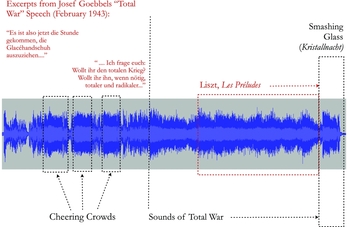
Katzer sets up a similar potential for shock in Mein 1989. The work was realized for a commission from the Bourges International Festival of Experimental Music in Belgium, where the festival's theme in 1990 was the Autumn Revolutions of 1989. Katzer had participated in this festival in previous years, including the year prior, when he submitted a work titled Mon 1789 to mark the centennial of the French Revolution. The parallel titles alone suggest that Mein 1989 functioned as an unintended sequel, a connection Katzer enhances by using the same recording of him reciting Nieztsche's Anaximander Fragment to open both works. Mein 1989 includes audio documents from across twentieth-century Germany to connect the present to less savoury moments of his country's past. He homes in on two lines of Goebbels's speech (refer back to Table 1), including the famous rallying question that preoccupied both Schumann and Zimmermann. A visual representation of this section is provided in Figure 1.
Annotated soundwave representing the Final Nightmare from Georg Katzer's Aide Mémoire (1983), and the opening montage of Mein 1989.

The section of Mein 1989 summarized in Figure 1 is a direct quotation of an earlier work Katzer developed to reflect on the Nazi period: a collage titled Aide Mémoire (subtitled ‘Seven Nightmares from the Thousand Year Night . . .’), which premiered on East German Radio in 1983.Footnote 46 To realize Aide Mémoire, Katzer relied on sometimes-dated equipment available to him through private avenues and in recording studios that were not primarily concerned with the production of musical works.Footnote 47 He manipulated original recordings from the Third Reich on equipment he had assembled in his private studio, and the tape was subsequently mixed at a radio studio in the GDR.Footnote 48 The episode unfolds as a simulation of total war. After the sound of crowds, Katzer manipulates two selected lines of the total war speech, layering repeated utterances on top of one another while increasingly distorting Goebbels's voice. He punctuates each repetition of Goebbels's famous inquisition with cheering crowds, only slightly exaggerating the original response in 1943. As the nightmare progresses, the crowds start to blend with white noise, as bombs and alarms envelop Goebbels's final lines. Sounds of the battlefield then overpower Liszt's Les Préludes. By the end of this passage, both forms of propaganda – speech and music – cannot match the destruction they have initiated. Smashing glass signals the end of the nightmare and is the final sound of its destructive soundscape, which evokes the events of Kristallnacht in 1938.
For Elaine Kelly, beginning Mein 1989 with such a famous recording places the Autumn Revolutions of 1989 in a linear narrative of German history that normalizes the Third Reich.Footnote 49 The title intensifies the discomfort of this historical continuity. For the first crowds you hear in Mein 1989 are not those at the Berlin Wall, but fanatic listeners at the Berliner Sportpalast in 1943. While Katzer draws on recordings made at rallies during the Autumn Revolutions later in the work, without the aid of visuals, texts, and context, the two instances of crowds in the piece are generic until contextualized by the sounds of two famous German politicians: Goebbels at the opening, and Erich Mielke – leader of the Stasi, or head of the German Secret Police – later in the work (refer back to Table 1). Katzer uses the associations provoked by his title to set up a framework for belated recognition that can trigger deep unease, as the sonic overlaps between the different crowds captured in this work are suddenly exposed upon hearing Goebbels's voice.
The connections between Mein 1989 and Aide Mémoire lend this episode additional, even autobiographical, significance. In his reflections on Aide Mémoire, Katzer notes that techniques of musique concrète provided him with a way to engage with his earliest sonic memories by physically cutting up documents from the Third Reich.Footnote 50 In the East German context, these sources – drawn primarily from Nazi radio broadcasts – also gave him a degree of artistic protection from censorship.Footnote 51 When Aide Mémoire was premiered on East German radio in January 1983, Katzer's use of fragments from Nazi speeches triggered an intense debate about Katzer's musical talents and moral standing.Footnote 52 Katzer defended himself by countering the ‘reality’ of a warped heroic narrative with the ‘reality’ of historical recordings. He noted that these were the sounds that had infiltrated homes during the Third Reich through the very broadcasts he was sampling. Splicing became a means to publicly challenge official narratives of the Second World War.
Cycles of dissociation and belated recognition are central to understanding Katzer's works, because he exploits situations of abstract sonic similarity to create re-readings of German history. In the GDR, where historical reality was so easily distorted, tape served as a means to access a past that was often covered up without directly challenging the narratives of the state. Adopting a documentary mode of musical expression provided a way to express emotional reactions to events that were frequently framed as heroic or celebratory at official commemorative events. In Reunified Germany, where East Germany was so quickly neglected, Katzer's return to both the techniques and the sounds of Aide Mémoire suggests that this mode of critique still applies.
Acousmatic memory
Listening to Zimmermann's and Katzer's works prompts a mode of aural decoding that has literary parallels in Beyer's representation of the total war speech in Flughunde. Helga narrates this scene in the present tense, sitting amid the crowd at the Sportpalast, forcing the reader to slowly rehear aspects of this famous passage through a loving daughter.Footnote 53 At first she is drawn to the implications of total war for her own family, noting how her own mother is going against ‘Papa's’ demands.Footnote 54 Goebbels's rhetorical intensity soon triggers sonic confusion: as he continues, she increasingly mishears certain words, and is only able to pick out complete phrases when they are repeated. By the time Goebbels's delivers his ten proclamations, her physical discomfort at the noise of the crowd commands almost all of her attention.Footnote 55 Helga's verbal comprehension is also at its lowest, but these particular lines of the speech are so familiar to German audiences that readers can surely fill in the gaps. This allows Beyer to focus on another legacy of Nazi acoustics: its lingering affective force. Helga's patchy comprehension, intense discomfort, and wandering associations capture the sensory overload that Goebbels's voice continues to trigger in the post-war years.
Acousmatic readings of the Nazi sound archive can inform both literal and metaphoric uses of tape as a mechanism for memory. These pieces move us far beyond the sonic metaphors that have dominated discourses about the Nazi past in post-war Germany, such as ‘collective silence’, and into a direct engagement with raw sonic traces of the Third Reich. Each artist enacts a mode of remembrance that does not shy away from the uncomfortable sonic traces of the wartime years, but endeavours to distort the continued familiarity of the sounds stored on tapes to quizzically engage listeners in the discomfort of Germany's violent wartime legacy. The result is a mode of memorial labour that draws on the affective force of acousmatic sound and echoes the wartime uses of tape itself.