Introduction
Building resilience and adapting to climate change are high on the agenda of the international community. The most recent Arctic Council Arctic Resilience Report defines resilience as the “capacity to navigate change by adapting or reorganising in response to stress and shocks in ways that maintain essential identity, function and structures” (Carson & Peterson, Reference Carson and Peterson2016, p. 2). The report calls for the development of community resilience at the global level. It identifies collective decision-making and action within and outside the Arctic as crucial components of building resilience. The report’s researchers especially focus on adaptive co-management (Berkes, Reference Berkes2009; Hahn, Schultz, Folke, & Olsson, Reference Hahn, Schultz, Folke, Olsson, Norberg and Cumming2008; Olsson, Folke, & Berkes, Reference Olsson, Folke and Berkes2004), which entails close collaboration between individuals, local communities and authorities. Based on examples from Canada and Sweden, the researchers call for adaptive co-management in order to facilitate the exchange of information and knowledge and to improve local ecosystem management practices (Olsson et al., Reference Olsson, Folke and Berkes2004). However, efforts to build resilience are not distributed evenly across the Arctic.
In Russia, collaboration between different individuals with the goal of enhancing resilience and adaptive capacity varies. Within larger networks of governance, communities’ adaptive capacity in response to globalisation and climate change is politically determined (Keskitalo & Kulyasova, 2016). In contrast, remote communities receive minimal federal aid and often rely on subsistence resources as a coping and resilience developing strategy (Graybill, Reference Graybill2013). The cultural resilience of reindeer herders, for instance, actually increases when the interference of regional authorities is minimal (Forbes, Reference Forbes2013). According to Goldstein (Reference Goldstein2008), state bureaucracies are generally not innovative in building resilience, so informal networks play a major role in this sector.
As the region with the highest share of indigenous peoples in Russia and a high level of cultural autonomy (Fondahl, Crate, & Filippova, Reference Fondahl, Crate, Filippova, Larsen, Schweitzer and Petrov2014), the Republic of Sakha illustrates how sharing networks enhance the resilience of indigenous communities in changing conditions. Local subsistence systems in the republic are adaptable to global change (Crate, Reference Crate2003; Takakura, Reference Takakura2016). Specific resources may have implications for the resilience of local communities, including water (e.g. Crate, Reference Crate2013) and fish (Ksenofontov, Backhaus, & Schaepman-Strub, Reference Ksenofontov, Backhaus and Schaepman-Strub2017). Another body of literature on the region analyses adaptation and disaster risk reduction, especially in the case of floods (one of the main issues associated with climate change). “Emergency” approaches often conflict with communities’ long-term adaptive practices (Stammler-Gossmann, Reference Stammler-Gossmann and Tennberg2012), the latter of which may lack strategies for responding to climate change and related floods (Ignatieva, Reference Ignatieva, Hiyama and Takakura2018). Where possible, seasonal migration between new and old houses helps mitigate flood risks (Fujiwara, Reference Fujiwara, Hiyama and Takakura2018). It is unclear, however, how local communities’ resilience would react to a diminished role of subsistence in household income (e.g. employment opportunities, remittances or pensions) or to abrupt changes.
In this paper, we explore how remote indigenous communities utilise and modify their traditions of sharing to adapt to changing social and environmental conditions and enhance their resilience. We begin with a consideration of theoretical approaches to the problem and attune previous studies of resilience to the social practices that are central to the concept of sharing. We then present the region and communities that we have chosen as exemplary instances of remote indigenous communities that are experiencing rapid change and that lack government support. On the basis of those case studies, we examine practices of sharing in different conditions, including immediate sharing within local communities, remote sharing via mediators and the mobilisation of all available mediators in the event of an emergency.
Methodology
Community resilience in the Arctic
Traditionally, studies of community resilience in the Arctic have focused on either social–ecological systems or the psychology of development and mental health (Berkes & Ross, Reference Berkes and Ross2013). The former is the dominant approach. The most developed social–ecological distinctions divide rural and urban areas and indigenous and non-indigenous communities. Rural and indigenous communities often overlap, whereas urban communities tend to be non-indigenous. Rural communities that depend on natural resources (Adger, Reference Adger2000), especially rural indigenous groups are more vulnerable to environmental change (ILO, 2017) than urban communities. As the primary holders of region-specific knowledge, indigenous people also play a significant role in maintaining the resilience of local social–ecological systems and in developing collective responses to climate change (Green & Raygorodetsky, Reference Green and Raygorodetsky2010). The preservation of indigenous knowledge is usually more challenging in urban conditions (Huntington & Fox, Reference Huntington and Fox2004; Mandelstam Balzer, Reference Mandelstam Balzer2014; Patrick & Tomiak, Reference Patrick and Tomiak2008).
In addition, many studies of the resilience of social–ecological systems have traditionally focused on specific territories (Crate et al., Reference Crate, Ulrich, Habeck, Desyatkin, Desyatkin, Fedorov and Mészáros2017; Forbes, Reference Forbes2013; Forbes et al., Reference Forbes, Stammler, Kumpula, Meschtyb, Pajunen and Kaarlejärvi2009), rather than on the relations between different communities. The shortcoming of such approach is that specific communities are represented in isolation from the external world, which can both affect and be affected by those communities.
Social network analyses are a framework for understanding social and ecological linkages both within and between communities (Kofinas, BurnSilver, & Petrov, Reference Kofinas, BurnSilver, Petrov, Petrov and Graybill2020). Social network research is critical to social–ecological systems (Baggio et al., Reference Baggio, BurnSilver, Arenas, Magdanz, Kofinas and Domenico2016; Hahn, Schultz, Folke, & Olsson, Reference Hahn, Schultz, Folke, Olsson, Norberg and Cumming2008), within and between settlements (Berkes & Jolly, Reference Berkes and Jolly2001; BurnSilver & Magdanz, Reference BurnSilver and Magdanz2019) and at various levels (Broderstad & Eythórsson, Reference Broderstad and Eythórsson2014; Carmack et al., Reference Carmack, McLaughlin and Whiteman2012). Most of these studies focus on food sharing, but the circulation of money and other resources is increasingly attracting researchers’ attention (BurnSilver, Boone, Kofinas, & Brinkman, Reference Burnsilver, Boone, Kofinas, Brinkman and Hegmon2017; BurnSilver & Magdanz, Reference BurnSilver and Magdanz2019; Kofinas, BurnSilver, Magdanz, Stotts, & Okada, Reference Kofinas, BurnSilver, Magdanz, Stotts and Okada2016).
While studies of social–ecological systems and social networks heavily rely on quantitative methods, a growing body of research focuses on cultural, social and other qualitative approaches to resilience. These approaches include the reinforcement of traditional cultural practices (Sakakibara, Reference Sakakibara2017), the increased agency of individual actors (Forbes, Reference Forbes2013) and social and territorial bonding (Graybill, 2012). A particularly important approach focuses on reducing natural resource dependence and studying responses to natural disasters (Berkes & Ross, Reference Berkes and Ross2013). This approach overturns a territorially restricted view of resilience and simultaneously pays close attention to the social structures of communities.
More detailed studies of social structure point to the growing gender and generational imbalance of the Arctic population as an important reason for change (Heleniak, Reference Heleniak, Larsen and Fondahl2014; Rasmussen, Reference Rasmussen2011). That imbalance manifests in various ways. For instance, the effects of climate change and strategies adapted to changing conditions are often gender- and age-specific (Bunce, Ford, Harper, & Edge, Reference Bunce, Ford, Harper and Edge2016; Kukarenko, Reference Kukarenko2011; Ulturgasheva, Rasmus, Wexler, Nystad, & Kral, Reference Ulturgasheva, Rasmus, Wexler, Nystad and Kral2014; Wexler, Joule, Garoutte, Mazziotti, & Hopper, Reference Wexler, Joule, Garoutte, Mazziotti and Hopper2014). The transmission of indigenous knowledge is different among men and women (Ohmagari & Berkes, Reference Ohmagari and Berkes1997), as are gender roles in many indigenous communities (Bodenhorn, Reference Bodenhorn1990; Larsen & Fondahl, Reference Larsen and Fondahl2014). Other issues, including the masculinisation of traditional activities (Rasmussen, Reference Rasmussen2009; Ulturgasheva, Reference Ulturgasheva2012), the flight of female working-age residents (Hamilton & Seyfrit, Reference Hamilton and Seyfrit1994; Povorozniuk, Habeck, & Vate, Reference Povorozniuk, Habeck and Vate2010; Rasmussen, Reference Rasmussen2009) and an overwhelmingly high proportion of female senior residents in villages (Begum, Reference Begum2016), also affect the resilience of Arctic communities. These dynamics imply that indigenous communities’ responses to a variety of challenges, including climate change, are shaped by the distinct roles of men and women and older and younger generations.
Practices of sharing
Traditional anthropological studies and theories of social practice are key to understanding the impact of sharing practices on resilience. Sharing is “a social practice of enabling access to what is valued on the basis of shared demands” (Widlok, Reference Widlok2016, p. XVII). It is not necessarily reciprocal or reflective of inequalities related to different stages of life and individual abilities (BurnSilver & Magdanz, Reference BurnSilver and Magdanz2019; Widlok, Reference Widlok2016). Yet sharing remains one of the most important traditions of indigenous cultures. As noted in Indicators Relevant for Indigenous Peoples: A Resource Book (Tebtebba, 2008, p. 340), “the sharing of food and other resources is an important cultural principle … that helps to ensure social cohesion and food security of the least advantaged households in a community”. This tradition is well-documented across the Arctic (Berkes & Jolly, Reference Berkes and Jolly2001; Collings et al., Reference Collings, Marten, Pearce and Young2016; Kishigami, Reference Kishigami2004; Ksenofontov et al., Reference Ksenofontov, Backhaus and Schaepman-Strub2017; Lavrillier, Reference Lavrillier2013; Magdanz, Utermohle, & Wolfe, Reference Magdanz, Utermohle and Wolfe2002; Sirina, Reference Sirina2012).
Digital resources and communication media broaden opportunities for sharing. Social media as a form of information exchange increases political engagement and promotes indigenous activism globally (Carlson, Reference Carlson, Harris, Nakata and Carlson2013; Wilson, Carlson, & Sciascia, Reference Wilson, Carlson and Sciascia2017). It supports the management, preservation and dissemination of indigenous knowledge (Molyneaux et al., Reference Molyneaux, O’Donnell, Kakekaspan, Walmark, Budka and Gibson2014; Owiny, Mehta, & Maretzki, Reference Owiny, Mehta and Maretzki2014), the development of indigenous art (Lewis & Fragnito, Reference Lewis and Fragnito2005) and the improvement of indigenous communities’ health (Waterworth, Rosenberg, & Braham, Reference Waterworth, Rosenberg and Braham2014). It is still unclear, however, how communication via social media and mobile technologies (especially cell phones) enhances resilience and mitigates the negative impact of climate change.
Social practice theory is useful in that regard because, unlike studies of network configuration that employ quantitative analysis, it focuses on the practices that form social networks. There are three main elements of social practices: materials (things and mediators), competences (skills) and meanings (social and symbolic significance) (Shove, Pantzar, & Watson, Reference Shove, Pantzar and Watson2012). We may likewise analyse sharing practices on the basis of available mediators (materials), objects of sharing, carriers (providers and recipients of sharing practices), their competences, embedded social and cultural values, and meanings. Moreover, infrastructure (including social media) and social practices are mutually constitutive (Shove, Reference Shove, Coutard and Rutherford2016), which allows us to identify the individuals who form and sustain sharing networks and how they do so.
Studies of resilience and social theory of practice are instrumental for identifying the ways in which indigenous communities in the Sakha Republic maintain social networks using practices of sharing, who has a decisive voice in those practices, and how sharing helps to sustain and enhance community resilience in different conditions. We specifically examine cases of immediate sharing in local communities, everyday sharing that involves mediators and sharing that occurs after extreme events such as floods.
Research methods
We have based our paper on materials from two independent projects. The first of these was an eight-month research field trip to Oymyakon, the goal of which was to document knowledge about climate change and identify the strategies that indigenous people use to enhance community resilience. This project was guided by our personal experience of growing up in an indigenous settlements, which permitted us to understand local contexts. The second project was a theoretical overview of resilience and social sharing networks that involved two short field trips to the city of Yakutsk. This project studied the accessibility of transportation and urban sustainability issues.
We conducted and analysed 28 interviews in the village of Khara Tumul (Oymyakonskiy ulus, Sakha Republic (Yakutia)) in 2015 and 23 interviews in the city of Yakutsk (5 in 2017 and 18 in 2018). For comparison with Khara Tumul, we also examine the village of Berezovka. We asked residents who they share with and from whom they receive, why they choose to share, what they typically share and how different mediators are involved in sharing and maintaining social networks. On the basis of those interviews, we identified the main carriers (givers and recipients), location, relationships and mediators, objects and social and cultural meanings of sharing practices. While the city of Yakutsk faces its own location-specific challenges, it demonstrates how sharing networks support remote indigenous communities.
Remote communities with rapid change: the Republic of Sakha
The Republic of Sakha (Yakutia) stands out as a large and sparsely populated area with harsh climatic conditions. Its temperatures are the coldest of any inhabited territory of Earth — nearly the entire republic is covered in continuous permafrost (Fondahl, Crate, & Filippova Reference Fondahl, Crate, Filippova, Larsen, Schweitzer and Petrov2014). The region is experiencing rapid environmental changes triggered by climate change; its temperature is increasing more than two times faster than that of the rest of the world (Anisimov, Ziltcova, & Zhegusov, Reference Anisimov, Ziltcova and Zhegusov2017; Grigoriev & Fedorov, Reference Grigoriev and Fedorov2011; IPCC, 2013). Floods have concomitantly increased in recent years and permanently threaten 14.9% of settlements (Filippova, Reference Filippova2011; Vinokurova et al., Reference Vinokurova, Filippova, Suleymanov and Grigoryev2016). The government’s efforts to minimise social, economic and environmental damage from such natural disasters have significant shortcomings and are often unable to help all flood victims (Pavlov, Reference Pavlov2018; REGNUM, 2018a, 2018b). Floods directly and indirectly impact local households by, for example, destroying existing village infrastructure such as roads and bridges (Vinokurova et al., Reference Vinokurova, Filippova, Suleymanov and Grigoryev2016).
Social-economic conditions include young working-age migration, a boom of extractive industries and poor infrastructural development (Kuklina & Filippova, Reference Kuklina and Filippova2019). Indigenous people, facing higher levels of unemployment on average than most Russians, have to adapt not only to a changing climate but also to economic precarity (Vinokurova, Reference Vinokurova2010). The Republic of Sakha, like many other Arctic regions, is increasingly being confronted with industrial development, urbanisation and gender imbalances. Industrial development makes large areas unsuitable for the pursuit of traditional livelihoods (Burtseva & Bysyina, Reference Burtseva and Bysyina2019). Growing urbanisation, with more people moving to the cities from rural areas, is sometimes accompanied by the adoption of a different dominant culture (Tomaska, Reference Tomaska2017). Local sociologists stress that among the indigenous people moving to cities, there are more women than men, creating a gender imbalance in rural areas (Donskoi, Reference Donskoi2001; Vinokurova, Reference Vinokurova1992, Reference Vinokurova2013).
Khara Tumul
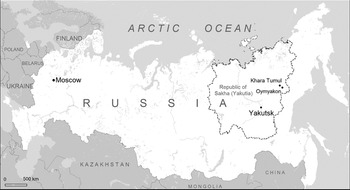
The village Khara Tumul illustrates the challenges faced by many remote communities with limited economic and decision-making opportunities in the region. A Sakha community of 29 households (94 people total), Khara Tumul is part of the municipal district “Borogonskiy 1 nasleg”, of which the village Oymyakon is the administrative centre (Fig. 1). The agricultural settlement was built during the Soviet period as part of the sovkhoz “Oymyakonskiy”, primarily for the purpose of livestock breeding. However, the territory was traditionally settled by Sakha and even indigenous peoples who relied on semi-nomadic and nomadic ways of life. All farms were abandoned after the collapse of the Soviet Union, and Khara Tumul has since experienced a deep crisis. Many residents moved to other villages and to Yakutsk. All official enterprises, such as administrative buildings, schools, hospitals and shops (including grocery stores), are located in Oymyakon, a few kilometers away from Khara Tumul. Local communities subsist mostly on cattle and horse breeding and hunting and gathering. They fetch water from the nearby river Indigirka and heat their houses with wood from the surrounding forest. They typically purchase products in Oymyakon for long-term storage. The only two enterprises where local residents can work (for minimum wage) in Khara Tumul are the kindergarten and its heating station.
Location of the study sites (map by V. Bogdanov).

Yakutsk
Yakutsk, the capital of the Republic of Sakha (Yakutia) (Fig. 1), is the main destination for rural and indigenous migrants in the region. It has become one of the fastest-growing cities in the Arctic — its population has grown by 73% over the past several decades, from 186,626 in 1989 (Demoscope, 2020) to 322,987 in 2020 (GosKomStat, 2020). About one-third of the region’s population (33%) currently lives in Yakutsk (GosKomStat, 2020). Existing studies show that Yakutsk is the only city where infant mortality, suicide and outmigration have decreased within the region (Fondahl et al., Reference Fondahl, Crate, Filippova, Larsen, Schweitzer and Petrov2014). As Vinokurova (Reference Vinokurova1992) has pointed out, it is also the only city in the republic that integrates ethnicity into its numerous cultural institutions. The city’s newcomers usually maintain tight connections with and make significant efforts to support their “small homeland” (Mandelstam Balzer, Reference Mandelstam Balzer2014). As a result, the city is characterised by the strong presence of local cultural elites (Kuklina & Shishigina, Reference Kuklina, Shishigina and Orttung2020).
Results
Carriers of sharing practices
The tradition of sharing food and other goods without asking or expecting to receive something in return, especially from elders, is transmitted from generation to generation and remains strong to this day. The recurrent explanation for this tradition in Khara Tumul is as follows: “Our parents used to share, and we are doing it too. It is our tradition”. This tradition has become significantly revitalised in new social, technological and environmental conditions.
Responsibilities for different sharing practices depend on the gender and age of carriers. In the traditional Sakha family, men provide food for their families. This tradition is preserved in Khara Tumul. While women usually have a more stable job, their salary is meager, and men can generate comparable levels of or even more income with only seasonal employment. Men provide additional food through subsistence activities such as hunting and fishing, and more often contribute to manual labour outside of the house (preparing ice for drinking water, chopping wood, supplying firewood, feeding cattle during the winter, bringing water from nearby lakes, as well as cleaning the house and barn in the spring).
Women often have the decisive voice on what the family will share and with whom. Women take care of their social networks and must be aware of the latest news in their communities to make decisions. It is not a surprise, then, that women in Khara Tumul are more connected to social media applications such as WhatsApp and Vkontakte (a Russian social network similar to Facebook). They are also more likely to share childcare responsibilities and housework (e.g. house cleaning, cooking, etc.).
As for generational differences, younger people are more likely to share their physical labour and food that results from subsistence activities, while senior people are usually recipients of sharing and may even extend that network by passing on food to others. Seniors have constant cash inflow from pensions, so they can lend money to households with less stable income. In the case of information and tradition sharing, elders share traditional knowledge, while younger generations possess and share technological skills and knowledge.
Sharing resources and labour within local communities
Khara Tumul exemplifies various configurations of sharing practices within its local community. Village residents heavily rely on activities such as farming, hunting, cattle and horse breeding, fishing and gathering, which have traditionally been based on the communal sharing of goods and labour. These activities not only serve economic and dietary purposes but also have traditional, cultural and social importance — they strengthen community ties and contribute to local residents’ self-identification as indigenous peoples.
Within the community, the “local” distribution of food, information and labour includes family members, friends and neighbours, and the volume of goods and labour is almost equal among them.
Sharing practices vary depending on age and physical ability. Children are often sent by parents to neighbours or relatives with food or other shared goods. By routinely participating in sharing activities, they not only serve as carriers but also gain traditional knowledge and skills.
Interviewees rarely mention the support that they provide to those outside of their families and communities. Only elders who have received support mention that their neighbours usually come and ask if they need help with chopping wood for the fire, bringing ice for drinking water and other necessary household chores. As one of the elders shared:
Just recently, our neighbor’s son brought us some firewood for free. He is a wonderful young man, always polite. We wanted to give him money, but he refused. We have money. We receive pensions, and we don’t spend much because we have everything we need: food, firewood. If you need money, just let us know, we will give you some because when you are far away from your home, you have to spend more. So, returning to our neighbors. Our neighbor’s son brought the firewood, and later his father chopped up the wood and put them in the woodpile. Overall, people come and ask how they can help, and it is very nice. (female, 77, 2015)
The neighbours whom the interviewee mentioned had themselves participated in interviews and talked only about food sharing, not labour — they view offering physical help as a mundane daily practice. Other unmentioned sharing practices in Khara Tumul include the spring cleaning of childless elders’ houses by their female neighbours and taking care of elders’ cattle during the winter, when the work is the most labour intensive. Neighbours bring cattle into their own barns, which they keep warm and clean during the winter, and give livestock water and feed. In these cases, elders pay only for the hay. People also share dwellings with relatives (e.g. extended families or adult siblings) and even some individual friends and neighbours in order to save firewood, electricity, food and just for company.
Distant sharing of resources
In Khara Tumul and Yakutsk, sharing also occurs between settlements and is facilitated by the use of social media. In contrast to sharing practices within the local community, the sharing of food and goods across settlements happens primarily within extended family networks and not as frequently among friends, even if family members live much farther away than friends. People in villages often send dairy and meat products, money to financially support students and younger people, and homemade food to close friends and relatives in the city.
Interviewees frequently mention the shared intergenerational responsibility for youth: when young family members leave villages and move to Yakutsk or other cities to study, elders join together to take care of these grandchildren. According to one interviewee, parents stay in the villages to work and send money to their children, while retired grandparents can receive their pensions anywhere and hence are more mobile (female, around 50, Yakutsk).
For example, Zinaida, a retired 60 year old, came to Yakutsk to take care of her oldest grandson, who is studying in university. His education is not free — his parents pay for tuition — so one of her roles is to make sure that the money will not be wasted and that her grandson dedicates his full attention to his studies. They rent an apartment because a dormitory is too distracting. Next year, his younger brother will come to the city, and Zinaida plans to return to the village. Her mission in the city is not limited to caring for her grandson:
I don’t have time to be bored; I’m here as a dispatcher. The prices [for food and goods] are very high there [in the village], so I’m here to buy and send what they call and ask for from there, at the airport I find somebody to send a parcel, every day I go there as a second job. (female, around 60)
The same practice of sharing resources has been sustained, even though the number of mediators and utilisation of transportation infrastructure have increased. The interviewee shares resources that are scarce or unavailable to the members of her network: store-bought goods in the village, and money and care in the city. At the same time, people who move to the city find that receiving food from their native homeland is also a form of communication with family and relatives. Often this food is shared with kith and kin to “taste”, exchange memories and strengthen mutual connections.
Social media networks are also important for sharing knowledge. People of all ages use social media platforms, but the most popular way to communicate, both in the Republic (RBK, 2019) and in Russia (Kommersant, 2020), is through the application WhatsApp. The app is growing in popularity among elders, especially women, because it allows them to enjoy all of the features of social media through a simple interface. In addition, it does not require a fast Internet connection, which is important for remote communities (Shlyakhtin, Reference Shlyakhtin2018). The content of social media is mostly local information, from news and jokes to photos and videos of environmental changes (based on the authors’ experiences as members of different WhatsApp groups).
In addition, social media facilitate other forms of knowledge sharing. For example, there are various groups for learning about indigenous languages and cultures (Kuklina, Vinokurova, & Ignatieva, Reference Kuklina, Vinokurova and Ignatieva2019). Social media networks not only help overcome distance but also strengthen existing connections. In particular, intergenerational links improve as the young generation shares news and photos with their parents and grandparents via kinship groups. Participation in interest groups and in many different social chats with kith and kin helps people to create and support a sense of community.
Sharing in emergency situations
We observed sharing practices in Khara Tumul and Yakutsk in the wake of emergencies. After a flood in Khara Tumul, the residents of the most damaged house were hosted by their relatives. They initially thought that they would live together only for a short time. Unfortunately, fungus grew on the walls of the displaced family members’ house due to flood damage. The monetary compensation that they received was too small and was not enough to build a new house. Their relatives had to then accommodate them for a much longer period of time than they expected. At the time of the interview, they had already been staying together for three years.
Since the government’s response is usually insufficient, communities have launched different informal initiatives to support those in need. Fundraising activities are one of the most popular initiatives. On the Internet, one can easily find numerous examples of these activities in different parts of the region. In Khara Tumul, help typically came from within remote communities. In the case of Yakutsk, in contrast, remote communities received help from the outside. These contrasting cases illustrate a diverse and complex configuration of sharing practices.
We may illustrate this with the case of Berezovka, a village in the Srednekolymskiy municipal district. Flooding had affected the village several times in the past, and in 2017, 37 houses and social facilities flooded, leaving 283 people without homes. As former residents of the community reported (interview, 2017), many residents had not managed to privatise their homes after perestroika due to the highly complicated logistics of transportation (Kuklina & Filippova, Reference Kuklina and Filippova2019). As a result, villagers generally found it difficult to prove their incurred losses. Interviewees listed a lack of communication as among the barriers to receiving regional and municipal support in previous years. After the flood in 2017, however, the government of the Republic of Sakha (Yakutia) met with residents of Berezovka, organised a campaign to support them and developed a comprehensive plan for village relocation (Vesti Yakutii, 2017). Interviewees suggested that one significant driver of the relocation project interviewees was former residents of Berezovka, now living in Yakutsk, who were able to mobilise their social networks to support the village. According to Lidia, who moved to Yakutsk about 15 years ago, the floods that had happened before were not as well-publicised as the latest one:
Srednekolymsk was once flooded, and only on the outskirts, but all (housing) certificates were given. And to us, what? Every year, or a year later, it flooded. Yes, all my life that I have lived there, I grew up in this water. Nobody paid attention. Now, there is widespread video, so people see and pay attention. Q: Do you have a telephone connection (with the village)? A: Of course, we do. But we did not have it before. You would say: ‘We have a flood!’, and they (local and regional authorities) – ‘Ah’, like they did not understand. So, we would stand by water. (female, around 40)
Previously unattainable, smartphones permitted representatives of local communities to publicise the scale and damage of flooding by sharing pictures. While local and regional authorities did not consider these pictures to be proof, they were sufficient for the dissemination of information throughout social networks. With better access to information about responses to floods in other communities, residents were now able to see what they could expect in the form of aid and recovery efforts.
Those Yakutsk residents who once lived in Berezovka organised a concert in the city of Yakutsk in July 2017 and raised money using their social networks. The Ministry for the Development of Civil Society, the Association of Non-Numerous Indigenous Peoples and the House of the Friendship of Peoples were listed among the organisers (SakhaPress, 2017), although the main work was on the shoulders of volunteers. According to the interviews, these volunteers were all women. The tickets sold out, and the amount of raised money exceeded 500,000 rubles (about $10,000, which is a significant amount for a small village), mostly received from individuals.
Discussion
We illustrate that combining studies of community resilience with practices of sharing in a remote community is highly fruitful. While sharing is inherent to indigenous cultures, its reproduction and transformation in different contexts and among individuals of different localities, ages and genders offer additional insights in regard to sources of resilience.
Our choice of the remote communities in the Republic of Sakha (Yakutia) allowed us to consider the compounding effects of remoteness, climate change, industrial development and limited support from authorities on those communities. In addition, in comparison with other countries, the lack of network development between local Russian communities and authorities at different levels is an important factor for consideration. In such conditions, local communities devise their own individual networking strategies and practices to withstand these changes. While our study conforms to the findings of previous research in the region (e.g. Crate, Reference Crate2003; Takakura, Reference Takakura2016), it also extends those findings by including urban communities and infrastructure and technology as foci of attention.
Indigenous communities in this study use various strategies grounded in both tradition and infrastructure and technologies to respond to problems associated with their remote locations, infrastructural degradation, and climate and social change. Climate change has reached such a degree that some rural households have begun to abandon traditional activities. Some families, for example, have gotten rid of their cattle in response to the degradation of pastures due to thawing permafrost. Urban migration has become one of indigenous peoples’ adaptive strategies, and resource sharing between households and between village and city is increasingly important to community resilience (Olsson et al., Reference Olsson, Folke and Berkes2004).
Sharing practices depend on the gender, age and kin relations of carriers. As in other Arctic communities (Bodenhorn, Reference Bodenhorn1990; Larsen & Fondahl, Reference Larsen and Fondahl2014), women in our case studies relate their activities to home and children and the need to take care of their parents and brothers. All of these areas remain the traditional domains of women’s responsibility. New means of communication and technologies, combined with increased access to information, allow them to apply sharing practices more broadly and thereby enhance the resilience of their communities. Meanwhile, members of the younger generation who currently share their labour with elders may tacitly expect to be receivers of support in the future. Based on these observations, we see that greater diversity in the pool of carriers who engage in sharing practices contributes to higher resilience in remote communities.
The case of Khara Tumul demonstrates how traditions and the everyday practice of sharing of food, goods and labour within the local context maintain the strength of an indigenous community. Networks of sharing in the village extend from neighbour to neighbour, to relatives and to friends with an emphasis on those in need. In the case of labour sharing, elders without close relatives are recognised as people in need and become receivers of help. In turn, these elders share their traditional knowledge and lend money to those households which have less stable income, even though those households are not necessarily the same ones that provided them with help. Therefore, sharing practices are not strictly reciprocal, which also adds to resilience — there is no expectation of mutual support.
In cases of distant sharing, we observe diverse practices that depend on the kind of shared resources. The sharing of goods emphasises kinship ties. As distance and the number of involved mediators increase, sending food and goods becomes more complicated, more expensive and requires more effort. This has not only economic but also social and cultural value — both food and connections are simultaneously shared.
Where information sharing is concerned, people moving from one place to another bring their contacts with them to new locations. Inclusion in different WhatsApp groups and sharing information and news with their communities on a daily basis help people feel connected to their “Malaya Rodina” (small homeland), even if they live far away. This conforms with Mandelstam Balzer’s (Reference Mandelstam Balzer and Kasten2004) observations about people who migrated to Yakutsk from different parts of the republic — they are loyal first to their relatives, then to their small homelands (uluses), and only after that to the republic as a whole. While such a distribution of loyalty may not be beneficial for regional social cohesion, it is key to local efforts to build resilience.
Sharing networks between settlements become extremely important in the event of natural disasters such as floods, especially those that affect small remote communities. The pattern of food and resource distribution quickly changes in response to these events, impacting not only residents of affected villages but also their family members, relatives and other members of their social networks. Those who live in the city of Yakutsk have better access to the media, authorities and other people and are able to publicise the plight of affected communities more effectively. The city also has better employment opportunities and economic resources due to its extraction of the republic’s rich natural resources. As a result, city dwellers are able to act as donors and enhance the resilience of their homeland communities in response to disasters such as the one that occurred in Berezovka. While this event should not replace the government’s efforts, it is an example of the success of spontaneous activities described by Berkes and Ross (Reference Berkes and Ross2013). It demonstrates how sharing practices can extend and evolve into civic activity in an apolitical fashion, which is key to community sustainability and resilience.
Conclusion
Sharing practices demonstrate that studies of resilience must engage with social theory. We have illustrated that the circulation of goods, money, and labour and the diversity of shared resources are more complex than that of a social network analysis. Social networks within indigenous communities are vital when authorities are inaccessible. The redistribution of resources between different places enhances community resilience. The sharing of shelter, food, goods and information based on principles of trust, generosity and reciprocity enables indigenous communities to solve everyday problems more effectively, support those in need and respond to natural disasters.
Social media and transportation technologies make traditional sharing possible across long distances. That is especially important for remote communities whose needs are otherwise overlooked by the government. With these technologies, distant networks rely less on natural resources and more on human capital, transportation and communication infrastructure. On the one hand, a gradual departure from the subsistence economy and related losses of traditional ecological knowledge and values seem inevitable as a result (Ford, Mcdowell, & Pearce, Reference Ford, Mcdowell and Pearce2015). On the other hand, communities have found ways to partially compensate for this loss and support indigenous identities by revitalising sharing traditions. Technology and social media even permit indigenous communities to extend practices of sharing within their networks. This amplifies the sharing economy (Widlok, Reference Widlok2016) and community ties and strengths community resilience.
The resilience that we have observed is mostly due to an increase in the strength of preexisting networks within indigenous communities with well-preserved traditions of sharing. The ability of indigenous communities to promptly mobilise existing social networks in the event of abrupt changes is worth exploring further, especially in the contemporary world. Meanwhile, more studies are needed in order to explore how media and technologies facilitate the development of new connections, expand and configure social networks and diversify resources for sharing.
We have focused on two particular communities with locally and culturally defined understandings of tradition and the distribution of economic resources between urban and rural communities. While communities were traditionally able to subsist directly on natural resources, they are increasingly dependent on industry. Future studies must therefore also analyse how sharing industrial extractive resources can enhance regional and local communities’ resilience.
Acknowledgments
The authors assert that all procedures contributing to this work comply with the ethical standards of the relevant national and institutional committees on human experimentation and with the Helsinki Declaration of 1975, as revised in 2008. The authors assert that all procedures contributing to this work comply with the ethical standards of the relevant national and institutional guides on the care and use of laboratory animals.
Financial support
The research was conducted with support from the U.S. National Science Foundation (V.S., Award numbers 1439468 and 1748092; V.K. Award number 2024166), the NSF Program for International Research and Education project “Promoting Urban Sustainability in the Arctic” (PIRE) (V.K., Award number 1545913) and the Russian Fund for Basic Research (V.K., award number 16– 02– 00570(а)). This study also benefited from RCN Arctic-FROST workshops (NSF, Award #1338850).