Introduction
The distributive consequences of occupational pensions have been a matter of concern for British social policy analysts since Richard Titmuss's seminal essays during the 1950s on the social division of welfare and pensions.Footnote 1 Titmuss emphasised the importance of fiscal and occupational welfare in the analysis of social policy, and on this basis famously warned that:
The direction in which the forces of social and fiscal policy were moving raised fundamental issues of justice and equality. … Already it is possible to see two nations in old age; greater inequalities in living standards after work than in work; two contrasting social services for distinct groups based on different principles, and operating in isolation of each other as separate, autonomous, social instruments of change (Titmuss Reference Titmuss1958: 74).
The nation, according to Titmuss, was split in 1958 between the 35 per cent of privileged workers who had access to occupational pensions and those who did not and who therefore faced a greater risk of old-age poverty (Lynes Reference Lynes, Rein and Wadensjö1997: 323). Despite this warning, Titmuss's preferred policy solution to these social divisions – a substantial increase in universal state provision – was largely ignored.
In 1975, the Labour government introduced State Earnings-Related Pensions (SERPS), but they were significantly less extensive than those proposed in 1957 by the Labour Party in National Superannuation, which Titmuss helped to draft (Baldwin Reference Baldwin1990; Fawcett Reference Fawcett1996), and SERPS implied acceptance of a continuing role for occupational pensions. Those who contributed to such pensions were allowed to ‘contract-out’ of the new SERPS scheme if their scheme passed various tests of quality (Income Data Services (IDS) Reference Hyde, Dixon and Drover2003). Moreover, SERPS was retrenched in the 1980s and has since been replaced by the State Second Pension, which over the next two decades will develop into a flat-rate pension. Replacement rates from state provision in the UK have thus been significantly lower than in most continental European countries and the United States of America (Pensions Commission 2004: 58). This makes occupational pensions a vital element in the UK old-age income system, but while coverage of occupational pensions increased up to the mid-1960s, it has remained fairly static at around 50 per cent of the workforce ever since (Lynes Reference Lynes, Rein and Wadensjö1997: 323). As a result, inequalities in pension income similar to those that Titmuss observed in the 1950s remain a significant feature of the UK pension system (Goodman, Johnson and Webb Reference Goodman, Johnson and Webb1997: 104; Joseph Rowntree Foundation 1995: 26–7; see also Pensions Commission 2004: 69; Lynes Reference Lynes, Rein and Wadensjö1997; Waine Reference Waine1995; Walker Reference Walker1999).
Against this background, the British literature on the social division of welfare in old age has understandably continued to focus on those without occupational pension provision, and emphasised the ways in which social class and gender influence on which side of the ‘have, have-not’ divide a worker falls (Arber Reference Arber1989; Ginn Reference Ginn2003; Ginn and Arber Reference Ginn and Arber1991, Reference Ginn and Arber1993; Sinfield Reference Sinfield1978). With regard to gender, feminists have emphasised the extent to which women are disproportionately represented among the ‘poorer nations’ in retirement, because job discrimination and the gendered division of caring means that they disproportionately lose by an occupationally-based welfare system (Ginn Reference Ginn2003). Regarding social class, various indicators of social stratification (e.g. occupation and income) have been used to show the particularly disadvantaged position of manual and semi-skilled workers (Ginn and Arber Reference Ginn and Arber1991).
As most commentators in the field have at least implicitly recognised, the social division of post-retirement income has always been more complicated and arbitrary than implied by the notion of ‘two nations’ divided by either or both class or gender (Titmuss Reference Titmuss1958; Ginn and Arber Reference Ginn and Arber1999). While occupational provision has always been most common among professionals, and has thereby contributed to class divisions in retirement, a significant minority of non-professionals have also been covered – and still are; ‘two nations’ in retirement is not and never has been entirely synonymous with class or gender divisions in work. Recent research by the Institute of Fiscal Studies (IFS) concluded that ‘whilst it is generally true that higher-income individuals have higher levels of pension wealth, there is still great inequality in wealth even amongst those with similar current incomes’ (Banks et al. Reference Banks, Emmerson, Oldfield and Tetlow2005: 22). For example, a substantial proportion (>25%) of those in the fifth and sixth highest income deciles of the IFS sample had more pension wealth than those in the seventh decile.
The aim of the study reported in this paper was to investigate the distribution of pension entitlements in the UK population, with particular attention to the implications for those with low to middling lifetime earnings (i.e. wages below the average but above the poverty line). To be clear, the study does not refute the importance of social class, care-responsibilities and gender-based job discrimination in conditioning pension outcomes. The authors agree with the findings of studies of the social division of welfare that these factors are associated with exclusion from occupational pensions and thus with the likelihood that an individual will suffer poverty after retirement, as concluded by the Pensions Commission (2004: 68–9). In other words, individuals who have received below-average lifetime incomes suffer a higher risk of exclusion from occupational schemes than those on higher wages.
Despite these associations, the fact that a substantial fraction of the high-risk groups have access to occupational schemes has implications for the overall distribution of pension income, and for the UK system's performance in combating poverty and social exclusion. It is argued in this paper that while the spread of occupational provision beyond the most privileged workers results in some vulnerable individuals avoiding old-age poverty, the main determinant of who among this group escapes and who does not is chance: the result of accidents of opportunity rather than planning or intention. As such it cannot be normatively justified on the basis of the desert-based conception of justice favoured by recent policy makers.
The paper is organised as follows. In the next section, the distribution of occupational pensions by employment sector is reviewed, to show the variability in the likelihood of employees being contributors to such schemes. The following section presents a micro-simulation of pension entitlements for the seven standard UK socio-economic classes (SEC), as well as for highly qualified women with a care-related employment gap (Office of National Statistics 2006).Footnote 2 The simulation illustrates the markedly variable outcomes of different types of pension schemes. These outcomes will be compared to those of identical biographies in two other countries, The Netherlands and Switzerland.Footnote 3 In these countries, occupational provision is more compulsory, either as a result of collective bargaining backed by the state, as in The Netherlands (Bannink Reference Bannink2005; Anderson Reference Anderson2004), or as a result of legislation, as in Switzerland (Bonoli Reference Bonoli2000; Queisser and Vittas Reference Queisser and Vittas2000; Queisser and Whitehouse Reference Queisser and Whitehouse2003). The comparison emphasises the generosity of the British system for those who have occupational provision, but also shows its variable incidence and effects. The paper then discusses the implications of these results for the policies that combat poverty and social exclusion in the UK, and justifies the emphasis on chance as the allocating mechanism. In the final section, the implications of the findings for the current international pensions' policy debate will be discussed, as well as recent UK pensions policy proposals.
Access to occupational provision
In the United Kingdom, employers have had considerable freedom to decide whether or not to offer pension schemes and to determine the types that they make available (Bridgen and Meyer Reference Bridgen and Meyer2005a). Pension benefits and conditions of access have varied widely as a result. Social policy analysts have given most attention to the social and gender biases of this coverage. Ginn and Arber (Reference Ginn and Arber1999) showed that just under 80 per cent of men in SEC I were paying occupational pension contributions in 1993/94, but only about 40 per cent of those in SEC VI (Pensions Commission 2004: 97); and that while 61 per cent of all men paid occupational pension contributions, only 42 per cent of women did so. Access to occupational schemes is not however totally blocked for workers with low qualifications or with care responsibilities. The coverage is broader and less differentiated by gender and occupational category (or SEC) in some employment sectors than others. Pension schemes in the better-covered sectors may not have been designed with low-skilled or part-time workers in mind, but they are all-encompassing.
The most comprehensive coverage is achieved in the public sector and by large private-sector companies. In the public sector in 2000, only about 16 per cent of employees were not covered (Pensions Commission 2004: 93). In companies with more than 250 employees, 55 per cent had access to an occupational pension, but in firms with 1–49 employees, only 19 per cent did so. In the private sector some types of economic activity are better covered than others; in manufacturing almost 60 per cent of employees are covered; in wholesale and retail the coverage is 40 per cent; and in hotels and restaurants it is about 12 per cent (Pensions Commission 2004: 64). Although access to occupational pensions for workers at risk of low income in old age is therefore possible, the benefits vary widely and are dependent on the employer. The most generous pensions, ‘defined-benefit (DB) schemes’, are disproportionately found in the public sector and are the only type of scheme that it had offered (Government Actuary's Department 2003: 9). In the private sector the generally less generous money purchase and hybrid schemes are more common, although DB schemes continue to predominate, particularly among older workers. The latter have been advantaged by the fact that when employers have closed DB schemes, this has generally been only to new contributors and existing members' entitlements have not changed (Department of Work and Pensions (DWP) 2004: 58; Pensions Commission 2004: 118; Bridgen and Meyer Reference Bridgen and Meyer2005a). Nevertheless, defined-contributions (DC) pensions can be advantageous to some workers, particularly the most mobile, given the generally inadequate arrangements in the UK for preserving the value of DB pensions left behind by workers when changing employer (Blake Reference Blake2000).
The distributive consequences: risk biographies and micro-simulation
One way of illustrating the distributive consequences of today's UK pension regime and the effect of the outlined variations by employment sector on employees' pension outcomes is by micro-simulation of its effects on a range of constructed biographies. This allows an assessment of the future impact of today's pension policies for various characteristic occupational biographies and illustrates the interaction between regime features and a person's employment history. As Johnson and Rake (Reference Johnson and Rake1998) suggested, comparative work makes it possible for researchers to bridge the differences in national socio-economic backgrounds and to focus purely on the impact of the pensions regime on individuals. Thus, micro-simulation is a two-stage process in which, first, a group of exemplar life biographies are constructed, and secondly, the entitlements to pensions of these individuals on retirement are calculated.
With regard to the first stage, as explained in the introduction, our concern is with individuals with lower qualifications, i.e. who are in semi-routine or routine occupations (SEC IV–VII), or who experience care-related employment gaps and part-time work. These factors mean that their lifetime earnings are below average. Within this group, individuals experience different life course and employment trajectories that influence their final pension entitlement. To reflect this diversity, we have made the exemplar biographies as non-schematic as possible. In other words, the imagined lifecourse trajectories are not defined solely by the level of earnings (see for example Pensions Commission 2004; Organisation of Economic Co-operation and Development 2005), but also include various social risks that are likely to affect the pension outcome (e.g. part-time work, periods of caring and early retirement), and they reflect broad social and economic trends in post-industrial societies (Armingeon and Bonoli Reference Armingeon and Bonoli2006; Castles Reference Castles2003; Hantrais Reference Hantrais1999; Pierson Reference Pierson and Pierson2001). Five exemplar ‘risk biographies’ were constructed. All five were aged 18 years in 2003, and will reach 65 years-of-age on 1 January 2050. The details are:
Biography 1. Tessa: an unqualified part-time worker and mother
Tessa is employed as a semi-routine retail salesperson (SEC VI) throughout her working life. Her earnings oscillate over and under 50 per cent of average full-time wages, falling to a low of 30 per cent of average wages when she returns to work after the birth of her second child, and rising to a high of 62 per cent of average wages in the final years of her working life. She is out of the workforce for five years when aged 23 to 29 years when caring for her children and, on returning to work, is on a part-time contract for 10 of the 35 years up to retirement.
Biography 2. Margaret: a qualified part-time worker and mother
Margaret gains a nursing qualification (SEC III). Her earnings oscillate over and under 60 per cent of the average full-time wage, rising to a high of 70 per cent of average wages in the years immediately before her marriage, and falling to a low of 38 per cent of average wages when she returns to work after the birth of her second child. Between the ages of 25 and 32 years, she spends four years out of the workforce caring for her children and another five years from the age of 60 years caring for an elderly relative. She is on a part-time contract from the age of 32 years, when she returns to work after childcare, until retirement.
Biography 3. Tony: an unqualified male worker
Tony worked in the motor industry as a semi-routine technical worker (SEC VI). His earnings rise steadily from a starting level of 65 per cent of average wages in 2003, to a high of 85 per cent when aged from his late thirties to late fifties, dipping thereafter to 80 per cent for the rest of his working life. He is unemployed for a year at the age of 26 years when between employers.
Biography 4. Gordon: an intermittent male worker
Gordon is a qualified manual worker (SEC V) who is employed in the construction sector from the age of 20 years. He consistently earns around the average full-time wage when in work, his highest wage of 140 per cent of average wages being achieved in the final year of his working life. His lowest wage, at 80 per cent of the average, is accrued when he starts employment and in his first year of self-employment at age 37 years. He is self-employed from this age until retirement at 65. He experiences four years out of the labour force between the ages of 27 and 37 years through unemployment and re-training.
Biography 5. David: a male small-business entrepreneur
David worked in the family business (SEC IV) until the age of 30 years, apart from one year in full-time training, and earned 50 to 75 per cent of the full-time average wage. He took over the business at the age of 30 years, after which his income oscillated above and below the average full-time wage, with a high of 110 per cent of average wages between the ages of 39 and 44 years.
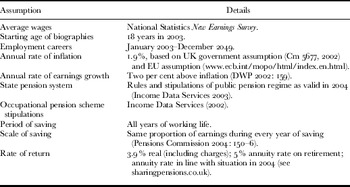
It is relatively straightforward to calculate the future state-pension entitlements of these biographies given various assumptions, as set out in Table 1.Footnote 4 The current state-pension formulae establish future entitlements on the basis of a projection of the working life (i.e. wages and contributions) of the biographies under various reasonable assumptions (detailed in Table 1). Assessing the projected level of non-state provision is less common in micro-simulation, because it raises several methodological problems, particularly for the UK (Meyer et al. Reference Meyer, Bridgen and Riedmüller2007). Decisions have to be made about the occupational entitlements of each risk biography, which raises questions about their prevalence and value. In some other European countries, such projections are less problematic, either because the scale and importance of occupational provision is not as great (until recently this was true for Germany), or because compulsion makes the coverage of occupational pensions greater and more uniform (e.g. Switzerland and The Netherlands).Footnote 5 In the UK, greater employer voluntarism means that coverage is patchier and variable, so predictions of the likely occupational coverage of individual biographies are not straightforward.
Assumptions in the simulations

Given the current pattern of UK occupational pension coverage, one approach might be to assume that employees with the described biographies are altogether excluded from occupational provision. Certainly they are generally less likely to have occupational provision than other types of worker but, we reiterate, exclusion from access is not total: all of the exemplar biographies could have some access to occupational provision for periods of if not the whole of their working life. This is more likely for some than others; for example, the nurse is highly likely to have worked in the public sector, and therefore almost certain to have a DB pension. Likewise, the car worker's prospect of an occupational pension is much higher than the construction worker's, particularly given that the latter was self-employed for much of his working life. If he does have access, the pension scheme could be either DB or DC. The shop-worker's chances of having an occupational pension are lower. If she does, it is likely to be DC, although some of the larger retailers provide DB pensions. Whether or not each of the biographies fall into the sub-group of employees in their sector that are covered is most influenced by the size of the employing firm.
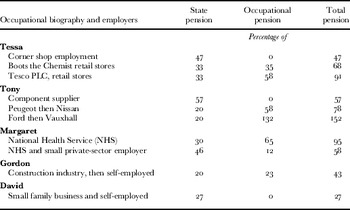
When estimating overall pension entitlements, there is little justification for simplifying this complex pattern of provision. Thus, rather than making a single assumption about each biography's access to occupational provision, we have examined variant employment histories. For example, the retail company for whom the unqualified part-time worker and mother works was varied. For the nurse, the variants are: (a) employed in the National Health Service (NHS) throughout, and (b) employed for the last 20 years of her working life by a small welfare charity. Finally, while all the biographies of unqualified male workers involved employment in the motor industry, one is employed by Rover and then Vauxhall, one by Nissan and Peugeot, and one throughout his working life by a small car-component manufacturer. The pension entitlements of all biographies and their variant employers have been examined in relation to the projected old-age poverty (i.e. dependency on social assistance) and social exclusion outcomes (the latter defined as a pension that is less than 40 per cent of average wages) (Table 2).Footnote 6 Comparisons are also made with the pensions and income outcomes in old age of similar working lives in The Netherlands and Switzerland.
Projected state, occupational and total pension income in 2050 as a percentage of the social inclusion threshold by risk biography and employer history

Note: The social inclusion threshold is defined as an annual income that is less than 40 per cent of average wages.
The United Kingdom pension system and social risks
The exemplar biographies and contrasting employment histories clearly reveal considerable variability in the pension outcomes and several complexities in the social division of occupational welfare. Some variants lead to a pension close to or above the social inclusion threshold, showing that neither a life on low wages nor an employment trajectory with several breaks or periods of part-time work inevitably leads to poverty in retirement, even if both occur. Some individuals and couples are therefore luckier than others with regard to occupational pensions; they obtain post-retirement incomes that compare favourably with those received by similar workers in Switzerland and The Netherlands, but the low level of UK state provision greatly exaggerates the cost of being a loser.
The variable outcomes are shown by the individual biographies. Let us start with Tessa, the unqualified worker and mother. She is employed in the retail sector throughout her working life, quite probably always for small, independent shop-keepers that do not provide occupational provision (Pensions Commission 2004: 64). It is also possible, however, that she works for employers that offer either DB or DC pensions. If, for example, she works for Tesco PLC, the UK's leading supermarket chain, she would receive an average-salary DB pension, but if she worked for Boots Group PLC (now Alliance Boots PLC), the UK's leading pharmaceutical and toiletries retailer, she would receive a DC pension in addition to the state pension (Incomes Data Services 2002). Her choice of employer is highly unlikely to have been influenced by the pension schemes that they offer. With regard to contributions, if she works for a corner-shop, she would pay National Insurance contributions of 11 per cent of gross income, whereas if she works for Boots, she would have to pay a reduced contracted-out National Insurance contribution of 9.4 per cent and an employee's contribution of three per cent to the occupational pension scheme, making total contributions of 12.4 per cent.Footnote 7 If she works for Tesco's, her total contributions would be 13.4 per cent, made up of the same National Insurance contribution as the Boots' worker and a four per cent occupational-pension contribution.
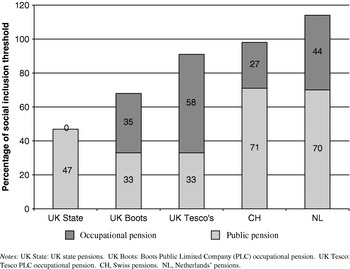
As can be seen from Table 2, the implications of this variation in pension provision for the income in retirement of the unqualified worker and mother are substantial. In comparison with a similar person who worked for smaller retail outlets without occupational pensions, women employed by Boots and Tesco's are significantly advantaged in terms of pension income. Whereas the pension income of the Tesco's worker on retirement is 91 per cent of the social inclusion threshold, and the Boot's worker's pension achieves 68 per cent of this threshold, the corner-shop employee is reliant on the state provision with a value of only 47 per cent of the social inclusion threshold. The corner-shop employee could, of course, save privately to boost her retirement income. Her total contributions are lower than those of her Boots and Tesco's peers, so there might be scope for this. Calculations based on the assumptions specified in Table 1 suggest that she would have to save five per cent of her gross yearly income to reach the pension level of the Boots worker, and eight per cent to reach that of the Tesco's worker. Thus, she would have to pay 16 per cent of her income in savings and National Insurance contributions to receive the same pension as the Boot's worker will receive for 12.4 per cent of her income, and 19 per cent of her income to receive the same pension as the Tesco's worker gets for 13.4 per cent. She has to pay more herself to make up for the fact that, unlike her counterparts employed in bigger firms, she does not benefit from an employer contribution to her non-state pension scheme. Indeed, as can be can be seen from Figure 1, the Tesco's employee's occupational pension is more valuable in relation to the UK social exclusion line than the occupational pensions received by a similar retail employee in The Netherlands or Switzerland. It is only because the size of state provision is higher in these countries that the equivalent occupational history leads to a greater pension in relation to national social exclusion thresholds.
An unqualified part-time worker and mother's (Tessa's) pension in 2050 with different UK employers and in Switzerland and The Netherlands.

Others are even bigger winners in terms of occupational pensions, particularly those who are employed for most of their working life by large manufacturing companies or in the public sector, where DB pensions remain common. Take, for example, Tony, the unqualified male worker: he is employed in the motor industry, earns no more than 80 per cent of the average wage throughout his working life, and experiences one year of unemployment. Such a person might work in a small firm that supplies components to the major motor manufacturers, or alternatively be employed by just such a firm. If he spent his working life employed successively by Peugeot and Nissan, he would receive a DC pension in addition to his state pension on retirement, whereas if he worked successively for Rover and Vauxhall, he would receive two DB pensions. Once again, it is highly unlikely that his choice of employer would be influenced by the type of occupational pension, if any, that they provide. With regard to contributions, if Tony worked for the component supplier he would have to pay National Insurance contributions of 11 per cent of gross income, whereas if he worked for Nissan and Peugeot he would have to pay reduced National Insurance contributions of 9.4 per cent and an employee's contribution to the occupational pension of between three and five per cent, making total contributions of between 12.4 and 14.4 per cent. In the simulations it was assumed that he paid total contributions of 12.8 per cent.Footnote 8 If he worked for Ford and Vauxhall his total contributions would be 17.4 per cent, made up of the contracted-out National Insurance contribution of 9.4 per cent and an eight per cent occupational-pension contribution.
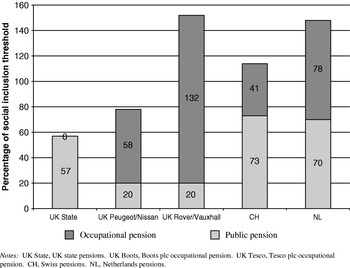
As Table 2 shows, the different employers substantially affect Tony's retirement income. In this regard, the Rover and Vauxhall employee does very well, for these companies provide the very best of UK occupational pensions, which yield an income substantially above the social inclusion threshold. Working for these companies, Tony's total old-age income is 152 per cent of the threshold. In fact, seen comparatively, the Rover and Vauxhall employee receives a significantly higher pension income than that achieved by similar workers in either The Netherlands or Switzerland, even though the UK state pension is much lower (Figure 2). In comparison with an occupational pension for the British worker of 132 per cent of the British social exclusion threshold, the Dutch worker receives an occupational pension that is 78 per cent of The Netherlands' social exclusion threshold, and the Swiss worker a pension that is 41 per cent of the Swiss equivalent.
An unqualified male worker's (Tony's) pension in 2050 with different UK employers and in Switzerland and The Netherlands.

An employee with a DC pension is advantaged in comparison with a component-firm employee but is not as fortunate as the Ford and Vauxhall worker: he secures an income on retirement substantially above social assistance on retirement but 22 percentage points below the social inclusion threshold. On the other hand, a small-firm employee is a serious loser. While he would clear the poverty threshold on retirement, he would not receive an income that allows participation in even the most customary out-of-home activities in contemporary Britain. He would have to save three per cent of his gross yearly income to reach the income of the Nissan and Peugeot worker, and 13 per cent to reach that of the Ford and Rover worker. Thus, he would have to pay 14 per cent of his income (in savings and National Insurance) to receive the same pension as the Nissan and Peugeot worker receives by paying 13.4 per cent of his income, and 24 per cent of his income to receive the same pension as the Ford and Rover worker receives by paying 14.4 per cent. This again illustrates the important advantages gained by those workers whose employers contribute to their non-state provision.
As noted earlier, the other big winners in the UK system are public-sector workers, as revealed by the circumstances of the qualified part-time nurse and mother, Margaret (Table 2). She is a trained nurse with earnings that oscillate between 40 per cent and 80 per cent of average wages. She experiences occasional periods out of the workforce, including early retirement, and works part time for long periods. In the simulations, we assumed that one variant of Margaret is employed throughout her working life in the NHS, and thus gains access to a good quality DB pension, while another works after 40 years-of-age for a small private welfare organisation that does not provide an occupational pension. With regard to contributions, NHS Margaret would have to pay total contributions of 15.4 per cent of gross wages throughout her working life, made up of a 9.4 per cent contracted-out National Insurance contribution and a six per cent NHS contribution. Her colleague who leaves the NHS would only have to pay this amount during her time with the organisation; afterwards she would only have to pay National Insurance of 11 per cent. As a result, NHS Margaret's pension is 37 percentage points higher as a proportion of the social inclusion threshold than that of her colleague who leaves the NHS. The latter would have to save 12 per cent of her gross income over her entire working life to receive the same pension as NHS Margaret. Thus, her total contributions while working for the NHS would amount to 27.4 per cent of gross income, a figure that would decline to 23 per cent when she no longer had to pay the NHS pension contribution. In comparison, NHS Margaret draws a much higher pension for 15.4 per cent.
The employees who are most disadvantaged by the distribution of UK occupational pensions are those who work for small private-sector firms or for themselves. Gordon, the intermittent worker, and David, the self-employed entrepreneur, illustrate the problems that these workers face. Gordon is a construction worker and receives lifetime wages just above and below 90 per cent of the average wage (so is paid more than Tony, the unqualified worker). Gordon works in a small business for the first 13 years of his working life and is then self-employed until retirement. David, the-self-employed entrepreneur, also earns more than Tony and close to the average wage for long periods, but is self-employed for longer – 35 years of his working life. Gordon has access to an employer-supported stakeholder pension while he is employed by someone else, into which he pays 2.4 per cent of his gross income. Thus his total contributions including National Insurance during this time are 11.8 per cent of gross income, but substantially less when he is self-employed, for then he pays a nominal flat-rate contribution of less than one per cent of average wages. David has no occupational provision and thus only pays the self-employed rate throughout his working life. As can be seen in Table 2, these working biographies significantly affect the income of these individuals on retirement: the pension received by Gordon is 43 per cent of the social inclusion threshold, while for David it is 27 per cent, even though both these workers earn more than the unqualified worker, Tony, whose access to good occupational provision ensures that he will benefit from a much better income in retirement.
Given that both Gordon and David receive reasonably good wages and pay much lower National Insurance contributions while self-employed, it might be argued that they can afford to save the seven per cent (intermittent worker) and nine per cent (self-employed entrepreneur) of gross earnings that our calculations suggest would be required to raise their retirement income above the social inclusion threshold. However, many self-employed people do not save because they regard their business as their pension. Only approximately 43 per cent of self-employed men and 35 per cent of self-employed women made any contributions to a private pension scheme in 2002/03 (Pensions Commission 2004: 91). For this reason, although the intermittent worker and the self-employed entrepreneur earn more than the unskilled worker, they are disadvantaged by the current distribution of British occupational pensions. In summary, the examples reveal the complicating effect of non-professional workers' access to occupational pensions on the social division of pension income in the UK. Although all the imagined individuals are disadvantaged by class or gender, some achieve incomes in retirement close to or above the social inclusion threshold. The biographies show well that a significant minority of non-core male and female workers with access to good occupational pension schemes do better than their class or gender peers in terms of pension income.
Couples and occupational pensions
So far we have considered the outcomes of the UK pension system only for individuals, which is consistent with the tendency in social policy away from seeing the household as the unit of relative material welfare towards individual assessment, as endorsed in forceful political statements by the European Union and the British government (Council of European Union 2003; DWP 2002). Pension systems based on an assumption of financial dependence between partners are problematic given the evidence that the ‘breadwinner’ does not always distribute ‘his’ resources equally (Graham Reference Graham, Brannen and Wilson1987; Pahl Reference Pahl1989). Nevertheless, if we are to gain a full appreciation of the distributive consequences of occupational pensions, it is important to consider the possibility that access to occupational-pension income might also occur through marriage. In this regard, the biographies illustrate changes in the gendered division of pension income among married couples and the very different old-age income outcomes for those on low and middle incomes.
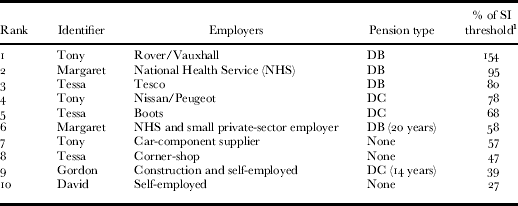
Through much of the 20th century, it was assumed that the male ‘breadwinner’ model of marital income was accompanied by reasonable sharing of the pension income. It followed that if a woman was disadvantaged or had low lifetime income, this would be mitigated by marriage (Ginn Reference Ginn2003). The model entrenched the gendered division of pension income, with married women without occupational provision of their own becoming dependent on their husband's income for a retirement above the poverty line. Today, however, the experience of workers such as NHS Margaret suggest that this situation could be changing. The growth of women's employment – much of it with public-sector employers that provide DB pensions – together with the decline of DB provision in the private sector (see below), has over the last decade reduced the gap between men and women in relation to DB pension coverage (Pensions Commission 2004: 98). With reference to all forms of occupational pensions, coverage among full-time women is now higher than among full-time men, and even among part-time women workers, for whom coverage has lagged behind, the trend is upwards (Pensions Commission 2004: 98). If these developments continue, we will see a gradual reduction in the gendered division of post-retirement income and it will become increasingly common for the woman's pension to contribute most to a couple's joint retirement income. Referring again to the exemplar biographies, this would be the case, for example, if the more fortunate women such as NHS Margaret were married to those of our men without access to occupational provision, for example car-component firm employee Tony (Table 3).
Total occupational pension as a percentage of the social inclusion threshold in 2050, rank order of exemplar the male and female biographies with different employers
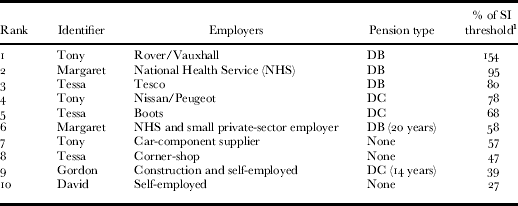
Notes: DB defined benefit. DC defined contribution. 1. Value of total pension as a percentage of social inclusion threshold.
Seeing individuals in couples also reveals the significance of marriage for retirement income. For a person who has restricted access to occupational pensions, the consequences might be reduced if she or he had a partner with a good occupational pension. This can be illustrated by both Tessa, the unqualified worker and carer, and Tony, the unqualified male worker. As was seen, their pensions varied considerably depending on their employers. If they were married to each other, the consequences of this variability would be felt by both of them. Let us consider in particular Tessa the corner-shop employee: she has an individual pension that amounts to 47 per cent of the social inclusion threshold. How would her situation in relation to social inclusion change if she were to marry? The answer depends on the occupational pension access of her partner. If she married Tony the component-firm employee, who has no occupational pension, she remains significantly disadvantaged. Together they have a joint income which is only 69 per cent of the household social inclusion threshold.Footnote 9 If, however, she married Tony the Ford/Vauxhall employee with two DB pensions, the total pension income of the couple would be 33 per cent above the household social inclusion threshold.
The consequences of non-professional access to occupational pensions
The occupational pension retrenchment
It is clear therefore that the social division of occupational pensions in the current UK system is far from straightforward. Among individuals on below-average wages, those with identical working-life biographies in terms of pay, part- or full-time working and labour market detachment, can receive very different retirement incomes solely on the basis of their particular employers. These differences are possible even between those with the same occupation. As has been seen, this situation has received less attention in the social division of welfare literature than differences by social class and gender, with the result that the role of the occupational sector in protecting not just core workers, but also more marginal individuals, has not been sufficiently considered.
If the positive features of UK occupational provision have been understated, their more explicit identification raises important concerns in relation to: (i) recent developments in the occupational sphere; and (ii) the determinants of the distribution of pension income among those on average to low incomes. Let us first consider recent developments in occupational provision. As is well known, a major shift has been taking place from DB to DC pensions (Bridgen and Meyer Reference Bridgen and Meyer2005a). Indeed, according to a recent survey of the pension arrangements offered by 186 of all FTSEFootnote 10 350 companies, the end of DB schemes in large private-sector companies is well underway (Towers Perrin 2004; The Financial Times, 28 June 2004; Confederation of British Industry (CBI)/Mercer 2004: 10). Since 1995, employers across the board have closed their schemes to new members, with high street banks, insurers and retail operators setting the trend, and the pace accelerating after 2000 (IDS 2002: 19, 32 and 37; Pensions Commission 2004: 114). After a fairly stable period during the early 1990s, in 1996 11 per cent, and in 1997 13 per cent, of all DB schemes of larger employers (>20 employees) were closed to new members (Department of Social Security (DSS) 1998: 47). Between 1998 and 2000, one-tenth of very large employers (>1000 employees) had closed their schemes to new members (DWP 2002: 53), and between 2000 and 2003 a further one-third did the same (DWP 2004: 61: IDS 2004). As a consequence of these closures, the coverage of the workforce in companies with more than 20 workers by salary-related schemes declined from 60 to 50 per cent between 1996 and 1998 (DWP 2002: 50), and from 48 per cent to 41 per cent between 2000 and 2003 (DWP 2004: 56, 61). Coverage today is still high because the trend only affects a company's new employees. A generational change has therefore been underway in many large private-sector companies. So far, public-sector schemes have remained unaffected by closures, and continue to provide good benefits, but even here important changes to the benefit structure are being considered (The Financial Times, 21 May 2004).
The results of the simulated biographies emphasise the problems that these developments will cause for those with below-average lifetime incomes. This is because DC pensions, while providing a substantial supplement to state provision and having some advantages over DB schemes, particularly in relation to job mobility (Blake Reference Blake2000), are less generous, mainly because while the average employer contribution to DB schemes is 15.7 per cent (IDS 2004: 184), it is only five per cent to DC schemes (IDS 2003; see also Pensions Commission 2004: 88–9). DC schemes also generally mean an increase in individual uncertainty and risk (Ring Reference Ring2002: 559–61). With the social role of employers declining, more of the below-average wages group will be at risk of social exclusion or even poverty in retirement (see also Pensions Commission 2004: 96). Our analysis has highlighted the dangers of these developments for a significant group of non-core workers, many of whom are women. Any substantial retrenchment in the public sector would leave women much more vulnerable to poverty or social exclusion in retirement, and may reverse the gains in employment equity that they have made in recent years.
Chance and the distribution of occupational pensions
A focus on the variable access of non-professionals to occupational provision also emphasises the role of chance in the distribution of these types of pension. To be clear, chance does not fully explain the distribution of occupational pensions, and class and gender remain very important predictors of occupational pension access. Among the less advantaged social groups, however, we argue that chance provides the best way of understanding why some workers have access to an occupational pension while others with similar or the same working-life biographies (in terms of wages, occupation and employment sector) do not. In this regard, we use the term ‘chance’ because some individuals find themselves with employers who provide good occupational schemes more by accident than design. Whether an individual has a good pension income is the result of an employment decision made for reasons unrelated to savings or pensions criteria.
Our emphasis on the role of chance is on two grounds. First, we argue that there is a general lack of knowledge about occupational pensions, which is particularly acute amongst those on low to middle incomes; this impedes informed choice and increases the influence of chance. Secondly, structural constraints on job availability, particularly for low- to middle-income workers, limits people's ability to choose their employer and thus the scope for basing employment decisions on occupational provision. Individual ignorance is generally not recognised in the economics of pensions' literature, even that element concerned with explaining individuals' pension-related decisions.
Rather, individuals are customarily conceived as rational actors in their approach to pension savings, who seek intentionally to determine their consumption within and across time periods to maximise lifetime utility (e.g. Gustman, Mitchell and Steinmeier Reference Gustmann, Mitchell and Steinmeier1994). They are assumed to save during working periods to ensure they have sufficient income when not working. As Rowlingson (Reference Rowlingson2002) suggested, this presumption has been shared by many recent UK social and pensions' policy makers. Under the Conservative governments of the 1980s and 1990s, and under New Labour since 1997, responsible individuals who anticipate risks and take appropriate prudent actions have been lauded. ‘[G]overnment cannot solve problems alone’, suggested New Labour in 1999, but needs ‘to work with people to encourage them to help themselves’ (DSS 1999, cited in Rowlingson Reference Rowlingson2002: 624). One way individuals might do this is by assessing the respective merits of employers on the basis of whether they provide an occupational pension.
A well-established critique of the rational actor model is that constraints of time, imperfect knowledge and imperfect ability bound rationality and thus the ability to choose. This is particularly the case with pensions, for which the complexity of products and instruments make it difficult for individuals to estimate risk and value (Burchardt Reference Burchardt1997). The levels of knowledge and understanding are generally low, with respect to both personal and occupational provision (Goode Committee 1994; Mayhew Reference Mayhew2001; Thomas, Pettigrew and Tovey Reference Thomas, Pettigrew and Tovey1999; Rowlingson Reference Rowlingson2002). These information problems have been made worse by the well-known scandals in the occupational- and personal-pensions fields, which have at the very least raised doubts about the ‘rationality’ of relying on employers or the financial sector (Waine Reference Waine1995). As Taylor Gooby (Reference Taylor Gooby1999) noted, these problems are not experienced equally by all social groups and are most prevalent among those on lower incomes.
Yet it is precisely this group that most needs knowledge of occupational pension provision, given that their access is much less certain on the basis of their employment. In its absence, the nature of pension provision supplied by a potential employer is unlikely to exert any major influence over the employment decisions of workers. This is certainly the conclusion reached by studies of employees' knowledge of and attitudes concerning occupational pensions, which suggest that occupational welfare plays little part in attracting workers to employers (Cable and Graham Reference Cable and Graham2000; Turban and Cable Reference Turban and Cable2003), and that most employees who work in companies with occupational provision have very little knowledge of their pension arrangements (Loretto, White and Duncan Reference Loretto, White and Duncan2001; Vickerstaff, Cox and Keen Reference Vickerstaff, Cox and Keen2003).
In addition to the imperfect knowledge of pension schemes, the idea that chance determines access to occupational pension provision among low to middle income workers is reinforced by the structural constraints that affect job choice. Even if individuals acted ‘rationally’ and sought occupations and employers that provide good occupational pensions, it is clear that the extent to which they have a choice of employer is affected by general economic conditions and job supply. In a tight labour market with many advertised vacancies, an individual might be able to choose between employers, but in times of above-average unemployment, workers have few choices, especially in less prosperous regions. We know that jobs, particularly in the private sector, are not dispersed evenly around the country and that there is a tendency for industries in the same sector to agglomerate in particular areas (Bennett, Graham and Bratton Reference Bennett, Graham and Bratton1999; Henderson and Hoggart Reference Henderson and Hoggart2003; Coombes and Raybould Reference Coombes and Raybould2004).
One consequence is that the supply of jobs and individual job choices is greater in some areas than others. We also know that variations in job availability are more pronounced at the local level (Sunley Reference Sunley2000: 490–1). Those areas with a significant manufacturing sector, for example, other things being equal, will have more jobs that offer occupational pensions opportunities than areas without. Given that most workers seek jobs that do not require them to move, the choice of possible employers will be constrained, and the chances of there being a good supply of employers providing occupational pensions vary by area. In summary, there are good reasons to conclude that the circumstances which lead a middle-income worker to find himself or herself with an employer that provides a good-quality occupational pension have very little to do with intention, but rather, are mainly a product of chance – accidents of timing, opportunities and location.
Occupational provision and pensions' reform
So far this paper has shown that the incomplete level of coverage of occupational pension provision in the UK creates inequalities in pension outcome not just between class and gender groups but also within them. It has demonstrated the important role that occupational provision has played and continues to play in boosting the retirement income of those at relatively high risk of retirement poverty. For a substantial minority of non-core workers, occupational pensions successfully deliver old-age welfare (DSS 1998). In this regard, the notion of ‘two nations’ in retirement is misleading, if understood as implying a straightforward division on the basis of class and/or gender. There are not clear-cut ‘haves’ and ‘have-nots’ among those with lower income, and higher income does not necessarily produce increased pension wealth (Banks et al. Reference Banks, Emmerson, Oldfield and Tetlow2005). Some women with incomes below average will have higher pensions as a result of good occupational provision and have better retirement income than some men with higher earnings.
The role played by the private sector in protecting non-core workers in this way has arguably received too little attention from critics of private-sector pensions. There are nonetheless significant policy implications from the general shift in the industrialised world away from state provision and towards private arrangements (Pedersen Reference Pedersen2004). Some policy analysts have argued that it is not so much private engagement per se which is at odds with social inclusion for citizens at risk; rather, much depends on the type of private-sector involvement and the nature of the continuing relationship between state and non-state providers (Bridgen and Meyer Reference Bridgen, Meyer, Meyer, Bridgen and Riedmuller2007; Hyde, Dixon and Drover Reference Hyde, Dixon and Drover2003; Stevens, Gieselink and Van Buggenhout Reference Stevens, Gieselink and Van Buggenhout2002). Non-state provision that involves employers organising and supporting risk-pooling in an effective way, and including citizens on moderate incomes, sometimes as a result of government regulation, can be an effective welfare tool. The extent to which this is so depends to a large degree on the continuing role of the state.
This dimension underlies the biggest problems of the British pensions system. The low level of state provision means that access to an occupational scheme is of considerable importance, but because provision of occupational pensions is voluntary, access to these schemes is found almost exclusively in large companies or in the public sector. While large employers have a strong self-interest to invest in company pension schemes, not least to attract and retain higher-skilled workers, and so to provide good benefits, the same motivation cannot be expected from small businesses with fewer resources (Mares Reference Mares, Hall and Soskice2001; Hannah Reference Hannah1986; Sasss Reference Sass1997). As a result, the pension income of low- and middle-income employees is more often the product of chance – with access to occupational provision an accidental by-product of an employment decision made for non-pension related reasons.
This situation is difficult to justify on the basis of the norms normally deployed by mainstream policy-makers to defend the current pension-income distribution.Footnote 11 They have emphasised ‘desert’ as a distributive principle, which is founded either on an expectation of ‘responsible’ behaviour among citizens or on merit, i.e. talent plus effort. Because individuals do not behave according to the rational actor model, however, any notion that they ‘deserve’ the pension outcome they receive is weakened. Merit-based arguments are equally problematic. In this regard, both the Conservative and Labour parties have generally been prepared to accept that the skewed distribution of occupational pensions in favour of the middle classes, like high levels of executive pay, can be defended as a consequence of ‘talent and hard work’. ‘The pension system should reward work’, New Labour stated in 1998 (DSS 1998). There are of course many problems with this argument (see Plant Reference Plant1991; Swift and Marshall Reference Swift and Marshall1997; Saunders Reference Saunders1996), but it is particularly weak when considered in the context of the distributive issues that we have discussed. Anyone could find themselves with an employer that provides no occupational pension, and therefore having to pay significantly more in social insurance contributions and savings for the same pension as a luckier person. This situation is much more likely to occur amongst individuals with below-average incomes, as exemplified by the imagined biographies, because of the more patchy coverage of occupational pensions for this group. Even on the basis of the meritocratic principles advocated by today's policy-makers, it cannot be considered as just.
For these and other reasons, several countries are exploring a different approach to the role of pensions in occupational and retirement welfare (Whiteford and Whitehouse Reference Whiteford and Whitehouse2006). In the comparator countries, for example, poverty risks are lower because some coercion over providers of occupational welfare is exercised in order to facilitate wide access to schemes and a minimum pension level. Such constraints are imposed by the state in Switzerland and by collective agreements backed by the state in The Netherlands. The avoidance of poverty in retirement is left far less to chance. Perversely, however, countries such as Germany and Italy that have recently reformed their pension systems appear to be taking the UK path rather than that set by Switzerland and The Netherlands (Meyer et al. Reference Bridgen, Meyer, Meyer, Bridgen and Riedmuller2007). Ironically, the agenda in the UK is to move in the other direction. On the basis of a broad consensus among pensions policy interests that has developed over the last few years, and in response to the final report of the government-appointed Pensions Commission (2005), New Labour has recently committed itself to a significant reform of the UK pensions system. This will involve the phased improvement of the basic state pensionFootnote 12 and the establishment in 2012 of ‘Personal Accounts’ for those not already covered by occupational provision (DWP 2006). The latter would automatically enrol relevant workers, but given continued sensitivities in the UK about compulsion, would allow individuals the option of contracting out. If employees chose not to contract out, they would contribute four per cent of earnings between upper and lower thresholdsFootnote 13 with employers compelled to add another three per cent. A further one per cent of earnings would be generated from the tax relief available on pension contributions.
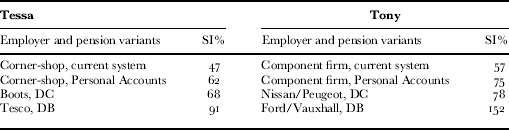
If passed, these proposals would go some way to mitigating the problems with the current system for future cohorts of workers that this paper has outlined (see also Bridgen and Meyer Reference Bridgen and Meyer2005b). They would, for example, almost certainly reduce the variability in pension outcomes between employees in the same sector, thus reducing the role of chance in determining pension outcomes. This can be illustrated by looking again at the risk biographies, particularly those of the least well protected individuals – corner-shop Tessa and component-worker Tony – who because they do not currently have occupational provision have most to gain in terms of retirement income from the introduction of the Personal Accounts (Table 4).Footnote 14
The effect of Personal Accounts on projected pension income in 2050, the exemplar biographies of Tessa and Tony
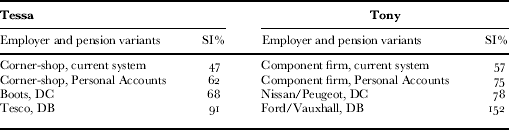
Notes: DB defined benefit. DC defined contribution. SI% Total pension as percentage of social inclusion threshold.
For Tessa, having a Personal Account when employed would mean that she would receive a pension that is 15 percentage points higher in relation to the social exclusion threshold than under the current system, and her retirement income at 65 years-of-age would be significantly closer to that received by someone with the same working life biography and a DC pension than in the current system (Table 4).Footnote 15 Similarly, component-worker Tony would receive a pension that was 18 percentage points above the social exclusion threshold than under the current system, which would mean that his retirement income, when aged 65 years, would also be significantly closer to that of someone with the same working life biography and access to a DC pension (Table 4). While Personal Accounts might improve the lot of future cohorts of workers, there is a concern that this will not necessarily be the case for current workers, who would pay contributions for only a part of their working life (Pensions Policy Institute 2006). Moreover, if introduced, Personal Accounts will not accrue for another six years (from 2007), and given the phased nature of the employer contribution, it will be another three years before the full eight per cent contribution is being paid. Moreover, even once the scheme is fully operational, the evidence from the simulations is that significant variations will remain, especially between Personal Account workers and those entitled to a DB pension (Table 4). Pension income will still be closely related to employer provision, and chance will still be a significant influence on how this income is distributed.
Acknowledgements
We thank most warmly Maria Evandrou, Jane Falkingham and Jay Ginn and two anonymous referees for their exceptionally helpful comments on earlier versions of this paper.