

Introduction
This paper identifies and examines the emergent modes of dementia activism. Activism – action on behalf of a cause that goes beyond what is conventional or routine (Martin Reference Martin, Anderson and Herr2007: 19) – by people diagnosed with a health condition is well established as a topic in sociology (Brown and Zavestovski Reference Brown and Zavestovski2004). There have been inquiries, for example, into the actions of people with mental health problems (Anspach Reference Anspach1979; Crossley Reference Crossley1999); women with breast cancer (Anglin Reference Anglin1997; Klawiter Reference Klawiter2008); and individuals affected by HIV/Aids (Epstein Reference Epstein1996; Gillett Reference Gillett2003). Taken together, this body of work provides substantive knowledge about how people directly affected by illness unite and seek to engage with health-care providers and influence policy and practice (Allsop, Jones and Baggott Reference Allsop, Jones and Baggott2004). Questions remain, however, as to what motivates people with a progressive health condition to take action, and how the illness shapes the form of action that people take (Brown and Zavestovski Reference Brown and Zavestovski2004).
One ‘emerging crop’ within health social movements is activism by people with dementia (Brown and Zavestovski Reference Brown and Zavestovski2004: 681). Since the Alzheimer's disease (AD) movement first developed in the 1970s, scholars have sought to understand how those personally affected by this condition might become involved (Fox Reference Fox1989). It is often assumed within medical discourse that the pathology of dementia prevents those with a diagnosis from taking action and representing themselves (Brown and Zavestovski Reference Brown and Zavestovski2004). While this may be so for individuals with advanced dementia, the current policy trend for early diagnosis in the United States of America (USA), United Kingdom (UK) and elsewhere means that increasing numbers of people with this condition have the capacity to take action (Beard Reference Beard2004a). The Scottish Dementia Working Group (SDWG) – an independent campaign group set up and run by people with dementia – is a prime example of the capacity of people with this condition to unite and influence policy (Weaks et al. Reference Weaks, Wilkinson, Houston and McKillop2012). Others are speaking at major conferences, campaigning in cyberspace, and volunteering to take part in media campaigns (see e.g. http://www.richardtaylorphd.com/). The processes that facilitate such activism are important to consider and document, not least because an ‘activist’ with dementia is likely to experience the condition differently from an ‘ordinary’ person with dementia and the specificities of this particular form of activism remain under-studied.
Dementia activism is a newly emergent phenomenon and scholars have concentrated on care issues rather than individual or collective action. With few exceptions, activism by people with dementia has not been the prime focus of research (Clare, Rowlands and Quin Reference Clare, Rowlands and Quin2008). However, it is clear from the few studies available that people with dementia want to be more involved in the Alzheimer's disease movement but face organisational constraints (Beard Reference Beard2004a), have the capacity and willingness to contribute to public life post-diagnosis (Beard, Knauss and Moyer Reference Beard, Knauss and Moyer2009; MacRae Reference MacRae2008) and feel a strong sense of collective strength when they do unite (Clare, Rowlands and Quin Reference Clare, Rowlands and Quin2008). Although these studies are necessarily small-scale, a desire to take action is clearly within some people with dementia.
The central aim of this paper is to propose social movement theory as a unifying framework and agenda for furthering understanding of dementia activism. Using data collected from a sample of ‘activists’ with dementia, the reasons why people take action and the tactics individuals used are explored. In so doing, the study elucidates the processes of personal change, politicisation and dynamics of collective action, and thus provides fresh insights into the multifaceted nature of the dementia experience. Sampling individuals who were members of a campaign group as well as those without any strong links to an organisation has also provided an opportunity to examine the relationship between individual motives, organisational tactics and formation of collective identity. Examining these factors is important as policy-level and practice-based solutions are required to meet the growing diversity and expectations of men and women with dementia.
A subsidiary aim of the paper is to make an empirical contribution to the health movement literature by emphasising a distinctive feature of dementia activism – namely temporality. Collective struggles related to health and illness are based on a ‘situated knowledge which draws on personal experience’ (Allsop, Jones and Baggott Reference Allsop, Jones and Baggott2004: 752–3). Thus, different (health) groups will have different practices, frames of reference, concerns, and orientations, depending on the nature of their illness or disability. For example, Patient Action Groups like Parkinson's Action Network – based in the USA – prioritise issues related to illness and biological identity, whereas younger people with physical disabilities typically highlight the social processes of discrimination (Hughes Reference Hughes2009). In this paper, it is posited that by taking the perspective of people with dementia, the temporal dimensions of health activism can be better understood. Understanding this dimension is critical if we want to know why some people take action when they do, and what the barriers are for some people to engage in activism (Allsop, Jones and Baggott Reference Allsop, Jones and Baggott2004).
In the case of people with dementia, temporal dimensions of life are particularly apposite. First, the condition is progressive and currently there is no cure; research suggests that the median life expectancy on being diagnosed with dementia is 4.5 years, although people can live much longer (Xie, Brayne and Mathews Reference Xie, Brayne and Mathews2008). Second, neurologically, the disease process affects the temporal lobe and so perceptions of time gradually become distorted (Emery, Olga and Oxman Reference Emery, Olga and Oxman2003). Thus, dementia unsettles basic sociological assumptions about peoples’ relationship to clock-time (Adam Reference Adam1990). Third, the condition is strongly associated with a particular time in the lifecourse – namely ‘old age’; consequently those affected mid-life defy normative expectations and therefore can find themselves particularly marginalised (Braudy-Harris and Keady Reference Braudy-Harris and Keady2009) and severe memory loss comes to be (mistakenly) seen as a ‘normal’ part of ageing (Beard Reference Beard2004b). Finally, because the temporal structure of this illness is so perplexing, people seek to understand it in a simple linear way – in terms of ‘mild’, ‘moderate’ and ‘severe’ stages (Gubrium Reference Gubrium1987). This, however, is misleading; it is too deterministic and fails to capture how the social environment adversely affects someone with dementia (Kitwood Reference Kitwood1997). In sum, people with dementia have a great deal, temporally, neurologically and culturally, to rally against.
Conceptual background
As the foregoing discussion has indicated, to examine the specificities of dementia activism the research draws on the social movement literature, and in particular, work by Crossley and Crossley (Reference Crossley and Crossley2001), Allsop, Jones and Baggott (Reference Allsop, Jones and Baggott2004), and others which emphasise the role of networks in relation to social movements in health. Social movements are defined as a ‘distinct social process’, linked by ‘dense informal networks’ and involving ‘conflictual relations’ and a shared distinct collective identity (Della Porta and Diani Reference Della Porta and Diani2006: 20). Mental health movements, with their emphasis on the formation of user-led groups, are a prime example of the mechanisms and processes involved in collective action (Crossley and Crossley Reference Crossley and Crossley2001), as are long-standing struggles around disability oppression (e.g. Charlton Reference Charlton1998). Clearly this body of knowledge is relevant to understanding what motivates men and women with dementia to take action, as not only does it illuminate the processes involved, it offers theoretical promise for transforming the way we think about the collective (potential) power of, and relations between, people with dementia.
The study of social networking is overdue in dementia research. The process is a powerful factor in the development of a social movement (Della Porta and Diani Reference Della Porta and Diani2006), particularly health movements where ‘extensive networking’ has been found to be necessary due to limited resources (within the health sector) and because illness can affect a person's ability to participate (Allsop, Jones and Baggott Reference Allsop, Jones and Baggott2004: 737). Expanding understanding to include social networking not only opens up new and productive lines of enquiry for the field of dementia research, it also illuminates a hitherto neglected feature of living with dementia, namely the formation of collective identity.
According to Saunders (Reference Saunders2008: 231), collective identity is facilitated at a group level and involves ‘networked activists and individuals from a broad range of organisations’. Much of the social movement literature is concerned with collective identity; indeed, the formation of collective identity is commonly regarded as integral to the success of a movement (Polletta and Jasper Reference Polletta and Jasper2001). Collective identity is defined as ‘individuals’, identifications of, identifications with and attachment to some collective in cognitive, emotional and moral terms (Della Porta and Diani Reference Della Porta and Diani2006: 20). People with dementia have been found, for example, to gain a sense of collective identity by emphasising (rather than downplaying) their personal shortcomings (Beard and Fox Reference Beard and Fox2008: 1518). Furthermore, within the health social movement literature generally, ‘affirmations of solidarity’ have been linked to wellbeing (Landzeliusik Reference Landzeliusik2006: 532). Collective identity is helpful, then, for understanding dementia activism; hence this study draws upon the social movement literature to contextualise peoples’ motivations for taking action.
Methodology
The study, funded by the Economic and Social Research Council, was ethnographic and participatory in design and used a combination of diary interview method and participation observation to generate data. A more detailed account of the approach is now provided.
Recruitment and sampling
Participants were recruited through the membership bodies of the Alzheimer's Society, which has hundreds of members with dementia, the SDWG which had around 80 members at the time of the study, and People Rely on People Group (PROP) which had around 20 members. Inclusion criteria for the study were a dementia diagnosis; engagement in some form of campaigning (defined here as an activity of benefit to both the individual and community, for example, lobbying politicians, speaking at conferences, talking to students); and being able to give informed consent to the study. With research assistance and the approval of the organisations involved, an advertisement about the study was placed in the Alzheimer's Society newsletter and short talks about the study were given by the principal investigator to SDWG and PROP members. This strategy resulted in 20 potential participants coming forward. Of these: two were excluded because they did not have a dementia diagnosis; one because he resided outside the UK; and one because he was in poor health and not currently involved in any form of action. A total of 16 participants were eventually recruited to and completed the study. Nine participants were affiliated to Alzheimer's Society England, five to the SDWG, and two were affiliated to PROP.
The sample
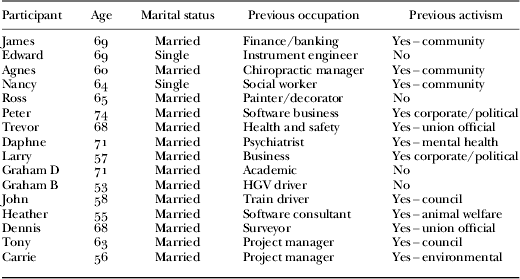
The participants (11 men and five women) were aged between 55 and 78, average age 64 years, as shown in Table 1. Thirteen participants lived with a spouse, two were ‘living apart together’, and two were single and lived alone. All participants confirmed they had been diagnosed with dementia for varying periods of time, most ranging between two and 11 years. Participants were atypical for a sample of people with dementia in that everyone was relatively young, and relative to their dementia status, verbally fluent and in good health.
Participant ages and other key characteristics

Participants were all of white British origin; 12 had worked in professional or managerial roles, the remainder had worked in either the trade sector or public transport. Socio-economic background is significant here because it may help to explain why some people turn to activism: other scholars argue, for example, that activism tends to attract people from an educated middle-class background concerned with social change (e.g. Allsop, Jones and Baggott Reference Allsop, Jones and Baggott2004). However, it does not completely explain the phenomenon, as dementia researchers have found that privilege can be linked to negative feelings about dementia (Hulko Reference Hulko2009, author's emphasis). So, the question remains, why do some people (from middle-class backgrounds) take action and not others?
Data generation procedures
Data were generated using diary interview method and participant observation (Zimmerman and Weider Reference Zimmerman and Weider1975). The conventional paper-based diary method was modified to include photo-diaries and audio-diaries to enable participation and to gain a more dynamic understanding of the topic (Pink Reference Pink2007). Given the complexities of this approach and the emphasis in this paper on results, it is not appropriate to give a full account of methods here. However, a more detailed account of using diary interview method to research the lives of people with dementia is reported elsewhere (Bartlett 2012). Briefly, a pre-diary interview was conducted with each participant approximately one week before the diary-keeping phase. Interviews lasted from 45 to 120 minutes and were tape-recorded for later transcription. With four exceptions, interviews were conducted on a one-on-one basis and in the person's own home. A focus group was conducted in a meeting room with four participants affiliated to the SDWG.
Following the pre-diary interview, participants kept a diary about their life as an ‘activist’ for one month. Five participants kept a photo-diary, three kept a paper-based diary, one kept an audio-diary, the remaining seven kept a combination of one or more of the diary methods but no one chose to keep all three. Written and verbal guidance for keeping a diary was provided and participants were offered support in the form of telephone calls and/or e-mails during the time they were keeping their diary.
While participants were keeping a diary, the principal investigator and research assistant spent approximately 30 hours participating in and observing key events that participants were involved in, including an Annual General Meeting and national conference. Being participant observers allowed us to collect ethnographic data of participants ‘in action’ and to experience and visualise for ourselves some of the events people were reporting on in their diaries. Consistent with a visual ethnographic approach (Pink Reference Pink2009: 101), during this period the camera was seen as an integral part of the researcher's identity and a total of 116 photographs were taken. These images were not analysed with participants’ photos, instead they were used to provide a visual record of the research.
Approximately one week after the diary-keeping phase, a post-diary interview was conducted with each participant. With one exception these were conducted face to face in the person's own home. A telephone interview was conducted with one participant due to time constraints. Post-diary interviews provided an opportunity to triangulate and expand upon diary entries (Elliot Reference Elliot1997) and to explore in more depth people's experiences and perceptions of campaigning. Prompts for discussion were derived from the participant's diary entry (Jacelon and Imperio Reference Jacelon and Imperio2005) and included questions like: Tell me more about this comment? Why was this day different? What comments do you think are most important and why? Is there anything important you forgot to include in your diary? Participants who kept a photo-diary were invited to describe and talk in detail about the images they had taken using prompts such as: Tell me about this picture? What made you take this photo? What do you like about this photo? What does it mean to you? What are you doing here? How did you feel when this photo was taken? Questions were asked in a sensitive and unhurried way, and breaks were taken when necessary. Fieldwork was carried out in the UK between August 2009 and August 2010.
Ethical considerations
Ethical approval for the study was obtained from a University Ethics Committee. The panel agreed that due to the nature of the sample group and the type of activity people were involved in, it was unlikely that individuals would lack the capacity to consent for themselves (even though they belonged to a ‘vulnerable group’). Thus, once assurances had been given to the Committee that in the case of any temporary loss of capacity we would: consult the person's carer about the person's continued involvement in the project; take the view that the person's best interests outweighed those of the research project; and if the participant indicated (in any way) that they wished to be withdrawn from the project they would be withdrawn without delay, ethical approval was granted.
In accordance with ethical guidelines, a letter of invitation and specifically designed information sheet, outlining what would be expected and any associated risks, was produced and sent to each individual who expressed an interest in the study (British Society of Gerontology 2008). The principal investigator or research assistant met with potential participants to gain informed consent in a setting that was relevant to the research, for example, their campaign office or own home. Informed consent was gained in writing from participants after talking to them about the study and explaining how the information would be used. The process of gaining informed consent was repeated at the start of each phase of data collection, giving participants several opportunities to leave the study and the researcher a chance to reassess capacity and remind participants that they were involved in a study (Hellstrom et al. Reference Hellstrom, Nolan, Nordenfelt and Lundh2007). Feedback was given to participants in the form of a written summary report on the research findings and verbally during a ‘thank-you’ meal.
During the process of securing informed consent each participant was offered anonymity but 14 chose not to take it; being identified was an integral part of dementia activism for most participants. Thus, those who waived their right to use a pseudonym are identified and given a voice in this paper. That said, following the advice of Hammersley and Atkinson (Reference Hammersley and Atkinson2007), data of a sensitive nature which may cause embarrassment or distress to those affected are not presented; hence, the source of some data is not stated. The identity of two participants has been protected (at their request) and the pseudonym they chose will be used. In doing this, it is acknowledged that individuals have a right to publicity as well as anonymity (Bauman Reference Bauman1999).
Data analysis
With research assistance, the data were handled manually using content and thematic methods of analysis, and coding and interpretive techniques proposed by Richards (Reference Richards2005). Even though the study involved different groups and oganisations, the unit of analysis used was always the individual. Data were coded and catalogued using basic search and categorisation macros adapted by the research assistant. In addition, diaries were examined for content such as what people recorded about their subjective experiences as a campaigner, and life generally. Photographic images were examined and classified according to content such as ‘friends’, ‘modes of transport’ and ‘family’, but also according to the meanings invested in them by participants during the post-diary interview (Pink Reference Pink2007). Having coded the data, how categories were related to each other were examined and themes constructed to explain the linkages. Wherever possible, themes were constructed and results are presented using the words of the participants. Findings were reported back to participants in the form of a brief report and verbally at specially convened feedback events. By drawing on insights from the social movement literature, it was then possible to infer and develop a typology of three distinct modes of dementia activism, these were the ‘protecting self against decline’ mode, ‘(re) gaining respect’ mode and ‘creating connections with other people with dementia’ mode. Taken together, as will soon become clear, these modes show how a sense of elapsing time pervades this form of activism. Feedback discussions with participants confirmed that they broadly concurred with the modes constructed.Footnote 1
Results
The research context
All the participants described their motives and tactics for activism in the context of different activities, events and issues, including, for example: speaking at conferences; lobbying politicians; talking to students in universities and schools; fundraising; chairing meetings; and attending formal workshops. Participants recounted the activism they were currently involved in, as well as campaigns they had been involved in in the past. For example, two participants referred to their involvement in protests over the proposed withdrawal of anti-dementia drugs and another explained how members of the SDWG engaged in a letter-writing campaign to Scottish Members of Parliament (MPs) on the same issue. The amount of time participants spent campaigning varied from frequently to episodically, as and when an opportunity arose. Participants affiliated to the SDWG were most likely to be campaigning on a daily basis, unless illness intruded.
Virtually all the participants knew each other and had in common not only a dementia diagnosis but a desire to raise awareness. Broadly speaking, participants were not concerned with health or medical issues per se, but rather any issue of perceived inequity. For example, Carrie imagined herself campaigning about having to pay for long-term care (because she had savings in excess of £24,000) and Agnes considered it unfair that she was no longer eligible to attend her art class when it moved to another district. As will become evident through the reporting of results, at the crux of peoples’ activism – ‘the cause’ that people were advancing – was an emotional desire for structural change; participants wanted people with dementia to be treated fairly and as equal (rather than second-class) citizens. Moreover, they needed change to happen quickly, because, as Heather wrote in her diary: ‘time is very precious to PWD [Persons With Dementia]’.
Protecting self against decline
The multiple and progressive deficits associated with dementia are well-documented (e.g. Emery, Olga and Oxman, Reference Emery, Olga and Oxman2003). In this study, participants were typically very aware that their cognitive prowess would inevitably decline and were keen to do whatever they could while they still could – as Agnes said: ‘you're at your optimum only for a certain period of time and then it'll lessen, you know’. The desire to ‘protect self against decline’ and to stay well triggered several participants to take action. For example, Dennis said that after about six months of receiving his diagnosis he wanted to do something, else he feared he would brood. In his words: ‘I sat here and thought I'm not going to sit and mope’. Peter reported experiencing a similar internal monologue at around the same time after his diagnosis:
I thought this is stupid, you can't go on for the rest of your life, however long that may be, moaning about the fact that you've got a terminal condition. You've got to do something about it and at that particular point I started [to campaign].
This kind of self-talk confirms how motivations for social action often come from within a person, they are not always externally driven (Heberle Reference Heberle1951). Moreover, they illustrate how the temporal space for dementia activism can develop once a person is over the initial shock of diagnosis.
The ‘protecting-self’ mode helps to sustain, as well as trigger, social action. Several participants were convinced that what they were doing was helping to slow the disease process. James, for example, who had had a diagnosis of dementia for 11 years, reflected, ‘I think being so active has slowed the progression … it's a big help, along with medication, it's keeping me from deteriorating’. Graham B chose to cite a story in which he said his doctor had told him he was benefiting. He said: ‘I had my MOTFootnote 2 with the doctor the other week and he thinks what I'm doing is helping to slow down the progress’. While it was not possible to corroborate individual accounts of the subjective health benefits of activism (as cognitive health was not measured and data were not collected from any other groups), these data indicate that activism is perceived to be giving people more time.
In the ‘protecting-self’ mode participants referred to what they gained personally from activism. In the main, participants perceived their actions to have an intrinsic energising quality. For example, three participants spoke independently of getting ‘a terrific buzz from [activism]’. Others drew on the public health cliché, ‘use it or lose it’: five participants incorporated this phrase into their response to questions about what motivated them to campaign. Agnes, for instance, wrote in her diary: ‘I feel alive, vibrant, and I believe Use it or Lose it’. Some participants specified exactly what ‘it’ was they liked to use. Dennis, for instance, wrote in his diary, ‘I was in charge of the tombola stall. I made £70 for funds for our group. I thoroughly enjoyed the responsibility of arranging the prizes and selling the tickets’ (author's emphasis). These comments illustrate how dementia activism enables a person to ‘anchor their self in the present’ and in effect stay well (Charmaz Reference Charmaz1991: 181).
According to current social movement theorists, many ‘activists’ are inspired to help others because others had supported and enabled them to campaign (Doestsch-Kidder Reference Doetsch-Kidder2012). In this study, the link between the ‘protecting-self’ mode and ‘cause’ is evidenced by the way in which participants, particularly those associated with the SDWG, made time to mentor others because of the benefits they had gained. For example, Agnes clearly felt indebted to others, she said: ‘I feel I owe the group and the new members, because of the help that I got’. In the same vein, when asked what motivated him, Ross spoke of reciprocating the benefits he had experienced: ‘I'm just giving back what I got from it’. Similarly, Edward was driven by a sense of duty to reciprocate; in his words: ‘I feel that because I've got so much out, I'm almost compelled to help others’. These data highlight how a health social movement can gain momentum within an organisational context.
(Re) gaining respect
Over the years, much has been written about the stigma and discrimination associated with dementia (e.g. Graham et al. Reference Graham, Lindesay, Katona, Manoel Bertolote, Camus, Copeland, De Mendonca Lima, Gaillard, Nargeot, Gray, Jacobsson, Kingma, Kuhne, O'Loughlin, Rutz, Saraceono, Taintor and Wancata2003). It was perhaps not surprising, therefore, to identify in the dataset a second reason why participants took action, namely to end this oppression and (re) gain respect. The need to (re) gain respect, not only for oneself, but for people with dementia generally, was evident in both interview and observation data. Edward, for example, mentioned the ‘poor public image of dementia’ in his pre-diary interview and others described their experiences of being treated like second-class citizens: ‘it annoys me when they treat you like an imbecile’ (Trevor) and ‘I don't like being spoken over or spoken down to’ (Ross). Personal experiences like these motivate some people to take action.
During fieldwork it was possible to arrive at an understanding of how activism enabled participants to (re) gain respect, particularly for themselves. At conferences and during meetings, participants occupied spaces of power and privilege, which as the following fieldnote illustrates, elevated their social standing:
Agnes and Edward are on stage with the Minister of State for Care Services. It is a very large auditorium. There are over 400 delegates in the audience. A lot of photographs are being taken. (Fieldnote 1)
In this instance, being on the same platform as a senior politician at a national conference, ‘letting others know about one's social capital’ (Lin Reference Lin2001: 44), yielded respect. Elsewhere, during the same conference, the chairing role enabled another participant to assert his authority:
[Co-chair] looks to Trevor and asks him if he would ‘shut her up’ if she talks too much as co-chair; ‘that won't be a problem’ he said and the audience laughed. (Fieldnote 3)
These observational data illustrate a central tenant of social movement theory – namely that ‘there is status in being called (or seen as) as an activist’ (Martin Reference Martin, Anderson and Herr2007: 22); something which Agnes recognised, she said: ‘I've been privileged in that I've been accepted. But the generality is once you get this diagnosis everybody suddenly puts you in a box somewhere down there’. Clearly, these participants were conscious of how people with dementia are stigmatised and sought to (re) gain respect in an effort to change this.
Typically, participants (re) gained respect by networking with those in positions of power, notably politicians; chief executives; nursing directors; medical students; academics; celebrities – individuals Trevor referred to as ‘high flyers’. Through written diary entries, participants revealed the range of powerful people and organisations they received invitations from and came into contact with:
We went down to the House of Lords and I got introduced to Lord xx and Lady xx. (Heather)
Yesterday I received an e-mail asking if I would talk to the Department of Health Commissioning Committee. (Graham)
Went to Edinburgh to see an MP … The Director of Nursing wants to meet up … (Agnes)
These data show how routinely participants were networking with people in positions of influence and power. In addition, photo-diaries included images of participants with their arms around leading celebrities and academics. Being afforded time with influential people was a regular occurrence for virtually every participant (N = 14). What is more, as Agnes commented in her post-diary interview, one of the benefits of meeting such people was that it meant finding individuals who could help you so much easier. She said: ‘when you go out to give talks, you're networking … instead of going through all the various places to try and find someone to help, you look up and you say, oh, there's someone that might help me. And you're standing beside them’. Thus, activism, specifically ‘vertical networking’, can save a person with dementia valuable time and effort.
Other participants spoke about how they respected themselves more because they were raising awareness. Here, one can begin to understand the link between activism and change in illness experience, which Klawiter (Reference Klawiter2008) identified in her study involving breast cancer activists. For example, Edward said he saw himself as being ‘of use’ and respected himself as a result, he said: ‘I can accept myself more, because I know I'm doing the right thing’. Likewise, rather than feeling negative about having dementia, another participant felt that being an ‘activist’ with this condition had improved his circumstances: Dennis said, ‘I quite enjoy my life, I've got a better life than I had before dementia, so I'd recommend it (laughs)’. The fact that this participant laughed suggests he realised it sounded counter-intuitive – having dementia is not normally associated with an improvement in one's quality of life. In a similar vein, Heather believed she had a great deal to offer because she had dementia, she said in relation to speaking out, ‘It's far better to come from the heart of somebody who has dementia’. These comments suggest that respecting oneself as a ‘person with dementia’ was an integral aspect of dementia activism. Furthermore, they reinforce the view that activism enables a person to situate themselves in the present.
A tactic used by participants in the ‘(re) gaining respect’ mode was to use their status as a ‘patient with dementia’ to accelerate the pace of change. Rather than shying away from the category ‘dementia’, participants reported using it in a strategic way. For example, Dennis, a former trade unionist, said he was ‘in a hurry to get results’ and described his approach to ‘(re) gaining respect’ using military metaphors, thus emphasising the urgency with which he sought to make things happen. He said, ‘I go straight to the top and give them a blasting’ [about the poor quality of services]. In a similar vein, Graham, an Alzheimer's Society Ambassador, said he consciously used his title and dementia status in written correspondence to senior politicians. He said: ‘If I write a letter and say “ambassador”, you know you will get an answer. It makes a lot of difference … as they don't expect an ambassador to be someone with dementia’. Elsewhere, Dennis reported using his new position in life as a ‘person/patient with dementia’ to leverage resources:
But the advantage I've got with being a patient, you can say what you think and it doesn't matter does it because they can't do anything to you … they can't sack me … you've got to use that to achieve what you want to achieve.
Illustrating, once again, how there is no time to lose and everything to gain when one is a ‘patient with dementia’.
Sometimes participants focused on the advantages of the actual disease. They said having dementia made them less inhibited about speaking out. As Edward explained:
I love this little voice being absent now, and it sort of frees you up, you know … I could say exactly what I thought, I could kick people's arses, I could get frustrated and express it, I could get annoyed and express it.
Similarly, Trevor spoke about the benefits of having dementia whenever he found himself speaking ‘out of turn’: he said, ‘I talk to people like that and I get away with it because I've got dementia and I forget I've said it (laughing)’. Another participant chose to comment on the advantages of the actual disease whenever she did media work. Heather said:
I've lost the emotional side of me. I don't get nervous anymore I've completely lost all of that and like standing up in front of the television and things like that it doesn't faze me one little bit, people can point cameras or mikes at me and I'm fine and years ago I used to be urgh.
These data are significant because they illustrate a distinctive feature of dementia activism, namely that there is a temporal space when disease pathology actually enables (as opposed to prevents) people from speaking out and campaigning.
Creating connections with other people with dementia
In the past, social researchers have focused on the relationships between people with dementia and care-givers (e.g. Kitwood Reference Kitwood1997). In this study, making connections with other people with dementia was significant, and these networks resulted from taking action. Most participants came into contact with other people with dementia during formal meetings and events, such as the Annual General Meeting and national conference, which was the object of participant observation as well as records in the photo-diaries of participants. It is noteworthy that of the 293 images from photo-diaries that were analysed, 52 were of other people with dementia, emphasising the extent to which social networking is an integral aspect of activism (Della Porta and Diani Reference Della Porta and Diani2006).
Reflecting on these social networks in post-diary interviews, people said they valued meeting other people with dementia for various reasons. One was quite basic and unrelated to activism: ‘It's not to bring about change; it's actually to be friends with someone’ (John); or, as Nancy put it, it creates a feeling of ‘togetherness’. Echoing and expanding upon this sentiment, Graham revealed why he valued creating connections with other people with dementia:
Res: And you said before it's almost as if you gained a life.
G: Gained a life and a new family.
Res: That being?
G: People with dementia. Cos you're not the only one, you're always learning off each other. Every time you talk to someone you learn something new. You work off each other.
For this participant, being with other people with dementia was like being with family. Ross, too, was of the opinion that his relationships with other members of the campaign group were kin-like. In his words: ‘It's a close family – cos we all get strength from one another’. These data show how for several individuals, simply being with other people with dementia was a valuable time in the ‘activist’ experience.
As well as deriving strength from other people with dementia, the phrase ‘work off each other’, which Edward also used, illustrates how the ‘creating connections’ mode was about making the best use of one's time. For example, Agnes said in relation to her visits to England to see other people with dementia, ‘we're going to exchange views and ideas and then bring it back to the group and empower us more’. Similarly, Edward made it clear how much he valued being with other people with dementia. In his words: ‘I address [people with dementia] as fellow travellers, we're all on the same journey and we can all bring our little insight to it and share it with each other’. Like other activists, people with dementia are keen to learn from and are inspired by each other (Martin Reference Martin, Anderson and Herr2007: 26).
A tactic used by participants in the ‘creating connections’ mode was to use language which expressed solidarity with other people with dementia. Rather than speaking in terms of individual needs and self-identity, participants referred to their collective identity. Notice, for instance, the referential indexing of these comments (author's emphasis):
We the people with dementia see the world from the inside out. (Peter)
I'm not gonna sit and let people walk over us. I'm going to stand up for people who won't talk or can't talk. (Trevor)
We're not individuals; we're a group. (Edward)
By using the terms ‘we’ and ‘us’, these participants highlighted their shared identity. Linguistically, they drew attention to the dementia community rather than themselves, because in the context of campaigning, as Agnes said: ‘the message is important, not the person’. These comments are significant because by placing emphasis on sameness (rather than difference) the formation of group identity is accelerated and the ‘cause’ is advanced (Della Porta and Diani Reference Della Porta and Diani2006: 103).
It should be noted that not all participants expressed solidarity with other people with dementia. Neither did everyone feel strongly about creating connections. Carrie, for example, the youngest and least politicised participant, said in her post-diary interview: ‘social change has to come from other people, not from me. Because I'm happy and accepting of you know, how I am at the moment’. Similarly, John was inclined to see the consequences of his actions in individualistic rather than collective terms. He said: ‘I tend to think that if there is a change it's likely to be a personal one’. Identifying different subject positions across the participants illustrates the phasic qualities of dementia activism, that is to say – some people will experience and move through each mode, but not everyone.
Participants associated with the SDWG were most likely to operate in the ‘creating connections’ mode, partly because they had the time and opportunity to do so at campaign meetings and while travelling to events. The adeptness and effect of people in Scotland connecting with each other was remarked upon by a participant based in England. He said, ‘they're in the hills and in the lochs and it's getting them together, but they do. Somehow they all get together and meet up. It's a very tight community’. The bond between people with dementia in Scotland was noticeable even to an ‘outsider’. By contrast, participants based in England were more likely to campaign on behalf of a charity, independently and/or with a spouse. For example, Graham reflected on how he and his wife ‘worked as a team’ and Daphne noted in her diary: ‘I received a request to speak at an Alzheimer's branch open meeting’. This difference in practice was discussed in the focus group (with Scottish participants), where an underlying reason was thought to be a cultural one: ‘There's a national thing here … people in England are just as able as us, just as good as us, I have met them, but they're not united’. Someone else suggested the reason might be geographical: ‘England is a much larger country than Scotland, making it difficult for people to attend meetings’. The salient points here are that the time required to create connections is seen as significant, and people's propensity to unite varied, even in this small-scale study.
Discussion
In this study, participants described their reasons and tactics for dementia activism in the context of a relationship – either with other individuals and organisations or with themselves. Other scholars have emphasised the significance of meaningful relationships for people with dementia (e.g. Kitwood Reference Kitwood1997). However, the research undertaken here advances understanding by drawing on the social movement literature, and showing how connections, particularly those between people with dementia, can be beneficial not only for the individual but also macro-culturally. As movement theorists explain, social linkages provide a structure for a ‘subcultural oppositional dynamics’ in which new ways of thinking and being in the world might emerge (Della Porta and Diani Reference Della Porta and Diani2006: 131). In the present case, these linkages provide the temporal space in which people with dementia can create social networks, develop a collective identity and become politicised (to varying degrees) in order to raise awareness and bring about social change.
Specifically, the analysis of textual, visual and field data indicates that people with dementia are motivated to take action on behalf of the ‘cause’ for three reasons: to protect self against further decline, to (re) gain respect and to create connections within the dementia community. Taken together, these modes show how a sense of elapsing time pervades this form of activism. People with dementia take individual and collective action while they still can and to stay anchored in the present, which is made both compelling and rewarding through activism. Other scholars suggest that time perspective is the dominating force that structures human motivations and goals. It has been argued that: ‘when time is perceived as open-ended, knowledge-related goals are prioritised; in contrast, when time is perceived as limited (as is the case for people with dementia) emotional goals assume priority’ (Carstensen, Isaacowitz and Charles Reference Carstensen, Isaacowitz and Charles1999: 165). Hence, the reason why participants involved in this study campaigned for equality and respect, as opposed to a stake in knowledge production, which arguably, is more common in health activism (see e.g. Brown and Zavestoski Reference Brown and Zavestovski2004).
Emphasising temporality has implications for the study of health social movements. It raises fundamental questions about the scheduling and pacing of activism and the relationship ‘health activists’ have to time. For example, when is the right time in an illness for an individual to act? For how long do people with a chronic illness have to take action for before social transformation occurs? And is there a ‘best’ time in the lifecourse to act? Other scholars suggest that getting involved in activism in later life is partly a ‘consequence of greater time availability’ (Barnes, Harrison and Murray Reference Barnes, Harrison and Murray2012: 276). However, this study highlights how time is a finite social resource for ageing ‘activists’ with a terminal, progressive condition like dementia; thus, a sense of elapsing time seems to explain participation. Clearly, temporal dimensions are central to social life regardless of age (McLeod and Thomson Reference McLeod and Thomson2009); but as this study reinforces, temporality is particularly salient in the context of individuals living with a terminal chronic condition – like dementia, as it takes effort, devours clock-time and fundamentally alters a person's relationship to lifetime (Charmaz Reference Charmaz1991).
Identifying temporal space as a distinctive feature of dementia activism has implications for service provision post-diagnosis. The present study implies that the point at which a person has overcome the initial shock of diagnosis and ‘settled into the illness’ is a critical moment in the dementia journey, as this is when people are most likely to have the time and wherewithal to seek opportunities for growth.Footnote 3 Arguably, this is because, time is ‘transcendence’ and ‘faced with decline we attempt to reverse it’ (Adam Reference Adam1990: 74). Hence, some people with dementia value the opportunity to become a public figure and speak out (MacRae Reference MacRae2008) and choose to use this ‘window of opportunity’ to raise awareness and self-advocate (Beard, Knauss and Moyer Reference Beard, Knauss and Moyer2009). Currently, however, services in the UK and elsewhere are designed to provide individualised care and support, as opposed to opportunities to take collective action, which is unfortunate given the (potential) benefits of activism.
This investigation raises the possibility that activism can protect against decline amongst people with dementia. Although by no means conclusive, a large-scale study on activism (involving young college students) found that being an ‘activist’ improves social wellbeing, and so available evidence suggests it is at least possible (Klar and Kasser Reference Klar and Kasser2009). This is noteworthy, particularly given the growing costs of care, because activism offers a social/cost-effective (as opposed to a pharmaceutical/expensive) solution to preventing further decline in people with dementia; plus, it offers an opportunity for men and women with dementia to reroute their skills, strengths and possibly anger, once over the initial shock of diagnosis. Further research is clearly needed to understand better and demonstrate the link between activism and preventing dementia-related decline.
Concerning the relationship between individual motives and organisational tactics, it appears from this investigation that people are more likely to experience each mode of dementia activism if they are associated with a ‘user-led’ organisation. This means that the dementia movement is only likely to evolve as and when the spaces for developing collective identity are identified and nourished. Comparable results were found in a review of the mental health user movement, where it was noted that to speak meaningfully of a movement one must be able to identify a ‘durable and dispersed culture of resistance and the mechanisms of reproduction which perpetuate and transmit it’ (Crossley Reference Crossley1999: 652). Since this study ended, the UK has witnessed a rise in the number of individuals and groups engaged in dementia-related activism (Williamson Reference Williamson2012). There is, then, the potential for a ‘culture of resistance’ to develop within the dementia field, and clear requirement to deploy social movement theory as a unifying framework and agenda.
An important consequence of these findings is that dementia activism, while an important process and experience for those involved, risks creating a ‘status gap’ (Weber Reference Weber1947), in which people with dementia who are not verbally fluent, visible, mobile and self-confident remain stigmatised and discriminated against. A person with severe language difficulties, for example, may not want to speak out in the way that seems to have become the cultural norm for ‘activists’ with dementia. Neither perhaps would an 80-year-old woman given the long-standing negative stereotypes associated with this social group (Ginn and Arber Reference Ginn, Arber, Johnson and Slater1993). Clearly, family carers and Alzheimer's Associations have an important practical role to play here, but so too does social movement theory, as it can provide conceptual tools to present and explore this issue, which is essentially one of marginalised identities, a point other scholars within the dementia community have eloquently made (O'Conner, Phinney and Hulko Reference O'Connor, Phinney and Hulko2010).
Findings should be considered alongside the following study limitations. First, as previously mentioned, the sample was of white British origin, the majority were men, had previous experience of campaigning and were from a professional background. As a result there was less variation in the sample than was hoped for, making it difficult to explore other aspects of social difference, such as gender and socio-economic background. Second, the sample consisted of just one group (people with dementia). The perspectives of those they work alongside or seek to influence were not actively sought; therefore an understanding of dementia activism at a group or movement level was not gained. Moreover, because data from family members, support workers or clinicians were not collected, nor was the disease process measured, it is not possible to verify people's claims that activism was a protective factor in helping to slow down the disease process. Third, men and women involved in this study were not representative of people with dementia per se. Neither did they claim to be. As such, findings cannot be universally applied. That said, patterns detected in this dataset mirror findings reported elsewhere. So, while not generalisable, they are credible. Finally, the presence and priorities of a social researcher should be taken into account when considering these findings and interpretations.