I. INTRODUCTION
A total of 77 Jomon pottery pieces were excavated from the Hinoki site (N 36°32′30″, E 140°13′22″) in Motegi town, Tochigi Prefecture, Japan (Kasai et al., Reference Kasai, Matsumoto, Ichikawa, Nakamura and Tsukamoto2014). These pottery pieces originated from the Middle Jomon period (2500–1500 BC), and among them, 59 pieces were Atamadai-type. These pottery type pieces have a unique paste containing abundant biotite fragments compared with other Jomon period potteries. Many Japanese archaeologists (e.g., Shimizu, Reference Shimizu1984; Taniguchi, Reference Taniguchi1999; Tsukamoto, Reference Tsukamoto and Kobayashi2008) noted that the biotite fragments were present in the granite fragments gathered in proximity to the site and were purposely mixed into the clay material in the pieces as a temper to improve the strength and viscosity of the pottery.
Mean chemical composition of the pottery using, e.g., X-ray fluorescence spectrometry is not useful to estimate the origin of the temper because the composition notably depends on clay which occupied a majority of the pottery. Thus, we focused on X-ray diffraction (XRD) to identify the origins of the minerals (i.e., the clay material and temper). This technique can archaeologically characterize the origins of clay and temper by affecting a shift in lattice spacing via variations in the solid-solution ratio of minerals. Existing studies revealed that (1) biotite (K(Mg,Fe)3AlSi3O10(OH,F)2) can be used as a fingerprint mineral for the provenance characterization of the temper of the Atamadai-type pottery pieces from the Hinoki site (Ichikawa et al., Reference Ichikawa, Morikawa, Kurisaki and Yamaguchi2018) and (2) river sand in the vicinity of the site, which is abundant in biotite, may have been mixed as a temper into the green bodies of the pieces during the manufacturing process (Ichikawa et al., Reference Ichikawa, Sakito and Kurisaki2019). Biotite is a solid-solution mineral. Its solid-solution ratio (Mg/Fe) may depend on its origins as does the change in the biotite lattice spacing because the geological materials generally have different chemical compositions among the origins. Therefore, variations in the ratio can be applied to estimate the origin of the temper in the Atamadai-type pottery pieces.
In this study, a preliminary examination was performed to elucidate the provenance dependency of biotite's lattice spacing using the biotite-containing rock samples gathered from seven regions in Japan. We report the following conclusions: (1) a diffraction peak of biotite for the examination was selected using XRD profiles of the seven rock samples; (2) counting time for the selected peak was optimized by the measurement of the Atamadai-type pottery pieces; and (3) the lattice spacings of biotite 001 in the samples were compared to clarify provenance dependency.
II. MATERIALS AND METHOD
A. Samples
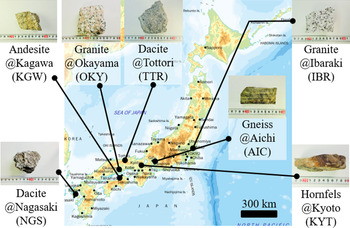
The following seven Japanese rock samples (Figure 1) were used to derive the provenance dependency of biotite lattice spacing: biotite granite from Inada, Ibaraki (IBR); sillimanite–biotite–siliceous gneiss from Kami-Kuwagai, Aichi (AIC); biotite hornfels from Mt. Daimonji, Kyoto (KYT); biotite–hornblende dacite from Daisen, Tottori (TTR); biotite granite from Mannari, Okayama (OKY); biotite andesite from Mt. Yura, Kagawa (KGW); and biotite–hornblende dacite from Mt. Unzen, Nagasaki (NGS). The samples were crushed using a hammer (crack hammer 4LB, Estwing) and fragments were finely ground and homogenized using an alumina mortar and pestle.
Collection spots of rock samples containing biotite.

B. XRD measurement
Powder XRD was performed using a Rigaku SmartLab diffractometer equipped with a Cu anode X-ray tube (1.542 Å for CuKα) operated at the voltage of 40 kV and the current of 30 mA. Parallel-beam optics with a scintillation counter (zero-dimensional detector) were used. The XRD profiles were recorded using the 2θ steps of 0.01° and the counting time of 1.0 s for each step. The profiles were measured three times for the qualitative analysis of the rock samples and 10 times for the calculation of the biotite 001 lattice spacing. The crushed powdered sample was placed on a silicon reflection-free sample plate with 20 × 18 × 0.2 mm sample cavity. Each diffraction peak was identified based on the Powder Diffraction File™ issued by the International Centre for Diffraction Data (Gates-Rector and Blanton, Reference Gates-Rector and Blanton2019). The lattice spacing of biotite 001 was calculated using the integrated X-ray powder diffraction software (PDXL, Rigaku).
III. RESULTS AND DISCUSSION
A. Selection of the diffraction peak from biotite
To calculate the lattice spacing of biotite, the biotite peak must not overlap with other peaks. Figure 2 indicates the XRD profile of the KGW sample in the seven rock samples as an example. Additionally, examples of XRD profiles of Atamadai-type pottery piece (Ichikawa et al., Reference Ichikawa, Morikawa, Kurisaki and Yamaguchi2018) from the Hinoki site and river sand (Ichikawa et al., Reference Ichikawa, Sakito and Kurisaki2019) in the proximity of the site are shown in Figure 2. All rock samples contained quartz, plagioclase, and biotite. Most of the biotite peaks, except for the strongest peak (001 plane, 2θ = 8.8°), were overlapped by other peaks from quartz and plagioclase. For example, according to ICDD No. 01-088-1899, the second strongest peak (200 plane) and third strongest peak (022 plane) of biotite were observed at 2θ = 34.22° and 2θ = 26.20°, respectively. Consequently, biotite 001 was selected to evaluate the provenance dependency of biotite lattice spacing.
XRD profiles of (a) KGW rock sample, (b) Atamadai-type pottery piece No. 6 (Ichikawa et al., Reference Ichikawa, Morikawa, Kurisaki and Yamaguchi2018), and (c) Amano river sand No. 1 (Ichikawa et al., Reference Ichikawa, Sakito and Kurisaki2019).

B. Optimization of counting time
XRD identified biotite in the Atamadai-type pottery pieces. However, the biotite was present to a much lower extent than quartz and plagioclase. Thus, counting time for XRD was optimized using a type of Atamadai pottery piece with the lowest peak intensity of biotite among 59 types of Atamadai pottery pieces (Ichikawa et al., Reference Ichikawa, Morikawa, Kurisaki and Yamaguchi2018, Reference Ichikawa, Sakito and Kurisaki2019) from the Hinoki site. Parallel-beam optics (Ohbuchi and Nakamura, Reference Ohbuchi, Nakamura and Meyers2018) were selected to complete measurements because their geometric nature could reduce systematic error resulting from surface roughness and different sample heights from the center of a goniometer.
Figure 3 shows the XRD profiles of the strongest peak (001 plane, 2θ = 8.8°) of biotite in the Atamadai pottery pieces employing 2θ steps of 0.01° and counting times of 0.5, 1.0, 2.0, 3.0, 4.0, and 5.0 s for each step. Each parameter of biotite 001 is presented in Table I. There were no significant differences among the parameters based on the aforementioned counting times except for the counting time of 0.5 s, which included significant noise. Therefore, the counting time of 1.0 s was used for the measurement of biotite 001.
XRD profiles of biotite 001 in the Atamadai-type pottery containing low biotite with 2θ steps of 0.01° and counting time of (a) 0.5 s, (b) 1.0 s, (c) 2.0 s, (d) 3.0 s, (e) 4.0 s, and (f) 5.0 s for each step.

Peak parameter of biotite 001 in Figure 3.

( ), relative standard deviation (%) (n = 10).
FWHM, full-width at half-maximum.
C. Lattice spacing of biotite 001
Seven biotite-containing rocks were analyzed by XRD to clarify the provenance dependency of the lattice spacing of biotite 001 for the application to the provenance estimation of the temper in Atamadai-type pottery pieces. Figure 4 demonstrates the XRD profiles of biotite 001 in the rock samples. Each profile had a slightly different peak-top position. The lattice spacing values were calculated from the profiles using the integrated X-ray powder diffraction software. The lattice spacing values are summarized in Figure 5. These values were classified into four types: 9.99 Å for TTR, 10.05 Å for KGW, 9.94 Å for NGS, and approximately 10.10 Å for the remaining samples. Thus, for the IBR, AIC, KYT, and OKY samples, no significant differences were observed in terms of lattice spacing. This may be caused by a nonlinear relation between the solid-solution composition and lattice spacing of biotite as in the case of plagioclase (Smith and Yoder, Reference Smith and Yoder1955). Therefore, the elucidation of the provenance dependency of the lattice spacing requires the lattice spacing of biotite from different origins and solid-solution composition, i.e., concentrations of Mg and Fe. Knowing the provenance dependency of biotite based on the lattice spacing of biotite 001 can be useful for the provenance estimation of temper material in the Atamadai-type pottery pieces.
XRD profiles of biotite 001 in the Japanese rock samples.

Lattice spacing (Å) of biotite 001 in the Japanese rock samples: error bar, 95% confidence limit (n = 10).

IV. CONCLUSIONS
The provenance dependency of the lattice spacing of biotite 001 was investigated to apply it to the provenance estimation of temper material in the Atamadai-type pottery pieces from the Hinoki site in Tochigi, Japan. Biotite is a fingerprint mineral for the provenance study of a temper. Additionally, most of the sand in the rivers running from a mountain situated within the site contained biotite in abundance. Thus, knowing the lattice spacing of biotite can be useful for temper estimation based on the conclusion that lattice spacing reflects the origin of a biotite sample. In this study, seven biotite-containing Japanese rocks of different origins were used to derive provenance dependency. Most of the diffraction peaks for biotite in the geological samples were overlapped by quartz and plagioclase peaks, which represent major minerals in these samples. The XRD profiles of the rocks, Atamadai-type pottery pieces, and river sand indicated that the second (200 plane, 2θ = 34.2°) and third (022 plane, 2θ = 26.2°) strongest biotite peaks were overlapped by the major mineral peaks. The strongest peak (001 plane, 2θ = 8.8°) without overlapping was selected for this study. The lattice spacing values of biotite 001 in the seven rock samples were separated into four groups: 9.99 Å for the first sample, 10.05 Å for the second sample, 9.94 Å for the third sample, and approximately 10.10 Å for the remaining samples. In these four samples, no significant differences were observed among each of the lattice spacing values despite the samples have had different origins. Accordingly, the provenance dependency of the lattice spacing of biotite 001 should be examined using the solid-solution ratio (Mg/Fe). The elucidation of the provenance dependency may be able to permit the provenance estimation of temper material in Atamadai-type pottery by XRD.
ACKNOWLEDGEMENT
This work was supported in part by JSPS KAKENHI Grant No. JP19K13410.