INTRODUCTION
The arrowhead dogfish, Deania profundorum (Smith & Radcliffe, 1912) (Chondrichthyes: Centrophoridae), is a deep-water squaloid shark, occurring on both sides of the Atlantic, from the Western Sahara to South Africa and in North Carolina (Compagno, Reference Compagno1984). Recently, the northernmost extension of this species in the eastern Atlantic was reported from south-west Portugal (Coelho & Erzini, Reference Coelho and Erzini2006). In the Macaronesian area it occurs in Cape Verde (Reiner, Reference Reiner1996; Menezes, Reference Menezes2003), the Canary Islands (Brito et al., Reference Brito, Pascual, Falcón, Sancho, González and Francisco2002) and the Azores (Santos et al., Reference Santos, Porteiro and Barreiros1997; ICES, 2006). Although this species has been caught for a long time around the islands of the Madeira archipelago, both in commercial and survey fisheries, it was only very recently referred to in the scientific literature from this area (Freitas & Biscoito, Reference Freitas and Biscoito2006; Ferreira et al., Reference Ferreira, Sousa, Delgado, Carvalho and Chada2008). It has also been reported in the Philippines (Pacific) and South Africa (western Indian Ocean) (Compagno, Reference Compagno, Carpenter and Niem1998).
Two congener species Deania calcea (Lowe, 1839) and Deania hystricosa (Garman, 1906) are also present in some areas where Deania profundorum occurs, as is the case of the Madeira archipelago, but this species is easily distinguished, even in field conditions, by the presence of a conspicuous sub-caudal keel on the underside of the caudal peduncle (Compagno, Reference Compagno1984).
Knowledge is scarce about the biology of this deep-water shark. According to Compagno (Reference Compagno1984), D. profundorum is a bathydemersal species found on or near the bottom at depths from 275 to 1785 m, being ovoviviparous and feeding mainly in small benthic and midwater boney fish. The author also indicates that this species can reach a maximum total length of ~76 cm and is thought to be above 31 cm at birth, the fecundity being estimated as five to seven embryos, judging from uterine fertilized eggs. In FISHBASE (Froese & Pauly, Reference Froese and Pauly2007) a more ample depth distribution is indicated ranging from 205 to 1800 m.
The lack of biological knowledge about this species prompted this study, which was developed as a first approach to investigate some of its biological traits, constituting, as far as we know, the first study dealing with this issue for the arrowhead dogfish. Also some biometrical aspects, such as the vertical distribution and structure of this population, are presented and discussed herein with the purpose of improving the knowledge on this deep-water shark.
MATERIALS AND METHODS
The material used in this study was collected during two fishing surveys off the archipelago of Madeira. These surveys were carried out in November 2004 and September 2005, and comprised a total of 27 fishing sets on the shelf and upper slope bottom around the islands of Madeira, Porto Santo and Desertas (32°00′–33°30′N 15°30′–18°00′W). The distribution of sets per fishing area was roughly proportional to the size of each island and the locations of the sets were randomly attributed.
The surveys were accomplished through the use of the research vessel ‘Arquipélago’ from the University of the Azores. In both surveys fishing sets followed a random stratified sampling design (Menezes et al., Reference Menezes, Delgado, Krug, Pinho, Silva and Carvalho1997). A bottom long-line was deployed along transects covering a depth range from around 25 to 1150 m. In each set the fishing gear was marked during deployment with numbered buoys allowing the separation of the captures by depth strata of 50 m each.
During retrieval, catches were sorted by depth strata and the biological sampling performed on board in each set. Individual data on total length, weight, sex, maturity stage and liver weight were recorded in some species. For Deania profundorum a more detailed sampling on the reproductive structures was performed in the 2005 cruise. In females the ovaries weight and length, condition of the uteri, ovarian egg diameter and the number of ripe eggs were recorded. In pregnant females embryos were counted, their total length measured and the liver, yolk sac and body weighed. In males the length, weight, number of testes and the presence or absence of seminal fluid were also recorded.
Primary sex identification was based on the presence/absence of claspers. Maturity stages were visually assigned following a scale based in macroscopic observation as described by Stehmann (Reference Stehmann2002). All maturity stage analysis was conducted only for data recorded in 2005.
The sex ratio (males:females) was calculated for each depth and length class. Differences between sex ratio were tested using Chi-square (χ2) test (Zar, Reference Zar1996) under the null hypothesis a 1:1 sex ratio.
For size–frequency analysis specimens were grouped into 5 cm intervals and tested for significant differences in length–frequency distribution, between females and males, using the Kolmogorov–Smirnov two sample test (Zar, Reference Zar1996).
Regression of length–weight, expressed logarithmically, was calculated by the least square method. Possible differences in the length–weight relationships and in isometric growth were tested using F test and Student's t-test, respectively (Zar, Reference Zar1996).
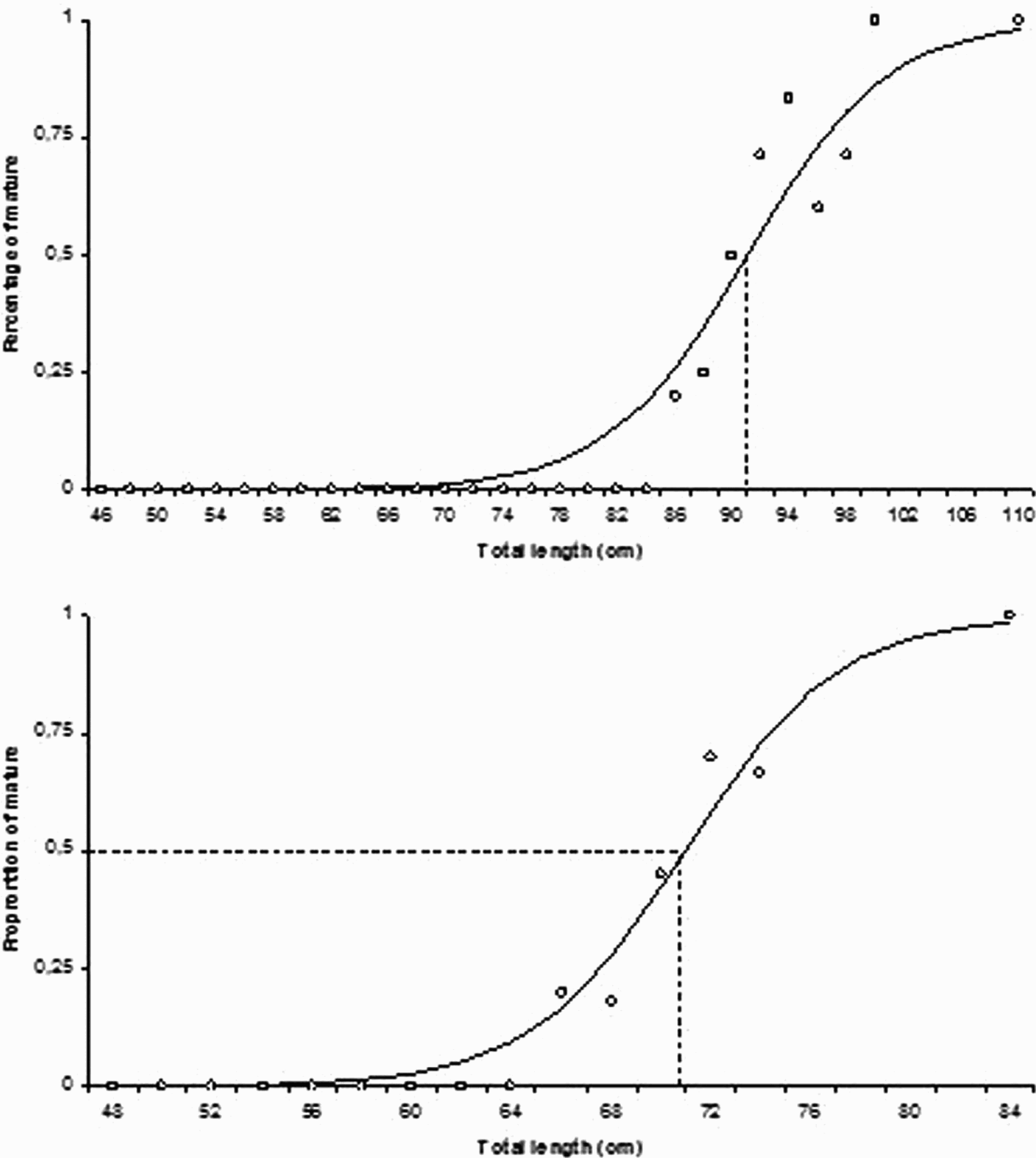
Maturation ogives for females and males were fitted to the proportion using the logistic model (King, Reference King1995). The length at 50% maturity was estimated for each sex by using the Probit model. Mature fish comprised all specimens of all maturity stages except A and B.
Data on fecundity were obtained by making direct ova and embryo counts in both right and left ovaries and uteri, respectively.
For pups, the specimens for size–frequency analysis were grouped in 2 mm intervals. Ordinary least square regression was used to determine the length–weight relationships, after log-transforming the data. Isometric growth of the pups was tested using Student's t-test (Zar, Reference Zar1996).
RESULTS
By area surveyed, the highest average catch rates (capture per unit of effort) obtained were from the slopes of Madeira Island (18.70 g/1000 hooks) and the lowest were from the Desertas Islands (7.90 g/1000 hooks) with both years pooled. Overall, the maximum catch rate occurred between 901 and 1050 m (99.04 g/1000 hooks) in 2005 and the minimum between 601 and 750 m (1.92 g/1000 hooks) in 2004. By depth strata the highest catch rates were obtained between 751 and 1050 m in both years and areas surveyed, with the exception of the high catch rates obtained in the Desertas Islands in 2005 (79.15 g/1000 hooks) between 450 to 600 m depth. Deania profundorum represented about 27% in the 2004 cruise, and about 38% in 2005, of the total weight of demersal captures, being by far the species presenting the higher biomass in the catches.
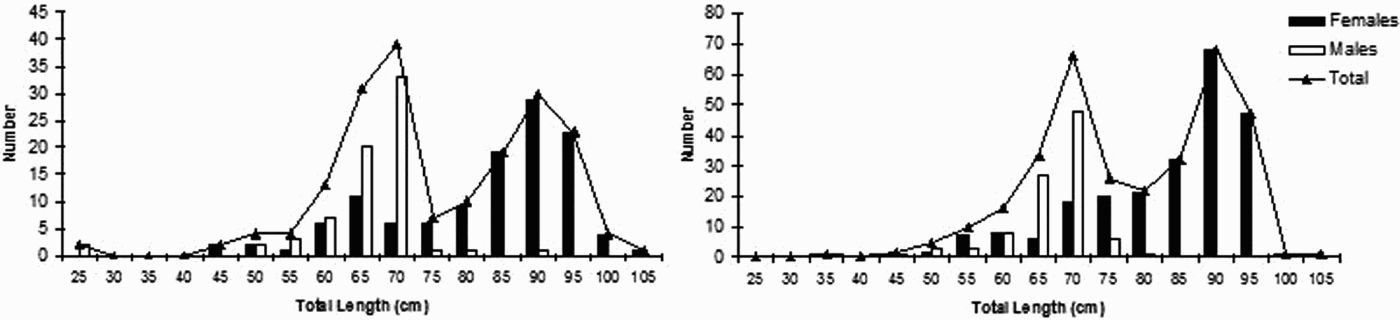
Overall, in the two surveys, a total of 520 specimens (351 females, 169 males) of D. profundorum were captured from a range of depths comprised between 151 and 1150 m. The size of the females caught ranged from 36 to 110 cm of total length and in males between 27 and 94 cm. Three small specimens, of less than 40 cm, were caught between 950 and 1100 m.
Length–frequency distributions of both sexes by depth are shown in Figure 1. The modal length-class of females for the entire catch was 85–90 cm and 65–70 cm for males. Deania profundorum show sexual dimorphism with females achieving greater length than males, with two evident length–frequency distributions (Kolmogorov–Smirnov test, P < 0.05).
Length–frequency distribution, by sex, of Deania profundorum captured off Madeira archipelago, during the cruises of 2004 (left) and 2005 (right).

The relationship between body weight (g) and total length (cm) by sex was described by:

The maximum and minimum weights of females used for the above calculation were 160 g (36 cm) and 5420 g (110 cm) and those of the male were 77 g (27 cm) and 3270 g (94 cm). There were significant differences in the length–weight relationship between females and males (F test, N = 501, P < 0.05). Both sexes had allometric growth (t-test, N = 502, P < 0.05), either immature (t-test, N = 130, P < 0.05) and mature (t-test, N = 68, P < 0.05).
Immature and mature D. profundorum were easily recognized by macroscopic examination. Total length of mature females ranged from 86 to 110 cm and from 66 to 85 cm in mature males.
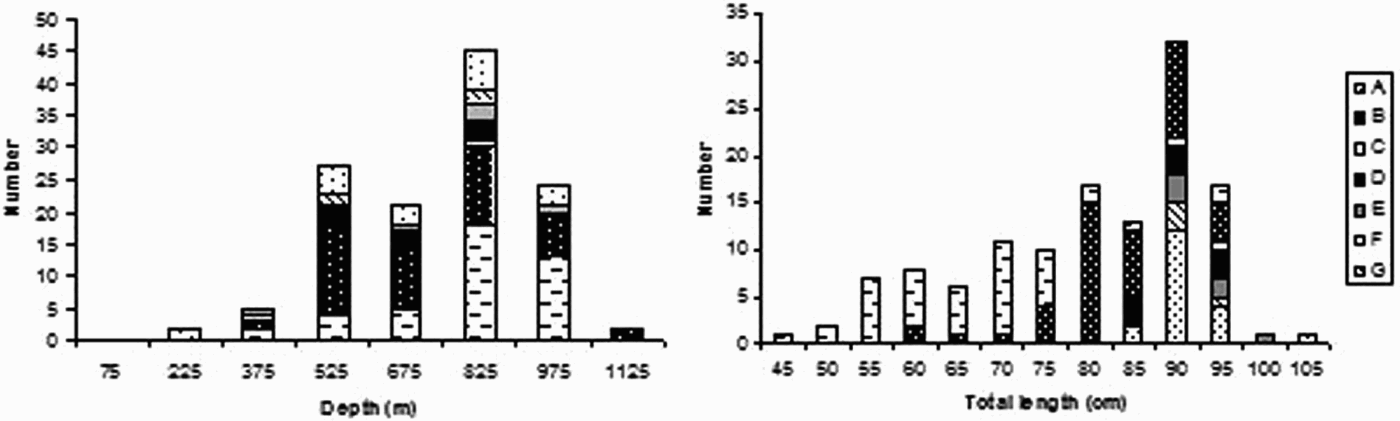
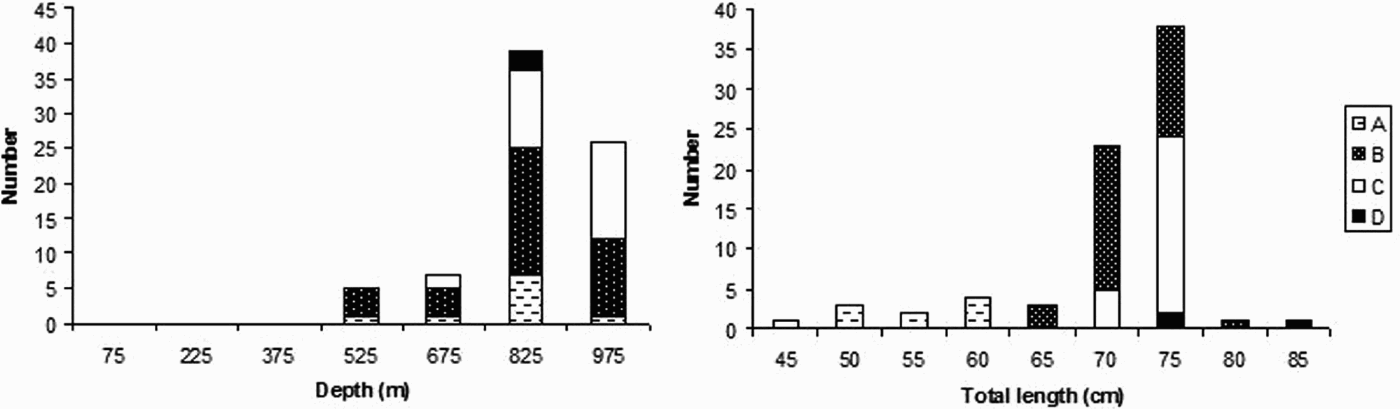
The sample taken for this study contained females and males in all stages of maturity (Figures 2 & 3). Approximately 31.75% of the females and 39.47% of the males were mature. Approximately 19 females were pregnant and ten had developed pups.
Variation in maturity stages by depth (left) and size (right) for female Deania profundorum.

Variation in maturity stages by depth (left) and size (right) for male Deania profundorum.

Mature females were present from 151 to 1200 m depth, but immature females (Stages A and B) predominated in most depths. Uterine stages (Stages D, E & F) were most frequent between 451 and 1050 m. Mature males were caught in all depths between 451 and 1050 m.
All females measuring from 41 to 85 cm were immature. Mature females predominated between 91 and 99 cm. All females larger than 101 cm were mature. In males, specimens caught with a total length of between 41 and 70 cm were immature and between 75 and 80 cm mature specimens were predominant.
Both immature and mature females had two equally developed ovaries. The ovary weight ranged from 0.11 to 24.98 g in immature females and from 4.13 to 560.38 g in mature females.
Immature and mature males had two equally developed testes. The testis weight ranged from 0.07 to 5.03 g in immature specimens and from 1.24 to 8.90 g in mature.
The Probit analysis, for females and males, is presented in Figure 4. Estimated length at 50% sexual maturity for females was 92.05 cm (r2 = 0.96) and 71.95 cm (r2 = 0.87) for males.
Maturity ogiva for Deania profundorum for female (top) and males (bottom) fitted by Probit analysis. Total length at 50% sexual maturity in the sample population 92.05 cm (females) and 71.95 cm (males).

The liver weight represented approximately 19% of the total body weight regardless of sex. The average proportion of the liver weight to body weight was 18.52% (N = 126, SD = 2.84) in females and 18.78% (N = 70, SD = 3.03) in males, with no significant differences between sexes (t-test, N = 196, P > 0.05). In embryos the liver weight represented approximately 8% of the total weight.
The absolute fecundity was determined for females in Stages D–F. Embryos and ripe oocytes are generally equally distributed in each uterus and ovary, respectively. Ripe oocytes varied between six and 14 per female (N = 117, x = 10), and ranged in size from 1.60 to 5.20 cm length. The number of embryos ranged from six to 11 per female (N = 43, x = 9). The smallest pup was 9.10 cm long and the biggest 18.00 cm long. All pups had an external yolk sac.
It was not possible to determine the sex of embryos and therefore they were analysed as a group. The weight of an embryo increases according to length while the weight of the vitellus decreases (t-test; N = 21, P < 0.05).
Pups show allometric growth (t-test, N = 42, P < 0.05) and their relationship between body weight (g) and total length (mm) was described by:

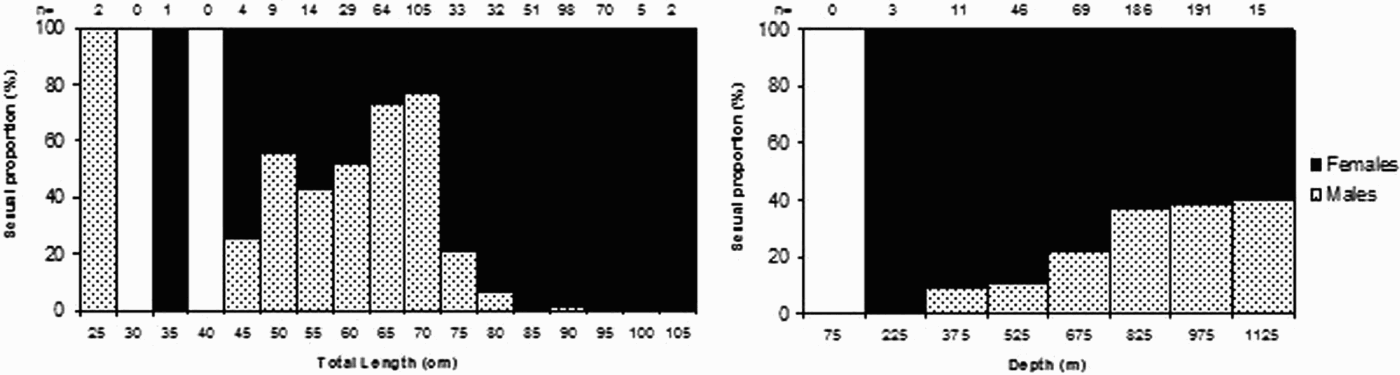
The sex ratio for the total of catches was 1:2.1, which departed significantly from unit (χ2-test, N = 519, P < 0.05). However, from 601 to 900 m deep, for mature specimens, the null-hypothesis for sex ratio 1:1 was not rejected (χ2-test, N = 22, P > 0.05). Variation of sex ratio by length-class (cm) and depth is present in Figure 5.
Variation in sex ratio (females:males) by total length in 5 cm intervals (left) and by depth range in 150 m intervals (right), for Deania profundorum.

DISCUSSION
In the present study we recorded the smallest specimens of Deania profundorum ever caught, measuring 27 and 36 cm TL, a male and a female respectively.
According to Girard & De Buit (Reference Girard and De Buit1999) and Clarke et al. (Reference Clarke, Connolly and Bracken2001, Reference Clarke, Connolly and Bracken2002), no neonates or juvenile squalidae were found by these authors in surveys performed in the north-east Atlantic. Machado & Figueiredo (Reference Machado and Figueiredo2000) referred to the occurrence of small specimens (26 cm) of Deania calcea on the Portuguese continental slope suggesting a possible migratory behaviour of this species. However, a minimum and a maximum size ever caught (27 and 110 cm) for D. profundorum indicates that this species might exhibit a different behaviour, at least for this area.
The vertical distribution for arrowhead dogfish is 275 to 1785 m depth (Compagno, Reference Compagno1984). Catch distribution for Deania crepidalbus and D. calcea in Namibian waters were 359 to 543 and 404 to 644 m depth, respectively (Yano, Reference Yano1991), 500 to 1400 m depth for D. calcea in Irish waters (Clarke et al., Reference Clarke, Connolly and Bracken2002) and 641 to 787 m depth in the Canary Islands (Uiblein et al., Reference Uiblein, Bordes and Castillo1996). Although in the studied area, D. profundorum was caught in shallower waters (151 m), presenting a broader vertical distribution. Since only one individual was caught at 151 m deep, there is not sufficient data to understand the biological importance or ecological significance of this larger vertical distribution.
Data from the present study show that there is a vertical stratification by size, since all the juveniles less than 40 cm length were caught deeper than 950 m. The tendency for smaller specimens to be found at greater depths was also found in Centroscyllium fabricii (Reinhardt, 1825) and Etmopterus princeps Collett, 1904 (Jakobsdóttir, Reference Jakobsdóttir2001). A possible explanation for this is that female deep-water sharks ready to give birth could migrate to the deepest areas for parturition (Girard & De Buit, Reference Girard and De Buit1999).
Females were twice as numerous as males. In Irish waters it was shown to be exactly the opposite for D. calcea (Clarke et al., Reference Clarke, Connolly and Bracken2002). A possible explanation for this is that the Madeira slopes are a nursery area in the north-east Atlantic to the genus Deania. Female Centroscyllium fabricii were found to outnumber males in the deeper part of their depth range (Yano, Reference Yano1995). In shallower waters, female Centroscymnus coelolepis Barbosa du Bocage & de Brito Capello, 1864 and Centroscymnus owstoni Garman, 1906 predominated (Yano & Tanaka, Reference Yano and Tanaka1984; Clarke et al., Reference Clarke, Connolly and Bracken2001). In Madeira, females were more numerous than males at most depths. However, in the middle range of 451–1050 m depth, the number of mature females and males was similar, suggesting that mating may occur at these depths. These data support the hypothesis of reproductive depth segregation also suggested by Yano & Tanaka (Reference Yano and Tanaka1988), Girard & De Buit (Reference Girard and De Buit1999) and Clarke et al. (Reference Clarke, Connolly and Bracken2001).
Deania profundorum are sexually dimorphic with females achieving larger sizes than males, which is also found with other deep-sea sharks such as D. calcea (Clarke et al., Reference Clarke, Connolly and Bracken2002), Centrophorus squamosus (Bonnaterre, 1788), Centroscymnus coelolepis (Girard & De Buit, Reference Girard and De Buit1999), Centrophorus cf. uyato (Rafinesque, 1810) (MacLaughlin & Morrissey, Reference MacLaughlin and Morrissey2005), Centroscyllium fabricii and Etmopterus princeps (Jakobsdóttir, Reference Jakobsdóttir1998, Reference Jakobsdóttir2001). The smallest mature female measured 86 cm, whereas the largest mature male measured 85 cm. Estimates of length at first maturity for females and males were slightly lower than D. calcea (Yano, Reference Yano1991; Clarke et al., Reference Clarke, Connolly and Bracken2002), easily explained by the bigger natural size of this congener. For the other congener species D. crepidalbus (Yano, Reference Yano1991) size at maturity was lower than D. profundorum.
Deep-sea squaloid sharks do not have a defined reproductive season like C. fabricii in western Greenland (Yano, Reference Yano1995), Centroscymnus coelolepis in Portuguese mainland waters (Veríssimo et al., Reference Veríssimo, Gordo and Figueiredo2003), Centrophorus squamosus and Centroscymnus coelolepis from the British Isles (Girard & De Buit, Reference Girard and De Buit1999), D. calcea from Ireland (Clarke et al., Reference Clarke, Connolly and Bracken2002), C. owstoni from Japan (Yano & Tanaka, Reference Yano and Tanaka1984) and E. princeps from Iceland (Jakobsdóttir, Reference Jakobsdóttir2001). Since the data recorded for this study refer to only two months sampling (November and September), it was not possible to determine if there was a defined breeding season for D. profundorum. Thus, future studies should consider a large time interval covering the whole reproductive cycle for at least two years as per Yano & Tanaka (Reference Yano and Tanaka1988) for two Centroscymnus sharks.
Deania profundorum are ovoviviparous with a probable number of five to seven young (Compagno, Reference Compagno1984). Clarke et al. (Reference Clarke, Connolly and Bracken2002) described fecundity to D. calcea of eight to 14 embryos. Nevertheless those data were achieved by only two gravid females, and in the present study a similar fecundity of six to 11 embryos was achieved with ten females. The presence of 19 gravid females in this study area in only a short time period, and the presence of small specimens indicate that D. profundorum spawns on the Madeira slopes.
All embryos found in the pregnant females had an external yolk sac with vitellus, indicating that size at birth is bigger than 18 cm length, this being the maximum recorded size for an embryo. Yano & Tanaka (Reference Yano and Tanaka1987) reported that the embryos of C. owstoni and C. coelolepis were apparently mainly nourished by the yolk because there were no placental attachments. However, it is not possible to verify this in D. profundorum.
The size of the neonate captured (27 cm) suggests that almost every length-class from embryo to post-parturition were present in this study. This information confirms the hypothesis already mentioned that Madeira slopes could be a nursery and reproduction area for D. profundorum.
Many female elasmobranchs have only one functional ovary that produces oocytes (Hamlet & Koob, Reference Hamlett, Koob and Hamlett1999). However, female D. profundorum had a similarly sized oocyte developing in each ovary. Most females during gestation also had oocytes developing in the ovaries. MacLaughlin & Morrissey (Reference MacLaughlin and Morrissey2005), for Centrophorus cf uyato, had suggested that the reason for this process is that mating occurs soon after parturition.
The proportion of the liver weight to body weight for arrowhead dogfish is about 19%, it being the largest organ in the body, and similar to records for several other squalidae sharks (Yano, 1985; Jakobsdóttir, Reference Jakobsdóttir2001). The large livers of squaloid sharks, which store enormous amounts of low density squalene oil, appear to be useful in regulating buoyancy, since elasmobranchs lack a swim bladder (Tota, Reference Tota and Hamlett1999).
The high capture rate of arrowhead dogfish obtained during the two biological surveys, the conservative reproductive strategy and the number of gravid females, implies that they are more vulnerable to over-exploitation. This is crucial in assessing the impact of fisheries on Deania profundorum populations and more biological knowledge is needed.
ACKNOWLEDGEMENTS
The authors would like to thank Captain Fernando Serpa and the crew of RV ‘Arquipélago’, and all of the on-board technicians and scientific staff for their contribution in the different surveys. Acknowledgments are also due to Direcção Regional de Pescas da RAM. Data used in this study were collected within two EU financed projects, performed in 2004–2005, namely ORPAM I/II (co-financed under EU Interreg III B programme).
Many thanks go to Dr Manuel Afonso-Dias, Faculdade de Ciências do Mar e do Ambiente, Universidadedo Algarve, Portugal, Dr Mário Rui Pinho, Departamento de Oceanografia e Pescas (DOP), Universidade dos Açores, Portugal, and Dr Maurice Clarke, Marine Institute, Ireland for their help and constructive advice.