INTRODUCTION
Ecosystems previously controlled by natural drivers such as climate and geography are increasingly viewed as being driven by societal and economic factors (Meybeck Reference Meybeck2003). This characteristic of the anthropocene requires knowledge of the synergistic effects of diverse stressors, and consequently research that crosses many environmental, social and academic boundaries (IPCC [Intergovernmental Panel on Climate Change] Reference Pachauri and Reisinger2007; Jackson et al. Reference Jackson, Randerson, Canadell, Anderson, Avissar, Baldocchi, Bonan, Caldeira, Diffenbaugh, Field, Hungate, Jobbagy, Kueppers, Nosetto and Pataki2008). As a result, previous barriers to collaboration across academic disciplines are breaking down (Campbell Reference Campbell2005), particularly where resource policy makers demand this (Heberlein Reference Heberlein1988). Disciplinary research questions such as ‘to what extent is sea level expected to rise?’ or ‘what factors need controlling in order to stem this rise?’ are increasingly orientated in social directions, towards for example ‘what are the likely social impacts of sea level rise?’ or ‘what factors motivate individuals to adopt the necessary changes in behaviour?’ (Millennium Ecosystem Assessment 2005; IPCC Reference Pachauri and Reisinger2007). This refocusing of research priorities is occurring across scales (Walker et al. Reference Walker, Moore, Arima, Perz, Simmons, Caldas, Vergara and Bohrer2009), with governments and funding bodies increasingly steering research towards interdisciplinarity in an attempt to solve some of the current ‘grand challenges’ facing society (Omenn Reference Omenn2006; Strathern Reference Strathern2006).
Although a growing body of literature on interdisciplinary research exists (Drews Reference Drews2000; Choi & Pak Reference Choi and Pak2007; MacMynowski Reference MacMynowski2007; Michon & Tummers Reference Michon and Tummers2009), some authors have argued that there is no empirical evidence for a fundamental change in the way science is approached (Shinn Reference Shinn1999; Miller et al. Reference Miller, Baird, Littlefield, Kofinas, Chapin and Redman2008). Furthermore, inconsistent or unclear use of interdisciplinary terminology hinders adequate assessments of progress or research effectiveness (Jakobsen et al. Reference Jakobsen, Hels and McLaughlin2004; Tress et al. Reference Tress, Tress and Fry2005a). Consequently, we develop a working definition to ensure consistency across this study from the outset. This does not aim to challenge established definitions, but builds upon them as follows. Disciplines are the intellectual and social structures through which knowledge is organized (Bordons et al. Reference Bordons, Morillo and Gomez2004), where epistemological frameworks for classifying and understanding the world are themselves produced by political economies, institutional cultures and relationships of power (Bourdieu Reference Bourdieu1990). ‘Multi’, ‘inter’ and ‘trans’ refer to increasing levels of interaction among disciplines (OECD [Organization for Economic Cooperation and Development] 1998), and increasing levels of overlap in terms of goal setting (Tress et al. Reference Tress, Tress and Fry2005a). Although ‘multi’, ‘inter’ and ‘trans’ constitute distinct approaches to research, the boundaries between them are not clearly defined (Rhoten & Parker Reference Rhoten and Parker2004; Tress et al. Reference Tress, Tress and Fry2005a). We therefore define interdisciplinarity as ‘the production of research which crosses disciplinary boundaries’ thus covering all of these forms. Two key components, recurrent in the literature, underpin this definition, namely the process of crossing disciplinary boundaries to borrow, share or transfer knowledge (experience, ideas, methods or theories) (OECD 1998; Karlqvist Reference Karlqvist1999; Pierce Reference Pierce1999), and the production of a more comprehensive understanding from this combined knowledge (Klein Reference Klein1990; Jakobsen et al. Reference Jakobsen, Hels and McLaughlin2004; Tress et al. Reference Tress, Tress and Fry2005b).
However, epistemological differences between disciplines often result in incompatibilities of method and approach, despite the existence of common goals (Campbell Reference Campbell2005; Max-Neef Reference Max-Neef2005; Kueffer et al. Reference Kueffer, Hadorn, Bammer, van Kerkhoff and Pohl2007; MacMynowski Reference MacMynowski2007). Interdisciplinary research therefore faces a number of cultural and practical barriers (Bruce et al. Reference Bruce, Lyall, Tait and Williams2004; Lele & Norgaard Reference Lele and Norgaard2005; McWilliam et al. Reference McWilliam, Hearn and Haseman2008), in spite of concerted attempts to address these issues (Heberlein Reference Heberlein1988; Klein Reference Klein1990; Campbell Reference Campbell2005). Such research remains notoriously difficult to assess by conventional peer-review and is believed to present fewer publishing opportunities in high-ranked refereed journals (Turner & Carpenter Reference Turner and Carpenter1999; Rhoten & Parker Reference Rhoten and Parker2004; Tress et al. Reference Tress, Tress and Fry2005a). As a result, the dynamism and creativity required by governments and funding agencies has been accompanied by the perception that the results of interdisciplinary research are often ‘compromised’ scientifically, hence of lower quality, and are marginalized by traditional disciplines (Mansilla Reference Mansilla, Feller and Gardner2006; Lowe & Phillipson Reference Lowe and Phillipson2009). In spite of such barriers, whether real or perceived, interdisciplinary research persists and identification of supporting factors is equally important to the management of interdisciplinary programmes (Lowe & Phillipson Reference Lowe and Phillipson2006).
Interdisciplinarity, however, is not novel and such approaches can be seen as an evolutionary process (Klein et al. Reference Klein, Smith and Zentner1998; Barry et al. Reference Barry, Born and Weszkalnys2008). Disciplines are continually changing and evolving over time. As knowledge accumulates, disciplines grow and nodes of scientific specialization occur. Two hypotheses for interdisciplinary developments are therefore possible:
(1) Nodes of specialization lead to divisions in ideology, epistemology and methodology. When such nodes from one field confront their counterparts from other fields, or big challenges are posed in new areas, innovation is likely to occur and new ‘inter-disciplines’ emerge (Dogan & Pahre Reference Dogan and Pahre1990; Balsiger Reference Balsiger2004). Newer disciplines are therefore likely to be more interdisciplinary (Daily & Ehrlich Reference Daily and Ehrlich1999; Pickett et al. Reference Pickett, Burch and Grove1999; Morillo et al. Reference Morillo, Bordons and Gomez2003; Barry et al. Reference Barry, Born and Weszkalnys2008).
(2) Larger disciplines bring with them more opportunity for interdisciplinary research and are therefore more interdisciplinary (Rinia et al. Reference Rinia, van Leeuwen, Bruins, Vuren and van Raan2002a; Boyack et al. Reference Boyack, Klavans and Börner2005).
This provides a basis from which to establish the extent to which such attributes can be measured and assessed, in the attempt to determine whether interdisciplinary science is achieving its aims; particularly whether large disciplinary divides, such as those between the ‘macrosciences’ of environment and society, are being successfully bridged (Stirling Reference Stirling2007; Lowe & Phillipson Reference Lowe and Phillipson2009; Lowe et al. Reference Lowe, Whitman and Phillipson2009; Porter & Rafols Reference Porter and Rafols2009).
Because scientific knowledge arises from scientific data published in peer-reviewed journals (Rinia et al. Reference Rinia, van Leeuwen, van Vuren and van Raan1998; Dalgaard et al. Reference Dalgaard, Hutchings and Porter2003; Bornmann et al. Reference Bornmann, Wallon and Ledin2008), these publications present a common starting point in interdisciplinary assessments (see review by Bordons et al. Reference Bordons, Morillo and Gomez2004). This addresses the second component of our definition of interdisciplinarity, namely ‘the production of a comprehensive understanding’. The first component of interdisciplinarity, namely the process of crossing disciplinary boundaries, can be assessed in a number of ways. This has often been based on the source of the citing or cited literature (for example Steele & Stier Reference Steele and Stier2000; Rinia et al. Reference Rinia, van Leeuwen, Bruins, Vuren and van Raan2002a; Moya-Anegon et al. Reference Moya-Anegon, Vargas-Quesada, Herrero-Solana, Chinchilla-Rodriguez, Corera-Alvarez and Munoz-Fernandez2004; Leydesdorff Reference Leydesdorff2007a, Reference Leydesdorffb), the assumption being that the distribution of references amongst disciplines relates to the flow of information between disciplines (Stirling Reference Stirling2007). Examining the breakdown of all publications citing or cited, in a particular article, journal or discipline within a particular field will therefore provide an overview of its interdisciplinary profile (Moed Reference Moed2005). The diversity of the citing or cited articles can then be used to quantify its interdisciplinarity (see Steele & Stier Reference Steele and Stier2000; van Leeuwen et al. Reference van Leeuwen, Moed, Tijssen, Visser and van Raan2000; Stirling Reference Stirling2007) and network analysis can be used to map it in relation to other fields (Leydesdorff & Rafols Reference Leydesdorff and Rafols2009). Issues may arise where citation data are used without checking the appropriateness of the source article (Todd et al. Reference Todd, Guest, Lu and Ming Chou2010). However, as the scale of interest is the discipline that the cited article is from, any errors are expected to have only minor statistical impact on the overall result. Centrality metrics, which refer to the position of an article, journal or discipline within the network, have been used to describe disciplinary roles or interdisciplinarity (for example see Leydesdorff Reference Leydesdorff2007b). Other measures of interdisciplinarity have been based on the disciplinary content of sampled articles, characteristics such as affiliation of the author (Steele & Stier Reference Steele and Stier2000) or journal assignation into disciplinary categories (Morillo et al. Reference Morillo, Bordons and Gomez2003; Porter & Rafols Reference Porter and Rafols2009).
We here employ citation data to help elucidate factors that inhibit or enable interdisciplinary research within the environmental sciences. Epistemological differences between disciplines and the internal structuring of academic institutions and review methodologies remain beyond the scope of this study. However, we assess three common themes, as identified in the literature, to test the following hypotheses: (1) newer disciplines are more interdisciplinary (for example see Barry et al. Reference Barry, Born and Weszkalnys2008); (2) larger disciplines are more interdisciplinary (for example see Boyack et al. Reference Boyack, Klavans and Börner2005); and (3) interdisciplinary research is less well cited than its counterparts, inferring inferior quality (for example see Turner & Carpenter Reference Turner and Carpenter1999).
In addition, interdisciplinary networks will be mapped at three scales (Leydesdorff Reference Leydesdorff2007b; Leydesdorff & Rafols Reference Leydesdorff and Rafols2009) to determine the relative extent to which disciplines within the environmental sciences draw on disciplinary perspectives from: (1) all other disciplines as classified by ISI; (2) only disciplines classified as within the social sciences; and (3) only disciplines we have classified as within the environmental sciences.
METHODS
Sampling strategy
No single library information database has full coverage of articles published. However, the Thomson Reuters ISI Web of KnowledgeSM (see URL http://wokinfo.com/) and Scopus (see URL http://www.scopus.com/home.url) databases enable the mapping of journals and delineation of specialties more easily than other databases (Leydesdorff et al. Reference Leydesdorff, de Moya-Anegón and Guerrero-Bote2010). Scopus has the broader coverage, however, due to its relative maturity, ISI has had longer to develop cleaning and normalization and standardization procedures, differences which are evident in the raw data and citation reports (Leydesdorff et al. Reference Leydesdorff, de Moya-Anegón and Guerrero-Bote2010). We therefore used the ISI science citation index (SCI), social science citation index (SSCI) and arts and humanities citation index (A&HCI) to select bibliographic data of published articles and reviews from a single year, namely 2006. ISI classified journals into 221 subjects based on a number of criteria, including journal title, journal content and citation patterns (Morillo et al. Reference Morillo, Bordons and Gomez2003; Bordons et al. Reference Bordons, Morillo and Gomez2004; Leydesdorff Reference Leydesdorff2007a, Reference Leydesdorffb). Established historically, these categories are content based; whilst they can be added to and subdivided, the original classification process is unchanged (Pudovkin & Garfield Reference Pudovkin and Garfield2002). While this categorization system has flaws and inconsistencies in inter-journal citation relations, for statistical and mapping purposes at the aggregate level, the ISI system is adequate (Boyack et al. Reference Boyack, Klavans and Börner2005; Leydesdorff & Rafols Reference Leydesdorff and Rafols2009; Rafols & Leydesdorff Reference Rafols and Leydesdorff2009). These ISI subject categories, hereafter ‘disciplines’, are used as proxies for the disciplines in our analysis; examining interactions between these can help quantify our first component of interdisciplinarity, namely the process of crossing boundaries between bodies of specialized knowledge or research practice (Porter & Rafols Reference Porter and Rafols2009).
We selected for further investigation 23 disciplines that (1) were directly related to environmental sciences and (2) addressed questions at an ecosystem level. Although ‘Multidisciplinary sciences’ fell within this categorization, the journals included in this discipline, such as Nature, Science and Proceedings of the National Academy of Sciences, were regarded as essentially containing mono-disciplinary articles from a diversity of fields, which would bias the results. We therefore excluded this category from further investigation.
We conducted a running mean sensitivity analysis using the discipline classified by ISI as ‘Environmental science’, to determine an appropriate sampling size (Appendix 1, see supplementary material at Journals.cambridge.org/ENC). The effects of sampling strategy on response variables were then tested using extrapolation based rarefaction curves (McAleece et al. Reference McAleece, Lambshead, Paterson and Gage1997) (Appendix 1, see supplementary material at Journals.cambridge.org/ENC).
Articles and reviews from journals within the 23 selected disciplines were extracted, in a random order, until the sample size of articles published for each discipline in 2006 had been met (5% of articles, or covering a minimum of five journals). Export of full bibliographic records of extracted articles to HistCite™ (Garfield Reference Garfield2004) produced a list of cited articles for each citing article. All articles, citing and cited, were assigned to a discipline based on the ISI classification of the journal in which they appeared. We therefore produced a matrix containing the number of citations from our 23 selected disciplines to a maximum of 221 available disciplines. Citations to or from journals which were assigned to more than one discipline by ISI were fractionally attributed to each assigned discipline. The interdisciplinarity of these multi-classified journals may thus be under-represented in our analysis (Morillo et al. Reference Morillo, Bordons and Gomez2001). Cited books and journals, which had not been categorized by ISI, were removed from further analysis.
Measures of interdisciplinarity
We used connectance and evenness, two diversity metrics drawn from the ecological sciences, to infer journal and discipline interdisciplinarity. A number of diversity measures have been used previously to infer interdisciplinarity using the total amount of references accruing to other disciplines (van Leeuwen et al. Reference van Leeuwen, Moed, Tijssen, Visser and van Raan2000; Steele & Stier Reference Steele and Stier2000; Rinia et al. Reference Rinia, Van Leeuwen and Van Raan2002b; Porter & Rafols Reference Porter and Rafols2009). Connectance, establishes the number of different disciplines cited. Evenness establishes how evenly those citations are distributed across the cited disciplines. We calculate connectance from the number of disciplines referenced by each article, relative to the total number of disciplines available to reference (Eq. 1; Bascompte et al. Reference Bascompte, Jordano and Olesen2006). We present discipline connectance as the mean of journal connectance:

where C is connectance, l is the number of disciplines cited and L is the total number of disciplines available to cite (in our case the 221 disciplines recognized by ISI).
To calculate evenness we used Pielou's evenness index J′ (Eq. 2), which is a normalization of the Shannon's diversity index H′ (Eq. 3) (Clarke & Warwick Reference Clarke and Warwick2001). We present discipline evenness as the mean of journal evenness calculated:

where

and where pi is the proportion of total citations arising from the ith discipline.
Independent variables influencing interdisciplinarity (quality, age and size)
In order to test whether interdisciplinary research is judged as being inferior in quality to its counterparts, we established discipline impact factor ratings based on the ISI impact factor scores assigned to the journals within each discipline. Although impact factor is a problematic measure that fails to capture quality adequately, particularly across disciplines (Olden Reference Olden2007), it provides a useful metric against which, with caution, a dimension of perceived quality can be tested (Chapron & Husté Reference Chapron and Husté2009). ISI bases impact factor scores on the journal citation reports for the preceding two years. Journal impact factors are calculated based on the number of citations received in this year's edition of the ISI Journal Citation Reports from articles published in the preceding two years (Eq. 4) (Moed Reference Moed2005).

In order to test whether newer disciplines were more interdisciplinary, we calculated discipline age from the average age of journals within the discipline where journal age was the time since publication of the first issue. To test whether larger disciplines were more interdisciplinary, we calculated discipline, journal and article size. We established discipline size from the total number of articles published in the discipline in 2006, journal size from the total number of articles published in the journal in 2006 and article size from the total number of references contained in the article.
Data analysis
Data were tested for normality with Shapiro-Wilks W test, for homogeneity of variances by plotting residuals against y, and for auto correlation by plotting residuals against x. Where normality did not exist data were square root transformed (Quinn & Keough Reference Quinn and Keough2002). Stepwise regressions were run to test the effects of independent variables (age, article size, journal size, discipline size and impact factor) on dependent variables (connectance and evenness) of the citing to cited articles. The resultant significant independent variables were used to populate a standard least squares multiple regression analysis. Their effects on the dependent variables (connectance, evenness and coefficient of variance of connectance) were tested at the discipline and journal level where relevant.
Where significant effects were found at the scale of the discipline, dependent variables were plotted, with 95% confidence intervals, against the independent variables to visualize relationships present. In addition, coefficients of variation or regression residuals were plotted. Connectance was plotted against impact factor at the journal level and betweenness (see next section) against impact factor at the discipline level with regression residuals plotted.
Mapping interdisciplinarity
Social network analysis (SNA) techniques were used to reveal the patterns and relationships in the environmental sciences citation data. SNA is the study of groups as networks of nodes connected by ties, and has been applied to a variety of network types (Wey et al. Reference Wey, Blumstein, Shen and Jordan2008), including many studies of citation data (for example Leydesdorff & Rafols Reference Leydesdorff and Rafols2009). Our citation analysis is based on the work of Freeman (Reference Freeman1972, Reference Freeman1977, Reference Freeman1979), who first described the relative prominence of disciplines depending on their visibility to other disciplines in the citation network. Therefore, in our network, each discipline is a node, and the network consists of the citing environmental science disciplines to all other disciplines cited. We calculated centrality measures by looking at the direct links (‘degree’) and indirect links via other disciplines (‘betweenness’). Degree is simply the number of links a given node, or discipline, maintains with the other nodes in a network. Here we have used ‘out’ degree to refer simply to the number of ‘outward’ citations made from one discipline to other disciplinary nodes. Leydesdorff (Reference Leydesdorff2007a) proposed this as an important metric for judging multidisciplinary research. ‘Betweenness’ (Eq. 5) incorporates the indirect links between two disciplines and measures how often a node is on the shortest path between other nodes in the network, revealing more about the role played by the discipline in the overall network. This relates to the degree of control a node has in the network; Leydesdorff (Reference Leydesdorff2007a) proposed this as an indicator of the interdisciplinarity of a journal:

Where gij is the number of geodesic paths between i and j, and gijk is the number of these paths that pass through k.
The citation network we developed represents a unidirectional network (Wasserman & Faust Reference Wasserman and Faust1994) consisting of 23 environmental science citing disciplines to up to 221 cited disciplines. Data were normalized to account for differences in the average number of references per article across disciplines (Rinia et al. Reference Rinia, Van Leeuwen and Van Raan2002b). Although impact factor may also influence the propensity of disciplines to cite, as we do not restrict our citations to a two-year time scale, we believe that the number of references would have the greater influence. Consequently, we only normalize for number of references. We calculated degree and betweenness centrality metrics using the UCINET software package (Borgatti et al. Reference Borgatti, Everett and Freeman2002) for the ‘environmental science to all disciplines’ citation network. For highly connected networks, correlation matrices allowed for better comparisons of betweenness metrics than in their original matrix forms, which might be overshadowed by the higher degree measures (Leydesdorff Reference Leydesdorff2008). Salton's cosine correlation index is the preferred choice when network visualization is intended (Egghe & Leydesdorff Reference Egghe and Leydesdorff2009). We therefore also calculated degree and betweenness centrality metrics based on the Salton cosine correlation matrices for: (1) the environmental science to all disciplines citation network; (2) the environmental science to social sciences citation network; and (3) the environmental science to environmental science citation network. We used Netdraw in the UCINET package (Borgatti et al. Reference Borgatti, Everett and Freeman2002) to produce cartographic visual representations of the four network citation patterns. We used the mean matrix value to set levels at which the matrices were dichotomized. Multidimensional scaling (MDS) was applied to the ordinations for the correlation matrices.
RESULTS
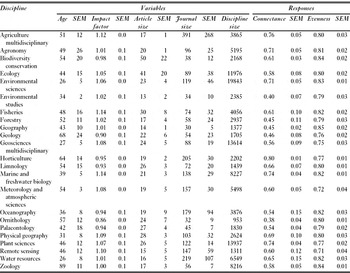
A total of 14 018 articles from 23 disciplines were selected, containing 319 756 references (Table 1).
List of all environmental science disciplines included in the analysis with the independent variables included in a multiple regression analysis and the response variable values of connectance and evenness, with standard errors of the mean.

Effects of quality, age and size on interdisciplinarity
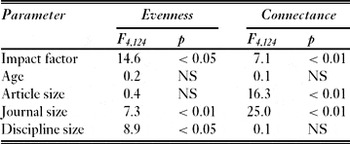
The stepwise regression analyses indicated that journal size and impact factor contributed to the variation in both evenness and connectance. Discipline size contributed to the variation in evenness alone and article size to the variation in connectance alone (Table 2). Age did not contribute to the variation in either variable, therefore only impact factor, discipline, journal and article size were included in the subsequent multiple regression analysis.
Results of stepwise regression analysis used to populate a multiple regression model. NS = not significant.

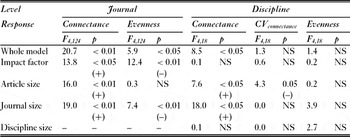
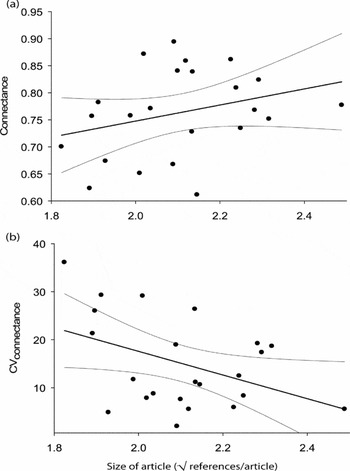
Larger articles were associated with greater connectance at the scale of both journal and discipline and a decrease in the associated variation of that connectance across journals, suggesting the observed increase in connectance with increased article size occurs across journals, rather than being driven by a few journals (Table 3). Both the increase in connectance and decrease in coefficient of the variation of that connectance with article size were linear (Fig. 1).
Results of multiple regression analysis testing effects of size and impact factor on the journal and discipline evenness, connectance and the variation in discipline connectance. Direction of significant relationships shown in brackets. NS = not significant.

Plots of (a) connectance at the subject level and (b) coefficient of variation of that connectance against article size (√references/article), showing linear regression with 95% confidence intervals.

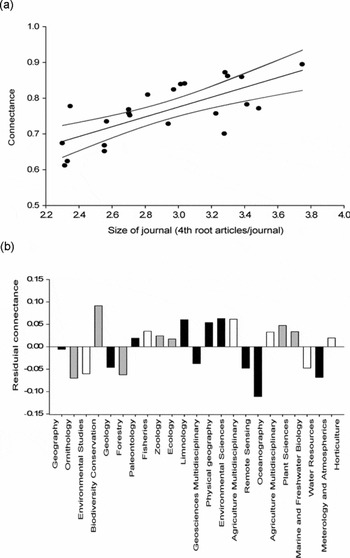
Larger journals were associated with greater connectance at the scale of both journal and discipline. A decrease in the associated evenness at the journal level suggests that the observed increase in journal connectance with increased journal size is driven by the incremental addition of citations to new areas (Table 3). Connectance increased linearly with journal size though there is no trend attributable to broader discipline groupings based on top-level UK JACS2 (Joint Academic Coding System Version 2) categories (HESA [Higher Education Statistics Agency] 2006) (Fig. 2).
(a) Plot of connectance of subject level against average size of journal showing linear regression with 95% confidence limits, (b) the resultant residuals plotted by broader subject grouping. Biological sciences = grey, Earth sciences = black, Agricultural and veterinary sciences = white.

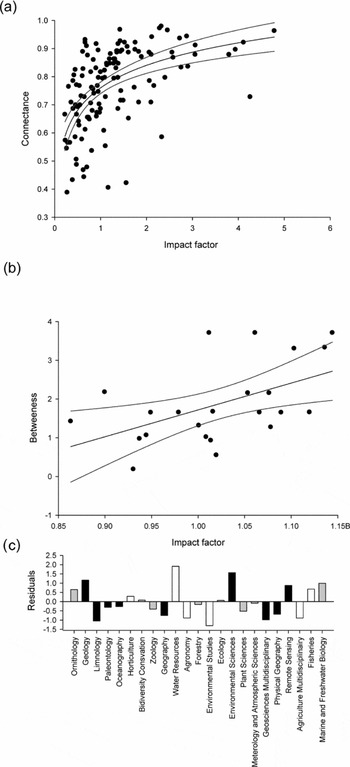
Larger impact factors were associated with greater journal connectance and a decrease in the associated journal evenness (Table 3). Greater journal connectance at higher impact factor levels may be driven by the incremental addition of citations to new areas; new links tentatively spread from established nodes to occupy the interdisciplinary space. Journal connectance increased log linearly with increasing impact factor, the greatest increase occurring below an impact factors of 1 (Fig. 3a). Journal betweenness increased linearly, although there was no trend attributable to broader discipline groupings (HESA 2006) (Fig 3b, c).
Plots of (a) connectance against impact factor at journal level and (b) betweenness against impact factor at the subject level, showing regression lines with 95% confidence limits and (c) the resultant betweenness residuals plotted by broader subject grouping. Biological sciences = grey, Earth sciences = black, Agricultural and veterinary sciences = white.

Mapping interdisciplinarity
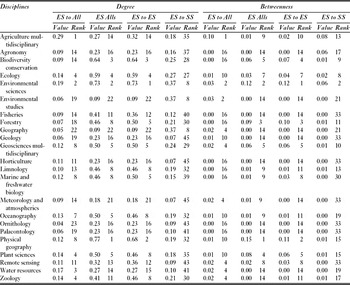
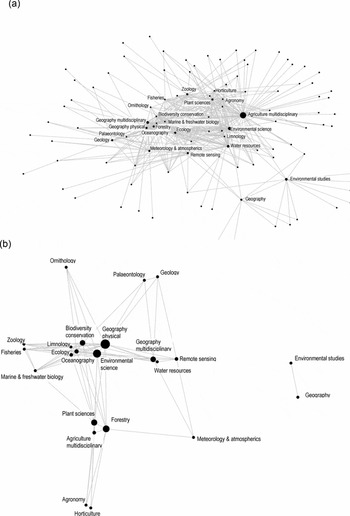
The environmental science to all disciplines citation matrix reveals a highly connected matrix. Based on an MDS ordination on similarities in citation environments, 21 environmental science disciplines occupied the centre of the map with all other subjects, including ‘Geography’ and ‘Environmental Studies’ from the environmental sciences disciplines, occupying the periphery. The disciplines with the greatest degree and betweenness measures were ‘Agriculture Multidisciplinary’ followed by ‘Environmental Sciences’ (Fig. 4a, Table 4).
List of all environmental science disciplines included in the analysis with their betweenness and degree values and rank based on (1) environmental sciences to all disciplines citation network (ES to All), (2) Salton's cosine correlation matrix based on the environmental sciences to all disciplines citation network (ES Alls), (3) the environmental sciences to social science disciplines citation network (ES toSS), and (4) Salton's cosine correlation matrix based on the environmental sciences to environmental sciences citation network (ES to ES).

Network maps based on multidimensional scaling (MDS) ordination. Bubbles represent subject nodes and lines represent links between subjects. The size of bubble corresponds to the betweenness measure; black nodes are environmental science citing subjects for: (a) the environmental sciences to all subjects citation environment, dichotomized at 3, and (b) The Salton's cosine similarity matrix of the environmental sciences to all subjects citation environment dichotomized at 0.3.

The Salton's cosine correlation matrix of the environmental sciences to all disciplines citation matrix reduced the prominence of ‘Agriculture Multidisciplinary’. Instead, ‘Physical Geography’, ‘Environmental Sciences’, ‘Forestry’ and ‘Plant Sciences’ were the disciplines with the greatest betweenness measures (Fig. 4b, Table 4). Based on MDS ordination of the similarities in citation environments, a cluster of six disciplines including ‘Biodiversity conservation’ and ‘Oceanography’, were at the centre of this network. ‘Physical Geography’ and ‘Environmental Sciences’ served to link peripheral disciplines including ‘Ornithology’, ‘Palaeontology’ and ‘Remote Sensing’ to the core ecology cluster. ‘Forestry’ and ‘Plant Sciences’, similarly served to link in peripheral disciplines including ‘Meteorology and Atmospherics’ and ‘Horticulture’ (Fig. 4b, Table 4).
In the environmental sciences to environmental sciences similarity matrix, ‘Environmental Sciences’ and ‘Physical Geography’ had the greatest betweenness and degree measures, followed by the ‘Forestry’ betweenness measure and ‘Biodiversity Conservation’ degree measure (Fig 5a, Table 4).
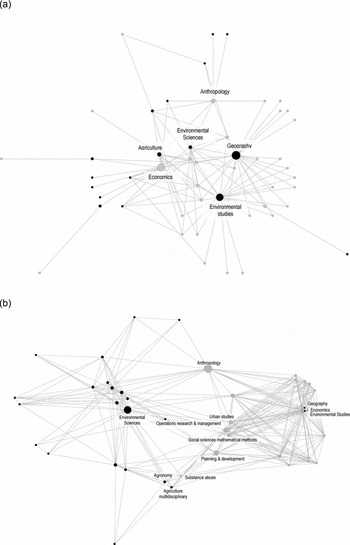
Network maps based on multidimensional scaling (MDS) ordination. Bubbles represent subject nodes and lines represent links between subjects. The size of bubble corresponds to the betweenness measure; black nodes are environmental science citing subjects, grey nodes are social science cited subjects for (a) the environmental sciences to social sciences citation environment, dichotomized at 0.3, and (b) the Salton's cosine similarity matrix of the environmental sciences to social sciences citation environment dichotomized at 3.

Prior to applying Salton's cosine correlation, the environmental science to social science citation matrix featured ‘Economics’, ‘Geography’, ‘Environmental Studies’ and ‘Anthropology’ as central to the network as represented as the disciplines with the greatest betweenness measures. These disciplines may link otherwise unconnected social science disciplines to environmental science disciplines (Fig. 5a, Table 4, Appendix 2, see supplementary material at Journals.cambridge.org/ENC). The network based on Salton's cosine correlation index differed somewhat. We could effectively decompose this network into two component networks, one containing the environmental sciences disciplines and one containing the social sciences disciplines. The environmental sciences disciplines network component was similar to that produced from the environmental sciences to all subjects similarity matrix with a central cluster containing six disciplines. The social sciences network component contained four main discipline clusters. Linking these networks are ‘Anthropology’, ‘Environmental Sciences’, ‘Planning and Development’ and ‘Operations Research and Management’, the disciplines with the greatest betweenness measures. Anomalous to this two component delineation is ‘Substance Abuse’ from the social sciences database which overlaps with ‘Agronomy’ and ‘Agriculture Multidisciplinary’ from the environmental sciences, and ‘Geography’ and ‘Environmental Studies’ from the environmental sciences, which overlaps with the Social sciences cluster containing ‘Economics’. ‘Economics’ no longer functions as a key linking node, as reflected in its lower betweenness measure. and MDS ordination where ‘Economics’ clusters closely with other disciplines (Fig. 5b, Table 4).
DISCUSSION
In this analysis, we found no evidence for barriers to interdisciplinarity (McWilliam et al. Reference McWilliam, Hearn and Haseman2008); in fact, quality and size were likely to increase interdisciplinary prospects. However, we found that diversity metrics alone were likely to be insufficient in addressing both components of interdisciplinarity. The network analysis added valuable insights into where crossing disciplinary boundaries might produce more comprehensive understanding (for example Tress et al. Reference Tress, Tress and Fry2005b).
Contrary to expectations (Turner & Carpenter Reference Turner and Carpenter1999), increasing impact factor ratings were associated with increasing interdisciplinarity. Associated with this increase in measured interdisciplinarity was a decrease in the evenness with which those citations were distributed. The increase in interdisciplinarity might therefore be viewed as sub-disciplines reaching out gradually, to incrementally incorporate more citations from new areas, an analogy that fits well with the idea of interdisciplinarity evolving (Klein et al. Reference Klein, Smith and Zentner1998; Barry et al. Reference Barry, Born and Weszkalnys2008). It is possible that the observed increase in interdisciplinarity is the result of a greater propensity to cite by certain disciplines with greater impact factor, rather than impact factor driving the increase in interdisciplinarity. However, as the variation in connectance with impact factor rating occurs at the journal level, not the discipline; differences in connectance are likely to be independent of inter-discipline impact factor ratings.
Disciplinary age and size (Barry et al. Reference Barry, Born and Weszkalnys2008) did not appear to affect our measures of interdisciplinarity, suggesting again that factors which enhance the likelihood of interdisciplinary research act at lower levels. The perception that large old disciplines are intransigent and boundaried (Morillo et al. Reference Morillo, Bordons and Gomez2003) is therefore incorrect, and it seems that these disciplines are equally capable of promoting interdisciplinary research as newer or smaller disciplines.
The suggestion that journal and article size have a positive effect on our interdisciplinary measures indicates that increased space may provide greater opportunities for interdisciplinary research (Boyack et al. Reference Boyack, Klavans and Börner2005). This increase evidently occurs through uneven addition of cited disciplines (reflected through the decrease in evenness), however this increase appears to occur across all journals (reflected in the decreased coefficient of variation). Both the factors that promote interdisciplinarity and the mode by which this increase occurs applies across disciplines, despite different disciplinary traditions and their variations in citation pattern.
Whilst a discipline may cite multiple disciplines, unless it integrates otherwise unconnected disciplines, its interdisciplinarity remains limited. We therefore used network analysis to examine interdisciplinarity further. Degree measures refer to the number of direct links to other disciplines (Freeman Reference Freeman1979) and equate roughly to connectance, while betweenness refers to the extent to which a discipline facilitates interactions between two otherwise unconnected disciplines (Wasserman & Faust Reference Wasserman and Faust1994). Within the environmental sciences to all disciplines network and the environmental sciences to social sciences network, the disciplines with the largest betweenness values were respectively ‘Agriculture Multidisciplinary’ and ‘Economics’. Both also had the largest degree measures, it was therefore likely that degree was overshadowing the betweenness values (Leydesdorff Reference Leydesdorff2007a). However, when similarity matrices were constructed for these networks, ‘Physical Geography’ replaced ‘Agriculture Multidisciplinary’ and ‘Anthropology’ replaced ‘Economics’ as the greatest betweenness measures, indicating these disciplines played a functionally important interdisciplinary role.
Across all networks, the ‘Environmental Science’ discipline appeared to be a node for interdisciplinarity, however it was never the key node. Interestingly, beyond ‘Environmental Science’, the disciplines playing interdisciplinary roles differed for each of the environmental science networks. For example, within the environmental science to all disciplines network ‘Physical Geography’ followed by ‘Forestry’ were identified as the most interdisciplinary nodes. When we reduced this network to include only the environmental sciences to social science citations, a broad natural science to social science divide was apparent. In addition to ‘Environmental Sciences’, ‘Anthropology’ followed by ‘Planning and Development’ were identified as playing the greatest interdisciplinary roles. The extent of interdisciplinarity interactions appeared smaller within this network, which supports observations reported elsewhere (Moya-Anegon et al. Reference Moya-Anegon, Vargas-Quesada, Herrero-Solana, Chinchilla-Rodriguez, Corera-Alvarez and Munoz-Fernandez2004; Boyack et al. Reference Boyack, Klavans and Börner2005). Were we to further reduce this network, and hence the extent of citations, we could expect to find different disciplines facilitating interdisciplinary roles. Network analysis also proved to be particularly valuable when considering interdisciplinary quality; although interdisciplinarity assessed through connectance (number of links relative to total possible links) showed no relationship with impact factor at the discipline level; disciplines with greater impact factors were associated with higher betweenness measures and evidently performed key roles connecting otherwise disparate disciplines.
Complexity aspects of interdisciplinarity are highlighted through the social network analyses undertaken here (Amaral & Uzzi Reference Amaral and Uzzi2007). Diversity metrics such as connectance provided simple results in terms of quality and impact, facilitated examination of crossing disciplinary boundaries (OECD 1998; Karlqvist Reference Karlqvist1999; Pierce Reference Pierce1999) and revealed a process of disciplines incrementally incorporating citations from new areas. However, network based betweenness measures were required to reveal critical interdisciplinary frontiers or nodes which perform critical bridging roles between otherwise unconnected areas and hence the production of a more comprehensive understanding (Klein Reference Klein1990; Jakobsen et al. Reference Jakobsen, Hels and McLaughlin2004; Tress et al. Reference Tress, Tress and Fry2005a). In this sense, we have achieved an assessment of interdisciplinarity within our chosen area. However, further evaluation into the context of that research is clearly required, to permit assessment of the true success of any observed integration, namely that which goes beyond the simple citation level. The volume of interdisciplinary interactions may prove to be less important than the quality of each. Ensuring the effective functioning of the disciplines within an interdisciplinary network may be more important than maximizing the interdisciplinarity of any one area. Additionally, promotion of interdisciplinary behaviour in one area may result in additional indirect benefits to the wider science community. Throughout, disciplinary classification remains an issue with the datasets employed, and further work is required to fully explore such structural impacts upon the metrics developed.
CONCLUSIONS
This study rather challenges perceived barriers to interdisciplinary research and reveals opportunities for interdisciplinary progress. We found that age or size of a discipline, and perceived quality of research output did not affect interdisciplinary research. Rather quality, as measured by impact factor, and the size of article and journal were associated with greater degrees of interdisciplinarity. Promotion of interdisciplinary research should not be restricted by discipline, but should focus on dispelling fears over the quality of outputs and create opportunities for interdisciplinarity by increasing the space available for different disciplines to encounter each other. However, just as the promotion of interdisciplinary behaviour in one area may result in additional indirect benefits to the wider science community, negative assessments of interdisciplinary research, based on disciplinary science based metrics, may result in unintended damage in fields far beyond the anticipated sphere of influence (Klein Reference Klein2008; Levitt & Thelwall Reference Levitt and Thelwall2008).
ACKNOWLEDGEMENTS
The Foundation for Environmental Conservation funded this study. We are grateful to Annette Muehilig-Hofmann for helpful comments in the early stages, Nick Graham for pre-review and Jonathan Kool for statistical advice and support. This paper was improved by the comments of the autonomous reviewers.