The Mughals as Paragons of Rulership
The memory of mankind is short, and outside of South Asia it has been largely forgotten that the Mughals were once a superpower of Asia and of the Islamic world. Great Britain provides an exception to this collective amnesia; there many families have an ancestor or family member who served in India, or spent time in India, and thus know about its history and culture.
Currently there is nowhere in the world where Mughal studies have a lobby, comparable to Ottoman studies in Turkey, or Safavids studies in the Iranian community (meaning exiled Iranians, because the Safavids as shahs are not popular in the Iran of the Mullahs). A potential candidate would be Pakistan which identifies strongly with the Mughal heritage but so far not much support for Mughal studies has come forth from there. Thus studying the Mughals outside of South Asia is almost something like l'art pour l'art, but those who undertake it are richly recompensed. The Mughal empire is paradigmatic in many of its formulations, and it is epitomised in the persons of its first six padshahs or emperors. The Great Mughals, Grao Mogor, Grand Mogul, Großmogul or Groote Mogul, as the padshahs were known in Europe, have been considered as paragons of rulership. In critical appraisals, which were the prevailing view in the seventeenth and eighteenth centuries, they were the quintessential Oriental despots, held up as a warning to those rulers in Europe with similar aspirations. One thinks here especially of François Bernier's letters of the Mughal court to his French contacts which included Colbert, the minister of Louis XIV (r. 1643–1715).Footnote 1 In more sympathetic (and more recent) opinions, such as those of the world-traveller, philosopher and enthusiastic inter-culturalist Count Hermann Keyserling, who was in India in 1911, they were “the grandest rulers brought forth by mankind”. Keyserling came to this conclusion because the Mughals “combined in their personalities so many divers talents: they were men of action, refined diplomats, experienced judges of the human psyche, and at the same time aesthetes and dreamers”. He felt that such a “superior human synthesis” (grossartige Menscheitsynthese) had not shown itself in any European king.Footnote 2
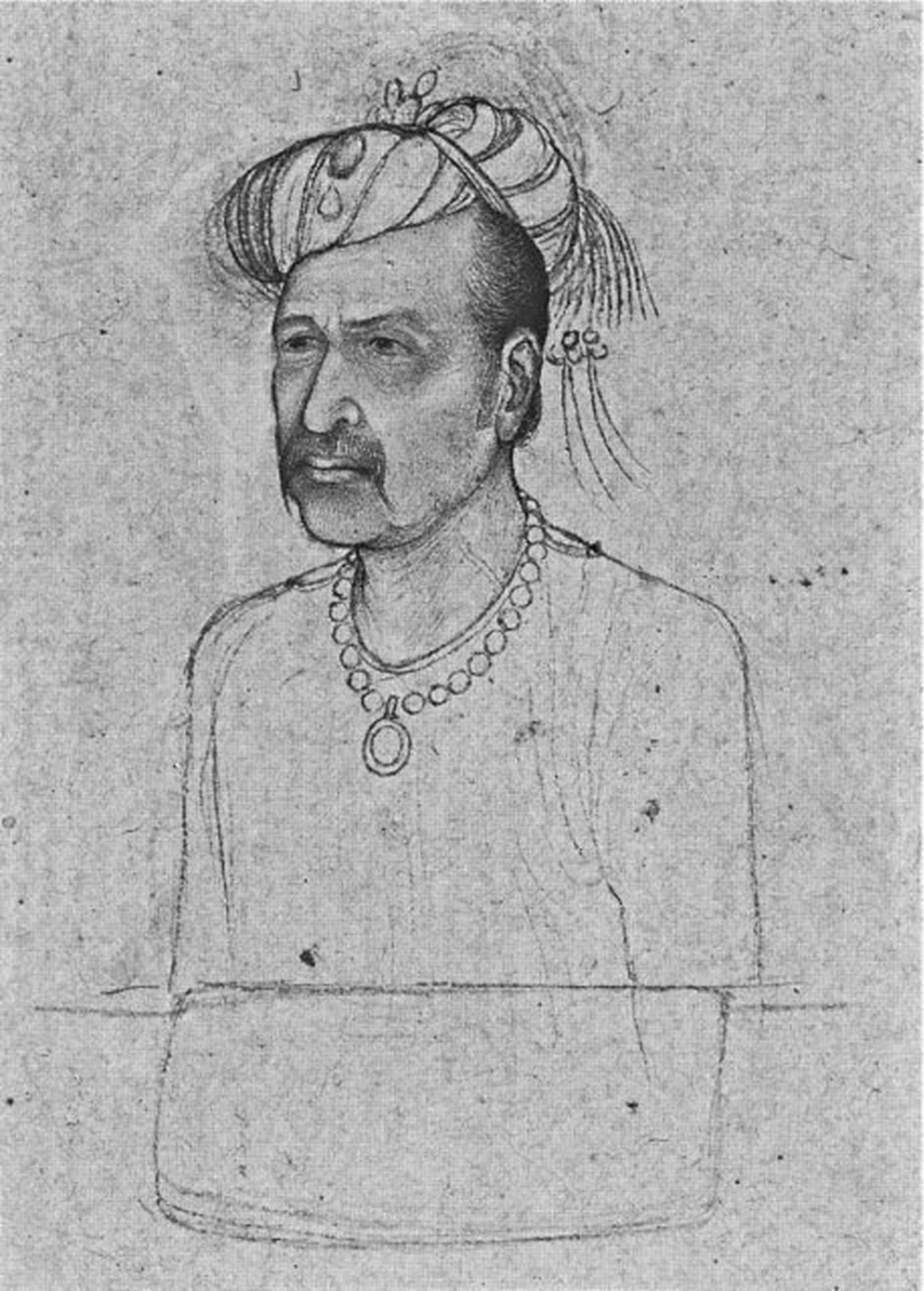
For Keyserling even a few of the qualities and interests of the Mughals were sufficient to make them exemplary rulers. He did not know, or did not choose to comment upon, other outstanding Mughal characteristics, such as their rationality and empiricism. These acquired a scientific quality in their affirmative attitude towards nature; the Mughals’ keen observation of the natural world became a feature of the dynastic personality. It began with Babur's (rul. in India 1526–30) vivid descriptions of natural phenomena, of the flora and fauna of Hindustan in his autobiography, the Baburnama.Footnote 3 And it culminated in Jahangir (rul. 1605–27) who emerges from his own Jahangirnama, virtue of his observations and the investigations and experiments he describes there, as an acknowledged naturalist if ever one sat on a throne (Fig. 1).Footnote 4
Portrait of Jahangir, attributed to Hashim, ca. 1620, courtesy of the British Museum, London.

Francis Bacon's concept of the ruler as an investigator of nature
Three hundred years before Keyserling in Europe, Jahangir's kingly involvement with nature would have not have gone unnoticed. It fitted perfectly with what Sir Francis Bacon (1561–1626), politician (Lord Chancellor of England under James I [1566–1625]), natural philosopher and writer of an utopia, expected of a king. Bacon postulated that the boundaries of ancient learning should be surpassed and advocated an inductive methodology for scientific inquiry which implied drawing knowledge from the natural world through experimentation, observation and the testing of hypotheses. For Bacon science was applied science and he claimed that rulership also would benefit from it. In the early modern period the concept of rulership began to change and the claims to power could no more be based solely on salvation history and divine right to rule. Many thinkers tried to gain influence on worldly power, and a distinct voice was Bacon's. In his The Advancement of Learning (1605) he reflects on the advantage which politics can draw from science and learning, and to bolster up his thesis, he adduces the biblical King Solomon. Solomon for Bacon is not only the just and wise ruler but also an investigator of nature, able “to compile a natural history of all verdure, from the cedar upon the mountain to the moss upon the wall ( . . . ) and also of all things that breathe or move”.Footnote 5 The saying of Solomon which Bacon cites: “The glory of God is to conceal a thing but the glory of the king is to find it out”. (Proverbs, 25,2)Footnote 6 becomes according to Rauschenberg “die Handlungsmaxime (the maxim of action) for all kings”.Footnote 7 When the king finds out about nature he fulfils the task which God has given him. In accordance with this postulate the wise king Solamana (patterned on Solomon), in Bacon's utopia New Atlantis (written probably in 1624, published in 1627) is not only a law-giverFootnote 8 but a founder of the Society of Salomon's House, an institution “dedicated to the works and creatures of God”,Footnote 9 “for the finding out of the true nature of all things”.Footnote 10 And Bacon directly exhorts his king James I in his introduction to The Great Instauration Footnote 11 to become a true and complete second Solomon — and thus an ideal king — by ordering the compilation of a Historia Naturalis et Experimentalis, a natural history:
Lastly, I have a request to make – a request no way unworthy of your Majesty, and which especially concerns the work at hand, namely that you who resembles Solomon in so many things – in the gravity of your judgments, in the peacefulness of your reign, in the largeness of your heart, in the noble variety of the books which you have composed – would further follow his [Solomon's] example in taking [giving] order for collecting and perfecting of a Natural and Experimental History (Historiam Naturalem et Experimentalem), true and severe [accurate] (unincumbered with literature and book-learning), such as philosophy may be built upon – such, in fact, as I shall in its proper place describe: that so at length, after a lapse of so many ages, philosophy and the science may no longer float in air, but rest on solid foundation of experience of every kind, and the same well examined and weighed. I have provided the machine, but the stuff must be gathered from the facts of nature. May God Almighty long preserve your Majesty.Footnote 12
The advantage for Bacon in the combination of rulership and learning is obvious, because “if they [the rulers]be illuminate by learning they have those notions of religion, policy and morality, which do preserve them and refrain them from all ruinous and peremptory errors and excesses”.Footnote 13 The ruler who is enlightened and empowered by learning and scientific research becomes able to understand the nature of things in general and to foresee the development of affairs and thus remains in control. Bacon brings political and scientific thinking together.Footnote 14
Jahangir as Naturalist
I have laid out Bacon's ideas in some detail because it is quite surprising how much of what he requests a ruler to be fits the Mughal padshah or Emperor Nur ud-Din Jahangir. Our best textual source on Jahangir is Jahangir himself in his Jahangirnama, his autobiography in which he reveals his multi-faceted persona as a sovereign, naturalist, hunter, aesthete, patron of the arts and collector. The importance and complexity of this text begins only now to be fully understood by modern historians.Footnote 15 Jahangir has indeed been something of a Cinderella of text–based Mughal historical studies because the focus of Mughal historians has been on Akbar's (rul. 1556–1605) and Aurangzeb's reign (rul. 1658–1707).Footnote 16 This is especially true of the dominant Aligarh school led by Irfan Habib. The Aligarh scholars, moreover, have concentrated on economic and administrative issues and have viewed cultural and social studies (including art history) with reserve; thus some of the richest contributions of the Mughals are still insufficiently understood.
While modern historiography has neglected Jahangir, the scientists and art historians have not. They paid attention to the Mughal padshah, and this has even led to something like an interdisciplinary discourse.
Scientists have explored the Jahangirnama for its observations on biology, botany, geology, ornithology, and zoology.Footnote 17 Jahangir's description of the breeding habits of the saras crane (Grus antigone), for instance, and the study by one of his painters of the now extinct Mauritius dodo (Raphus cucullatus L.) have become part of the ornithological literature. I shall come back to this later.
And art historians have analysed how Jahangir directed his artists to turn his observations of natural phenomena into nature studies.Footnote 18 Art historians have also undertaken what historians have largely omitted, they have studied Jahangir's concept of rulership by basing their observations on visual sources, especially the emperor's famous political allegories.Footnote 19
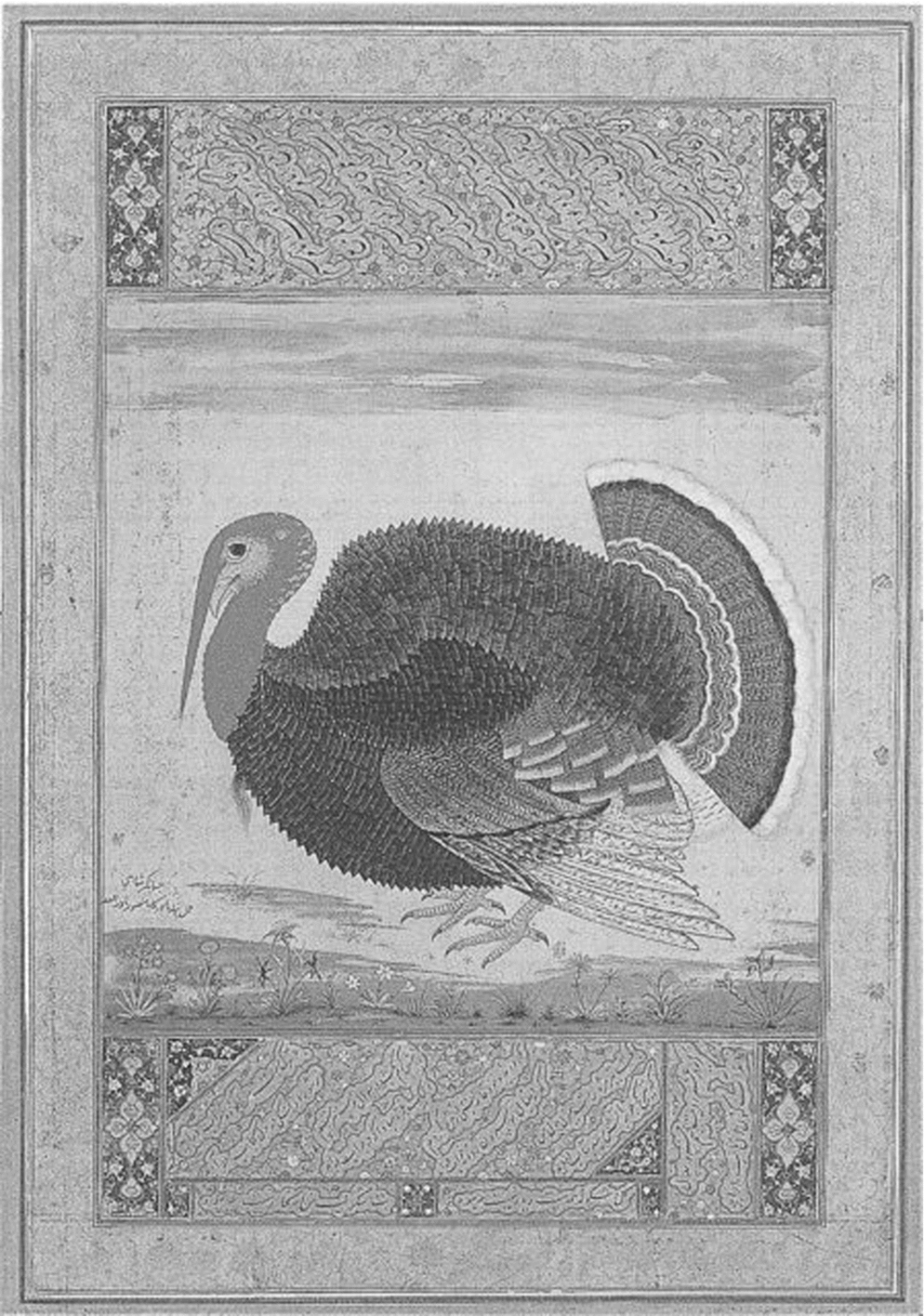
This interdisciplinary discourse between natural scientists and art historians is brought about by Jahangir himself – he explains the advantages of a combined method, written and visual, in representing natural phenomena, and sees in it an improvement of his ancestor Babur's approach. He reflects about it in March 1612 in the Jahangirnama, when Muqarrab Khan brought a turkey cock and a monkey to the court. Jahangir had placed the high ranking noble as his agent at Goa to purchase rare objects and exotic animals, with no expense to be spared (the Mughals looked at Goa for their purchases, like European princely collectors — only from the other direction).Footnote 20 The emperor writes:
He [that is Muqarrab Khan] had brought several very strange and unusual animals I had not seen before. No one even knew what their names were. Although His Majesty Firdaws-Makani [Babur] wrote in his memoirs of the shapes and forms of some animals, apparently he did not order the artists to depict them. Since these animals looked so extremely strange to me, I both wrote of them [described them] and ordered the artists to draw their likeness in the Jahangirnama so that the astonishment one has at hearing of them would increase by seeing them. One of the animals was larger in body than a peahen and significantly smaller than a peacock. Sometimes when it displays itself during mating it spreads its tail and its other feathers like a peacock and dances. Its beak and legs are like a rooster's. Its head, neck, and wattle constantly change color [sic]. When it is mating they are as red as can be—you'd think it all had been set with coral. After a while these same places become white and look like cotton. Sometimes they look turquoise. It keeps changing color like a chameleon. The piece of flesh it has on its head resembles a cock's comb. The strange part about it is that when it is mating, the piece of flesh hangs down a span from its head like an elephant's trunk, but then when it pulls it up it stands erect a distance of two fingers like a rhinoceros’ horn. The area around its eyes is always turquoise-colored and never changes. Its feathers appear to be of different colors, unlike a peacock's feathers (Then follows a detailed description of the monkey).Footnote 21
This patient and exact observation of a bird is not something one would expect from the pen of a Mughal emperor, even less in his autobiography. Jahangir shows himself with this and other entries into the Jahangirnama as a naturalist of first rank, and impresses us the more, both because he is, but for his ancestor Babur's precedent, self taught, and because he pursues his interest out of his own initiative. It is fortuitous that the painting of the turkey cock has survived to match the description and it testifies to the artistic quality and accurate detail of the natural history illustration created for Jahangir (Fig. 2).
A turkey cock signed by Mansur, ca. 1612, opaque water colour on paper, image area 12.9 ×12. cm, by courtesy of the Trustees, Victoria and Albert Museum, I. M. 135–1921 bequeathed by Lady Wantage.

We may ask then, how did Jahangir's painters arrive at what was so important to their imperial patron, namely depicting animals and plants in an exact manner, so that from description and depiction a full representation of the natural phenomenon could be obtained?
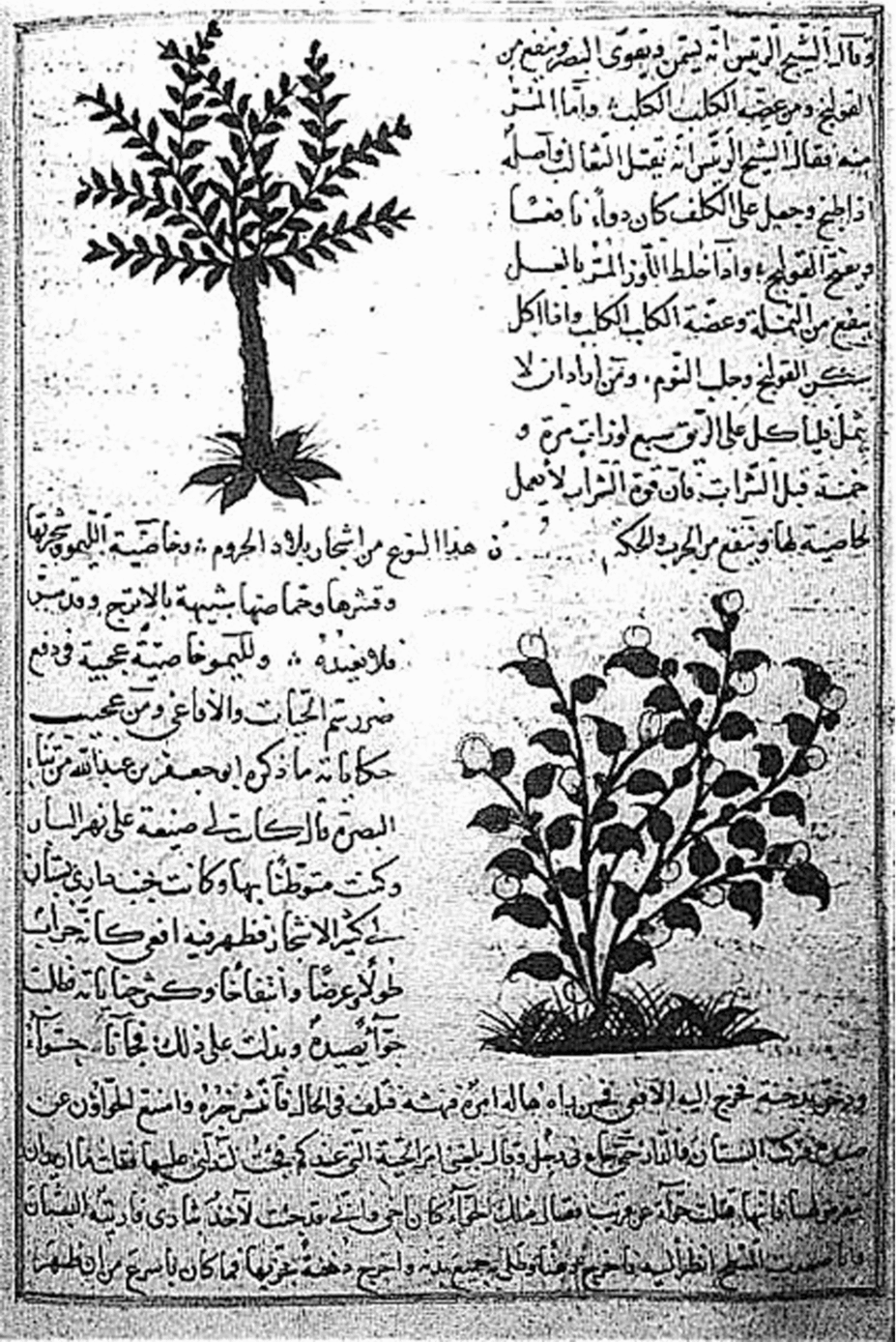
In the Islamic world natural history illustration, of elementary importance in the early periods, had, by the time of Jahangir, lost its life and scientific relevance, perpetuated in stereotyped illustrations of classical works of science, especially Arabic and Persian translations of Dioscorides’ (ca 40 – 90 A. D.) De materia medica, or of Qazwini’ s (1203–82) ever popular cosmography, the ʿAja'ib al-makhluqat Footnote 22 (Fig. 3). Further in pre-Mughal India no suitable models were available which satisfied the Mughals’ understanding of nature.Footnote 23 Already in Akbari painting we discern the attempt to render the flora and fauna of Hindustan with more naturalism than in Persian, Timurid or in Deccani painting by looking at European models,Footnote 24 and in their endeavour to raise this naturalistic trend to a scientific level Jahangir and his artists turned to European scientific illustration.
Almond tree (9.8 × 6.7 cm) and lemon tree (9 × 7.5 cm), from al-Qazwini, ʿAja'ib al-makhluqat wa ghara'ib al-maujudat (The Wonders of Creation and the Marvels of Existence), copied ca 1640 from a Timurid manuscript, The New York Public Library, Spencer, Pers. ms. 45, fol. 88b (after B. Schmitz 1992).

Emperor Rudolf II as Leading Patron of Natural Research andIllustration in Europe
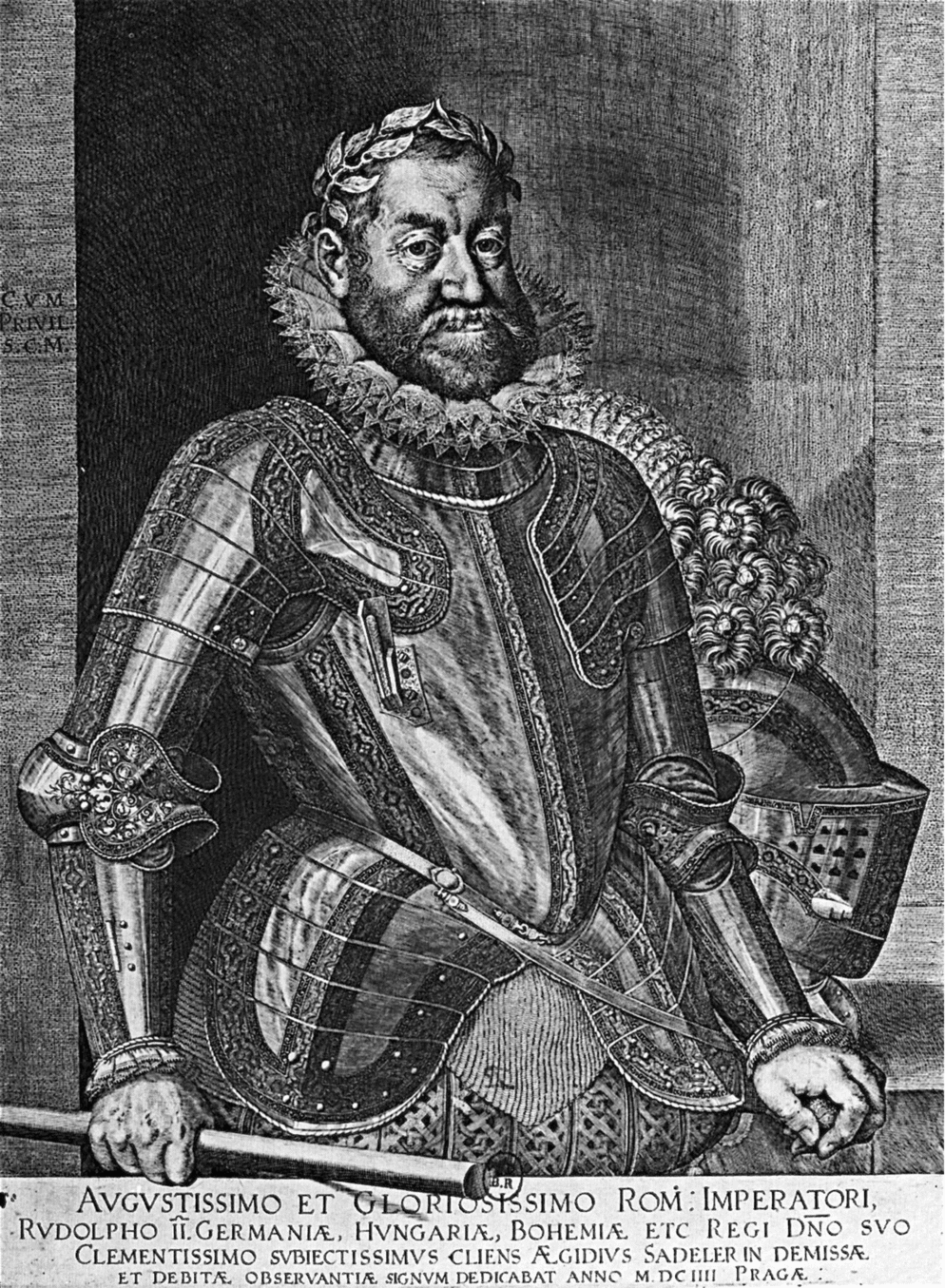
In Europe scientific research and illustration had been on the rise throughout the sixteenth century, freeing itself from the refraining impositions of the Catholic church and finding sponsorship from European courts, most notably the court of the Medici at Florence,Footnote 25 the Munich court of the Bavarian Dukes (Duke Albrecht V and Duke Wilhelm V), and the court of the Holy Roman Emperor at Vienna and Prague. The shining figure here is Emperor Rudolf II (rul. 1576 – 1612),Footnote 26 almost a contemporary of Jahangir and in many ways a kindred mind (Fig. 4). Rudolf II brought the naturalistic, scientific and artistic interests of the Habsburgs to an apogee. He was preceded by his uncle Archduke Ferdinand II (1529–95), ruler of Bohemia at Prague, and after that in charge of Tyrol and Further Austria; and by his father, Emperor Maximilan II (ruled 1562 – 1576), both nephews of Charles V.
Portrait of Rudolf II, engraving after Hans von Aachen, 1604, Bibliothèque Nationale, Paris.

Maximilian II had a special interest in botany and zoology and drew the distinguished Netherlandish naturalists and physicians Charles d'Écluse (Carolus Clusius) (1526–1609) and Rembert Dodoens (Rembertus Dodoneus) (1517–85) to Vienna (they were also to work for Rudolf at Prague) and the learned ambassador Ogier Ghislain de Busbecq who brought the first tulips and lilac from Turkey. The emperor kept rare and foreign plants and animals in his gardens and tended to them personally, and corresponded with his ambassadors to the court of Philip II of Spain (rul. 1556–98) about the acquisition of exotic flora and fauna. In 1552 the first (Indian) elephant arrived in Vienna and delighted the population; the emperor had brought it with his new bride from Spain.Footnote 27
His son and successor Rudolf II transferred his court in 1583 from Vienna to Prague where he brought together an impressive assemblage of flora and fauna and an extensive collection of nature drawings, objects and specialised instruments that would help him to pursue the knowledge of nature.Footnote 28 A deer park surrounded Hradschin Castle, with an aviary where one could see birds of paradise, and after 1598 a dodo, and there was also a botanical garden with exotic plants.Footnote 29
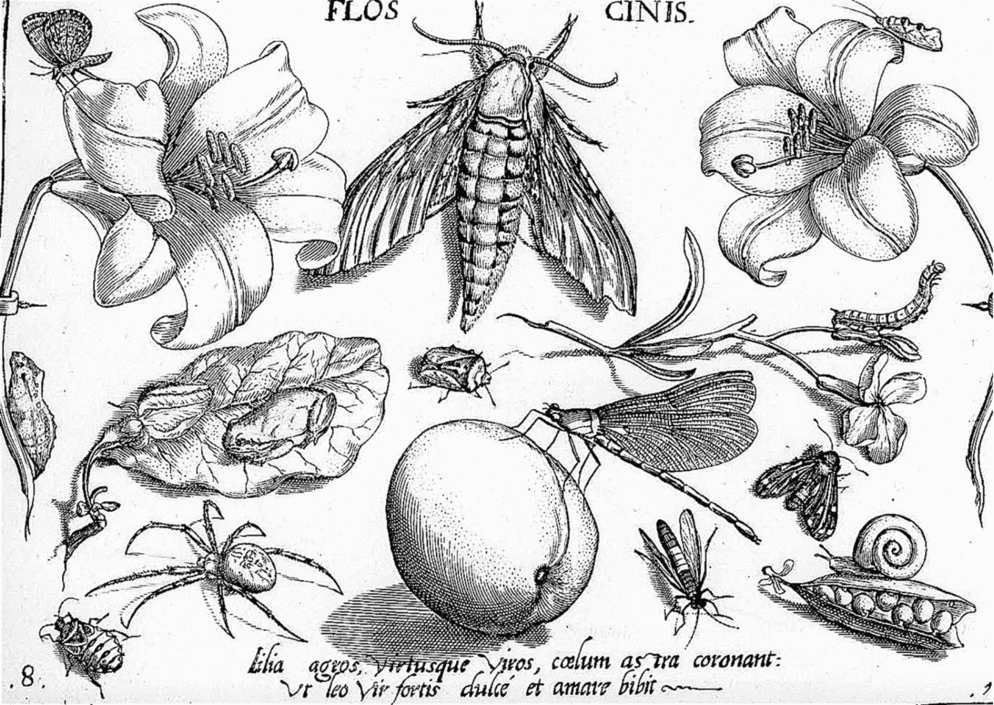
Outstanding artists were called to Prague from all over Europe to tend to Rudolf's taste for nature illustrations, among them Hans Hoffmann (born c. 1530 perhaps in Nuremberg, died between 1591 and 1592 most likely in Prague) who newly interpreted Dürer's celebrated Hare (1502) (also in the collection of Rudolf) with his own versions, such as a Hare among Plants (1585) creating for the animal “an ecological whole”;Footnote 30 the Antwerp born Joris (Georg) Hoefnagel (born 1542–1600) created the Four Elements, that is four ‘animal books’ corresponding to the four elements (dated variously to 1575, 1576, 1580 and 1582, completed 1590) “a compendium of the known world of natural history” based on prints by A. de Bruyn, Adrian Collaert, Conrad Gesner's Historia animalium, drawings by Dürer, and works by other artists.Footnote 31 Hoefnagel added between 1590–94 his celebrated nature miniatures to the Schriftmusterbuch of Georg Bocksay (completed 1594), and to Bocksay's Mira Calligraphiae Monumenta (1561–62, Hoefnagel 1596), today in the J. Paul Getty Museum.Footnote 32 Jacob Hoefnagel (1575–1630) also worked at Rudolf's court, son of the more famous Joris (Georg) who paraphrased the work of his father with his Archetypa studiaque patris Georgii Hoefnagelii (1592) (Fig. 5); Daniel Fröschl (born 1563 in Augsburg, died 1613), kaiserlicher Miniaturmaler (imperial miniature painter) who did studies of birds and compiled, between 1607 and 1611, as imperial antiquarius an inventory of the imperial collections; and Dirck de Quade van Ravesteyn (ca 1565–1619).Footnote 33 Then there were Roelandt Savery (born probably 1576 in Kortrijk/Courtrai–1639 in Utrecht) who adapted the subject matter of natural history illustration for use in oil painting,Footnote 34 and the Milan born Guiseppe Arcimboldo (1526–93) who made a fund of nature studies on the basis of which he created his famous composite heads.Footnote 35 Two impressive manuscripts with miniature paintings of animal studies and Kunstkammer objects, the so called Museum of Rudolf II (completed 1611), documenting his naturalia collection, are preserved in the Austrian National Library.Footnote 36 These artists produced woodcuts and engravings of plants or animal specimens with which the scientists illustrated their works.
Flos cinis, Jacob Hoefnagel, Archetypa studiaque patris Georgii Hoefnagelii, Frankfurt a. M. 1592.

Rudolf's patronage of nature studies and illustrations were part of his larger interests. His galleries at Hradschin Castle housed several thousand paintings and equally vast numbers of sculptures, coins, vases, gems, natural rarities, precious medicines, scientific instruments, clocks, books and other curiosities that represented the imperial Kunstkammer. In the last decade of his reign, Rudolf epitomised, as Paula Findlen pointed out, the image of the learned monarch who created and consumed all forms of knowledge. Francis Bacon, had he ever made the voyage from London to Prague, would have found here a ruler much to his liking,Footnote 37 though he would have disapproved of Rudolf's passion for alchemy.Footnote 38
Habsburg control reached into Germany, the Netherlands, Flanders, Spain and Portugal and from there overseas, into the Estado da India with its capital Goa. Scholars and artists patronised by the Habsburgs moved also to other courts and cities of Europe.Footnote 39 It was a time of intense artistic exchange and free flow of ideas, which, through religious, commercial and political connections, extended beyond Europe. In this way European nature illustration also reached Mughal India.
Europeanising nature illustration under Jahangir
Robert Skelton and Vivian Rich have shown that Mughal artists based studies of flowers and plants, including those which were native to their own environment, on the illustrations of the great European scientific plant books.Footnote 40 Mughal nature studies belong to the genre of miniature painting, small pictures painted in opaque water colour on paper, conceived as illustrations of books or to be pasted in an album. On the album page a painting or a collage of several paintings would be typically be surrounded by a calligraphic frame, made of verses or text (not necessarily related to the painting) and a wider ornamental margin.
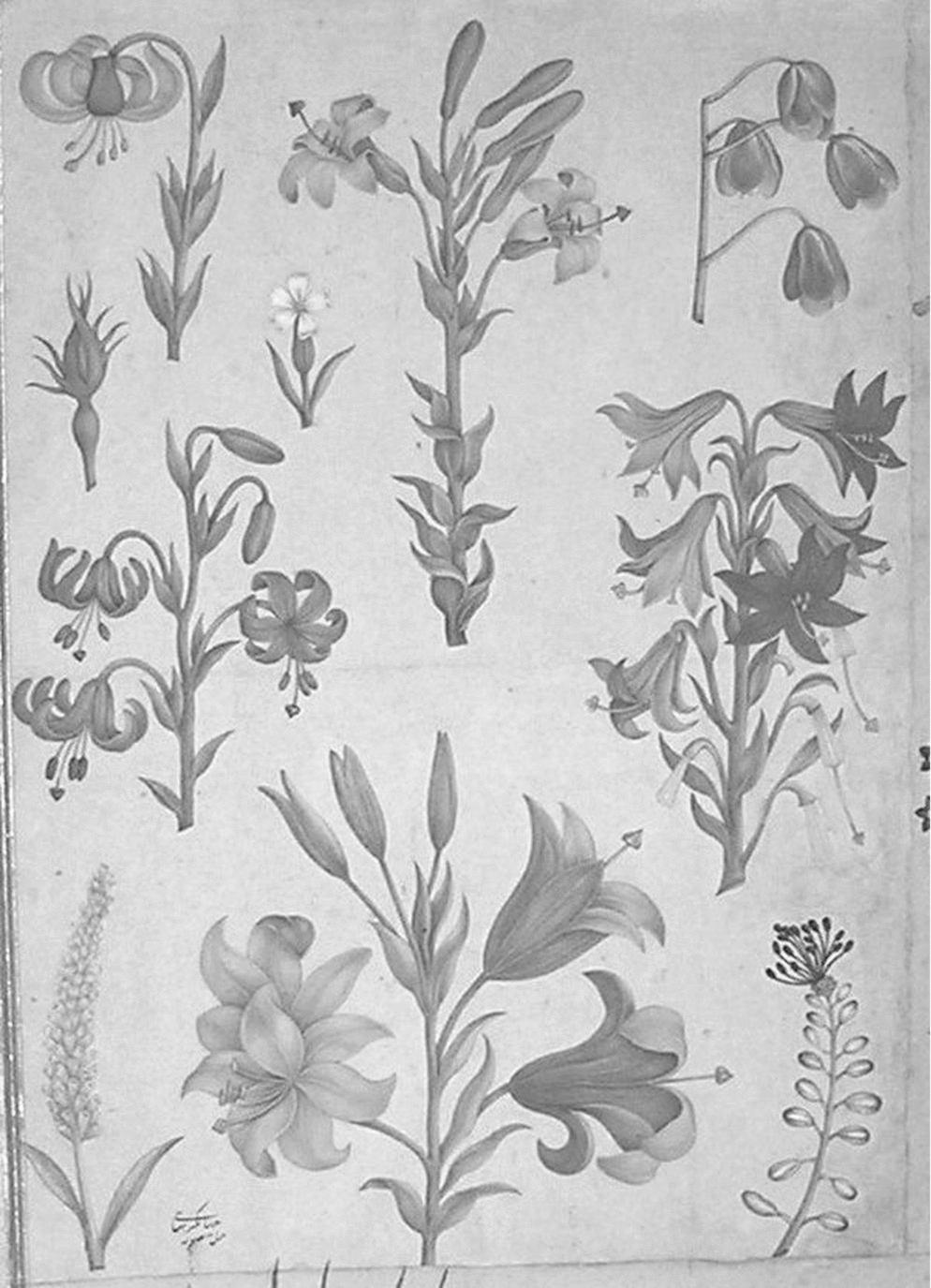
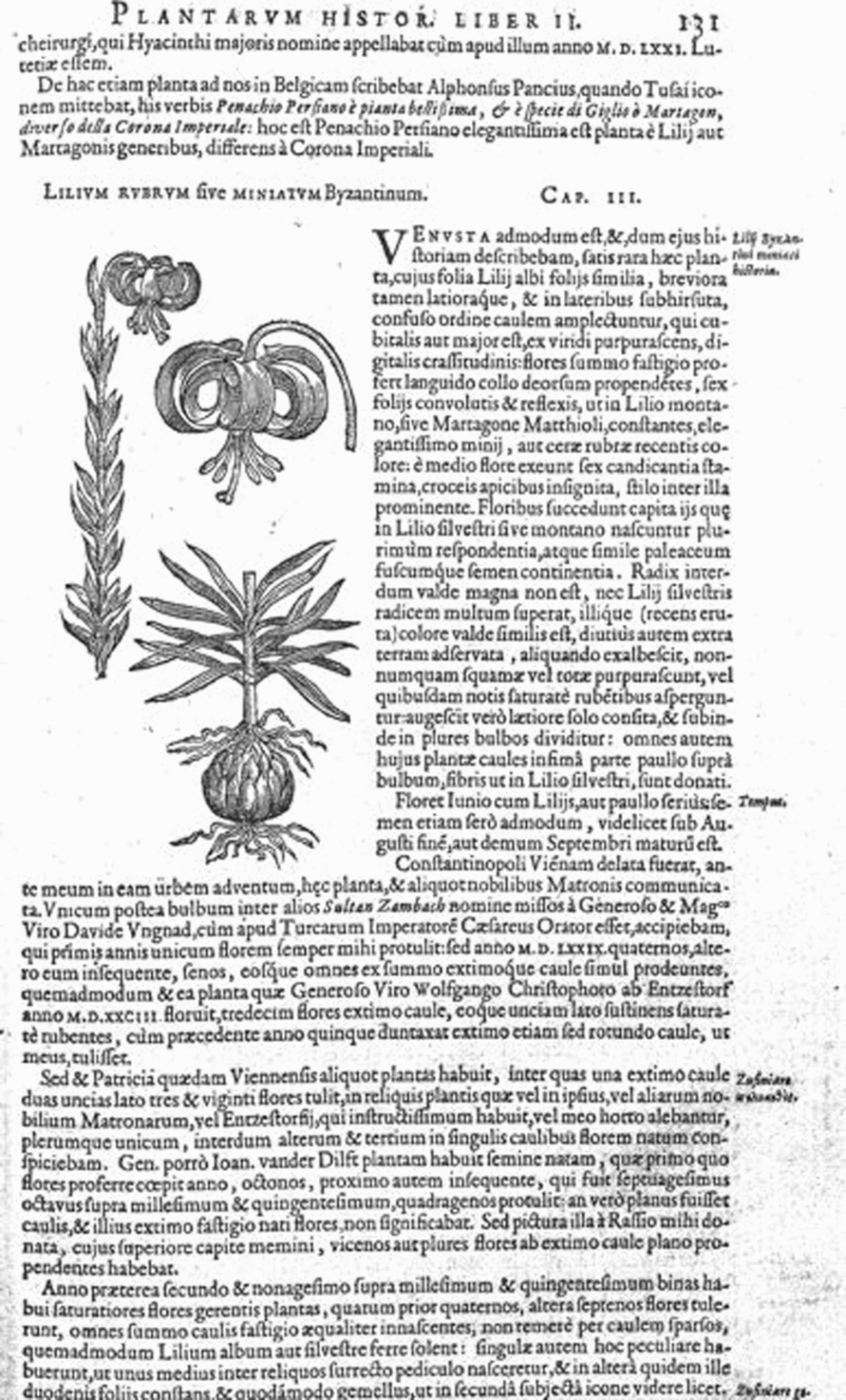
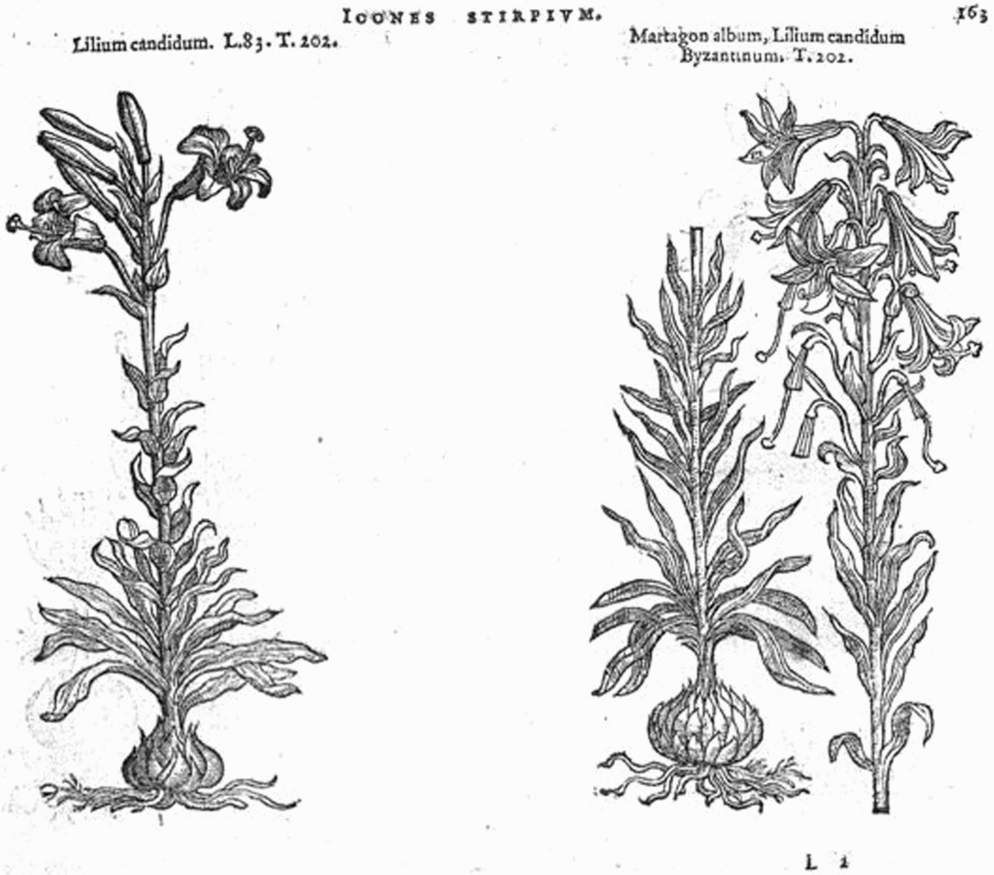
A key image of Mughal floral illustration by ustad Mansur is inserted in Jahangir's great album, a major part of which is kept today under the name Gulshan album in the Gulistan Library at Tehran (Fig. 6).Footnote 41 Mansur's page, signed camal-i Mansur Jahangir Shahi (work of Mansur [servant] of King Jahangir), shows a compendium of different kind of flowers, mainly lilies, copied in reverse from various works and rendered in colour.Footnote 42 The models of Mansur's lilies were woodcuts based on drawings by Pieter van der Borcht and they illustrated the plant books of Carolus Clusius (Charles de l'Écluse), Rariorum aliquot stirpium per Hispanias observatarum historia libris duobus expressa (Antwerp: Plantin, 1576); idem, Rariorum aliquot stirpium per Pannoniam, Austriam et vicinas quasdam provincias observatarum historia, quatuor libris expressa (Antwerp: Plantin, 1583), idem, Rariorum plantarum historia (Antwerp: Plantin, 1601) (Fig. 7); Mathaeus Lobelius (Mathias de l'Obel), Plantarum seu stirpium historia (Antwerp: Plantin, 1576), Kruydsboechk (Antwerp: Plantin, 1581); idem, Plantarum seu stirpium icones (Antwerp: Plantin, 1581); idem, Icones stirpium seu plantarum tam exoticarum, quam indigenarum, in gratiam rei herbariae studiosorum in duas partes digestae (Antwerp: Plantin, 1591)(Fig. 8); and Rembertus Dodonaeus, Stirpium historiae pemptades sex; . . . (Antwerp: Plantin, 1576, 1583 and 1616).Footnote 43
Lilies and other flowers, signed by Mansur, ca. 1610. Opaque water colour on paper, Gulshan album, detail of album page. Gulistan Palace Library, Tehran, No. 1663, p. 103 (Photo Ebba Koch).

Lilium rubrum from Carolus Clusius (Charles de l'Écluse), Rariorum plantarum historia, Antwerp, 1601.

Lilium candidum and Martagon album from Mathaeus Lobelius (Mathias de l'Obel), Icones stirpium . . ., Antwerp, 1591.

Clusius and Dodonaeus were sponsored by Maximilan II and Rudolf II; Lobelius (1538–1616) was the physician and botanist of James I of England. Their works were printed by Christophe Plantin in Antwerp and his principal artist Pieter van der Borcht did most of the illustrations. The renowned publisher had also brought out the famous Polyglot Bible (1568–72) with the support of Philip II of Spain (and since 1580 of Portugal as well), which the first Jesuit Mission had brought via Goa to the court of Akbar in 1580, and its illustrations had a great impact on Mughal art.Footnote 44
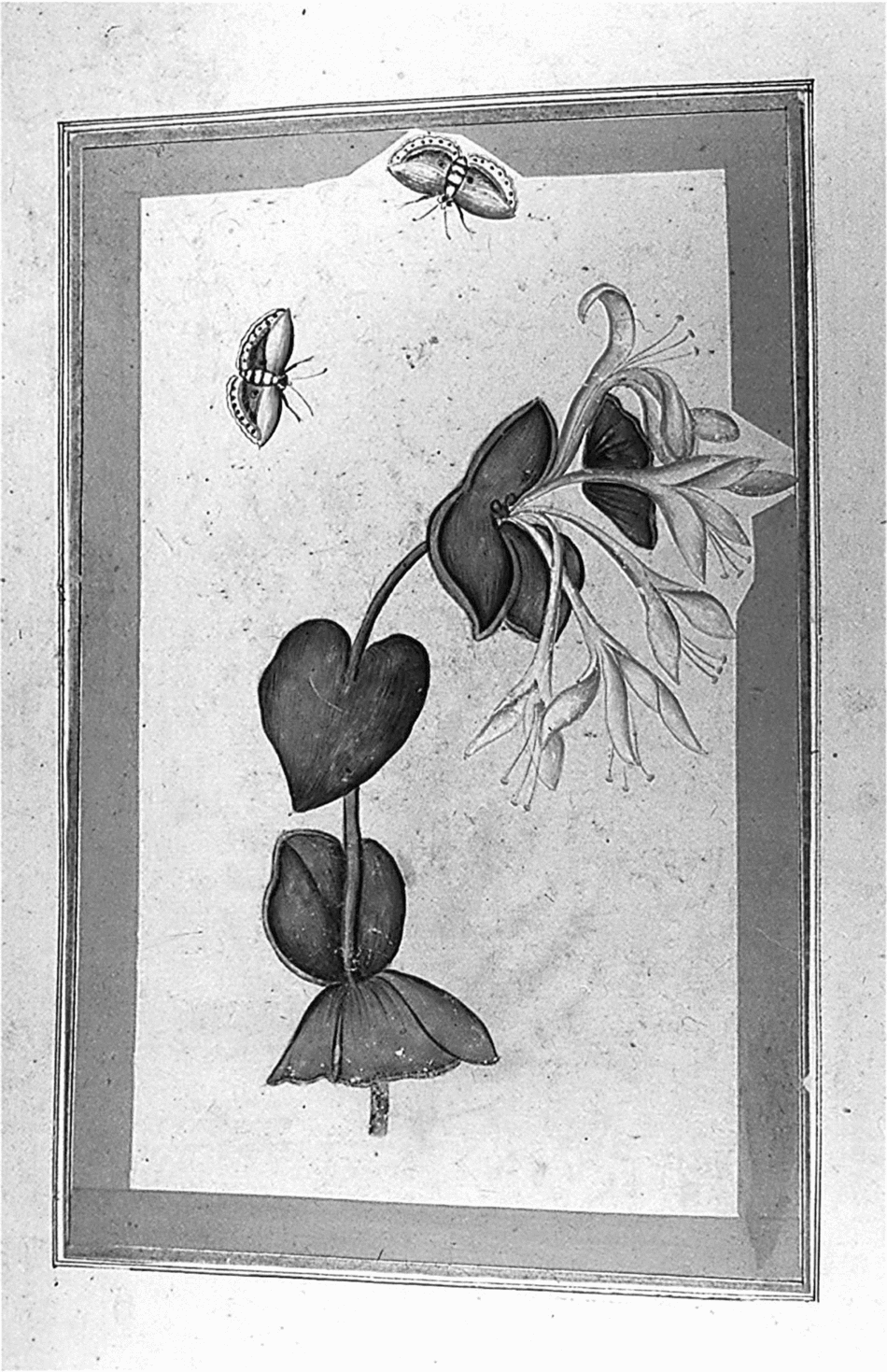
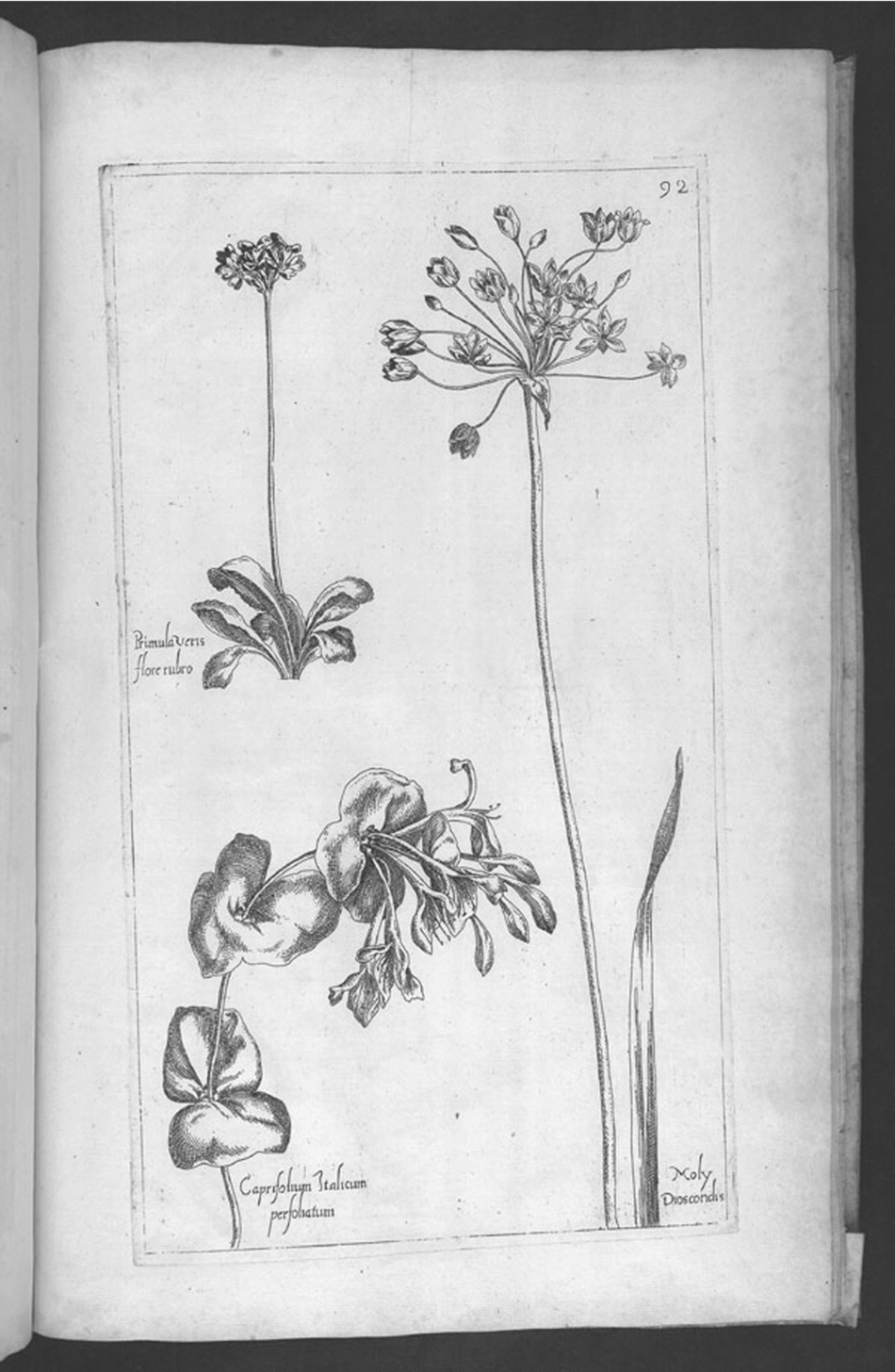
Another instance of the use of European plant models is in the flower studies of the so called Small Clive Album of the Victoria & Albert Museum, London (late seventeenth or eighteenth century) (Fig. 9). Several are copied from the French florilegium of Pierre Vallet, Le Jardin du Roi très Chretien Henry IV (Paris, 1608; second enlarged edition Roi très Chretien Louis XIII, 1623) (Fig. 10).Footnote 45
Flower, opaque water colour on paper, Small Clive album, by courtesy of the Trustees, Victoria and Albert Museum, London, I. S. 48–1956, fol. 39 (Photo Ebba Koch).

Caprifolium italicum perfoliatum (a type of honeysuckle) from Pierre Vallet. Le jardin du Roy (1623), p. 92.

Since Jahangir's involvement in nature went hand in hand with his highly developed sense of aesthetics, he put his most outstanding masters to the task; the specialists trained for nature studies were the already mentioned ustad Mansur, Nadir al-Asr, the Wonder of the Age, and Abu'l Hasan or Nadir az-Zaman also meaning Wonder of the Age, as the emperor had titled them.Footnote 46 The resulting paintings emerge as exact natural history drawings which, in their best moments, are compelling works of art.
The Mughal artists did not only copy flowers of European herbals. They adopted from the herbals’ system the composition in the rendering of a flower, the use of front and side views of the blossoms, the progression from bud to full blossom to withered bloom on one plant, and the arrangement of the blossoms to display the botanical details of stamen and carpels. This was combined with a sense of movement in the petals, leaves and stems which was also typical of herbal illustration of the period.Footnote 47
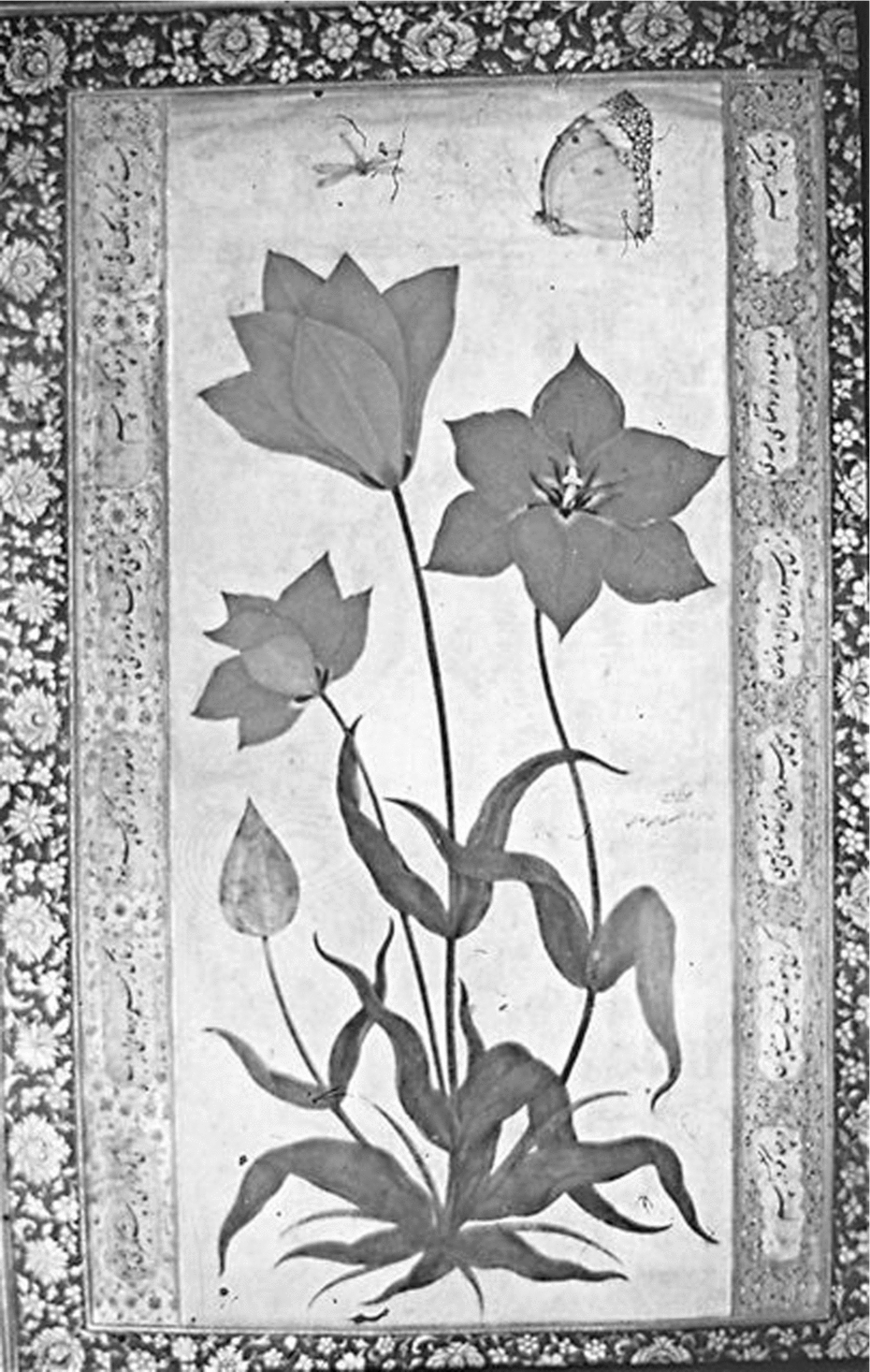
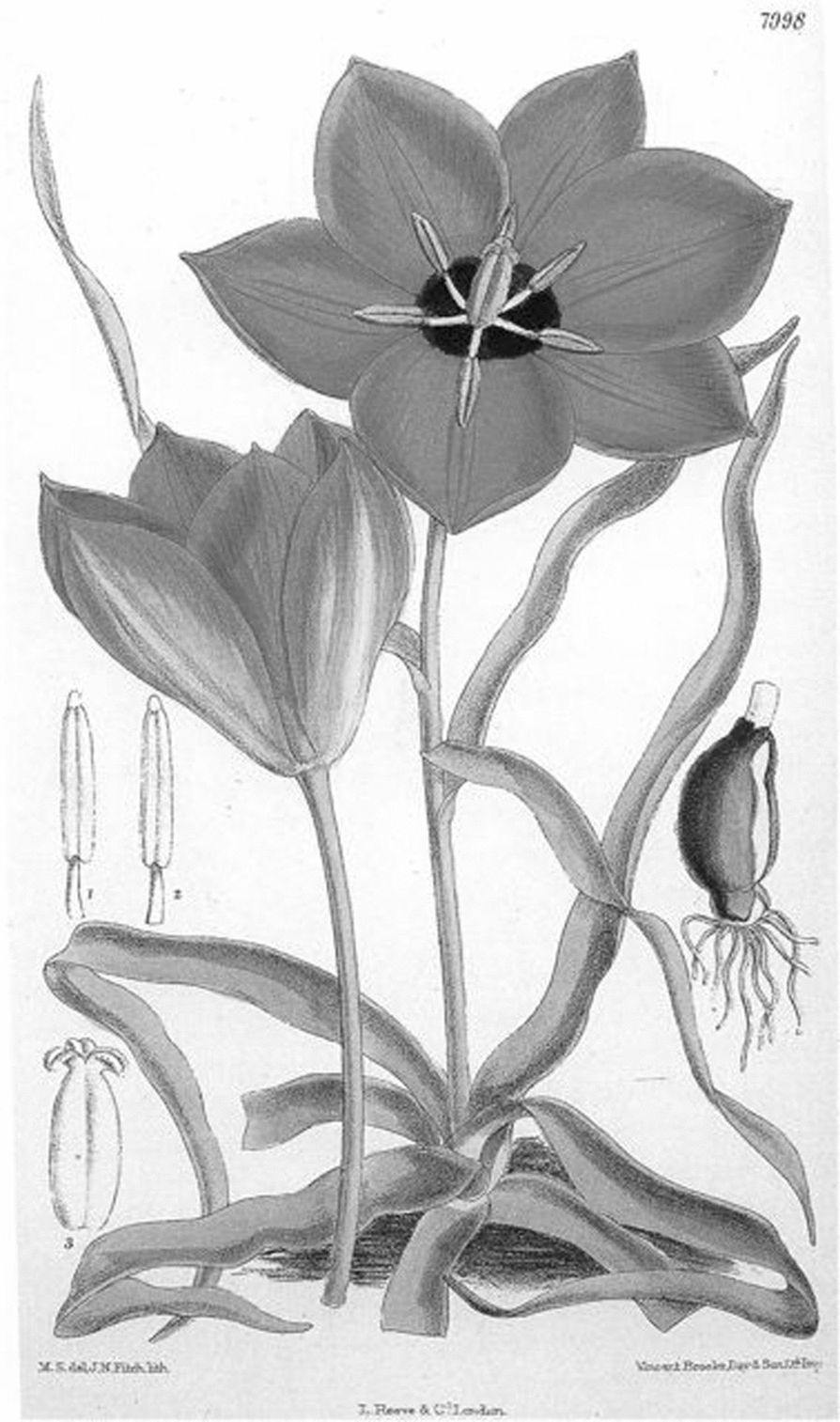
On the basis of this principle, of representing a plant native to India according to the European herbal style, ustad Mansur's famous Tulips, c. 1620, at the Maulana Azad Library, Aligarh Muslim University, could possibly be the earliest botanical illustration of Tulipa linifolia Regel 1884 (Fig. 11).Footnote 48 It grows in western Central Asia, reaching into the Himalayas in Kashmir and North India, Mansur renders correctly the undulating leaves, and the broad glowing red petals that abruptly contract to a fine point and curve outward, all characteristic of the species. In Europe Tulipa linifolia Regel was only described at the end of the nineteenth century by Eduard August Regel (1815–1892), since 1855 Director of the Imperial Gardens of St Petersburg, who expanded botanical knowledge towards the regions of the Caucasus and Central Asia. One of the early botanical illustrations by an anonymous artist from Curtis Botanical Magazine (1905) shows a striking resemblance to the tulips of Mansur (Fig. 12).Footnote 49 It is uncertain whether the artist knew Mansur's image but it shows in retrospect how close the Mughal artist was to a western scientific representation of a plant so far unrecorded, and how he turned it into a striking work of art.
Tulips, signed by Mansur, c. 1620, opaque water colour on paper, Maulana Azad Library, Aligarh Muslim University, Aligarh (Photo Ebba Koch).

Tulipa linifolia Regel 1884 from Curtis Botanical Magazine, 1905.

Another favourite of the Mughals was Fritillaria imperialis, or crown imperial. Jahangir described one he saw during a trip to Kashmir in March 1620, and in this context, also comments on the problem of methodology in assessing his material:
There was one strange flower in particular with an odd shape. It had five or six orange-coloured flowers blooming with their heads down, and several leaves were poking out from inside the flowers. It was something like a pineapple [he means obviously the topping crown of leaves] ( . . . ). The flowers of Kashmir are beyond counting or enumeration. Which ones shall I write about? How many can one write about? Only those that are really special can be recorded.Footnote 50
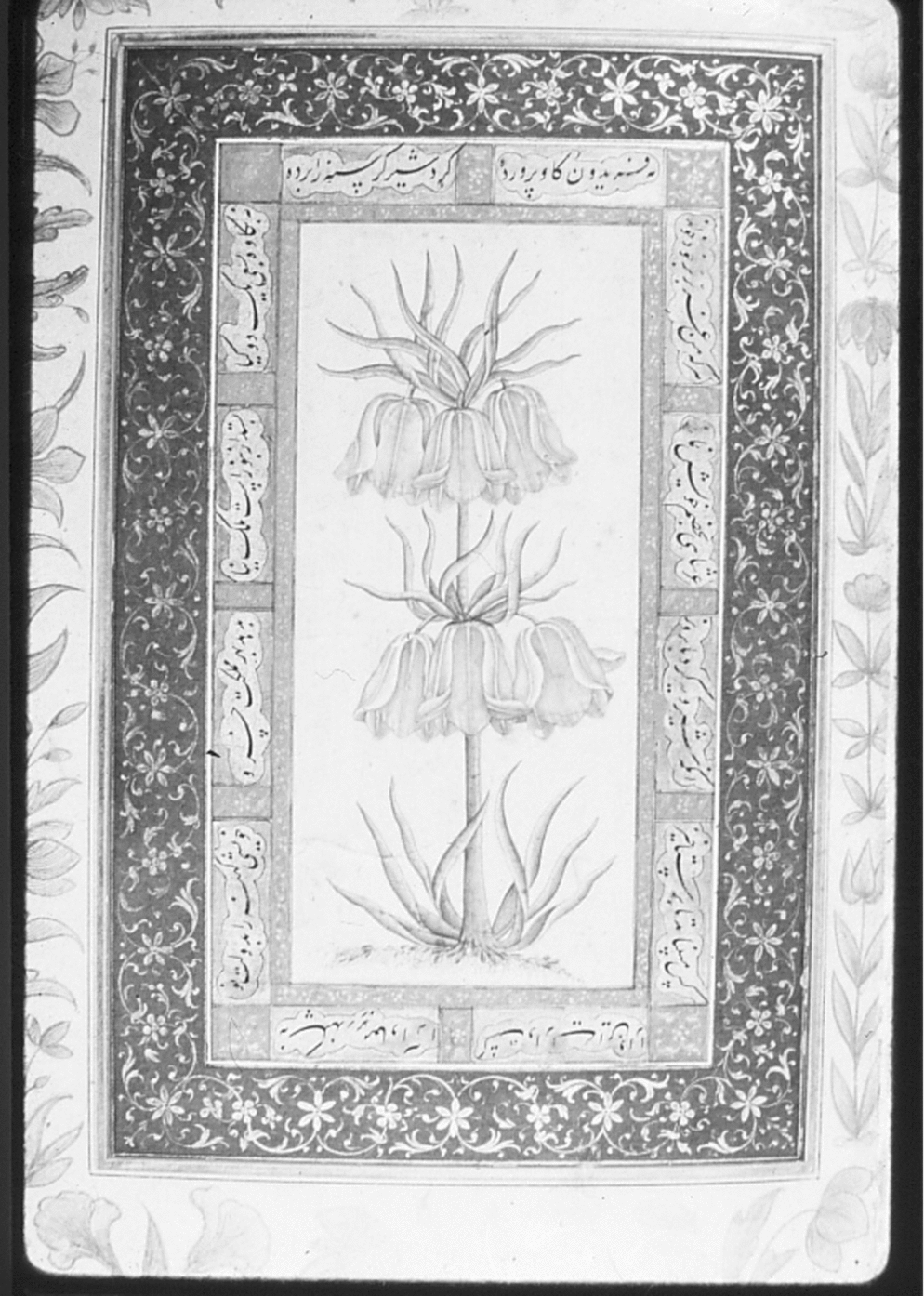
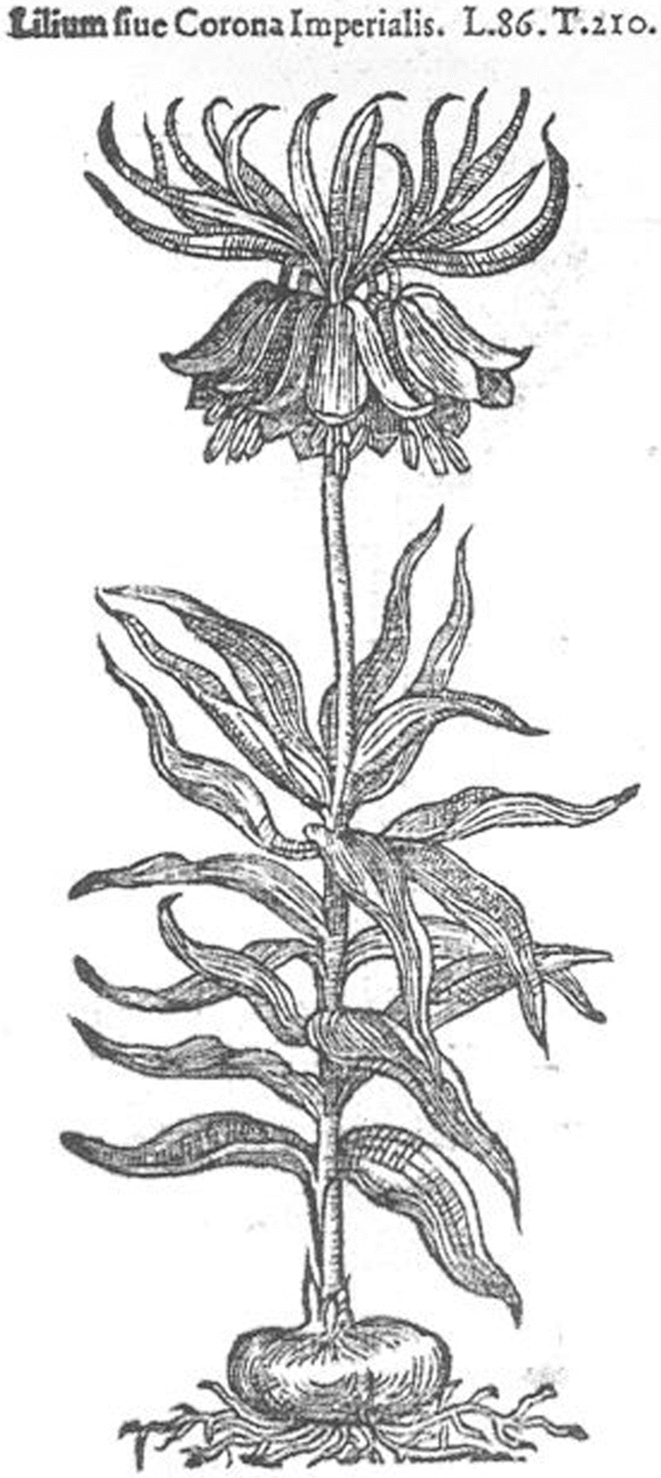
No image by any of Jahangir's painters is preserved to match this description but a doubled tiered Fritillaria imperalis appears later in the Dara Shikoh Album, British Library, assembled between circa 1633–42 (Fig. 13).Footnote 51 The fleshy rendering of its stem, leaves and blossoms is close to European botanical representation (Fig. 14), only its colour is altered to a somewhat unrealistic pink which was in line with the new ‘Shahjahani’ trend of subjecting botanical correctness to artistic alienation.Footnote 52
Fritillaria imperialis (double tiered), Dara Shikoh Album, 1641–42, opaque water colour on paper, c. 1635, British Library Add. Or. 3129, fol. 62a, London

Tusai or Lilium persicum (single tiered) from Carolus Clusius (Charles de l'Écluse), Rariorum plantarum historia, Antwerp, 1601.

Besides flowers, Jahangir had a deep interest in birds. I have referred to his famous experiment of breeding saras cranes (Grus antigone) in captivity. Over an extended period from end of June to September 1618 he reports in five consecutive detailed entries in the Jahangirnama how a pair of these birds named Laila and Majnun, which he had kept for five years in his establishment and which were tended by eunuchs, began to mate, and how, after the female laid her eggs, the birds took turns sitting on them, and how they hatched the chicks and raised them.Footnote 53
It is worthwhile to cite at least some lines of Jahangir's long observation;
One day one of the eunuchs told me they had mated in his presence. . . . He came one morning at dawn and told me they were going to mate [again]. I immediately ran out to watch. The female stretched her legs straight and then bent them slightly . . . First the male lifted one of his legs off the ground and put it on her back, and then the other. The instant he was seated on her back they mated. Then he got down, stretched out his neck, put his beak on the ground, and circled once around the female. It is possible that they have produced an egg and young will be brought forth.Footnote 54
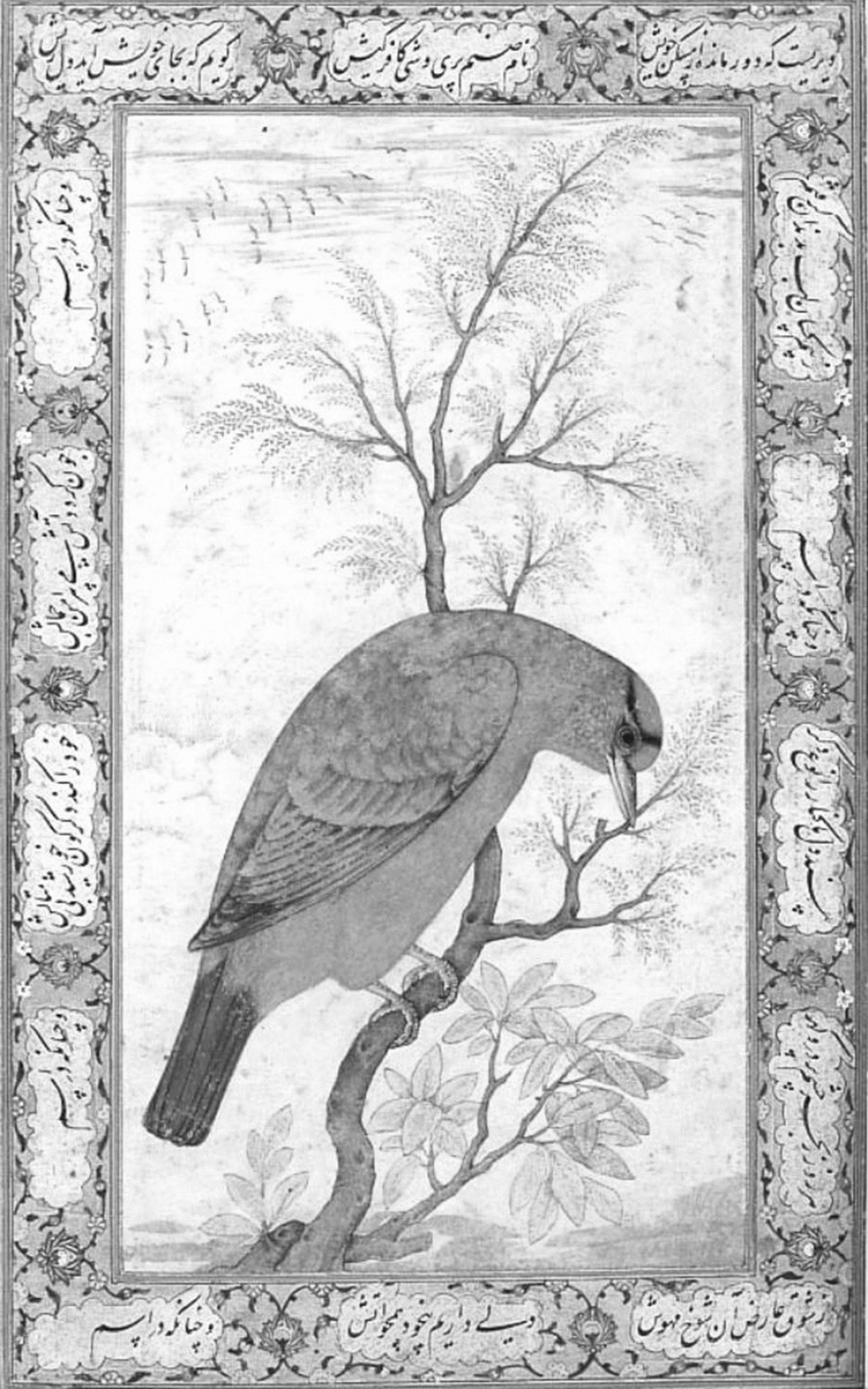
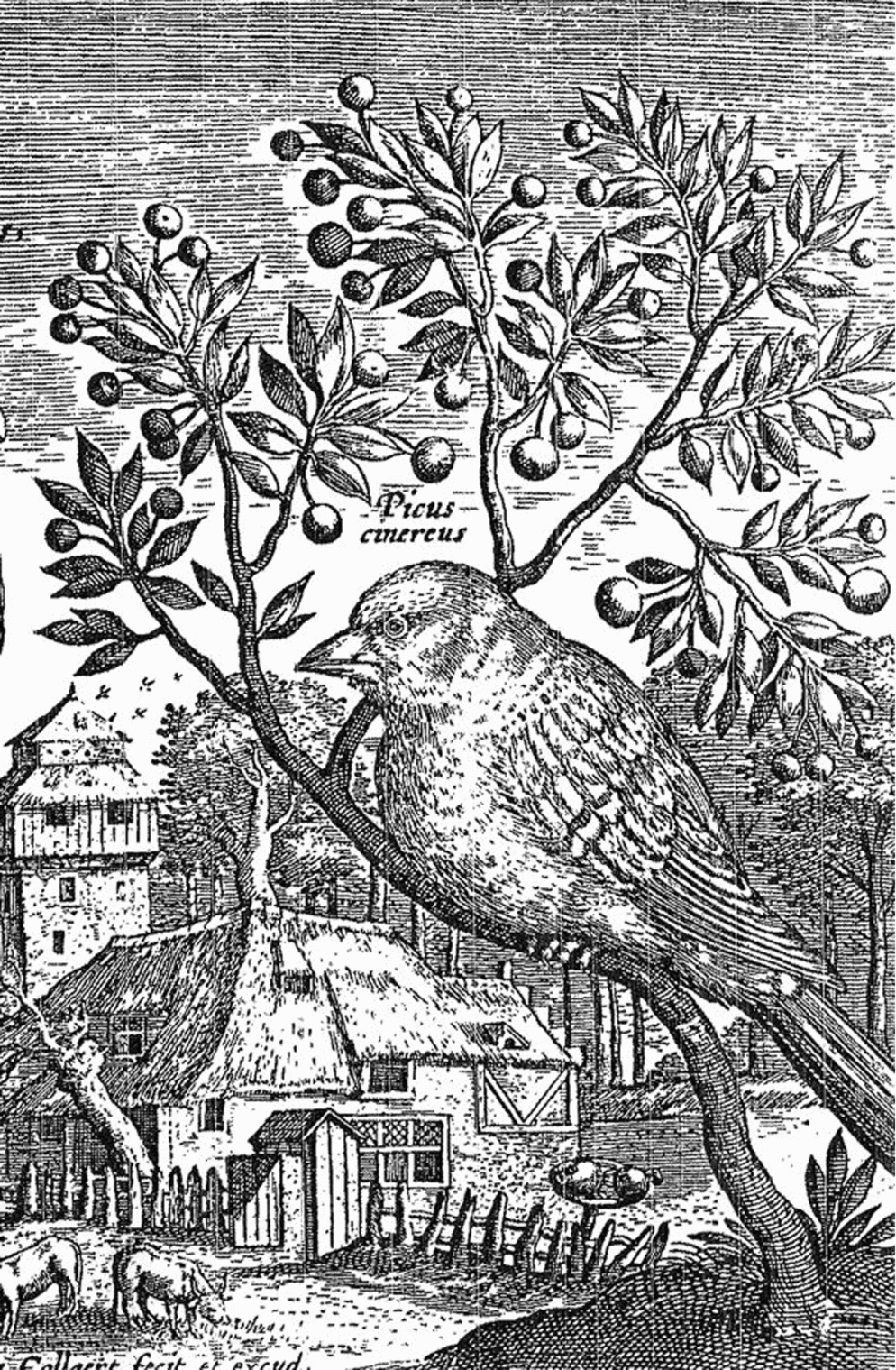
There are other reports about birds in the Jahangirnama, complemented by numerous bird studies. Several appear to be, and this does not seem to have been fully studied by ornithologists, like Mansur's Tulips, the first representations of their species. They, too, follow the Europeanising style of scientific representation. The connection is obvious when we look, as has been suggested by Robert Skelton, at the carefully observed engravings of Adrian Collaert, Avium vivae icones (1580, probably Antwerp, with several later editions)Footnote 55 and compare them with Mughal paintings. Moreover, the Flemish artist placed several of his birds on small trees in a landscape and Mansur did exactly that with his famous Bluethroated Barbet (Megalaima asiatica), ca 1615 in the Victoria & Albert Museum, London (Fig. 15)Footnote 56 which has a close relative in Collaert's Picus cinereus (tree creeper) of Avium vivae icones (Fig. 16).Footnote 57
Himalayan blue throated barbet (Megalaima asiatica) by Mansur, c. 1615, opaque water colour on paper image area, 14.3 × 7.7 cm, by courtesy of the Trustees, Victoria and Albert Museum, London, I. M. 137–1921 bequeathed by Lady Wantage.

Picus cinereus (tree creeper), detail, from Adrian Collaert, early 17th century, illustration of his Avium vivae icones, Antwerp 1640.

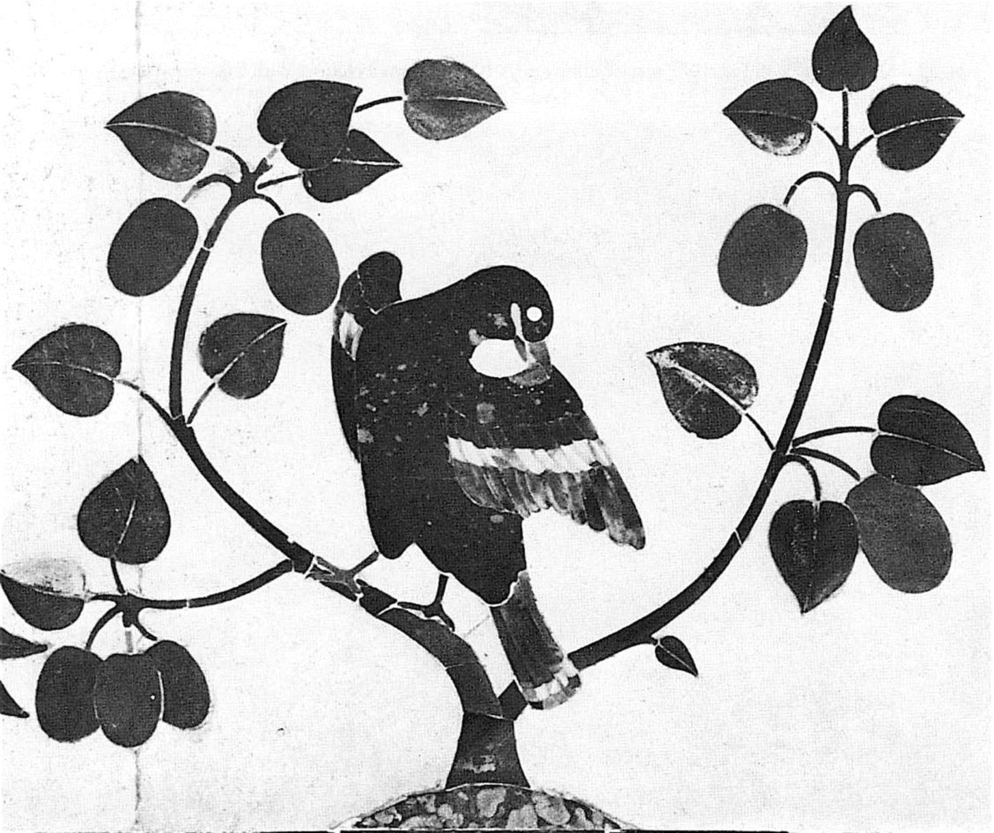
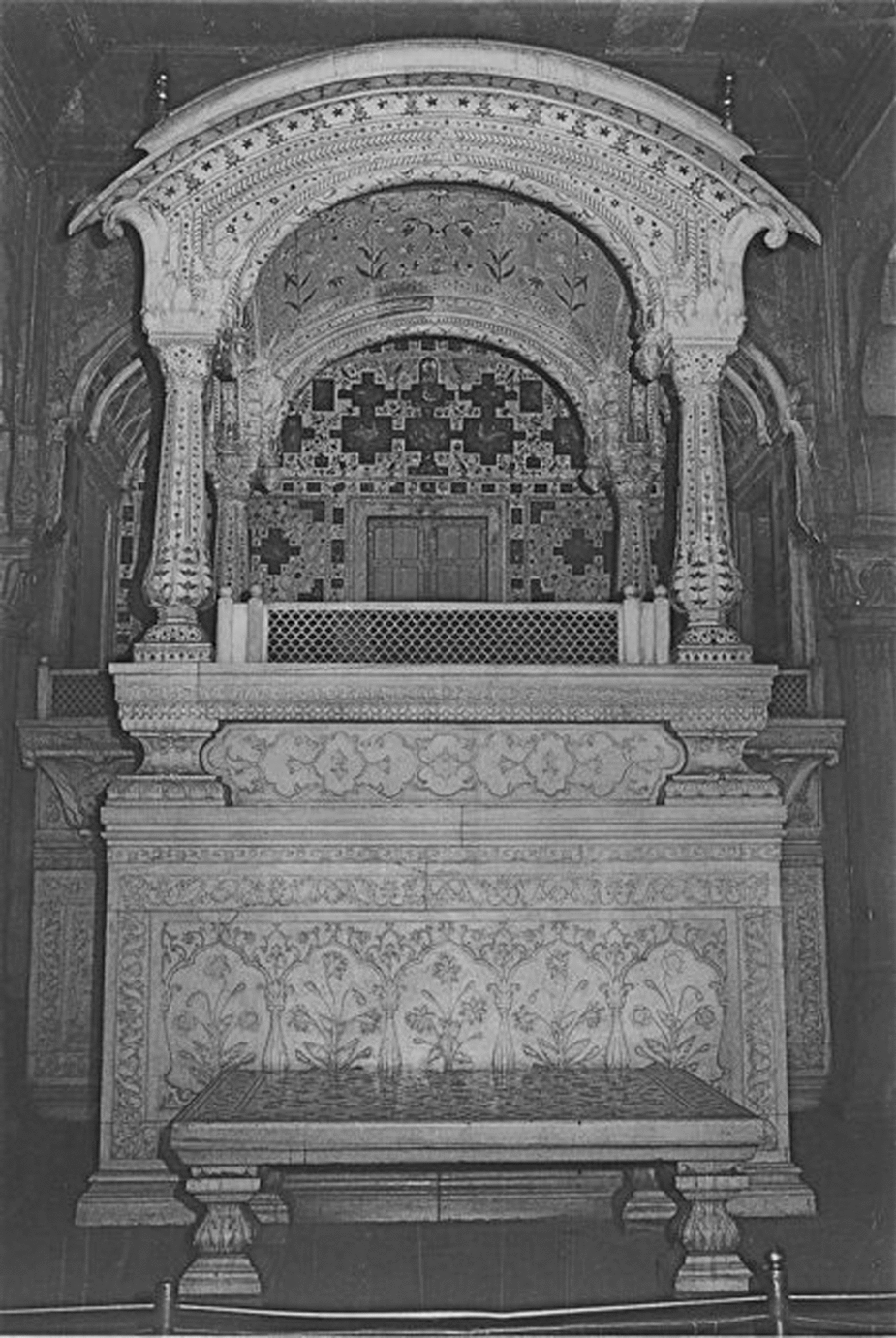
Later, under Shah Jahan the motif of birds sitting on trees was translated into a hard stone inlay in the pietra dura/ parchin kari decoration of Shah Jahan's throne wall in the Red Fort of Delhi (1639–48) where they featured as observed in nature, identifiable ornithological species in an artistic symbolic setting (Fig. 17).Footnote 58
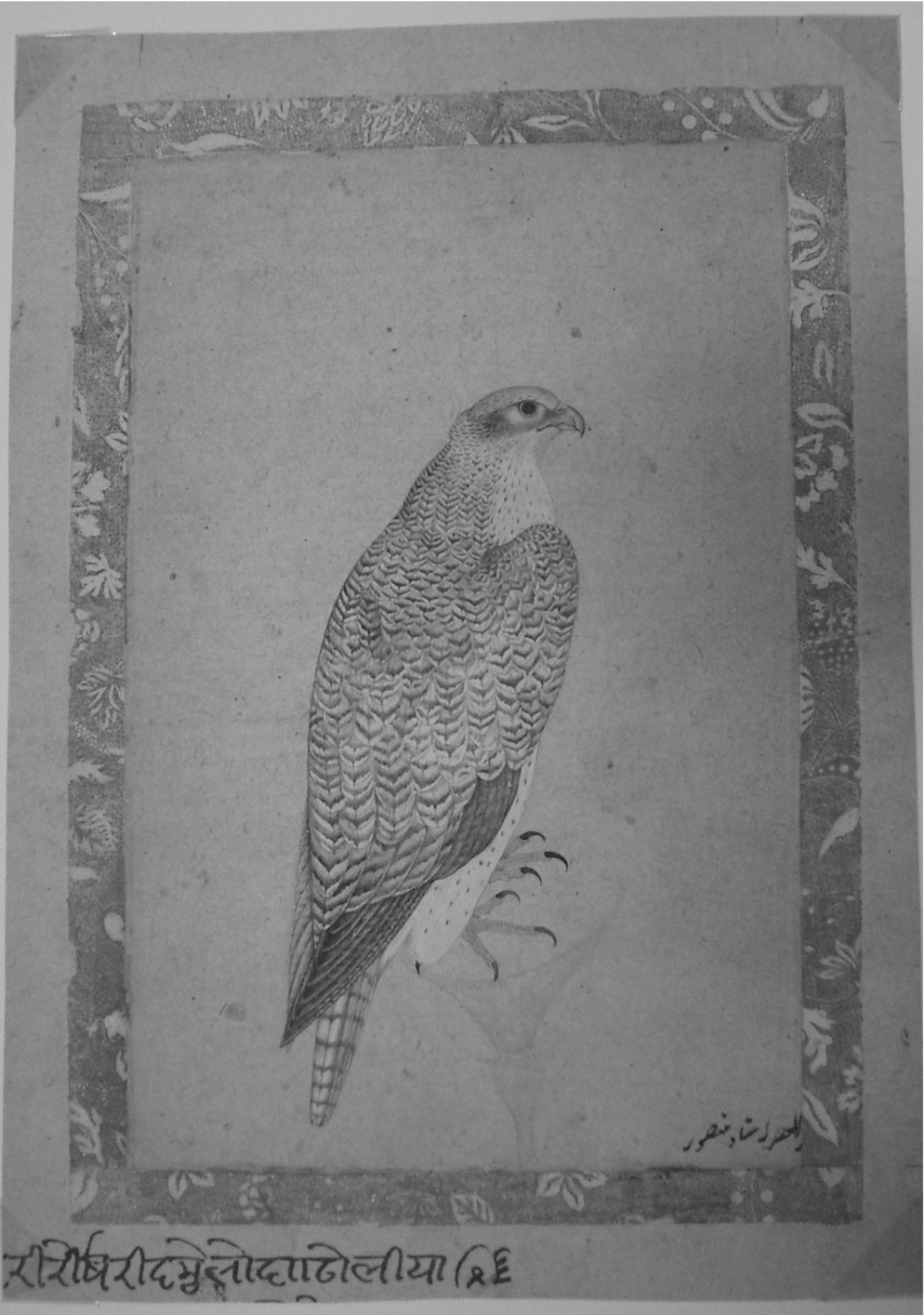
Falcon ascribed to “Nadir al-Asr, Ustad Mansur”, early 17th century, opaque water colour on paper, Museum of Fine Arts, Boston, No 14.683

In several instances we can match Jahangir's description of birds with surviving images. One is of a falcon which he got as a present from the Shah ʿAbbas of Iran in October 1619.
What can I write of the beauty of the bird's colour? It had black markings, and every feather on its wings, back and sides was extremely beautiful. Since it was rather unusual I ordered Master Mansur the painter who has been entitled Nadirul' asr Rarity of the Age to draw its likeness to be kept.Footnote 59
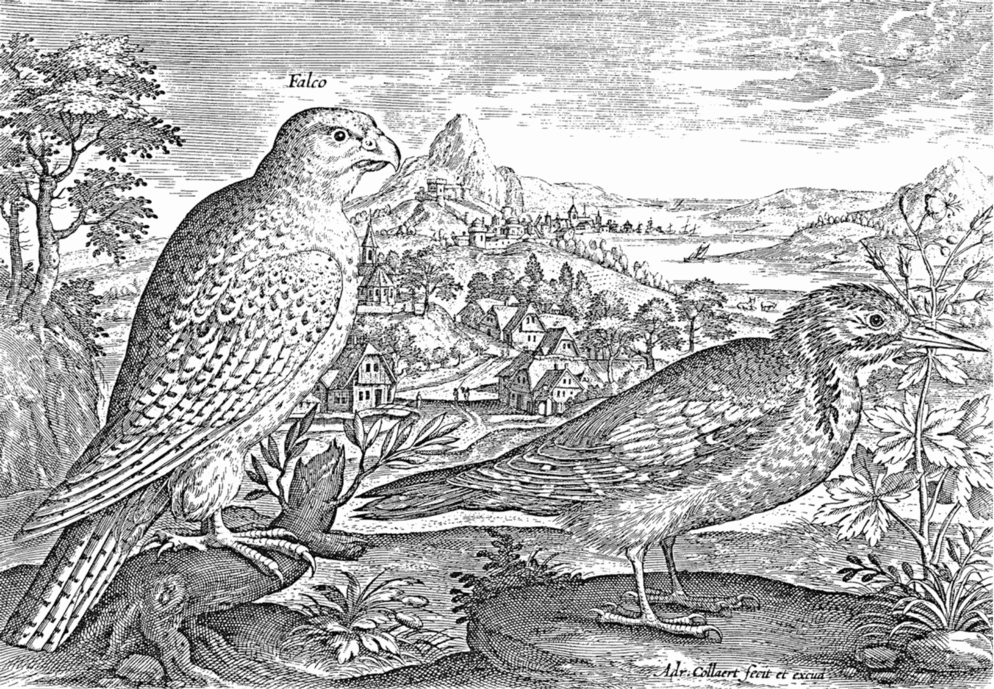
One would like to think here of the portrait of a falcon in the Museum of Fine Arts, Boston, attributed with an inscription to Nadir al-Asr, Ustad Mansur (Fig. 18). The ‘Boston’ bird shows again a great resemblance to a “Falco” of Collaert (Fig. 19).Footnote 60 Yet the painting far surpasses the generic treatment of the engraved model and by grasping the psychology of the bird it gives us the portrait of an individual. This, and the masterful detailed treatment of the texture of the feathers, supports the attribution to Mansur.
Falco, detail, from Adrian Collaert, early 17th century, illustration of his Avium vivae icones, Antwerp 1640.

Bird (Myna?) from the back wall of Shah Jahan's throne jharoka, Red Fort Delhi (see Fig. 30), semi precious stone inlaid in marble (Photo Ebba Koch).

The picture of a spotted forktail (Enicurus maculatus) in the Metropolitan Museum of Art, New York, a bird of the Himalayas living by running stream, has an explanatory text directly on the painting. An inscription on one of the rocks tells us that it was caught at a place called Jangespur and that Jahangir ordered Abu'l Hasan, Nadir az-Zaman to draw it.Footnote 61
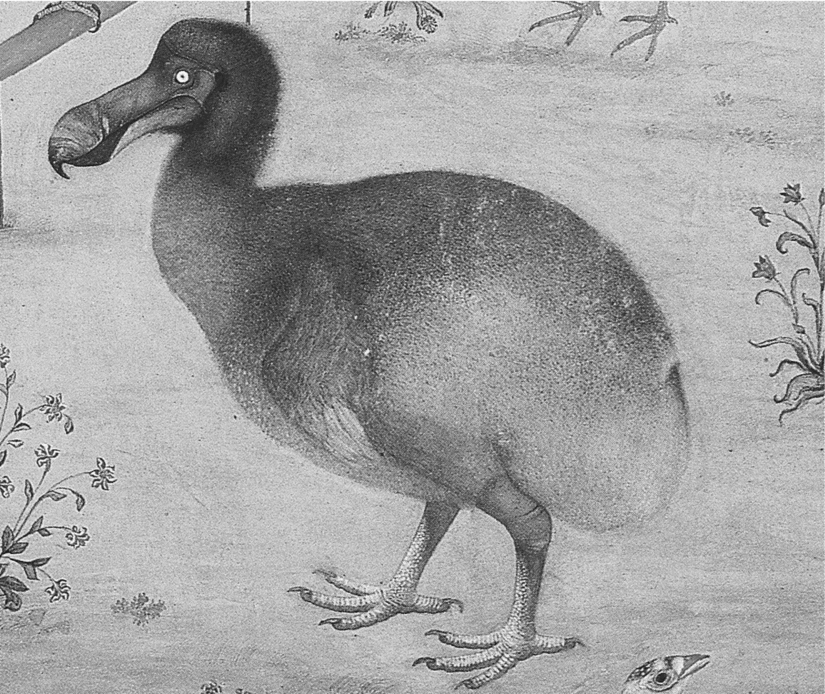
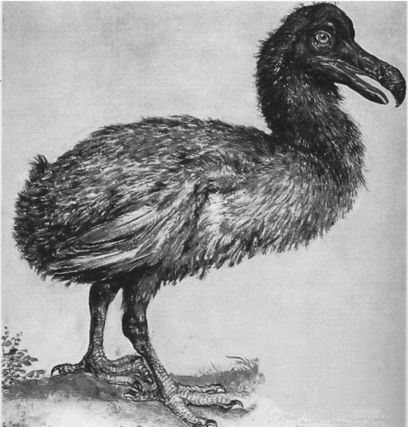
The ornithological studies done for Jahangir included, as I have mentioned, one of the earliest depictions of the Mauritius dodo (Raphus cucullatus Linnaeus 1758). The bird appears among several other bird studies pasted together on a page of the St Petersburg Album, St Petersburg. Welch ascribes it to Mansur and dates it 1615 (Fig. 20).Footnote 62 The painting created quite a sensation at the XII International Ornithological Congress at Helsinki in 1958 because the bird, extinct since about 1670, was supposed to have been taken from a living model.Footnote 63 There is a rich body of literature on the dodo and to the present day scholars have not been able to establish with certainty whether Jahangir's dodo was taken from a living model,Footnote 64 from a stuffed bird, or from a picture.Footnote 65 There is a general consensus among ornithologists that Jahangir's dodo gives us the most exact and trustworthy image of the bird, and thus it is quite likely that it was taken from a living specimen, “sensitively, knowingly drawn, and painted with finesse”.Footnote 66
Dodo, attributed to Mansur, detail of a collage with bird studies, opaque water colour on paper, entire painting 15, 3 × 26 cm, St Petersburgh album, Academy of Sciences, St Petersburgh, f. 80a.

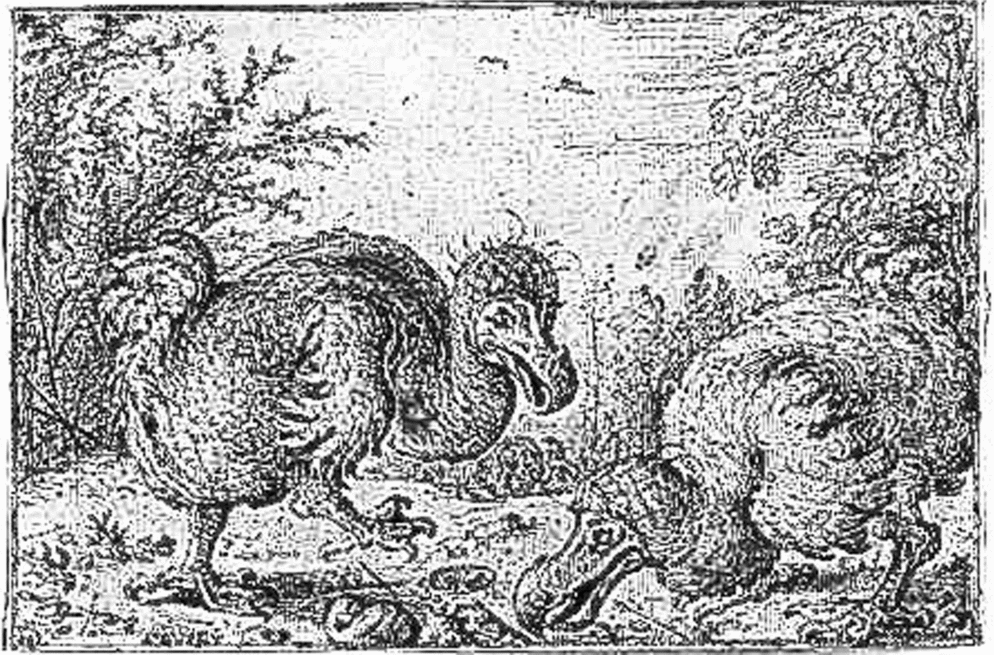
The other early depictions of the extinct bird were made at the court of Rudolf at Prague, one appears on a page in the Museum of Rudolf II (Fig. 21).Footnote 67 Between 1626 and 1628 Roelandt Savery and Andriaen Pieterszoon van der Venne did a couple of studies of the dodo and especially those of Savery were blamed for having distorted the image of the entire species because the model of both artists was an overfed specimen held in captivity in Amsterdam in 1626 (Fig. 22).Footnote 68 The bird appears also in Savery's paradisiacal and Orphic landscapes.Footnote 69
Dodo, from the Museum of Rudolf II, early 17th century, 40.1 × 30.3 cm., Österreichische Nationalbibliothek, Vienna, Codex miniatus 130, fol. 31a.

Dodoes by Roelandt Savery, drawing in black and red chalk and light brown wash. Crocker Art Museum, Sacramento, California, E. B. Crocker Collection, 1871.102.

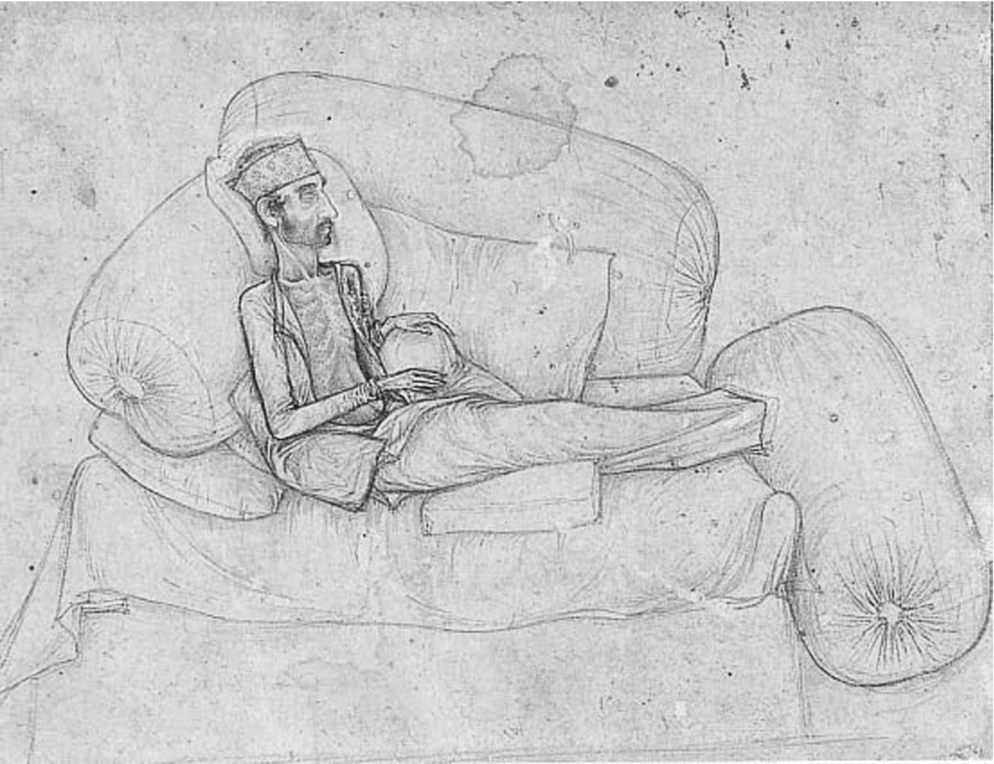
Jahangir's scientific attention was also directed to the human condition. When he saw in October 1618 the wretched agonising condition of his noble Inayat Khan, he was fascinated described him, and had the dying man drawn and painted (Fig. 23). The artist whose identity is disputed produced a gripping clinical study of the physical and mental state in the final stage of opium addiction – Inayat Khan died several days after his likeness was taken.Footnote 70
The dying `Inayat Khan, 1618, opaque water colour on paper, 9.5 × 13.5 cm, Museum of Fine Arts, Boston, Francis Bartlett Donation of 1912 and Picture Fund, 14.679.

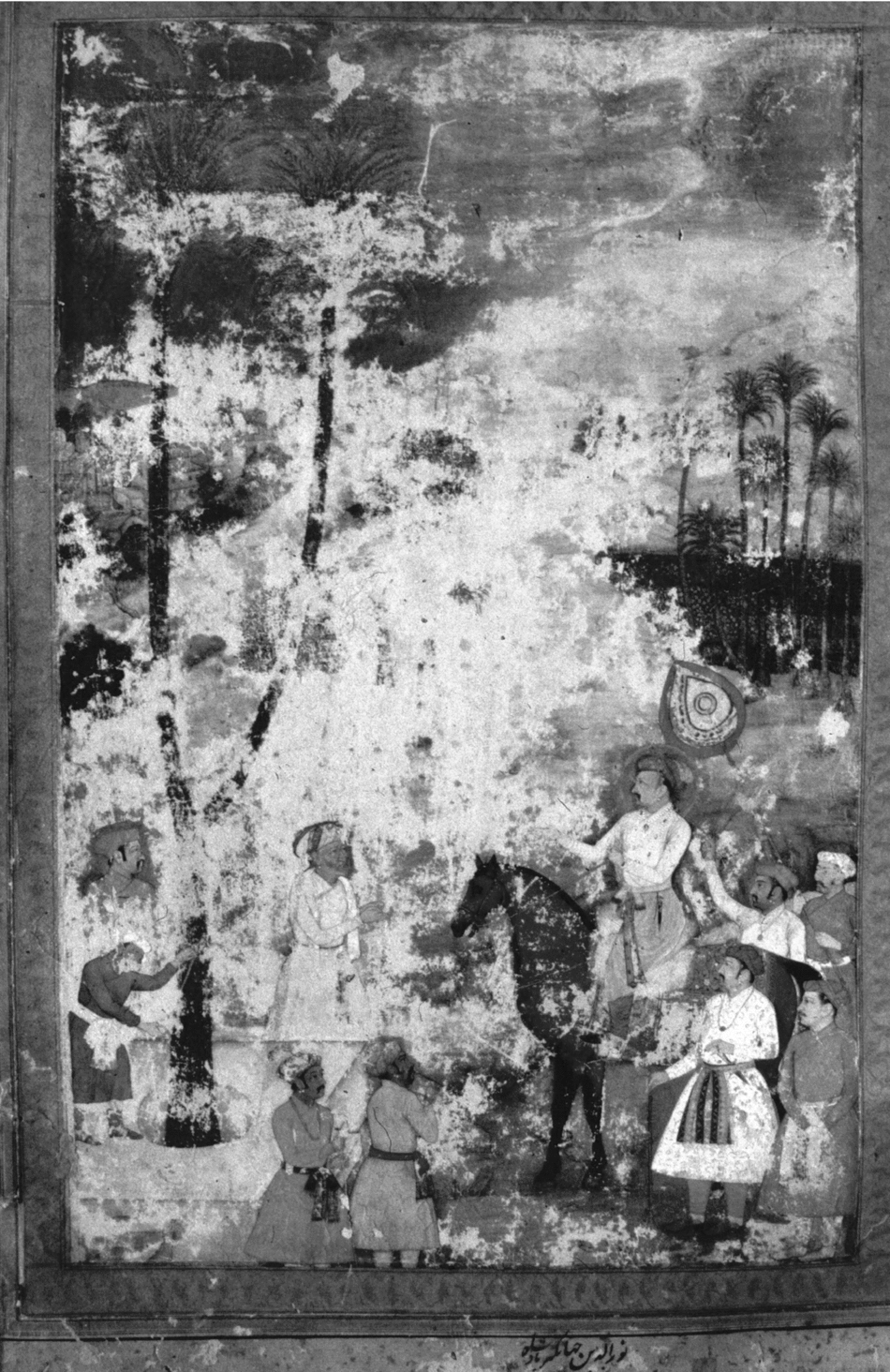
From text and image we also learn how Jahangir went about collecting his data. In 1617 near Ujjain in central India Jahangir he noted a strangely shaped palm tree the trunk of which had forked into two branches, and, as the imperial scientist he was, he had it measured and painted. It is worthwhile quoting the full passage of the Jahangirnama which again testifies to Jahangir's scientific approach and thoroughness in observing detail:
At this station I saw a palm tree [dirakht-i khurma] that had a very strange shape. It originally had only one trunk, but when it had grown to a height of six ells [gaz, one gaz is a Mughal measure of length which corresponds to about 32 inches or 81.28 cm] it had forked into two branches, one ten ells and the other nine and a half ells. The distance between the two branches was four and a half ells. The distance from the ground to the place where the branches and the leaves came out was sixteen ells for the larger branch and fifteen and a half ells for the other. From the place where the branches and the green leaves were green to the top of the tree was two and a half ells, and the circumference was two an eighth ells. I ordered a terrace [chabutara, rather platform] three ells high made around it. Since it was so very straight and harmonious [well shaped], I told the painters to draw a picture of it for the Jahangirnama.Footnote 71
And indeed, one of the illustrations of the Jahangirnama, an unfortunately badly-damaged painting in the Raza Library at Rampur, visualises this scene (Fig. 24). In a grove of palm trees Jahangir supervises, on his horse, the measuring of the forked tree in the foreground. That Jahangir puts a platform around the tree belongs to a Mughal phenomenon which can be described as the imprinting of nature. The Mughal padshah claims nature as his own by making a permanent imprint on it with architectural features, sculptures and dynastic inscriptions. Thus he marks his territories with artistic means. With this will to dominate nature through art Jahangir shows himself, in India, as a true patron of the Mannerist age and it is difficult to decide whether this represents a parallel development or is motivated by direct connections.Footnote 72
Jahangir has a palm tree with a forked trunk measured in 1617 near Ujjain, illustration of the Jahangirnama, opaque water colour on paper, 34.3×22 cm, Rampur, Raza Library, Album 1, fol. 8a.

Jahangir also assesses his dominions scientifically and this is reflected by his general concern with measures and weights. He had, for instance, the valley of Kashmir re-measured, to check the measurements of Abu'l Fazl in the Akbarnama.Footnote 73
Jahangir's Experiments
Jahangir comes particularly close to Bacon's ideas of science when he resorted to experimentation to increase his knowledge, to give a natural explanation for unusual phenomena or to test out traditional beliefs.
With experimentation he followed in the footsteps of Akbar, though his father had employed empirical research in another cause, to find out about true religion, natural to all men. In the late 1570s Akbar started a Kaspar Hauserian experiment and had children brought up in a secluded house with nurses who were not allowed to talk to them, to find out whether they would speak on their own and in what language, and “what religion and sect these infants would incline to and above all what creed they would repeat”.Footnote 74 The project failed tragically because “after three or four years they all turned out dumb” and some of the children even died. This experiment bespeaks the Mughal empirical approach which took a turn towards natural history in Jahangir, but it also has a long tradition with kings and made its appearance in different times and cultures. The Hohenstaufen Frederick II (1194–1250), Holy Roman Emperor, King of Sicily and Jerusalem, and in many ways a kindred spirit of Akbar, is credited with having undertaken a similar venture (with similar results), to establish which was the first language of mankind, Hebrew, Greek, Latin, or Arabic.Footnote 75
But back to Jahangir; in the Jahangirnama he describes a number of his empirical procedures of which I mention a few, such as the dissection of the body of a lion to find out what would be the physical origin of the proverbial bravery of lions and tigers, or the skinning of two sheep and the exposure of their carcasses at two different places to see which one would rot faster and “what the difference in the air was”. And to test out an often reported belief, Jahangir applied bitumen on a chicken's leg which he had broken to find out whether the substance had indeed a healing effect – it had not, as he observed.Footnote 76
Jahangir also carried out zoological experiments and was particular interested in cross-breeding different species. In 1619 he ordered that two wild male markhor goats he had in his establishment be mated with seven female Barbary goats from Arabia, and was so delighted with the offspring that he kept the kids around him and even gave them names.Footnote 77
If we consider Jahangir's methodology we note that, as a scientist, he has a selective approach; he records, depicts, measures, enumerates and tests what he considers as noteworthy and outstanding. He fails to feed the results of his empirical research into a theoretical framework and his observations do not lead to a systematic body of knowledge. If we compare him with Rudolf II we note that Jahangir's was something of a one man show, he did not have a circle of scientists and scholars at his disposal. His personal involvement and his achievements thus deserve more admiration and, so I feel, come closer to what Francis Bacon saw in practiced science as a means to sharpen the faculties of a ruler to see through things and evaluate behaviour and situations, “to rule with a clear understanding of nature and mankind”.Footnote 78 Jahangir is remarkably self-reflective and, as a seeker of knowledge, he speaks to us with his own voice. The imperial attention becomes the measure of all things and behind it is the will to dominate the nature of his territories.Footnote 79 It is also a manifestation of his universal power.
Nature Studies and Science in Allegory and Symbolism
This leads us to the role of science and nature studies in allegory and symbolism about which Bacon also reflects. And, also here I can not resist presenting Rudolf II as Jahangir's European alter ego.
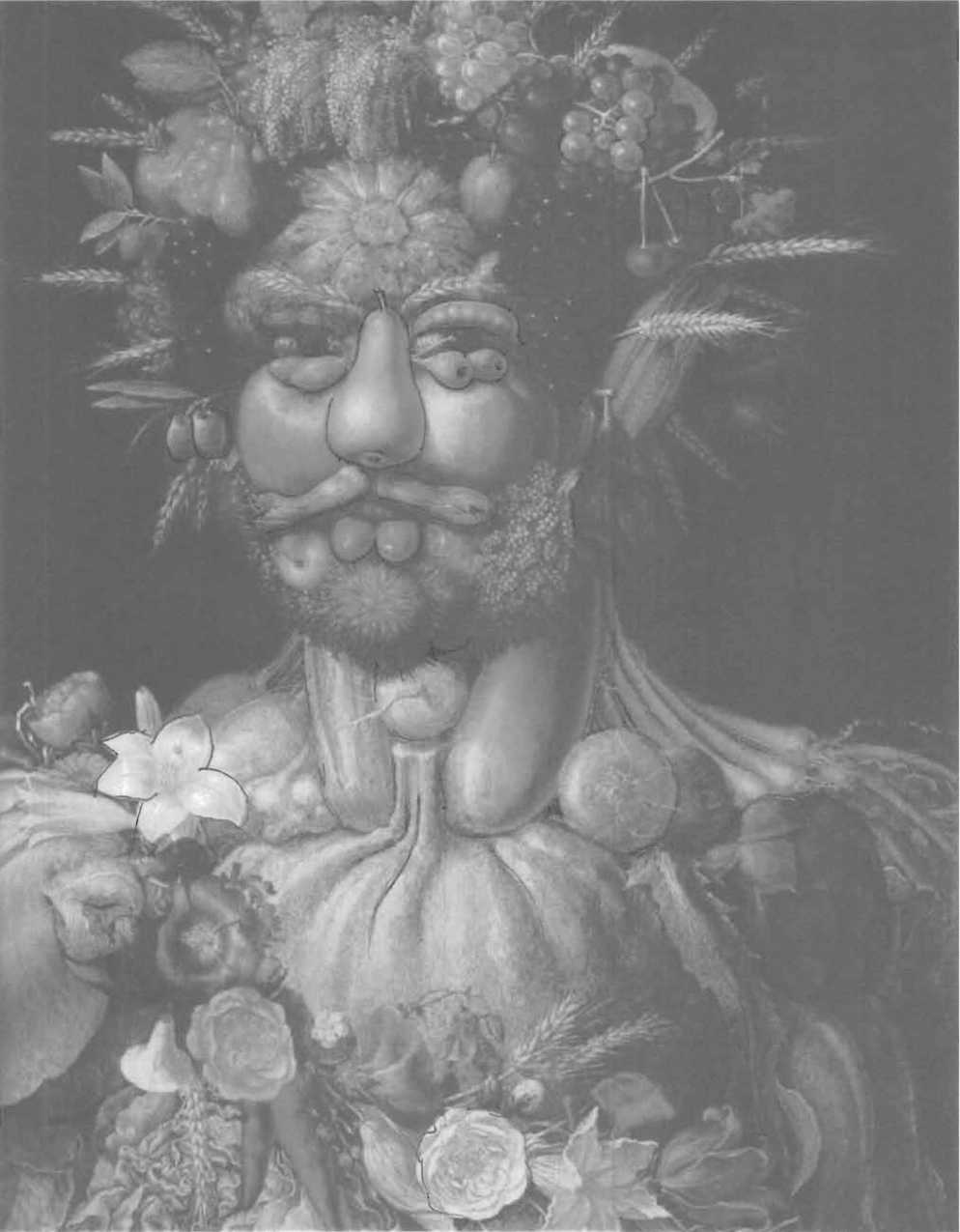
According to DaCosta Kaufmann, Arcimboldo's composite heads were allegories meant to glorify Habsburg rule, and the concept would culminate in the portrait of Rudolf as Vertumnus (1591), the emperor as god of the seasons who is also comparable to Jove, god of the elements (Fig. 25).Footnote 80 In our context the question arises whether Arcimboldo was inspired by Indian or Persian sources for the idea of composite figures,Footnote 81 but for the present discussion it is of more immediate interest that he assembled his symbolic heads from individual nature studies.Footnote 82
Emperor Rudolf II as Vertumnus by Guiseppe Arcimboldo, ca. 1591, Skokloster Castle, Skokloster, oil on panel, 68 × 56 cm. Redrawn.

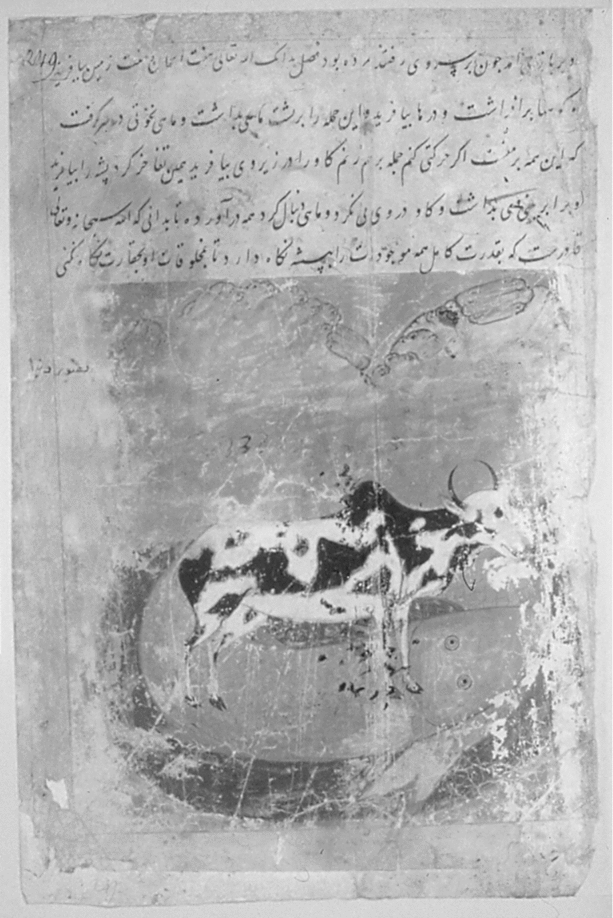
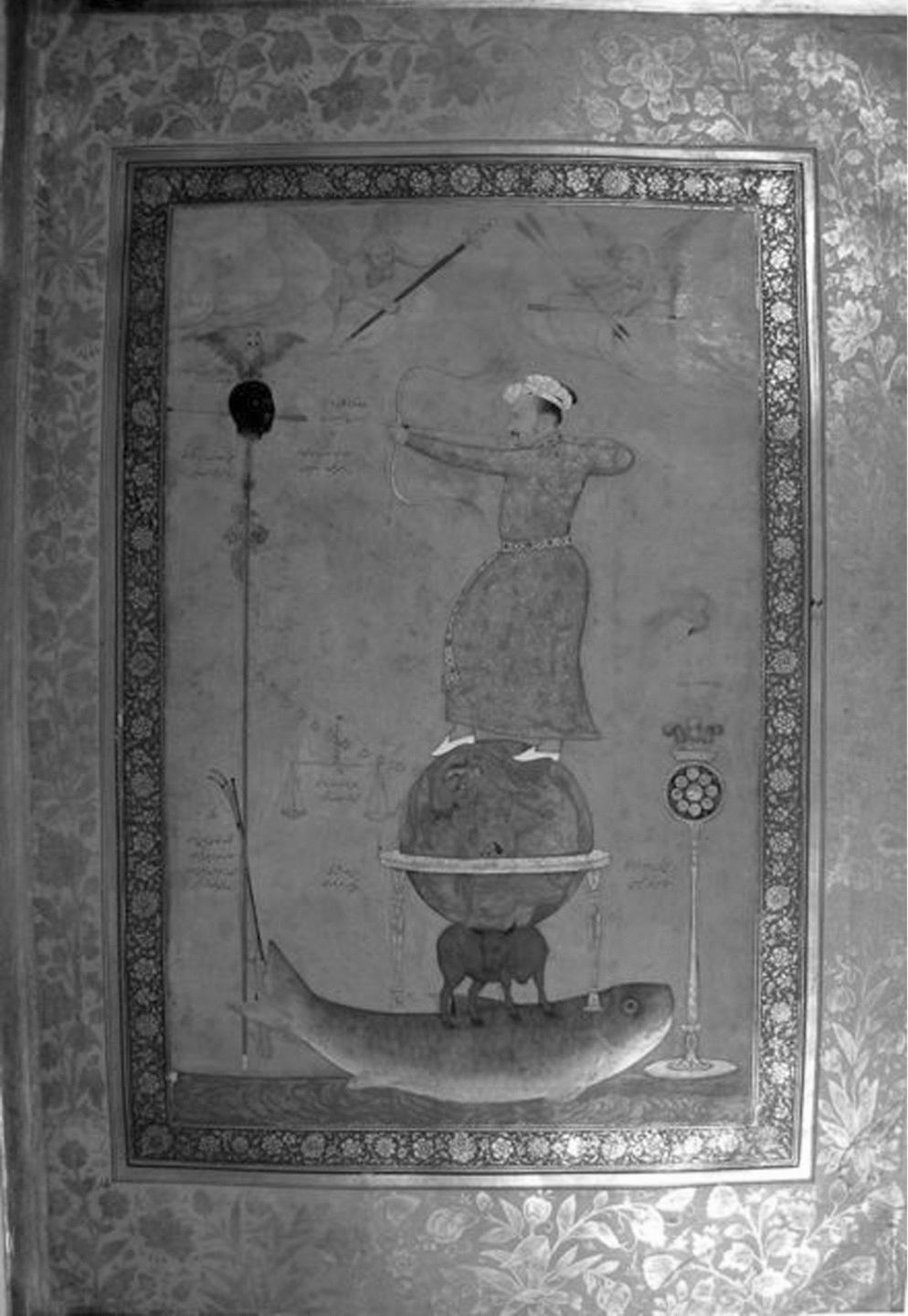
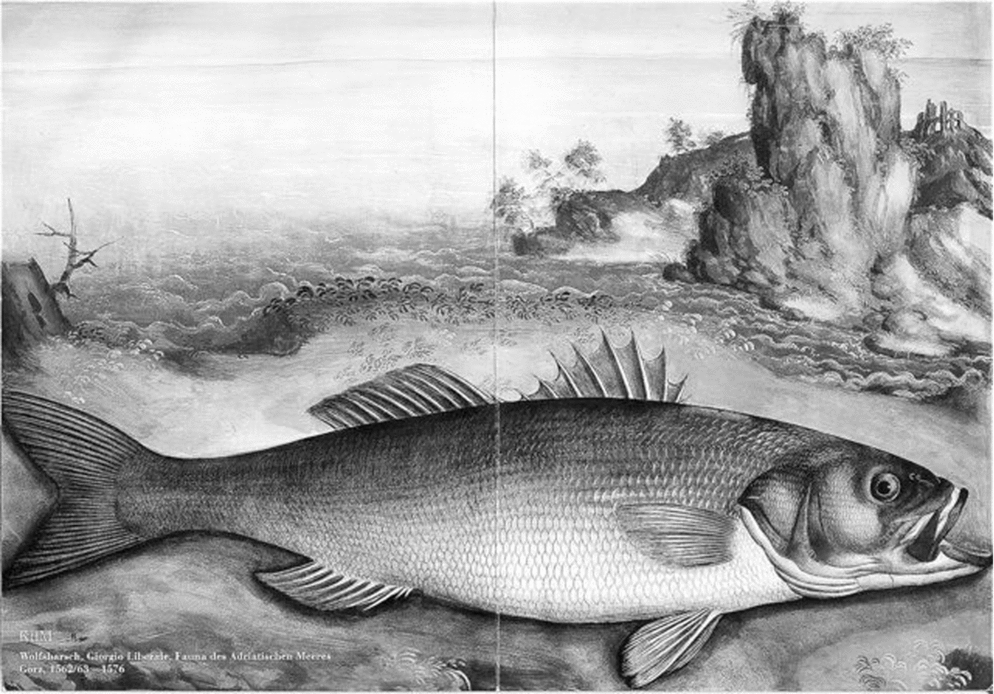
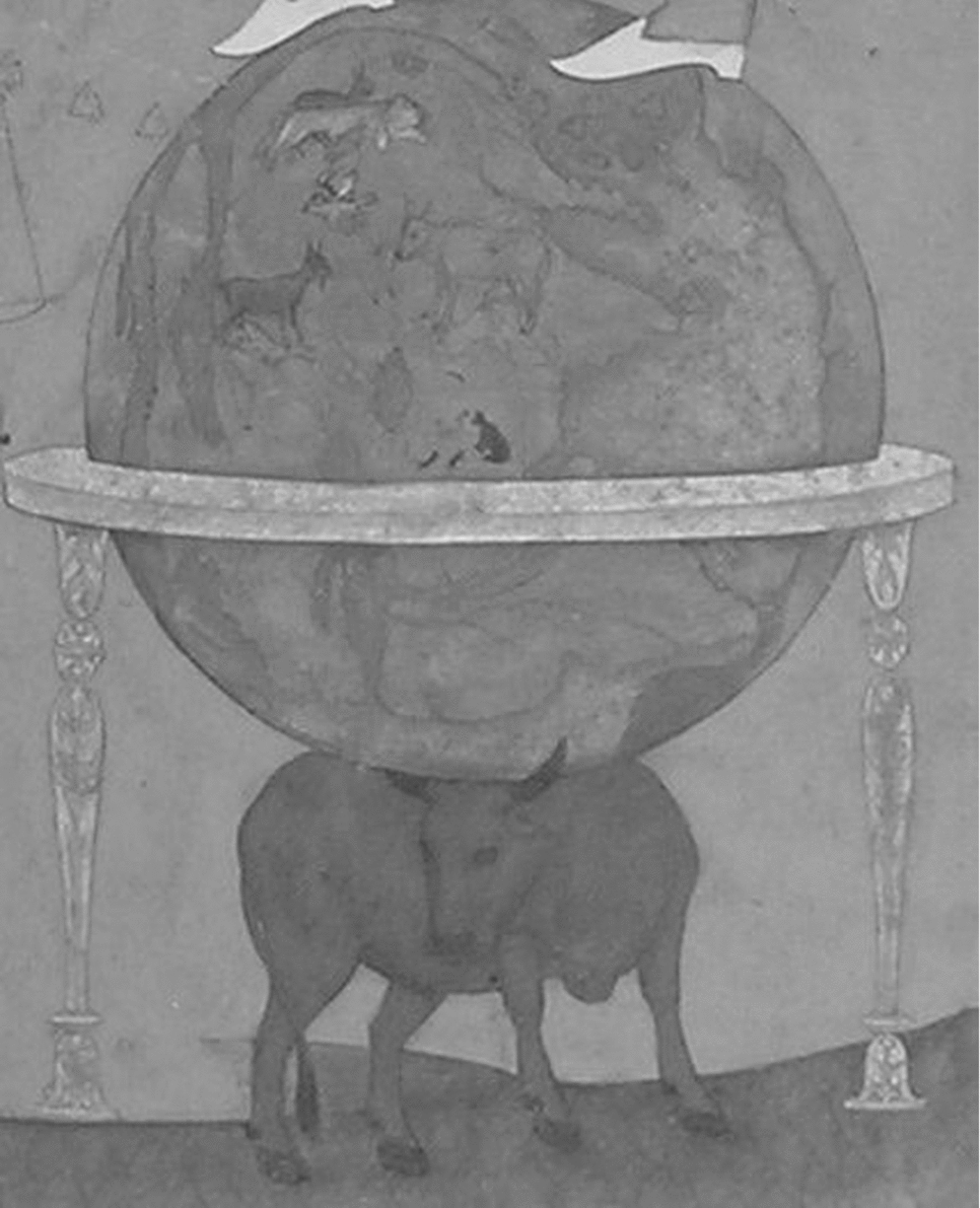
This inspired me to take a fresh look at one of Jahangir's political allegories, where he stands on a globe shooting at the head of his enemy Malik ʿAnbar, painted by Abu'l Hasan in ca. 1620, in the Chester Beatty Library, Dublin.Footnote 83 The old Islamic cosmological concept of the world fish on which the earth rests through the intermediation of the cosmic bull (Fig. 26)Footnote 84 is here newly expressed with components representing the latest European scientific achievements and related to Jahangir as world ruler (his name literally means “World-seizer”) (Fig. 27). He stands on a terrestrial globe of the kind done at Antwerp around 1600;Footnote 85 the globe on its stand is placed in turn on the back of a naturalistic bovine with its head turned in Europeanising foreshortening, and both man and bull stand on a fish, a nature study in the manner of Giorgo Liberale from Udine (1527–1579/80, an artist sponsored by the Habsburgs) (Fig. 28).Footnote 86
Cosmic bull supporting earth (indicated by mountains) and standing on the world fish, from at-Tusi Salmani, Aja'ib al-makhluqat, 1388, Départment des Manuscrits, Division Orientale Bibliothèque Nationale de France, Paris, supplément persan 332, fol. 249a.

Jahangir standing on a terrestrial globe supported by the cosmic bull and the world fish shooting at the head of his enemy Malik. ʿAnbar, c. 1620 opaque water colour on paper, image area 25.8 × 16.5 cm. ©The Trustees of the Chester Beatty Library, Dublin, 7A.15 (Photo Ebba Koch).

Adriatic fish by Giorgo Liberale(?) (1527 Udine – 1579/80 Udine) from a collection of animal studies commissioned by Archduke Ferdinand II of Tyrol, 1562–79 Osterreichische, Nationalbibliothek, Cod. Ser. no. 2669

Sumathi Ramaswamy has perceptibly analysed Jahangir's preoccupation with the European scientific instrument of the globe which he adopted and appropriated in his pictorial representations as an imperial attribute. Jahangir and his artists fully understood the potential of manipulating the globe as a symbol of territorial dominion:Footnote 87 While globes, when they feature in Western paintings, are most often Europe-centred and the rest of world marginalised,Footnote 88 on the depiction of Jahangir's globe India appears larger and in the middle. Ramaswamy does not include the territorial distribution of the globe of the Chester Beatty painting in her discussion but an enlargement of it shows that it is a particular striking example of this manipulation (Fig. 29). The northern hemisphere is not on top under the elegantly-shoed feet of Jahangir (where China is now situated) but shifted to the “west”, to the left side, which brings the Indian subcontinent in full view in the centre and, in a wild contradiction to all European cartographic conventions, in alignment with the equatorial axis. Moreover the Mughal peaceable kingdom, where lions socialise with goats, oxen and bears is projected over most of Asia, spreading out from India into Iran and China.
Terrestrial globe with India in the centre and in alignment with the equatorial axis, detail of Fig. 27.

Abul Hasan thus manipulates the terrestrial globe in three ways. First, he alienates it, in its full identity as a European scientific instrument, and appropriates it to make it a player in the Islamic cosmological concept of the universe. Second, he uses the globe to place India in the centre of the world. Third, he populates the globe with Mughal symbolic imagery, with wild beasts and their potential prey, weak and tame animals, in Persian called dam-u-dad, which coexist peacefully together to testify to the Great Mughals' justice and ideal kingship. This triple manipulation puts the globe entirely into Mughal service and literally under the feet of Jahangir – it has to give the emperor's own allegorical concept of universal rule more weight.
The foreign was assimilated, as the French archaeologist and historian Paul Veyne proposes, it is to bring one's own identity up to date.Footnote 89 The Mughals had no problem with selectively taking from Central Asian, Persian, older Indian and European traditions whatever served their purposes.Footnote 90 After all, nobody forced them to do so. And in the area of naturalistic representation and allegorical symbolic construction in the arts, Europe for them had to offer the best solutions – they did not realise (and in any case would not have been bothered) to what extent they were to irritate modern Indian art historians who out of post colonial resentment often try to ignore or explain away this interest. Akbar's historian and conceptualist Abu'l Fazl openly appreciated the European artists for these very faculties in an intriguing argument (written at the end of the sixteenth century) which begins in almost post-modern philosophical terms, anticipating Saussure's notions of ‘sign’, ‘signifier’, and ‘signified’, continues on a neo-Platonic post-Tridentine note in pointing out that painting, especially European naturalism, may serve as a means to recognise a higher truth:
A picture (surat) leads to the form it represents [khudawand-i khud, lit. its own master] and this [leads] to the meaning (ma'ani) just as the shape of a line (paikar-i khati) leads one to letters (harf) and words (lafz) and from there the sense (mafhum) can be found out. Although in general they make pictures (taswir) of material appearances (ashbah-i kauni), the European masters (karbardazan-i firang) express with rare forms (ba-shigirf surat-ha) many meanings of the creation (basa ma'ani khalqi) and [thus] they lead those who see only the outside of things (zahirnigahan) to the place of real truth (haqiqatzar).Footnote 91
As I pointed out earlier, it is not always possible to make out whether we can speak of direct connections or independent parallel developments. But is remarkable that in using scientific elements to produce a political allegory, both Arcimboldo and Abul Hasan emerge as case studies of a hybrid in the sense of the French sociologist of science Bruno Latour, of a system that mixes politics, mythology, science and nature.Footnote 92
Solomon and Orpheus as Bacon's and Jahangir's Models of Ideal Kingship
The concept of universal and ideal rule leads us also to Solomon. For Bacon, as I have pointed out at the beginning, the biblical Solomon was to be the ruler's model on which he patterns Solamona the king of the New Atlantis. Still, Solomon does not seem to play a major role in the symbolism and allegories of European rulers. On the other hand, many a Muslim ruler presented himself in one way or the other as a second Salomon who features as the ruler par excellence in the Quran.
I have repeatedly drawn attention to the Solomonism of the Mughals strongly promoted by Jahangir in his artistic schemes, and he is in this followed by Shah Jahan.Footnote 93 Jahangir's pictorial programmes show that he identified with Salomon especially in his aspect as the just law giver who rules over the animal world and brings inimical nature to a peaceful coexistence. The globe with the pacified animals (dad-u-dam) in the Malik Anbar picture is an application of this idea and we have other Jahangiri pictures with this theme,Footnote 94 and a number of Mughal texts to explain the image:
An early voice is Khwandamir who eulogises in 1533/34 the rule of the second Mughal Emperor Humayun (r. 1530–43, 1555–56) with the following verses:
Under the protection and shelter of his justice deer sleep carelessly in the lap of panthers, and fish fearlessly take rest near crocodiles; pigeons become friends of falcons and sparrows chirp fearlessly in front of eagles
Under his just administration deer in the forest
Go abreast with the male lion
The waterfowl tells its secrets to the hawk
The pigeon relates its story to the falcon
If injustice is indicated in the actions of any government officers
They receive from the hands of the subjects a slap on the face.Footnote 95
The concept of pacified animals (in Persian dad-u-dam) as a symbol of the ruler's Solomonic justice was powerful and flexible enough to absorb related ideas, the Biblical image of the peace among the animals under the just rule of the Messiah; the image of Majnun, the ultimate lover of Arabic and Persian lore who flees into the wilderness where the animals, tamed by the power of his emotion, surround him peacefully; and even the European image of Orpheus, the mythical hero who pacifies the beasts with his music.Footnote 96 The connection was worked out visually in the albums of Jahangir and Shah Jahan. On one of the Gulshan album pages (p. 248) three images of Majun and Laila surrounded by the animals of the desert enclose the copy of a European Orpheus; in an album of Shah Jahan in the Bodleian Library, Oxford, Majnun residing among the animals is juxtaposed with Salomon on his throne surrounded by his animal subjects. And in the same album Jahangir appears as a new imperial Majnun among the animals of the wilderness, and becomes thus a Solomonic figure.Footnote 97
It appears that at the European courts Orpheus was more popular than Salomon though the significance of the mythical musician as a political symbol is as yet not sufficiently understood. Karla Langedijk who undertook decipherment of the meaning of Baccio Bandinell's Orpheus in Medici Florence (c. 1518) was the first to argue that the statue was meant as an allegory of good rule. She based her hypothesis on indirect evidence, on impress and emblematic literature, and on contemporary neo-Platonic philosophy, about the cosmic harmony brought about by music.Footnote 98
It is Sir Francis Bacon who makes it clear that the “Orpheus theatre”, as he puts it, in the early decades of the seventeenth century was indeed understood as a metaphor of a society pacified by civilising achievements, a process which would meet with more success under the good government of a learned king:
VII.2 . . . the Orpheus’ theatre, where all beasts and birds assembled; and forgetting their several appetites, some of prey, some of game, some of quarrel, stood all sociably together listening unto the airs and accords of the harp; the sound whereof no sooner ceased, or was drowned by some louder noise, but every beast returned to his own nature: wherein is aptly described the nature and condition of men, who are full of savage and unreclaimed desires, of profit, of lust, of revenge; which as long as they give ear to precepts, to laws, to religion, sweetly touched with eloquence and persuasion of books, of sermons, of harangues, so long is society and peace maintained; but if these instruments be silent, or that sedition and tumult make them not audible, all things dissolve in anarchy and confusion”.
3. But this appeareth more manifestly, when kings themselves or persons of authority under them . . , are endued with learning . . . . . yet so much is verified by experience, that under learned princes and governors there have been ever the best times . . . . Footnote 99
Jahangir and Bacon have the same reference models for exemplary kingship, namely Salomon and the civilising hero Orpheus. For Bacon Solomon is the exemplary king, above all because he observes and records nature and writes a natural history “of all plants ( . . . ) and of all things that have life and motion”.Footnote 100 Bacon's “Orpheus theatre” corresponds to the animal metaphor with which the Mughal textual sources illustrated the good government of the just Solomonic ruler.
Surely, Sir Francis Bacon could not have imagined a more splendid and meaningful realisation of his “Orpheus theatre” than Shah Jahan's throne jharoka at Delhi (completed 1648) (Fig. 30).Footnote 101 Jahangir's ideas and works inspired his son's Gesamtkunstwerk of a Mughal Solomonic throne; the major components of the throne niche, pietra dura birds and plants, were based on scientific nature studies and a Florentine panel of Orpheus playing to the beasts advertised the programme of just rule.Footnote 102
Throne jharoka of Shah Jahan in the Red Fort of Delhi, completed 1648, marble inlaid with semi precious stones. The niche in the background is decorated by Florentine pietre dure panels and corresponding Mughal work. The Florentine panels show birds (South American parrots in the large panels), lions, flowers and vases, on top is Orpheus playing to the beasts. In the interstices are birds native to India and flowers by Mughal artists (Photo Ebba Koch).

 ahangir: Untersuchungen zur politischen und religiösen Legitimation in Text und Bild (Bonn, 2005) which represents her dissertation in Comparative Religious Studies at the University of Bonn, Germany.