It is well established that climate change contributes to the increase in extreme cold weather conditions, which is associated with negative impacts on health.Reference Semenza, Ploubidis and George 1 Health intervention strategies are needed to reduce associated health risks and protect vulnerable populations from suffering negative effects of cold weather. In the past, epidemiological studies have emphasized elucidating the specific groups that may be vulnerable to suffering from extreme temperature anomalies.Reference Wolf, Adger and Lorenzoni 2 Such studies found that extreme cold is associated with excess mortality among the elderly.Reference Shah and Peacock 3 - Reference Wilkinson, Pattenden and Armstrong 6 However, to design more meaningful and effective intervention strategies in order to protect high-risk populations, policy-makers also need to better understand the public’s perception of extreme cold, because public perception is a strong motivator for engaging in mitigating and adaptive behaviors.Reference Hale and Dillard 7
According to the study by Wolf et al,Reference Wolf, Adger and Lorenzoni 2 the elderly group, which was identified as a vulnerable group by epidemiology studies, did not perceive that they were vulnerable to extreme cold weather, indicating a possible discrepancy between actual risk and subjectively perceived risk. This discrepancy should be recognized and addressed by policy-makers. An individual’s lack of risk awareness may contribute to their failing to take protective action and ultimately increase their vulnerability to potential health risks related to local extreme cold temperatures.Reference Wolf, Adger and Lorenzoni 2 Furthermore, by combining objective health risk levels from epidemiology studies and subjectively perceived risk levels from perception studies, vulnerable populations could be identified on the basis of which targeted risk communication and health intervention strategies could be developed.Reference Bassil and Cole 8
Currently, public perception of extreme cold is a low priority concern in China. This study measured public perception of extreme cold in a cold region of China and aimed to find discrepancies between actual risk and perceived risk, thus identifying vulnerable groups of greater need.
METHODS
Sampling and Data Collection
Harbin is located at E 125°42′-130°10′, N 44°40′-46°40′ and is one of the coldest metropoles in China. Winter in Harbin begins in November and continues to the following March, with the average temperature ranging from -15°C to -30°C. Because Harbin experiences frequent extreme cold weather during the winter, a face-to-face personal interview measuring public perceptions of extreme cold weather and its related health risks was conducted among local residents.
The survey was conducted in 2 urban districts from December 2012 to February 2013. A 3-step sampling method was adopted. We first selected several sample units (communities) on the basis of probabilities proportional to population size. Second, households were selected within each sample unit by using simple random sampling. Third, the KISH table, which is widely used to select members within a household to be interviewed, was applied. One person per household was selected and participated in a structured and anonymous interview at their home. If detailed population information was unavailable, simple random sampling was used. Research groups from the Harbin Center for Disease Control and Prevention (CDC) were deployed to conduct the survey after an intensive training. There were about 20 trained researchers in Harbin. The interviews were conducted at home by use of a paper questionnaire written in Chinese. The interviewer gave the respondent a paper questionnaire and the respondent filled it out. Each interview took about 15 minutes. A total of 20 interviewers were deployed in different survey sites. The surveys were approved by the Ethics Committee of the Harbin CDC. Written informed consent was obtained from all participants.
Approximately 1000 respondents were interviewed. Excluding incomplete questionnaires and those with missing values and logical errors, valid responses were obtained from 891 respondents, with an effective response rate of 89.1% (891/1000). Sample structure is listed in Table S1 in the online data supplement, in which the studied sample is compared to the local population structure. City population data were obtained from the 2010 China population census. As seen in Table S1, the survey respondents were similar to the city’s population in terms of age and occupation. However, there was sampling bias indicating more females and a higher education among the respondents than in the city, a pattern also found by Huang et al’s study.Reference Huang, Zhou and Han 9 This might be attributed to the fact that women are more likely to stay at home during the survey time and uneducated people are more likely to have difficulty understanding survey questions and cannot easily complete a questionnaire.
The Questionnaire
The questionnaire used for this study was designed by following a widely used psychometric paradigm methodReference Slovic 10 with slight modification based on local conditions. At the beginning of the questionnaire, a paragraph describing subjective background information on extreme cold temperature in Harbin, which included conception of extreme cold, the recent local weather condition, and possible health effects, was provided to ensure the respondents had a basic understanding of extreme cold. This is helpful for obtaining effective responses in a risk perception survey.
Respondents were encouraged to express their attitudes directly toward each perception factor by giving a score ranging from “1” to “5,” with higher scores representing higher levels of perceptions. Table S2 in the online data supplement presents the perception questions and the definition of the ranges of the 5-point scale. Individual perception of local extreme cold was measured by calculating the individual’s score for each perception factor. Integration of the scores of these factors provided a general estimate of the local residents’ risk perception.
Perception factors included knowledge, instance, severity, benefit, controllability, and acceptance (Table S2). Risk controllability perception measured individuals’ judgment on the possibility of cold-related risk being avoided or controlled by taking preventive actions. Perception of risk acceptance represented individuals’ overall risk judgments, which may be affected by other perception factors.Reference Huang, Zhou and Han 9 We assumed that individuals who perceived extreme cold as a well-known, serious, unavoidable, and unacceptable risk may be more willing to take health protective actions for coping with local extreme cold weather. By contrast, individuals who perceived less knowledge, lower severity, and a higher acceptance level of local extreme cold may be less willing to take precautions owing to their inadequate perception of extreme cold and less awareness of cold-related health risks.Reference Wolf, Adger and Lorenzoni 2 , Reference Spence, Poortinga and Butler 11 , Reference Whitmarsh 12
Data analysis was performed by using SPSS 18.0 (IBM Corp, Armonk, NY). Descriptive statistics of the sample and risk perception scores were conducted to show public perception levels.
RESULTS
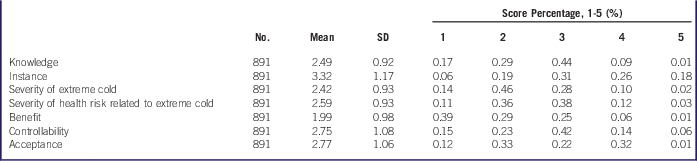
The frequency distributions of each perception factor score (Table 1) were summarized as follows: over 80% of residents had low levels of knowledge about extreme cold. About 40% of the residents believed the cold weather health effect could occur immediately and felt cold weather events were serious. Over 60% of residents considered that cold-related health effects were very serious; 70% denied any benefit from extreme cold. Over 40% of residents believed extreme cold weather and its related health risks were uncontrollable. A total of 40% of residents provided a score of less than 3 for perceived acceptance of risk, which indicated a very low perceived risk acceptance level.
General Descriptive Statistics for Each Perception Factor of Extreme Cold-Related RiskFootnote a

a See Table S2 in the online data supplement for the definition of the ranges of scales.
The mean score for each question (Table 1) was mostly below the middle value of 3, indicating that local residents did not know much about cold weather but thought that extreme cold weather and related health effects were serious, that they could not benefit from extreme cold, and that they were not sure whether the negative effects could be controlled by themselves.
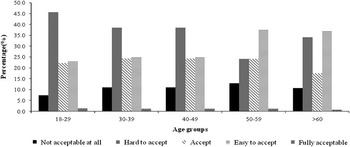
Table S3 in the online data supplement shows a clear variation of risk acceptance perception level among different age groups (chi-square test, P=0.004). Over 35% of respondents in the age groups of 18-29, 30-39, and 40-49 years perceived a lower acceptance level of extreme cold and its related health risk, whereas this percentage was reduced in the age groups of 50-59 years and older than 60 years. A larger proportion of high perceived acceptance level indicated that elderly respondents were more likely to accept local extreme cold (Figure 1). In particular, over 35% of elderly respondents in the age groups of 50-59 years and over 60 years indicated higher acceptance of cold-related risk, respectively. We also stratified by gender, education level, and income, but did not observe any significant differences (see Table S3).
Description of Perceived Risk Acceptance Level in the Different Age Groups.

DISCUSSION
The observed overall perceived risk acceptance of the respondents was at a middle level (according to the mean score for risk acceptance perception of 2.77), which indicates that residents may be tolerant of the current extreme cold weather and its related health risks. This neutral acceptable level may be due to 2 reasons: first, residents are used to cold weather and adapt well to extreme cold. On the other hand, extreme cold weather may be considered a natural disaster, which is an acceptable risk in the individual’s perception.Reference Slovic 10
Although residents could be tolerant of extreme cold, over 80% of residents thought that cold weather was harmful to their health and that the associated health risks were difficult to avoid. This suggests that residents are aware of the health effects and are willing to take actions to protect themselves but are uncertain of specific strategies. These findings indicate the need for risk communication and health protection guidance for coping with extreme cold for the residents in the area. Since different perception scores revealed diverse attitudes from different residents, target-specific intervention options are necessary, especially focusing on specific vulnerable groups, such as the elderly.
We found that the elderly were relatively unaware of extreme cold and related health risks. They perceived a higher acceptance level of extreme cold than did younger residents. Most of the elderly perceived that they were less sensitive to extreme cold and were not affected by it. However, the results of epidemiological studies suggest that the elderly are vulnerable to cold because of their weak immunity and high susceptibility to diseases.Reference Shah and Peacock 3 - Reference Wilkinson, Pattenden and Armstrong 6 Therefore, the elderly should be considered a “high health risk, low risk perception” group in this study, which is a more vulnerable group under extreme cold weather. Their judgment on cold-related health risk is not consistent with the objective health risk they may suffer from, which indicates that they may underestimate the negative health effect of extreme cold weather. This phenomenon may be due to lack of knowledge or a life-long adaption to cold weather. Their low perception level may lead to a weakened awareness of demanding health protections.
Since the elderly are identified as a vulnerable group, risk communication and health interventions are needed to protect them. On the one hand, risk communication strategies should focus on the elderly to increase their awareness of cold-related health risks and to strengthen their willingness to take self-protecting actions in their daily life. Risk education, including risk-related knowledge and common tips for the elderly regarding health protection in extreme cold weather, may be actively promoted. On the other hand, health interventions should focus on the elderly and provide them with easy access to medical services in their communities. These strategies may increase their risk perception and encourage effective reactions to reduce exposure and health effects from extreme cold. Furthermore, it should be noted that while the elderly are one of the most vulnerable populations, they do not perceive extreme cold as a personal risk. Therefore, planned preventive measures by elderly individuals maybe largely elusive.Reference Wolf, Adger and Lorenzoni 2 Policy-makers should keep that in mind and design unique risk communication strategies that may especially appeal to the elderly.
The identification of inconsistencies between objective and subjective risk levels is a critical component of formulating public health interventions For example, we can also identify “low health risk, high risk perception” groups who may overreact to cold-related risks. Strategies for this group will differ from those for the “high health risk, low risk perception” group in terms of risk communication. Therefore, risk perception could build a connection between objective risk assessment and subjective risk understanding. Our study helps to characterize vulnerable groups from both objective and subjective perspectives, which may extend the standard for vulnerable group identification and bring new insights regarding diverse risk communication strategies.
This study initially measured individual’s subjective perceptions on extreme cold in an urban area in China. Although a 3-step sampling method was adopted, there was still slight sampling bias (more females and a higher educational level) in Harbin, making the sample not fully representative of the city. Consequently, this bias may influence the public perception level, because previous studies have demonstrated that being female and having a higher educational level can significantly influence perception ratings.Reference Bronfman and Cifuentes 13 Further analysis of the association between public perception and possible influencing factors will be addressed in future studies.
Acknowledgments
People who have contributed to this article are all presented in the author list. Jie Ban and Tiantian Li designed this study, analyzed the data, and wrote the manuscript; Jie Ban, Tiantian Li, and Chen Chen designed the questionnaire; Li lan, Chao Yang, and Jian Wang designed and organized the field survey; Chen Chen and Ganlin Huang cleaned the data.
Funding
Our work was supported by the National Natural Science Foundation of China (project number: 21277135), Beijing Natural Science Foundation (project number: 8132048), State Key Laboratory Research Fund of Earth Surface Processes and Resource Ecology (project number: 2013-KF-10), and Heilongjiang Provincial Health Department Research Fund (project number: 2013308).
SUPPLEMENTARY MATERIALS
To view supplementary material for this article, please visit https:/doi.org/10.1017/dmp.2016.176