Introduction
Tripartite foliose Psoroma species have now been transferred to the genus Pannaria (Jørgensen Reference Jørgensen2001; Elvebakk & Galloway Reference Elvebakk and Galloway2003; Passo & Calvelo Reference Passo and Calvelo2006). Many can preliminarily be referred to species groups characterized by morphology, anatomy and chemistry. Species related to P. pallida (Nyl.) Hue have pannarin as the major secondary compound (Passo & Calvelo Reference Passo and Calvelo2006; Elvebakk & Elix Reference Elvebakk and Elix2006), those related to P. sphinctrina (Mont.) Tuck. ex Hue have vicanicin (Lumbsch et al. Reference Lumbsch, Ahti, Altermann, Amo de Paz, Aptroot, Arup, Bárcenas Peña, Bawingan, Benatti and Betancourt2011), and those related to P. leproloma (Nyl.) P. M. Jørg. have vicanicin and leprolomin, in part also scabrosin esters (Elvebakk et al. Reference Elvebakk, Fritt-Rasmussen and Elix2007). Some additional species with vicanicin or isovicanicin and species not thoroughly re-examined recently cannot yet be assigned to the groups listed above. The recent phylogenetic studies by Passo et al. (Reference Passo, Stenroos and Calvelo2008) and Elvebakk et al. (Reference Elvebakk, Robertsen, Park and Hong2010) both included ten sequenced samples of foliose, tripartite Pannaria species. These were grouped differently in comparison with the bipartite Pannaria species. However, a comparison of these two groups was not the target of either of these phylogenetic studies, and the relationship between these species has not been resolved, except that they are clearly within Pannaria s. lat. and not included in the Psoroma clade.
Among the 17 species currently accepted, seven species are panaustral, whereas another seven species are widely distributed endemics in New Zealand, South-East Australia, or southern South America, respectively, except for P. euphylla (Nyl.) Elvebakk & D. J. Galloway, which occurs in both New Zealand and Australia. In addition, both P. isidiosa Elvebakk and P. phyllidiata Elvebakk are regional endemics in New South Wales, Australia (Elvebakk & Elix Reference Elvebakk and Elix2006; Lumbsch et al. Reference Lumbsch, Ahti, Altermann, Amo de Paz, Aptroot, Arup, Bárcenas Peña, Bawingan, Benatti and Betancourt2011), whereas P. lobulifera Elvebakk is known only from three collections in a restricted area of New Caledonia (Elvebakk Reference Elvebakk2007).
During herbarium studies of Pannariaceae, two new tripartite, foliose Pannaria species were discovered from the small and isolated Lord Howe Island. The aim of the present study is to describe these species and discuss their affinity to other known species.
Materials and Methods
Collections were found only in the herbaria BG, H and CANB. However, the species were sought in material from the herbaria AK, BM, PC, S, TROM, UPS, and WELT. When studied microscopically, iodine+ reactions were examined by adding IKI to mounts pretreated with KOH (Orange et al. Reference Orange, James and White2001). Perispore structures were studied in water mounts and restricted to spores liberated from their asci. Thin-layer chromatography of acetone extracts followed standardized procedures and included solvents A and C (Culberson Reference Culberson1972; Orange et al. Reference Orange, James and White2001). HPLC analyses were carried out according to Feige et al. (Reference Feige, Lumbsch, Huneck and Elix1993) and Bjerke et al. (Reference Bjerke, Lerfall and Elvebakk2002). Nomenclature of ascospore structures follows Nordin (Reference Nordin1997).
The Species
Pannaria howeana Elvebakk sp. nov.
MycoBank No: MB 563995
Pannariae araneosae similis, sed lobis tenuioribus, secundariis lobis suberectis et tenuibus, tomento laminali minus evoluto, praesentiaque leprolominis et acidi porphyrolici differt.
Typus: Australia, New South Wales, Lord Howe Island, Mt. Gower summit area, 31°35′12″S, 159°04′38″E, 820 m alt. Low vegetation dominated by Metrosideros nervulosa, Zygogynum howeanum, Dysoxylum pachyphyllum, Dracophyllum, tree ferns and palms, on shaded shrub (Dracophyllum) stem, 11 February 1995, leg. H. Streimann 56126 (CANB—holotypus!; H!, B, NY—isotypi).
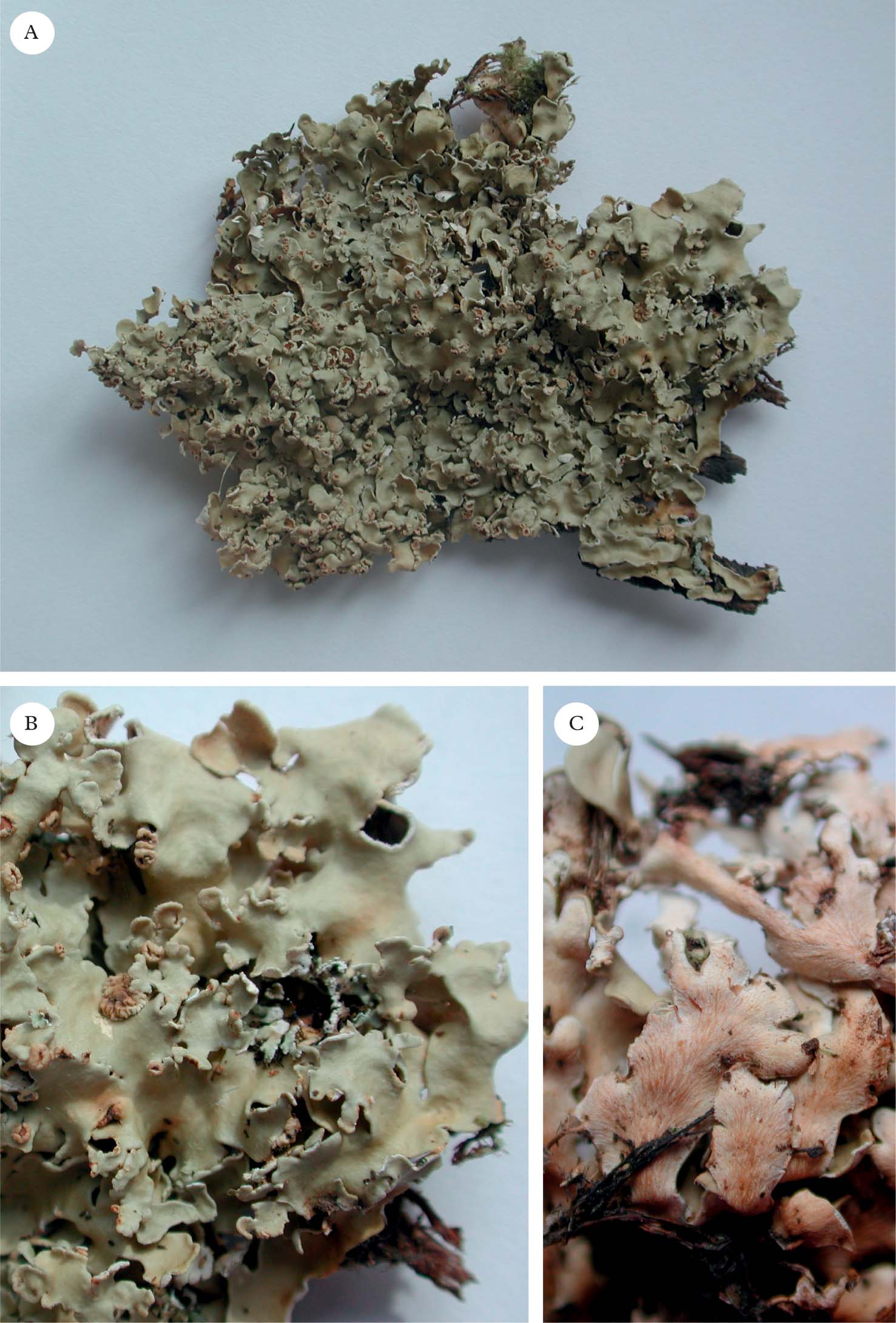
(Fig. 1)
Pannaria howeana (holotype). A, general habit; B, detail, showing suberect lobules and one cephalodium; C, lower side of lobes with radially arranged hyphae.
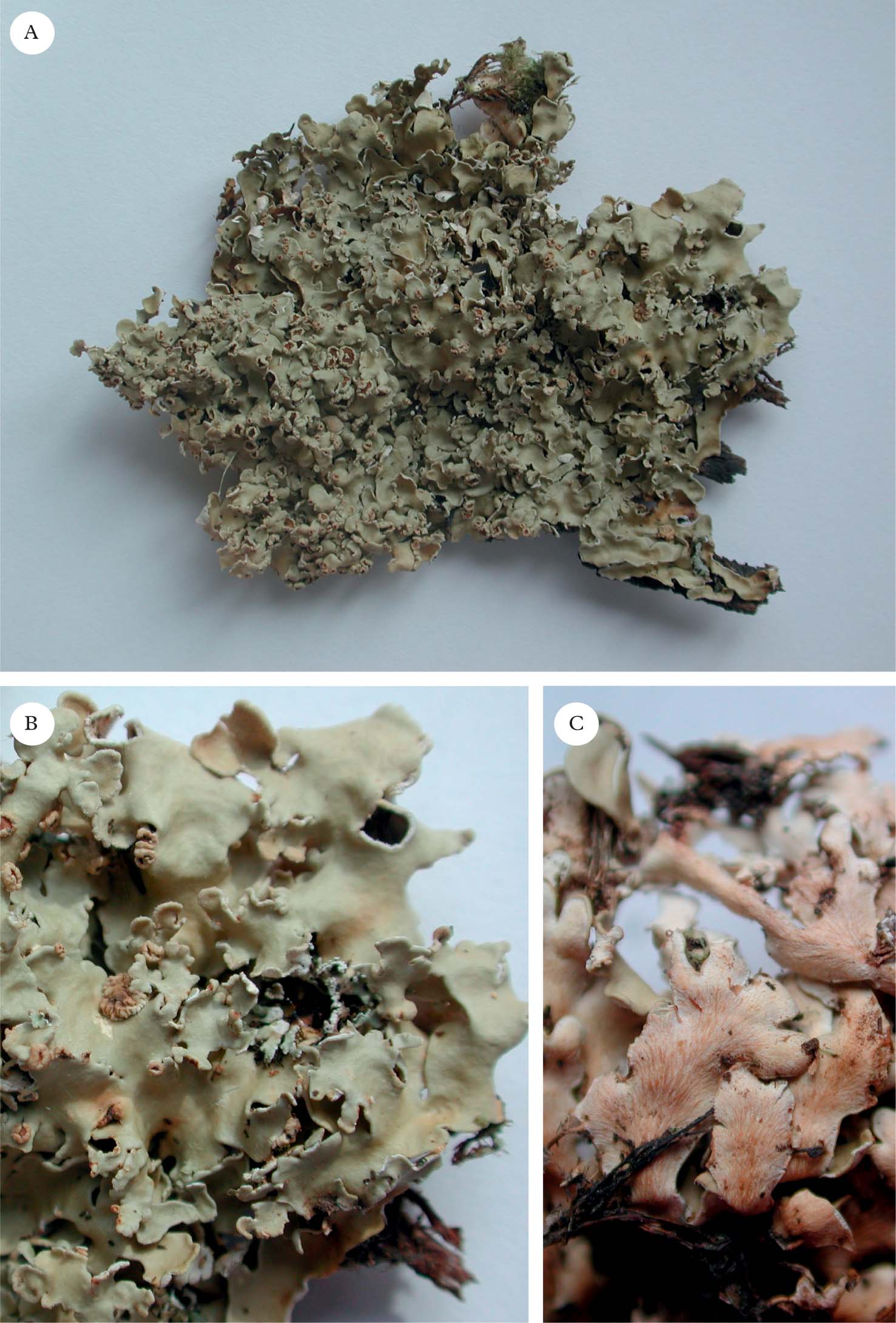
Thallus foliose, corticolous, forming rosettes 5–10 cm diam., very loosely attached to the substratum. Lobes 180–250 μm thick, irregularly branched, discrete to slightly overlapping in peripheral parts, coalescing centrally, weakly concave, 1·5–3·0 mm broad; ascending and partly incurved lobules, without basal constrictions, c. 0·5×2·0 mm, also present; margins distinctly and very narrowly recurved. Prothallus not observed. Upper surface probably pale greenish grey when fresh and dry, changing to pale yellowish brown after storage in herbaria, glossy and glabrous, except very weakly tomentose close to margins. Upper cortex 50–60 μm thick, without pigmentation and without colour change after application of water to old herbarium specimens, paraplectenchymatous, surface layer sclerenchymatous, lumens globose and small above, elongated and 7–12 μm long below, walls 3–5 μm thick. Photobiont layer 20–30 μm thick, of globose to subglobose very small cf. Myrmecia cells, 2·5–3×2·5–5 μm in size. Medulla 100–140 μm thick. Lower cortex lacking, but lowermost part of the medulla forming a distinct pattern of longitudinally radiating and pale brown hyphae; rhizines sparse, pale brown and simple, 2–3 mm long, mostly arranged in central parts of lobe systems.
Cephalodia common, laminal on the upper side, 1·0–2·5 mm long, placodioid and pulvinate, lobes irregularly arranged and convex; upper cortex as in the chlorobiont; cyanobiont cf. Nostoc, cells bluish green, subglobose to ellipsoid, 3–6×3–4 μm, organized within indistinct spherical glomeruli, 10–20 μm wide, delimited by a mucilaginous sheath; no chain structures observed.
Apothecia common, laminal, substipitate, 1·0–2·5 mm broad, discs rufous brown, plane to weakly concave, occasionally with a deposited thalline granule; thalline excipulum crenulate-striate, distinctly incurved; epithecium brown, 15–20 μm thick, IKI−; hymenium colourless, but IKI+ blue, 100–120 μm thick; hypothecium light brown, IKI−, 60–90 μm thick; paraphyses simple to sparingly branched, c. 2·5 μm thick, multiseptate, slightly swollen near the septa; asci clavate, 100–120×15–20 μm, no internal amyloid structures observed, with eight ascospores. Proper ascospores ellipsoid, 13·5–17·0×8–10μm, irregularly verrucose; perispores ellipsoid, 14–18×9–11 μm, smooth when immature, gradually developing verrucae on a c. 0·5 μm thick wall, without apical extensions.
Chemistry. TLC: porphyrilic acid and vicanicin (major), leprolomin (nil to minor), unidentified terpenoids (trace). HPLC (isotype at H): porphyrilic acid (major), vicanicin minor), leprolomin (very weak trace).
Etymology. Named after Lord Howe Island, which is the only known locality of this species.
Pannaria streimannii Elvebakk sp. nov.
MycoBank No: MB 563996
Pannariae howeanae similis, nisi quod apotheciis destituta et phyllidiis instructa est.
Typus: Australia, New South Wales, Lord Howe Island, Mt. Gower summit area, 31°35′12″S, 159°04′38″E, 820 m alt. Low vegetation dominated by Metrosideros nervulosa, Zygogynum howeanum, Dysoxylum pachyphyllum, Dracophyllum, tree ferns and palms, on treelet (Atractocarpus stipularis) stem, 11 February 1995, leg. H. Streimann 56128 (CANB—holotype!; B, H—isotypi).
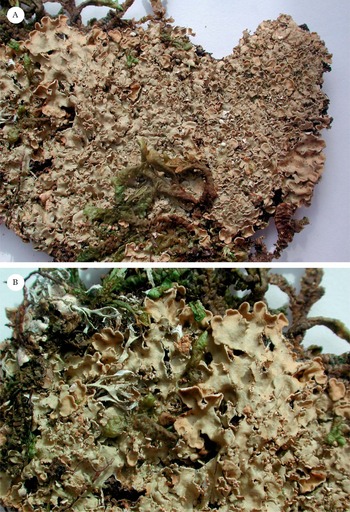
(Fig. 2)
Pannaria streimannii (holotype). A, general habit; B, detail showing phyllidia.

Similar to P. howeana, except for the following:
Lobes partly covered laminally with a sparse tomentum. Phyllidia common, semi-erect, 0·2–1·0 mm wide, occasionally up to 2·5 mm, orbicular or nearly so, constricted at base, other ascending lobules not seen.
Apothecia not seen.
Etymology. Named after Heinar Streimann (1938–2001), an outstanding collector and student of bryophyte and lichen biodiversity, particularly within Australasia, who collected both this species and P. howeana on Mt. Gower.
Additional collection. Australia: New South Wales: Lord Howe Island, slope of Mt. Gower, August 1981, P. M. Jørgensen s. n. (BG L-44187).
Discussion
The two new species are obviously closely related, with P. streimannii considered to be a phyllidiate counterpart of P. howeana. Both differ considerably from other known tripartite Pannaria species. The most distinctive feature is their exclusive chemosyndrome, combining vicanicin and leprolomin with porphyrilic acid. The last substance is known from several pannarin-containing species within Pannariaceae, in addition to being known from a number of Psoroma species as a related compound, mostly referred to as porphyrilic acid methyl ester (methyl porphyrilate). There are no reports in the literature of porphyrilic acid co-occurring with vicanicin/leprolomin, nor is this combination known from numerous unpublished TLC analyses of Pannariaceae specimens made by the present author.
It has been established that secondary chemistry is of particular taxonomic importance in tripartite Pannaria species (see review by Elvebakk & Elix Reference Elvebakk and Elix2006). One might speculate that the occurrence of porphyrilic acid here represents an occasional divergence to its usual association with pannarin in several Pannaria species. However, the HPLC analysis of P. howeana showed that porphyrilic acid, including a twin peak with slightly higher retention value, had a peak six times higher than vicanicin. Although the peak height is not an accurate indication of relative concentrations of these two substances, this result makes it unlikely that porphyrilic acid is an accessory compound.
Morphologically, the two species appear most strongly related to the New Zealand species P. araneosa (C. Bab.) Hue. The lobes are large and broad, although not as broad as in P. araneosa. Their tomentum is either sparse or rudimentary along margins, in contrast to its more prominent development in P. araneosa.
However, all these species have just a few rhizines in older parts of their thalli, and are therefore loosely attached to the substratum. Their lower sides have a very characteristic pattern of long, adpressed, longitudinal and radiating hyphae following the branching of the lobes, similar to the morphology of many Heterodermia species (Fig. 1C). Their lobes also have a characteristic very narrow and distinct recurved margin representing the growth zone.
Pannaria araneosa is currently being studied (A. Elvebakk, J. A. Elix & T. Dahl, unpublished data), and details of its anatomy, chemistry and distinguishing features compared with other, mostly undescribed, species are not known, although its chemosyndrome consists of compounds in the vicanicin complex. Further studies involving molecular analyses are needed to support the hypothesis presented here that these three species form a phylogenetically distinct clade within the group of tripartite foliose Pannaria species. Although stated to be widely distributed in New Zealand by Galloway (Reference Galloway2007), unpublished data suggests that P. araneosa is restricted to northern areas of the country. This would be consistent phytogeographically, given the occurrence of P. howeana and P. streimannii on subtropical Lord Howe Island.
The chlorobiont cells of both Lord Howe Island species are myrmecioid, but significantly smaller than those of all other Pannaria species studied by the present author. Another interesting aspect is that the thalli of the herbarium specimens, now 16 to 30 years old, are pale olive green, without the strong dark brown or yellowish brown pigmentation observed in other old tripartite Pannaria specimens. In addition, the dead P. howeana and P. streimannii thalli do not change colour to violet-brown immediately after exposure to water, as is the case with most other tripartite Pannaria species. It is still not known whether this is due to the breakdown of specific chlorobiont strains, or whether it is due to the particular mycobionts or their symbioses.
The perispores are verrucose in P. howeana, a feature shared by many tripartite Pannaria species. However, in P. howeana the proper spore wall is also verrucose, which is a far less common feature in this group of lichens.
In an evolutionary context, the presence of two related, locally endemic species from this isolated island is interesting. The small (10 km2) and isolated Lord Howe Island is situated 600 km east of continental Australia and more than twice that distance from New Zealand, is of volcanic origin and is estimated to be 6·9 million years old. Its vascular flora comprises 249 species, of which 103, or 40 %, are endemic, and mostly with relationships to species in adjacent territories (Hutton Reference Hutton2002). The vascular flora also includes several endemic genera.
The present study has established that a corresponding evolutionary process has taken place within the genus Pannaria leading to local endemism. The situation is similar to that of the Juan Fernández Archipelago in the eastern Pacific, islands which are only slightly younger, and of similar distance from the nearest continent. Their level of vascular plant endemism at species and generic level is in the same range, although higher at Juan Fernández, an archipelago which has higher habitat diversity. According to our current knowledge, the Juan Fernández Archipelago houses three local endemic species of Pannaria and Psoroma, in addition to a higher number of several widespread species present on the South American mainland.
Lord Howe Island provides another site to study the balance between long-distance dispersed and local endemic taxa within this group of lichens. Pannaria howeana probably required a long evolutionary period to develop from its presumed ancestors, which could be the P. araneosa lineage in New Zealand or an unknown group in Australia. Pannaria sphinctrina (Mont.) Tuck. ex Hue is a well-known primarily fertile, foliose tripartite Pannaria species which appears to be evolutionarily old based on its panaustral distribution pattern, whereas other primarily fertile species in this group either have more restricted distribution patterns, or are not well understood. Interestingly, no primarily fertile species other than P. howeana are known to be local endemics, except P. rolfii Elvebakk in ed. (Elvebakk Reference Elvebakk2012). Pannaria streimannii is presumed to be a secondary species that evolved from P. howeana. The co-occurrence of two related species with different vegetative propagules matches the situation both in the P. leproloma and in the P. sphinctrina complexes (Elvebakk et al. Reference Elvebakk, Fritt-Rasmussen and Elix2007; Lumbsch et al. Reference Lumbsch, Ahti, Altermann, Amo de Paz, Aptroot, Arup, Bárcenas Peña, Bawingan, Benatti and Betancourt2011).
Both species have conspicuous vegetative propagules. The phyllidia of P. streimannii become so large that it was tempting to refer to them as lobules, although they maintain the same basal constrictions as normally sized phyllida (Fig. 2B). In addition to its abundant apothecia and primary thallus lobes, P. howeana produces brittle, erect to recurved secondary lobes which evidently function as vegetative propagules (Fig. 1B), an adaptation which is not known from other primarily fertile tripartite Pannaria species. The particularly large diaspores developed during the evolution of these two species parallels the development of gigantism in vascular plant diaspores on isolated islands. Such evolutionary adaptation to short-distance dispersal is a classical aspect of island biogeography (see e.g. Carlquist Reference Carlquist1966). This is particularly pronounced in small, moist forests of evolutionarily old islands, a situation which matches Lord Howe Island.
Obviously, there is a great need to investigate the population status of these two species, both with holotypes originating from the summit area of Mt. Gower. The additional specimen of P. streimannii collected by Jørgensen was growing on rock on the slopes of Mt. Gower, where it was probably common (P. M. Jørgensen, pers. comm.). The populations collected by Streimann were probably quite large, given that duplicates of both were sent to the herbaria B and H, as well as to NY in the case of P. howeana. Both collections at B had been determined as Psoroma microphyllizans (Nyl.) D. J. Galloway. Care should be taken when new species are described based on one or two collections only. However, these two species were found to be very distinct, and they are considered here to doubtlessly represent new species, although there is a need to study their variation, for example in propagule size, from a larger number of samples.
Curators of the herbaria AK, BG, BM, CANB, H, PC, S, TROM, UPS, and WELT are acknowledged for permitting study visits, and CANB and H for loans of material presented here. Tina Dahl, then at the Department of Biology, University of Tromsø, is acknowledged for the HPLC analysis of one sample, Per P. Aspaas, University of Tromsø Library, kindly translated the texts in Latin, and Professor P. M. Jørgensen, University of Bergen, kindly supplied information about the collection on the slope of Mt. Gower, and, together with an anonymous referee, commented on the manuscript.