INTRODUCTION
Voice is a proactive and challenging extra-role behavior, aiming at benefiting the organization (LePine & Van Dyne, Reference Liang, Farh and Farh2001; Detert & Burris, Reference Detert and Edmondson2007). Voice plays an increasingly important role in the dynamic and uncertain business environment, including crisis prevention (Schwartz & Wald, Reference Scott and Bruce2003), helping managers to identify and respond to threats and opportunities (Grant, Reference Greguras and Diefendorff2013), innovation (Scott & Bruce, Reference Sheldon, Ryan and Reis1994; LePine & Van Dyne, Reference LePine and Van Dyne1998), and team learning (Edmondson, Reference Edmondson1999; Liang, Farh, & Farh, Reference Lindell and Whitney2012). Some researchers (e.g., Edmondson, Reference Edmondson1996; Gladwell, Reference Greenberg, Solomon, Pyszczynski, Rosenblatt, Burling, Lyon, Simon and Pinel2008; Grant, Reference Greguras and Diefendorff2013) have indicated that lack of voice correlates with organizational disasters such as medical errors and airline crashes. Scholars thus have explored the antecedents of voice at the organizational and individual levels, such as organizational context (Dutton, Ashford, O’Neill, Hayes, & Wierba, Reference Edmondson1997; Edmondson, Reference Edwards and Lambert2003), leadership behavior (Detert & Burris, Reference Detert and Edmondson2007), individual personality (LePine & Van Dyne, Reference Liang, Farh and Farh2001; Crant, Reference Deci2003), and individual psychological factors (Liang, Farh, & Farh, Reference Lindell and Whitney2012; Takeuchi, Chen, & Cheung, Reference Tangirala, Kamdar, Venkataramani and Parke2012).
Despite these progresses, current approaches to examining voice can still be improved in several ways. First, most studies (i.e., Eisenberg, Fasolo, & Davis-LaMastro, Reference Ferris, Brown, Berry and Lian1990; Detert & Burris, Reference Detert and Edmondson2007; Tucker, Chmiel, Turner, Hershcovis, & Stride, Reference Vallerand2008) examine how support from organization and supervisor promotes employees’ voice. However, few studies have investigated the influence of negative factors, such as ostracism, being ignored and excluded by others (Williams, Reference Williams2001), on employees’ voice behavior. Second, the role of new employees’ voice behavior has received scant attention. Even that some newcomers are self-confident about their competence, organizational adjustment is a new learning experience for them. This adjustment phase can be precarious and stressful (Van Maanen & Schein, Reference Vansteenkiste and Ryan1979; Bauer & Truxillo, Reference Bauer, Bodner, Erdogan, Truxillo and Tucker2000), characterized by shocks, surprises (Kim, Cable, & Kim, Reference Malhotra, Kim and Patil2005), and anxiety (Katz, Reference Kim, Cable and Kim1985). Thus, newcomers’ motivation to speak up during their adjustment phases should be a topic of great importance. Third, previous studies have explored the impact of several psychological factors in isolated ways (e.g., Fuller, Marler, & Hester, Reference Gagné and Deci2006; Detert & Burris, Reference Detert and Edmondson2007). Studies indicate that certain proximal motivations are prone to predict coexistent voice behavior (Van Dyne, Ang, & Botero, Reference Van Dyne, Ang and Botero2003; Liang, Farh, & Farh, Reference Lindell and Whitney2012). Our research attempts to investigate how multiple psychological factors synergistically influence voice.
We adopt self-determination theory (Deci & Ryan, Reference Deci, Ryan, Gagné, Leone, Usunov and Kornazheva1980) to examine how ostracism affects newcomer’s voice behavior. This theory defines three basic psychological needs that are essential for individual integrity and development: competence, relatedness, and autonomy (Ryan, Sheldon, Kasser, & Deci, Reference Ryan, Sheldon, Kasser and Deci1996). Failure or frustration of these basic needs satisfaction has a negative influence on individuals (Gagné & Deci, Reference Gerber and Wheeler2005). These negative outcomes include well-being reduction, rejection to external contingencies, and negative affect to organization (Lanaj, Johnson, & Lee, Reference LePine and Van Dyne2016; Van den Broeck, Ferris, Chang, & Rosen, Reference Van den Broeck, Ferris, Chang and Rosen2016). Moreover, current study reveals that when social context is not supportive and makes employees’ psychological needs thwarted, they tend to be defensive (Vansteenkiste & Ryan, Reference Vecchio2013). Thus, ostracism deprives people of the satisfaction of three psychological needs (Williams & Sommer, Reference Williams1997) and may have negative effects on employees’ motivation to benefit organization, including hindering employees’ voice behavior. Therefore, we believe self-determination theory is an appropriate perspective to explore the relationship between ostracism and newcomers’ voice behavior.
We also investigate how narcissistic individuals respond when they feel ostracized. According to self-determination theory, individuals tend to maintain a positive feeling of the self. Individuals with high narcissism are expected to have an inflated evaluation of self (Morf & Rhodewalt, Reference Nahrgang, Morgeson and Ilies2001). They pursue superiority and have the need for dominance of their environment (Campbell, Reeder, Sedikides, & Elliot, Reference Campbell, Reeder, Sedikides and Elliot2000). Meanwhile, narcissists are also fragile and sensitive about their inflated self-views, and they exert great effort to maintain their ego (Morf & Rhodewalt, Reference Morf and Rhodewalt1993; Rhodewalt & Eddings, Reference Rollag, Parise and Cross2002; Wallace & Baumeister, Reference Wei, Zhang and Chen2002). As such, the narcissist may be vulnerable to the negative influence of ostracism, because their perception of being ignored by others would harm their positive self-views, which in turn affects their voice behavior. Therefore, we use narcissism as the moderator in the relationship between ostracism and voice.
This study contributes to the literature in several ways. First, we contribute to the self-determination theory by enriching the influence of psychological needs satisfaction. Although the critical role of psychological needs satisfaction in improving individual outcomes are noticed (Vallerand, Reference Van Dyne, Cummings and McLean Parks2000; Greguras & Diefendorff, Reference Gladwell2009), self-determination theory does not specify whether and how psychological needs satisfaction influences these outcomes. Therefore, efforts are needed to identify these outcomes (Greguras & Diefendorff, Reference Gladwell2009). Existing studies indicate that psychological needs satisfaction can promote well-being (Sheldon, Ryan, & Reis, Reference Skinner1996), work engagement (Deci, Ryan, Gagne´, Leone, Usunov, & Kornazheva, Reference Detert and Burris2001), affective organizational commitment, and task performance (Greguras & Diefendorff, Reference Gladwell2009). However, the influence of psychological needs satisfaction on voice, a challenging proactive behavior, has not been examined. In addition, existing self-determination theory literature mainly focuses on factors that can satisfy or enhance psychological needs satisfaction. Studies on factors that frustrate psychological needs satisfaction should be conducted (Van den Broeck et al., Reference Van den Broeck, Ferris, Chang and Rosen2016). In this study, we contribute to this gap by examine how workplace thwarts newcomers’ psychological needs satisfaction.
Second, we extend voice study by examining when employees are motivated to speak up from a systematical perspective. Voice has been explored from the perspectives of social exchange theory, social identity theory, and mood as feedback theory (Edmondson, Reference Edwards and Lambert2003; Tangirala, Kamdar, Venkataramani, & Parke, Reference Tucker, Chmiel, Turner, Hershcovis and Stride2013). However, what these theories may neglect is the motivational state of voice. In their study, Parker, Bindl, and Strauss (Reference Pavot and Diener2010) argued that employees speaked up only when their motivational states signaled that they ‘can do’ so or that they had a ‘reason to’ or were ‘energized to’ do so. In our study, we intend to examine whether the three psychological needs (i.e., autonomy, competence, and relatedness) can motivate employees to speak up.
Third, we shed light on newcomers’ voice behavior in organizations. Voice is challenging in general (Van Dyne, Cummings, & McLean Parks, Reference Van Dyne, Kamdar and Joireman1995) and thus can be a challenge specifically for leaders (Tangirala & Ramanujam, Reference Tangirala and Ramanujam2008). The disruptive aspects of voice behavior can backfire on employees, resulting in a loss of trust, respect, promotion, or other career opportunities (Milliken, Morrison, & Hewlin, Reference Morrison and Milliken2003; Tangirala & Ramanujam, Reference Tangirala and Ramanujam2008). Considering these risks, employees sometimes may feel reluctant to express their voice (Milliken, Morrison, & Hewlin, Reference Morrison and Milliken2003). Newcomers’ voice behavior exhibits considerable differences between those of other employees. Compared with employees with longer tenures, newcomers have less social status (Vecchio, Reference Wallace and Baumeister2005) and face more challenges in their works (Louis, Reference Milliken, Morrison and Hewlin1980). New employees may be more prone to anxiety and frustration and thus may have different attitudes toward voice behavior when compared with seasoned employees. Our study attempts to define these differences and help scholars to understand how the transition to a new work environment affects newcomer’s proactive behaviors.
THEORY AND HYPOTHESES
Self-determination theory
Self-determination theory holds that individuals’ behaviors consist of three basic psychological needs: autonomy, competence, and relatedness (White, Reference Williams1963; deCharms, Reference deCharms1968; Deci, Reference Deci and Ryan1975; Baumeister & Leary, Reference Baumeister and Leary1995). These three needs are innate and universal for all individuals (Ryan & Deci, Reference Saks and Ashforth2000). Individuals satisfy these three basic psychological needs through social interaction and self-perception. These intrinsic behaviors help to internalize personal values and to promote self-realization and self-growth (Ryan et al., Reference Ryan, Sheldon, Kasser and Deci1996). Self-determination theory posits that understanding an individual’s development requires understanding his or her internal psychological needs, social environmental conditions, and the relationship between these two factors (Deci & Ryan, Reference Deci, Ryan, Gagné, Leone, Usunov and Kornazheva1980). The role of social context is critical for individuals’ behaviors. Specifically, social context can satisfy employees’ needs and frustrate their needs, bringing very different influences in employees’ development (Lam, Law, Chan, Wong, & Zhang, Reference Lanaj, Johnson and Lee2015).
Moreover, self-determination theory argues that external environments are critical to the process of internalization and integration of individuals’ extrinsic motivation (Pavot & Diener, Reference Poile2013; Yam, Klotz, He, & Reynolds, Reference Bruneau2017). The social–contextual events that satisfy people’s psychological needs can thus promote intrinsic motivation, whereas failure to meet these needs can undermine intrinsic motivation (Deci, Reference Deci and Ryan1975; Ryan & Deci, Reference Saks and Ashforth2000; Gagné & Deci, Reference Gerber and Wheeler2005). Recent studies find that fulfillment of these three psychological needs can promote employees’ psychological well-being and positive affect to organization (Pavot & Diener, Reference Poile2013; Lanaj, Johnson, & Lee, Reference LePine and Van Dyne2016).
Workplace ostracism and voice
As an act of sabotage within the organization (Duffy, Ganster, & Pagon, Reference Dutton and Ashford2002), workplace ostracism negatively affects employees’ behaviors and attitudes. For example, some studies have shown that workplace ostracism can negatively affect employees’ job performance (Ferris, Brown, Berry, & Lian, Reference Fuller, Hester, Barnett, Frey, Relyea and Beu2008), increase employee turnover (Hitlan, Cliffton, & DeSoto, Reference Hobfoll2006), endanger employee relationships (Gerber & Wheeler, Reference Gerstner, König, Enders and Hambrick2014), and reduce employees’ personal and work satisfaction (Ferris et al., Reference Fuller, Hester, Barnett, Frey, Relyea and Beu2008). Perceptions of ostracism are subject to the individual’s subjective attribution and evaluation (Williams, Reference Williams2001). Williams (Reference Withey and Cooper2009) further argued that ostracism threatened the four fundamental needs at workplace: attachment, self-esteem, control, and meaningful existence.
Liang, Farh, and Farh (Reference Lindell and Whitney2012) divided voice into two parts: promotive voice, which refers to suggestions to improve status quo and to organizational operations, and prohibitive voice, which addresses concerns about issues that may undermine organizational functioning. Promotive voice can facilitate positive actions, such as favorable performance evaluation and recognition of leaders (Dutton & Ashford, Reference Dutton, Ashford, O’neill, Hayes and Wierba1993; Stamper & Van Dyne, Reference Takeuchi, Chen and Cheung2001). Prohibitive voice can challenge (Van Dyne, Cummings, & McLean Parks, Reference Van Dyne, Kamdar and Joireman1995) and even threaten organizational harmony and leaders (Milliken, Morrison, & Hewlin, Reference Morrison and Milliken2003; Tangirala & Ramanujam, Reference Tangirala and Ramanujam2008). Employees who use prohibitive voice may experience undesired outcomes, such as loss of trust among coworkers and supervisors and loss of promotion (Milliken, Morrison, & Hewlin, Reference Morrison and Milliken2003; Tangirala & Ramanujam, Reference Tangirala and Ramanujam2008). Employees therefore may engage in voice behavior only when the benefits outweigh the costs (Dutton et al., Reference Edmondson1997; Milliken, Morrison, & Hewlin, Reference Morrison and Milliken2003).
When explaining voice behavior, some scholars focus on employees’ perceptions of safety at workplace (e.g., psychological safety created via management openness and leadership) as the driving forces of employee voice (Withey & Cooper, Reference Yam, Klotz, He and Reynolds1989; Edmondson, Reference Edwards and Lambert2003; Detert & Edmondson, Reference Duffy, Ganster and Pagon2007; Wei, Zhang, & Chen, Reference White2015). Others consider achieving benefits for the organization as the motivation behind employees’ voice behavior. Employees are likely to voice constructive suggestions to benefit the organization when their self-esteem is enhanced (Fuller, Hester, Barnett, Frey, Relyea, & Beu, Reference Fuller, Marler and Hester2006) or when they have a high-quality relationship with leaders (Van Dyne, Kamdar, & Joireman, Reference Van Maanen and Schein2008; Liu, Zhu, & Yang, Reference Louis2010). As previously indicated, most voice studies are conducted from a single perspective that cannot completely reveal the uniqueness of voice. Moreover, scholars (i.e., Van Dyne, Ang, & Botero, Reference Van Dyne, Ang and Botero2003; Liang, Farh, & Farh, Reference Lindell and Whitney2012) have argued that some factors may coexist in forecasting voice behavior. Therefore, we suggest that studies focus on how motivation drives employee voice when explaining voice behavior. In our current study, we investigate the relationship between the newcomers’ satisfaction of basic psychological needs and their voice behavior.
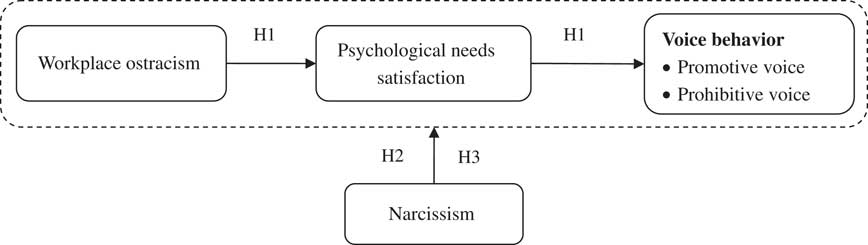
New employees maintain a relatively low social status in their organizations (Vecchio, Reference Wallace and Baumeister2005). They confront many challenges and obstacles in their new jobs (Louis, Reference Milliken, Morrison and Hewlin1980). In such conditions, newcomers have a strong desire to establish their identity and to be recognized by their organizations (Ashforth & Mael, Reference Ashforth and Mael1989). They also want to develop good relationships with their coworkers and supervisors (Berger & Calabrese, Reference Berger and Calabrese1975). In other words, newcomers seek to fulfill their competence, relatedness, and autonomy needs. Feelings of ostracism during this stage can exert a significant negative influence on the satisfaction of these psychological needs. As previously indicated, voice is a challenging and proactive behavior. Employees speak up if they feel comfortable to do so (Parker, Bindl, & Strauss, Reference Pavot and Diener2010). Ostracism prevents employees from meeting their psychological needs and undermines their intrinsic motivation, which in turn distorts their intentions to speak up. In this study, we use self-determination theory to establish the mechanism of how workplace ostracism affects new employees’ voice behavior. Figure 1 displays our theoretical framework.
Conceptual model

Mediating role of psychological needs satisfaction
Satisfaction of psychological needs derives from three aspects: autonomy, competence, and relatedness (Deci & Ryan, Reference Deci, Ryan, Gagné, Leone, Usunov and Kornazheva1980). Autonomy is the individual ability to make independent choices (deCharms, Reference deCharms1968; Deci, Reference Deci and Ryan1975). Workplace ostracism creates pressure and anxiety for new employees, which diminishes their sense of control over their work and their ability to make self-adjustments (Bruneau, Reference Buss and Chiodo1973; Baumeister, Dewall, Ciarocco, & Twenge, Reference Baumeister, DeWall, Ciarocco and Twenge2005). It prevents employees from making independent choices and thus threatens their autonomy.
Competence is the ability to respond to various challenges to achieve desired results (White, Reference White1959; Skinner, Reference Stamper and Dyne1995). Feeling excluded at the workplace can cause employees to lose focus, which negatively affects their performance. They may even doubt the value of their work (Cooley, Reference Crant1902; Greenberg et al., Reference Grijalva and Harms1992). These factors harm the employees’ competence (Hitlan, Cliffton, & DeSoto, Reference Hobfoll2006).
Relatedness is the sense of belonging in an organization and harmonious relations with others in a working group (Baumeister & Leary, Reference Baumeister and Leary1995). Workplace ostracism signals to the focal employee that he or she is not accepted by the organization. It may reduce the employee’s sense of belonging (Williams, Reference Williams and Sommer2007). It also damages relationships between the employee and other colleagues, which in turn reduces the employee’s satisfaction of relatedness need. Therefore, ostracism is expected to have negative influence on newcomer’s psychological needs satisfaction.
According to self-determination theory, if the organization cannot satisfy employees’ basic psychological needs, it may deprive employees of their intrinsic motivation to conduct behaviors that benefit the organization (Gagné & Deci, Reference Gerber and Wheeler2005). Hobfoll (Reference Jones1989) also pointed out that when employees’ psychological needs were not fulfilled, they might spend time and resources engaging in self-adjusting activities instead of work tasks, thus decreasing their extra-role behaviors (Vansteenkiste & Ryan, Reference Vecchio2013). They instead engage in self-protection to fix the sense of imbalance caused by other incidents (Organ, Reference Orth and Luciano1988; Lam et al., Reference Lanaj, Johnson and Lee2015). Thus, newcomers’ psychological needs satisfaction can promote voice behavior.
In accordance with self-determination theory, employees are motivated to conduct extra-role behaviors for either autonomous motives (factors that intrinsically meet individual’s interest or are consistent with their values or the sense of the self) or controlled motives (factors driven by an external locus of causality, such as expectations and roles) (Ryan & Deci, Reference Saks and Ashforth2000; Yam et al., Reference Bruneau2017). Either autonomous or controlled motives can shape employees’ behaviors. When the three psychological needs are satisfied, psychological internalization (a proactive process to transform external reasons for behavior into internal reasons that promote psychological growth and well-being) will be promoted (Ryan & Deci, Reference Saks and Ashforth2000). With psychological internalization, employees can experience meaning even with an unenjoyable job (Poile, Reference Raskin, Novacek and Hogan2017). Such experience will motivate employees to benefit organization. The purpose of voice is to benefit organization. In this case, employees’ voice is likely to be enhanced.
In contrast, at workplace of ostracism or social exclusion, employees’ psychological needs are frustrated or thwarted, which will hinder their psychological internalization. As mentioned, voice is a risky behavior for employees. When employees’ psychological needs are frustrated, they tend to be defensive and silent (Vansteenkiste & Ryan, Reference Vecchio2013). To summarize all the above, we present the following hypothesis:
Hypothesis 1: Psychological needs satisfaction mediates the negative influence of workplace ostracism on voice behavior.
Moderating effect of narcissism and moderated mediation effect
Narcissism means the strong tendency of inflated self-evaluation and superiority, keeping the self-view continuously improved (Gerstner, König, Enders, & Hambrick, Reference Grant2013). Based on summary by the DSM-5 (American Psychiatric Association, 2013), employees with high narcissism have strong need for public admiration and desire to control others at workplace. Typically, they have such characteristics as superiority, self-centeredness, and entitlement (Ackerman, Witt, Donnellan, Trzesniewski, Robins, & Kashy, Reference Ackerman, Witt, Donnellan, Trzesniewski, Robins and Kashy2011; Orth & Luciano, Reference Parker, Bindl and Strauss2015). As such, they tend to be more sensitive to the external environment than are those with a low level of narcissism.
We argue that under conditions of workplace ostracism, the difference in narcissism levels among employees can result in discrepancies in the fulfillment of psychological needs. First, employees with high narcissism tend to be superior in their minds (Gerstner et al., Reference Grant2013), believing that they are highly intelligent. They are overconfident in their abilities (Campbell, Goodie, & Foster, Reference Cooley2004; Judge, LePine, & Rich, Reference Lam, Law, Chan, Wong and Zhang2006). In addition, narcissists have the need to dominate their organizations (Raskin, Novacek, & Hogan, Reference Rhodewalt and Eddings1991; Gerstner et al., Reference Grant2013). Ostracism implies the rejection of chance to grow and is likely to be the obstacle for narcissists’ needs for their competence, entitlement, and their pursuit of ‘unlimited success’ (Grijalva & Harms, Reference Grijalva, Harms, Newman, Gaddis and Fraley2014). Consequently, the negative influence of ostracism on need for competence is stronger for employees with high narcissism than low narcissism.
Second, we expect that ostracism may have different influences on needs for relatedness and autonomy for employees with different level of narcissism. Narcissists have the desire for attention and applause (Buss & Chiodo, Reference Campbell, Goodie and Foster1991), using their organization as a stage to fulfill their pursuit of being protagonist (Morf & Rhodewalt, Reference Nahrgang, Morgeson and Ilies2001; Bogart, Benotsch, & Pavlovic, Reference Bogart, Benotsch and Pavlovic2004; Gerstner et al., Reference Grant2013). Sensation-seeking is also one of their ways to satisfy their need (Emmons, Reference Eisenberg, Fasolo and Davis-LaMastro1987; Gerstner et al., Reference Grant2013). Workplace ostracism is a kind of exclusion, which can frustrate narcissists’ need for attention and applause. Current research also shows that narcissists view ostracism in the workplace as a challenge to their self-views (Hepper, Gramzow, & Sedikides, Reference Hitlan, Cliffton and DeSoto2010).
To summarize, narcissists have the tendency of ‘hypersensitivity to criticism,’ (Grijalva & Harms, Reference Grijalva, Harms, Newman, Gaddis and Fraley2014; Grijalva, Harms, Newman, Gaddis, & Fraley, Reference Gumpel, Wiesenthal and Soderberg2015). Because narcissists unrealistically overestimate their own character, they may view workplace ostracism as threat to their perceived perfection. Their perception of exclusion by others threatens their needs and pursuit of superiority and relatedness (Gumpel, Wiesenthal, & Soderberg, Reference Hepper, Gramzow and Sedikides2015). Therefore, compared with less narcissistic individuals, narcissists are more susceptible to the inhibiting effects of workplace ostracism on their psychological needs. Thus, we present the following hypothesis:
Hypothesis 2: Narcissism may strengthen the negative effect of workplace ostracism on psychological needs satisfaction.
Voice is a risky behavior that may bring undesired outcomes, such as loss of credibility and frustration, to those who speak up (Liang, Farh, & Farh, Reference Lindell and Whitney2012; Takeuchi, Chen, & Cheung, Reference Tangirala, Kamdar, Venkataramani and Parke2012). As mentioned, the narcissists are prone to self-importance, admiration, and excessive attention (Gerstner et al., Reference Grant2013; Grijalva & Harms, Reference Grijalva, Harms, Newman, Gaddis and Fraley2014). Ostracism at workplace will frustrate their need for social dominance and self-image as a powerful social actor (Gumpel, Wiesenthal, & Soderberg, Reference Hepper, Gramzow and Sedikides2015). The negative influence from ostracism on voice behavior of employees with higher narcissism will be stronger than with lower narcissism. In other words, how employees perceive ostracism’s influence on their voice, via their psychological needs satisfaction, may be contingent upon the extent of their narcissism. We thus present that when narcissism of employees is higher, the indirect influence of workplace ostracism on voice through psychological needs satisfaction is stronger than narcissism is lower.
Hypothesis 3: Narcissism may strengthen the indirect effect of workplace ostracism on voice through psychological needs satisfaction. Such indirect effects on voice will be stronger when narcissism is higher rather than lower.
METHOD
Sample and procedure
Based on self-determination theory, the three psychological needs are universal for all human beings. Moreover, few studies use samples from nonindividualistic social context to enrich related research (Van den Broeck et al., Reference Van den Broeck, Ferris, Chang and Rosen2016). Thus, we used samples for Chinese company.
We obtained samples from a large high-technology company in China. Before we conducted survey, we interviewed some employees and knew that relational conflicts and ostracism frequently happened in this company. Because there is no universally accepted definition of newcomers, we collected data from research and development employees who joined the company within less than one year. To avoid common method bias, we used a four-wave method for data collection, with each wave separated by 10 days. We asked newcomers to report control variables (Time 1), their perceived ostracism in the workplace (Time 1), psychological needs satisfaction (Time 2), and narcissism (Time 3). We also asked the supervisors to rate newcomers’ voice behavior (Time 4).
With CEO approval and support from the human resource department, we sent emails to all employees describing the survey and explaining that participation was voluntary and confidentiality was guaranteed. We provided pens and printed questionnaires. We gave the respondents our email addresses and telephone numbers in case they had questions. In Time 1, we handed out 684 questionnaires and obtained 591 valid samples. In Time 2, we obtained 503 valid samples. We matched 353 supervisor–subordinate samples. Respondents completing all-round surveys were given 25 Chinese Yuan as rewards.
Measures
Workplace ostracism
Newcomers were asked to report workplace ostracism with Ferris et al.’s (Reference Fuller, Hester, Barnett, Frey, Relyea and Beu2008) 10-item workplace ostracism scale (α=0.89), which included the following sample item: ‘Please indicate the extent that others ignore you in the workplace.’
Psychological needs satisfaction
We used Kasser, Davey, and Ryan’s (Reference Katz1992) 21-item psychological needs satisfaction scale (α=0.83, composite reliability=0.79). Sample question includes ‘Most days I feel a sense of accomplishment from working.’ Based on previous research (Rosen, Ferris, Brown, Chen, & Yan, Reference Ryan and Deci2014) and for theoretical perspective, we viewed need satisfaction as an overall index rather than separate need satisfaction categories. Moreover, we did not expect every needs to relate differentially to employee outcomes.
Narcissism
We selected five items with the highest loading from the Narcissistic Personality Inventory scale (α=0.76) (Ames, Rose, & Anderson, Reference Ames, Rose and Anderson2006) to measure narcissism. A sample item is ‘I insist upon getting the respect that is due to me.’
Voice behavior
We employed promotive and prohibitive voice developed by Liang, Farh, and Farh (Reference Lindell and Whitney2012), to measure employees’ voice behavior. Cronbach’s α is 0.90 for both promotive and prohibitive voice scales.
Control variables
We controlled gender, age, education, position, and tenure of employees. Tenure was categorized as the number of months that the employees worked. Education was measured as below college, college, and above college.
RESULTS
Common method test, descriptive statistics, and correlations
Some variables (workplace ostracism, psychological needs satisfaction, narcissism) were from the same source (newcomers) and other variables (promotive voice and prohibitive voice) were from another source (supervisors), first, we employed Harman one-factor test to test the common method effect (Malhotra, Kim, & Patil, Reference Morf and Rhodewalt2006). We loaded all items of workplace ostracism, psychological needs satisfaction, and narcissism on a single latent construct. The fit of this model was not good (χ2[594]=3,164.96, comparative fit index (CFI)=0.70, incremental fit index (IFI)=0.70, root mean square error of approximation (RMSEA)=0.11, standardized root mean square residual (SRMR)=0.13). Similarly, the model of loading all these items of prmotive voice and prohibitive voice on a single factor showed weak fit (χ2[35]=798.67, CFI=0.65, IFI=0.65, RMSEA=0.25, SRMR=0.16). In addition, we further tested common method effect with Marker variable analysis (Lindell & Whitney, Reference Liu, Zhu and Yang2001). After we added the marker variable into our research model, no paths and correlations showed significant changes.
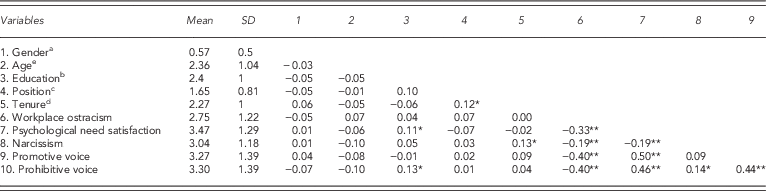
Table 1 presents the descriptive statistics of each variable along with their correlations. Workplace ostracism had a significant negative correlation with psychological needs satisfaction, promotive voice, and prohibitive voice.
Mean, standard deviation and correlations of variables

Note. n=353.
a Gender was measured using two categories: 1= ‘male,’ and 2=‘female.’
b Education was measured using three categories: 1=‘college or below,’ 2=‘college,’ and 3=‘above college.’
c Position in the organization was measured using four categories: 1=‘employee,’ 2=‘first-line manager,’ 3=‘middle manager.’
d Organizational tenure was measured in months.
e Age was categorized into: 20–25; 26–30; 31–35; 36–40.
*p<.05; **p<.01.
Hypothesis testing
To test the mediating effect of psychological needs satisfaction between workplace ostracism and employee voice, we applied methods of Baron and Kenny (Reference Baron and Kenny1986). Psychological needs satisfaction and employee voice were treated as dependent variables, workplace ostracism was treated as an independent variable, and psychological needs was treated as mediating variable. Gender, age, degree of education, position, and tenure were treated as control variables.
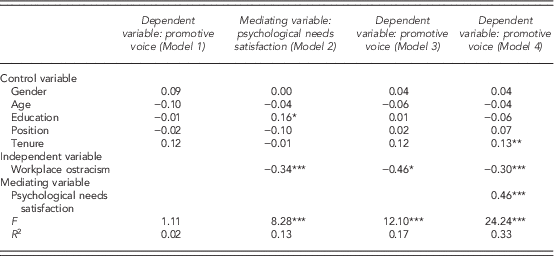
Table 2 shows that the control variables have a nonsignificant impact on promotive voice (Model 1: F=1.11, p>.05) but that the independent variable (i.e., workplace ostracism) had a significant negative effect on psychological needs satisfaction (Model 2: β=−0.34, p<.001). The independent variable alone has a significant negative effect on promotive voice (Model 3: β=−0.46, p<.05). When the mediating variable was added, psychological needs satisfaction significantly affected promotive voice (Model 4: β=0.46, p<.001). The regression coefficient of the independent variable dropped to 0.34 from 0.30. It indicates a significant mediating effect. The mediating effect exerted by psychological needs satisfaction between workplace ostracism and promotive voice is −0.16. The gross effect shows −0.46 (Model 3), hence the ratio of mediating effect is 34.78%. The independent variable (i.e., workplace ostracism) had a significant predictive effect on promotive voice in Model 4 (β=−0.30, p<.001). We thus concluded that psychological needs satisfaction had a partial mediating effect between workplace ostracism and promotive voice.
Regression analysis result of mediating effect of psychological needs satisfaction (promotive voice)

Note. n=353.
*p<.05; **p<.01; ***p<.001.
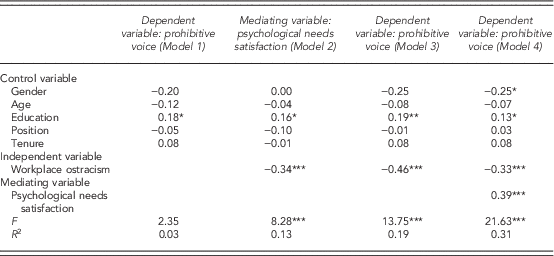
Table 3 reveals that the independent variable (i.e., workplace ostracism) has a negative effect on the mediating variable (i.e., psychological needs satisfaction) (Model 2: β=−0.34, p<.001). The independent variable alone has a significantly negative predictive effect on prohibitive voice (Model 3: β=−0.46, p<.001). After adding the mediating variable, psychological needs satisfaction exerted a significantly positive effect on prohibitive voice (Model 4: β=0.39, p<.001). The regression coefficient of the independent variable dropped to 0.34 from 0.33, indicating the significant mediating effect. The mediating effect of psychological needs satisfaction between workplace ostracism and prohibitive voice was −0.13. Table 3 shows the gross effect is −0.46 (Model 3), hence the ratio of the mediating effect is 28.26%. Because the independent variable (i.e., workplace ostracism) significantly affected prohibitive voice in Model 4 (β=−0.33, p<.001), we concluded that psychological needs satisfaction had a partial mediating effect between workplace ostracism and prohibitive voice.
Regression analysis result of mediating effect of psychological needs satisfaction (prohibitive voice)

Note. n=353.
*p<.05; **p<.01; ***p<.001.
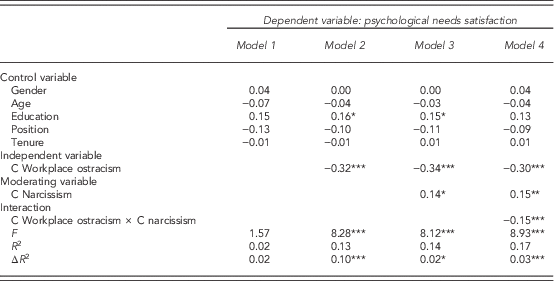
Employing methods of Aiken and West (Reference Aiken and West1991), we tested narcissism’s moderating effect between workplace ostracism and psychological needs satisfaction (Hypothesis 2). We first obtained the mean center of narcissism and workplace ostracism and then multiplied narcissism by workplace ostracism to obtain the interaction effect. We further treated psychological needs satisfaction as a dependent variable and regarded workplace ostracism, narcissism, and workplace ostracism by narcissism as independent variables. We included control variables (gender, age, degree of education, position, and tenure) to conduct layered linear-regression analyses.
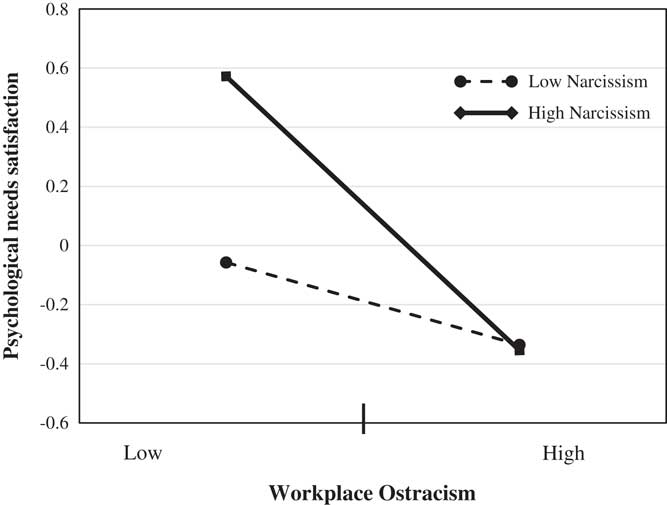
Table 4 shows that the interaction of workplace ostracism by narcissism had a significantly negative effect (Model 4: β=−0.15, p<.001) on psychological needs satisfaction. The fact that significant interaction effect indicates that narcissism may significantly moderate the relation between workplace ostracism and psychological needs satisfaction. Thus, Hypothesis 2 is supported.
Moderating effect of narcissism

Note. n=353. C Workplace ostracism and C narcissism are variables after centering.
*p<.05; **p<.01; ***p<.001.
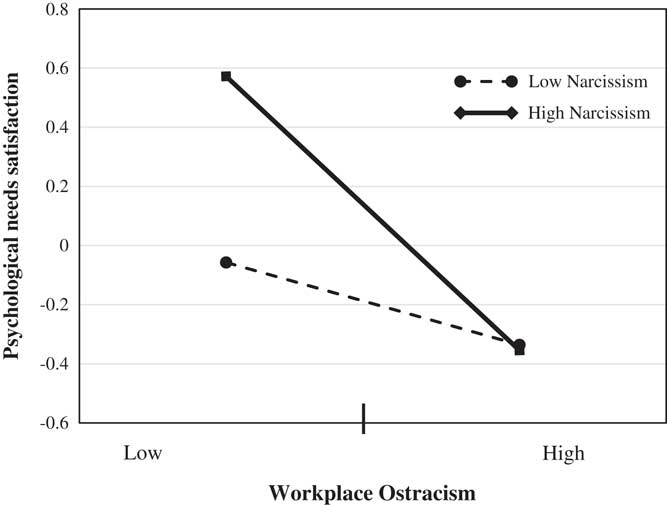
We computed slopes based on two levels of narcissism (i.e., high and low, a standard deviation above and below the mean, respectively) to show the moderating effect. Figure 2 shows the interaction under different levels of narcissism.
Interactive effect of workplace ostracism with narcissism on psychological needs satisfaction
Moderated mediation effect
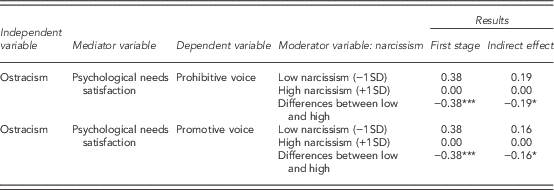
The results reported in Table 5 support the first-stage moderation effects, providing additional support to the moderating role of narcissism between ostracism and psychological needs satisfaction (Hypothesis 2).
Results of the moderated path analysis

Note. n=353. Tests of differences for the indirect and total effect were based on bias-corrected confidence intervals derived from bootstrap estimates.
*p<.05; ***p<.001.
Using the moderated path analysis approach (Edwards & Lambert, Reference Emmons2007), we tested moderating role of narcissism among the indirect effects. As indicated in Table 5, the difference in the indirect effect of workplace ostracism on prohibitive voice was significant (difference= −0.18, p<.05), and the difference in the indirect effect of workplace ostracism on promotive voice was significant (difference =−0.12, p<.05). Therefore, Hypothesis 3 (narcissism may strengthen the indirect effect of workplace ostracism on voice through psychological needs satisfaction) is supported.
DISCUSSION
Theoretical implications
In accordance with self-determination theory, we advanced and tested a moderated mediation model that explains how workplace ostracism influences newcomers’ voice behavior. We found that workplace ostracism negatively influenced newcomers’ promotive and prohibitive voice through the mediating role of psychological needs satisfaction. Our findings also indicated that narcissism moderated the influence of ostracism on psychological needs satisfaction and strengthened the indirect influence of ostracism on voice through psychological needs satisfaction. Actually, recent studies have indicated that social conflict and other negative factors in the workplace can result in undesirable behaviors and attitudes among employees. For instance, social conflict may undermine new employees’ performance (Kammeyer-Mueller, Wanberg, Rubenstein, & Song, Reference Kasser, Davey and Ryan2013). Nahrgang,Morgeson, and Ilies (Reference Nifadkar, Tsui and Ashforth2009) found that workplace ostracism exerted a negative influence on employee performance and extra-role behaviors. Nifadkar, Tsui, and Ashforth (Reference Organ2012) indicated that conflict with coworker frustrated newcomers’ need for belonging.
We believe our study has several theoretical contributions. First, we enrich self-determination theory studies by showing how employees’ psychological needs are frustrated. Traditionally, previous studies on self-determination theory focus on how employees’ needs are satisfied. Factors satisfying and thwarting employees’ psychological needs should be explored to completely identify antecedents of basic psychological needs. In fact, some scholars (Van den Broeck et al., Reference Van den Broeck, Ferris, Chang and Rosen2016) have called for relevant studies on the factors that frustrate psychological needs satisfaction.
Second, we regard psychological needs satisfaction as a primary mechanism through which new employees can be motivated to speak up (Parker, Bindl, & Strauss, Reference Pavot and Diener2010). As a special proactive behavior, voice is driven by various psychological motivations. Psychological needs satisfaction can motivate empower employees to conduct voice. Previously, substantial efforts have explored how and why employees speak up from a narrow perspective, such as psychological safety (Edmondson, Reference Edwards and Lambert2003; Detert & Edmondson, Reference Duffy, Ganster and Pagon2007) and social identity (Van Dyne et al., Reference Van Maanen and Schein2008). Many scholars (e.g., Morrison & Milliken, Reference Kammeyer-Mueller, Wanberg, Rubenstein and Song2000; Liang, Farh, & Farh, Reference Lindell and Whitney2012) call for an integrated perspective in studying voice. We respond to this call by exploring the joint impact of three basic psychological needss on employees’ voice behavior.
Finally, we enriched ostracism study in newcomer context. As individuals become more mobile (Bauer, Bodner, Erdogan, Truxillo, & Tucker, Reference Bauer and Truxillo2007), nearly 25% employees have transitioned to new jobs (Rollag, Parise, & Cross, Reference Rosen, Ferris, Brown, Chen and Yan2005). New employees’ successful organizational socialization thus has become critical for organizations. Previous studies on organizational socialization have focused on the influence of positive factors, such as employees’ information-searching behaviors (Van Maanen & Schein, Reference Vansteenkiste and Ryan1979) and organizational socialization strategies (Jones, Reference Judge, LePine and Rich1986; Saks & Ashforth, Reference Schwartz1997; Allen, Reference Allen2006). Moreover, it is also common for new employees to confront unfavorable contextual factors, such as verbal aggression from leaders (Nifadkar, Tsui, & Ashforth, Reference Organ2012; Kammeyer-Mueller et al., Reference Kasser, Davey and Ryan2013). These factors prevent newcomers’ psychological status and successful socialization. However, few studies have noticed how social exclusion or ostracism frustrates newcomers’ psychological needs and voice behavior. In this study, we found that workplace ostracism could harm newcomers’ promotive and prohibitive voice behavior. These findings may help close the gap in ostracism study.
Practical implications
Our study provides practical implications for organizations. First, during rapid economic development, employees play vital roles in helping their organizations to survive by sharing suggestions and concerns about work-related issues (Van Dyne et al., Reference Van Dyne, Ang and Botero2003; Liang, Farh, & Farh, Reference Lindell and Whitney2012). Companies have thus sought or used various management methods to encourage employee to speak up. Given this situation, studies on factors that may discourage newcomers’ voice behavior can be useful. To encourage voice behavior of new employees, managers and executives should try to reduce workplace ostracism in organization and improve supportive working atmosphere. For instance, executives should encourage and create a cooperative and friendly organization climate. Second, as the agents of organization, leaders also should employ effective management methods to enhance subordinates’ sense of autonomy, competence, and relatedness. By reducing newcomers’ anxiety and satisfying their psychological needs, their work outcomes and voice behavior are likely to be improved.
Finally, with transitions to new work environments, new employees’ successful adjustment has become a concern for managers. In our study, we shed light on the possible negative effects of ostracism on these adjustment periods. Understanding the risks of ostracism can help to identify measures to mitigate its negative effects on newcomers.
Limitations and future research
Our study may have potential limitations. The first is that we did not distinguish between coworker and supervisor ostracism. Although some studies have found no major difference between the effects of supervisor and coworker undermining on newcomer’s performance (Kammeyer-Mueller et al., Reference Kasser, Davey and Ryan2013), leaders may have greater influence than coworkers on employees’ behavior and attitudes, because they are the agents of the organization.
Second, Chinese culture prioritizes harmonious relationships and friendly ties between people and thus participants may do not want to report interpersonal conflicts than other cultural contexts. In this regards, social desirability should be considered when using Chinese samples. The Chinese proverb ‘silence is golden’ reflects its culture. In addition, although Liang, Farh, and Farh (Reference Lindell and Whitney2012) develops the measures of promotive voice and prohibitive voice in the Chinese context, the driving forces of voice behavior may be culture-bound.
Third, we did not compare the differences of psychological needs satisfaction in collectivistic and individualistic cultures. Some studies (Schwartz, Reference Schwartz and Wald2000) questioned the view that the three psychological needs were universal for all human beings in self-determination theory. In fact, in management of globalization, samples from nonindividualistic cultures are needed in self-determination studies, because individuals in collectivistic and individualistic cultures may have different needs (Van den Broeck et al., Reference Van den Broeck, Ferris, Chang and Rosen2016). For instance, interpersonal relationship is highly valued in collectivistic culture and thus relatedness becomes more obviously important for employees from collectivistic cultures than for their peers in individualistic social context. Future studies should conduct comparative studies with samples from different cultural contexts.
CONCLUSION
In this study, using self-determination theory as the theoretical framework, we examined the influence of workplace ostracism on newcomers’ voice behavior. We find that psychological needs satisfaction can mediate the negative relationship between ostracism and voice behavior. Narcissism plays a moderating role in both the effect of ostracism on psychological needs satisfaction and its indirect effect on voice behavior through psychological needs satisfaction. Overall, our study suggests that newcomers will not speak up when their psychological needs are frustrated.
ACKNOWLEDGEMENT
The authors express their sincere gratitude to the editor and two reviewers for their insightful comments.