


Introduction
Paediatric patients frequently show undesirable behaviour that impacts on their oral health. These behaviours can range from digit sucking (Cipes et al., Reference Cipes, Miraglia and Gaulin-Kremer1986) to showing disruptive behaviour in the dental chair (Roberts et al., Reference Roberts, Curzon, Koch and Martens2010). Paediatric dentists are often required to instigate interventions to decrease the likelihood of these behaviours occurring, using the basic principles of behavioural psychology. The use of non-pharmacological techniques to change behaviour is widely supported throughout the international paediatric dental field (American Academy of Pediatric Dentistry, 2015).
Dentists undergoing specialist paediatric training should be able to describe non-pharmacological behaviour management techniques used in Paediatric Dentistry and to apply this knowledge in the management of anxiety and anxiety-related behaviour in the dental setting (RCS, 2009).
Although behavioural interventions are widely researched outside of dentistry, there has been little research completed from the dental field. A systematic review found only 11 relevant studies on behavioural interventions related to paediatric dental patients (J.D. Coxon, J.T. Newton and M.T. Hosey, unpublished observations). A small number of studies have supported the use of behavioural interventions to improve oral hygiene measures (Dahlquist and Gil, Reference Dahlquist and Gil1986), decrease disruptive behaviours in the dental chair (Allen et al., Reference Allen, Loiben, Allen and Stanley1992) and change dietary habits (Pal, Reference Pal1986). In addition, little is known about the level of behavioural knowledge that specialist paediatric dentists possess, although one paper suggested that the level of behavioural knowledge was poor among members of the profession who specialized in treating patients with special needs (Humza Bin Saeed et al., Reference Humza Bin Saeed, Daly and Newton2012).
This study sought to identify paediatric dentists’ knowledge of behavioural management principles as applied to paediatric dentistry.
Method
The study took the form of a cross-sectional postal survey of paediatric specialist dentists. All specialists in Paediatric Dentistry registered with the UK General Dental Council at the time of the study (January 2016) were eligible to participate (n = 234). Specific steps were taken to increase the response rate based on the recommendations of Dillman (Reference Dillman1978) and Edwards et al. (Reference Edwards, Roberts, Clarke, DiGiuseppi, Pratap, Wentz and Kwan2002). Following the initial mailing, subsequent mailings to non-respondents were posted 3 and 5 weeks later. Each follow-up package contained a reply paid envelope and a covering letter, stating that a questionnaire had already been sent but a reply had not been received.
Measures
The questionnaire comprised three sections:
Section A asked questions in relation to the dentists’ experience and confidence in managing paediatric dental patients and their perceived familiarity with behavioural management techniques. Participants were asked specifically to rate the following:
-
• The number of paediatric patients they had treated on average per week over the previous 2 years.
-
• Their experience of using behavioural management techniques with paediatric patients using a four point scale: none at all; very little experience; some experience; extensive experience.
-
• Their confidence in using behaviour management techniques on a 10-point scale with anchors 0 = not confident at all, and 10 = very confident.
-
• Their familiarity with a range of specific behaviour management techniques. In order to control for social desirability responses, an additional fictional behavioural management technique was included in this section – termed ‘reptation’. Participants were asked to make the same ratings for this technique as for all other techniques. Ratings were made on a three point scale: yes; no; not sure.
-
• How often they used each of the specific behaviour management techniques (including ‘reptation’) on a 5-point scale: never; very rarely; occasionally; frequently; very frequently.
Section B was modified from a questionnaire developed by O'Dell (Reference O'Dell, Tarler-Benlolo and Flynn1979) and validated by Sturmey et al. (Reference Sturmey, Newton, Milne and Burdett1987), which was designed to assess parents’ knowledge of behavioural management principles as applied to children. This questionnaire consists of 16 questions to assess the dentists’ knowledge of behavioural management principles as applied to children. Each question had four response options. A ‘knowledge score’ was obtained by summing the number of correct answers to the 16 questions. This was the main outcome measure for this study.
Section C consisted of questions regarding demographic details of the participants: age, sex, and year of dental qualification.
Analysis
Descriptive statistics (frequencies, measures of central tendency and dispersion) were calculated for the questions in sections A and C. For the Knowledge of Behavioural Principles questionnaire, a score was calculated by summing the total number of correct responses given by each participant. Relationships between the Knowledge score and demographic variables were explored using non-parametric statistics (Mann–Whitney U test or Kruskal–Wallis for categorical variables) or the Spearman correlation coefficient for continuous variables.
Results
Characteristics of the participants
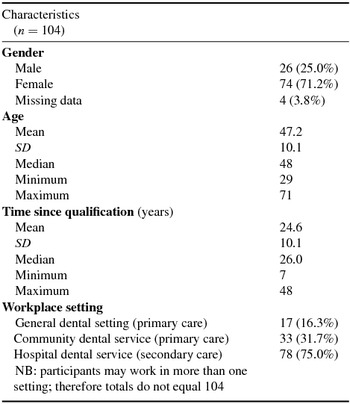
A total of 104 questionnaires were returned from 234 possible participants (response rate = 44.4%). Table 1 summarizes the characteristics of the respondents.
Characteristics of respondents

Experience of treating paediatric dental patients, confidence and familiarity with behaviour management techniques
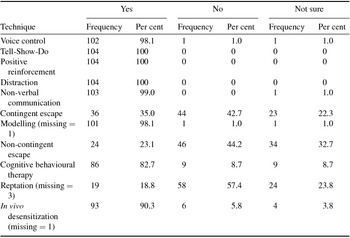
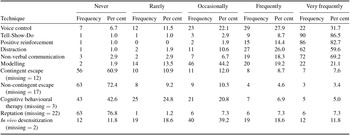
The average number of patients seen a week by the participants was 38.02 (SD = 34.1; median 30, maximum 200, minimum 0). In terms of their overall rating of their experience of using behavioural techniques with paediatric dental patients one participant said they had ‘none’ (1.0%); five said ‘some experience’ (4.8%) and 98 participants (94.2%) rated their experience as ‘extensive’. The average rating of confidence in using behaviour management techniques for the participants was 9.13 (SD = 0.99; median 9, maximum 10, minimum 5). For ratings of the participants’ perceived familiarity with the techniques and frequency of use, see Tables 2 and 3.
Frequency of familiarity with behaviour management techniques

Frequency of reported use of behaviour management techniques

Knowledge of behavioural principles
The average knowledge score for the ‘Knowledge of Behavioural Principles as Applied to Children Questionnaire’ was 38.5% (SD = 14.2; median 37.5, maximum 75.0, minimum 0).
There was no significant difference in knowledge score between groups defined by gender (p = .62) or workplace (p = .57). The Spearman correlation coefficients for knowledge score were: for number of paediatric patients treated, rho (ρ) = .09 (p = .38); for self-rated confidence in behaviour management, ρ = –.05 (p = .65); for number of years since qualification, ρ = .06 (p = –.54).
Discussion
This survey of dental practitioners specializing in the treatment of children reveals that the practitioners express a high level of confidence in their ability to manage behaviour, and familiarity with a range of techniques that could be used in dental settings. However, there is a clear discrepancy between the reported confidence of specialist paediatric dentists using non-pharmacological behaviour modification techniques and their actual knowledge of the principles underlying the use of such techniques. For example, the vast majority of participants reported frequently using positive reinforcement, but a large proportion failed to demonstrate a knowledge of simple principles associated with positive reinforcement, such as the effect of variable reinforcement on resistance to extinction.
There are some limitations to the present study; in particular, the relationship between knowledge and practice may be weak. Future research should explore the effectiveness of behaviour management techniques practised by dental practitioners.
Any interpretation of the data should be tempered by consideration of some aspects of the methodology. Firstly, some 19 participants reported familiarity with a fictional behaviour management technique, with 18 participants reporting using the fictional technique to some degree, bringing into question the validity of their self-report. The average proportion of correct answers from the 16 questions was 38.5%. Each question had four response options, thus on average participants should obtain a score of 25% by chance. With 104 participants the 95% confidence limits of a proportion of 25% are ±10%. A total of 39 participants (37.5%) scored below the limits of estimate for chance responding. Furthermore, it seems likely that knowledge levels among the population of specialist paediatric dentists may be even lower – since non-response may indicate poorer knowledge or experience.
The techniques which the participants report using most frequently are largely those advocated by the American Academy of Pediatric Dentistry (AAPD, 2008), such as Tell-Show-Do. There appears to be less familiarity with techniques founded in the tradition of Applied Behaviour Analysis (ABA). Studies identified in a review of the use of ABA support the use of these techniques which are based on sound behavioural psychology principles, such as contingency management, i.e. the addition of an appetitive or aversive stimulus following the presentation of a defined behaviour. For example, the use of negative reinforcement (the removal of an aversive stimulus) to decrease disruptive behaviour in the dental chair (Allen and Stokes, Reference Allen and Stokes1987; Allen et al., Reference Allen, Loiben, Allen and Stanley1992; O'Callaghan et al., Reference O'Callaghan, Allen and Powell2006).
One exception to the non-use of techniques based on Applied Behavioural Analysis principles were interventions that used positive reinforcement, which 97.1% of participants frequently used. The use of positive reinforcement is widely supported in the scientific community to aid behavioural change in multiple environments, including dentistry. For example, Pal (Reference Pal1986) used positive reinforcement via pre-negotiated rewards to change the dietary intake of six children. However, the participants’ performance on the knowledge questionnaire related to positive reinforcement demonstrated that there was a clear lack of basic understanding about how to implement an effective intervention.
The techniques of ABA show great promise for use in dental settings but require a thorough understanding of the principles of behaviour management. The findings of the present study suggest that in order for ABA to be more widely adopted in dental settings, there is need for further training of dental practitioners (particularly those working in paediatric care settings) in the principles and practice of ABA.
Acknowledgements
The authors acknowledge King's College London.
Conflicts of interest: None.
Financial support: This study was supported by King's College London.



Comments
No Comments have been published for this article.