Introduction
In recent years, there has been a substantial investment in radiotherapy equipment and staffing, resulting in increased capacity in the United Kingdom.1 This investment was in part to replace and modernise old equipment and to bring capacity to levels as deemed necessary in the late nineties.2 Concerns have been raised that the investment will be insufficient to meet the increased future demand for radiotherapy due to changes in population demographics and advances in medicine.3 Nevertheless, the investments have been accompanied by a clear associated drive to reduce radiotherapy waiting times and there have been a large number of reports and projects aiming to change working practices to support this process.4, 5
Despite staff shortages in all disciplines involved in delivering a radiotherapy service, generally the main bottleneck for radiotherapy treatment is perceived to be insufficient treatment capacity, i.e. a combination of an insufficient number of linear accelerators and staff to operate this equipment.Reference Williams, Summers, Drinkwater and Barrett6 Understandably therefore, most effort has gone into optimising the use of the available treatment capacity by prioritising patientsReference Bridge and Jenkinson7, Reference Martin, Ryan and Duchesne8 and increasing capacity itself, e.g. by extending hours,Reference Martin, Ryan and Duchesne8–Reference White, Beckingham, Calman and Deehan10 measuring linear accelerator utilisation and efficiency,Reference Delaney, Gebski and Lunn11 looking into radiographer retentionReference Probst and Griffiths12 and a radiographer career structure with (advanced) radiographersReference Bolderstron13 supported by assistant practitioners, helpers and administrative booking staff.14
To optimise treatment machine utilisation, modern operations management theory suggests that the processes feeding the treatment machines, i.e. all treatment preparation and associated scheduling, needs to be geared to minimising empty treatment slots.Reference Slack, Chambers, Harland, Harrison and Johnston15 Empty slots can arise because treatment preparation work has not been completed in time or the circumstances of a patient change. A successful approach for process improvement in industry has been to shorten the manufacturing or processing time and to continuously analyse bottleneck constraints.Reference Liker16, Reference Cox and Goldratt17 Judging from recent reports, such concepts are also being introduced into the NHS.18, Reference Head and Routsis19
In light of the above, it is perhaps surprising that only two references were found relating to improvements in processes throughout the radiotherapy department with the specific aim to increase treatment capacity and reduce radiotherapy waiting times.20, Reference Erridge, Porter and Rugg21 One further study looked at treatment planning specifically, adapting the basic treatment equivalent model for assessing linear accelerator throughput and developing the so-called dose plan unit.Reference Holmberg and McClean22 A vital prerequisite for the successful introduction of any detailed scheduling for a treatment planning unit would be the availability of robust information on how long each activity takes and how these activities are distributed around a mean or median value. The main conclusion from this work is probably that this is not straightforward, especially when considering naturally occurring variations in staffing levels, particularly in smaller departments, and the required input of oncologists. Patients sometimes enter the planning process with some degree of uncertainty in their medical management plan, e.g. staging, not to mention other treatment modality impact and social factors. This workflow input is very challenging to categorise, regularise and schedule. As a mechanism to cope with naturally occurring fluctuations, scheduling to 90% capacity is recommended when establishing the required capacity and workforce level,Reference Thomas23 but doing so for a department with an existing waiting list would be unacceptable.
The Princess Royal Hospital radiotherapy department currently treats about 2,800 patients a year and has a high number of satellite clinics serviced by the oncologists. A more flexible system was chosen to organise the workflow through treatment planning. The approach allows for variations in workload and available staff resources and does not require detailed programming of all activities. In this article, management of the workflow in the treatment planning department is described, using standard spreadsheet software with macros developed in-house. Data of achieved treatment planning times from September 2003 onwards are presented.
Materials and Methods
In July 2003, information of planning status for all patients in treatment planning at that moment were copied from a whiteboard into a spreadsheet file (Microsoft Excel 2000). From that moment onwards, new patients were logged into the spreadsheet list, and workflow through the department was managed based on this list. The system of work around early 2004 was presented elsewhere.Reference Vaarkamp, Holmes, Melling, Lewis, Jeffery and Whitton24 Over time, the full potential of using the software and patient list was explored and working practices adapted to respond to wider changes outside of treatment planning, to reduce manual manipulation of data and to manage changes in staffing levels, i.e. loss of experienced staff and training dosimetrists and physicists. The system described here is currently in use.
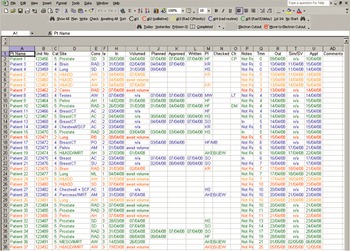
After patients have had their computed tomography (CT) imaging or simulator appointment, their folder is taken to treatment planning. Subsequently, patient name, unit number and simulator verification and treatment appointments are extracted from the radiotherapy information system into a treatment planning spreadsheet containing a list of all patients being planned. Also recorded in the spreadsheet are the date treatment planning receives the patient folder, i.e. the CT or simulation imaging date, the treatment modality for which the patient has been booked, type of plan or treatment site, the oncologist under whose care the patient will receive radiotherapy treatment and the date the patient was first seen by the oncologist. For tracking purposes, it is recorded whether full hospital notes or only a radiotherapy summary is received. Patients are colour coded according to the category; urgent (black), palliative (red), radical priority (orange), radical (yellow), radical low priority (blue) and elective delay (green). Figure 1 shows an anonymised screenshot of the layout and data available.
Anonymised screenshot of the layout and data collected in the treatment planning patient list.

The list of patients in treatment planning is displayed in order of first appointment date. As work on the treatment plan progresses, at completion of each stage the date is recorded, i.e. when the oncologist defines a target volume or a virtual simulation beam arrangement, the date the plan/calculation is performed and by whom, the date the oncologist reviews and approves the plan, the date the plan information is exported into the treatment machine database and the date all planning information is checked and by whom. Sublists for a planning stage, such as all patients who require designing/calculating a plan, treatment information putting into the treatment machine database and checking, can be displayed at a mouse click using macros that have been defined in the spreadsheet software. When all treatment planning work for a patient has been completed, the full record is removed from the list and moved to a list of completed patients, also with one mouse click using a macro. Figure 2 shows the macro menu bar, with the macros available to manipulate the list.
Macro menu with macros available to manipulate the treatment planning patient list. There is macros for displaying specific sublists, sorting, adding and removing patients from the list and insert various dates.

The patient list is kept on a shared drive and accessible throughout the hospital, so that e.g. treatment staff can check the current status of a patient. The list is read-only for all staff, but for the treatment planning staff who have full edit access. The department operates a pre-booked appointment system. Inevitably sometimes a delay in treatment start is required because not all diagnostic information is available at the time of scanning or the status of a patient changes. If a treatment start delay occurs, the reason is annotated.
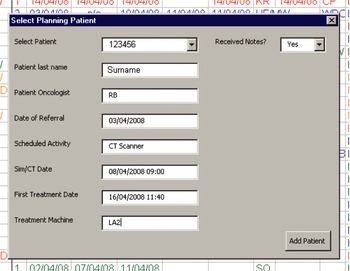
A routine was developed that queries the radiotherapy database for all simulator and CT imaging appointments. This query runs every night and generates a file with the patient information available from the radiotherapy database. Subsequently an insertion routine was written for importing a patient into the planning list that requires only typing the patient unit number and to approve the information. Figure 3 shows the window display for the user to approve the information to be inserted in the list.
Window for the user to approve the patient information to be inserted from the radiotherapy database into the treatment planning patient list.

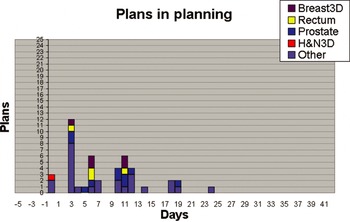
Treatment planning staff pick in principle the first patient in the list they can work on, taking account of their personal competency, regardless of whether this is checking, further processing or planning. This includes trainee dosimetrists. New work is claimed by adding the initials for planner or checker, so that in case of queries it is known who is, or was, dealing with the particular patient. Through this approach, effectively a single queue is operated from which staff take the next task available to them, as recommended by the NHS Modernisation Agency to maximise capacity.25 Work allocation in treatment planning is based on these decision rules and the process is not, as such, actively managed, with one exception. Peak workloads can be identified on a graphical display showing how many patients need to be treated on each day for the coming weeks (an example is shown in Figure 4). At peak times the senior dosimetrists can explore getting extra resources e.g. requesting physicists to check patients, or initiate discussions to postpone patients with sufficient notice.
Example of the display showing how many patients need to be finished on each day for the coming weeks. The graph is used to identify busy periods so that the need for extra help or postponing patients can be flagged up in a timely fashion.

For part-time planning staff, such as trainee clinical scientists, their planning training mentor can ensure that suitable work is available by putting the trainee's initials down for a particular task the moment it becomes available, regardless of its position on the list in terms of urgency. Completion of a task is indicated by entering the completion date. If input is required from a specific individual, e.g. because the treatment is unusual or off protocol, the initials of that member of staff are recorded in either the planner or checker column as appropriate and the specific staff member can see outstanding tasks.
With reduced mould room work, due to MLCs on all machines and the transfer to thermoplastic masks for immobilisation, the service was reorganised and mould room tasks have become part of the dosimetrists’ job role. To ensure staff contribute fairly, maintain competency and contribute to administrative activities, a rota has been introduced for tasks that, if they come up, have priority over planning/calculation activities.
Clinicians each have a box in treatment planning, storing patient folders requiring their input. There is a further inbox into which patient folders are dropped after the simulation or CT imaging session, awaiting entry into the planning list and introducing the CT scan into the treatment planning system. Treatment planners pick patients’ folders up from either the planning, writing or checking box in which patient folders are stored awaiting planning, introducing into the treatment database after plan approval and checking, respectively.
On a monthly basis, the number of patients coming into treatment planning was calculated and the average number of working days it took to generate a full treatment plan. To answer questions on whether more rigorous scheduling of oncologist input would reduce planning times, the number of working days was calculated after subtraction of the wait for clinical input.
Results
The spreadsheet has been in operation for 4 years. However, the software has since been adapted and augmented on a number of occasions responding to changing circumstances, and tailoring to the needs of the clinic, underlining the flexibility of the approach. Seemingly trivial things, such as introducing a macro for inserting today's date rather than manually typing it, greatly reduced typing errors and improved data accuracy.
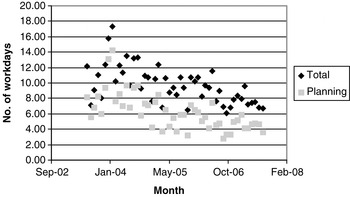
Figure 5 shows the average number of workdays required to finish all treatment planning work for each calendar month, and the planning time without the wait for oncologist input for defining a volume or virtual simulation and plan approval. Throughout the 4 years, the wait for oncologist volume definition or virtual simulation is approximately twice as long as the wait for plan approval. There seems to be two main reasons for this. First, though oncologists are generally quite willing to sign off plans for patients under the care of a colleague, defining a treatment volume for somebody else's patient is mostly limited to holiday cover. Second, although a patient may have had a CT planning scan, delays occur for awaiting the outcome of diagnostic tests, diagnostic information to be sent from elsewhere and MDT discussions.
Average total planning time (in workdays) for patients coming into treatment planning between September 2004 and August 2007. Also shown for the same period is the planning time (in workdays) after subtracting the wait for oncologist input.

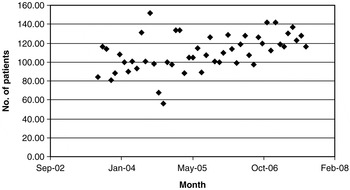
Figure 6 shows the number of patients coming into treatment planning on a monthly basis.
Number of patients coming into treatment planning each month for the period between September 2004 and August 2007.

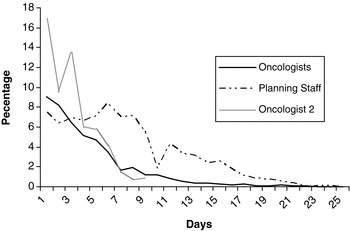
Figure 7 shows the relative distributions to total planning time required for the planning process for one individual oncologist, allReference White, Beckingham, Calman and Deehan10 oncologists and all planning staff. The data for cases which were simulated and point dose calculated, or planned the same day, have been excluded, as have delays of longer than 25 days. For the latter group, the management of the patient changes or the plan is a second or even third phase treatment.
Frequency distribution of the relative contributions to total planning time of one oncologist (No. 2), all oncologists and planning staff for all patients between September 2004 and August 2007, excluding same day simulator/calculation cases and delays over 25 days.

Discussion
When the spreadsheet list was introduced, average treatment planning times varied substantially on a monthly basis. The main reason for this seems a strongly fluctuating number of patients coming into treatment planning. Months with a high influx of patients can be linked to periods of waiting time initiatives. Months with a low influx of patients are associated with linacs scheduled for major upgrades. From approximately May 2005, there seems to have been a constant but gradually increasing number of patients coming into planning. Bearing in mind that the amount of work involved for one patient can vary between less than an hour and perhaps as much as three working days for very complex plans, small variations in patient numbers cannot be expected to correlate with increases and decreases in planning times.
Planning times seem to be systematically coming down from spring/early summer 2004. An important factor in achieving this seems to be reducing a backlog in planning. Whereas in autumn 2003, between 80 and 100 cases would be in treatment planning at any given time, as of autumn 2007, this has reduced to between 40 and 60 cases. This reduction is against a backdrop of increasing monthly patient numbers and continuously increasing complexity of planning techniques for head and neck treatments and the introduction of CT-based breast planning.
A period of dropping treatment planning times seems to begin with a new treatment planner starting in the department in March 2004 and April 2006. A period of increasing treatment planning times such as between October 2006 and March 2007 is linked to unusually high staff absence due to a long-term sickness and vacancies because of staff leaving for other jobs. The impact of the absences was limited because the department had a high number of trainee clinical scientists requiring treatment planning training, but who also contributed to treatment planning. The reversal in this upward trend in April 2007 is related to a dosimetrist joining the group to fill the vacancy. Data such as these show how vulnerable small groups/departments are to prolonged absences of single individuals.
In hospitals where oncologists run a substantial number of satellite clinics, and therefore are at the main site only on a limited number of days, it is quite natural to look at how much of treatment planning time results from delays in oncologists’ input. Over the 4 years, this wait has been remarkably constant but has come down from approximately four working days to three working days at the moment. However, because the average total planning time in the autumn of 2007 is now under seven workdays, a three workday wait for oncologist's contribution is approaching half of the planning time. To make further improvements in planning times from the current level, it does become meaningful to look at what is recorded as the input from oncologists. In discussion with the oncologists, it may be useful to look at this delay and start to record ‘ready for care: voluming’ or ‘decision to volume’ date, to remove delays due to external factors. Other approaches could include looking at scheduling oncologist planning sessions to be synchronised with CT scanning patients, expansion of team working and perhaps also further role extension of dosimetrist/radiographers for palliative virtual simulation and breast planning.
Acquiring a record of performance data as part of the normal work process is useful. It allows for analysing real or perceived bottlenecks, such as the input from oncologists, or to answer whether there is a problem getting complex plans through. By reviewing the times taken to progress through the planning process for various individuals or for categories or tumour sites, trends may be seen which would not be visible to individuals over shorter time frames. As an example, pooled data in Figure 7 shows highly skewed and irregular distributions for both the oncologists and planning staff. This might suggest bi-modal or tri-modal peaks corresponding to different work processes and patient profiles requiring further analysis. The individual oncologist plotted is doing a greater proportion of his or her planning work within 1–5 days, when compared to his colleagues. Simple rate-based measures and parametric statistics should be used with caution in interpreting data such as these because of the distribution of the data.
Acquiring performance data also allows for measuring the impact of any changes that are made, such as introducing a duty physicist checking rota, and can be used as evidence supporting claims for more resources, provided that the actual input from staff other than treatment planners is properly documented and recognised. An electronic list like this can be utilised for staff development purposes. Staff themselves can track how many of each type of plan they did in a given period and ensure they stay up to date by working on, for example, complex plans, or a few plans after some change in protocol. It might be potentially linked with other datasets in a Cancer Network to incorporate patient tracking activity on a wider scale and Breach Date Management. Off-the-shelf large-scale Oncology Information Systems (OIS) do not have NHS focussed patient tracking tools such as this built in, and customising an in situ OIS Module to perform similarly to our scheduler, for instance, would be extremely difficult.
This article describes how the treatment planning group is organised at the moment. However, it would be very easy to implement further changes, which illustrates the flexibility of the in-house software solution. For example, staff on treatment machines currently have viewing access to the patient list and can monitor how far a patient is in the process. In the same way oncologists could have access from their office to see whether any of their patients needs their input. With a macro, each oncologist could view such a personal list. The software allows defining lists of valid entries in a cell. This could be exploited to, for example, prevent trainees from picking up work they have not been signed off for as competent. However, it could be more widely used when techniques change or roles are extended to ensure existing staff have received proper instruction and updates before working on such cases.
In conclusion, workflow through treatment planning is indirectly managed and the described approach allows for day-to-day staffing fluctuations and competency levels. From the introduction of an electronic patient list the functionality has been adapted and expanded to accommodate (external) changes in work practices. Rather than duplicating the described approach, departments who may be considering the introduction of similar electronic list should take account of their specific practice and organisation. That the ideas described in this work are easy to tailor to another user's working practices illustrates its flexibility. The spreadsheet has facilitated a continuous decrease in planning times against a background of increasing patient numbers and complexity of the work. There is instant information on planning status for all patients throughout the department, building up a record as part of the work process. Bottlenecks and staff training needs can be analysed by reviewing the historic patient workload.