In the last two decades, the prevalence of overweight and obesity in children has tripled in CanadaReference Tremblay, Katzmarzyk and Willms 1 and the United States.Reference Ogden, Carroll, Curtin, McDowell, Tabak and Flegal 2 It is estimated that over 30% of children in North America may now be considered overweight or obese. Approximately 113,000 of 625,000 children in our catchment area of Southwestern Ontario are overweight (body mass index > 85th percentile), of whom 39,000 are obese (body mass index > 95th percentile).Reference Shields 3 Childhood obesity represents a significant threat to longevity and may increase the risk of developing diabetes mellitus, cardiovascular disease, systemic hypertension, obstructive sleep apnoea, hyperlipidaemia, social isolation and clinical depression.Reference Galli-Tsinopoulou, Kyrgios and Maggana 4 – Reference Cohen 6 Obesity is a multifactorial condition resulting from an imbalance between energy intake and expenditure.
Congenital heart disease ranks among the most common birth defects. The incidence of moderate and severe forms of congenital heart disease is about 0.6% of live births – 1.9% of live births if the potentially serious bicuspid aortic valve is included – and of all forms increases to 7.5% of live births if tiny muscular ventricular septal defects present at birth and other trivial lesions are included.Reference Hoffman and Kaplan 7
The number of adolescents and young adults with congenital heart disease is rising, and their management now includes follow-up and medical treatment of late complications. There are more than 100,000 children with congenital heart defects in Canada (Statistics – Heart and Stroke Foundation of Canada, 2009), and the potentially modifiable risk factor of obesity on their cardiovascular health remains understudied. Recently, a working group of the National Heart, Lung, and Blood Institute met to delineate the scope of the problem.Reference Pemberton, McCrindle and Barkin 8 The authors are only aware of two reports that exist on the prevalence of overweight/obesity in children with congenital heart disease in North America,Reference Pinto, Marino and Wernovsky 9 , Reference Shustak, McGuire, October, Phoon and Chun 10 but a recent study from 2012 in Asia confirmed that this problem exists worldwide. There seems to be a shift from underweight to overweight and obesity in Asian children and adolescents with congenital heart disease as well.Reference Chen, Wang, Lue, Hua, Chang and Wu 11 There is a concern that children with congenital heart disease might be at greater risk of being obese than their peers, given their potential physical ability limitations and activity restrictions.Reference Cohen 6 , Reference Kavey, Allada and Daniels 12
The present study sought to investigate the prevalence of overweight/obesity in children with congenital heart disease in our catchment area in comparison with a regional age-matched control cohort.
Materials and methods
Data collection
This was a retrospective cross-sectional study approved by the institutional review board at Western University, London, Canada (HSREB #103261). We reviewed the charts of all patients aged 2 to 18 years who presented to our Paediatric Cardiology Outpatient Clinic from January, 2008 to December, 2010. For patients with more than one visit during this period, the anthropometric data at the most recent visit were used. Patients with congenital heart disease formed one group and those cardiology patients without any congenital heart disease or systemic disease formed a control group. The control group comprised healthy children referred to the cardiology programme for evaluation of a functional murmur, palpitations, syncope or chest pain, or family history of heart disease but found to have no organic heart disease.
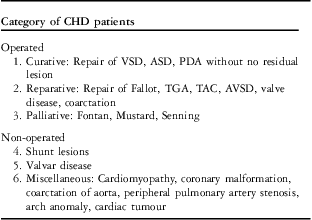
Patients with congenital heart disease were divided in two groups: operated and non-operated. On the basis of the study by Perloff et al,Reference Perloff and Child 13 the operated group was divided into three subgroups: curative, reparative and palliative. The non-operated group also consisted of three subgroups: valvar disease, shunt lesions and miscellaneous (Table 1).
Categories of patients with CHD; operated patients are classified according to Perloff et al.Reference Chen, Wang, Lue, Hua, Chang and Wu 11

ASD = atrial septal defect; AVSD = atrioventricular septal defect; CHD = congenital heart defect; PDA = patent ductus arteriosus; TAC = truncus arteriosus communis; TGA = transposition of the great arteries; VSD = ventricular septal defect
An experienced registered nurse measured body weight on a calibrated digital scale and standing height using a Harpenden stadiometer. Body mass index was calculated from weight and height data and then plotted on Centers for Disease Control and Prevention body mass index curves to determine age- and gender-appropriate percentiles and z-scores.Reference Hedley, Ogden, Johnson, Carroll, Curtin and Flegal 14 On the basis of these growth charts, body mass index was categorised (underweight, <5th percentile [z-score <−1.2]; normal weight, 5th–85th percentiles [z-score −1.2 to 1.2]; overweight, 85th–95th percentiles [z-score 1.2 to 1.7]; obese, >95th percentile [z-score > 1.7]).
Exclusion criteria were patients with genetic diseases and other comorbidities – for example, Down's syndrome, Duchenne muscular dystrophy, Marfan syndrome and any malignancy or tumour – that could affect body habitus and those who required a tracheostomy for ventilation or a gastrostomy tube for feeding.
Analyses and statistics
Analysis was performed using IBM SPSS Statistics, version 20.0. Continuous variables were described using the mean and standard deviation. Categorical variables were reported as percentages. The independent samples t-test was used to compare mean differences between the congenital heart disease and control group, and the χ2-test was used to compare differences in proportions for categorical outcomes. Logistic regression analysis was performed on overweight/obese as the outcome variable and gender and age as predictor variables for both congenital heart disease patients and healthy individuals.
Results
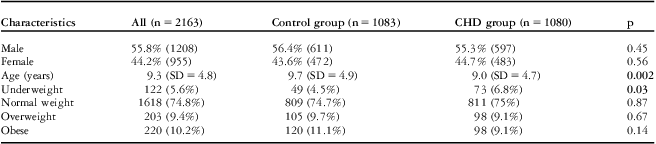
The congenital heart disease group consisted of 1080 and the healthy children group included 1083 children. The gender distribution was comparable in both groups. Healthy children were on average slightly older than congenital heart disease patients (Table 2), but the use of age-independent z-scores eliminated that problem.
Study cohort characteristics.

CHD = congenital heart defect; SD = standard deviation
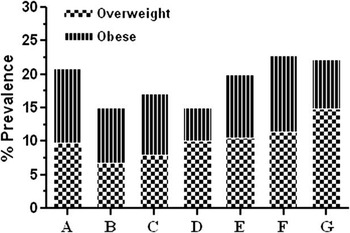
The weight category distribution was similar between the two groups. There was no difference within the categories normal weight, overweight and obese. The percentage of underweight patients was slightly but significantly higher in the congenital heart disease group compared with healthy individuals (6.8 versus 4.5%, p = 0.03, Table 2). A total of 18.2% of congenital heart disease patients and 20.8% of healthy children fell into the overweight/obese category. Figure 1 demonstrates the prevalence of overweight/obesity in the healthy control group, as well as in subgroups of patients with congenital heart disease.
Prevalence of overweight/obesity. A, healthy control group; B, congenital heart defect patients after curative surgery; C, congenital heart defect patients after reparative surgery; D, congenital heart defect patients after palliative surgery; E, congenital heart defect non-operated patients with shunt lesion; F, congenital heart defect non-operated patients with valvar disease; G: congenital heart defect non-operated patients with miscellaneous lesion.

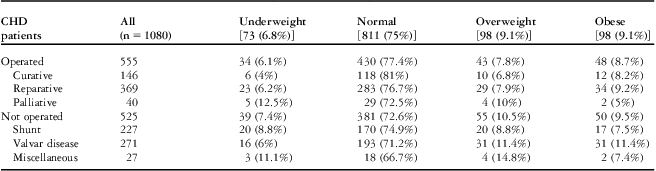
Table 3 illustrates the characteristics of the congenital heart disease patients and shows the distribution of the weight categories within the subgroups. There were comparable numbers of patients in the operated and non-operated groups (555 and 525, respectively). The prevalence of overweight/obese patients in each subgroup was similar and did not show any significant difference (data not shown).
CHD subgroups and their distribution into weight categories.

CHD = congenital heart defect
When the underweight congenital heart disease patients were further divided into their subgroups, there were no significant differences between these subgroups; the prevalence of underweight patients was comparable between children who underwent a curative, reparative and palliative operation, and between those who had valvar, shunt or miscellaneous lesions (data not shown).
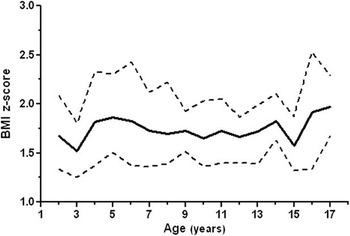
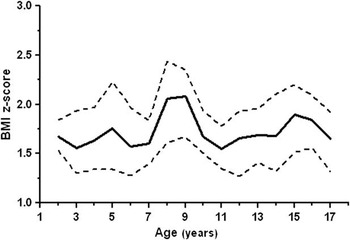
The body mass index z-scores of overweight/obese patients were plotted against age in congenital heart disease and healthy controls separately (Figs 3 and 2). The overall distribution of the body mass index z-scores within the different age groups was comparable, except that the body mass index z-score showed a peak, which was most evident in the congenital heart disease group around age 9 and in the control group between ages 16 and 17 years.
Body mass index z-score of healthy overweight/obese children plotted against age. Median with 25th and 75th percentile.

Body mass index z-score of overweight/obese patients with congenital heart defects plotted against age. Median with 25th and 75th percentile.

It was found that neither age nor gender was a significant risk factor for being overweight or obese in healthy or congenital heart disease patients.
A χ2-test was performed to compare the percentage of overweight/obese children and adolescents in our study compared with the Centers for Disease Control and Prevention NHANES national prevalence data. It revealed that the percentages were statistically different from one another (20% and 31% respectively, p = 0.0001).
Discussion
The prevalence of overweight/obesity in healthy North American children has been rising in the past few decades. Efforts have been made to identify risk factors in order to develop strategies for prevention, as obesity in childhood and its sequelae are major causes for acquired cardiovascular diseases in later life.Reference Bray 15 – Reference Daniels, Loggie, Khoury and Kimball 18 This might have even greater impact on children who already have pre-existing congenital heart disease, as these patients might have residual lesions after surgery and/or activity restrictions.
Our study confirms the high prevalence of overweight/obesity in children in Southwestern Ontario. Almost 20% of these children were either overweight or obese. This was different from the Centers for Disease Control and Prevention NHANES national prevalence data, indicating that 31% of children aged 6 to 19 years were either obese or overweight.Reference Hedley, Ogden, Johnson, Carroll, Curtin and Flegal 14 Different age ranges (in our study 2 to 18 years) may explain partially the discrepancy between those data and our findings; the incidence in our healthy control group rises to 27.5%, if only children aged 6 to 18 years are included. It is also possible that different lifestyles between Canadians and Americans may play a role, causing lower prevalence of overweight/obesity in Canada. This was recently discussed by Shustak et alReference Shustak, McGuire, October, Phoon and Chun 10 who found that almost 30% of children with heart disease were overweight/obese. In their New York population, Hispanic ethnicity was the highest risk factor for the development of obesity. They postulate that lifestyle and cultural factors may explain the high prevalence of obesity in the Hispanic population. In addition, Kaufman and KarpatiReference Kaufman and Karpati 19 noted that Hispanic mothers regard heavier children as “safer and less fragile” than those of normal weight. Furthermore, studies indicate that a large proportion of Hispanic mothers believe being overweight is a direct indicator of happiness.Reference Crawford, Gosliner and Anderson 20 , Reference Snethen, Hewitt and Petering 21
Congenital heart disease patients seem to be more sedentary than healthy peers even though exercise capacity is unrelated to medical status or disease severity,Reference Longmuir, Russell, Corey, Faulkner and McCrindle 22 , Reference Reybrouck and Mertens 23 and the level of physical activity seems to be lower, even if they have no activity restrictions.Reference Massin, Hovels-Gurich, Gerard and Seghaye 24 , Reference Lunt, Briffa, Briffa and Ramsay 25 Many congenital heart disease patients have simple defects that do not require any intervention; however, they may not be encouraged to participate in physical activities that “stress the heart” and may live a relatively sedentary lifestyle, which can lead to an increased risk of obesity, although another study did not find a correlation between physical activity and obesity in children with congenital heart disease.Reference Shustak, McGuire, October, Phoon and Chun 10 , Reference Ray, Green and Henry 26 , Reference Majnemer, Limperopoulos, Shevell, Rohlicek, Rosenblatt and Tchervenkov 27 Several studies have noted that children with congenital heart disease and their parents are often misinformed regarding activity restrictions, resulting in overprotection by parents.Reference Cheuk, Wong, Choi, Chau and Cheung 28 – Reference Moola, McCrindle and Longmuir 30 These conditions led to the perception that children with congenital heart disease may be at increased risk for obesity compared with their healthy peers.Reference Cohen 6
In our analysis, there was no difference in prevalence in overweight/obesity among healthy children and children with congenital heart disease, even when the congenital heart disease group was further divided and analysed in specific subgroups. Our control group was slightly older than the congenital heart disease group, but as we have used age-independent z-scores this should not introduce a bias when comparing the two groups. The only mild but statistically significant difference was found in underweight congenital heart disease patients compared with healthy children (6.8 versus 4.5%, p = 0.03). The prevalence of underweight children tends to be higher in congenital heart disease patients, who had complex heart defects and underwent palliative surgery – single ventricular physiology. This is in accordance with already published data and may be a consequence of prolonged hypoxaemia in early ages and a generally elevated risk of post-operative complications.Reference Cohen, Bush, Ferry, Spray, Moshang and Wernovsky 31 , Reference Anderson, Kalkwarf, Kehl, Eghtesady and Marino 32
The distribution of body mass index z-scores of overweight/obese patients in both congenital heart disease and healthy controls (Figs 2 and 3) showed no significant difference. In our study, neither age nor gender was a significant risk factor for being overweight or obese in healthy children or congenital heart disease patients. This is in contrast to the published data by Shustak et alReference Shustak, McGuire, October, Phoon and Chun 10 but in accordance with other publications.Reference Pinto, Marino and Wernovsky 9 , Reference Pasquali, Marino and Pudusseri 33
The body mass index z-score showed a peak in the congenital heart disease group around age 9, whereas the control group had a peak between ages 16 and 17 years. We cannot offer an explanation for that finding, and do not know whether there is any clinical relevance to that fact.
The report of the National Heart, Lung, and Blood Institute's Working Group on obesity and other cardiovascular risk factors in congenital heart disease, which was published in 2010,Reference Pemberton, McCrindle and Barkin 8 raises the concerns of health issues with respect to congenital heart disease-related obesity. This report recommends a reduction of sugar-sweetened beverages, limitation of screen time, for example amount of time watching TV, playing computer games and/or using computer media as a tool of communication – and subsequent increase of physical activity to help prevent obesity in this patient group. Nonetheless, there is a need for randomised controlled trials to find the most effective approach for congenital heart disease patients to improve their body composition, exercise capacity and quality of life.
There were some limitations in the present study. The data had been collected retrospectively, and it is unclear whether the area investigated is representative of other areas in Canada. The population was not further analysed into different racial/ethnicity subgroups, and the socio-economic background was not taken into consideration. Comorbidities such as high blood pressure and medication, which might have an impact on body composition, have also not been assessed.
In conclusion, the epidemic of obesity has not excluded children and adolescents with congenital heart disease. Children with congenital heart disease are not immune to the traditional risk factors for obesity such as genetic predisposition, sedentary behaviour and poor diet habits. Obesity is as common among children with congenital heart disease as in healthy controls. It represents an additional and potentially modifiable risk factor for the long-term cardiovascular health for congenital heart disease patients aside from the underlying heart problem. The importance of maintaining a healthy weight should be emphasised in congenital heart disease patients. Healthy lifestyle counselling might therefore be especially important in children with congenital heart disease. The paediatric cardiology team should reinforce the positive benefits of physical activity. The recommendations for activity restrictions in children with congenital heart disease should be more specific and individualised for that purpose. Our results might be helpful for future investigations that try to elucidate some of the potential aetiological factors for the development of obesity in children. Being aware of those factors might be helpful to develop a strategy for prevention, for example, establishing an exercise programme before and after surgery for cardiac patients. The efficacy of interventions will need to be established.
Acknowledgement
This study was supported by research grants from the University of Western Ontario (ADF-5609-8), Children's Health Research Institute (LHRF 7712), The Academic Medical Organization of Southwestern Ontario innovation Fund (AMOSO, #INN 12-003) and a grant from Children's Health Foundation, London to Dr K. Norozi and through a grant from Children's Health Foundation, London, Ontario, to Dr G. Filler.
Conflicts of Interest
The authors declare no conflict of interest.