- NAS
National Archives of Scotland, Edinburgh
- RSCHS
Records of the Scottish Church History Society
Whether the ministry is defined as a profession, career or calling, it is a remarkably neglected feature of the Scottish reformed Church. While much is known about key figures like John Knox, James Melville and Alexander Henderson, very little is known about the ordinary foot soldiers of the ministry in Scotland's thousand or so parishes. There is no full-length study of the Scottish parish ministry in the post-Reformation period, and as a group they appear mostly in sections or chapters in books on broader themes, or in article-length surveys.Footnote 1 Certain aspects of the ministry, such as preaching, theology and spirituality, have been relatively well covered, but much knowledge of the careers of post-Reformation parish ministers is essentially an overview, based on generalisation rather than detailed local study.Footnote 2 This is particularly noticeable in contrast with the highly developed literature on the English clergy.Footnote 3
One particularly important topic which has yet to be fully addressed is the economic condition of the ministry. Post-Reformation ministers were increasingly united by their graduate status, professional organisation and shared social and family networks, but did any professionalisation of the ministry extend to their financial position? Were they a distinct group in society? Did they share secure and stable incomes, or were there significant variations in ministers' economic fortunes? Ministers' financial status also has a bearing on their ability to perform pastoral functions. Across Europe, the new Protestant minister had a wide range of tasks to perform alongside his defining functions of preaching the Word and administering the sacraments. He was supposed to travel his parish (or parishes) and to catechise, to provide an example, to reconcile feuders, to visit the sick. He was also supposed to support a godly family. All of this required significant resources, not to mention energy: although the necessary calorie intake for a minister was doubtless lower than for an agricultural labourer, even the activity of preaching would probably have been quite draining. This was an active job, and one which required reasonable remuneration, particularly if the most able graduates were to be attracted into the clergy. The Reformation did not entirely solve the problems of an impoverished clerical estate, but a more nuanced understanding of the finances of the reformed clergy is vital to a full assessment of both their social and religious impact.
The editors of a recent volume on the European Protestant clergy as a whole have called for a greater emphasis on the geographical variations in the ministry, and on the particular, rather than the general, but there has been very little attention paid to what the Scottish situation has to say about these questions.Footnote 4 This is not to say that there have not been some attempts to trace the finances of the post-Reformation ministry in Scotland. Walter Foster has discussed some seventeenth-century stipends, albeit largely though the lens of official attempts to improve them, and Walter Makey has carried out a more detailed analysis of ministers' economic situation in the 1630s and 1640s.Footnote 5 But less is known about the crucial first few decades of the reformed Church. There has also been very little detailed local study of individual parishes' and ministers' stipends.Footnote 6 For various technical reasons, this is an immensely difficult topic, and needs to be treated with great caution. There are two main problems, the first being that this was a period of substantial inflation, especially from 1580 to 1600, making analysis of change over time very difficult.Footnote 7 Things are complicated further still by the tendency for stipends to be paid in kind as well as in cash. This was obviously an advantage for the ministers in a time of inflation, but a distinct disadvantage to the historian trying to discern trends in stipend patterns.Footnote 8 Detailed and contextual analysis is therefore required of both ministers' stipends, and, where they survive, their testaments. A further problem is that there is no certainty that ministers were actually paid the stipends assigned to them.Footnote 9 Indeed, this fact has been neglected in previous discussions of ministers' testaments, since many of their ‘assets’ were actually debts owed to them, often consisting of late stipend payments, which hardly represent real wealth. This article does not pretend to offer a simple revision of previous estimates of ministerial finances (which in any case have varied widely); instead it offers its own account, noting in places where this has diverged from previously published discussions.Footnote 10 Like any study based on a locality, the question of the typicality of the chosen region remains. But Fife was an important part of the Scottish lowlands, and if a clearer picture of the Scottish ministry as a whole is to be built up, it is in the parishes that it must begin.
Stipends
What was a good basic stipend for a minister at this time? The First book of discipline (1560) acknowledged the difficulty of settling on a figure, since ‘the charge and necessitie of all, will not be alike’. Nevertheless, a rough figure of forty bolls of meal, twenty-six bolls of malt plus further money for other provisions was cited as the minimum.Footnote 11 Walter Foster has estimated that by 1600 500 merks (£333 6s. 8d.) was a reasonable minimum.Footnote 12 In 1617 five chalders victual were set as the minimum, and by the reign of Charles i the figure had risen to eight chalders victual.Footnote 13 It is tempting to use such figures as the basis of analysis, since they seem to provide a reasonably solid yardstick against which to measure stipends. But the warning of the authors of the First book of discipline cautions against this. The effective worth of these stipends would have depended on other factors, like the possession or non-possession of manse and glebe, the size of the minister's family and household, the size of his charge and perhaps, if the late eighteenth-century subject of John Galt's fictional Annals of the parish was typical, the skill of his wife in household management.Footnote 14 This is leaving aside the question of rapid inflation, which means that what was a minimum in 1600 might have been reasonably comfortable only ten or fifteen years earlier. Given that a safe and simple index of stipend value cannot be produced, and that even if it could it would be difficult to find something against which to measure it, an alternative approach has been employed. Rather than using averages, a sample of Fife stipends have been traced over the years, to get a sense of how they improved (or failed to improve), and when the changes came. This small-scale approach may not offer such satisfying conclusions as the broad use of statistics, but it should avoid most pitfalls, and reflect the situations of some actual Fife ministers. The large variations between parishes certainly suggest that simple averages would mask the complexities of the data.
The main source of information on stipends in Fife is the manuscript record of the ‘Assignation and modification of stipends’ (1576–1615), from which the figures in this section are taken.Footnote 15 These volumes record the stipends assigned to ministers and readers in each parish or group of parishes sharing a minister. Ministerial stipends came from the ‘thirds of benefices’, originating in the scheme whereby two-thirds of the income from benefices were retained by the original benefice-holder, while the remaining third was divided between the church and the crown. These thirds provided the bulk of stipends after the Reformation, although there was not always a clear geographical link between the source of income and the parish served, and some stipends were supplemented by contributions from town councils and other sources.Footnote 16 Rather than attempting to produce averages, two different approaches have been taken to this data. First the stipends of some individual ministers have been examined, and second, the development of stipends in some individual parishes has been assessed. This should help to avoid one other problem with a more statistical approach which stems from the widespread practice of parishes sharing ministers: the need to decide whether to define stipends in relation to the minister or to the parish. Both approaches have their merits, and to focus on one alone for the purpose of statistical clarity would be misleading and fail to do justice to the complexity of the evidence.Footnote 17
The first minister selected is Thomas Biggar, whose main parish was Kinghorn. In 1567 his stipend had been £120, and by 1576 it had risen to £173 6s. 8d. with the kirklands and manse of Kinghorn.Footnote 18 This came from the thirds of Holyroodhouse (£40), and the thirds of Dunfermline (£133 6s. 8d.). This arrangement continued until 1585. By 1588 his stipend had risen to £204 8s. 4d. for the three parishes of Kinghorn, Burntisland and Auchtertool. By 1591 he was minister of Kinghorn alone, and received the slightly reduced figure of £187, but this was accompanied by two chalders of bear (a variety of barley), and two chalders of oats, a quantity of victual roughly equivalent to around £130, meaning that his overall stipend had increased significantly.Footnote 19 From 1594 to 1597 Biggar was to be paid £286 13s. 4d., which dropped slightly to £273 6s. 8d. in 1601. Allowing for inflation, the increases were fairly modest, apart from the period when he received substantial victual payments. Unfortunately for Biggar, this was not sustained, and his stipend of under £300 in the early seventeenth century was well below Walter Foster's minimum of 500 merks in 1600. Peter Blackwood of Aberdour also saw his static stipend of the 1570s (£120 and one chalder of meal) rise in the 1580s to £160 8s. 10d.
Unlike Biggar and Blackwood, younger ministers like John Michaelson would live to see a much larger proportion of their stipend paid in victual. In 1588 Michaelson was paid just £16 for the charge of Auchtertool. As minister of Markinch in 1591, he received the whole vicarage (£80), and one chalder four bolls of oats (worth around £20) from the thirds of St Andrews Priory. The £80 payment remained standard until the beginning of the seventeenth century, and by 1607 and 1615 had risen to £126. But the real improvement came in the victual element of his stipend, which rose in value to £180 in 1594, and to over £300 by 1607. By 1615 Michaelson was receiving a very healthy total of six chalders nine bolls victual, equivalent to around £570. So although he was initially relatively poorly off, his victual payments steadily increased in the 1590s and 1600s. Another minister who did relatively well was Thomas Douglas. When he first served Balmerino and Logie in 1578, he was paid just £80.This was unchanged in 1580, but in 1585 his stipend had risen to £133 6s. 8d. Given the inflation during this period, this increase may not have been as large in real terms as it might at first appear. However, by 1591, it had risen again, to £200 17s. 9d. plus around £130 worth of victual. By 1594 the cash element had risen to £220 11s. 1d., and the victual element was worth almost £200. In 1597 the cash element dropped back to £204 11s. 1d., but the victual was substantially augmented to one chalder twelve bolls of meal, one chalder of wheat and two chalders eight bolls of bear, roughly equivalent to £570. In 1601 the stipend dropped slightly to £133 10s. 1d. plus about £520 in victual, but the 1607 and 1615 stipends were similar, suggesting that the stipend had levelled off at a very reasonable rate. This is precisely the sort of significant increase that would be masked by statistics, in the absence of a reliable index of values. Despite the ongoing problems with stipends, some ministers did very well in the final years of the sixteenth century and the early seventeenth century. Unsurprisingly, these were the ministers whose cash stipends came to be supplemented by victual payments from the 1580s onwards. It is only when the rough cash values of these payments in kind is considered that the full extent of the increase in the real value of some stipends becomes apparent.
This was not the whole story, however. The case of David Mearns offers a counterpoint to that of Thomas Douglas. Serving the equally rural parish of Carnbee, his stipend remained in cash form, at a steady rate of just over £200 between 1591 and 1607. Similarly Robert Rait of Kinross was paid £100 in 1580, rising to £120 for a reduced charge in 1585 and 1588, and then up to £146 13s. 4d. in 1591. And Patrick Geddie's stipend as minister at Orwell remained static between 1601, 1607 and 1615, at £146 13s. 4d. So there were considerable variations in the stipends of ministers in the later sixteenth and early seventeenth centuries. There was no clear trend of steadily increasing stipends: although many ministers seem to have easily kept up with inflation, others fell behind. Much must have depended upon local circumstances.
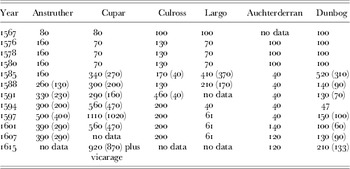
This discussion relies on defining stipends as the sums of money paid to an individual minister, but given the sharing of ministers between parishes, it is also worth tracing stipends for selected parishes over the same period. Table 1 shows the stipends paid in six Fife parishes during the period.Footnote 20 The parishes range roughly from the more to the less urbanised. Anstruther, Cupar and Culross all contained significant burghs. Largo, on the south-east coast of Fife, and Auchterderran, inland from Kirkcaldy, were both rural parishes, but neither was as geographically isolated as the more inland rural parishes of Cupar presbytery like Dunbog.
Total stipends in £ Scots in six parishes (victual element value in brackets)

The example of Anstruther confirms earlier impressions of declining cash payments (especially when inflation is considered), coupled with an overall increase in the value of stipends in the late 1580s and 1590s. This increase was not sustained in the early seventeenth century, although the stipend remained at a reasonable level, with always at least three chalders victual to accompany the regular money payment of £100. Similarly, Cupar ministers did very well from 1590 onwards, with the cash payments remaining below £100, but supplemented by very substantial victual payments. The burgh parishes seem to have fared well during this period, and saw the main increase in the late 1580s and 1590s, especially between 1585 and 1594. In Culross, however, the increase in stipend came more slowly and later. The minister still only received a small amount of victual alongside his cash payments in 1591, and then reverted to money payments – albeit increased ones – in the late 1590s. The parish of Largo actually improved more swiftly than Culross, though it too reverted to money after some striking successes in the late 1580s. By the early seventeenth century Largo's ministers were in urgent need of improvements to their stipend, and were receiving absolute breadline sums. If payments were not supplemented somehow (perhaps informally), it is difficult to see how these ministers could have supported a household.
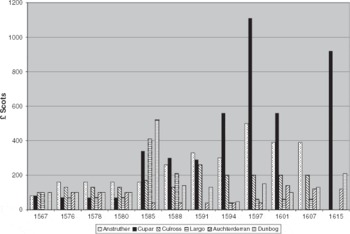
It is important, however, to remember that some of the decreases in stipend came at the same time as a reduction in the number of parishes held by a minister, an example of this being Auchterderran after 1580. Auchterderran had a negligible stipend through the 1590s, and although it more than trebled in 1601, £140 was still a relatively low figure. These trends cannot be attributed solely to the rural nature of some of the parishes, as even Dunbog saw a major increase in 1585. However, by 1588 its cash payments had significantly dropped while the victual element of one chalder fourteen bolls remained constant. Progress in Dunbog remained slow, and there was never much more than one chalder available to supplement the £100 cash element. The complex nature of the development of stipends in these parishes can be seen in Figure 1, which graphically reproduces the data from Table 1.
Stipends in six Fife parishes, 1567–1615.

This analysis does not add any simplicity to the already complicated picture of stipends during this period. The fluctuations and the complicated nature of the development of stipends only serve to illustrate the futility of attempting to discern clear trends using statistics. If each year's stipends were to be totalled to produce averages, even just from this small sample of six parishes, the figures would be meaningless, and would mask the real situation in parishes. Table 1 also demonstrates that a distinction between stipends in rural parishes and the burghs cannot be assumed. Although the stipends of the burghs were on the whole larger than the other parishes, this was not always the case. In 1585, for example, the minister of Dunbog earned substantially more than each of the ministers of Anstruther, Cupar and Culross. The anecdotal impression from the full selection of parish stipends is that there was a general increase in the late sixteenth and early seventeenth century, but it may have come too late to save some of the ministers of the 1580s and 1590s from the high inflation of those years. The overall increase masks falls in stipend in some parishes.
Although the evidence is less systematic, there is some evidence for the stipends of some Fife ministers in the later part of the period 1560–1640. The ‘Sederunt Book’ of the High Commission on Teinds contains details of augmentations made to stipends in a few Fife parishes in 1631. Fortunately, these record both the old stipend and the new, although some allowance has to be made for the fact that the old stipends were described by ministers appearing before the Commission to argue their case for an increase. The old stipend of Carnbee was 300 merks, one chalder of oats and one chalder of bear, making a total of about £320 at 1631 grain prices. This was augmented by two chalders, to a total of about £430.Footnote 21 The minister of Anstruther was in a worse position, with a stipend of only 300 merks, with which he also supported a reader. The augmentation here was only very slight, as his old stipend was replaced by twelve bolls of meal, twelve bolls of bear and £100, making a total only slightly higher than the previous sum. However, as it now included victual, it was at least more secure.Footnote 22 A more substantial increase came in 1634, when seventy-two bolls victual were provided.Footnote 23 The minister of Largo reported that his current stipend was 200 merks plus forty bolls victual, without possession of the glebe. Because the proportion of different grains is not recorded, the value of this stipend cannot be accurately assessed, but assuming that it resembled other stipends in consisting mainly of meal and bear (as opposed to the much more valuable wheat and the much less valuable oats), it may have been between £300 and £400. It was augmented with one chalder of bear and one chalder of meal, amounting to roughly £75 extra.Footnote 24 The evidence from Culross is more straightforward, with the stipend being augmented from 600 merks (£400) to 900 merks (£600).Footnote 25 Finally, in 1632, the stipend of Abdie was increased from sixty-six bolls victual and 180 merks to ninety-four bolls victual plus 200 merks. As the Commission acknowledged, the former stipend was not, as in many other cases, ‘verie meane’, but it was still judged ‘not ane sufficient and competent stipend’.Footnote 26 This judgement further emphasises the meanness of some of the other stipends, although it should be remembered that this evidence only exists because the stipends were augmented, and so were probably felt to be the most urgent cases.
The final piece of evidence on stipends towards the end of this period is in some ways the most reliable, because by its very nature it proves that the sums recorded were actually paid to the ministers. A few receipts for complete payment of stipends have survived, signed by the minister to acknowledge payment, and helpfully noting that they represented full payment of both cash and victual for both Whitsunday and Martinmas terms. Again, these date from 1631, the first being a receipt from the minister of Dunfermline for a stipend of 400 merks, two chalders of bear and two chalders of white oats.Footnote 27 This was worth about £500 at 1631 grain prices. The minister of Kinglassie received 400 merks plus one chalder of bear, a total roughly equivalent to £350.Footnote 28 The stipend for Kirkcaldy was £320 with four bolls of wheat, one chalder of bear and one chalder of white oats, worth roughly £470 in total.Footnote 29 On an even more positive note, although not arising from a receipt, the stipend for the rural parish of Balmerino was worth a total of about £600 in 1634, largely as a result of higher grain prices for that year.Footnote 30 Unfortunately there is no overlap between the parishes for which we have 1631 augmentations or 1631 receipts, so it is not clear whether the stipends recorded in the receipts were recently augmented, or soon to be augmented. Nevertheless, the early 1630s did see substantial improvements in stipends, at least for some Fife ministers, although some very poor stipends remained.Footnote 31
It is worth pausing to consider what it might mean for a minister to be paid largely in kind. The quantities involved are so large (a boll was equivalent to around 150 litres) that as well as storing grain, ministers and their families would have sold some on to their parishioners. Of course, when harvests were poor, insufficient grain might be available for their stipend, and although they could still be paid in cash using the price of grain as a guide, this may help to explain some late stipend payments. For England, Rosemary O'Day has noted the importance of harvests for ministers paid in kind; those who possessed their glebes benefited from an extra layer of security.Footnote 32 This may help to explain the Synod of Fife's attempts in the early seventeenth century to ensure that ministers held their glebe, although glebe land was of varying quality and may have also been required to provide feed for a horse, should the minister own one.Footnote 33 So, even ministers being paid in kind, although relatively immune from inflation, were far from insulated from sharing the potential hardship of a poor harvest with the rest of their community.
Ministerial pay continued to be a very troubling issue for the Church into the seventeenth century. Apart from the the varying needs of ministers, parochial circumstances could change dramatically. A privy seal letter from 1609 regarding Burntisland demonstrates this nicely:
remembering the great extraordinar and exorbitant expenses sustained and deburseit be [the burgesses and inhabitants of Burntisland] in the erecting edefieing and building of ane new paroch kirk within our burgh albeit destitut altogether of ane certaine stipend for ther minister serveing the cuir thereof … to give and assigne to Mr William Watson present minister at the said kirke the soume of ffyve hundreth marksFootnote 34
So even parishes like Burntisland, with well-established ministers and active kirk sessions, could have problems with providing stipends for various reasons.Footnote 35 The newly erected parish of Ferryport-on-Craig (now Tayport) even had its minister poached in 1605, when Aberdeen made him an offer of more substance than the ‘meane provision’ he received in Ferryport.Footnote 36
Any conclusion about the state of ministerial incomes must remain tentative, especially as it could not be guaranteed that the designated stipend would be received on time. Jenny Wormald is right to point out that the post-Reformation clergy were in a far stronger financial position than the pre-Reformation clergy, whose minimum income had been set at £13 6s. 8d., and to draw favourable comparisons with the much worse situation in England.Footnote 37 But those ministers who, after several decades of inflation, were still only receiving stipends below £70 would have struggled to appreciate the difference, especially now that they normally had families to support, not to mention travel between their parishes.Footnote 38 And although stipend figures based on assignations are not precise, they are unlikely to be under-estimates of the real situation, and are much more likely to be over-estimates. While significant progress had been made by the end of the sixteenth century, financial provision for ministers was still problematic, and remained so well into the seventeenth century.
Testaments
Did the problems with stipends lead to an impoverished ministry? There are few signs of serious poverty in the records of church courts. But when actual evidence for ministers' financial situations is sought, it is only marginally less problematic to attempt to assess their economic status from sources of information other than their pay. There were ongoing problems with possession of manses and glebes in the later sixteenth century, and in the 1610s the synod of Fife was still investigating these matters at a parish level.Footnote 39 A more direct source of information is the testaments of ministers. These have been used by historians working on various periods and themes, the most relevant sample for the period being that taken by Walter Foster.Footnote 40 The usual approach has been to add up the totals and derive averages and conclusions from them.Footnote 41 Because the focus here is on Fife alone, it has been possible to analyse a smaller sample of ministers' testaments in greater detail, examining their contents as well as the overall sums. This has also made it possible to present the full range of values, as well as the average figures.
This small sample consisted of twenty-seven Fife ministers. This amounts to every clearly identifiable Fife minister with a surviving testament who died between 1560 and 1640. While the testaments may not be representative, there is no particular reason to suppose that they are more likely to be those of unusually wealthy or unusually poor ministers. There are four main elements to the testaments: the inventory of the minister's movable possessions; debts owed to him; debts owed by him; and the overall net value of the estate (inventory plus debts to the minister, minus debts owed).
The value of the inventories of the testaments sampled here was relatively modest in most cases. The mean total was £184, although the median (the middle value) was rather lower at £100.Footnote 42 The inventories of Thomas Buchanan (£898), William Murray (£690) and Robert Buchanan (£689) inflate the mean substantially, while all the other testaments were well below £400.Footnote 43 As well as these very valuable inventories, there were also some very small ones, such as those of Peter Ramsey and William Laing, which were each valued at £7, while Patrick Mearns had ‘na guids nor geir movabill except the detts … awand to him’.Footnote 44 If the top three and bottom three testaments are removed from the analysis, the mean total is rather closer to the median, at £127. Despite the inflation of the late sixteenth century, there was no real change over time in the value of inventories (see Figure 2). Looked at in this way, the inventories seem a rather less positive indicator of ministerial wealth than the raw mean of £184 suggests, with the majority clustered around £100 or even below. This compares unfavourably with the average figures produced by Walter Foster for the period 1600–38.Footnote 45
Value of ministers' inventories, 1560–1640.

Turning to debts owed to ministers, the figures are initially rather larger. The overall mean was £891, while the median was only £274. As with the inventories, the mean is greatly inflated by a few key ministers.Footnote 46 Without the top three and bottom three ministers, the mean was £577. Of the twenty-seven testaments, five record debts owed to the minister below £100, six record debts to the minister above £1,000, while a clear majority of sixteen record debts somewhere between these two figures. The debts owed by ministers were on a much smaller scale. Thirteen had no debts recorded, and of the fourteen who did owe money, the mean was £117, while the median was only £36. The vast majority of ministers owed less than £100. Again, there was no clear chronological pattern to the level of debt.
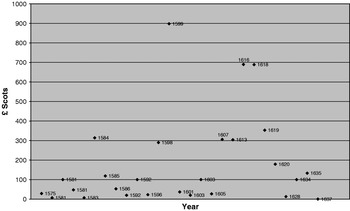
In terms of the overall net assets recorded in the testaments the mean (£984) is much higher than the median (£387). As usual, a few exceptionally large testaments inflate the mean. A clearer impression can be derived from looking at the overall range of data (see Figure 3). In order for the majority of testaments to be clearly visible, two very large testaments had to be excluded from the chart: that of Robert Hamilton in 1581 (£5,414) and Thomas Buchanan in 1599 (£5,220). As well as further demonstrating the lack of any clear chronological trends, the figure illustrates that the vast majority of testaments recorded net assets of well below £1,000, with a large proportion below £500. Once again, this compares unfavourably with averages that have been given elsewhere.Footnote 47
Ministers' net assets, 1560–1640.

These statistics are only the bare bones of any discussion of ministers' testaments, however. Although the figures given above can offset the obvious problem of exceptional cases skewing the averages, there is also the problem of interpreting them. For example, the net asset figures do not distinguish between possessions and money owed to the minister, and so are hardly a clear-cut indicator of wealth. Also, in an age when many normal transactions were based on credit, debts owed by ministers do not necessarily indicate poverty. It is thus necessary to turn to a more qualitative analysis of the contents of the testaments, which should also provide more insight into the financial and material circumstances of the ministers.
At the core of most of the inventories were the personal belongings of the ministers: household goods, furniture and clothes. These were normally valued between a mere ten merks and £30, though a few were rather more valuable. Only in rare cases does the testament give any more detail on what the personal possessions comprised. For example Andrew Morton of Cults possessed four feather beds worth £26 13s. 4d., plus some silverware and kitchenware.Footnote 48 But in the majority of cases, where household goods and clothes were valued at or below £30, it can be assumed that the minister's possessions were fairly modest. This is especially the case given that if ministers had possessed a valuable array of furnishings, clothes and household items, it would be more likely to have been recorded in the inventory. Slightly more valuable, although sadly not described in any more detail, were ministers' book collections.Footnote 49 Fifteen of the testaments mention books, with an average value of around £100. This is only a rough average, however, since some ministers had collections worth several hundred pounds, while others only mention books as part of the minister's possessions without giving a specific value. But even those with much less valuable collections must still have had a reasonable number. Book prices were highly variable, but a Bible could cost as much as £5, while a small catechism could cost just 8d. For the 1570s, Alastair Mann has estimated that the average unit price was just under 1s. 6d., rising to 3s. 6d. in 1603, and as high as 6s. by the 1640s.Footnote 50 Even a conservative estimate, allowing for the cost of binding, indicates that a typical book collection worth just £20 must have contained dozens of books. The collections worth well over £100 must have consisted of hundreds of books. In any case, books seem to have made up the most significant element of many ministers' possessions.
The next most common type of property found in the inventory was supplies of victuals. William Murray had £680 worth of bear, oats and peas, although most had much smaller quantities.Footnote 51 In most cases this was probably made up of stipend payments, and perhaps sometimes the produce of the glebe. Only William Clerk of Anstruther possessed foodstuffs other than grain and pulses; his inventory also recorded a barrel and a half of herring.Footnote 52 Some ministers also owned livestock, with eight recorded as possessing at least one animal in their inventory. These ranged from a single milk cow worth £13 6s. 8d. (Andrew Moncrieff), or a cow with a calf and a brown horse (Henry Leitch) to rather more substantial holdings.Footnote 53 Robert Buchanan's portfolio included ‘nyne hoggis’, while William Clerk had a horse and twenty-four sheep.Footnote 54 Livestock must have provided a crucial supplement to the grain payments received by way of stipend. Transport opportunities provided by animals seem to have been more limited, with only four of the twenty-seven ministers recorded as owning a horse.
Finally, very few ministers appear to have possessed ready cash, although again this is more of a reflection on the nature of the economy than on ministers' wealth. David Ferguson had £52 in cash, while John Rutherford's coinage included ‘of gold ane doubill deucatt’. Thomas Buchanan had a rather more substantial £312 in ready money.Footnote 55 William Watson was unique in the sample in owning a share of a ship, worth £133 6s. 8d.Footnote 56 Although he died as minister of inland Markinch, until a few years before his death Watson had been minister at the coastal burgh of Burntisland, where the unnamed ship was based. Indeed the master of the ship was Andrew Watson, a baillie in Burntisland and long-standing kirk session elder.Footnote 57 Evidence of economic activity was lacking for most ministers. Some of the sample, moreover, had inventories valued at very low levels. Robert Thomson of Torrie and Crombie, who died in 1628, towards the end of the period, was not exceptional in having an inventory which consisted solely of household goods and clothes worth £13 6s. 8d. Footnote 58 Most ministers had a modest set of furnishings, a good collection of books, and perhaps some spare victuals in store, but the overall impression from the inventories is of modest comfort and security rather than any real prosperity.
The debts owed to ministers provide rather less insight into their material circumstances, but are hugely important in terms of understanding their financial situation. These debts were normally higher than the value of their inventories. This in itself should provide a warning against using overall net assets as a simple measure of ministerial wealth. The fact that so many ministers were owed substantial sums of money might lead to the assumption that they were active moneylenders, displaying a high level of economic agency and confidence.Footnote 59 Indeed there were some smaller sums owed by ordinary laypeople to ministers which might have been personal loans. In one case this was made explicit: David Henryson owed his minister, John Kinneir, £46 of ‘lent’ money.Footnote 60 But much of the debt related explicitly to overdue stipend payments. For example, Robert Thomson was owed £266 13s. 4d. by the laird of Cleish and the parson of Torrie for his stipend.Footnote 61 Patrick Lord of Lindores owed John Kinneir a total of £144 for his stipend.Footnote 62 John Rutherford was owed £103 by the laird of Laurestoun for part of his stipend, and the debts owed to David Ferguson included £40 16s. 8d. from a widow as part stipend.Footnote 63 Even when stipend is not mentioned, it seems to have been the most likely source of the debt in many cases. For example, James Tullis was owed 100 merks by William Kirkcaldy of Grange ‘conforme to his obligation’, and £120 by the baillies and council of Kinghorn ‘conforme to an act’.Footnote 64 Both of these probably relate to his ministerial pay. The stipendiary payments in question need not have been long overdue in each case, and in some instances might well have simply been a payment which was due shortly before the minister's death. But most of the debt owed to most ministers seems to have been late stipend rather than money that they lent out to others. Although the fact that ministers seem to have been able to cope with late stipend payments without getting too far into debt themselves suggests that their financial situations were not too marginal, the large debts owed to them can hardly be interpreted as an indicator of prosperity.Footnote 65
The debts owed by ministers were almost always much smaller than the debts owed to them. Only two of the twenty-seven ministers had net assets in the negative.Footnote 66 While only three of the ministers had no debts owed to them, as many as thirteen owed no money themselves. Of the fourteen who did, the average of £117 was inflated considerably by a few men with unusually high debts. The most common group of creditors were servants. There would often be a small debt to a servant-man and a servant-woman, normally for a year or six months' service. Such payments rarely exceeded £10.Footnote 67 These debts were not debts in our sense of the word; rather they were probably payments which had yet to be made at the time of death. Similarly, another form of debt consisted of payments due to various tradespeople, presumably for goods and services. For example, James Tullis owed 40s. 6d. to a wobster, 50d. to a cordiner in Auchtertool, 16d. to a baxter in Kirkcaldy, and so on.Footnote 68 In John Rutherford's case there are details of the goods purchased, which included silver spoons made by Patrick Guthrie (40s.), plus wine (23s.) and ale (20s.).Footnote 69 Like debts to servants, these are evidence of a credit economy, not of serious ministerial debt. The only other common creditors were family members. If ministers owed money, it was not usually because they had borrowed large sums of money out of necessity, but because they still owed payment for goods and services. This reflects rather more positively on their financial situation, and perhaps indicates a tendency for ministers to live within their means.Footnote 70 Their income was usually reasonable, but not always regular, and so they did not spend lavishly. As with the inventories, the evidence from their debts points to modesty rather than significant prosperity, and to ongoing variations rather than sustained increases in their standard of living.
The testamentary evidence is crucial to understanding the economic fortunes of Fife's ministers. The study of stipends, based as it is on central records, can give the impression of money being parachuted in on a regular basis, as if by a modern clearing system. But early modern ministers were of course as intimately connected to the local economy as anyone else; they depended on local sources for their stipends, would have suffered with their parishioners when harvests were poor, and most of the economic links recorded in their testaments were to the local community. Nevertheless, those ministers whose testaments have survived seem to have coped reasonably well with the difficulties with stipends, and managed to run comfortable but modest households. It seems clear that neither serious poverty nor significant prosperity was the norm. The account offered here suggests a more negative picture of ministerial finances than the two main existing studies, by Foster and Makey. This is in part no doubt a reflection of its earlier time frame; certainly things seem to have improved by the middle of the seventeenth century. But it is also a reflection on how complicated these matters are, and on the need for very detailed and contextual discussion, qualifying the use of averages and broad trends with individual examples of stipends and the contents of testaments. For all that the ministry was becoming an increasingly professionalised calling, the economic fortunes of its practitioners remained far from uniform.