Introduction
The alpine edelweiss (Leontopodium alpinum Cass. or L. nivale subsp. alpinum (Cass.) GreuterFootnote *) holds an important position in the cultural heritage of the European Alps. Starting from a tradition in folk medicine, phytochemical research has revealed the presence of various new or uncommon secondary compounds, some of which are of high biological activity (Grey et al., Reference Grey, Hook, James and Sheridan1999; Stuppner et al., Reference Stuppner, Ellmerer, Ongania and Dobner2002; Dobner et al., Reference Dobner, Ellmerer, Schwaiger, Batsugkh, Narantuya, Stutz and Stuppner2003a, Reference Dobner, Schwaiger, Jenewein and Stuppner2003b, Reference Dobner, Sosa, Schwaiger, Altinier, Loggia, Kaneider and Stuppner2004; Schwaiger et al., Reference Schwaiger, Adams, Seger, Ellmerer, Bauer and Stuppner2004). The present study has evolved under the growing need for an applicable taxonomy and systematics of the genus for further pharmaceutical research.
Leontopodium (Pers.) R.Br. is a genus containing about 120 published binomials. Based on the earlier work of Franchet (Reference Franchet1892) and Beauverd (Reference Beauverd1909, Reference Beauverd1910, Reference Beauverd1911, Reference Beauverd1912, Reference Beauverd1914), Handel-Mazzetti (Reference Handel-Mazzetti1927) completed the only monograph to date, in which he accepted 41 species. Several new taxa have subsequently been described (e.g. Voroshilov, Reference Voroshilov1979; Akiyama, Reference Akiyama1999). We found the species concepts of Handel-Mazzetti (Reference Handel-Mazzetti1927) generally sound. However, several taxa he accepted, and almost all of those described since, are probably better reduced to synonymy. Many were known only from their types and, on account of more recent collections, are now known to fall within the often wide morphological variation of other species. Ongoing studies suggest there are fewer species, perhaps as few as 30 (W. B. Dickoré, unpubl.).
Most taxonomic treatments of Leontopodium in modern Asian Floras, such as the Flora of the USSR (Shishkin, Reference Shishkin1999), Flora Iranica (Rechinger, Reference Rechinger1980), Flora of India (Hajra et al., Reference Hajra, Rao, Singh and Uniyal1995), Flora of Pakistan (Qaiser & Abid, Reference Qaiser and Abid2003), Flora of Japan (Iwatsuki et al., Reference Iwatsuki, Yamazaki, Boufford and Ohba1995), Flora of Bhutan (Grierson & Long, Reference Grierson and Long2001) and for Central Asia (Grubov, Reference Grubov2003), do not seem fully satisfactory, because of their rather incompatible regional viewpoints.
Except for two taxa in the mountains of Central and Southern Europe (Leontopodium alpinum and L. nivale; author abbreviations for species are given in Table 1), the genus occupies an extensive and largely continuous distribution in the mountains of Central, temperate Southeastern, and Eastern Asia. This wide generic disjunction is unusual (Meusel & Jäger, Reference Meusel and Jäger1992). Whereas Leontopodium alpinum is well known due to ample work on various aspects of its biology, ecology, chorology, and secondary chemistry (e.g. Uexküll-Gyllenband, Reference Uexküll-Gyllenband1901; Sokolowska-Kulczycka, Reference Sokolowska-Kulczycka1959; Maugini, Reference Maugini1962; Tira et al., Reference Tira, Galeffi and Dimodica1970; Erhardt, Reference Erhardt1993; Hook, Reference Hook1994; Stuppner et al., Reference Stuppner, Ellmerer, Ongania and Dobner2002), very little is known about the Asian members of the genus.
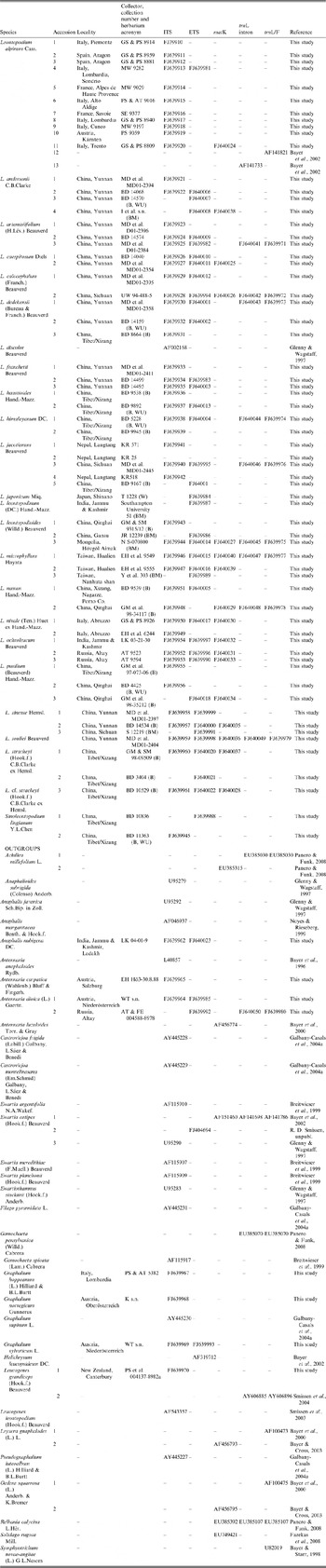
Species names, localities, collectors and voucher numbers, and GenBank accession numbers of the analysed taxa. All vouchers are deposited in WU unless stated otherwise. Collectors are abbreviated as follows: AT = A. Tribsch; BD = B. Dickoré; EH = E. Hörandl; FE = F. Essl; GM = G. Miehe; GS = G. Schneeweiss; I = Iwatsuki; JR = J. F. Rock; K = Kleesadl; KR = K. Reiter; LK = L. Klimes; MD = M. Dobner; MW = M. Wiedermann; N = Narantuja; PS = P. Schönswetter; SE = S. Ertl; SM = S. Miehe; S = Smith; UW = U. Wündisch; WT = W. Till; Y = Yamazaki. Voucher information for sequences drawn from GenBank can be found in the indicated references

This study employs DNA sequences to understand affinities among species of Leontopodium and among some possible close generic relatives. More than two-thirds of the species of Leontopodium are sampled, hence providing a good taxonomic and geographical representation, plus taxa from related genera of Gnaphalieae and more distantly related taxa from other tribes of Asteraceae. Two nuclear ribosomal DNA markers (internal transcribed spacer (ITS) and external transcribed spacer (ETS)) and three plastid markers (matK, trnL intron, and trnL/F intergenic spacer) were investigated. ITS1 and ITS2 have frequently been used for phylogenetic studies in Asteraceae especially at the generic level (Clevinger & Panero, Reference Clevinger and Panero2000; Samuel et al., Reference Samuel, Stuessy, Tremetsberger, Baeza and Siljak-Yakovlev2003, Reference Samuel, Gutermann, Stuessy, Ruas, Lack and Tremetsberger2006; Kimball & Crawford, Reference Kimball and Crawford2004; Plovanich & Panero, Reference Plovanich and Panero2004; Tremetsberger et al., Reference Tremetsberger, Weiss-Schneeweiss, Stuessy, Samuel, Kadlec, Ortiz and Talavera2005), and for phylogenetic studies in Gnaphalieae (Antennaria Gaertn., Bayer et al., Reference Bayer, Soltis and Soltis1996; Anaphalioides (Benth.) Kirp., Glenny, Reference Glenny1997; Australasian Gnaphalieae, Breitwieser et al., Reference Breitwieser, Glenny, Thorne and Wagstaff1999; Mediterranean Helichrysum Mill., Galbany-Casals et al., Reference Galbany-Casals, Garcia-Jacas, Susanna, Saez and Benedi2004a). The ETS region of the 35S rDNA cistron belongs to the same functional unit as ITS (Baldwin & Markos, Reference Baldwin and Markos1998), but so far ETS has been used less frequently (e.g. Baldwin & Markos, Reference Baldwin and Markos1998; Clevinger & Panero, Reference Clevinger and Panero2000; Plovanich & Panero, Reference Plovanich and Panero2004). The matK gene, which is one of the fastest evolving genes of the chloroplast genome (Wolfe, Reference Wolfe1991), is frequently employed for inferring plant phylogeny at the intergeneric level and above. Within Asteraceae matK, trnL intron, and trnL/F spacer have been used to infer higher level phylogenies, for example the trnL intron and trnL/F spacer at the tribal level (Bayer & Starr, Reference Bayer and Starr1998), matK for South African Gnaphalieae (Bayer et al., Reference Bayer, Puttock and Kelchner2000), and matK, trnL intron, and trnL/F spacer for Australian Gnaphalieae (Bayer et al., Reference Bayer, Greber and Bagnall2002). We employed these plastid markers to reveal intergeneric relationships involving Leontopodium and relatives.
The aims of this molecular study of Leontopodium, therefore, were to (1) elucidate phylogenetic relationships among species within the genus (including monophyly and infrageneric classification), (2) clarify relationships with other genera, including the recently described monotypic Sinoleontopodium Y.L.Chen (Chen, Reference Chen1985; Chen & Yang, Reference Chen and Yang2009), and (3) address the origin and evolutionary history of the alpine edelweiss (L. alpinum), a prominent taxon of the European mountain flora.
Materials and Methods
Sampling
We have included in our study 22 species of Leontopodium in 65 accessions (Table 1) from a broad geographic range and with a good representation from the Himalayan/Tibetan centre of diversity. Less material was available from North and East Asia. Since many taxa occur only in remote areas, most DNA samples were obtained from herbarium specimens. Silica gel dried material from natural populations was available only from the European taxa (Leontopodium alpinum, L. nivale) and from the Taiwanese L. microphyllum. Vouchers are deposited in B and WU. Additional sequences, mostly of outgroup taxa, were drawn from the NCBI GenBank (Table 1).
Several outgroup taxa were included to investigate the position of Leontopodium within Gnaphalieae: Anaphalioides subrigida, Anaphalis javanica, A. margaritacea, A. nubigena, Antennaria anaphaloides, A. carpatica, A. dioica, A. luzuloides, Castroviejoa frigida, C. montelinasana, Ewartia argentifolia, E. catipes, E. meredithiae, E. planchonii, Ewartiothamnus sinclairii, Filago pyramidata, Gamochaeta pensylvanica, G. spicata, Gnaphalium hoppeanum, G. norvegicum, G. supinum, G. sylvaticum, Helichrysum leucopsideum, Leucogenes grandiceps, L. leontopodium and Pseudognaphalium luteoalbum. In addition, several accessions from the ‘Relhania clade’ (Gnaphalieae) and from other Asteraceae tribes were added to root the plastid phylogenies, namely Leysera gnaphalodes, Oedera squarrosa and Relhania calycina (Relhania clade, Gnaphalieae), Achillea millefolium (Anthemideae), Solidago rugosa and Symphyotrichum novae-angliae (Astereae).
DNA extraction and amplification
Total genomic DNA was extracted from one leaf of herbarium material with the modified CTAB protocol of Doyle & Dickson (Reference Doyle and Dickson1987). The complete ITS (ITS1, 5.8S rRNA gene, ITS2), the 3′ part of ETS, a partial sequence of the plastid gene matK and the trnL/F region (trnL 5′-exon, intron, 3′-exon, intergenic spacer and trnF gene) were amplified with the universal primers ITS4, ITS5, ITS2, ITS3 (White et al., Reference White, Bruns, Lee, Taylor, Inis, Gelfand, Sninsky and White1990), 17SE and 26SE (Sun et al., Reference Sun, Skinner, Liang and Hulbert1994) for ITS; ETS-Hel-1 and 18SR (Baldwin & Markos, Reference Baldwin and Markos1998) for ETS; trnL-c and trnL-c-1F/trnL-F (Taberlet et al., Reference Taberlet, Gielly, Pautou and Bouvet1991) for trnL (UAA) intron and intergenic spacer between trnL (UAA), as well as 3′-exon and trnF (GAA) and 800F/1710R (Samuel et al., Reference Samuel, Kathriarachchi, Hoffmann, Barfuss, Wurdack, Davis and Chase2005) for a partial matK. Polymerase chain reaction was carried out in a volume of 25 μl, containing 10–50 ng of genomic DNA, 10 pmol of each primer, 1× Reddy Mix TM PCR Master Mix (including 2.5 mM MgCl2; Abgene, Vienna) and 0.04% dimethyl sulfoxide (DMSO; for ITS and ETS) or 0.016% bovine serum albumin (BSA; for trnL/F and matK). The PCR profile consisted of an initial pre-melt at 94°C and 35 cycles of 1 min denaturing at 94°C, 30 s annealing at 48°C and 1 min extension at 72°C followed by a final extension of 10 min at 72°C. Amplified fragments were checked on 1% agarose gel.
Sequencing
The amplification product was gel purified using Invitek Invisorb® Spin DNA Extraction Kit (Invitek Biotechnology & Biodesign Ltd, Berlin). The purified fragments were directly sequenced using dye terminator chemistry following the manufacturer’s protocol and run on an ABI 377 automated sequencer (Applied Biosystems, Foster City, CA). The cycle sequencing reactions were performed with the same primers as used for PCR amplification. The programs Sequence Navigator version 1.0.1 and AutoAssembler version 1.4.0 (Applied Biosystems, Foster City, CA) were used to edit and assemble the complementary sequences. Alignments were obtained using the program Clustal X 1.5b (Thompson et al., Reference Thompson, Gibson, Plewniak, Jeanmougin and Higgins1997) and improved by manual refinement using the program BioEdit 7.09 (Hall, Reference Hall1999). Pairwise genetic distances were calculated in the program BioEdit (Hall, Reference Hall1999) using the feature Identity Matrix. Sequences are deposited in GenBank (www.ncbi.nlm.nih.gov).
Phylogenetic analyses
Fitch parsimony analyses (Fitch, Reference Fitch1971) were performed using PAUP* 4.0b10 (Swofford, Reference Swofford2002). Four datasets were analysed: (1) ITS, (2) ETS, (3) partial sequence of matK, and (4) the trnL intron sequence and the trnL/F intergenic spacer. Heuristic search was conducted with equal weights, 1000 replicates of random sequence addition, tree bisection reconnection (TBR) branch swapping, and MulTrees on permitting 10 trees to be held in each step. Indels were treated as missing data, except for the ETS dataset where an additional parsimony analysis was conducted adding characters from gap coding using the MCIC method (Müller, Reference Müller2006) as implemented in SequState (Müller, Reference Müller2005). Trees were rooted in the plastid datasets using outgroups from the Gnaphalieae ‘Relhania clade’ (Leysera L., Oedera L., Relhania L’Hér.; Ward et al., Reference Ward, Bayer, Breitwieser, Smissen, Galbany-Casals, Unwin, Funk, Susanna, Stuessy and Bayer2009) and from more distantly related tribes, namely Achillea L. (Anthemideae) and Solidago L. (in the matK dataset) or Symphyotrichum Nees (in the trnL/F dataset; both Astereae). The root for the nuclear markers was chosen using results of the plastid trnL/F dataset, in which Ewartia Beauverd was not sister to Leontopodium. To test the monophyly of Leontopodium, the following putatively close relatives from Gnaphalieae (according to Merxmüller et al., Reference Merxmüller, Leins, Roessler, Heywood, Harborne and Turner1977; Anderberg, Reference Anderberg1991; Bayer et al., Reference Bayer, Soltis and Soltis1996; Glenny & Wagstaff, Reference Glenny and Wagstaff1997; Breitwieser et al., Reference Breitwieser, Glenny, Thorne and Wagstaff1999) were included: Anaphalis DC. (ITS, ETS), Anaphalioides (ITS), Antennaria (ITS, ETS, matK, trnL/F), Castroviejoa Galbany, L.Sáez & Benedí (a recently recognised segregate of Helichrysum; ITS), Ewartia (ITS, ETS, matK, trnL/F), Ewartiothamnus Anderb. (ITS), Filago L. (ITS), Gamochaeta Wedd. (ITS, trnL/F), Gnaphalium L. (ITS, ETS), Helichrysum (ETS), Leucogenes Beauverd (ITS, trnL/F), and Pseudognaphalium Kirp. (ITS). Nodal support was assessed via bootstrap values (Felsenstein, Reference Felsenstein1985), which were calculated using PAUP* 4.0b10 with 10,000 bootstrap replicates each with 20 random sequence addition replicates holding a maximum of 10 trees per replicate, SPR branch swapping, and MulTrees on.
To find the best-fit substitution models for the Bayesian analysis, all four datasets were tested using MrModeltest 2.2 (Nylander, Reference Nylander2005). The following partitionings were used for the analysis: (1) the ITS region was split into two partitions (the genic and the spacer regions of the ribosomal cistron) with GTR+I and GTR+G substitution models; (2) the matK/trnK region was also split into two partitions (the genic partial matK and the partial intron of the trnK gene) with GTR+G and F81 substitution models; (3) the trnL/F region was split into three partitions (the trnL intron, the trnL gene and the trnL/F spacer) with F81+G, the Jukes-Cantor, and GTR+G substitution models. For the ETS dataset Bayesian analysis was performed using the HKY+G with Mr Bayes (Ronquist & Huelsenbeck, Reference Ronquist and Huelsenbeck2003), running four simultaneous Markov chains for 10,000,000 generations using four chains. Trees were sampled after every 1000 generations with a total of 40,000 trees. The first 10% of trees was discarded to ensure that sufficient allowance was made for the chains to become stationary, thereby reducing the number of trees to 36,000.
Results
Nuclear markers
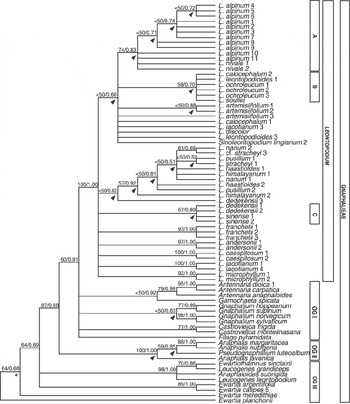
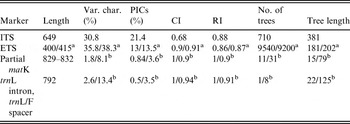
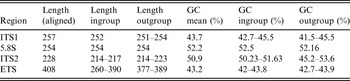
The data matrix of the combined ITS region (ITS1, 5.8S, ITS2) included 22 ingroup taxa in 53 accessions (including one accession of Sinoleontopodium) and 23 outgroup accessions from 11 currently accepted genera (see Table 2 for analysis statistics and Table 3 for sequence statistics). Pairwise genetic distance in the complete ITS region (ITS1, 5.8S, ITS2) ranged from 0.2% to 6.8% among the Leontopodium species. Pairwise sequence divergences between ingroup and outgroup were between 6.2% and 17%. Maximum parsimony and Bayesian analysis did show congruent results, with the latter providing considerably more resolved nodes. Therefore, phylogenetic results of the ITS region are presented showing the Bayesian majority rule consensus tree (Fig. 1).
Phylogenetic relationships of species of Leontopodium and related genera of tribe Gnaphalieae inferred from Bayesian and maximum parsimony analysis of the nuclear ITS region. Branches collapsing in the strict consensus tree of 710 equally most parsimonious trees are indicated by arrowheads. Bootstrap values/posterior probabilities are indicated at the nodes. Clades discussed in the text are marked with A–C and OG I–OG III.

Sequence statistics for ITS, ETS, matK and trnL/F

a Including coded gap characters.
b Including outgroups from tribes Anthemideae, Astereae and Gnaphalieae (Relhania clade).
Abbreviations: var. char. = number of variable characters; PICs = number of parsimonious informative characters; CI = Consistency Index; RI = Retention Index.
ITS and ETS sequence characteristics showing length of the different ITS and ETS regions and GC content for ingroup and outgroup

Leontopodium was supported as monophyletic, with the inclusion of Sinoleontopodium lingianum, the only species in Sinoleontopodium, with 100% bootstrap support (BS) and 1.00 posterior probability (PP) (Fig. 1). Some weakly (PP≥0.70) supported clades could be identified (clades A–C, Fig. 1), although the ingroup was not well resolved. Sister to the ingroup (BS 60, PP 0.91) were Antennaria, Castroviejoa, Gnaphalium, Filago and Gamochaeta (OG I). Sister (BS 87, PP 0.98) to Leontopodium and the taxa of OG I were Anaphalis and Pseudognaphalium luteoalbum, which together formed OG II (BS 100/PP 1.00). A third group of outgroup taxa comprised the Australian and New Zealand Gnaphalieae: Anaphalioides, Ewartia, Ewartiothamnus and Leucogenes (BS 87, PP 0.98; OG III).
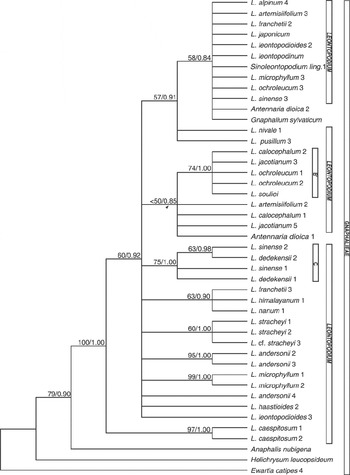
The dataset of the ETS consisted of 39 ingroup accessions of 22 species and six outgroup accessions of five genera, namely Anaphalis, Antennaria, Gnaphalium, Ewartia and Helichrysum (Fig. 2). Generally, sequence divergence within the ETS dataset (Tables 2, 3) was extremely low except for Helichrysum and Ewartia. Antennaria dioica and Gnaphalium sylvaticum were nested within the ingroup. One clade (BS 57, PP 0.91) shared almost identical sequences and included Antennaria dioica, Gnaphalium sylvaticum, as well as most Leontopodium species (L. alpinum, L. artemisiifolium, L. franchetii, L. japonicum, L. leontopodinum, L. leontopodioides, L. microphyllum, L. nivale, L. ochroleucum, L. pusillum, L. sinense) and Sinoleontopodium lingianum. Two groups that were supported in the ITS analysis could be identified in the ETS analysis as well: Group B′ (BS 74, PP 1.00) showed almost identical sequences and included Leontopodium calocephalum, L. ochroleucum, L. souliei and L. jacotianum (the last came out in a different position in the ITS analysis). Group C contained Leontopodium sinense and L. dedekensii (BS 75, PP 1.00) which share almost identical sequences. Leontopodium caespitosum appeared as sister to the ingroup comprised of Leontopodium, Antennaria and Gnaphalium (which were supported with BS 60, PP 0.92). The ingroup was supported with BS 100, PP 1.00, when rooted with Ewartia, having Helichrysum leucopsideum, Ewartia catipes and Anaphalis nubigena as clearly defined outgroups.
Phylogenetic relationships of species of Leontopodium and related genera of tribe Gnaphalieae inferred from Bayesian and maximum parsimony analysis of the nuclear 3′ ETS region. Branches collapsing in the strict consensus tree of 9200 equally most parsimonious trees are indicated by arrowheads. Bootstrap values/posterior probabilities are indicated at the nodes. Clades discussed in the text are marked with B′ and C.

Plastid markers
Both plastid markers used in this study (matK, trnL intron–trnL/F spacer) had very low sequence divergences, with ingroup sequences being identical or almost identical. The matK dataset comprised 17 accessions of the ingroup and two outgroup accessions from the Gnaphalieae, namely Antennaria luzuloides and Ewartia catipes (for analysis details refer to Table 2). Furthermore, five outgroup accessions from other tribes of Asteraceae were included.
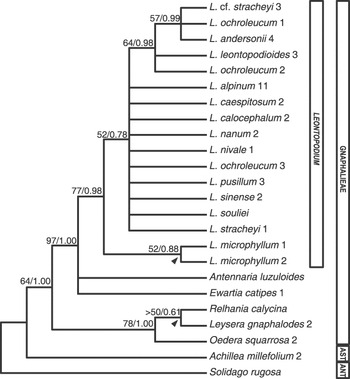
The two outgroup genera from Gnaphalieae were clearly separated by three synapomorphic substitutions as compared to Leontopodium. Considering the low variation within the whole dataset, these substitutions provide further support for monophyly of the ingroup (BS 77, PP 0.98; Fig. 3).
Phylogenetic relationships of species of Leontopodium and related genera of tribe Gnaphalieae, as well as of additional accessions from the tribes Astereae and Anthemideae inferred from Bayesian and maximum parsimony analysis of the partial plastid matK region. Branches collapsing in the strict consensus tree of 31 equally most parsimonious trees are indicated by arrowheads. Bootstrap values/posterior probabilities are indicated at the nodes. AST = Astereae, ANT = Anthemideae.

Within Leontopodium, one group consisting of L. cf. stracheyi (3), L. ochroleucum (1 and 2), L. andersonii (4), and L. leontopodioides (3) was supported (BS 64, PP 0.98). However, the relevance of this group might be in doubt as they share only a single nucleotide substitution not present in other Leontopodium accessions. This well-supported group, which is not supported by either morphology or chorology, may be an artefact of the low sequence divergence. Leontopodium microphyllum appears sister to the remainder of Leontopodium (BS 52, PP 0.88).
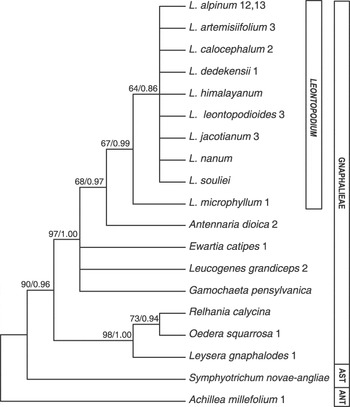
The combined dataset of the trnL intron and the trnL/F spacer region included 10 ingroup accessions and three additional accessions from the crown group of the Gnaphalieae (Ward et al., Reference Ward, Bayer, Breitwieser, Smissen, Galbany-Casals, Unwin, Funk, Susanna, Stuessy and Bayer2009), namely Antennaria carpatica, Ewartia catipes and Leucogenes grandiceps. The trees were rooted using three accessions from the ‘Relhania clade’ of Gnaphalieae (Ward et al., Reference Ward, Bayer, Breitwieser, Smissen, Galbany-Casals, Unwin, Funk, Susanna, Stuessy and Bayer2009) and one accession each from Astereae and Anthemideae (analysis details in Table 2). All accessions of the ingroup had identical sequences for the intron, exon and spacer regions, except for Leontopodium microphyllum, which showed two autapomorphic substitutions and one substitution shared with the other included genera of Gnaphalieae. The ingroup was supported by BS 67 and PP 0.99. Sister to Leontopodium was Antennaria dioica (BS 68, PP 0.97; Fig. 4). Ewartia, Gamochaeta and Leucogenes were together sister to Antennaria and Leontopodium (BS 97, PP 1.00). The outgroup taxa of Gnaphalieae shared one synapomorphic substitution.
Phylogenetic relationships of species of Leontopodium and related genera of tribe Gnaphalieae, as well as of additional accessions from the tribes Astereae and Anthemideae inferred from Bayesian and maximum parsimony analysis of the plastid trnL gene and trnL/F spacer region. Branches collapsing in the strict consensus tree of 8 equally most parsimonious trees are indicated by arrowheads. Bootstrap values/posterior probabilities are indicated at the nodes. AST = Astereae, ANT = Anthemideae.

Despite the lack of resolution, the plastid sequences support the monophyly of Leontopodium. Furthermore, the sequences from Leontopodium microphyllum were distinct from the other sequences of the ingroup in both regions. Further infrageneric grouping could not be inferred using these markers. However, it is noteworthy that the ingroup sequences were clearly different from the outgroup sequences of Antennaria, Ewartia, Gamochaeta and Leucogenes and that according to the trnL/F dataset, Antennaria was the closest relative of Leontopodium of the four included genera of the crown radiation of Gnaphalieae (according to Ward et al., Reference Ward, Bayer, Breitwieser, Smissen, Galbany-Casals, Unwin, Funk, Susanna, Stuessy and Bayer2009).
Discussion
Intergeneric relationships
The genus Leontopodium is monophyletic if the monospecific Sinoleontopodium is included. Three of the four employed markers support its monophyly: ITS (BS 100, PP 1.00), matK (BS 77, PP 0.98) and trnL/F (BS 67, PP 0.99). The ETS dataset included part of Antennaria and Gnaphalium in the ingroup (BS 100, PP 1.00), probably due to the lack of sequence divergence and homoplasy.
The position of Sinoleontopodium within Leontopodium is morphologically and chorologically supported and, therefore, the following new combination is made:
Leontopodium lingianum (Y.L.Chen) Dickoré, comb. nov. – Sinoleontopodium lingianum Y.L.Chen, Novon 19: 24 (2009) [Sinoleontopodium lingianum Y.L.Chen, Acta Phytotaxon. Sin. 23: 458, fig. 1 (1985), nom. inval. (two types cited)].
Leontopodium lingianum is a local endemic of the high mountains around the Tsangpo Gorge of Southeast Tibet (Mainling, Mt Namcha Barwa, Mt Gyala Peri), where it occurs at 4400–4850 m in a perhumid alpine belt. Leontopodium lingianum displays distinct morphological adaptations: a dense cushion of columnar shoots; leaves many, imbricate, small, ovate-spathulate, long and densely lanate; calathidia sessile, solitary, without a star. However, all individual characters and its distribution are contiguous to other species of Leontopodium. The peculiar habit of Leontopodium lingianum is closely matched by L. aurantiacum, a species from the Burma/Yunnan border, which was not available for the present study. Complete dioecy, one of the main distinguishing characters of Sinoleontopodium, occurs facultatively in Leontopodium haastioides, another acaulescent, cushion-forming species from the Central Himalayas, and in several other species of Leontopodium. Hirsute corollas, although not to the extent of Leontopodium lingianum, are also found in other species of Leontopodium. The exact position of Leontopodium lingianum within the genus is still unclear; ITS1 data place it within a large polytomy.
Relationships of Leontopodium within Gnaphalieae are currently largely unresolved. Based on cladistic analysis of morphological data, Anderberg (Reference Anderberg1991) concluded that the ‘New Zealand edelweiss’ Leucogenes is sister to Leontopodium. This hypothesis was, however, rejected by the molecular phylogenetic analyses of Glenny & Wagstaff (Reference Glenny and Wagstaff1997) and Breitwieser et al. (Reference Breitwieser, Glenny, Thorne and Wagstaff1999). Based on morphology Merxmüller et al. (Reference Merxmüller, Leins, Roessler, Heywood, Harborne and Turner1977) placed Leontopodium within an ‘Anaphalis-group’ consisting of Antennaria, Anaphalis and Leontopodium. However, it grouped with Antennaria in the molecular study of Glenny & Wagstaff (Reference Glenny and Wagstaff1997) as sister to Pseudognaphalium and Anaphalis. The latter findings are partly concordant with Bayer et al. (Reference Bayer, Soltis and Soltis1996) who identified Antennaria as sister to Leontopodium and both as sister to the Australian–New Zealand genus Ewartia. The studies of Ward et al. (Reference Ward, Bayer, Breitwieser, Smissen, Galbany-Casals, Unwin, Funk, Susanna, Stuessy and Bayer2009) on the phylogeny of Gnaphalieae, with a focus on African and Australasian taxa, show that relationships within Gnaphalieae are not well resolved, that taxa from the so-called Relhania clade are basal to the rest of the Gnaphalieae, and that Leontopodium is sister to Antennaria. Our combined plastid and nuclear data indicate that Leontopodium is closely related to a group comprised of representatives from the bicentric (south and north hemisphere) genus Gnaphalium, the northern hemisphere genus Antennaria, the newly described genus Castroviejoa (Galbany-Casals et al., Reference Galbany-Casals, Saez and Benedi2004b), and Filago. Accordingly, none of the solely southern hemisphere (mainly Australian–New Zealand) taxa, which form a distinct clade in our study and include Ewartia which was sister to Leontopodium and Antennaria in the study of Bayer et al. (Reference Bayer, Soltis and Soltis1996), is sister to Leontopodium. Despite strong morphological similarities with Leontopodium, the large genus Anaphalis, primarily of temperate East Asian–North American distribution but also with a considerable representation in tropical Indo-Malaysia, seems to be even more distantly related to Leontopodium and instead is rather close to Pseudognaphalium.
Species delimitation and infrageneric classification
The ITS dataset, and to a lesser degree the other markers, reveals information about infrageneric relationships within Leontopodium. Three groups may be recognised but these do not correspond well to the hierarchical scheme of Handel-Mazzetti (Reference Handel-Mazzetti1927). While species delimitations within Leontopodium were partly supported by our study (not all taxa were monophyletic), broader infrageneric relationships were not fully resolved, indicating close species relationships and suggesting recent speciation. Hybridisation seems probable in Leontopodium, due to nested distributions of species and often contiguous variation, especially in the Himalayas and the Hengduan Shan. We could not confirm any of the hybrids proposed by Handel-Mazzetti (Reference Handel-Mazzetti1927). Furthermore, species delimitation in Leontopodium seems to be complicated by the possible occurrence of apomixis. This was mentioned, for example, in the Flora of Pakistan (Qaiser & Abid, Reference Qaiser and Abid2003). The only species where apomixis has been studied and found is in Leontopodium alpinum (Sokolowska-Kulczycka, Reference Sokolowska-Kulczycka1959; Maugini, Reference Maugini1962). In a review of apomixis in Asteraceae, Noyes (Reference Noyes2007) mentions that apomixis within Leontopodium has been poorly studied so far. On the basis of available data, therefore, no further conclusion on apomixis can be drawn.
We have identified the following molecular clades of Leontopodium, each with morphological integrity:
Group A contains the European taxa (Leontopodium alpinum, L. nivale). These taxa belong to the type section Leontopodium [Alpina Hand.-Mazz.]. They are genetically distinct from all Asian species in the ITS analysis, although perhaps not as distinctly separated as might be expected from the geographic distance. In ETS, matK and combined trnL intron–trnL/F spacer datasets, sequences of the European Leontopodium alpinum were the same as for many Asian Leontopodium species. In contrast, the similarly geographically isolated Leontopodium microphyllum from Taiwan had clearly distinct sequences in all three datasets. The question is still unresolved as to whether the European taxa comprise two distinct species (Handel-Mazzetti, Reference Handel-Mazzetti1927), subspecies (Tutin, Reference Tutin1973; Greuter, Reference Greuter2003), or a series of varieties or unclassifiable forms. We recommend recognising Leontopodium alpinum and L. nivale at species rank until more sophisticated population-level analyses may clarify their status (S. Safer et al., unpubl.). Similar problems also occur in Asian Leontopodium.
Group B, consisting of Leontopodium calocephalum, L. leontopodioides, L. ochroleucum and L. souliei (all in Leontopodium sect. Leontopodium in Handel-Mazzetti, Reference Handel-Mazzetti1927), is moderately supported by ITS and ETS, in the latter with the inclusion of L. jacotianum. Morphologically, this group (except Leontopodium jacotianum) is quite coherent and close to the European representatives. Except for Leontopodium jacotianum, group B species occur mostly in areas with cold, humid or mesic conditions in Central and Northern Asia and are largely absent from the warm and humid to perhumid areas of the Sino-Himalayan region and the dry-cold core of Central Asia. Morphological, ecological and chorological properties would thus make group B species (except for Leontopodium jacotianum) candidates for the closest Asian relatives of the European taxa.
Group C, supported by both the ITS and ETS datasets, consists of Leontopodium sinense and L. dedekensii. Both species belong to Leontopodium sect. Nobilia (Handel-Mazzetti, Reference Handel-Mazzetti1927) and are very similar in habit and range, being partly sympatric, from subtropical Southwest China to subalpine altitudes of the Eastern Tibetan Plateau. Although Leontopodium sinense and L. dedekensii are morphologically and ecologically sufficiently distinct, they share identical sequences in all the markers used in this study. Although Handel-Mazzetti’s Leontopodium sect. Nobilia is morphologically well defined, the remaining species of the section are in unsupported positions in both the ETS and ITS phylogeny.
Origin and evolution
In the absence of any fossil record, a hypothesis for the origin of Leontopodium needs to take into account our molecular findings plus inferences from present-day ecology, distribution and diversification. In the molecular data two morphologically similar species, Leontopodium caespitosum (from the Hengduan Shan) and L. microphyllum (Taiwan), were basal, suggesting they are part of an ancestral stock within the genus. The East Himalaya-Hengduan Shan region on the south and east rim of the Tibetan Plateau, home of Leontopodium caespitosum, comprises a major hotspot of biodiversity outside the tropics and is renowned for the occurrence of numerous ‘relict’ taxa (Liu et al., Reference Liu, Wang, Wang, Hideaki and Abbott2006). The island flora of Taiwan, where Leontopodium microphyllum occurs, is dominated by paleotropical elements, while its mountains show strong biogeographic parallels to the Himalaya-Hengduan Shan region (Wu & Wu, Reference Wu, Wu, Zhang and Wu1998). The southern edge of the temperate Sino-Japanese (Grisebach, Reference Grisebach1872; Good, Reference Good1974) or East Asiatic floristic region (Diels, Reference Diels1901; Takhtajan, Reference Takhtajan1969) towards the paleotropics of Indo-Malesia includes the highest present-day species diversity in Leontopodium and may also have been its centre of origin.
Many species of Leontopodium show distinct ecological adaptations to high altitudes and dry-cold conditions, but this may not have been the climate of its origin. In its Southwest Chinese centre of diversity, the genus spans a wide range of elevations and climates. The ecology of Leontopodium shows strong links to what is commonly called an ‘Arcto-Tertiary laurel forest flora’ (Takhtajan, Reference Takhtajan1969), and the highest concentration of species occurs at or near the subtropical/meridional laurel forest region of Southwest China. The unique floristic richness of this region can be explained by an unbroken connection between tropical and temperate, generally rather favourable, climates, with wide altitudinal gradients and relative stability throughout a long geological timespan (Axelrod et al., Reference Axelrod, Al-Shehbaz, Raven, Zhang and Wu1998; Kubitzki & Krutzsch, Reference Kubitzki, Krutzsch, Zhang and Wu1998). The modern stock of Leontopodium may have evolved from plants adapted to an equable, subtropical climate, which prevails in part of this area.
Speciation of Leontopodium has been influenced by the turbulent geological history in its centre of distribution, the Tibetan Plateau. Following the collision of the Indian Plate with Eurasia, the Tibetan Plateau began to uplift between 70 Ma (Unsworth et al., Reference Unsworth, Jones, Wei, Marquis, Gokarn and Spratt2005) and 50 Ma ago (Searle, Reference Searle1991; Royden et al., Reference Royden, Burchfiel and van der Hilst2008). The uplift of the Himalayas and the Tibetan Plateau led to large-scale climate changes in Asia, basically by establishing the monsoon system, but also causing a general transition towards cooler, more pronounced seasonal climates over large areas (Jen, Reference Jen1982; Axelrod et al., Reference Axelrod, Al-Shehbaz, Raven, Zhang and Wu1998; Kubitzki & Krutzsch, Reference Kubitzki, Krutzsch, Zhang and Wu1998). During the Pleistocene several glaciations affected the region (Zhou et al., Reference Zhou, Wang, Wang and Xu2006). While the (‘Sino-Japanese’) flora of the Hengduan Shan is considered to be derived from the ancient Laurasian flora, epibiontic and relict in nature, the Himalayan (‘Sino-Himalayan’) flora may be characterised as being mixed with neoendemic elements derived from several (Laurasian, Tethyan and Gondwanic) geoelements (Wu & Wu, Reference Wu, Wu, Zhang and Wu1998). Species diversity in Leontopodium is higher on the Hengduan Shan eastern edge of the Tibetan Plateau, and individual species’ distribution patterns would also imply a subsequent colonisation of the Himalayas, approximately separated by the Mekong–Salween divide (Ward, Reference Ward1921). However, a considerable distribution gap between the regions, such as in the genus Roscoea Sm. (Ngamriabsakul et al., Reference Ngamriabsakul, Newman and Cronk2000), is absent in Leontopodium, possibly because this genus spread much more into the cold-arid hinterland. Distribution and diversification of Leontopodium aligns to climatic and geomorphological patterns around the Tibetan Plateau, and repeated, partial re-colonisations of large high altitude areas (i.e. during the Pleistocene glaciation cycles) would seem most likely.
Recent molecular phylogenetic studies in various Asian alpine plant groups have also assumed that extreme abiotic factors related to the geological and climatic history of this region have substantially affected biota and speciation processes (Liu et al., Reference Liu, Gao, Chen and Lu2002, Reference Liu, Wang, Wang, Hideaki and Abbott2006; Wang & Liu, Reference Wang and Liu2004; Y. J. Wang et al., Reference Wang, Li, Hao and Liu2004, Reference Wang, Liu and Miehe2007; A. L. Wang et al., Reference Wang, Yang and Liu2005). In all these studies levels of nucleotide substitution and support for internal branches in the phylogenetic analyses are low, and morphologically diverse species often group together. These patterns could also be detected in this study. They have perhaps arisen due to rapid radiation and hybridisation triggered by multiple, severe climatic changes, and habitat fragmentation and rejoining. Ecological constraints might also have been responsible for the occurrence of similar morphological characters in unrelated lineages, resulting in the grouping of taxa with few morphological similarities.
The origin of the European taxa of Leontopodium cannot be inferred with high confidence on the basis of available data. Nevertheless, a migration from Southeast Asia via Middle Asia seems most probable. While there are no extant intermediate occurrences between Central Asia and Eastern Europe, long-distance dispersal spanning this gap does not seem likely as the pappus of achenes in Leontopodium cypselas is not well suited for wind dispersal. The geological history of Eurasia and the alpine orogenic belt, however, might suggest migration during cooler climatic cycles of the Pleistocene. A continuous distribution from Central Asia to Eastern Europe might have been possible during the last interglacial (120,000 years ago) along with widespread herb-grass and Artemisia-grass steppe formations (Grichuk, Reference Grichuk1992).
Acknowledgements
This work was funded by the Austrian Academy of Science (KIÖS grant) to R.S. We are grateful to a number of people who provided us with plant material: E. Hörandl, G. Schneeweiss, P. Schönswetter, A. Tribsch (WU), G. Miehe, S. Miehe (Faculty of Geography, University of Marburg), L. Klimeš (PRA) and M. Dobner (Institute for Pharmacy, University of Innsbruck). The authors wish to thank E. Grasserbauer, G. Kadlec and V. Klejna (WU) for technical support. We are grateful to S. Zorinyants (IMBA, University of Vienna) for translation of Russian publications and to W. Till (Institute of Botany and the Botanical Garden, University of Vienna) for his advice on nomenclatural issues. We also thank H. Weiss-Schneeweiss (Institute of Botany and the Botanical Garden, University of Vienna), G. Wagenitz (Albrecht-von-Haller-Institute, University of Göttingen), A. Susanna (Institute of Botany, Barcelona), M. Galbany-Casals (University of Barcelona), Y. Kadota (Department of Botany, National Museum of Science and Nature, Tokyo), M. Kriechbaum and G. Karrer (both University of Natural Resources and Applied Life Sciences, Vienna), and an anonymous reviewer, for their advice and discussion.