I Introduction
Attempts to create a safer and more secure future abound, particularly in respect of highly uncertain risks that threaten to have a particularly grave or even catastrophic impact. Indeed, these attempts have, it seems, never been so prominent or important, not simply to safeguarding health, life and the economy, but also to the legitimacy of formally accountable actors.Footnote 1 Global public health security (GPHS) is one key example of these attempts and their importance. The World Health Organisation (WHO), the European Union (EU) and individual states, have made GPHS central to their approach towards diverse threats to public health, and through it the production and legitimation of their identities, socio-political orders and projects of rule.
GPHS was defined in the World Health Organisation’s (WHO’s) The World Health Report 2007: A Safer Future: Global public health security in the 21st century (A Safer Future):
“Public health security is … the activities required, both proactive and reactive, to minimise vulnerability to acute public health events that endanger the collective health of national populations. Global public health security widens this definition to include acute public health events that endanger the collective health of populations living across geographical regions and international boundaries…”Footnote 2
This definition has been so successful that rare diseases like Ebola or Zika and emerging infectious diseases like pandemic influenzaFootnote 3 nowadays tend to be considered alongside HIV/AIDSFootnote 4 and the use of chemical, biological, radioactive and nuclear weapons by terrorist organisations or rogue states.Footnote 5 Together these are understood as threats that must be regulated in order to maintain security.
However, as in other attempts to govern the future through action in the present, the actors that produce and employ GPHS in and through their regulationFootnote 6 have faced acute and mounting criticism of its efficacy, and challenges to their accountability and legitimacy. In respect of GPHS the most prominent example is the WHO’s handling of the Ebola outbreak in west Africa, particularly Guinea, Liberia and Sierra Leone. The Director General at the time waited four months after Médecins Sans Frontières (MSF) announced an unprecedented outbreak to declare a Public Health Emergency of International Concern (PHEIC) under the International Health Regulations 2005 (IHR 2005)Footnote 7 on 8 August 2014. In July 2015 the WHO’s Ebola Interim Assessment Panel, which was chaired by the former Ethiopian health minister Dr Tedros Adhanom Ghebreyesus, gave a damning verdict.
Most significantly for this article, the Panel noted inter alia that the WHO’s “technical, normative culture… [was not] well-suited to challenging its Member States”,Footnote 8 some of whom were slow to report outbreaks for fear that a PHEIC would lead others to implement travel and trade restrictions beyond the scope of the WHO’s recommendations and in contravention of Article 43 IHR 2005 (over 40 countries did).Footnote 9 As for the WHO’s decision-making in relation to declaring a PHEIC, the Panel’s report proclaimed that urgent warnings like MSF’s “either did not reach senior leaders or senior leaders did not recognise their significance”.Footnote 10 The Panel was also “surprised and dismayed by serious gaps … in terms of engaging with the local communities”,Footnote 11 particularly in the early stages of the outbreak.
The Ebola outbreak was only the most recent challenge to GPHS. The 2009 outbreak of pandemic influenza H1N1 did not transpire on anything like the imagined scale. This led the Parliamentary Assembly of the Council of Europe to criticise the WHO for declaring a PHEIC, weaknesses in transparency, and the EU and national authorities for their stockpiling of medical interventions to deal with the potential threat from outside Europe. Stockpiling produced a “distortion of priorities of public health services across Europe, [and the] waste of large sums of public money”.Footnote 12 This criticism was echoed before inter alia the Council of the EUFootnote 13 and the European ParliamentFootnote 14 in respect of EU level responses. Despite the criticisms of GPHS, its core features – scientific-technical knowledge as the basis for planning a surge of vertical or disease-specific and treatment-based interventions; the focus on ensuring the resilience of essential infrastructures so they “bounce back” to their original state after an emergencyFootnote 15 – have remained intact. Nevertheless, the official criticisms underscore the way in which the (mis)handling of attempts to manage highly uncertain threats and create a safer future can produce institutional risks, ie a risk to standing and reputation that in turn generates pressure for action.
The Ebola Interim Assessment Panel also noted the importance of transforming the WHO’s culture and delivery and that “it will need to be held accountable to ensure that this transformation is achieved”.Footnote 16 Nevertheless, little more is said by either the Panel, in official responses to the 2009 outbreak of pandemic influenza H1N1, or in scholarly discussion on GPHS, about the potential role of the governed to improve accountability or legitimacy, the specific role of their “on the ground” knowledges or the way in which they might contribute to decision-making.Footnote 17 With the latter in mind, in this article I proffer answers to the following questions. Why might the integration of “on the ground” knowledges with the scientific-technical knowledges that dominate GPHS be important? How might those knowledges be generated and contribute towards decision-making? How might regulators’ sensitivity to institutional risks be leveraged to facilitate epistemic integration? What conceptual or hermeneutic resources are available to facilitate this? Overall, I argue for the take-up of “on the ground” knowledges in decision-making through new technologies that will provide a supplement to GPHS. The Panel’s report is referred to throughout the article, since its critique of the implementation of GPHS in some of the most vulnerable settings throws the normative concerns discussed into stark relief.Footnote 18
Through the conceptual perspective outlined in the next section, and which provides the basis for the subsequent discussion, I identify some of the core components of two key current technologies of global public health regulation – prevention and health promotion and GPHS – and the technologies of reflexivity developed in this article. The core components include the respective risk rationalities,Footnote 19 related forms of knowledge and the actors that produce and interpret them. Prevention and health promotion are mentioned in brief in order to situate GPHS, underscore its necessity and explain its key features. Drawing on key literatures on risk, I explain that it is the scientific-technical framing of GPHS that underlies the lack of recognition of “on the ground” knowledges noted by the Ebola Interim Assessment Panel. In addition to an outline of public health regulation at the global level, brief reference is also made to the EU.Footnote 20 It is not possible to provide a more extensive overview of GPHS and its operationalisation in individual countries within a single article. Nevertheless, reference to the WHO and the EU enables me to underline the way in which GPHS is embedded within and increasingly tied to wider processes of governing. These include, in particular, the production and legitimation of the WHO’s and EU’s respective organisational identities, socio-political orders and projects of rule. Further, at least outside EU studies on (public) health law,Footnote 21 the EU’s role in this area has hitherto been largely overlooked.Footnote 22 This article therefore also contributes towards an understanding of the EU’s significance to GPHS and the significance of GPHS to the EU and the WHO in the servicing of their respective legitimacy needs.Footnote 23 In the final part of the next section I reflect on the way in which the scientific-technical framing of GPHS valorises those in possession of the expertise to understand and interpret these knowledge forms, and marginalises and subordinates those that do not, ie those governed by GPHS, and their “on the ground” knowledges.
I outline those knowledges at the start of the third section, before turning to discuss the potential of the governed to contribute them towards decision-making. In order to realise that potential I proceed in two steps. First, I reflect on the discussion in the previous (second) section and pinpoint the importance of risk to regulatory frameworks such as GPHS. Subsequently, I explain how this could provide a “way in” to decision-making. The “way in” is via regulatory sensitivity to and reflexive engagement with institutional risks to standing and reputation that, in turn, threaten the production and legitimation of organisational identity, socio-political order and projects of rule. Reflexivity is the capacity of individuals, groups and institutions to engage in the automatic monitoring of social reality so as to (re)shape the terms constitutive of it (including regulatory frameworks, or indeed themselves).Footnote 24
In the final part of the third section, and the second step, I extend the analysis by reflecting further on the previous (second) section, and in particular the regulatory architecture, and identify one of its key components, human rights, as the conceptual or hermeneutic resource, foundation and lens to enable reflexivity. I explain how the latter can be used to forge technologies that make use of the “way in” to decision-making so as to facilitate epistemic integration. Reflexive engagement by the individuals and groups comprising the governed can engender the gathering and production of “on the ground” knowledges. In order to ensure the take up of these knowledges and their integration with scientific-technical knowledge in decision-making, I suggest that human rights can be used to (re)articulate “on the ground” knowledges as the basis for claims, and to generate institutional risks to the wider process of governing. It is the specific nature of the threat posed by these risks to governing that might increase the likelihood that regulators will reflexively notice the claims, integrate the knowledges that underpin them within decision-making, and thus act upon them. Technologies of reflexivity are, in short, an attempt to reframe, reimagine and reassemble various components in order to supplement technocratic regimes such as GPHS, and improve their knowledge base, efficacy, accountability and legitimacy.
II Regulating global public health security: risk rationalities, knowledge and key actors in its construction and interpretation for decision-making
1 Prevention and health promotion and the regulation of established threats
The discovery of “population” and statistics to track its size and patterns through a body of archival-statistical knowledge made it possible to measure the incidence of disease through epidemiology, the science of public health.Footnote 25 This in turn led to a new field of power/knowledge, a term that denotes the way in which changes in knowledge help to provide the basis for the production and exercise of governmental power and control. Knowledge is essentially “the ‘know how’ that makes government possible”Footnote 26 and it is produced and interpreted by those with the necessary expertise.
These developments led to the displacement of the protection of territory and sovereignty as the dominant understanding of security. As Foucault explained, security became understood as being about regulating the dangers and threats attendant to freedom understood as the movement of “both people and things”.Footnote 27 Security is about responding “to a reality in such a way that ... [it] cancels out the reality to which it responds ... regulates it”.Footnote 28 Moreover, these developments gave rise to governmentality.Footnote 29 The various knowledges, discourses, techniques, processes and practices that regulate everyday life, including law, are underpinned, orientated, directed and made to work together as technologies by particular rationalities.Footnote 30 Throughout this article I examine how GPHS is a particular example of the transformation and integration of law and regulation within governmentality.
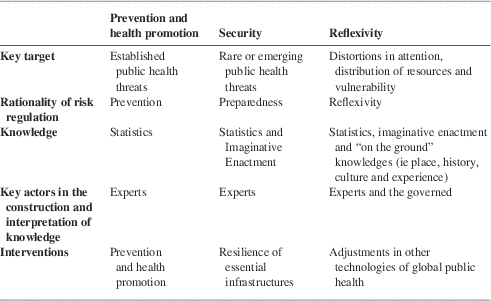
Prevention is the risk rationality that has long been central to public health regulation. Risk is a form of attention to the world that constructs targets of regulation, renders them knowable and creates the basis for regulatory action, and it has been taken up in diverse fields.Footnote 31 Nothing is a risk in itself, but instead risk is co-constituted through a field of knowledge and regulatory processes.Footnote 32 Risk shapes and frames perceptions of problems and their solutions, such as prevention and health promotion efforts. These occur through technologies – see Table 1 – that regulate dangers or threats not only at the national level, but since the constitution of “population” as a global phenomenon,Footnote 33 also at the global level.Footnote 34 For instance, the WHO adopted the Declaration of Alma-Ata and a number of other important formal statements that reaffirmed health as a human right that includes health care or treatment and action on the socio-economic determinants of health, including the quality of food, environmental protection, the provision of public housing and welfare benefits.Footnote 35 Law, specifically the content of the right to healthFootnote 36 and health-related rights,Footnote 37 has supported these developments.Footnote 38
Technologies of global public health regulation: prevention and health promotion, security (GPHS), and reflexivity

EU level action includes efforts to address the social determinants of undefined major public health problems through prevention and health promotion, including by fostering cooperation with third countries and international public health organisations.Footnote 39 EU action is underpinned and justified by Article 168(1) of the Treaty on the Functioning of the EU (TFEU), which provides an obligation to ensure a high level of human health protection in the definition and implementation of EU policies and activities i.e. a health in all policies approach. This obligation is a more specific instantiation of the cross-cutting obligation found in Article 9 TFEU and Article 35 EU Charter of Fundamental Rights (CFR) on the right to health care, the final portion of which repeats and takes over from Article 168(1) TFEU.Footnote 40 Prevention and health promotion are the key – even the archetypal – technologies of public health, and they provide a necessary contrast to GPHS and the rationality that underpins its technologies, preparedness. I turn now to discuss the latter in greater depth, before underlining some of the main ways in which technologies of public health relate to the wider process of governing. After which I commence reflection on the implications of the core features of these technologies for the governed and the place of their knowledges within decision-making.
2 Preparedness and the regulation of rare and emerging threats
A cluster of rare and emerging threats to public health, including infectious diseases and perhaps especially the 9/11 terrorist attacks in New York and elsewhere, meant that the existing body of archival-statistical knowledge provided a weak basis for prediction and, therefore, the rationality and techniques of prevention became of less use to regulation.Footnote 41 Consequently, the rationality and techniques of preparedness and response, with their underpinning knowledge of planning or so-called imaginative enactment, were adopted to ensure that a developing emergency could be regulated despite high levels of uncertainty.Footnote 42 The techniques of preparedness target rare and emerging public health threats as risks, thereby subjecting them to regulation and rationality.Footnote 43 The aim is to strengthen health preparedness and response globally in order to address “all hazards”.Footnote 44 Preparedness entails using planning to build-up the resilience of essential infrastructures, including containment measures, vigilance and surveillance,Footnote 45 so that they can respond to and rebound from a health emergency.
As Collier and Lakoff explain, preparedness “demands that experts constantly assess the vulnerability of [these] vital systems and the readiness to respond to, and recover from, events that threaten them”.Footnote 46 In this way the circulation of population and things in the economy is protected indirectly or reflexively by, as Dean put it, “securing the mechanisms of government”Footnote 47 and governing at a distance through a cycle of preparedness planning and response. An emergency is alerted and identified through techniques of risk assessment involving monitoring and surveillance. Subsequently there is a turn to risk management through a rapid response involving a surge of measures such as kits, antivirals and treatments allocated by triage. Containment can also involve limitations on travel, embargoes and quarantine. Risk communication between experts and those affected or “at risk” is important throughout and is aimed at shaping behaviours “on the ground”, building trust and improving the efficacy of interventions. The overall goal of preparedness and response is to ensure the containment of threats “at source”, essentially externalising threats outside the countries of the West.Footnote 48 This also shifts the responsibilities for threat management to other (non-Western) countries, but with the chief goal of minimising disruption to the economy and protecting the interests of richer (Western) countries.
Although GPHS was formally instantiated in 2007’s A Safer Future, the technology itself – see Table 1 for its core components – comprises a range of actors, sites and fora. At the global level GPHS includes the Global Outbreak Alert and Response Network (often simply referred to as GOARN). This was established by WHO in 2000 and comprises agencies and technical institutions, including the EU’s European Centre for Disease Control (ECDC).Footnote 49 Beyond the United Nations system there is the Global Health Security Initiative, which is dominated by Western countries and with which the EU cooperates.Footnote 50 The most important legal component of GPHS is the IHR 2005, which replaced the IHR 1969. Adding to the few brief points made in the introduction to this article, the IHR 2005 takes an “‘all risks’ approach”Footnote 51 to infectious diseases and aims to:
“prevent, protect against, control and provide a public health response to the international spread of disease in ways that are commensurate with and restricted to public health risks, and which avoid unnecessary interference with international traffic and trade”.Footnote 52
Public health, then, is closely tied to protecting the global economy, ie by regulating and optimising the global flows of people and things.Footnote 53 The IHR 2005 significantly expanded expectations of states in the face of public health emergencies and required them to improve their core capacities to detect and contain them. States are obligated to notify the WHO of events within their territories that may constitute a “public health emergency of international concern” (PHEIC). PHEIC are declared by the WHO Director General.Footnote 54 In respect of diseases and other public health threats the WHO primarily undertakes global risk assessments that enable more local level risks assessments. The WHO also engages in risk communication and provides guidance on interventions through risk management (consistent with the IHR 2005).Footnote 55 This centralisation of scientific-technical knowledge valorises those deemed in possession of the expertise to interpret it.
Besides State Parties the IHR 2005 also applies to the EU.Footnote 56 This is reflected in the EU’s key legal instrument relating to GPHS, which actually goes beyond disease, Decision 1082/2013/EUFootnote 57 on serious cross-border threats to health.Footnote 58 This instrument is founded upon and consistent with Article 168(5) TFEU,Footnote 59 which reflects that EU competence in the public health field is complementary to that of its Member StatesFootnote 60 (and who therefore have the main responsibilitiesFootnote 61 ). The aforementioned obligation to ensure a high level of human health protection in the definition and implementation of EU policies and activities is referred to in and helps to underpin and justify the Decision.Footnote 62 These provisions have been developed to embed GPHS within the EU’s legal and constitutional framework and socio-political order.Footnote 63
The Decision is intended to strengthen surveillance and control, and coordination by providing a legal footing for the EU’s Health Security Committee (HSC). The HSC was established in 2001 and is composed of representatives from EU Member State health ministries, the European Commission, the ECDC and the European Medicines Agency (which oversees the law and regulation relating to pharmaceuticals for human use). The ECDCFootnote 64 lies at the heart of the EU’s Early Warning and Response System (EWRS). The EWRS was established in 1999.Footnote 65 After the adoption of Decision 1082/2013/EU the EWRS is defined as “a rapid alert system for notifying at Union level alerts in relation to serious cross-border threats to health” and it is aimed at enabling “the Commission and the competent authorities responsible at national level to be in permanent communication for the purposes of alerting, assessing public health risks and determining the measures that may be required to protect public health”.Footnote 66
Thus, much like action by the WHO, EU action centres on the gathering and production of scientific and technical knowledge as the basis for decision-making and periodic monitoring and evaluation.Footnote 67 On this basis public health threats are risks to be regulated and, as at the global level, preparedness is “directed towards identifying and addressing the current impact and subsequent threat potential [of a risk] … in order to limit its consequences”Footnote 68 – especially to the vitality of the economy. EU action was central to, for example, European planning and response to H1N1 in 2009. EU action was also an important part of the response to the outbreak of Ebola in west Africa that began in 2014. EU action encompassed “political, financial and scientific resources to help contain, control, treat and ultimately defeat Ebola”,Footnote 69 and although the risk of transmission to the EU was low, the ECDC coordinated the exchange of information and preparedness.Footnote 70 The two key technologies of global public health regulation I have outlined are also important to the wider process of governing – as I turn now to explain in the final part of the conceptual perspective.
3 Risk regulation, socio-political order and projects of rule
Risk thinking has become central not only to regulation but also to the very organisation of society,Footnote 71 including in relation to determining priorities, allocating resources and enhancing efficiency of the regulatory process, and distributing responsibilities and accountabilities for blame in the event of failure.Footnote 72 A related major contribution of science and technology studies (STS) is to highlight how risk and its related knowledges are “incorporated into practices of state-making, or of governance more broadly”.Footnote 73 Risk therefore provides a key way of auditing, verifying and legitimating regulatory technologies and their related socio-technical orders and projects of rule.Footnote 74 Risk and its underpinning knowledges become even more important to these related aspects of governing in light of neoliberal political rationality. This rationality fuses governmentality with technical reason and means-end, instrumental, market rationality with the aim of optimising life.Footnote 75 A key implication is the way in which knowledge is also increasingly entwined with, shaped by and made instrumental to power. In that regard, in the introduction to this article I made apparent the tightening relations between GPHS, including its underpinning form of knowledge, and the production and legitimation of the WHO’s identity. But the WHO is one (albeit very important) site where GPHS operates: as I have mentioned, the technology operates in many sites, it is dominated by Western countries and is central to their respective and related socio-political orders and projects of rule,Footnote 76 including as part of the notion of “global health”.Footnote 77
The wider importance of GPHS is also apparent at the EU level. Together for Health: A Strategic Approach for the EU 2008–2013 (Together for Health), published in 2007, builds on and develops Article 168 TFEUFootnote 78 and has been approved by the European Council.Footnote 79 This document purports to “give direction to [EU] activities in health”.Footnote 80 Health emergencies are noted as one of the main challenges to be addressed by Together for Health.Footnote 81 Significantly, the core principle of strengthening the EU’s voice in global health in Together for Health figures EU “responsibility regarding the health of citizens in third countries”, including proactive action and a “new focus … to tackle health threats within and outside the EU”.Footnote 82 Together for Health configures EU public health regulation and its priorities within the overarching goal of the Europe 2020 agenda: forging European integration through the optimal circulation of people and things within the internal market,Footnote 83 growth and jobs.Footnote 84 Overall, for both the WHO and the EU, the regulation of public health, including GPHS, is not an end in itself, but is tied to the production and public legitimation of their related and respective organisational identities, socio-political orders and projects of rule.Footnote 85 In order to provide a bridge towards the discussion that follows, I turn now to reflect on the implications of the discussion thus far for the inclusion of the governed and their knowledges in decision-making.
4 Marginalisation of “on the ground” knowledges and the governed in decision-making
Like any field of power/knowledge, those underpinning the risk-based technologies of prevention and promotion as well as GPHS instantiate particular power relations, while also obscuring and naturalising and depoliticising them and their effects.Footnote 86 Both of these technologies valorise scientific-technical knowledge and those deemed to have the requisite expertise to produce and interpret it. In respect of GPHS the uncertain nature of its regulatory targets actually makes the available scientific-technical knowledge and expertise more salient to decision-making; existing understanding and expertise become even more important to attempts at getting to know emerging threats so that they can be regulated.
Widening the sources of knowledge is likewise important, and that is reflected in strategies of two-way and multi-directional risk communication, ie between regulators, scientists and those affected or “at risk”. The IHR 2005 included an attempt to improve risk communication through the recognition of “unofficial” sources of information (eg from news media and social networking) as the source for a declaration of a PHEIC by the WHO Director General. Nevertheless, the focus on biomedical approaches within GPHS appears to engender the centralisation and prioritisation of the biomedical aspects of public health problems over the existential aspects. This can be detrimental to the achievement of public health aims.Footnote 87 Comments made in the Ebola Interim Assessment Panel report also bear this out. For instance, although engagement with local community leaders and their knowledges and expertise was noted as “essential”,Footnote 88 it was not prioritised in the response to the Ebola outbreak despite the fact “[t]raditional cultural practices, including funeral and burial customs, contributed to virus transmission”.Footnote 89 In other words, non-biomedical interventions such as behaviour change and broad based social measures to tackle the determinants of disease and vulnerability were neglected.
The approach to the work undertaken in response to a medical emergency – delivering vertical “magic bullet” interventions, performed on the basis of triage and driven by efficiency in order to contain the present threat at source – can, therefore, reflect and reinforce the underpinning power relations. Like wider forms of scientific-technical knowledge, and notwithstanding strategies to improve risk communication, the centrality of these knowledges to GPHS effectively marginalises and subordinates knowledges from “on the ground” and those who produce and contribute them, ie the governed. As Foucault put it, these knowledges “have been disqualified … [as] naïve knowledges, hierarchically inferior knowledges, knowledges that are below the required level of erudition or scientificity”.Footnote 90 Within biomedicine the dominance of scientific method and objectivity has often led to the discounting and sidelining of patients’ views and experiences.Footnote 91 As Kidd and Carel explain, biomedical approaches tend to have the effect of “closing down opportunities for establishing sustained contact between a particular health professional and an individual patient, and for the rich forms of communicative relationship that might facilitate recognition and cultivation of patients’ ability to contribute to the epistemic aspects of their care”.Footnote 92 In other words, two-way risk communication can suffer.
The most prominent proposed reforms of GPHS would seem to perpetuate the latter – and that is, perhaps, not entirely surprising given that the reforms are often the products of expert-led initiatives.Footnote 93 There are, for instance, proposals to redesign or reconfigure the broader architecture of global health.Footnote 94 Another proposal seeks to factor social justice into preparedness and responseFootnote 95 through the inclusion (and reframing) of global health security as a Sustainable Development Goals (SDG 18).Footnote 96 What remains largely unexamined within these proposals is the central role of scientific-technical knowledge and experts in ensuring the resilience of essential infrastructures, and the power relations this ordering of knowledge and regulation establishes and perpetuates. Within GPHS and discussions on its reform, the epistemic capacity of those that are governed is limited, their “on the ground” knowledges are sidelined and consequently their voices are silenced within decision-making processes.
Those governed by GPHS will either be ill or “at risk” of becoming ill, and this makes them particularly vulnerable to marginalisation and silencing. There are of course other social positions (such as gender, race, sexuality and socio-economic position) that can intersect with and compound the vulnerability and silencing of the ill or “at risk”. This has been the subject of discussion on social epistemology in philosophy. Fricker describes the latter kinds of silencing within social interactions and systems, including courts and science panels, as an “epistemic injustice”. This is a “wrong done to someone specifically in their capacity as a knower”.Footnote 97 More particularly, those governed by GPHS seem to be subject to testimonial injustice, ie a form of injustice that arises when individuals or groups lack credibility.
Those governed by GPHS, like other individuals and groups that are subject to epistemic injustice, are treated as the subjects of knowledge through “top-down” or vertical interventions, including risk communication. In this way, then, the governed are, as Pohlhaus notes, “relegated to the role of epistemic other”:Footnote 98 their epistemic capacities are reduced to those of providers of the factual information necessary to facilitate treatment, rather than wider forms of knowledge, and risk communication seems to be about enabling this. Intersecting with other forms of objectification, such as those that occur through the medical gaze (ie through the focus on their bodies),Footnote 99 instances of testimonial injustice place patients “somewhere between an epistemic subject and object”.Footnote 100 This refusal to accept that the information being provided by particular individuals or groups is relevant or significant can be linked to another: a refusal to reconsider the kinds of information that are legitimate within decision-making processes.Footnote 101 The epistemic labour of those subject to GPHS is thereby constrained through its regulatory processes. This in turn effectively precludes any contribution to decision-making that might challenge the dominant forms of knowledge that underpin the regime, its design or interventions, and the distribution of responsibilities and accountabilities.
Similar themes have been explored by those working within the social studies of science and especially STS. Chiming with the notion of epistemic injustice, work within STS has noted that “the technical is potentially political” and that participation by the governed through the contribution of their knowledges and perspectives makes sense only where there is injustice.Footnote 102 In this regard, a key contribution of STS has been to challenge the “deficit model” of those that are governed by scientific-technical institutions and systems that tended to inform understandings of risk communication as being one-way (from expert to the governed). STS has pointed out how this understanding of the governed as one-dimensional non-knowers is inaccurate. Scientific facts, their use and deployment have been noted as contingentFootnote 103 and non-scientific knowledges are not necessarily less valid. Indeed, although individuals and diverse publics might not have full or complete understanding of particular scientific facts, these facts form part of a larger web of meaning and social understanding. Individuals know about diverse things in different ways, have a range of expertise, and are often reflexively aware of limitations to their comprehension of particular sociotechnical developments that they may actively seek to address.Footnote 104
As such individuals and publics might feasibly contribute their knowledge, including on framing (ie GPHS),Footnote 105 whom it hurts, whom it benefits, and how we might know,Footnote 106 and how regulation should be reframed.Footnote 107 With this in mind, and by reference to the other conceptual points outlined above, I shall turn now to extend these insights in order to chart a way towards epistemic integration of the governed and their knowledges in decision-making.
III Global public health security, risk, the governed and legitimation
1. Potential contribution of “on the ground” knowledges by the governed
Building on the insights above, and especially those from STS, the key starting point is appreciation of the way in which GPHS, like other fields of power/knowledge, engenders biopolitics, ie space for attempts by those that are governed to demand or contest the exercise of power over life.Footnote 108 The individuals and groups comprising the governed, and perhaps especially those that are affected or “at risk” from public health threats, are, as I have just suggested, most likely to be best placed to contribute knowledges from “on the ground”, ie since these knowledges are “theirs”.Footnote 109 These knowledges might pertain to framing and the distortions in the distribution of resources away from health infrastructures and towards health emergencies, and vulnerability and encompass embodiedFootnote 110 and experiential knowledges. The latter can include direct experience of the impact of social position, culture, history and place in determining such matters as the effectiveness of GPHS and its biomedical interventions. “On the ground” knowledge and experience can also shed further light on the way in which GPHS skews attention and resources towards a focus on managing the consequences of medical emergencies.Footnote 111
In terms of specific instances of the potential contribution of “on the ground” knowledges by the governed towards scientific-technical decision-making, examples abound. As I have already noted, in an apparent breakdown of risk communication, in respect of the outbreak of Ebola in 2014 the importance of “on the ground” knowledges was realised within the infrastructures of GPHS only long after the initial outbreak.Footnote 112 The Ebola Interim Assessment Panel quoted one community leader in Liberia:
“at first, there was confusion – we didn’t know what Ebola was, what to do. We didn’t know where to start; there were dead bodies in our houses; rumors about witchcraft. Then we organised ourselves, educated our community members about hand washing, touching, and how to handle the sick and the dead”.Footnote 113
Far from being non-knowers or simply reservoirs of information for the practitioners of GPHS, individuals and groups in stricken communities demonstrated their epistemic capacities and exercised agency. Indeed, since many of these communities were not engaged with in the initial stages of the Ebola outbreak, or indeed later on, this is an example of the way in which the epistemic and institutional failure of GPHS led to, and even forced, renewal of epistemic capacities “on the ground” in ways that highlighted institutional failings and provided an opening for reform of the established regime.
This sort of “bottom-up” engagement has also been seen across contexts where risk and security dominate regulation.Footnote 114 This includes through formal strategies of community engagement and attempts to elicit participation.Footnote 115 These strategies are present in the public health context, such as HIV/AIDS action and breast cancer awareness, and they are one of the key characteristics of Gostin’s influential notion of “public health law”. Gostin explains that such strategies “should result in stronger support for health policies and encourage citizens to take a more active role in protecting themselves and the health of their neighbours”.Footnote 116 In terms of more informal modes of engagement, activism in relation to HIV/AIDS is perhaps the most renowned example. For instance, ACT UP was successful in challenging the biomedical establishment so as to foster research on preventing and treating AIDS.Footnote 117 Treatment regimes in the global South have also been modified in response to activism that demonstrated that treatment is possible in resource poor settings.Footnote 118 And as terms such as “citizen science” make clear, on the platform of new and cheaper information and communication technologies, citizens are increasingly involved in, catalysing and leading knowledge creation that supports new interventions in health.Footnote 119
However, despite awareness of the importance of two-way and multi-directional risk communication practices, it is the capacity for understanding and action by the governed that has clearly yet to be fully developed, fostered and, if necessary, disciplined so that it can be rendered usable. The model of GPHS not only potentially under-estimates the knowledge of public health threats that those it governs may have, but it also reaffirms the technocratic rationalities that exclude them and creates informational lacunae.Footnote 120 In spite of this, “on the ground” knowledges could be mediated through the techniques and practices of the technocratic regime. This could occur, for example, by researchers in the fieldFootnote 121 using anthropological, ethnographic and participatory approaches.Footnote 122 Indeed, as the Ebola Interim Assessment Panel also noted:
“[s]ocial science expertise is critical to understanding local beliefs, behaviors and customs. These experts can inform those who are at the front line, enabling them to better understand the context and work more effectively with communities to change behavior”.Footnote 123
The key point, then, is that “on the ground” knowledges can be generated, they might need to be disciplined (further), and they can be – and need to be – integrated with classic epidemiological and biomedical knowledges by and within the epistemic community for use in decision-making.Footnote 124
2. Regulatory frameworks as resources for epistemic integration
Nevertheless, as the discussion in STS, the wider social studies of science and philosophy demonstrates, the integration of “on the ground” with scientific-technical knowledges remains problematic. The failure to engage “on the ground” knowledges that was underscored in the Ebola Interim Assessment Panel’s report is far from an isolated occurrence. In fact the importance of “on the ground” knowledges to understanding and formulating a response to Ebola was known (if not realised in practice) long before the most recent and most publicised outbreak.Footnote 125 Indeed, in 2003/2004 “on the ground” local experience of H5N1 became part of serious reflection among policymakers, albeit only when the emergency did not transpire.Footnote 126 The 2009 outbreak of H1N1 saw a return to scientific-technical knowledge and antivirals as the dominant approach to pandemic response, as the report of the Parliamentary Assembly of the Council of Europe underscored.Footnote 127
To borrow a phrase from Medina, it seems GPHS regulators “have been trained not to hear or to hear only deficiently and through a lens that filters out the speaker’s perspective”Footnote 128 – the speakers here being those with and articulating “on the ground” knowledges. It seems that the potential contribution of the governed is being stymied by processes that not only render them as having limited discursive and epistemic capacities, but that thereby effectively silences them. In order to advance their biopolitical claims, the individuals and groups that comprise the governed must convince an epistemic community and/or regulators of the importance of their “on the ground” knowledges. In addition to enduring testimonial injustice, the governed also seem to be made subject to hermeneutic injustice, which arises here because individuals or groups do not articulate through the conceptual resources that resonate with regulators, and that inform the lens through which they view reality, think and act. As Medina goes on to state, “if one exhibits a complete lack of ‘alertness or sensitivity’ to certain meanings or voices, one’s communicative interactions are likely to contain failures … for which one has to take responsibility”.Footnote 129 This responsibility extends beyond individuals to communities and “[i]nstitutions and people in a position of power”.Footnote 130
Yet, within the disciplines I have mentioned, the discussion on epistemic integration and responsibility for epistemic injustice(s) – epistemic responsibility – that flows from the framing of GPHS stops short of fully appreciating the salience of the regulatory framework itself. Regulatory frameworks play a key role in establishing, reflecting and (re)producing the social relations that silence and engender epistemic injustice. Yet, the very framing of regulatory frameworks, including of GPHS, naturalises, depoliticises and masks their fabrication, and obscures that which produces (or contributes towards) a lack of alertness or sensitivity by regulators, ie the regulatory framework itself. The framing in turn mediates and masks the epistemic responsibilities for, and the epistemic injustices that arise from, the lack of sensitivity shown by regulators to those individuals and groups that do not or cannot articulate their knowledges and perceptions in the correct register, ie one that gets them noticed. Moreover, much discussion misses the significance of the regulatory framework in contributing towards the conditions by and through which it becomes possible (or not) to facilitate (risk) communication, and ensure the epistemic integration of “on the ground” knowledges and the governed, on the one hand, with the knowledges and experts that are privileged by GPHS, on the other hand.
The importance of regulatory frameworks, their rationalities, logics and constitutive discourses, including law and human rights, in producing political culture is implied within the disciplines I have mentioned thus far. Within law and regulatory studiesFootnote 131 discussion has focused on the appropriate relationship between expert legal and regulatory reasoning and popular or lay understandings.Footnote 132 Particular attention has been given to the shape and design of procedures for participation, and in light of the Aarhus Convention’s innovations,Footnote 133 this is especially apparent in environmental law.Footnote 134 This focus is perhaps unsurprising in light of liberal accounts where democratic decision-making is delegated to trusted elites wielding scientific and technocratic knowledge and expertise. The focus on participatory procedures is especially apparent in situations where there is little possibility of substantive agreement and participation is essentially used to quell contestation, produce public legitimacy and maintain a functioning economy.Footnote 135 Despite such acknowledgement, epistemic integration in decision-making is either given brief mention (notably (albeit) as one of the key characteristics of Gostin’s notion of “public health law” – as noted above), is less a focus these days, i.e. in environmental law, or it remains largely untouched in mainstream law and regulatory studies engagement with public health.
However, across these related disciplines there has been little attention to the conceptual or hermeneutic resources that regulatory frameworks could provide in order to facilitate collective (societal and regulatory) understanding and communication of perspectives between the governed and regulators, and their epistemic integration as the basis for decision-making. In other words, there has been little attention to the hermeneutic resources available and that could be used by the governed to sensitise regulators to their hitherto subordinated and marginalised voices and perspectives.Footnote 136
Moreover, within the disciplines I have noted, there has been little discussion of the way in which the regulatory frameworks create pitfalls for epistemic integration. Indeed, the contribution of valuable “on the ground” knowledge can be frustrated by the risk governance process itself. As explained by Power, within risk-based governance accountability has become linked with organisation in a single logic through which democratic ideals “are increasingly positioned within ideals for good governance of the risk analysis process ...”.Footnote 137 Consequently, techniques for accountability become part of a broader process of rendering organisations auditable and inspectable. Such techniques “are increasingly framed as an organizational strategy to manage public expectations”,Footnote 138 govern perceptions that might undermine regulation, and foster relegitimation.
As I turn now to explain, the importance of risk to regulatory frameworks such as GPHS could help to make regulators responsible and accountable for their framing of GPHS and the attendant epistemic injustice(s). In the following, therefore, I aim to lay the foundations for technologies that could highlight lacunae in and pluralise the production of knowledge and expertise for GPHS. These technologies could, I shall suggest, introduce doubt and controversy into any view of the sufficiency of GPHS, its foundational knowledges and practices,Footnote 139 improve the knowledge base for decision-making and, through this, the quality, effectiveness and legitimacy of the decisions made.
3. Towards epistemic integration: risk regulation, two types of reflexivity and the significance of legitimation
As I have already noted, the reports of both the Ebola Interim Assessment Panel and the Parliamentary Assembly of the Council of Europe generated institutional risks to the standing and reputation of GPHS actors, and thereby held them accountable for failures to meet their responsibilities. At the same time the reports also provided ways for GPHS actors to limit and manage those risks and, therefore, to maintain the production of legitimacy. In both cases the institutional or secondary risk of damage to institutional reputation reflexively drove a response to (future) societal risks (perhaps especially Ebola and pandemic influenza).Footnote 140 Rothstein and others explain this dynamic as follows:
“the growing centrality of risk to regulation can be driven by the institutional risks of regulatory control and is characterised by the development of systematic and sophisticated reflexive use of the risk instrument as a defensible means for justifying the regulation of societal risks … Institutional risks … can become a category for control in their own right, if they cannot be reflexively handled by the management of societal risk”.Footnote 141
A focus on institutional risks can bring attention to societal risks and shape approaches to them via changes to regulatory frameworks. In this way, then, the reports and the very responses to them underscored the potential to demand and contest decision-making and, therefore, for biopolitics.
Individuals, groups and institutions are, also as already noted, reflexive agents in that they monitor social reality, including societal risks, and on that basis may take action to (re)shape reality and even themselves. Risk society can conceivably become a regulatory society.Footnote 142 Societal perception of failure to identify and/or manage societal risks can lead to demands and contestation and, in turn, institutional risks to standing or reputation. As Power explains, managing institutional risk entails attempts at governing “unruly perceptions” and maintaining the “production of legitimacy in the face of these perceptions”.Footnote 143 Institutional risks, and the knowledges that underpin them, can generate doubt and controversy, or, in Medina’s terms, “epistemic friction”.Footnote 144 Importantly, the take up and pluralisation of knowledges in decision-making hinges on regulators’ reflexive engagement with and monitoring of social reality, and in particular their sensitivity to institutional risks to standing and reputation that threaten the production and legitimation of organisational identity, socio-political order and projects of rule. Provided the institutional risks are threatening in this regard, they should be deemed important enough to warrant regulatory attention and action. Indeed, the friction generated by these sorts of risks and threats could compel regulators to take up and integrate the knowledges underpinning risk-based claims within decision-making. This would be in an effort by regulators to shape public perceptions, manage institutional risks and maintain legitimacy.
The key point is that institutional risks can generate a “way in” to decision-making and compel action to address them. Reflexivity is key to this “way in” – and to summarise, two specific and linked types of reflexivity are central. First, the reflexivity of individuals and groups comprising the governed leading to the generation of institutional risks or claims grounded on their (“new”) knowledges. Second, the reflexivity of regulators in responding to the institutional risks.Footnote 145 Within public health itself reflexivity has been used in different ways to underpin specific techniques. In terms of GPHS, the rationality of preparedness planning and response makes use of reflexivity, ie by governing population indirectly via essential infrastructures. Reflexivity is central to future preparedness planning, such as through the EU’s “pandemic 2009 evaluations and lessons learned” exercise.Footnote 146
Engendering reflexivity and pluralising knowledges for decision-making is likewise resonant with strategies of two-way and multi-directional risk communication in preparedness planning, as well as in prevention and health promotion (and in wider risk regulation). Reflexivity underpins the latter techniques in that attention to them is used to govern ill health. Within closely related domains reflexivity also plays a central role. For example, in environment policy various designs of reflexive governance have been developed.Footnote 147 Within EU law and policy-making, for example, reflexivity is not only integrated across these domains, it is also reflected in, for example, the “better regulation” agenda,Footnote 148 and techniques and processes such as impact assessment that aim to facilitate this (and other agendas and aims – like transparency, public legitimation and institutional risk management).Footnote 149 In the health policy domain impact assessment involves a determination of the impact on health of proposals for new laws and policy.Footnote 150
4. Building supplementary technologies: reflexivity, human rights and institutional risk
I seek to build upon these examples in order to develop the more specific understanding of reflexivity noted above into the rationality – see Table 1 – to underpin technologies that reframe, reimagine and reassemble various components sketched in the following so as to supplement GPHS. In order to generate the two types of reflexivity in particular (by individuals and groups and by regulators), there must be a common starting point: a conceptual or hermeneutic resource, foundation and lens that can generate the two types of reflexivity and ensure the governed gain influence within decision-making. I work in broad brush strokes rather than close detail to highlight the way in which this lens could generate reflexivity and help to realise new possibilities for two-way risk communication, organisational learning and action.Footnote 151
Looking back at the discussion in Section II, human rights seems the most prominent and likely candidate for the common starting point. Human rights is woven into the socio-political orders of both the WHO and the EU (and individual countries) and it is central to their legitimation. Human rights is of course a body of law. At the global level the right to health and related rights underpins and justifies interventions in public health, including GPHS.Footnote 152 The body of law is essential to realising the right to health, as underlined in the WHO’s recent report Advancing the Right to Health: The Vital Role of Law.Footnote 153 Within the EU’s legal and regulatory order the protection of health as underpinned by Article 35 CFR could be developed by reference to broader human rights norms.Footnote 154 More than a body of law, human rights is also a discourse, a particular form of attention to the world, with its own way of thinking, articulating and responding that encompasses the practices and projects, the “movements or groupings of lawyers, non-governmental organisations, and others who seek to secure and defend a particular right, group of rights, or human rights in general”.Footnote 155 Human rights is probably the most successful and culturally resonant discourse internationally.
This is apparent in the articulation of demands for and contestation around issues of social justice, in the EU and globally.Footnote 156 Indeed, human rights is widely recognised as an important form of attention to the world and register through which to frame and respond to injustice and unequal power relations,Footnote 157 such as in the distribution of epistemic capabilities, and the benefits, risks and vulnerabilities produced by particular framings of issues. It is now widely recognised that “promotion and protection of rights and health are inextricably linked”.Footnote 158 The influence of human rights and a marker of their success in global public health is found in the way in which, as one commentator puts it, it has been a “game-changer in how we think about health”.Footnote 159 The importance of human rights is also borne out in discussions that it might even be supplanting bioethics in the regulation of health.Footnote 160
More particularly, participation by the governed, including through the provision of their knowledge, is part of the process of human rights-based approaches to health-related decision-making, encompassing transparency and access to information, agency and the scope for social mobilisation and action.Footnote 161 Participation is also linked to the outcome of a human rights-based approach, such as through mechanisms for distributing responsibilities, monitoring and holding to account, including beyond the legal sense.Footnote 162 References to human rights have been used, and maintain the potential, to power discussion and ongoing questioning – in other words, reflexive engagement with social reality by individuals and groups.Footnote 163 Thus, human rights is especially adept at denaturalising the framing of issues, such as GPHS.Footnote 164
Linked to this human rights is firmly part of the repertoires of social movement activism on health-related matters – as, indeed, the examples of the contribution of knowledges from “on the ground” noted above underscore. Social activists have had notable success in using human rights “at least to disrupt … by challenging the language, the types of problem recognised … and the working methods of the public bioethics process”.Footnote 165 In other words, resonant with what I said above, an actual or perceived breach of human rights can generate institutional risks to standing and reputation that demand action.Footnote 166 “On the ground” knowledges could generate, support and make possible human rights-based claims and, indeed, help to construct the lens through which they become apparent.Footnote 167 Vitally for the generation of the “way in” to decision-making, these claims and their underpinning knowledges could in turn generate institutional risks not only to standing and reputation, but also to the production and legitimation of organisational identity, socio-political order and projects of rule, and as such they would be even more cogent.
Of course, as discussed more extensively elsewhere, the use of human rights is not without paradoxes and pitfalls that might reproduce and reinforce epistemic injustice through the effective silencing of the governed.Footnote 168 For instance, even as human rights promises and delivers results when deployed to combat social difference and its attendant injustices, it can also produce and reinforce social position as identity. Human rights can also depoliticise and naturalise the social origins of problems, and emphasise and abet moves towards self-management and individualisation that deny the potential of collective action to reshape governance. In these kinds of ways, human rights can narrow the discursive space available and within which problems can conceivably be recognised and framed and claims articulated. Nevertheless, human rights can generate reflexivity by individuals and groups comprising the governed and biopolitics.
In addition and closely related to this first type of reflexivity, human rights can generate the second type, ie reflexivity by regulators. This is essentially because human rights can get attention – and open doors. Human rights demands the attention and time of regulators. As one prominent human rights lawyer has observed, “[r]ights talk buys ten minutes of their attention. I use it like a magic wand”.Footnote 169 Human rights can persuade and convince regulators,Footnote 170 and a large part of the reason is that it can generate the institutional risks described above.Footnote 171 This is facilitated by the way in which human rights provides a common discursive and hermeneutic framework, which can, as Black explained, put “the views of each set of participants [in governance] into a language that the others can understand”.Footnote 172 The perspective of those who articulate their “on the ground” knowledges through the register of human rights seems more likely to be understood and far less likely to be dismissed or filtered out by regulators (i.e. since they are framed as the particular institutional risks and existential threats noted above, and are therefore “seen” or identified through the dominant regulatory lens). In short, human rights based claims can more readily compete for and gain attention amongst the competing claims to address risks.Footnote 173
Overall, human rights has the potential to facilitate the two types of reflexivity outlined above. Through the joint operation of the two types of reflexivity the governed might prompt the take up and integration of their knowledges – see Table 1 – with the dominant scientific-technical knowledges of decision-making, and thereby restore their epistemic agency. This could lead to adjustments in the existing technologies of global public health (GHPS; prevention and health promotion). The mechanisms to facilitate epistemic integration (and leading to adjustments) could be modelled on, use or be built into the existing techniques of risk assessment, management and communication that comprise the cycle of preparedness planning and response. For example, monitoring and surveillance could seek out or be sensitive to “on the ground” knowledges and especially those that (could) underpin human rights claims and institutional risks in “real time” as a public health event is developing. The resulting data could feed into decisions on the kinds of harms or hazards to which risk to public health pertains and their prioritisation.
The related knowledges, claims and risks could also inform decisions on response and risk management, including on what constitutes reasonable use of the precautionary principle in responses, and the kinds of interventions chosen to deal with a certain risk profile.Footnote 174 Post-event and during planning for the next cycle, evaluations exercises could pay more attention to these related knowledges, claims and risks. In this way the latter could form part of impact assessments and the “lessons learned” built into revised plans and future responses. This could include attention to non-biomedical interventions for prevention and health promotion: behaviour change programmes and broad based social measures. Reflexivity (the two types of reflexivity and their dynamic relationship) could, in short, provide the rationality to (re)assemble components of the existing techniques of public health regulation into new technologies spanning and operating at various levels of decision-making: WHO, EU, national and, crucially, “on the ground”.
IV Conclusion
In this paper, I have considered the limited role of “on the ground” knowledges in GPHS and public health regulation more generally. I sought to cast fresh light on the salience of regulatory frameworks in producing the epistemic injustice endured by those that could contribute to these knowledges, and the potential of those selfsame frameworks in tackling that injustice. Through this analysis I have charted a way forward towards the integration of “on the ground” knowledges with scientific-technical knowledges within. I traced the key components of the technologies of global public health regulation, and GPHS in particular: the risk rationalities, related forms of knowledge and the actors that produce and interpret these knowledges. I highlighted both the scientific-technical framing of GPHS that underlies the lack of recognition of “on the ground” knowledges and the silencing of those that could contribute to decision-making, and then how this engenders lacunae in the knowledge base for decision-making. In so doing, I have underscored the construction of GPHS and its significance, and explained the way in which the integration of “on the ground” knowledges produced by those governed by this technology could improve its knowledge base, efficacy, accountability and legitimacy.
Why, then, has more not been done to ensure epistemic integration within GPHS’ decision-making processes? What does this reveal about the actual function of the technology of GPHS? It seems that epistemic integration would challenge the technology, its design and the priorities built into it. A key role of GPHS, then, is to protect the Western countries that are its chief architects and supporters, and, apparently, also its main beneficiaries. The epistemic integration that I have argued for in this article would involve bringing those that are governed within decision-making processes via their knowledges. Epistemic integration would seem to threaten the position of Western countries and undermine their interests in GPHS. GPHS essentially externalises, cordons off and manages threats,Footnote 175 and thereby shifts the responsibility to deal with them, ie the threats are something to be dealt with “at source”, typically in the global South. While these countries are allocated the main responsibility for dealing with public health threats, rich Western countries have more limited responsibility by acting at a distance. Although Western countries seem to act beneficently and ethically through the framework of GPHS, they actually act more out of self-interest and self-protection. Epistemic integration would seem to undermine the power and dominance of Western countries within GPHS and the global economy.
Epistemic integration of embodied and experiential knowledges within decision-making might also threaten to shed light on the limits of the extant technologies of global health. In particular, while techniques of prevention and health promotion are important, there are limits to their efficacy, not least the resources made available to them. This is, of course, partly due to state sovereignty, since it limits the scope for interventions within states by other states and external actors. But the broader organisation of the global economy also plays a key role in limiting the ability of the countries that are most vulnerable to public health threats to grow their economies and fund health infrastructures. This is not least because of the dominance of Western countries and their interests in the organisation of international trade, most notably, within the World Trade Organisation.Footnote 176 More deeply, epistemic integration would challenge modernist values on the import of empirically-derived knowledge and the salience of technological “fixes” (like kits and pharmaceuticals) to the management of societal “problems”.Footnote 177 Public health knowledge thus becomes re-problematised: what public health knowledge is required in order to protect health so as to optimise the movement of people and things in the economy? To resist epistemic integration is, therefore, essentially to bolster extant power relations. As I have pointed out, these relations are actually antithetical to the protection of public health, and to the accountability and legitimacy of GPHS.
In order to foster epistemic integration and discussion of its potential and realisation, I have argued for the development of technologies of reflexivity. Specifically, I have reflected on the significance of risk regulation to GPHS and the actors that employ and operationalise it through their governance, and explained that this provides a “way in” to decision-making by the governed and through which they might contribute their knowledges. Regulatory alertness and sensitivity to institutional risks to standing and reputation provide the “way in”. This is particularly the case when, as I have suggested, the risks also threaten to undermine the wider process of governing: the production and legitimation of organisational identity, socio-political order and the related project of rule. Regulatory frameworks also provide opportunities to generate these kinds of institutional risks and reflexivity by those governed by GPHS and regulators. Indeed, I have suggested that the centrality of human rights to those frameworks means it is most likely to serve as a lens and hermeneutic resource to both underpin reflexivity and animate the gathering and production of “on the ground” knowledges by the governed, and ensure their articulation in terms that receive regulatory attention, reflexivity and integration in the knowledge base for decision-making, i.e. as human rights claims that generate institutional risks.
In proposing technologies of reflexivity, therefore, I refuse the way in which the extant technologies of (global) health regulation figure those they govern as possessing epistemic capacities that are of little use to its technocratic regimes. Indeed, to do otherwise would be to perpetuate forms of epistemic injustice and limit the epistemic responsibilities and accountabilities of those that frame the regulatory technologies in the first place. Thus, my goal throughout has been to suggest that it is an appreciation of those that are governed and regulators as reflexive agents, and the norms, values and the diverse and plural forms of knowledge constitutive of more democratic technologies and socio-political orders, that needs to be built into supplementary technologies of (global) health regulation. This challenges the dominance of the current technocratic means of regulating, and reimagines “unruly” perceptions and knowledges as potentially supportive of the regimes and particularly GPHS, and its continued efficacy, accountability and legitimacy.