1 Introduction
Traditional wisdom has it that the positioning of adnominal adjectives in Old English (henceforth OE) is rather flexible in the sense that they may precede, follow or flank the noun they modify:
(1)

(2)
(3)

In most grammar books of OE, as well as in publications on the syntax of nominal expressions, adnominal adjectives (i.e. adjectives that are embedded in nominal expressions) are referred to as attributive adjectives which, in accordance with typological harmony, are predominantly found in prenominal position (see Quirk & Wrenn Reference Quirk and Wrenn1955: 88f.; Sørensen Reference Sørensen1956: 262; Spamer Reference Spamer1979: 244ff.; Mitchell Reference Mitchell1985: 76ff.; Lightfoot Reference Lightfoot1979: 168–86; Traugott Reference Traugott1992: 282f.; Fischer, van Kemenade, Koopman & van der Wurff Reference Fischer, Kemenade, Koopman and Wurff2000: 46ff.). Postnominal occurrences as in (2) and (3) are generally acknowledged and considered somehow marked, but not dealt with at any length or even swept under the linguistic rug. One notable exception is the work of Olga Fischer (Reference Fischer2000, Reference Fischer2001, Reference Fischer2006), who focuses specifically on the distribution of adnominal adjectives in relation to their inflectional properties and interpretation. Since adjective placement patterns of types illustrated in (1)–(2) are attested both within individual languages and across languages, the objectives of Fischer's research on adjective positions in OE should be seen as closely related to those formulated in recent comparative and/or theoretical studies on word order and word order variation involving adjectives and the nouns they modify (see Cinque Reference Cinque1994, Reference Cinque2007; Larson Reference Larson1998; Laenzlinger Reference Laenzlinger2004, Reference Laenzlinger2005; Alexiadou Reference Alexiadou2001; Giusti Reference Giusti2002; Dimitrova-Vulchanova Reference Dimitrova-Vulchanova2003; Larson & Marušič Reference Larson and Marušič2004; Larson & Takahashi Reference Larson and Takahashi2004; Alexiadou, Haegeman & Stavrou Reference Alexiadou, Haegeman and Stavrou2007).Footnote 1
The present article has two objectives. The first is to show that the positioning of adnominal adjectives is not random but follows exclusively from interpretive and functional differences between prenominal and postnominal adjectives. The second is to discuss the formal implementation of word order and word order variation involving adnominal adjectives in Old English and thereby create synergy between historical linguistics and recent syntactic theory.
2 Inflectional type, definiteness sensitivity and adjective position
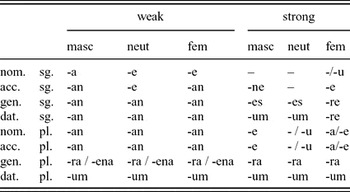
Adnominal adjectives agree with the noun they modify in number, gender and case, with the adjective inflecting either weak or strong, as schematically indicated in table 1 (adapted from Fischer Reference Fischer2000: 159).
Weak and strong adjectival inflection in OE

It is generally held that weak vs strong inflection compensates for the lack of a definite and indefinite article, with weak adjectival inflection indicating definiteness and strong adjectival inflection indefiniteness (see, among others, Quirk & Wrenn Reference Quirk and Wrenn1955: 68f.; Mitchell Reference Mitchell1985: 51; Traugott Reference Traugott1992: 171ff.; Fischer Reference Fischer2000: 159ff.; Reference Fischer2001: 249ff.; Reference Fischer2006: 256ff.). Adnominal adjectives inflect weak if preceded by a possessive pronoun, e.g. hiora ‘their’ (4a), or a demonstrative, e.g. þone ‘that’ (4b), but they inflect strong in the absence of definiteness markers (5):Footnote 2
(4)
(5)
However, definiteness and indefiniteness are indicated only by prenominal adjectives. Postnominal adjectives, which always inflect strong, construe freely with definite nominal expressions as in (6a) and indefinite nominal expressions as in (6b):
(6)
(7)
(8)
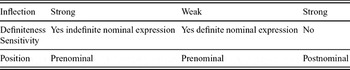
The correlations of inflection, definiteness sensitivity and position can be summarized as in table 2: depending on whether the nominal expression containing them is indefinite or definite, prenominal adjectives inflect strong or weak, respectively. Postnominal adjectives always inflect strong irrespective of whether the nominal expression containing them is indefinite.
Inflectional type, definiteness sensitivity and adjective position

The observation that adjective placement is related to both overt adjectival agreement morphology and definiteness indicates that word order variation is not random but follows from the interplay of adjectival and nominal properties.
In the following section I will review Cinque's (Reference Cinque, Koster, Pollock, Rizzi and Zanuttini1994) N(oun)-raising account of word order variation within nominal expressions, which builds on the interplay of adjectival and nominal properties in terms of agreement. Even though the N-raising analysis has proven impossible to maintain, I consider it instructive for our understanding of adjective placement to examine the problems this analysis encounters.
3 On N-raising (and why it fails)
Since the 1990s, the relative linear orders of attributive adjectives and the nouns they modify have come to be seen in the Minimalism of that time as a result of N-raising (or the lack of it) across one or more prenominal APs, which are located in the specifier positions of agreement-related functional projections (FP) sandwiched between NP and DP (see Cinque Reference Cinque1994):
(9)
According to Cinque (Reference Cinque1994: 85, 105f.), N-raising is triggered by strong adjectival agreement morphology (i.e. overt number and gender features) which must be checked in overt syntax under specifier head agreement within a functional projection dominating NP. That is to say, the noun raises to the head of FP and checks its features against those of the adjective located in the specifier position of FP.
Given that in OE both nouns and adjectives inflect for number and gender,Footnote 4 and that adjectives agree with the nouns they modify, variation in the linear order of adnominal adjectives and the nouns they modify appears to be readily explainable in terms of N-raising. Thus the linear order AN in (10a) would obtain in the absence of N-raising (10b), the linear order NA in (11a) would result from N-raising across the adjective bliðe ‘merry’ (11b), and, finally, the ambilateral placement pattern, ANA, in (12a) would result under partial N-raising (12b), i.e. the noun raises only across beorhtne ‘bright’, the lower of the two adjectives:
(10)
(11)
(12)
Attractive though the analysis seems at first glance, there are a number of empirical facts it cannot handle. First, partial N-raising is subject to stipulation, i.e. there is no need for the noun to raise across beorhtne ‘bright’ and untweogendum ‘staunch’:
(13)
Second, since postnominal adjectives in OE are not recursive (see Fischer Reference Fischer2000: 171, 176; Reference Fischer2001: 258), N-raising must be restricted so as not to proceed across more than one adjective (cf. Cinque (Reference Cinque2007: 10) on similar restrictions in Italian; see also Svenonius (Reference Svenonius1995: 442f.), Larson & Marušič (Reference Larson and Marušič2004: 271, 282ff.) for discussion):
(14)
Third, the contrasts in acceptability between (15) and (16) are both unexpected and unexplained:Footnote 5
(15)
(16)
For the analysis to account for the contrasts under consideration, N-raising would have to be sensitive to weak vs strong inflection and thus with respect to the distinction definiteness vs indefiniteness (see (17) vs (18)). That is to say, N-raising would have to be restricted to proceeding across strong adjectives and thus to be available only within indefinite nominal expressions, DP[−def]:
(17)
(18)
However, an analysis along these lines is not tenable on empirical grounds. As seen in section 2, postnominal adjectives, which always inflect strong, are not sensitive to the distinction [±definite], but construe freely with definite and indefinite nominal expressions.
In this context, clearly, the interesting case is the one in which a postnominal adjective is construed with a definite nominal expression, as is the case with iungne ‘young’ and ondwardum ‘present’ in (19). Definiteness of the nominal expression is flagged by both the demonstrative þone ‘that’ and the weak prenominal adjective ilcan ‘same’ in (19a), and by the demonstrative þissum ‘this’ in (19b):
(19)
If the postnominal occurrence of the adjectives iungne ‘young’ in (19a) and ondwardum ‘present’ in (19b), in fact, results from the nouns Ceaddan ‘Chad’ (a proper name) and life ‘life’ having raised across them (20), the question arises why the strings in (19) do not constitute a ‘definiteness clash’, but the counterparts of the nominal expressions without N-raising in (21) do. In other words, it remains unclear why conflicting definiteness information induces ungrammaticality in non-raising cases (21), but not in raising cases (19):Footnote 6
(20)
(21)
Since nominal expressions cannot be definite and indefinite at the same time, with definiteness being encoded by both þone ‘that’ and ilcan ‘same’ ((19a) and (21a)) and by þissum ‘this’ ((19b) and (21b)), and with indefiniteness being signposted by iungne ‘young’ and ondwardum ‘present’ inflecting strong, the strings in (19) and (21) should be equally unacceptable. The fact that they do not exhibit the same grammaticality not only poses an insurmountable problem for N-raising analysis (unless we want to claim that N-raising obliterates ‘definiteness clashes’), but also casts doubt on the assumption that adnominal adjectives all have the same status.Footnote 7
Crucially, the N-raising analysis not only fails to account for the availability of partial N-raising (13), the non-recursiveness of postnominal adjectives (14), certain contrasts in acceptability (15) and (16), and the (non)induction of ‘definiteness clashes’ (20) and (21), but also for the fact that prenominal and postnominal adjectives display systematic interpretive differences, which is indicative of a systematic difference in status (see, among others, Bolinger Reference Bolinger1967; Sadler & Arnold Reference Sadler and Arnold1994; Stavrou Reference Stavrou1996; Larson Reference Larson1998; Fischer Reference Fischer2000, Reference Fischer2001, Reference Fischer2006; Cinque Reference Cinque2007; Larson & Marušič Reference Larson and Marušič2004; Larson & Takahashi Reference Larson and Takahashi2004).
4 The status of adnominal adjectives
Given the correlations in table 2 above, two lines of investigation suggest themselves: either we take adjectival inflection as a point of departure or we take the positional parameter (and with it definiteness sensitivity) as a point of departure.
Fischer (Reference Fischer2000, Reference Fischer2001) pursues the first option. In reply to the question of ‘what the weak and strong forms of the adjectives in themselves stand for’ (Fischer Reference Fischer and Nänny2001: 253), she argues that ‘weak’ vs ‘strong’ adjectival inflection is iconically related to the distinctions ‘definiteness’ vs ‘indefiniteness’, ‘attributive’ vs ‘predicative’, ‘given information’ vs ‘new information’ and ‘individual-level reading’ vs ‘stage-level reading’. In this article, the second option is pursued. I will show that there is a clear division of labor between prenominal and postnominal adjectives which is largely independent of adjectival inflection (pace Fischer Reference Fischer2000, Reference Fischer2001, Reference Fischer2006). For the sake of both clarity and maximal contrast, the discussion in section 4.1 is restricted to weak adjectives, which are confined to occurring prenominally, and to only postnominal occurrences of strong adjectives. Strong adjectives in prenominal position are at the heart of section 4.2.
4.1 Weak prenominal and strong postnominal adjectives
In the following, drawing on Fischer's work (Reference Fischer2000, Reference Fischer2001), I show that there is a clear division of labor between weak adjectives, which are confined to occurring prenominally, and strong adjectives in postnominal position with respect to the distinctions ‘attributive’ vs ‘predicative’ (section 4.1.1), ‘given information’ vs ‘new information’ (section 4.1.2), ‘individual-level reading’ vs ‘stage-level reading’ (section 4.1.3) and ‘non-restrictive reading’ vs ‘restrictive reading’ (section 4.1.4). A further systematic difference between weak prenominal and strong postnominal adjectives relates to their (in)ability to support degree modifiers (section 4.1.5).Footnote 8
4.1.1 Attributive vs predicative adjectives
While it is generally held that weak adjectives are attributive adjectives (22), the status of strong adjectives (23) is not always clear:
(22)
(23)
Thus, Mitchell (Reference Mitchell1985: 75ff.) takes postnominal adjectives to be attributive, but concedes that ‘it is not always clear whether we have to do with an attributive, predicative or appositional use’ and that postnominal adjectives, since they inflect strong, ‘may seem predicative to some readers’ (Mitchell Reference Mitchell1985: 77). Conversely, Fischer (Reference Fischer2000) maintains that ‘all strong adjectives in Old English are, or started off as, predicative adjectives’ (Fischer Reference Fischer2000: 170) and ‘[s]trong adjectives are predicative rather than attributive’ (Fischer Reference Fischer2000: 176; see also Fischer Reference Fischer2001: 257ff., 265ff.). The fact that postnominal adjectives (23) and ‘regular’ predicative adjectives (24) are formally identical (i.e. they both inflect strong) suggests that postnominal adjectives are predicative adjectives:
(24)
Postnominal adjectives are not only formally identical to predicative adjectives, they also correspond interpretively to predicative adjectives in (reduced) restrictive relative clauses (section 4.1.4).
4.1.2 Given vs new information
Closely related to the distinction ‘attribution’ vs ‘predication’ is the distinction ‘given information’ vs ‘new information’. According to Bolinger (Reference Bolinger1972), attributive adjectives play a vital role in the identification of the referent of the noun they modify, whereas predicative adjectives assign (additional) properties to the already identified referent of the noun (see also Stavrou Reference Stavrou1996: 110; Fischer Reference Fischer2000: 170; Reference Fischer2006: 256ff.). Since weak adjectives are restricted to occurring within definite nominal expressions which are thematic, they convey ‘given’ information about the noun they modify (see Fischer Reference Fischer2001: 258). Thus, feondlic ‘hateful’ and dead ‘dead’, halgan ‘holy’ in (25), are true attributes in that they ‘change the noun into a new “compound” noun, a new noun token’ (Fischer Reference Fischer2001: 258):
(25)
Conversely, the strong adjectives unaræfnendlicum ‘unendurable’ in (26a) and iungne ‘young’ in (26b) convey new or additional information about the entities denoted by the nominal expressions ðam tintregum ‘the tortures’ and þone ilcan Ceaddan ‘the same Chad’:
(26)
4.1.3 Individual-level vs stage-level interpretation
Corroborating evidence for the attributive status of weak adjectives and the predicative status of strong adjectives derives from their interpretation as expressing individual-level vs stage-level properties, i.e. inherent or enduring properties as opposed to accidental or temporary properties (see Bolinger Reference Bolinger1967: 15; Sadler & Arnold Reference Sadler and Arnold1994: 192ff.; Cinque Reference Cinque1994: 94f.; Reference Cinque2007: 16ff., 37ff., passim; Stavrou Reference Stavrou1996: 83f.; Larson Reference Larson1998: 154ff.; Larson & Marušič Reference Larson and Marušič2004: 274f.; Larson & Takahashi Reference Larson and Takahashi2004: 7ff.; Haumann Reference Haumann2003: 59ff.). Thus, for example, mæra ‘great’ and hwitan ‘white’ in (27) express inherent/enduring properties of the nouns they modify, whereas cene ‘bold’, sigefæst ‘victorious’ and bliðe ‘merry’ in (28) express accidental/temporary properties of the nominal expressions they are construed with (even more so since cene and sigefæst in (28a) are further specified with respect to the circumstances in which Hingwar is bold and victorious):
(27)
(28)
4.1.4 Non-restrictive vs restrictive interpretationFootnote 9
A further parameter in which weak prenominal and strong postnominal adjectives differ is ‘non-restrictive’ vs ‘restrictive’ modification. The weak adjectives feondlic ‘hateful’ and bliðe ‘pleasant’ in (29) do not identify a particular referent from among a set of entities that contrast with respect to the property denoted by the modifier. Thus, þone feondlican casere ‘the hateful emperor’ does not contrast with e.g. þone arleasan casere ‘the dishonorable emperor’ (ÆLS (George), 145). As can be read off the respective paraphrases in (30), the adjectives under consideration characterize the referents themselves:
(29)
- (30)
(a) Georius þa befran þone feondlican casere
= George questioned the emperori, hei was fiendish
≠ George questioned the emperori whoi was fiendish
(b) to ðan bliðan wunenessum ðara hwittra gasta & fægra
= to the abodesi of the white and fair spirits, theyi were pleasant
≠ to the abodesi of the white and fair spirits whichi were pleasant
Conversely, the strong adjectives unaræfnendlic ‘unbearable’ and grimme ‘hostile’ in (31) do not characterize the referents of the nominal expressions they occur in, but identify a particular referent from among a set of entities that contrast with respect to the property they denote, i.e. ðam tintregum unaræfnendlicum ‘the unendurable tortures’ contrasts e.g. with ðam tintregum aræfnendlicum ‘the endurable tortures’. Consider the respective paraphrases in (32):
(31)
- (32)
(a) . . . be ðam tintregum unaræfnendlicum ic oft sæcgan herde
= I often heard about the torturesi whichi were unendurable
≠ I often heard about the torturesi, theyi were unendurable
(b) And eac her syn on earde . . . leodhatan grimme ealles to manege
= there are too many persecutorsi here on earth whoi are hostile
≠ there are too many persecutorsi here on earth theyi all are hostile
Supportive evidence for the status of strong adjectives as restrictive modifiers derives from the fact that they may co-occur with indefinite pronouns, such as hwæthwugu ‘something’ and nanwuht ‘nothing’ in (33).Footnote 10 Weak adjectives are systematically barred from co-occurring with indefinite pronouns (see (34); recall that weak adjectives are restricted to occurring in definite nominal expressions where they precede the noun they modify):
(33)
(34)
4.1.5 (Non)support of degree modifiers
As has been pointed out by Fischer (Reference Fischer2000: 168f.; Reference Fischer2001: 261f.), only strong adjectives support degree modifiers, e.g. swiðe ‘very (much)’ and swa ‘thus/so’ in (35). Constructions as in (36), where swiðe ‘very (much)’ and swa ‘thus/so’ are construed with weak adjectives, are not found:Footnote 11
(35)
(36)
4.1.6 Weak prenominal adjectives vs strong postnominal adjectives
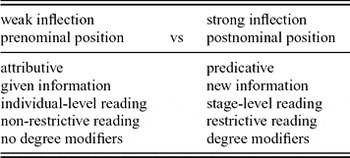
From the contrasts between weak prenominal adjectives and strong postnominal adjectives discussed in sections 4.1.1–4.1.5 the picture in table 3 emerges.
Properties of weak prenominal vs strong postnominal adjectives

The correlations in table 3 amount to a strict division of labor between weak prenominal adjectives and strong postnominal adjectives with respect to their function and interpretation. In light of these correlations, the answer to the question of ‘what the weak and strong forms of the adjectives in themselves stand for’ (Fischer Reference Fischer2001: 253) is this (but see below): weak inflection stands for prenominal positioning, attributive function, given information, inherent/enduring properties and non-restrictive modification, whereas strong inflection stands for postnominal positioning, predicative function, new information, accidental/temporary properties and restrictive modification. Moreover, weak and strong adjectives differ with respect to whether they support degree modifiers. However, the picture drawn in table 3 is idealized for a number of reasons which, as we shall see in the following, ultimately follow from strong adjectives not being confined to the postverbal position.
4.2 Strong prenominal adjectives
As we have already seen in section 2, strong adjectives are not confined to the postverbal position but may also occur prenominally, provided the nominal expression is indefinite, as in (37):
(37)
Fischer hypothesizes that ‘all strong adjectives in Old English are, or started off as, predicative adjectives’ and ‘[s]trong adjectives are predicative rather than attributive’ (Reference Fischer2000: 170, 176).Footnote 12 Given that the properties of strong adjectives in postnominal position discussed in the previous section are inherent properties of strong adjectives, we would expect strong adjectives in prenominal position to display the same properties as their postnominal counterparts: strong prenominal adjectives should be predicative, convey new information, receive the stage-level interpretation and function as restrictive modifiers (see Fischer Reference Fischer2006: 256ff. for arguments to this effect). In other words, strong prenominal adjectives should contrast with weak adjectives on all parameters discussed (excepting the positional parameter). As we shall see, these expectations are not borne out. On the contrary, strong prenominal adjectives contrast with strong postnominal adjectives, not with weak adjectives. The only property strong adjectives display across positions is their ability to support degree modifiers, e.g. swiðe ‘very (much)’ and ful ‘very’ in (38) for prenominal occurrences of strong adjectives (see (35) for strong postnominal adjectives; recall from (36) above that weak adjectives resist degree modification (cf. Fischer Reference Fischer2000: 168f.; Reference Fischer2001: 261f.)):
(38)
As can be seen from the contrast between (39) and (40), strong prenominal adjectives differ from their postnominal counterparts in that they (a) do not convey new information, (b) receive an individual-level reading and (c) are interpreted as non-restrictive modifiers. These properties they share with weak adjectives (which are confined to the prenominal position), as shown in (41):
(39)
(40)
(41)
The strong prenominal adjective giongne in (39a), as opposed to its postnominal counterpart iungne in (40a), does not provide additional or noteworthy information about the referent of the indefinite nominal expression it occurs in; rather giongne, like the weak adjective iunga in (41a), combines with the noun to form ‘a new noun token’ (Fischer Reference Fischer2001: 258). Giongne in (39a), again unlike iungne in (40a) but like iunga in (41a), receives an individual-level interpretation: both giongne in (39a) and iunga in (41a) express inherent or characterizing properties of the nouns they modify, i.e. being of young age is a property that characterizes Brettisc monnan in (39a) and man in (41a). Conversely, iungne in (40a) does not characterize Ceaddan, but induces a stage-level, i.e. a temporal or episodic reading: being young is not an inherent property of Chad, but a transient one which relates to Chad's past (see also Fischer Reference Fischer2001: 267). Since the strong prenominal adjective giongne in (39a) does not single out from a set of entities a particular referent, i.e. anne giongne Brettisc monnan ‘a young Briton’ does not contrast with anne ealdne Brettisc monnan ‘an old Briton’, it functions as a non-restrictive modifier. This property is shared by iunga in (41a). Conversely, iungne in (40a) induces a contrast, i.e. þone ilcan Ceaddan iungne ‘the same Chad (when he was) young’ contrasts with e.g. þone ilcan Ceaddan ealdne ‘the same Chad (when he was) old’. The respective paraphrases in (42)–(44) illustrate the contrasts under consideration:
(42) [hi] ofslogon anne giongne<str> Brettisc monnan
= they killed a Britoni, hei was young
≠ they killed a Britoni whoi was young
(43) þes iunga<wk> man is forliden
= this mani is shipwrecked, hei is young
≠ this mani whoi is young is shipwrecked
(44) se geara mid þone ilcan Ceaddan iungne<str> . . . syndrig munuclif hæfdon
≠ who long ago had separate cloisters with Chadi, hei was young
= who long ago had separate cloisters with Chadi whoi was young (then)
The same contrasts can be observed with respect to the strong prenominal adjective bliðe in (39b) and the weak adjective bliðan in (41b) vs the strong postnominal adjective bliðe in (40b). First, both bliðe in (39b) and bliðan in (41b), as opposed to bliðe in (40b), do not convey new information but given information. Second, both bliðe in (39b) and bliðan in (41b) receive an individual-level interpretation, i.e. the property denoted by these two prenominal adjectives is not a transient one, but one that characterizes the nominal expressions they combine with. Conversely, bliðe in (40b) denotes a temporal, not an inherent, property of gebeoras ‘companions’. Third, neither bliðe in (39b) nor bliðan in (41b) pick out from a set of entities a particular entity, i.e. bliðe gebeorscipe does not contrast with unbliðe gebeorscipe, while bliðe gebeoras in (40b) contrasts with e.g. unrote gebeoras ‘sad companions’.
4.2.1 Weak and strong prenominal adjectives vs strong postnominal adjectives
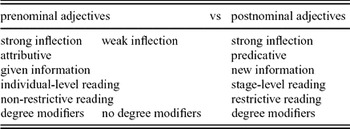
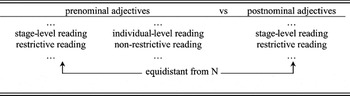
In light of the data discussed in this section, Fischer's (Reference Fischer2000, Reference Fischer2001) claim that ‘weak’ vs ‘strong’ adjectival inflection iconically relates to the distinctions ‘definiteness’ vs ‘indefiniteness’, ‘attributive’ vs ‘predicative’, ‘given information’ vs ‘new information’ and ‘individual-level reading’ vs ‘stage-level reading’ cannot be maintained. Rather, the resulting picture, as shown in table 4, is a symmetric one with the prenominal position expressing attributive function, given information, individual-level properties and non-restrictive modification and the postnominal position flagging predicative function, new information, stage-level properties and restrictive modification. These findings strongly suggest that the prenominal and the postnominal position in OE represent two quite distinct structural domains, each with its own specific interpretive properties (see section 5). By and large, these properties are dissociated from adjectival inflection (pace Fischer Reference Fischer2000, Reference Fischer2001).Footnote 13
Properties of prenominal vs postnominal adjectives

In concluding this section, I return to Fischer's (Reference Fischer2000: 170) hypothesis that ‘all strong adjectives in Old English are, or started off as, predicative adjectives’. As it stands, Fischer's hypothesis entails that indefinite nominal expressions cannot but contain adjectives that convey new information, have a stage-level reading and function as restrictive modifiers. As we have seen in this section, this hypothesis is irreconcilable with the empirical fact that strong adjectives occur prenominally in indefinite nominal expressions where they convey given information (39a), where they have an individual-level reading (39b) and where they function as non-restrictive modifiers (39c). The only property strong prenominal adjectives share with their postnominal counterparts is their ability to support degree modifiers (38), which, arguably, is due to analogy. By the same line of reasoning, the empirical findings discussed in this section cast doubt on Fischer's (Reference Fischer2000: 174ff.) conjecture that the prenominal placement of strong adjectives, as discussed here, is an inconsistency which ultimately results from the loss of adjectival inflection in conjunction with the rise of the article system, simply because strong prenominal adjectives display markedly different properties from their postnominal counterparts.
5 Two distinct domains for adnominal adjectives
Recent comparative and theoretical studies (Larson Reference Larson1998; Cinque Reference Cinque2007; Larson & Marušič Reference Larson and Marušič2004; Larson & Takahashi Reference Larson and Takahashi2004) show that adnominal adjectives are crosslinguistically distributed across two structural domains, each with its own specific interpretive properties (table 4).
Before turning to the issue of structural implementation proper (section 5.2), it is worthwhile to take a brief look at the distribution and interpretation of adnominal adjectives in Present-day English (henceforth PDE).
5.1 A brief look at adnominal adjectives in PDE
It has often been remarked that postnominal occurrences of adjectives in the context of ordinary nouns are, by and large, restricted to adjectives followed by a complement or adjunct (45) and participial adjectives or modal adjectives in -able/-ible (46) (see, among others, Bolinger Reference Bolinger1967; Sadler & Arnold Reference Sadler and Arnold1994; Cinque Reference Cinque2007; Larson & Marušič Reference Larson and Marušič2004):Footnote 14
- (45)
(a) So in [some schools [keen [on the creative arts]]], children never opened their mouths in drama lessons! (BNC AM6)
(b) I watch their faces rise to meet me from the green depths of [a culture [older [than I can fathom]]]. (BNC FU5)
- (46)
(a) Mrs Bloomer has offered a one thousand pounds reward for the return of [the items [stolen]]. (BNC K1X)
(b) [The remedies [available]] are injunctions, damages, and an account of profits. (BNC ECD)
While the former are confined to the postnominal position, the latter typically occur in both post- and prenominal position:
- (47)
(a) Descriptions of [the [[stolen] items]] are now being circulated to every museum in Britain. (BNC K1H)
(b) Once again, it appears that the nature of [the [[available] remedies]] is having some effect on the character of the diagnosis. (BNC CN5)
Adjectives that may occur both post- and prenominally have often been observed to display interpretive asymmetries with respect to the parameters ‘restrictive vs non-restrictive’ and ‘stage-level vs individual-level’ (see also Bolinger 1976: 4; Larson Reference Larson1998: 155f.; Cinque Reference Cinque2007: 16ff.; Larson & Marušič Reference Larson and Marušič2004: 275).Footnote 15 Postnominal adjectives are invariably conceived of as reduced restrictive relative clauses (see Sadler & Arnold Reference Sadler and Arnold1994: 194ff.; Cinque Reference Cinque2007: 36ff., 129ff., passim; Larson & Marušič Reference Larson and Marušič2004: 280ff.; Larson & Takahashi Reference Larson and Takahashi2004: 14ff.), whereas their prenominal counterparts are ambiguous between the restrictive and non-restrictive reading. As can be read off the paraphrases in (48) and (49), postnominal unsuitable is unanimously interpreted as a restrictive modifier, whereas its prenominal counterpart is ambiguous between the restrictive and non-restrictive modifier reading ((48)–(51) adapted from Cinque (Reference Cinque2003: 2) and Larson & Takahashi (Reference Larson and Marušič2004: 10)):
(48)
(49)
Interpretive asymmetries can also be observed in (50) and (51). In postnominal position, the adjective cannot but receive a stage-level interpretation, whereas in prenominal position it is systematically ambiguous between the stage-level and individual-level reading:
(50)
(51)
The fact that there may be two occurrences of the adjective visible supports the interpretation of prenominal visible in (51) as ambiguous between the individual-level and stage-level reading ((52) from Larson Reference Larson1998: 155):
- (52)
(a) The visible stars visible include Capella.
(b) The visible visible stars include Capella.
Both (52a) and (52b) are interpreted as ‘[t]he inherently visible stars which happen to be visible at the moment include Capella’ (Larson Reference Larson1998: 155). In (52a), the individual-level reading is expressed by the first, i.e. the prenominal adjective, and the stage-level reading by the second, i.e. the postnominal adjective. In (52b) both adjectives are prenominal, with the one closer to the noun expressing individual-level visibility and the other expressing stage-level visibility. As is argued by Larson (Reference Larson1998), Cinque (Reference Cinque2007), Larson & Marušič (Reference Larson and Marušič2004), Larson & Takahashi (Reference Larson and Takahashi2004), the interpretive contrasts illustrated in (48)–(51) do not follow from linear order, i.e. from the pre- vs postnominal positioning of adnominal adjectives, but rather from the adjectives’ ‘relative closeness to N’ (Larson Reference Larson1998: 155), as is also witnessed by the contrast in coherence in (53).Footnote 16 While (53a) is coherent in that it asserts the visibility of the inherently visible stars, (53b) is incoherent because it asserts the visibility of the inherently invisible stars ((53) from Larson Reference Larson1998: 156):
- (53)
(a) The invisible visible stars include Capella.
(b) # The visible invisible stars include Capella.
The foregoing discussion shows that the interpretive contrasts between adnominal adjectives in Present-day English (PDE) follow exclusively from their ‘relative closeness to N’ (Larson Reference Larson1998: 155). As a corollary of this, outer prenominal adjectives and postnominal adjectives are equidistant from N, with the prenominal position being the canonical position, as shown in table 5.
Properties of adnominal adjectives in PDE

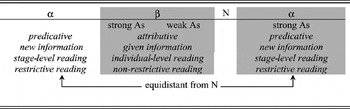
PDE and OE should therefore share the same basic structure, with adjectives that express individual-level properties and/or function as non-restrictive modifiers being closer to the noun they modify than adjectives that express stage-level properties and/or function as restrictive modifiers (see section 5.2). In terms of linear order, the major difference between PDE and OE lies in the positioning of adjectives that express stage-level properties and/or function as restrictive modifiers. In the context of ordinary nouns, the canonical position assumed by this type of adjective in PDE is the prenominal position. In OE, adjectives displaying the properties under consideration are strictly postnominal. A prenominal adjective position which would be equidistant to the noun is not (yet) available because prenominal adjectives, via strong vs weak inflection, interact with the (in)definiteness properties of the nominal expression they occur in (section 2).
The following section sketches two proposals concerning the structural implementation of the interpretive differences of adnominal adjectives.
5.2 Structural implementation
As mentioned at the outset of this chapter, the findings reported for OE in section 4 are replicated across languages in the sense that adnominal adjectives are distributed across two structural domains, each with its own specific interpretive properties. Since different languages make different choices with respect to linearization and inflection,Footnote 17 I adopt Larson & Marušič's (Reference Larson and Marušič2004: 280, 284ff.) labeling convention whereby adjectives that are closer to the noun are referred to as β and adjectives that are less close to the noun as α, as illustrated in table 6 for PDE and OE, with the properties given in the gray cells representing the OE situation and the properties given in italics representing the PDE situation.
Properties of adnominal adjectives in PDE and OE

According to Larson & Marušič (Reference Larson and Marušič2004) and Larson & Takahashi (Reference Larson and Takahashi2004), adjectives of type β are within the NP domain, where they are confined to the prenominal position (54a), whereas adjectives of type α originate in postnominal position within the DP domain, but may be subject to raising (54b) ((54) adapted from Larson & Marušič Reference Larson and Marušič2004: 280, 284ff.):Footnote 18, Footnote 19
(54)
(54a) represents the situation in OE, with type β adjectives being strictly prenominal and type α adjectives strictly postnominal, as is illustrated in (56) for the data in (55). Note that the demonstrative þone ‘that’ is located in a functional projection on top of DP:Footnote 20
- (55)
(a) Forhwon ne recst þu us [þone hwitan hlaf]
‘Why do you not give us the white loaf (of bread)?’
(b) þa gemette he [gebeoras bliðe] at þam huse
‘then he met merry companions at the house’
(c) ða easternan tungelwitegan gesawon [niwne steorran beorhtne]
‘the oriental astrologers saw a new bright star’
(d) se geara mid [þone ilcan Ceaddan iungne] . . . syndrig munuclif hæfdon
‘who long ago, when Chad was young, had separate cloisters’
(56)
Prenominal occurrences of type α adjectives, as is typical in the context of ordinary nouns in PDE, are derivative in the sense that type α adjectives raise from the postnominal position across [NP (β) N] ((57) adapted from Larson Reference Larson1998: 155):
(57)
Cinque's (Reference Cinque2007) proposal differs from Larson & Marušič's (Reference Larson and Marušič2004) and Larson & Takahashi's (Reference Larson and Takahashi2004) in that both types of adnominal adjective originate in prenominal position, with adjectives of type β universally being closer to the noun than adjectives of type α (see (58a), adapted from Cinque Reference Cinque2007: 61). Adnominal adjectives are realized as specifiers of functional projections (FP) that are sandwiched within two distinct structural domains within a split DP layer, where DP is the domain of referential binding and dP ‘the first constituent that has some referential import’ (Cinque Reference Cinque2007: 61):Footnote 21
(58)
(58a) accounts straightforwardly for the fact that prenominal adjectives in PDE are ambiguous between the type α and the type β reading ((59) is based on (50)–(52)):
(59)
Linear orders that diverge from the basic order yielded by (58a) are derivative. Thus, in OE, where the two types of adjectives invariably flank the noun they modify (with type α adjectives unanimously occupying the postnominal position), the chunk of structure containing adjectives of type β and the noun, notably dP, raises across the position taken by adjectives of type α, as schematically indicated in (58b). The following examples illustrate dP raising in OE ((60) is based on the data in (55)):
(60)
Both types of analysis involve syntactic movement of a phrasal category to the left periphery of the nominal expression, i.e. DP. Under Larson & Marušič's (Reference Larson and Marušič2004) and Larson & Takahashi's (Reference Larson and Takahashi2004) proposal the canonical order of adnominal adjectives and nouns in PDE involves type α AP raising across the chunk of structure containing the noun and adjectives of type β (= NP), whereas under Cinque's proposal the canonical order of adnominal adjectives and nouns in OE is derivative in the sense that the chunk of structure containing the noun and adjectives of type β (= dP) raises across type α AP.
In reply to the question of what triggers syntactic movement, Larson & Marušič (Reference Larson and Marušič2004: 285f.) conjecture that AP raising from the postnominal position is triggered by the requirement that adjectives have their Case features checked. In the context of ordinary nouns, adjectives cannot check their Case features in situ but must raise to an appropriate checking site within the DP domain (see Larson & Yamakido Reference Larson and Yamakido2008: 59ff.). To account for the fact that (57a) is well-formed even though [α (in)visible] does not raise, Larson & Marušič (Reference Larson and Marušič2004: 285f.) and Larson & Yamakido (Reference Larson and Yamakido2008: 59ff.) would have to argue that postnominal [α invisible] is embedded in a reduced relative clause, i.e. [CP . . . [α (in)visible] . . .], which, not being a nominal category, is not subject to Case checking.Footnote 22 While conceding that the motivation for phrasal movement ‘is not really understood’ (Cinque Reference Cinque2007: 63), Cinque presents a number of empirical facts and theoretical considerations that are strongly suggestive of phrasal movement operations. As a detailed discussion of Cinque's (Reference Cinque2007) arguments in favor of phrasal movement falls outside the scope of this article, I will confine myself to two brief points. First, phrasal movement accounts for the empirical fact that, across languages, there is only one prenominal order of adjectives (e.g. α > β > N), but two postnominal orders, notably the same order or the mirror order (N > β > α) (see Cinque Reference Cinque2007: 61ff.).Footnote 23 Second, the prenominal generation of adnominal adjectives in conjunction with phrasal movement is in line with antisymmetry (cf. Kayne Reference Kayne1994), because the linear order of adjectives to the left of N is basic while postnominal linear orders are necessarily derivative.
In the remainder of this section I concentrate on the nature of dP and probe its interaction with phrasal movement in OE (or the lack of it in PDE).
5.2.1 Some speculations on dP and phrasal movement in OE
As we have seen, dP ‘has some referential import’ in the sense that adjectives of type β modify ‘something that is still predicative in nature, while [adjectives of type α] modify something that already has some referential status’ (Cinque Reference Cinque2007:61). In other words, the domain below dP displays different referential properties than the domain above dP. This qualification not only ties in with Bolinger's (Reference Bolinger1967, Reference Bolinger1972) observation that attributive adjectives are reference modifiers, whereas predicative adjectives are referent modifiers, but also with definiteness (in)sensitivity. Recall that only prenominal adjectives in OE are definiteness-sensitive, with weak adjectival inflection signposting definiteness and strong adjectival inflection indefiniteness, thus compensating for the lack of the (in)definite article (section 2). Recall further that prenominal adjectives in OE, irrespective of their inflectional properties, are adjectives of type β (section 4.2.1). Given that (a) the two types of adjectives are distributed across two distinct domains, (b) type β adjectives are closer to the noun than type α adjectives and (c) type β adjectives in OE are definiteness-sensitive, while type α adjectives are not, dP suggests itself as the natural demarcation line between definiteness sensitivity and definiteness insensitivity within nominal expressions. While dP is associated with definiteness ([±def]), DP is associated with referentiality.Footnote 24 Thus, under the interrelated assumptions that dP, depending on the inflection of type β adjectives, is specified as [+def] (weak inflection) or as [−def] (strong inflection), and that [±def], as typically expressed by the (in)definite article, feeds the pragmatic interpretation of a nominal expression (e.g. referential vs anaphoric properties), it seems plausible to conclude that dP raises to the specifier of DP, so that definiteness information is available where the referential status of the nominal expression is fixed (see (58)–(60)). Under this analysis, the loss of the canonical postnominal position of type α adjectives is a consequence of the loss of dP raising. With the loss of adjectival inflection and the advent and subsequent establishment of the Middle English (ME) article system, dP raising to specDP, as illustrated in (60), is obviated, since definiteness information is now provided by the (in)definite article whose natural habitat is the head position within DP.
In conclusion, I would like to come back to Fischer's (Reference Fischer2000: 174ff.) conjecture that the prenominal placement of strong adjectives is an inconsistency that ultimately results from inflectional loss in tandem with the rise of the ME article system. In section 4, I argued that strong prenominal adjectives, while sharing all interpretive properties with their weak prenominal mates, display markedly different properties from their postnominal counterparts, i.e. strong adjectives are distributed across two types, α and β, and thus across two distinct structural domains. During the transition from the OE to the ME (and ultimately PDE) system, there may have been a phase of inconsistency along the lines argued by Fischer (Reference Fischer2000). This inconsistency, however, would have only affected type α adjectives which, due to the gradual loss of dP raising, start to occur prenominally. In other words, type α adjectives may have had access to both the canonical OE position and the canonical PDE position, which, as we have seen, are equidistant from N (table 6).
6 Concluding remarks
I argued that adnominal adjectives in OE are of two types which differ significantly with respect to their position and interpretation, and that the positioning of adnominal adjectives is, by and large, disassociated from their inflectional properties (pace Fischer Reference Fischer2000, Reference Fischer2001, Reference Fischer2006). In accordance with recent proposals by Larson & Marušič (Reference Larson and Marušič2004), Larson & Takahashi (Reference Larson and Takahashi2004) and Cinque (Reference Cinque2007), I suggested that the two types of adjectives be seen as located in two distinct syntactic domains within nominal structures, each with its own specific interpretive properties. I followed Cinque (Reference Cinque2007) in assuming that word order and word order variation in nominal expressions is contingent on phrasal movement and argued that phrasal movement in OE should be seen as triggered by the requirement that definiteness information be available where the referential status of the nominal expression is fixed.
Appendix
Specification of text sources in the Dictionary of Old English Corpus (DOE)