


Introduction
Exclusion from school is a widely used disciplinary tool to remove a child from the classroom. Few studies have explored the inter-relationship between exclusion and psychopathology. The literature has largely an educational perspective, yet understanding the full range of influences seems essential, as exclusion affects children with multiple vulnerabilities (Paget et al., Reference Paget, Parker, Heron, Logan, Henley, Emond and Ford2018). Two linked systematic reviews reported an association between the presence of clinically impairing psychopathology and exclusion but highlighted a lack of primary research (Whear et al., Reference Whear, Marlow, Boddy, Ukoumunne, Parker, Ford and Stein2013; Parker et al., Reference Parker, Whear, Ukoumunne, Bethel, Thompson-Coon, Stein and Ford2014). Mental health may be an important influence on children's ability to cope at school (Parker and Ford, Reference Parker and Ford2013), while there may be a bi-directional relationship between exclusion from school and psychopathology (Ford et al., Reference Ford, Parker, Salim, Goodman, Logan and Henley2018a).
Children who are more likely to be excluded shared many characteristics with children who are more likely to have poor mental health (Hemphill et al., Reference Hemphill, Toumbourou, Smith, Kendall, Rowland, Freiberg and Williams2010; Paget et al., Reference Paget, Parker, Heron, Logan, Henley, Emond and Ford2018). The UK Department for Education reported an increase in the proportion of fixed period (suspension) (from 4.29% in 2016/17 to 4.76% in 2015/16) and permanent exclusions (expulsions) (0.08% in 2016/17 to 0.10% in 2016/17) per school enrolment (Department for Education, 2018). Children with recognised special educational needs or disability (SEND) were over seven times more likely to be excluded from school than their peers (Department for Education, 2018), which suggest that schools struggle to support children with additional needs, although mental health is prioritised in the most recent UK SEND code of practice (Department for Education and Department of Health, 2014). In the USA, children are not eligible for special education services if they are determined to be ‘socially maladjusted’ rather than ‘emotionally disturbed’ under the Disabilities Education Improvement Act, since no definition of social maladjustment exists in federal regulations, implementation varies across States (Cloth et al., Reference Cloth, Evans, Becker and Paternite2014). In Canada, despite an inclusive educational policy, students who are of Aboriginal descent, who have learning exceptionalities, newly arrived immigrants, and are from lower socioeconomic groups are most at risk for exclusion (Specht, Reference Specht2013). Public data from European countries on exclusion generally is not reported; however, there are similar data on dropout rates, which may be indirectly related to exclusion (MECD, 2016).
The role of schools in children's mental health is a current policy focus in the UK (Frith, Reference Frith2016; Department of Health and Social Care, and Department for Education, 2018). Teachers, however, often report that they lack the necessary training, skills, and support to work effectively with children who have increasingly complex needs (Rothi, Leavey and Best, Reference Rothi, Leavey and Best2008; Association of Teachers and Lecturers, 2015). Teachers are the most commonly consulted professional regarding children's mental health and they often initiate referral to Child and Adolescent Mental Health Services (CAMHS, Ford et al., Reference Ford, Hamilton, Meltzer and Goodman2007; Patalay et al., Reference Patalay, Giese, Stanković, Curtin, Moltrecht and Gondek2016; Mellin et al., Reference Mellin, Ball, Iachini, Togno and Rodriguez2017). Persistent disruptive behaviour is the most common reason given by head teachers for excluding children in England (Department for Education, 2018), as well as the commonest psychiatric disorder in school-age children but frequently occur with other types of difficulty (Ford et al., Reference Ford, Parker, Salim, Goodman, Logan and Henley2018a). The accurate recognition of difficulties by key adults is necessary to access support for children who are struggling.
The present study comprised secondary analyses of the British Child and Adolescent Mental Health survey (BCAMHS) from 2004 (Green et al., Reference Green, McGinnity, Meltzer, Ford and Goodman2005) and its follow-up in 2007 (Parry-Langdon, Reference Parry-Langdon2008). We aimed to explore the recognition of difficulty among children who had experienced exclusion from school, and whether this varied by whether parents, teacher or both were concerned. We predicted that children with unrecognised difficulties in 2004 would be more likely to be excluded from school compared with children with a recognised difficulty. We hypothesised that children with neurodevelopmental disorders such as Autism Spectrum Conditions (ASC) and Attention Deficit Hyperactivity Disorder (ADHD) would be particularly likely to be excluded as the associated behaviours can be hard to manage within the classroom situation.
Methods
Participants
The BCAMHS 2004 was a nationally representative cross-sectional survey of 7997 children aged 5–16 years (Green et al., Reference Green, McGinnity, Meltzer, Ford and Goodman2005), all of whom were invited to follow up in 2007 (n = 7329, 73%; Parry-Langdon, Reference Parry-Langdon2008). The baseline survey used the Child Benefits register to develop a sampling frame for England, Wales and Scotland from which to select one child per family. At the time, it was a universal benefit that was estimated to cover 90% of all British children (Green et al., Reference Green, McGinnity, Meltzer, Ford and Goodman2005). Addresses were selected from a sample of 426 postal sectors with a probability related to the size of the sector, and stratified by the regional health authority and social economic group. Figure 1 demonstrates the response fraction, which was 65% and 72% of those eligible in 2004 and 2007, respectively.
Flow diagram of participant recruitment to the British Child Mental Health Survey in 2004, and its follow up in 2007.

Ethical approval for the original surveys was obtained by the Medical Research Ethics Committee; all participants gave informed consent while approval for our secondary analysis was granted by the Peninsula College of Medicine and Dentistry Research Ethics Committee.
Measures
Exclusion from school
Exclusion from school included both permanent (expulsion) and fixed term (suspension) exclusions. At both time-points parents reported ‘yes’ or ‘no’ to the following question: ‘Has [Name of Child] ever been excluded from school’ (Green et al., Reference Green, McGinnity, Meltzer, Ford and Goodman2005; Parry-Langdon, Reference Parry-Langdon2008). The prospective analysis only included children excluded in the follow-up (2007) and therefore omitted any children who had reported an exclusion at baseline (2004) (n = 73).
Psychopathology
The Development and Wellbeing Assessment (DAWBA, Goodman et al., Reference Goodman, Ford, Richards, Gatward and Meltzer2000) and the Strength and Difficulties Questionnaire (SDQ, Goodman, Reference Goodman2001) were used to assess psychopathology.
The DAWBA was completed by parents, children aged 11 or more, and if the family agreed, a teacher in both surveys. The DAWBA is a validated standardised diagnostic interview (Goodman et al., Reference Goodman, Ford, Richards, Gatward and Meltzer2000; Green et al., Reference Green, McGinnity, Meltzer, Ford and Goodman2005), which combines both structured and semi-structured questions based on the diagnostic criteria in the Diagnostic and Statistical Manual of Mental Disorders (DSM-IV, American Psychiatric Association (APA), 1994) and International Classification of Diseases (ICD-10, World Health Organisation (WHO), 1993). A small group of experienced clinical raters (including TF and RG) reviewed all data from all informants to assign diagnoses according to DSM-IV criteria. Clinical rating allowed the resolution of disagreements between informants as would occur in clinical practice, the correction of informant misunderstanding of questions and the coding of ‘not otherwise specified’ diagnoses when children had clinically significant difficulties that did fit the required symptoms of the DSM-IV. Each rater worked independently with the opportunity to discuss difficult or borderline cases with RG (the programme developer). These were reviewed, diagnosis by diagnosis, by RG for consistency. The κ statistic for chance-corrected agreement between two clinicians who independently rated 500 children was 0.86 for any disorder (standard error s.e. 0.04), 0.57 for internalising disorders (s.e. 0.11), and 0.98 for externalising disorders (s.e. 0.02) (Ford, Goodman and Meltzer, Reference Ford, Goodman and Meltzer2003). Differentiation between clinical and community samples has been successfully demonstrated in a validation study, which showed substantial agreement (Kendall's Tau from 0.47–0.70) between the DAWBA and clinical case notes amongst the clinical sample (Goodman et al., Reference Goodman, Ford, Richards, Gatward and Meltzer2000).
The SDQ is a validated brief screen for common childhood psychopathology (Cronbach alpha 0.73, test-retest reliability of 0.62; Goodman, Reference Goodman2001). The measure, which was completed by parents, teachers and young people over the age of 11 years, includes 25 statements, half stated positively and half negatively, that the informant endorses as ‘not true’, ‘somewhat true’ or ‘certainly true’. These items contribute to five sub-scales; emotional symptoms, conduct problems, hyperactivity/inattention, peer problems and pro-social behaviour. A total difficulties score is derived by summing the sub-totals of the first four subscales, and ranges from 0 to 40 with a higher score indicating greater distress. In contrast, a higher score on the prosocial subscale indicates better social function. The SDQ Impact Supplement includes questions about whether the child has a mental health problem, (‘No’, ‘Minor difficulties’, ‘Definite difficulties’’ or ‘Severe difficulties’) and if so, chronicity, associated distress, impact and burden related to the child's difficulties.
Recognition of difficulty
A binary variable was derived from parent and teacher responses to the question on the SDQ Impact score about whether the child ‘has difficulties in one of the following areas; emotions, concentration, behaviour or being able to get along with people?’ A child was coded as having ‘no recognised difficulties’ if both informants reported ‘No’ or ‘Minor difficulties’ or having ‘recognised difficulties’ if the parent and/ or the teacher had reported ‘definite’ or ‘severe’ difficulties.
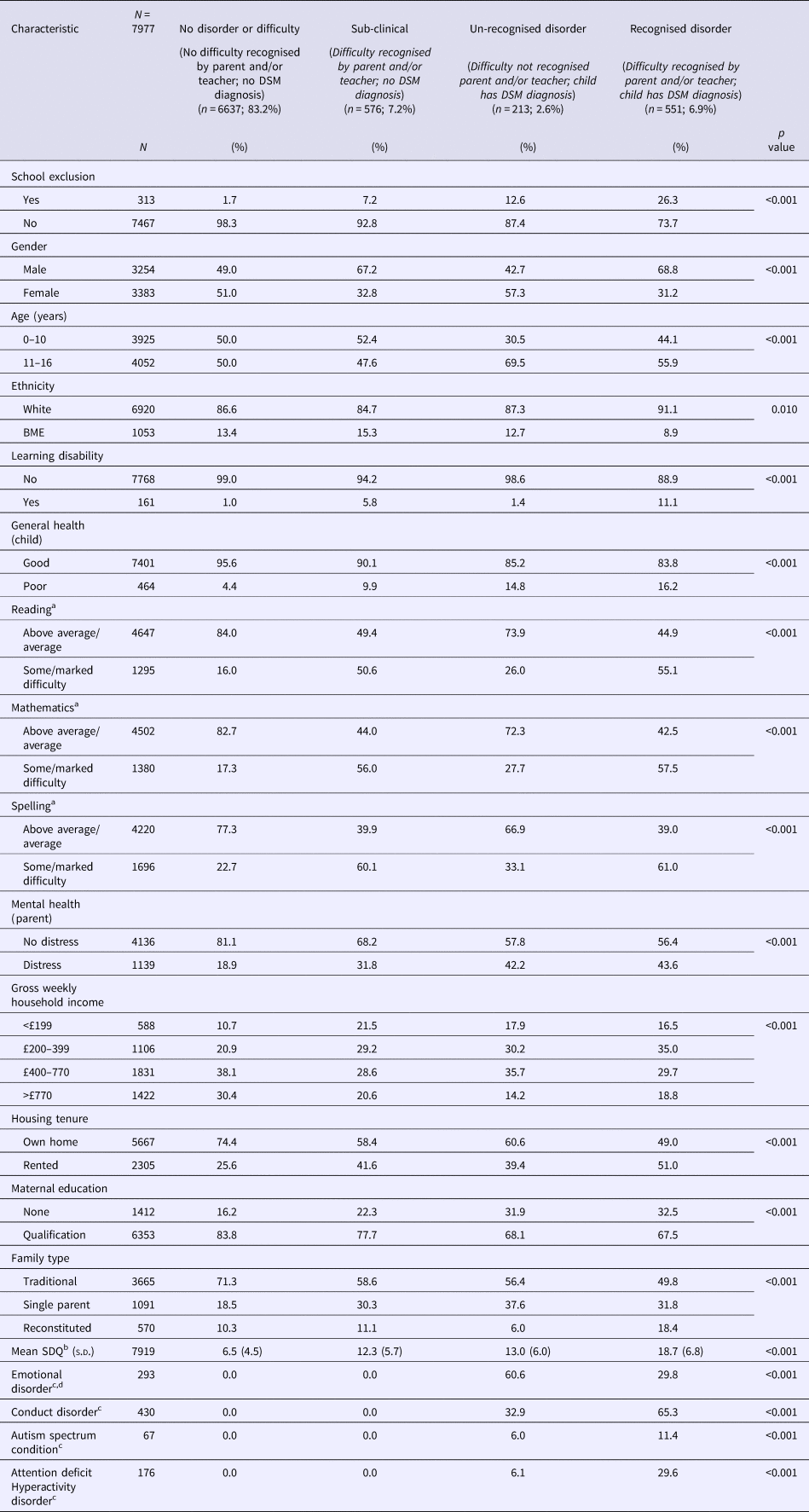
We then grouped children into four categories based on the presence/absence of a psychiatric disorder according to the DAWBA and the recognition of difficulties defined by the SDQ (Table 1). Throughout the paper, we refer to parent/teachers perceived recognition of ‘difficulties’. The four groups are defined as: the no difficulties group had no psychiatric disorder and no recognised difficulties (n = 6637), while for the sub-clinical group, the parent or teacher reported difficulties, but the child did not have a psychiatric disorder (n = 576). The unrecognised difficulties group included children that both parent and teacher reported had no difficulty but had a psychiatric disorder (n = 213), while in the recognised difficulties group, parent and/or teacher recognised the difficulty and the child had a psychiatric diagnosis (n = 551). Most analyses focused on the combined response of the parent and teachers level of recognition. However, for some analyses, the subclinical group and recognised difficulties groups were further categorised by whether the parent, teacher or both recognised the child's difficulties.
Unweighted, unadjusted description of the BCAMH sample in 2004 according to the absence/presence of psychiatric disorder and its recognition
BME, Black and minority ethnicity.
a Compared with other children.
b Parent reported total difficulties score, SDQ, Strengths and Difficulties Questionnaire (Goodman, Reference Goodman2001).
c Children with disorder only; column percentages presented in line with the rest of the table as insufficient space for the comparison group.
d Emotional disorder includes any depression and/or anxiety disorder.
Sociodemographic, parental and attainment characteristics
Confounders were selected based on literature in the field and our hypotheses. Demographic details (family type, ethnicity, parental educational qualifications, and weekly household income) were obtained from the interview with parents. In line with our previous work (Ford, et al., Reference Ford, Parker, Salim, Goodman, Logan and Henley2018a), housing tenure was grouped by whether families owned or rented their accommodation. Neighbourhood environment was assessed using the ACORN (A Classification Of Residential Neighbourhoods; CACI Information Services, 1993). Parents rated their child's general health using a five-point Likert scale from very good (1) to very bad health (5), which was dichotomised (very good and good health, n = 7401, v. fair, bad and very bad, n = 464). Parent's mental health was measured using the 12 item General Health Questionnaire (GHQ Goldberg and Williams, Reference Goldberg and Williams1988) with a cut point of 3 or more to indicate distress (Green et al., Reference Green, McGinnity, Meltzer, Ford and Goodman2005). A child was deemed to have a learning disability if one or both of the parents or teachers had estimated that the child's mental age was 60% of the chronological age or less (e.g. a mental age of 6 or less at a chronological age of 10) (Liddle et al., Reference Liddle, Batty and Goodman2009). Teachers also estimated the child's level of attainment in comparison with their peers (no learning disability, n = 7768, v. moderate/severe learning difficulty, n = 161).
Analysis
Analyses used Stata version 14.0 (StataCorp, 2015) on children with complete data for the outcome and exclusion at the relevant time-point. In line with our previous work using the BCAMHS data, the analysis was based on unweighted samples as there are very small design effects on estimates while the small size of strata and clusters mean that it is impossible to run follow-up analyses while preserving the complex survey design (Heyman et al., Reference Heyman, Fombonne, Simmons, Ford, Meltzer and Goodman2001; Ford et al., Reference Ford, Parker, Salim, Goodman, Logan and Henley2018a).
Rates of missing data were low (<3%) at baseline for most demographic and family characteristics apart from weekly income and family type (see online Supplementary Table S1). There was a considerable amount of missing teacher data in both surveys; 94% of families consented to contact a teacher at baseline and 80% at follow-up, with a response rate of 78% and 71% among teachers, respectively. Child attainment was teacher reported which accounts for the higher percentage of missing values. More teacher data were missing in the follow-up survey as more children were over 16 and therefore parents were not asked to give consent for teachers to be contacted (Parry-Langdon, Reference Parry-Langdon2008). The attrition rate from 2004 to 2007 was 33.2%.
The analysis was conducted to explore any differences in those with missing data in the follow-up survey. As we expected there was a significantly higher proportion of children with a psychiatric diagnosis than those without a diagnosis [13.13% (n = 348) v. 7.81% (n = 416) p < 0.001]. Similarly, those who had dropped out were at greater risk of exclusion from school (6.18% (n = 154) v. 3.01% (n = 159) p < 0.001). Consistent with our previous work (Ford et al., Reference Ford, Parker, Salim, Goodman, Logan and Henley2018a), multiple imputations were not conducted in this study as the data was systematically missing and the sample size was considered sufficient. Previous cohort studies have found drop-out to have minimal impact on associations (Wolke et al., Reference Wolke, Waylen, Samara, Steer, Goodman, Ford and Lamberts2009). Data on an exclusion at baseline were missing most often for children with subclinical difficulties (6.3%) compared with 2.1% of those with no disorder or recognised difficulty, 2.8% of those with unrecognised difficulties and 2.7% of those with recognised difficulties. As not all families agreed that teachers could be contacted and not all teachers responded, there was a considerable amount of missing teacher data in both surveys. Where teacher SDQ's were missing, children were conservatively assumed to have no recognised difficulties. A sensitivity analysis was conducted that assumed that if contacted, the teachers would have responded as the parents had, which indicated moderate agreement with our conservative approach on cross-tabulation (κ = 0.5, p < 0.001) and suggests that a further 225 children would be included among those with recognised difficulties, mainly increasing the number of children in the sub-clinical disorders group.
Descriptive analyses compared the distribution of psychopathology, exclusion and potential confounding factors according to our four recognition groups using χ2 or one-way ANOVA. For multivariable analyses, the reference group were children who were considered to have no difficulties and did not have a disorder. Logistic regression models explored whether the recognition of psychopathology was associated with exclusion in 2004 or predicted it in 2007. Confounders were selected-based literature in the field and our hypotheses.
In line with our previous study of the BCAMHs (Ford et al., Reference Ford, Parker, Salim, Goodman, Logan and Henley2018a), we used a backwards stepwise approach, where non-significant variables were individually removed until all variables retained were significant, aside from gender, age and ethnicity, which remained in the models due to the established association with exclusion from school. All models also initially controlled for household occupation and income, neighbourhood deprivation, parental mental health, and educational qualifications, plus child general health and learning disability. Mental health diagnosis as measured by the DAWBA was omitted from models due to collinearity; as it was involved in the derivation of the ‘recognition’ variable, we could not then adjust for the presence or absence of disorder.
A sub-group cross-sectional analysis was conducted to explore whether children with neurodevelopmental disorders were more likely to be excluded than children with other disorders. There were insufficient numbers to explore these associations prospectively. As comorbidity was common, a hierarchy of disorder was composed at baseline in order to have mutually exclusive groups (Ford, Reference Ford2004). Children were categorised as having no disorder (n = 7236), ASC only (n = 67), ADHD but not ASC (n = 158), conduct disorder but not ADHD or ASC (n = 312) or an emotional disorder but not conduct disorder, ADHD, or ASC (n = 204). Children with ADHD (n = 176) or ASC (n = 28) were compared against children with an emotional disorder (depression or anxiety, n = 293). As disruptive behaviour is the most common reason for exclusion, the impact of comorbidity of conduct disorder was explored across the three disorders (ADHD n = 106; ASC n = 28; and emotional n = 79). Logistic models were built to explore the difference of association between children with a neurodevelopmental or emotional diagnosis and exclusion from school at baseline. For all models, the reference group was whether the child had an emotional disorder diagnosis.
Results
Table 1 describes the sample in terms of the recognition of difficulty and suggests that girls and children with emotional disorders were overrepresented among children with unrecognised difficulties (60.5%). Children with sub-clinical and recognised difficulties were more likely to have a general learning disability. Interestingly, those with an unrecognised difficulty were only marginally more likely to have a general learning disability than the no disorder group, although they had similar SDQ total difficulties scores, which suggests a similarly poor mental health, to children with recognised difficulties. The unrecognised difficulties group also reported a higher percentage of above average/average scores across all three attainment measures. In comparison with children without difficulties, all three groups with poor mental health were from more disadvantaged families, and reported poorer parental mental health.
Recognition was related to the severity of children's difficulties (see online Supplementary information; Figure S2 and Tables S2 and S3). Both parents and teachers were more likely to recognise poor mental health among children with recognised needs compared with those within the subclinical group (online Supplementary Tables S2 and S3). Interestingly, the proportion of recognition from both informants increased as the difficulties for the child increased. This suggests that recognition may be driven by the severity of the difficulty. Those who have been recognised by both the parent and teacher have a higher total SDQ score than those recognised by only one adult or neither; however, parents are more likely to report a higher SDQ score than teachers (online Supplementary Tables S2 and S3).
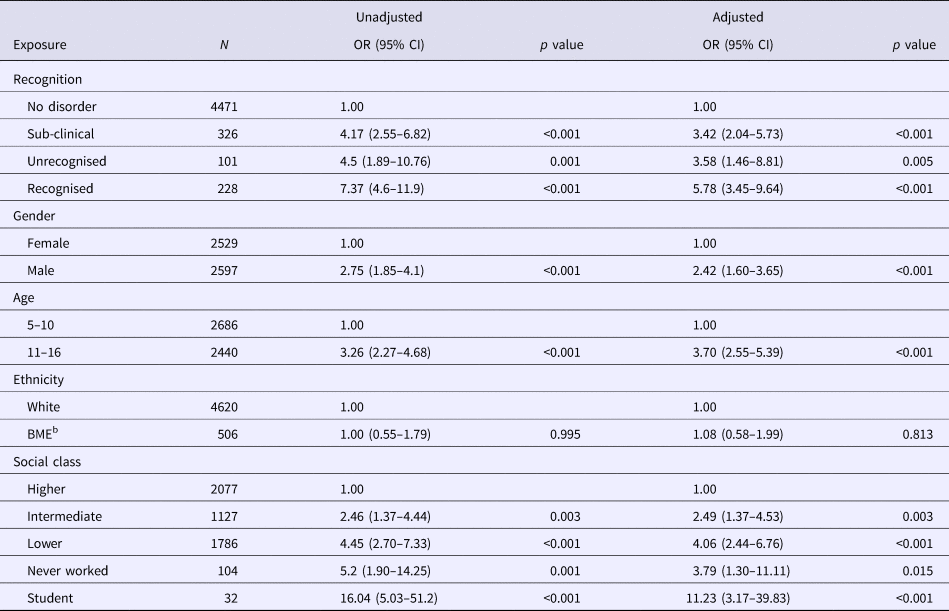
Cross-sectional multivariable analyses revealed a strong association between unrecognised difficulties and exclusion from school, which remained once the model was adjusted (Table 2). Children were considerably more likely to have un-recognised difficulties in 2004 if they had also been excluded [adjusted odds ratio (OR) 8.55, 95% confidence interval (CI) 4.45–16.40), p < 0.001]. Boys and older children were also overrepresented among those excluded with marginal associations with poor parental mental health and poor child physical health. Psychiatric disorder and its recognition predicted exclusion over 3 years (Table 3), but counter to our hypothesis, children with recognised difficulties were the group most likely (adjusted OR 5.78, 95% CI 3.45–9.64, p < 0.001) to experience exclusion.
Cross-sectional analysis of the association of unrecognised disorders at baseline and the child's likelihood of exclusion at baselinea

a Maternal education, social class, neighbourhood environment, weekly income and learning disability status were considered in the model but removed (p < 0.01).
b Recognition included children whose difficulties were recognised or not, compared with their peers with no disorder. Those children defined in the sub-clinical group, who had recognised difficulties by the parent and teacher but no psychiatric disorder according to the DAWBA were omitted from these analyses.
c Black and minority ethnicity.
d Measured by the General Health Questionnaire (Goldberg and Williams, Reference Goldberg and Williams1988).
Overall unadjusted and adjusted odds ratio (OR) for the recognition of disorder among children in 2004 who had been excluded from school in 2007a
a Maternal education, neighbourhood environment, weekly income, parent general mental health, child general health, and learning disability status were considered in the model but removed (p < 0.01).
b Black and minority ethnicity.
On further analysis, poor mental health predicted exclusion in 2007 regardless of recognition, even after controlling for background characteristics (Table 4). Contrary to our hypothesis, children with the unrecognised disorder were no more likely than children with subclinical difficulties to be excluded, while as with our cross-sectional analysis, those who were most likely to experience exclusion were children whose difficulty was recognised.
Unadjusted and adjusted multivariable analysis of the impact of recognition of poor mental health on the likelihood of exclusion at follow-upa

a Maternal education, neighbourhood environment, weekly income, parent general mental health, child general health and learning disability status were considered in the model but removed (p < 0.01).
b Black and minority ethnicity.
Children with an emotional disorder (12% v. 7%), ADHD (28% v. 10%) and ASC (27% v.13%) were all more likely to be excluded if they had a comorbid conduct disorder (online Supplementary Table S4), while there was a higher odds of exclusion for children with ADHD but not ASC (OR 15.68, 95% CI 9.55–25.74) and for those with conduct disorder but not ADHD or ASC, (OR 16.52, 95% CI 10.38–26.28) p < 0.001 respectively. Once adjusted for background characteristics (Table 5), children with ADHD or conduct disorder continued to have higher odds of being excluded (OR 6.44, 95% CI 3.17–13.08) and (OR 8.02, 95% CI 4.16–15.47) p < 0.001 respectively.
Multivariable analysis of the hierarchy of disorders at baseline on the likelihood of exclusion at follow-upa

a Neighbourhood environment, weekly income, parents’ mental health, child's general health and learning disability status were considered in the model but removed (p<0.01).
b Black and minority ethnicity.
Discussion
To our knowledge, this is the first study to explore the recognition and type of psychopathology in relation to exclusion from school. Psychopathology was associated with exclusion, including subclinical difficulties that worried important adults in the child's network. Contrary to our hypothesis, children with recognised difficulties were more likely to be excluded from school than young people with unrecognised difficulties. Our findings suggest that recognition was related to the severity of the child's difficulties, which is intuitively plausible given that contact with services in relation to psychiatric disorder is associated with the impact of the disorder (Ford et al., Reference Ford, Hamilton, Meltzer and Goodman2008). Severity might also explain why children with recognised difficulties were more likely to be excluded. Our findings suggest a failure to support rather than recognition of difficulties may contribute to some exclusions from school.
There was a stronger association between psychopathology and exclusion among children when only one informant recognised their distress compared with when both parent and teacher reported concerns (Table 4, online Supplementary Table S3). Optimal clinical practice would endorse close liaison and consistent approaches between key adults around a vulnerable child, which this finding might reflect. Better joint working between parents and staff at school might mitigate the risk of exclusion.
The recognition of poor mental health was commoner among those with global learning difficulties, which suggests that developmental delay may appropriately focus the attention of key adults on children's ability to function in school. It is also likely to influence how a child copes with school and predicted the persistence of conduct disorder in an analysis that combined data from the 2004 BCAMHS with the earlier 1999 study (Ford et al., Reference Ford, Macdiarmid, Russell, Racey and Goodman2017). The common co-occurrence of learning disabilities with a psychiatric disorder (Munir, Reference Munir2016) is a potential explanation for difficulties with school that should be high on the differential diagnosis of practitioners undertaking assessments of children whose school placement is at risk of breaking down. It is important, however, that the mental health of those who are coping academically is not overlooked.
In line with previous research, girls who were excluded from school were more likely to have unrecognised and emotional disorders (Department of Health and NHS England, 2014; Paget et al., Reference Paget, Parker, Heron, Logan, Henley, Emond and Ford2018), but the low numbers of girls who were excluded precluded more detailed analyses. Conduct disorder was the most ‘recognised’ difficulty and comorbidity with conduct disorder increased the prevalence of exclusion among children with the other types of disorder studied. As others have reported, teachers are more accurate at the appraisal of children's behavioural difficulties than their emotional problems (Loades and Mastroyannopoulou, Reference Loades and Mastroyannopoulou2010). A small prospective study of psychopathology among children excluded from school (Parker et al., Reference Parker, Marlow, Kastner, May, Mitrofan, Henley and Ford2016a) reported that 90% had conduct disorder.
Implications for practice and policy
Psychiatric disorder and exclusion from school have adverse outcomes and a complex interrelationship (Hemphill et al., Reference Hemphill, Toumbourou, Smith, Kendall, Rowland, Freiberg and Williams2010; Parker et al., Reference Parker, Paget, Ford and Gwernan-Jones2016b). In the Dunedin cohort, half of the adults who had a psychiatric disorder in their mid-20s had met diagnostic criteria by the age of 15, and 75% by the age of 18 (Kim-Cohen et al., Reference Kim-Cohen, Caspi, Moffitt, Harrington, Milne and Oulton2003). This is a key time for education, while one in ten of the school-age population in the UK has a psychiatric disorder (Ford et al., Reference Ford, Goodman and Meltzer2003; Green et al., Reference Green, McGinnity, Meltzer, Ford and Goodman2005).
Government policy in England has outlined improvements in CAMHS to be implemented by 2020 and aims to increase the use of evidence-based treatments and routine outcome monitoring (Department of Health and NHS England, 2014; NHS England, 2016a, 2016b). The recent Green Paper proposes a designated mental health lead for every school and school-based mental health teams (Department of Health and Social Care and Department for Education, 2018). Our findings suggest that monitoring the mental health of children with learning difficulties would be important but not sufficient, and suggests prompt effective management of mental health conditions might prevent some children from experiencing exclusion.
Conduct disorder, reported by teachers as a major source of stress and challenge, (Department for Education, 2010, 2012), was strongly associated with exclusion in this and other studies and is largely absent from these policies. A qualitative study of parents reported that exclusion from school was often used as a threshold in order to access CAMHS services; parents believed that teachers did not feel equipped to offer the support needed (Parker et al., Reference Parker, Paget, Ford and Gwernan-Jones2016b). In a supplementary paper, teachers were interviewed regarding exclusion from school of the same group of children discussed in Parker et al., Reference Parker, Paget, Ford and Gwernan-Jones2016b. Teachers discussed the dilemmas they often make sense of exclusion in justifying their response but also managing their feelings of not being able to support the child (Parker et al., Reference Parker, Paget, Ford and Gwernan-Jonesin submission). Improved joint working between schools and mental health services is an acknowledged ongoing focus of policy (Department of Health and NHS England, 2014; Mellin et al., Reference Mellin, Ball, Iachini, Togno and Rodriguez2017). Barriers to better integration could be overcome through joint training and joint work between professionals from both backgrounds ‘improving knowledge, changing attitudes and acquiring new skills’ (Vostanis et al. (Reference Vostanis, O'Reily, Taylor, Day, Street, Wolpert and Edwards2012) p.110). Adequate classroom management training for teachers is one avenue to explore further (Nye, Reference Nye2017; Ford et al., Reference Ford, Hayes, Byford, Edwards, Fletcher, Logan, Norwich, Pritchard, Allen, Allwood, Ganguli, Grimes, Hansford, Longdon, Norman, Prices and Ukoumunne2018b).
Some children may not be able to cope with mainstream school due to psychiatric disorder, learning difficulties or a combination thereof, but a planned transition to support their needs rather than an exclusion that may implicitly blame the child and family would seem the preferable option (Parker, et al., Reference Parker, Paget, Ford and Gwernan-Jones2016b). Teacher and/or parental concern was not limited to children who met diagnostic criteria, and children with subclinical difficulties were also at increased risk of exclusion from school. When psychological distress is measured using a dimensional approach, there is a continuous spectrum of functioning (Ford and Parker, Reference Ford and Parker2016). A diagnosis is argued to be an important aspect of the formulation of a child's predicament, but while assessment can reassure, reduce blame and communicate information (Craddock, Mynors-Wallis, Reference Craddock and Mynors-Wallis2014), if not coupled with effective intervention, it is unlikely to improve the child's function and quality of life.
The BCAMH surveys’ did not offer clinical diagnoses of children's difficulties as both were conducted as research studies. Therefore, we could not in this analysis explore the impact of clinical diagnoses discussed with families or with school might have. Only a small proportion of children with psychiatric disorders reach specialist services (Ford et al., Reference Ford, Hamilton, Meltzer and Goodman2007; Newlove et al., Reference Newlove-Delgado, Ukoumunne, Stein and Ford2015). Thus, less than a third of children in the current analysis with the disorder will have been in contact specialist mental health services, and data were not available on any clinical diagnoses they may have received. Labelling children as having a mental health condition might influence the behaviour of school staff and thus the risk of exclusion. Anecdotally, such assessments if discussed proactively with school often change perceptions of key staff from seeing the child AS a problem to a view that they HAVE a problem. This would be an important avenue of future research, as the experiences, both positive and negative of families and schools in relation to this, plus data on how children subsequently cope at school, including attendance, attainment, and exclusion, would be useful to both education and mental health policy makers and providers. In our West country-based study of children who had been excluded, some parents of children who had received formal assessments reported that diagnosis helped to manage uncertainties and validate the families concerns, but for others, these labels were experienced as stigmatising and unhelpful (Parker et al., Reference Parker, Paget, Ford and Gwernan-Jones2016b).
Strengths and limitations
These analyses benefitted from a large nationally representative dataset with longitudinal data, although we cannot account for changes that might have occurred in between these surveys. We were able to adjust for most known confounders, but secondary analyses are constrained by the data collected. In addition, we recognise the lack of a priori knowledge about other potential confounders may have resulted in misspecification of the selected models when using the backwards elimination procedure. The wording of questions related to exclusion from school could have led to some ambiguity as to the time period of when the exclusion occurred; hence outcomes at follow-up were restricted to new exclusions only. Classification of recognition and the level of difficulty were reliant on the parent and teacher's perceived level of difficulty of the child and therefore. We lacked a measure of the formal recognition of need. Our findings, however, do indicate that these key adults reported a certain level of mental health impairment for the child.
We lacked data on some potential risk factors for exclusion and mental health, such as school mobility (Winsper et al., Reference Winsper, Wolke, Bryson, Thompson and Singh2016). Despite very large initial samples, the analysis of the influence of disorder was highly constrained by small numbers of children who experienced exclusion as well as psychiatric disorder. To deal with this we adopted a hierarchical approach to the types of psychiatric disorder, which we have used successfully previously (Ford et al., Reference Ford, Macdiarmid, Russell, Racey and Goodman2017) for this particular analysis. Future research could use special school or clinical samples to generate sufficient power to explore exclusion in relation to particular types of psychiatric disorder in greater depth.
Missing data are common within large population samples, particularly, those followed over time. Importantly, missing data on key exposure and outcome variables was minimal, although data on exclusion was missing on more children with subclinical difficulties than other recognition groups. The majority of parents consented for teachers to be contacted, however, the response was not 100% and the proportion of missing data from teachers was therefore higher. Although we know those who drop-out of cohort studies tend to be those with the greatest need, this has been shown to have minimal impact on associations between predictors and outcome (Wolke et al., Reference Wolke, Waylen, Samara, Steer, Goodman, Ford and Lamberts2009).
A potential limitation to the study is not conducting multiple imputations of the data to account for missing data; this was not completed due to the size of the dataset. Our conservative approach in assuming that the missing teachers would not have recognised poor mental health may have underestimated the children with recognised difficulties, but means that the detected associations with exclusion are robust. Some studies have shown differences in informant perspectives of child mental health difficulties (Achenbach et al., Reference Achenbach, McConaughy and Howell1987; Collishaw et al., Reference Collishaw, Goodman, Ford, Rabe-Hesketh and Pickles2009) and parent and teacher perspectives likely differ according to the context in which they observe and interact with the child. Similarly, exclusion was reported by parents and not linked to formal educational records. Parents may have an under-reported exclusion from school, due to stigma (Parker et al., Reference Parker, Paget, Ford and Gwernan-Jones2016b). Indeed, 19 parents omitted to report exclusions in 2007 that they had reported in 2004 (Ford et al., Reference Ford, Parker, Salim, Goodman, Logan and Henley2018a). There are growing concerns regarding the number of illegal ‘hidden’ exclusions in schools that are not formally recorded, therefore, school records may not be any more accurate (Children's Commissioner, 2012, 2013; Gill, Reference Gill2017). This is an issue which could be addressed empirically.
Conclusion
Children with recognised difficulties were more likely than children with unrecognised, subclinical or no difficulties to be excluded, which suggests a failure of support for at least some of these children, rather than a failure of recognition. The exclusion was commonest among children with disruptive behaviour, which suggests training and support for teachers in managing and understanding the behaviour that is being expressed is essential. Prompt formal identification, if coupled with adequate support or a planned transition to alternative provision, may prevent some exclusions from school, an event that is likely to further compromise mental health (Ford et al., Reference Ford, Macdiarmid, Russell, Racey and Goodman2017), and that has adverse health and education outcomes on both an individual and societal level.
Key points
• The association of psychopathology and exclusion from school varied according to whether the child's difficulties were recognised by key adults.
• Emotional disorders were more likely to be unrecognised than disruptive disorders among children who had been excluded from school.
• Children with recognised difficulties had a higher likelihood of exclusion compared those who with unrecognised, subclinical or no difficulties.
• Children with conduct disorder or ADHD were more likely to be excluded from school compared to children with Autism Spectrum or emotional disorders.
Supplementary material
The supplementary material for this article can be found at https://doi.org/10.1017/S0033291718003513.
Author ORCIDs
Claire Parker 0000-0002-7364-7046.
Acknowledgements
We would like to thank all the children, their families and the schools for taking part in the study. We are grateful for all the support that has been provided by a number of services and individuals across the county. We are grateful to the Peninsula CLAHRC for funding Claire Parker's doctoral studentship. This research was funded by the National Institute for Health Research (NIHR) Collaboration for Leadership in Applied Health Research and Care (CLAHRC) South West Peninsula. The views expressed are those of the author(s) and not necessarily those of the NHS, the NIHR or the Department of Health and Social Care in England.
Conflict of interest
Robert Goodman is the owner of Youthinmind Limited, which provides no-cost and low-cost websites related to the DAWBA and SDQ.



