Introduction
In 1991, Butterworths, as part of their Perspectives on Individual and Population Aging Series, published a volume titled Economic Security in an Aging Population. I was the sole author. Obviously, much has changed since 1991 including significant reform of the Canada/Quebec Pension Plans. This article updates some of the issues discussed in that Economic Security volume and provides more-current data support. In particular, the article shows that retired and retiring Canadians today are, in the main, achieving a high level of financial economic security. But given an aging population, will that be true in the future?
This article investigates the cause of rising costs of retirement income security in Canada. Because many of our government-sponsored retirement income security benefits are indexed to the cost of living rather than wage growth, the rising costs are shown to be manageable in a growing economy. Finally, the article shows that a modest increase in the normal age of retirement, along with gains in labour force productivity, would assist greatly in stabilizing the future costs of the Canadian financial security systems.
Demographic Background
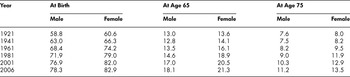
Canada’s shifting demographics are one of the important forces affecting (and effecting) the cost of our social support programs over the next half century. There are actually two causes of “population aging”. The first is the demographic tidal wave of the baby boom/bust (see Figure 1). The second cause, as Table 1 indicates, is ever-improving life expectancies.
Number of births and deaths in Canada, 1926 to 2056 (Source: Statistics Canada (2010b, p. 7)


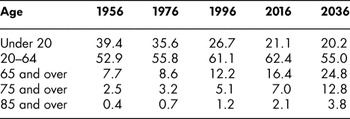
Together, these two forces result in the population aging, which Table 2 indicates. In particular, Table 2 shows that if we compare the projected Canadian population in 2036 to the population as it existed at the time of the 1996 census, the proportion of the population aged 65 and over will have doubled, and the proportion of the population aged 85 and over will have tripled. This situation is anticipated from the combination of growth in those age groups and actual declines in the younger age groups (the baby bust).
Distribution of Canadian population by age group, 1956 to 2036

Source: Statistics Canada (2010c)
Even as the baby boom ends over the next half century, the projected proportion in elderly age groups will continue to be high by historical comparisons, largely because of the impact of the anticipated continued improvement in life expectancy. Thus, it isn’t so much that the baby boom has caused population aging, but rather that the baby boom has advanced the timing of the impact from population aging.
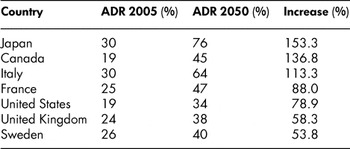
Using data from the United Nations, and on the basis of their projection assumptions, Table 3 indicates the increase in the Aged Dependency Ratio (ADR), which is defined as the number of people aged 65 and over per member of the labour force, as we move from a base year of 2005 to 2050. From these data, we can see that on an international comparative basis, Canada faces a dramatic demographic shift.
Aged Dependency Ratios (ADRs), and growth therein, 2050 versus 2005

Source: United Nations (2008)
Of the countries listed, Canada has the second most dramatic aging increase (after only Japan) with a much more rapid shift than has occurred in the United States, a fact that reflects the more dramatic shift in Canada’s fertility rates. Today, the United States has a fertility rate of 2.1 (which means that their population will replace itself without in-migration) while ours is only 1.6 (well below the replacement rate). Similarly, Canada has experienced a more pronounced age shift than more mature societies in Europe (e.g., Sweden). In fact, it is probably true that if Sweden can afford its support systems today, then it faces a very small increase in financing over the next half century.
Income Patterns of the Elderly
Canada’s retirement income support system can be compared somewhat to a three-legged stool. The first leg, or pillar, of support consists of government-sponsored retirement income security systems that include Old Age Security (OAS), the Guaranteed Income Supplement (GIS), and the Canada/Quebec Pension Plans (C/QPP). OAS and GIS are funded through general tax revenues while the C/QPP are funded by mandatory contributions.
The second support pillar is employer-sponsored pension plans. These plans can be either defined-benefit (DB) or defined-contribution (DC) plans. DB plan coverage has been declining and now includes only 38.5 per cent of the employed labour force (Ontario Expert Commission on Pensions, 2008). Only 25 per cent of workers in the private sector, however, are covered (2008).
Finally, individual savings plans, offering tax incentives, comprise the third pillar of support. These plans include Registered Retirement Savings Plans (RRSPs) and Tax Free Savings Accounts (TFSAs were introduced in 2008). These are very important sources of retirement income especially for those without an employer-sponsored pension plan.
Recent debate on pension reform has generated a number of excellent reports providing information about income and expenditure patterns of the elderly. These include the report of the Ontario Expert Commission on Pensions (OECP, 2008) plus the follow-up supplement by Baldwin (Reference Baldwin2009), the report to the Ministers of Finance (based on six research papers) from Mintz (Reference Mintz2009), and a report comparing Canada’s economic security systems to those of other Organization for Economic Co-operation and Development (OECD) nations by Whitehouse (Reference Whitehouse2009).
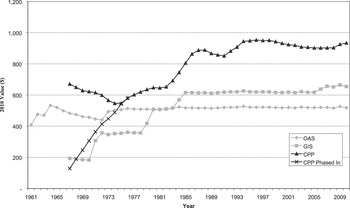
These reports generally indicate that the present Canadian system in its entirety (i.e., government-sponsored systems plus private pension plans plus RRSPs/TFSAs) is, in fact, doing a good job in providing Canadians with retirement income security. Canadians now receive larger benefits from our retirement income security systems than was the case historically. This circumstance has occurred partially because of the maturation of the C/QPPs and also from increases in the GIS (see Figure 2 and Table 4).
Real maximum monthly CPP, OAS, and GlS benefits (1961 to 2010; calculations performed by the Office of the Chief Actuary, Canada Pension Plan, 2010).
Notes: GIS benefits are for single individuals. The CPP phase-in calculation is for December of the indicated year.

Percentage of income from various sources for those 65 and over

Source: Statistics Canada (1988) and Tamagno (Reference Tamagno2006)
* “Other” includes work earnings
From the results presented in the aforementioned reports, we can here review poverty rates, pension coverage rates, replacement ratios, cost of administration, and sources of income. This review will set a starting point for later discussions of the impact of population aging on economic security.
Poverty Rates
Canada has one of the lower poverty rates among those aged 65 and older within the OECD countries (Mintz, Reference Mintz2009). According to Whitehouse (Reference Whitehouse2009), in the mid-2000s, on average, 13.3 per cent of those aged 65 and over in OECD countries were income poor. The old-age poverty rate was just 4.4 per cent in Canada, the fifth lowest among the 30 OECD countries. In Whitehouse’s view, the explanation for this rate is that income-tested schemes, such as the GIS, pay a significant benefit to poorer pensioners and zero benefits to richer retirees. Means-tested benefits (that is, GIS) are received by about one third of older Canadians (Whitehouse).
Whitehouse (Reference Whitehouse2009) also pointed out that Canada has strongly progressive mandatory retirement income systems. For low earners, the replacement ratio exceeds the OECD average, but then the negative gap between Canada and the OECD average replacement ratio grows larger as earnings increase. That growth means that in Canada there exists a significant need for voluntary pension savings to finance a secure retirement. The phrase “replacement ratio” as used here indicates the ratio of income earned immediately post-retirement versus income earned just prior to retirement. There are numerous ways to calculate a replacement ratio including the ratio of gross income before and after retirement, net income (consumable income) before and after retirement, income adjusted for family size, and so on. In the Whitehouse study, the replacement ratios represent gross post-retirement income to gross pre-retirement income. For a more in-depth discussion about replacement ratios, see MacDonald and Moore (Reference MacDonald and Moore2011).
Pension Coverage Rates
As Baldwin (Reference Baldwin2009) observed, although pension coverage rates are trending downward, more Canadian workers than ever (in fact, 5,900,000) have pension coverage. This anomaly is explained by the rapid increase in the size of the Canadian labour force, due largely to the continued rise in female labour force participation rates. (In the period from the mid-1990s to 2007, the percentage of women receiving C/QPP benefits increased from 70 to 84 per cent while the percentage with “third pillar” income – employer-sponsored pensions, or personal Registered Retirement Savings Plans [RRSPs] – increased from 34 to 55 per cent.) However, because the labour force is growing faster than the number of workers with pensions, the pension coverage rate is lower than it was in 1991 (Baldwin). It is also true that private sector DB coverage is down. (These data do not include Group RRSPs, which are a growing vehicle for employers to provide employees with pension benefits.)
Despite the fact that individual coverage rates are down, family coverage rates are up. Two reasons account for this. First, with increased female labour force participation rates, “no coverage” families are decreasing in number (Baldwin, Reference Baldwin2009). Second, pension splitting on divorce and survivor benefits in retirement are both causing an increase in pension coverage rates.
Finally, Baldwin (Reference Baldwin2009) stated that just because a worker does not have third-pillar coverage at a particular time does not mean that he or she will acquire no pension benefits over the working lifetime. Workers move from job to job: some jobs have pensions and some do not. Consequently, it is quite likely that the coverage rate at a given moment provides an imperfect indication of how many Canadians retire with at least some pension benefits. Nevertheless, Whitehouse (Reference Whitehouse2009) noted that in Canada, private pension coverage increases strongly with earnings. In 2007, just 10 per cent of people in the lowest two deciles of the earnings distribution had private pensions, compared with more than 85 per cent of people in the highest two deciles.
Replacement Ratios
A longitudinal study by LaRochelle-Cote, Myles, and Picot (Statistics Canada, 2008) indicated a median replacement ratio equal to about 80 per cent and revealed that this median holds steady by age. This study also reported that within different income quintiles significant differences exist in replacement ratios, however. Data from the Mintz report (2009) suggested that one fifth of Canadians may have insufficient RPP and RRSP assets to replace at least 90 per cent of their pre-retirement consumption.
These data can be placed into an international context. In the mid-2000s, within OECD countries, older people had, on average, 82.4 per cent of the incomes of the actively working population. Canada’s figure of 90.8 per cent is well above this OECD average, with only France and Germany having higher relative incomes (Whitehouse, Reference Whitehouse2009).
The replacement ratio from mandatory schemes in Canada (GIS, OAS, and CPP/QPP, all of which are publicly provided) is 45 per cent, rather less than the OECD average of 59 per cent, but higher than seven of the 12 countries studied (Whitehouse, Reference Whitehouse2009).
Both Mintz (Reference Mintz2009) and Whitehouse (Reference Whitehouse2009) concluded that Canadians are, by and large, doing relatively well in ensuring that they have adequate savings for retirement. The OECD suggests that the Canadian retirement income system performs exceedingly well by international standards, with the three support pillars enabling Canadians to provide enough retirement income to sustain an adequate standard of living in retirement without unduly affecting incentives for people to work and save. Whitehouse noted that Canada is to be congratulated for its mixed system of retirement income provision. Each element of the system has its own strengths and weaknesses and a flexible balance among them not only diversifies risk but also offers a more balanced burden of risk bearing between generations.
Evidence from Mintz (Reference Mintz2009) has shown, perhaps surprisingly, that Canadians with RPPs have somewhat less retirement income than those without RPPs. This situation likely is because those without a RPP tend to have other assets to support their retirement and are more likely to work after age 65.
Cost of Administration
The cost of fund administration is important for Canadians who are saving for retirement on their own. While Canada’s public pension system appears to be administered at low cost – just one quarter of the average among OECD countries (Whitehouse, Reference Whitehouse2009) – a bigger issue in Canada is the scale of administrative charges for personal pensions: that is, for RRSPs. Many RRSPs have charges of two per cent of assets per year, or even more. These higher-cost options tend to be actively managed, individual RRSPs. Nevertheless, lower-cost options are available. For example, investing through indexed rather than actively managed funds typically involves only about one half the costs, and exchange-traded funds are cheaper still. Also, many people have group RRSPs in which, due to economies of scale, costs tend to be lower. A levy of one per cent of assets implies that 21.5 per cent of the total retirement accumulation (or, equivalently, 21.5% of contributions) is paid in fees. With a levy of two per cent of assets, the charge ratio is 37.3 per cent.
Research from Mintz (Reference Mintz2009) has suggested that active management does not provide returns on a consistent basis any better than passive management for both pension plans and mutual funds. Once active management costs are accounted for, passively managed assets provide superior returns. Individual investors do not seem to be advised sufficiently to invest in indexed and exchange-traded funds to improve fund performance.
Sources of Income
Baldwin (Reference Baldwin2009) has demonstrated that the retirement income that Canadians receive today, including OAS and C/QPP, is up significantly from previous years. Table 4 shows that this is partially because of the maturation of the C/QPP and improvement in OAS/GIS benefits, but also the table indicates that RPPs are a part of this improvement. In the period from 1976 to 2007, real incomes for couples increased by 55 per cent. For singles, the real increase was 79 per cent. For couples at the 5th percentile, income was up 99 per cent. For those at the 95th percentile, it was up 28 per cent. For singles, the comparable numbers were 140 per cent and 79 per cent. The sources of income have changed remarkably over the years as Table 4 indicates.
From Table 4, we can see the improved provision of retirement income from RPPs and RRSPs. Horner (Reference Horner2009) stated that, in 2006 among 19.8 million tax filers under age 65, those belonging to an RPP and/or an RRSP totaled 8.7 million individuals, or 43 per cent of all tax filers. However, if we consider only those tax filers who clearly do need private savings to maintain their living standards in retirement – that is, the 8 million C/QPP contributors with incomes over $30,000 – we find that 6.9 million, or 86.6 per cent, were RPP/RRSP savers.
LaRochelle-Cote, Myles, and Picot (Statistics Canada, 2008) reported that among workers with average income, post-retirement income tends to stabilize at approximately 80 per cent of the workers’ income level at age 55. Low-income individuals (those in the bottom income quintile) experience little change in income largely because of the income maintenance effects of the public pension system (OAS/GIS). Individuals in the top quintile experience substantially larger income declines in retirement so that income inequality within a cohort declines with retirement. More-recent groups of retirees are experiencing higher income levels than earlier cohorts, largely because of higher private pension payouts. Replacement rates have changed little among cohorts. Whether this trend will continue is questionable since pension coverage has been falling among younger workers.
Future Funding of Canadian Retirement Income Security Programs
Although we have seen that today’s Canadian retirees have achieved a high level of financial security in retirement, concerns remain about the next generation of workers (Mintz, Reference Mintz2009). Here, I will explore methods that could be adopted to stabilize the future funding costs of Canada’s retirement income security programs.
According to Fellegi (Reference Fellegi1988) and Denton, Feaver, and Spencer (Reference Denton, Feaver and Spencer2005), retirement-income security programs appear to be our primary source of rising expenses as the population ages. Are Canada’s retirement-income security programs sustainable?
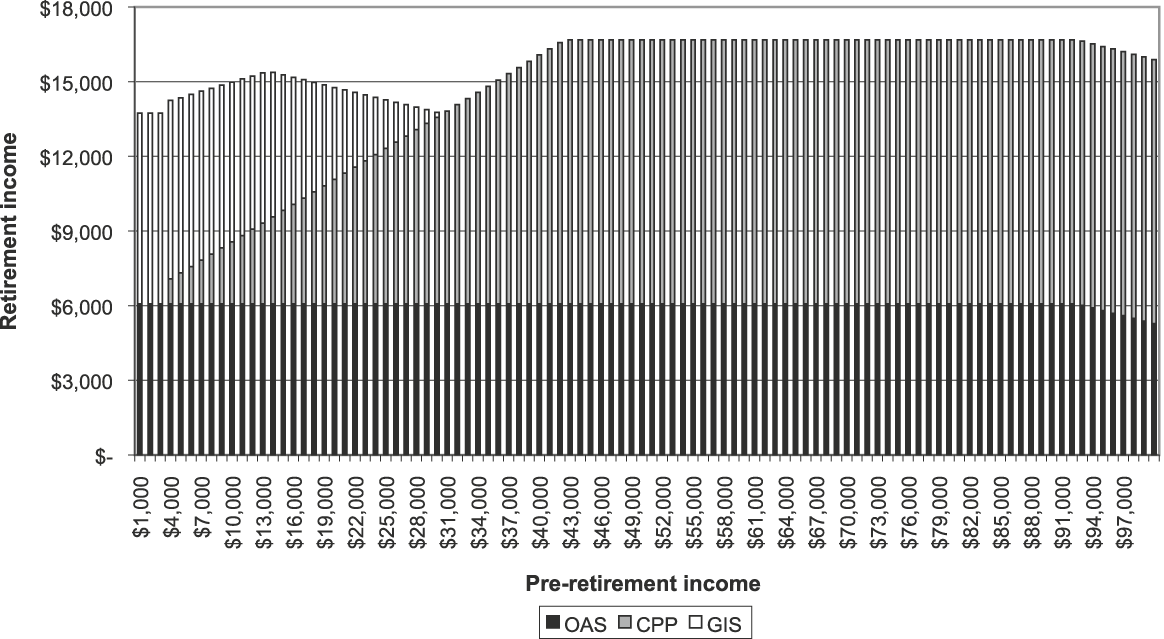
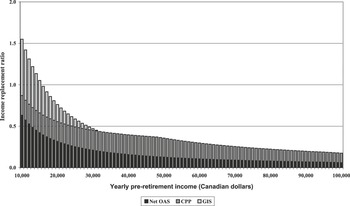
Canada does not have an overly generous social security system relative to most European countries. Instead, our system targets benefits to the poorly paid to alleviate poverty as Figures 3 and 4 show. Figure 3 shows that all Canadians receive very similar total dollar benefits from the government-sponsored system. As a person moves through the wage sectors, we find that new dollars of C/QPP are offset first by the GIS clawback and later by the OAS clawback. Figure 4 shows how much more Canadian retirement income support there is for the poor.
2008 Canadian retirement income (Source: Chisholm and Brown, Reference Chisholm and Brown2008)

Canadian security system in 2011 – $10,000–$100,000 (Author’s calculation.)

It is this focused approach to government-sponsored retirement income security that results in our systems being sustainable. Although social security costs will rise over the next half-century, they seem to be within affordable levels. OAS and GIS are indexed to prices (the Consumer Price Index) while taxes rise with earnings. In a normal economy, wages rise faster than prices so that the tax rate needed to fund OAS/GIS does not rise as quickly as the rate of benefits growth. According to the 8th Actuarial Report of the Old Age Security Program (Office of the Superintendent of Financial Institutions [OSFI], 2008), while OAS (including GIS) expenditures will rise from $33 billion in 2007 to $110 billion in 2030, the ratio of expenditures to the GDP will increase from 2.2 per cent in 2007 to a high of 3.1 per cent in 2030. The ratio then reduces to 2.7 per cent by 2050.
The C/QPP were significantly reformed in 1997. As a result of these amendments, a $109 billion fund now exists within the CPP. The fund has returned 5.1 per cent per annum since its inception in 1999. Further, every CPP actuarial report since its reform has indicated that the 9.9 per cent contribution rate will sustain the projected benefits for at least 75 years (OSFI, 2010).
As the proportion of the population aged 65 and over is now rising, it is also true that the proportion of those aged 20 and under is falling. Thus, it might be argued that no problem exists since the total proportion of the population that is dependent on government funds is stable. Unfortunately, transfers of wealth from government to citizens who qualify (e.g., publicly funded education and health care) to educate and provide health care to the young are not equal to the transfer of wealth required for health care and retirement income security for the elderly. Analysis (e.g., Foot, Reference Foot1982) has shown that government expenditures on the elderly are about 2.5 times those for the young (per capita). Therefore, any model that attempts to stabilize the cost of social wealth transfers must account for the higher demands by the elderly versus youth. Such analysis has been conducted by Brown and Bilodeau (Reference Brown and Bilodeau1999). The authors developed a statistic called the Wealth-Transfer Index (WTI) defined as follows:

Y = Youth, 0-19
U = those Unemployed
A = Aged, 65 and over
LF = the projected employed Labour Force
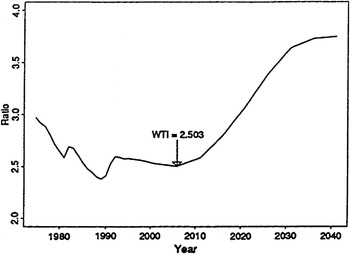
The weights of 1.866, 1, and 4.636 were derived by McDonald and Carty (Reference McDonald and Carty1980, pp. 16–17), whose research is the most recent available. Note that 4.636/1.866 = 2.48 (about 2.50) which matches the statistic used by Foot (Reference Foot1982). These weights are based on payments for health care, education, unemployment transfers, and retirement income security made by any level of government. Although this does not represent the totality of dependencies, it does capture the key macro indicators. The WTI statistic is a single indicator of the supply of (denominator) and demand for (numerator) wealth. As Figure 5 shows, the WTI actually trended downward from 1991 to 2006. After 2006, it has increased rapidly as the population ages and, in particular, as the baby boomers retire and the labour force turns to the baby bust generation for wealth creation (mostly after 2011).
Wealth Transfer Index, 1975 to 2041 (Source: Brown and Bilodeau Reference Brown and Bilodeau1999)

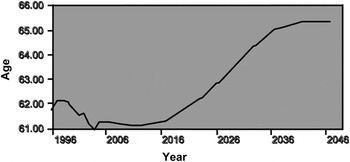
Brown, Damm, and Sharara (Reference Brown, Damm and Sharara2000) showed that the WTI can be held constant at its 2006 level by raising the age at which people retire. This would move Canadians out of the “dependent” numerator and into the “productive” denominator. Even with no productivity improvements, the needed shift to attain full stability is small (as can be seen in Figure 6). With productivity improvement, the shift is smaller still (2000). In fact, the authors showed that if Canada could achieve a productivity growth rate of 1.29 percent per annum, the normal retirement age would never have to rise. Unfortunately, recent productivity improvement rates in Canada have been closer to 0.9 per cent.
Median retirement age required to maintain a constant Wealth Transfer Index with no productivity improvements, 1996 to 2047 (Source: Brown, Damm, and Sharara, 2000)

Conclusion
Many things have changed since the 1999 publication of the monograph Economic Security in an Aging Population (Brown, Reference Brown1991). Some events have been distinct and abrupt such as the major amendments made to the C/QPP in 1997; others have been more gradual and not as distinctive. These include the general aging of the population and continuing increases in health care costs. Finally, the literature on the impacts of population aging has grown exponentially.
Despite the fact that the cost of retirement income security will rise as the population ages, because the Canadian financial security safety net is relatively meager its costs will remain sustainable. This is also true because OAS (including GIS) is indexed to the CPI rather than wages, so it should decline in importance over time as a percentage of GDP. Further, the 1997 amendments to the C/QPP have placed them on a much firmer foundation, and public faith in these two plans has broadened significantly as result.
Finally, it has also been shown that a very modest increase in the normal retirement age along with modest increases in workplace productivity could result in totally stable support systems affordability. Raising the normal retirement age needs to be a focus within the discussion of potential reforms in the effort to provide economic security to an aging Canadian population.