Introduction
The present study focuses on older people's experiences of loneliness in assisted living facilities. Research is paying increasing attention to loneliness among older people (e.g. Theurer et al., Reference Theurer, Mortenson, Stone, Suto, Timonen and Rozanova2015; Andrew and Meeks, Reference Andrew and Meeks2016) because the feeling has been associated with negative health outcomes such as poor self-rated health and cognitive decline (Cacioppo and Hawkley, Reference Cacioppo and Hawkley2009), depression (Luanaigh and Lawlor, Reference Luanaigh and Lawlor2008; Smith and Victor, Reference Smith and Victor2019), disability and increased mortality (Tilvis et al., Reference Tilvis, Routasalo, Karppinen, Strandberg and Pitkälä2011; Drageset et al., Reference Drageset, Eide, Kirkevold and Ranhoff2012a) and increased use of health services (Gerst-Emerson and Jayawardhana, Reference Gerst-Emerson and Jayawardhana2015). Loneliness, however, is a multifaceted problem, causing suffering and reducing the quality of life.
In Finland about 20–40 per cent of home-dwelling older people report experiences of loneliness at least sometimes, and 5–10 per cent frequently suffer from loneliness (Savikko et al., Reference Savikko, Routasalo, Tilvis, Strandberg and Pitkälä2005; Yang and Victor, Reference Yang and Victor2011; Vaarama et al., Reference Vaarama, Mukkila, Hannikainen-Ingman, Vaarama, Karvonen, Kestilä, Moisio and Muuri2014; Saari, Reference Saari and Saari2016). Living alone is a predictor of loneliness (Routasalo et al., Reference Routasalo, Savikko, Tilvis, Strandberg and Pitkälä2006), but the experience of loneliness may also emerge even when people live surrounded by others. Moving into a nursing home or assisted living facility is a life event that may even increase loneliness if adjusting to the new life situation is difficult (Savikko et al., Reference Savikko, Routasalo, Tilvis, Strandberg and Pitkälä2005).
However, relatively few studies have explored loneliness in nursing homes and assisted living facilities. A Norwegian study found that more than half (56%) of nursing home residents (aged 75+) without cognitive impairment reported feeling lonely sometimes or often (Drageset et al., Reference Drageset, Kirkevold and Espehaug2011). In Helsinki, Finland, 9 per cent of residents in nursing homes and assisted living facilities (mean age 84) felt lonely often or always, and 26 per cent sometimes (Jansson et al., Reference Jansson, Muurinen, Savikko, Soini, Suominen, Kautiainen and Pitkälä2017). More than half (55%) of 85+ year-olds living in institutional settings in northern Sweden and western Finland were often or always lonely (Nyqvist et al., Reference Nyqvist, Cattan, Andersson, Forsman and Gustafson2013). In Ohio, in the United States of America, the respective figure was 29 per cent among 65+ year-olds living in assisted living facilities (Bekhet and Zauszniewski, Reference Bekhet and Zauszniewski2012).
The prevalence of loneliness varies greatly in different societies, but obviously also according to research design and the way in which loneliness is conceptualised and measured. Furthermore, it may be difficult for survey data, on which studies are for the most part based, to provide a sufficiently rich and diverse picture of loneliness (Smith and Victor, Reference Smith and Victor2019). The complexity of loneliness is not adequately reflected in binary definitions of loneliness and social isolation (Smith and Victor, Reference Smith and Victor2019). In assisted living facilities, the frequency of social contacts, or their absence, is not necessarily associated with the residents’ experiences of loneliness (Drageset et al., Reference Drageset, Kirkevold and Espehaug2011; Prieto-Flores et al., Reference Prieto-Flores, Fernandez-Mayoralas, Forjaz, Rojo-Perez and Martinez-Martin2011). It is important that we deepen our understanding of this (Brownie and Horstmanshof, Reference Brownie and Horstmanshof2011; Tiilikainen and Seppänen, Reference Tiilikainen and Seppänen2017).
Assisted living facilities aim to create a home-like environment for older people, to promote a good quality of life among their residents, and to recognise and respect individuality and autonomy (Roth and Eckert, Reference Roth and Eckert2011). The staff's priority should be a person-centred, community-oriented and rehabilitative working approach. The aim is that in the facility, residents consider their lives safe, meaningful and valuable (Finlex, 2012). Fulfilment of these goals is supposed to increase residential satisfaction, which has a protective effect against loneliness (Prieto-Flores et al., Reference Prieto-Flores, Fernandez-Mayoralas, Forjaz, Rojo-Perez and Martinez-Martin2011). However, there may be a gap between these goals and reality in care practices (Pirhonen, Reference Pirhonen2017). Residents do not easily adjust and integrate into their new institutional settings, and do not necessarily consider them their home (Cooney, Reference Cooney2012).
Loneliness may arise when residents do not feel that their surroundings and settings are familiar or home-like. Although other people may live close physically, they may feel far away mentally, and companionship between residents and staff may be lacking (Cooney, Reference Cooney2012). According to Pirhonen et al. (Reference Pirhonen, Tiilikainen and Pietilä2017), residents perceive ruptures of affiliation both inside and outside assisted living facilities. These experiences are associated with distance from co-residents and staff, as significant others often live outside the facility, where the residents’ biographies are also located (Pirhonen et al., Reference Pirhonen, Tiilikainen and Pietilä2017). Living in nursing homes or assisted living facilities may feel safe, but at the same time, less autonomous and more lonely (Slettebø, Reference Slettebø2008). Therefore, addressing and recognising residents’ experiences of loneliness is a key issue when designing good care and care practices and when promoting good quality of life in assisted living (Routasalo and Pitkälä, Reference Routasalo and Pitkälä2003; Savikko, Reference Savikko2008; Drageset et al., Reference Drageset, Kirkevold and Espehaug2011, Reference Drageset, Espehaug and Kirkevold2012b).
Assisted living facilities represent a specific environment in which to study loneliness because they are somewhere between a home and an institution, while at the same time being workplaces and enterprises (Roth and Eckert, Reference Roth and Eckert2011). They are challenging to research. One has to look more closely at not only experiences of loneliness but also its contexts and surroundings, the everyday environment in which the suffering and emotions take place. In this article we therefore scrutinise older people's experiences of loneliness and focus particularly on how they contextualise their feelings in terms of both physical environments and the course of their everyday lives. We focus on the residents’ distressing feelings of loneliness and their expectations of social relationships, with a particular interest in how these are shaped by their living environment (Perlman and Peplau, Reference Perlman, Peplau, Peplau and Perlman1982; Smith and Victor, Reference Smith and Victor2019).
Aim and methods
The aim of the article is to give older people a voice and to listen to them carefully. We ask how loneliness is experienced and articulated, and what specific factors are related to these experiences in assisted living facilities.
Bright House and Long House
The present study is part of a larger project which examines loneliness, its prevalence, associated factors, prognosis and alleviation (Jansson et al., Reference Jansson, Muurinen, Savikko, Soini, Suominen, Kautiainen and Pitkälä2017, Reference Jansson, Savikko and Pitkälä2018). The study was implemented in two assisted living facilities operated by the City of Helsinki, Finland. In order to obtain an apartment in this kind of facility, older people have to apply to the local social services department. Social workers make their decision on the basis of specific criteria, which mainly relate to the need for care and inability to live in a private home even if assisted.
Both houses aim to provide a safe, active life for their residents. According to the written goals of the facilities, the work is client centred and rehabilitative, and respects each resident's individuality and uniqueness. However, when the first author of the article (AHJ) observed the settings and collected the research data, the physical characteristics of the houses, as well as their actual care practices, proved to be different. ‘Bright House’ was built in the 1980s. It is a bright, light and fresh building consisting of four floors in two different wings. During almost every observation period, nurses, relatives and volunteers chatted with the older people in the corridors, but interaction between the residents themselves was less frequent. The other six-floor house was built in the 1970s and had later been modified into an assisted living facility. One resident characterised its long corridors leading to the apartments as follows: ‘This house is as long as your arm – it's hard to say where it begins or ends’. When AHJ walked along the corridors of ‘Long House’ during the six-month period of data collection, she saw or met hardly anyone. The corridors were gloomy and slightly musty; the atmosphere was almost secretive. In Bright House, she saw the manager chatting with older residents on three different occasions; in Long House the manager never appeared in the corridors.
Both houses have quite similar facilities and common spaces: clubrooms, a sauna, a gym, a dining room and a hobby room. Along the corridors are sofas, where residents watch television. Housekeeping and care, meals-on-wheels, and 24-hour personal support and nursing are available for those who need it. The staff includes a manager, nurses, physiotherapists, occupational therapist and social instructors. Both houses have apartments for single residents and couples, as well as special group homes for cognitively impaired older people. The size of a single person's apartment is approximately 30 square metres, consisting of a combined living room/bedroom, a kitchenette and a bathroom. Two of the study participants had two-room apartments because their late spouses had also lived there. Some of the rooms also have a balcony. Basically, the residents are free to furnish and decorate their homes as they please.
Participants
The study involved 13 older people with a variety of medical conditions and capabilities. Six lived in Bright House and seven in Long House.
The study was conducted carefully, in accordance with ethical guidelines. After the Helsinki University Hospital ethics committee and respective committee of Helsinki City approved the study protocol, we contacted the management of Bright House and Long House and received permission to conduct the study in their premises. The staff and residents were informed of the research through face-to-face group conversations and information sheets. After the initial information, we approached the residents of both houses through the staff to recruit them for the study. The potential respondents and their relatives received a letter and information about the data collection procedure. We emphasised that participation in the research was fully voluntary and could be cancelled at any time.
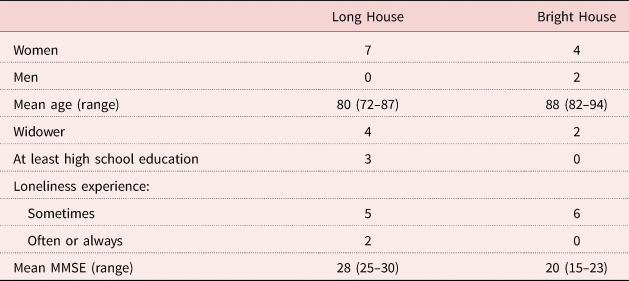
We recruited cognitively healthy people (Mini-Mental State Examination, MMSE > 24–30p) for the study from Long House and mild or moderate cognitively impaired people (MMSE 15–24p) from Bright House. However, advance information regarding their loneliness was the main inclusion criterion. This was elicited by a written questionnaire, asking ‘Do you suffer from loneliness?’ (seldom or never/sometimes/often or always), and we recruited only respondents who suffered loneliness at least sometimes. This question has been used for decades and has proven to be easy for older people to understand and answer (Savikko, Reference Savikko2008; Tilvis et al., Reference Tilvis, Routasalo, Karppinen, Strandberg and Pitkälä2011). In the questionnaire we also asked for the participants’ age, marital status and education. Two of the informants filled in the questionnaire with the help of a nurse, others did it independently. The participants were 72–94 years old, and their other main characteristics, elicited by the questionnaire, are shown in Table 1.
Main characteristics of participants

Note: MMSE: Mini-Mental State Examination.
Data collection
The data were collected through a mixed-method approach, which is typical in ethnographic research. The first author of the article (AHJ) entered the everyday lives of the older people and collected data through individual interviews, group meetings, informal chats and observations over a six-month period. At first, the participants were interviewed individually, flexibly using a semi-structured thematic guide. The interviews, the duration of which varied from half an hour to one and a half hours, were informal discussions, in which participants openly shared their feelings and experiences. Approximately three to four weeks later, all of them participated in group meetings organised for older people suffering from loneliness (Jansson et al., Reference Jansson, Savikko and Pitkälä2018). The groups in both houses gathered once a week for three months and each meeting was facilitated by two trained group facilitators. AHJ observed the participants’ experiences and articulations of loneliness, as well as their personal ways of coping with it, at the beginning, middle and end of the group process. Free discussions, recorded during these meetings, were also utilised in analysis.
Approximately two to four weeks after the group process had ended, the participants were individually interviewed once again. These interviews were inspired by the qualitative longitudinal research approach (Nikander, Reference Nikander2014; Tiilikainen, Reference Tiilikainen2016), and elaborated on the topics of the first interviews. The respondents received complete attention in the interviews (Heyl, Reference Heyl, Atkinson, Coffey, Delamont, Lofland and Lofland2001), and the interviewer (AHJ) listened carefully and respectfully to their stories. The respondents’ right to remain silent was respected, and particular attention was paid to situations in which they did not speak. Usually, however, vivid discussions started immediately and continued in the second round of interviews, the duration of which varied again from half an hour to one and a half hours.
The final stage was the focus group interviews of five participants in Bright House and three participants in Long House: in Bright House three weeks, and in Long House six weeks after the second individual interviews. The focus group interview lasted one hour and 40 minutes in both houses.
The data were collected over six months, and consisted of 26 individual interviews, individual observations made during 27 visits to the houses, six group observations and two focus group interviews. The data comprised 810 transcribed interview pages (Times New Roman 12, single spacing) as well as observation field notes of around 50 hand-written pages.
Data analysis
Data analysis began with the reading and re-reading of the transcribed interviews to reach a comprehensive understanding of the rich data. When reading the material, the researchers also took advantage of the observational field notes. Emotional responses often arose during the interviews, and these were reproduced in the field notes, as in the following example:
When asked about loneliness the interviewee became tearful, whereupon the interviewer was also sensitised. After a silent moment, the interviewee started talking about her loneliness with few, but strong, emotional words.
In order to answer the research questions, the data were first analysed with the help of computer software Atlas.ti (Hwang, Reference Hwang2008). By identifying all the data blocks in which loneliness was mentioned, our goal was to map the different experiences. We found altogether 106 data blocks consisting of the Finnish word loneliness (yksinäisyys), lonely (yksinäinen) and their derivatives. However, very soon this proved to be too mechanical an approach because there were also relevant data blocks in which loneliness was not explicitly mentioned but was obviously the issue. The participants described their experiences of loneliness in an idiosyncratic way, using many other words and phrases derived from their dialect or personal style of speaking. We also found expressions of positive loneliness or solitude, but excluded these from the analysis because they did not serve the purpose of our study. Moreover, expressions of solitude would have been hard to discover, because there is no proper word for solitude in the Finnish language.
Reading the data line by line, in order to distinguish data blocks describing explicit expression of loneliness as well as personal and unique experiences of loneliness, associated meanings and relevant situations of everyday life, resulted in a total of 546 segments. By manually grouping and finding clues and paths between these segments, we learned much more about the 13 lonely residents and their everyday lives. Respondents described their loneliness very similarly at different time-points in the data collection, which confirmed the reliability of the data. However, there were many repeated expressions and duplicates in the statements that affected the amount of data. We therefore ignored these duplicates. We also left out from the analysis the theme of loneliness alleviation, which we will deal with in another article. When reading the data we leant on abductive reasoning (Ojala, Reference Ojala2010), finding clues from the data as well as from literature on loneliness. We tried to be as sensitive as possible, because we found that also incidents, emotions, significant fluctuations in tempo and silent moments in speech provided clues as to what the speakers considered especially meaningful.
We chose 90 segments for closer analysis because they provided relevant information from the viewpoint of the research questions. These segments contained single phrases and larger textual blocks. They were coded, and the codes were grouped into categories, inspired by the coding practices typical of the Grounded Theory (Charmaz and Mitchell, Reference Charmaz, Mitchell, Atkinson, Coffey, Delamont, Lofland and Lofland2002; Foley and Timonen, Reference Foley and Timonen2015). The categories were thus constructed from numerous separate and more or less crystallised experiences of loneliness. For example, ‘lack of autonomy’ and ‘superficial interaction with changing staff’ further produced a ‘living in a lonely place’ category, which was refined to the core category ‘place-dependent loneliness’. The two other core categories were ‘time-dependent loneliness’ and ‘loneliness is uniquely perceived and expressed’.
Results
Loneliness is uniquely perceived and expressed
Respondents described their experience of loneliness in a rich way. Of course, they often used the Finnish words of lonely and loneliness when recounting their experiences: ‘I am lonely’, ‘everyday life is so lonely’. But they also used metaphorical language, when, for example, characterising their life as nothing but ‘wading through loneliness’, John who lived in Bright House thus articulated his emotions. Teresa talked about a ‘fence’ between herself and the other Bright House residents: ‘I have enough life experiences to talk about, but I can never get started. I never get over the fence that prevents me from being in contact with others’.
Half of the respondents in both houses described loneliness in the first round of interviews in notably general terms, not explicitly – even trying to avoid the painful topic while speaking of it for the first time. These scarce descriptions seemed to indicate that the respondents did not initially want to express feelings of loneliness in full depth or talk about their negative feelings. They preferred to speak about the hypothetical loneliness of other residents: ‘Everyone feels it and it's always there. And, of course, those in a wheelchair or tied to a bed. They may suffer more from loneliness’. After such an opening, however, the respondents more easily accessed their own experiences of loneliness. The method of data collection may also have made it easier: the interviewer may have become familiar to the respondents after the first interview, which resulted in more open, sensitive descriptions later. People tend to whitewash things with strangers, saying they are fine even if this is not the case. Overcoming such a ‘happiness barrier’ in the data collection requires time and perseverance (Roos, Reference Roos1998).
Other respondents reported their loneliness surprisingly directly already at the beginning of the first interview. For example, Lars from Bright House said that loneliness is present every day, although in the written questionnaire he had responded to suffering from it only sometimes. His loneliness even seemed to be a part of his inner self: ‘Well, I'm just a man of loneliness.’ For some respondents, it appeared to be the utmost sensitive subject. Alea from Bright House, for example, sat on the edge of her bed at the beginning of the first interview, and did not quite look the interviewer in the eye. When describing her loneliness, she crouched down, as if she wanted to be protected. Her expression became tighter, there was a long pause, and then she breathed: ‘Well, everyday life is a bit … lonely.’ As the interview went on, her loneliness began to unfold, as if that breath had opened a lid under which her experiences and feelings had been waiting to erupt. Just as Kirkevold et al. (Reference Kirkevold, Moyle, Wilkinson, Meyer and Hauge2013) suggest, people will often ‘reveal’ their loneliness when they have the opportunity to talk about it in a safe atmosphere.
Some of the respondents expressed a need to define their own understanding of loneliness, but this happened mainly in Long House. This may be due to better cognition than that of the Bright House respondents. Sophie criticised people older than her for understanding loneliness too simplistically and felt that she was above this: ‘Oldies are used to thinking that loneliness is only bad and friendship is good. That's a bit cliché.’ For Emma, a familiar manifestation of loneliness was ‘irritable loneliness’, although she doubted whether this definition was generally accepted as loneliness at all. Her loneliness arose with changes in functional capacity and poor mastery of life:
I experience irritable loneliness. Life increasingly revolves around me myself, the world's circle is narrowing and shrinking so terribly, and I won't accept it – there's a rebel inside me.
In these definitions, cultural constructions of loneliness may have coloured the respondents’ experiences, thoughts and doubts (Peplau et al., Reference Peplau, Miceli, Morasch, Peplau and Perlman1982).
Time-dependent loneliness
Loneliness proved to be a constant, repetitive and deeply rooted feeling or experience, but it was also experienced weakly and less frequently: ‘I always feel it’, ‘I feel it often’, ‘I sometimes feel it’, ‘I don't feel it now’. The depth of experience varied not only inter-individually but intra-individually. In the first interview, Marian from Bright House talked about loneliness as if she only faced the edge of the experience: ‘I don't suffer, sometimes I feel it, but when I do, I don't care.’ However, the second interview showed that loneliness often shadowed her everyday life: ‘This life has become just lonely waiting, I'm just constantly waiting for something.’
Experiences of loneliness were time dependent in many ways. They varied according to seasons, days of the week and daily hours. In Finland, seasons are clearly distinct from each other. Wintertime, when the sun hardly rises, is difficult for many people. Holidays, weekends, evenings and nights were also challenging for the residents: as the pace is slower then, with less staff and activities.
Well my loneliness is transient, I'm always waiting for spring and summer, and winter is terrible.
Saturday and Sunday are the lonely days, other people get visitors, and I don't.
I sometimes experience loneliness, especially in the evenings.
Experiences of loneliness were also attached to the three time horizons of life: the past, the present and the future. Loneliness began to bother a respondent when they found out that things were no longer as they used to be or how they remembered them as being in the past: they searched for lost time but could not recapture it, the present did not offer enough and they felt that the future was shrinking. The respondents’ acknowledgement of their limited lifespan and one's own finite human nature is reflected as fundamental aloneness and existential suffering (Kissane, Reference Kissane2012). Sophie asked:
I wonder about loneliness … We're all near death and we don't need to be here very long, so why should we invest in life anymore?
Jenny was explicitly waiting for the end of her lonely life: ‘I'd like to get away from here, from the world.’ Lonely respondents’ talk of dying may be related to existential loneliness (Bolmsjö et al., Reference Bolmsjö, Tengland and Rämgård2018).
The concept of ‘timescape’ (Adam, Reference Adam2004: 17) has been constructed to remind us that time and place are not distinct, but interconnected frames of life. The timescape of a lonely person may appear as a deserted plain, with hardly any landmarks to locate oneself. Mikkola (Reference Mikkola and Jokinen2005) concludes that autobiographical reports of loneliness are primarily stories of emptiness in these kinds of silent surroundings in which time becomes devastating, ‘the hours become shapeless and stretched like watches in Salvador Dali's paintings’ (Kapuscinski, Reference Kapuscinski1994: 36; Karisto and Tiilikainen, Reference Karisto and Tiilikainen2017). de Lange (Reference de Lange2014) uses a labyrinth metaphor when describing the timescape of an old person who has had to give up their active agency. They still move in the labyrinth, not rapidly and linearly, but slowly and blunderingly, sometimes getting stuck.
For many respondents, life was merely nebulous waiting for something meaningful to happen. Sometimes this waiting had a destination: ‘This foot has been a bit sore, I can't walk long distances. I'm waiting for it to get better.’ Often waiting was compulsive and aimless. The respondents did not really know what to expect or were already convinced that their expectations would not be met. They suffered from a ‘lack of things to do’ and tried to fill their idle time and cope with it in surrogate ways (Peplau and Perlman, Reference Peplau, Perlman, Peplau and Perlman1982), such as by watching television in abundance. John from Bright House said: ‘But television is okay. Without television, I'd have a hard time.’
AHJ: You said that you are stuck in difficult positions for a long time.
Jenny: Yes, I've been like this for half an hour [standing still in the middle of the room].
AHJ: How does it feel when you're in that position for half an hour?
Jenny: I don't know. I don't think much at the time. I don't know beforehand how long the waiting is going to last. I imagine I can get away soon, but I never know. Half an hour goes by. And I hear the bell ringing every time. It rings every half an hour.
Living in this kind of passive mode, waiting and doing nothing, may intensify feelings of loneliness (Harper, Reference Harper2002). It also may give rise to existential loneliness (Larsson et al., Reference Larsson, Edberg, Bolmsjö and Rämgård2018). Eleonora from Long House spent a large part of her daily time sitting by her telephone table. She solved sudokus, ate and had coffee in her room, or just sat and looked out of the window. ‘I don't eat where I could eat, with the others, because I can sit by this table, and if someone calls … And I can call if I want to.’ In fact, she very seldom received phone calls, although she was constantly waiting for calls from her children. For her, the phone was a ‘lifeline’. It had helped her adapt to living alone; it was an important tool to help her stay connected (Kirkevold et al., Reference Kirkevold, Moyle, Wilkinson, Meyer and Hauge2013), although it actually represented only potentiality for action (Pirhonen and Pietilä, Reference Pirhonen and Pietilä2016).
Jenny was waiting for the priest to visit, even though she knew that she was on vacation:
I'm waiting for the priest. The priest visits me once a week. She won't be here tonight, but I still set the table and got the coffee cups ready.
Karisto and Tiilikainen (Reference Karisto and Tiilikainen2017, 530) made a respective observation of lonely waiting, when one of their respondents was waiting for the doorbell to ring: ‘Again, today I thought, when the doorbell hadn't rung, that the batteries were dead. I changed them, but it still didn't ring.’ The doorbell, phone and coffee cups are artefacts that represent tools for potential social interaction; according to Latour (Reference Latour2005) they are not so dissimilar actors as human beings.
The experience of an empty, lonely life was not necessarily related to whether or not a person had activities during the day. For example, Marian from Bright House had a variety of different activities such as groups and the gym every week, but lonely waiting was still very much present in her daily life. Having a variety of activities and being busy may disguise the experience of an empty life and meaninglessness (Katz, Reference Katz2000). Previously, old age was thought to be a time of disengagement, but now active ageing is a model (Timonen, Reference Timonen2016). The ‘old body’ should be a ‘busy body’ (Katz, Reference Katz2000). When an older person deviates from these expectations, it is noticed; and when the tempo around other people accelerates, the rhythm of their own time slows down:
My everyday life is just sitting around and waiting for (laughs), the skiing to begin on the TV, it's just waiting, I tell you. Sometimes you wait for your meds and things like that. Waiting from morning to night. Waiting for this, waiting for that. (Marian)
Time may alleviate or help a person cope with loneliness, as in Sophie's case: ‘I was told that time heals, but I wasn't sure it would happen. But it seems to have worked!’ Lars, from Bright House, described how: ‘I've been so engaged with loneliness that I'm used to it’. For Emma, the roots of her loneliness arose from youth and young adulthood, her expectations of partnership and children were left unfilled. Gradually, however, she grew accustomed to loneliness and sometimes overcame it:
When I was young, I felt lonely. They were bad times. So, when I got past that, it was no longer a bad thing.
Time can heal, but it also can reignite former loneliness. It was a surprise for Emma when she began to suffer from loneliness in recent years, along with difficulties in her functional capacity and life control. Tiilikainen and Seppänen (Reference Tiilikainen and Seppänen2017) also illustrate how previous life events may reflect one's personal experience of loneliness and also extend to future expectations.
Place-dependent loneliness
Experiences of loneliness were place dependent. None of the respondents considered their apartment home. If the word home was mentioned, it represented a longing for one's earlier, ‘real’ home, the cosiness and domesticity that they missed in the facility. ‘Sometimes I miss my home … all the old memories are still alive there’, Alea from Bright House said. Cooney (Reference Cooney2012) describes how people in long-term care settings feel homesick and often talk about ‘going home’ in relation to loneliness. Our respondents’ current residence was not their real home; actually it had entirely opposite characteristics, as Hanna crystallised: ‘In a place like this you sometimes feel truly lonely.’
Particularly in Long House, residents were in danger of losing their identity. They felt invisible. ‘When no one pays attention to me, I disappear’, Hanna said. These feelings of invisibility or being ignored were related to poor communication between the residents and staff. For example, a staff member could use their own keys to enter the residents’ apartments to perform their duties, and often did not tell the resident why they had come or what they were doing. Other experiences of not being recognised as persons (Pirhonen, Reference Pirhonen2017) were also quite common in Long House: ‘We are put into boxes. And fed through a hatch.’
Fortunately, these assisted living facilities were not entirely experienced as void of cosiness and domesticity. Residents’ positive feelings arose from human contact and from artefacts such photographs, pieces of art and furniture. This was especially true among the women. Jenny (Long House) recounted how she likes clocks: ‘Ticking makes the room cosy and alive. I have six clocks ticking here.’ Artefacts activate residents’ memories and may act as links to significant others. These cherished objects may also arouse feelings of positive solitude (Nord, Reference Nord2013).
However, the respondents almost always used harsh, coarse expressions when describing their current house and apartment: ‘hospital’, ‘prison’, ‘market place’ and ‘warehouse’; or, more neutrally, ‘cabin’, ‘cottage’ or just ‘apartment’ and ‘room’, but never even accidentally ‘home’. Drageset et al. (Reference Drageset, Espehaug and Kirkevold2012b) suggest that an inadequate sense of coherence in institutional living may be associated with loneliness. In this study, these harsh expressions also revealed how loneliness was shaped by the living environment, in which a lack of privacy and poor life control prevailed. Respondents felt they were bystanders in their own lives. They had to spend long periods in their rooms without being able to get out. They made ironic comments about even real prisoners being in better positions: ‘They get to the shower twice a week and are outdoors every day.’ The lack of privacy gave rise to ‘hospital’ and ‘market place’ experiences: nurses randomly came and went. Eleonora thought that
when talking about loneliness, people talk about being pretty alone in a room that someone just visits, does something and rushes away. In that situation, there is loneliness.
Earlier research findings (Drageset et al., Reference Drageset, Kirkevold and Espehaug2011; Prieto-Flores et al., Reference Prieto-Flores, Fernandez-Mayoralas, Forjaz, Rojo-Perez and Martinez-Martin2011) have also demonstrated that frequency of social contacts does not necessarily alleviate loneliness; passing contacts may even cause or intensify it.
Particularly in Long House, the facilities were strictly divided into public and private areas. There was no sufficiently semi-public space; ‘third places’ or ‘great good places’ (Oldenburg, Reference Oldenburg1989) that facilitated socialising and social contacts (Cooney, Reference Cooney2012) and thus prevented loneliness (Prieto-Flores et al., Reference Prieto-Flores, Fernandez-Mayoralas, Forjaz, Rojo-Perez and Martinez-Martin2011). Respondents described how bad they felt when they had insufficient opportunities to talk with other residents in the house. Previous research findings (Fessman and Lester, Reference Fessman and Lester2000; Slettebø, Reference Slettebø2008; Prieto-Flores et al., Reference Prieto-Flores, Fernandez-Mayoralas, Forjaz, Rojo-Perez and Martinez-Martin2011; Cooney, Reference Cooney2012) also suggest that other residents may be the key means of protection against loneliness and increasing the sense of belonging.
Emma (Long House) described difficulties in creating social networks or joining them:
When I went to a new group which already existed, it wasn't easy to get in. This is why people don't want to move to assisted living facilities and want to stay at home until the very end.
Sophie was openly disappointed with the other residents in Long House:
When I moved to this house, it was so shocking how demented the people here were. I started to argue about having no one to talk to. Because you just can't talk with the oldies.
Pirhonen and Pietilä (Reference Pirhonen and Pietilä2018) also found that perceived limitations to one's social surroundings may lead to isolating oneself from others and thus to loneliness.
Facilities outside the private apartment were considered unfamiliar and difficult to approach. Especially in Long House, the long lifeless corridors did not encourage people to leave their apartments, nor did the opposite, when someone made a noise in the corridor. Eleonora (Long House) wondered:
When loneliness strikes, where I can go? Nowhere. There should be some kind of space where you can sit with others at a certain agreed time.
The respondents pointed out that the couches in the corridors were empty, people rarely sat in them. In Bright House, the nurses gathered residents at the couch or television groups from time to time, but even there the longed-for social interaction with other residents was not easy to create:
When some interesting programme is on the TV, we are collected in the chairs around it. But it doesn't take long until some people are snoring. It bothers me.
The residents did not get out often enough, which they felt unhappy about. To them, getting out represented hope of escaping their loneliness. ‘Well, of course loneliness overcomes you occasionally, when there's no chance to leave the apartment’, Hanna (Long House) said. She continued:
If I get out I'm not lonely anymore. I take a taxi and go to the mall to do some window shopping and drink tea. I spend a few hours there and take a taxi back. The day is saved again.
Even the shopping mall seemed to create a sense of belonging for Hanna that Long House did not.
Physical barriers functioned as obstacles to getting out: ‘I can't go out alone, I feel dizzy. It restricts me so much that I can't leave alone. I just have to be in my cottage’, Fiona (Long House) regretted. The respondents lacked courage because they feared, for example, slipping during wintertime. Mental barriers also made it difficult to get out from their apartments. Hanna (Long House) used the metaphor of a ‘threshold’: ‘Many people have too high a threshold, they spend too much time in their apartment. That's the biggest thing’. In both houses, residents often lamented that they did not get satisfactory help or support from the staff, even though they often expressed their wishes and needs to get out. Many often did not know whether they were allowed to leave the house at all: ‘There was a new resident and she had seen me going out. She asked me whether she is also allowed to leave the house’.
Of course, in principle, residents with sufficient cognitive capacity are allowed to go out, but in practice this is not so easy. Taube et al. (Reference Taube, Jakobsson, Midlöv and Kristensson2016) suggest that older people, due to their social losses and impaired functional capacity, are excluded from the social world and stacked in a bubble, which is full of experiences of loneliness. The bubble in this case was constructed from the physical walls of the assisted living facilities, the poor health and functional capacity of the residents, and the mental barriers caused by routines and care practices.
Although it was not so common to ignore residents’ needs in Bright House, even elementary interaction was sometimes lacking. The staff members came into the club room during the group sessions, regardless of the ‘Group meeting, please do not disturb’ sign attached to the door. None of them knocked on the door when entering, asked for permission to interrupt or apologised for the interruption. However, these interruptions did not seem to disturb the respondents, as they were so used to them.
Conclusion
The study raises the voice of older people who suffer from loneliness. Using our rich data, we examined how loneliness was experienced and articulated, and what specific factors were related to these experiences in assisted living facilities.
The respondents expressed loneliness in a varied, copious manner, often using figurative metaphors. Loneliness proved to be time and place dependent. It often struck in the evenings, at weekends and in the winter. The experiences of loneliness seemed to be related to the passing of time, or rather, the feeling of time stagnating. Never-ending, indefinite waiting was common and residents had no meaningful content in their daily lives. Time-dependent loneliness was also experienced, because the residents were aware of the end of their lives approaching, for which some even desperately wished.
Place-dependent loneliness was evident in both houses, but more so in gloomy Long House, which was not very home-like. When describing their apartments, neither houses’ respondents used the word home; instead they used harsh, coarse expressions in their descriptions. They suffered from a lack of privacy and poor life control, and perceived themselves as bystanders in their own daily lives. They also felt invisible and like one of the masses; they felt that were not recognised as persons. The respondents wished to get out from the apartment or house, which signified their desire to get away from their loneliness. They were too stuck in a bubble, which was constructed of both physical and mental barriers.
The time- and place-dependent experiences of loneliness were severe and acted as important signals. They revealed that the experiences of older people living in assisted living facilities are quite the opposite to the objectives of the houses. The facilities promised to provide their residents with a home-like environment and to recognise and respect individuality and autonomy. The residents’ contrasting viewpoints should be taken into the consideration when developing care practices in these places. To prevent loneliness, attention should be paid to the sense of meaning in one's life, the rhythm of living and interaction between the residents. Preventing the shrinkage of the residents’ life circle and promoting their mobility inside and outside should also be taken into consideration. It is very important that the staff understand the complex nature of loneliness in assisted living facilities.
The results of the study represented the viewpoint of older people suffering from loneliness. Other residents may be more satisfied with the same facilities. However, loneliness proved to be such a painful experience in the last years of life that it should be a general prevention and intervention target in every assisted living facility.
Financial support
This work was supported by the Olvi Foundation (grant number 201810048); the Orion Research Foundation (grant number 180044); and the Signe and Ane Gyllenberg Foundation (no grant number available). The funding sources played no role in the design or conduct of the study; in the collection, analysis or interpretation of the data; nor in the preparation, review or approval of the manuscript.
Ethical standards
This research was approved by the Helsinki University Hospital ethics committee (1150/2016) and respective committee of Helsinki City (2016-014058).