Introduction
Autism spectrum disorder (ASD) is a neurodevelopmental condition that is typically characterised by social communication and interaction deficits and repetitive or stereotypical behaviour and has a current global prevalence of approximately 1% (Zeidan et al., Reference Zeidan, Fombonne, Scorah, Ibrahim, Durkin, Saxena and Elsabbagh2022). In ASD, comorbid disorders including anxiety, depressive, and obsessive-compulsive disorder (OCD) are highly prevalent in children, often persisting into adolescence (Simonoff et al., Reference Simonoff, Jones, Baird, Pickles, Happe and Charman2013) and increasing in adults (Lai et al., Reference Lai, Kassee, Besney, Bonato, Hull, Mandy and Ameis2019) [up to 84, 57 and 37%, respectively (Croen et al., Reference Croen, Zerbo, Qian, Massolo, Rich, Sidney and Kripke2015; Joshi et al., Reference Joshi, Wozniak, Petty, Martelon, Fried, Bolfek and Biederman2013; Lever & Geurts, Reference Lever and Geurts2016)]. The cause of these high prevalences is not yet fully understood. However, social skill deficits (Eussen et al., Reference Eussen, de Bruin, Van Gool, Louwerse, van der Ende, Verheij and Greaves-Lord2015) as well as poorer executive functioning (Hollocks et al., Reference Hollocks, Jones, Pickles, Baird, Happe, Charman and Simonoff2014) have been related to greater levels of anxiety. Also, low levels of social support and high levels of loneliness have been associated with depression in ASD (Hedley, Uljarevic, Foley, Richdale, & Trollor, Reference Hedley, Uljarevic, Foley, Richdale and Trollor2018). Furthermore, psychiatric comorbidities have a negative impact on an individual with ASD's socioeconomic status, including poorer quality of life (Cadman et al., Reference Cadman, Eklund, Howley, Hayward, Clarke, Findon and Glaser2012; Olatunji, Cisler, & Tolin, Reference Olatunji, Cisler and Tolin2007; Smith, Ollendick, & White, Reference Smith, Ollendick and White2019), increased caregiver burden (Cadman et al., Reference Cadman, Eklund, Howley, Hayward, Clarke, Findon and Glaser2012) and economic consequences, such as unemployment and increased service use (Rogge & Janssen, Reference Rogge and Janssen2019). This translates into a lifetime cost of approximately $2.2 (UK) to $2.4 (US) million when supporting an individual with ASD and intellectual disability and approximately $1.4 million (US and UK) for an individual with ASD without intellectual disability (Rogge & Janssen, Reference Rogge and Janssen2019). Nonetheless, the numbers of unmet health needs are higher in ASD than in the general population (Cassidy, Bradley, Bowen, Wigham, & Rodgers, Reference Cassidy, Bradley, Bowen, Wigham and Rodgers2018). Hence, it is of key importance to treat these psychiatric comorbidities in order to tackle the problems they may cause throughout the lives of individuals with ASD. However, at the moment it is unclear whether different types of psychotherapy are effective in treating psychiatric comorbidities in ASD. Nonetheless, there is evidence supporting cognitive behavioural therapy (CBT) for treatment of anxiety in children with ASD.
CBT is a relatively short form of psychotherapy consisting of 5–20 sessions, commonly delivered once per week, given either in a group, individual or combined setting. During CBT patients will first learn to recognise their irrational beliefs, negative thoughts and intensified emotions, after which they will be taught to restructure these negative cognitive patterns, implement problem-solving skills into daily life and coping with their emotions (Beck, Reference Beck1976; Dobson, Reference Dobson2010; Kendall & Kriss, Reference Kendall, Kriss and Walker1983). However, individuals with ASD quite often show a certain inability to infer their own mental state as well as the mental states of others, al referred to as Theory of Mind (ToM) (Baron-Cohen, Tager-Flusberg, & Dohen, Reference Baron-Cohen, Tager-Flusberg, Dohen, Baron-Cohen, Tager-Flusberg and Cohen2000), resulting in difficulty feeling, distinguishing and giving words to (their own) feelings (Spek, Scholte, & Van Berckelaer-Onnes, Reference Spek, Scholte and Van Berckelaer-Onnes2010), thus potentially lowering the effectiveness of CBT in ASD (Wood et al., Reference Wood, Kendall, Wood, Kerns, Seltzer, Small and Storch2020). Furthermore, it is frequently observed in ASD CBT studies (Hwang & Hughes, Reference Hwang and Hughes2000), that obtained skills and behaviour adjustment are not being translated into participants their natural (stressful) environments, such as work or school. Therefore, adjustments to ‘regular’ CBT have been introduced, mainly during the past decade, such as visual aids, implementation of social skills training (SST) into the treatment, increased parent involvement (for children), prolonged duration of treatment and more gradual build-up of exposure elements, and whole CBT programmes for ASD have been developed to accommodate for the ToM and the previously mentioned impaired EF and social skills (Attwood, Reference Attwood2004; Garnett, Attwood, Peterson, & Kelly, Reference Garnett, Attwood, Peterson and Kelly2013; White et al., Reference White, Ollendick, Albano, Oswald, Johnson, Southam-Gerow and Scahill2013; Wood et al., Reference Wood, Drahota, Sze, Har, Chiu and Langer2009).
The effectiveness of this and other modified CBTs as treatment for anxiety in children with ASD has been researched in a few meta-analyses over the past decade (Perihan et al., Reference Perihan, Burke, Bowman-Perrott, Bicer, Gallup, Thompson and Sallese2020; Reynolds, Wilson, Austin, & Hooper, Reference Reynolds, Wilson, Austin and Hooper2012; Ung, Selles, Small, & Storch, Reference Ung, Selles, Small and Storch2015), with the most recent meta-analysis (Sharma, Hucker, Matthews, Grohmann, & Laws, Reference Sharma, Hucker, Matthews, Grohmann and Laws2021) showing a large significant effect for the reduction of clinician rated anxiety symptoms. However, lacking in these previous meta-analyses were data on the effects of CBT on symptoms of depression or OCD, and whether CBT is effective for adults with ASD. Moreover, there is currently no available evidence from meta-analyses supporting other psychotherapies in ASD.
In this study, we therefore aimed to systematically review any form of psychotherapy for comorbid symptoms of anxiety, depression or OCD in children and adults with ASD, and, where possible, conduct meta-analyses on available evidence pooled from randomised controlled trials (RCT).
Methods
Search strategy and selection criteria
We conducted a systematic review and meta-analysis on psychotherapies for reduction of symptoms of anxiety, depression or OCD in individuals with ASD.
Pre-determined study inclusion criteria were (1) English or Dutch articles, published in peer-reviewed journals; (2) articles studying individuals with a primary diagnosis of ASD (including autism, Asperger's syndrome, atypical autism and pervasive developmental disorders) and secondary anxiety, depressive, or OCD symptoms or disorder(s); (3) designs that sought to test the effectiveness of any form of psychotherapy (defined as a therapy that uses talking and psychological methods to treat symptoms of mental disorders); (4) research using a randomised controlled trial study design and (5) studies employing at least one post-treatment self-, informant-, or clinician-rated outcome measure of anxiety, depression or OCD.
Pre-determined study exclusion criteria were (1) non-English or -Dutch language publications; (2) grey literature; (3) no RCT design; (4) papers that studied individuals without a primary diagnosis of ASD; (5) studies on patients with a primary ASD diagnosis without secondary anxiety and/or depressive symptoms or disorder(s) or with other severe psychiatric co-morbidities (i.e. psychosis or bipolar disorder); (6) research using any other type of treatment; (7) studies combining psychotherapy with other (pharmacological) treatments (regular use of psychotropic medications were accepted).
No papers were omitted based on the publication date or on the age, sex or level of intelligence of the participants or on the types of control group(s) or control intervention(s).
The electronic databases used were EMBASE, PsycINFO and PubMed. Our search terms were compiled by combining search strings, which make use of a standardised vocabulary (e.g. MeSH terms), search terms for searching titles and abstracts and Boolean operators (online Supplementary material). The last search was conducted on 1 February 2022. Our study protocol was preregistered at PROSPERO (CRD42021262351) during the database search. Ethical approval and informed consent were obtained by the primary investigators of the retrieved studies.
Titles and abstracts of the articles were screened by two independent researchers (first on title and/or abstract, later on full text) and articles suitable for inclusion, based on our inclusion criteria, were selected. Conflicts between the two researchers were resolved during consensus meetings and consensus percentages were calculated. If no consensus could be reached during these meetings, a principal investigator was asked to advise.
Data-analysis
Patient and study characteristics, as well as baseline and post-treatment summary outcome measures, were retrieved from the included articles by one researcher and cross-checked by another researcher. If trial data or protocols were unreported or incomplete, trial researchers were contacted and requested to share the data.
The risk of bias was assessed by two independent researchers, using the ‘Risk of Bias assessment tool’ developed by the Cochrane Library (RoB 2) (Sterne et al., Reference Sterne, Savovic, Page, Elbers, Blencowe, Boutron and Higgins2019). This tool includes assessment on five domains: (1) randomisation process; (2) deviations from intended interventions; (3) missing outcome data; (4) measurement of the outcome and (5) selection of reported results. Conflicts between the two researchers were resolved during consensus meetings. If no consensus could be reached during these meetings, a third researcher was asked to advise. The included studies were categorised as ‘low risk’ or ‘high risk’ of bias, or ‘some concerns’.
Comprehensive Meta-Analysis Software (version 3) (Borenstein, Hedges, Higgins, & Rothstein, Reference Borenstein, Hedges, Higgins and Rothstein2013) was used to calculate effect sizes based on the number of patients (n), means (M) and standard deviation (s.d.) of post-treatment outcome measures. Since some studies had relatively low n, Hedges' g was used to calculate the effect size. A negative value of Hedges' g indicated a favour of the experimental intervention, labelling mean effect sizes −0.2, −0.49 small; −0.5, −0.79 medium; and ⩽0.8 large (Cohen, Reference Cohen1988). Since it was assumed that there would be a considerable variance between studies, the random-effects model was used. Heterogeneity of the studies was measured by the I 2 index, in which <30% was considered small; 30–50% moderate; 50–75% substantial; and 75–100% considerable heterogeneity (Higgins et al., Reference Higgins, Thomas, Chandler, Cumpston, Li, Page and Welch2020).
Main effect sizes were calculated separately for anxiety, depression and OCD for all age combined and for either children or adult age groups if more than three RCTs were available. Subgroup analyses were performed, using mixed effect models, by dividing the studies into the following subgroups: adults or children, family-based or non-family based, individual, group or combined CBT and clinical assessor or self/parent-based assessor. Afterwards the significance of the differences in effect size between subgroups was determined. A minimum of 3 studies per subgroup was maintained to ensure sufficient power, hence only subgroup analyses were performed for anxiety symptoms.
Publication bias was evaluated by inspection of the funnel plots and asymmetry was assessed by performing Egger's test of the intercept (Egger, Davey Smith, Schneider, & Minder, Reference Egger, Davey Smith, Schneider and Minder1997). Effect sizes were recalculated after imputation of potential missing studies using Duval & Tweedie's trim and fill procedure (random effects model) (Duval & Tweedie, Reference Duval and Tweedie2000).
Results
Study selection
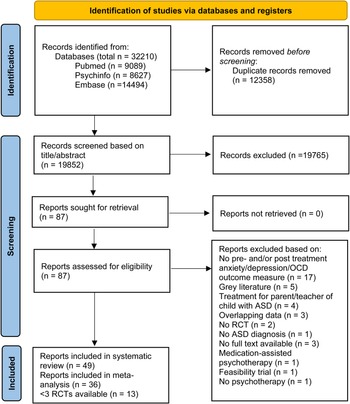
We identified 32 210 articles in EMBASE, PsycINFO and PubMed combined, and, after removal of duplicates, 19 852 articles remained for screening on title and abstract (99.81% agreement between reviewers, 100% after consensus meeting), leaving 87 articles for full-text screening (92.5% agreement between researchers, 100% after consensus meeting). A total of 38 articles were found ineligible, based on our exclusion criteria (see Fig. 1 for details). A total of 36 RCTs were included in the meta-analysis. A final 13 RCTs were not included in the meta-analysis as less than 3 RCTs per psychotherapy were available. An overview of these RCTs is available in supplementary material (online Supplementary Table S1).
Identification of studies via databases and registers.

Study characteristics
Participants
Overall 1726 participants were included in the RCTs that examined the effect of psychotherapy in ASD. Only for CBT and SST three or more RCTs were found. For CBT a total of 1251 participants, aged 5–65 years were included. For SST a total of 475 participants, aged 5–26 years were included. Most studies investigated either anxiety, depression or OCD in ASD. However, one study (Langdon et al., Reference Langdon, Murphy, Shepstone, Wilson, Fowler, Heavens and Mullineaux2016) investigated both anxiety and depression and two studies (Russell et al., Reference Russell, Jassi, Fullana, Mack, Johnston, Heyman and Mataix-Cols2013, Reference Russell, Gaunt, Cooper, Barton, Horwood, Kessler and Wiles2020) included all three of the comorbidities.
Interventions
For CBT 26 RCTs, and for SST 11 RCTs met criteria for inclusion. The duration of the interventions varied from 6 to 40 weeks. Fifteen studies used a group CBT intervention, while seven studies used an individual CBT intervention. A combination of both group and individual CBT was used in four studies. Ten studies used a family-based CBT intervention, whereas the other 16 studies used a non-family-based CBT intervention.
The control groups were mostly waitlist control or treatment as usual. For CBT, two studies (Hesselmark et al., Reference Hesselmark, Plenty and Bejerot2014; Sung et al., Reference Sung, Ooi, Goh, Pathy, Fung, Ang and Lam2011) recreation activities was used as control condition, one study (Murphy et al., Reference Murphy, Chowdhury, White, Reynolds, Donald, Gahan and Press2017) used supportive counselling and another study (Russell et al., Reference Russell, Jassi, Fullana, Mack, Johnston, Heyman and Mataix-Cols2013) used anxiety management as control intervention.
For SST, all interventions were group-based. Seven studies used the Programme for the Education and Enrichment of Relational Skills (PEERS) SST (Laugeson, Frankel, Gantman, Dillon, & Mogil, Reference Laugeson, Frankel, Gantman, Dillon and Mogil2012), 1 study the Acquiring Career, Coping, Executive control, Social Skills (ACCESS) Programme (Oswald et al., Reference Oswald, Winder-Patel, Ruder, Xing, Stahmer and Solomon2018) and 1 study the Social Skills Group Training (‘KONTAKT’) (Choque Olsson et al., Reference Choque Olsson, Flygare, Coco, Gorling, Rade, Chen and Bolte2017), that all required involvement of a parent and/or social coach. One study used a modified group and individual family-based CBT focused specifically on social skills (White et al., Reference White, Ollendick, Albano, Oswald, Johnson, Southam-Gerow and Scahill2013). The control groups for SST were, apart from one study (Afsharnejad et al., Reference Afsharnejad, Falkmer, Black, Alach, Lenhard, Fridell and Girdler2021) using an interactive cooking programme, waitlist control, treatment as usual or delayed treatment.
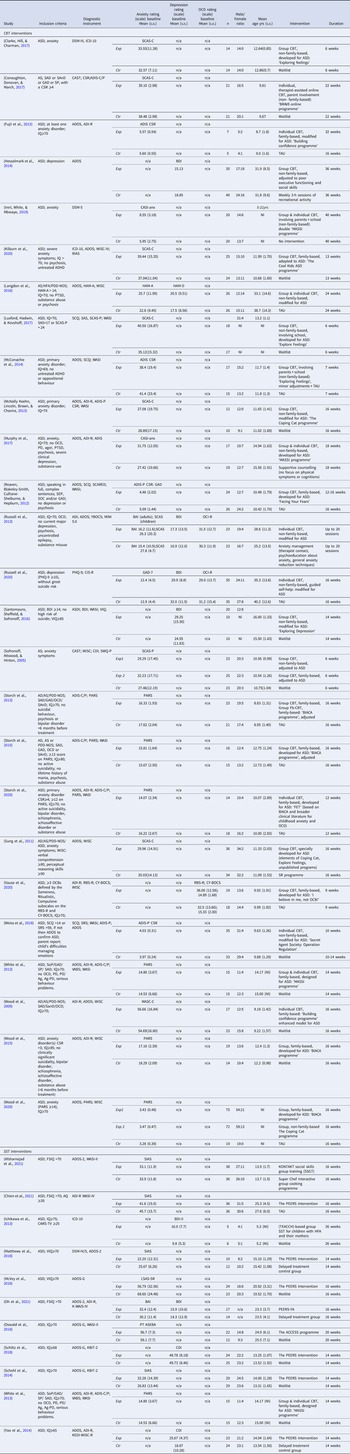
Diagnostic rating scales, outcome measures, mean age and mean baseline symptom severities are outlined in the study characteristics (Table 1).
Characteristics of included studies

ADHD, attention deficit/hyperactivity disorder; ASD, autism spectrum disorder; AS, Asperger's syndrome; ag, agoraphobia; AD, autistic disorder; GAD, generalised anxiety disorder; HFA, high functioning autism; OCD, obsessive-compulsive disorder; PD, panic disorder; PDD-NOS, pervasive developmental disorder – not specified; PTSD, post-traumatic stress disorder; SAD, separation anxiety disorder; SAnD, social anxiety disorder; SEP, seperation anxiety disorder; SOC, social anxiety disorder; SP, specific phobia; ABA, Applied Behaviour Analysis; (Fb-)CBT, (function-based) cognitive behavioural therapy; DBT, dialectical behavioural therapy; ERP, exposure and response prevention; FET, family-based exposure-focused treatment; GSH, guided self-help; IBI, Intensive Behavioural Intervention; PEERS, The Programme for the Education and Enrichment of Relational Skills; STAR, Stop – Think – Act – Reflect; SR, Social recreational; SST, social skills training; TAU, treatment as usual; t-CBT, transdiagnostic cognitive behavioural therapy; ADIS, Anxiety Disorders Interview Schedule; ADI-R, Autism Diagnostic Interview-Revised; ADOS, Autism Diagnostic Observation Schedule; ASASC, Australian Scale for Autism Spectrum Conditions; ASDI, Asperger Syndrome (and High-Functioning Autism) Diagnostic Interview; BAI, Beck Anxiety Inventory; BDI, Beck Depression Inventory; CAIS-P, Childhood Anxiety Impact Scale-Parent; CALIS-C/P, Child Anxiety Life Interference Scale – Child/Parent version; CAPE, Children's Assessment of Participation and Enjoyment; CASI-anx, Child and Adolescent Symptom Inventory-4 ASD Anxiety; CAST, Childhood Asperger Syndrome Test; CATS, Child and Adolescent Trauma Screen; CBCL, Child Behaviour Checklist; CDI, Children's Depression Inventory; CGI-I, Clinical Global Impression–Improvement; CGI-S, Clinical Global Impression–Severity; CIS-P, Columbia Impairment Scale–Parent Version; CIS-R, Clinical Interview Schedule-Revised; CSDS-P, Child Sheehan Disability Scale for Parents; CSR, clinical severity rating; (C)YBOCS, (Children's) Yale–Brown Obsessive-Compulsive Scale; DASS, Depression Anxiety Stress Scale; DD-CGAS, Developmental Disabled Children's Global Assessment Scale; ERQ, Emotion Regulation Questionnaire; EQ-5D-5L, quality of life and health; FAS-PR, Family Accommodation Scale-Parent Report; FQ, fear questionnaire; FSSC-R, Fear survey schedule for children-revised; GAD-7, General Anxiety Disorder Questionnaire; GRID-HAM-D-17, GRID-Hamilton Rating Scale for Depression; HAM-A, Hamilton Rating Scale for Anxiety; HAM-D, Hamilton Rating Scale for Depression; ICD-10, International Classification of Diseases; LSAS, Liebowitz Social Anxiety Scale; MASC-C/P, Multidimensional Anxiety Scale for Children–Child or Parent Version; MASS, Multidimensional Adolescent Satisfaction Scale; OCI-R, Obsessive Compulsive Inventory-Revised; PANAS, Positive and Negative Affect Schedule; PARS, Paediatric Anxiety Rating Scale; PAS, Preschool Anxiety Scale; PHQ-9, Patient Health Questionnaire-9; PR-CHOCI-R, Children's Obsessive Compulsive Inventory-Parent Version; QABF, Questions About Behavioural Function; RBS-R, Repetitive Behaviours Scale–Revised; RCADS, Revised Child Anxiety and Depression Scales; RCMAS, Revised Children's Manifest Anxiety Scale; RMET, Reading the Minds in the Eyes Task; SACA, Service Assessment for Children and Adolescents-Service Use Scale; SAS-TR, School Anxiety Scale – Teacher Report; SCARED, Screen for Child Anxiety and Related Emotional Disorders; SCAS-C/P, Spence Children's Anxiety Scale-child (SCAS-C) and parent version (SCAS-P); SCQ, Social Communication Questionnaire; SF-12, 12-Item Short Form Health Survey; SIAS, social interaction anxiety scale; SPIN, social phobia inventory; SRS, Social Responsiveness Scale; SWQ, Social Worries Questionnaire; VABS, Vineland Adaptive Behaviour Scales; (V)IQ, (verbal) intelligence quotient; WISC, Wechsler Abbreviated Scale of Intelligence; WSAS, Work and Social Adjustment Scale; ARC, Autism Resource Centre; CGC, Child Guidance Clinic; ctr, control group; exp, Exp group; M, mean; n/a, not applicable; NI, no information; s.d., standard deviation.
Risk of bias assessment
Eighteen studies (9 CBT and 9 SST) were rated as ‘high risk’, 16 (14 CBT and 2 SST) as ‘some concerns’ and 3 CBT studies as ‘low risk’ on the overall bias. The randomisation process was considered to have the least risk of bias, whereas the highest risk of bias was due to missing outcome data (online Supplementary Figs S1 and S2).
Main pooled effect of CBT on anxiety, depressive and OCD symptoms
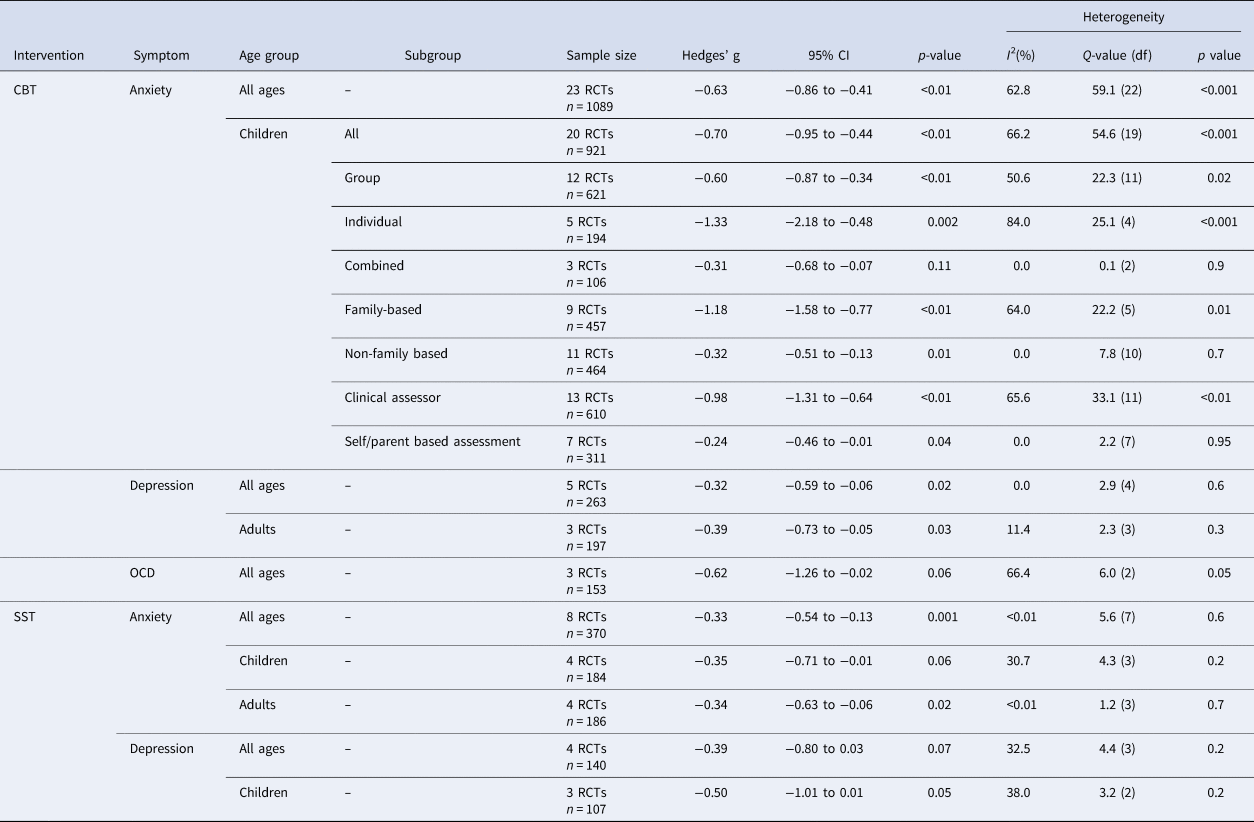
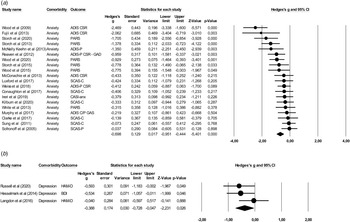
The pooled effect of CBT on anxiety symptoms for the all age group was moderate [g = −0.63; 95% CI (−0.86 to −0.41)] and significant (p < 0.001), with substantial heterogeneity (I 2 = 62.7%; Q = 59.1; p < 0.01) (Table 2, online Supplementary Fig. S3). In children the pooled effect size was moderate [g = −0.70; 95% CI (−0.95 to −0.44)] and significant (p < 0.001), with substantial heterogeneity (I 2 = 66.2%; Q = 54.6; p < 0.01) (Table 2, Fig. S2a).
Main results of meta-analyses

OCD, obsessive-compulsive disorder; CBT, cognitive behavioural therapy; SST, social skills training; RCT, randomised controlled trial; CI, confidence interval.
The pooled effect of CBT on depressive symptoms for the all age group was small [g = −0.32; 95% CI (−0.59 to −0.06)] and significant (p = 0.02), with small heterogeneity (I 2 = 0.0%; Q = 2.9; p = 0.6) (Table 2, online Supplementary Fig. S4). In adults the pooled effect size was small [g = −0.39; 95% CI (−0.73 to −0.05)] and significant (p = 0.03), with small heterogeneity (I 2 = 11.4%; Q = 2.3; p = 0.3) (Table 2, Fig. 2b).
(a) Forest plot including RCTs on CBT in children with ASD and symptoms of anxiety. (b) Forest plot including RCTs on CBT in adults with ASD and symptoms of depression.

The pooled effect of CBT on OCD symptoms in the all age group was moderate [g = −0.62; 95% CI (−1.26 to 0.02)] but not significant (p = 0.06), with substantial heterogeneity (I 2 = 66.39%; Q = 6.0; p = 0.05) (Table 2, online Supplementary Fig. S5).
Main pooled effect of SST on anxiety and depressive symptoms
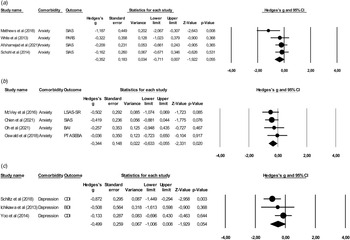
The pooled effect of SST on anxiety symptoms for the all age group was small [g = −0.33; 95% CI (−0.54 to −0.13)] and significant (p = 0.001), with small heterogeneity (I 2 < 0.01%; Q = 5.6; p = 0.6) (Table 2, online Supplementary Fig. S6). In children the pooled effect was small [g = −0.35; 95% CI (−0.71 to 0.01)] and not significant (p = 0.06), with moderate heterogeneity (I 2 = 30.7%; Q = 4.3; p = 0.2) (Table 2, Fig. 3a). In adults the pooled effect was small [g = −0.34; 95% CI (−0.63 to −0.06)] and significant (p = 0.02), with small heterogeneity (I 2 < 0.01%; Q = 1.2; p = 0.7) (Table 2, Fig. 3b).
(a) Forest plot including RCTs on SST in children with ASD and symptoms of anxiety. (b) Forest plot including RCTs on SST for adults with ASD and symptoms of anxiety. (c) Forest plot including RCTs on SST for children with ASD and symptoms of depression.

The pooled effect of SST on depressive symptoms for the all age group was small [g = −0.39; 95% CI (−0.80 to 0.03)] and not significant (p = 0.07), with moderate heterogeneity (I 2 = 32.5%; Q = 4.4; p = 0.2) (Table 2, online Supplementary Fig. S7). In children the pooled effect was moderate (g = −0.50; 95% CI (−1.01 to 0.01)] and significant (p = 0.05), with moderate heterogeneity (I 2 = 38.0%; Q = 3.2; p = 0.2) (Table 2, Fig. 3c).
Subgroup analyses
Individual v. group and combined CBT for anxiety symptoms
Subgroup analysis showed no significant difference (p = 0.11) between individual (g = −1.33) and group CBT (g = −0.60) The difference between individual (g = −1.33) and combined CBT (g = −0.31) was significant (p = 0.03) (Table 2, online Supplementary Fig. S8).
Family involvement in CBT for anxiety symptoms
Subgroup analysis showed a significant difference (p < 0.01) between family-based CBT (g = −1.18) and non-family-based CBT (g = −0.32) (Table 2, online Supplementary Fig. S9).
Assessor of anxiety symptoms
Subgroup analysis showed a significant difference (p < 0.01) between studies where the outcome of anxiety symptoms was assessed by a clinical assessor (g = −0.98) and self/parent-based assessment (g = −0.24) (Table 2, online Supplementary Fig. S10).
Publication bias
Inspection of the funnel plot (online Supplementary Fig. S11) showed that for CBT there were 5 possible outliers. Egger's test of asymmetry was significant (intercept: −4.95, 95% CI (−7.50 to −2.40), t = 3.97, p < 0.001) suggesting publication bias. Duval and Tweedie's procedure resulted in an adjusted effect size [original g = −0.57; 95% CI (−0.75 to −0.39)], adjusted g = −0.61; 95% CI (−0.79 to −0.44) with 2 imputed studies.
For SST there were no outliers (online Supplementary Fig. S12). Egger's test was not significant [intercept: −1.06, 95% CI (−3.82 to −1.71), t = 0.85, p = 0.41] suggesting no publication bias. Duval and Tweedie's procedure resulted in an adjusted effect size [original g = −0.35; 95% CI (−0.52 to −0.17), adjusted g = −0.37; 95% CI (−0.53 to −0.20)].
Discussion
In this meta-analysis we reviewed the current available evidence for any type of psychotherapy for co-occurring symptoms of anxiety, depression and OCD in individuals with ASD. For CBT 26 RCTs, and for SST 11 RCTs met criteria for inclusion. Cognitive behavioural therapy for anxiety in children with ASD was most extensively studied and moderately effective (g = −0.70). In adults with ASD, the pooled effect size for CBT for depressive symptoms was small (g = −0.39). For OCD symptoms, a moderate, but not significant, pooled effect size (g = −0.62) was observed in a mixed-age group. SST, which has not previously been meta-analysed for affective symptoms in ASD, is a behavioural therapy that can help to learn social skills and improve understanding of social interactions (Soares et al., Reference Soares, Bausback, Beard, Higinbotham, Bunge and Gengoux2021). For SST the overall effect sizes were small for reduction of anxiety symptoms in children (g = −0.35) and adults (g = −0.34) and moderate (g = −0.50) for reduction of depressive symptoms in children with ASD. To our knowledge, this is the first meta-analysis reporting evidence for (1) CBT for depressive symptoms, and (2) SST for anxiety and depressive symptoms in ASD. Evidence for the effectiveness of CBT for reducing symptoms of anxiety in children with ASD has been investigated in meta-analyses previously.
The latest 3 meta-analyses (Perihan et al., Reference Perihan, Burke, Bowman-Perrott, Bicer, Gallup, Thompson and Sallese2020; Sharma et al., Reference Sharma, Hucker, Matthews, Grohmann and Laws2021; Ung et al., Reference Ung, Selles, Small and Storch2015) investigating the effect of CBT on anxiety symptoms in children with ASD include studies up to 2020 and similar to our meta-analysis, investigated the impact of informant, CBT design (individual or group) or family involvement.
The most recent meta-analysis (Sharma et al., Reference Sharma, Hucker, Matthews, Grohmann and Laws2021) included 833 children in 19 RCTs and reported a large effect size for clinician rated symptoms (g = 0.88), and small effect sizes for both parent (g = −0.40) and child-reported anxiety (g = −0.25), which is similar to our subgroup analysis on outcome assessor revealing that assessment of symptoms by clinician was significantly larger (g = −0.98), in comparison to assessment by self/parents combined (g = −0.24). Furthermore, their effect size for individual CBT (g = −1.16) exceeded group design (g = −0.53), similar to our results (individual: g = −1.33 v. group: g = −0.60). However, for parent or child reported symptoms the difference between individual or group design was not significant. Overall, the blinded clinician ratings show a greater change in symptoms than unblinded self/parent reported outcomes. Possibly, a trained clinician is better able to identify changes in symptomatology, and disentangle anxiety symptoms from core features of ASD, than a child or their parent.
Another recent meta-analysis (Ung et al., Reference Ung, Selles, Small and Storch2015) that included 511 children, in 14 studies, including both RCTs and open trials, yielded a small effect size (g = −0.47), after removal of an outlier. Their subgroup analysis on CBT design revealed that group CBT (g = −0.75) was favourable over individual CBT (g = −0.62). This is in contrast with our results showing that individual CBT (g = −1.33) exceeded both group (g = −0.60) and combined (individual and group) (g = −0.31) CBT designs. This difference could be explained by the reported outlier that was included in this study. Although there is no evidence to support this, it could be speculated that individual CBT is favourable over group CBT due to group CBT being experienced more intensely by individuals with ASD due to overstimulation. Hence, future studies should focus on the impact of sensory processing difficulties in ASD on group therapy, and whether this impacts treatment outcome.
Last, a meta-analysis conducted by Perihan et al. (Perihan et al. Reference Perihan, Burke, Bowman-Perrott, Bicer, Gallup, Thompson and Sallese2020) included 615 children, in 22 studies, of which 7 studies without a control group. A moderate pooled effect size (g = −0.66) for decrease in anxiety symptoms was reported, including the previously mentioned outlier. Furthermore, similar effect size ratios were reported compared to our results regarding family-based (g = −0.85) in comparison to non-family-based (g = −0.34) CBT. Parental involvement in CBT can help as parents of children with ASD are likely to have higher levels of stress themselves, and struggle with managing parental stress when trying to improve their parental skills for their children with ASD (Hassall, Rose, & McDonald, Reference Hassall, Rose and McDonald2005). Hence, understanding their child's behaviour can impact on their parental skills and have a potential secondary effect on the child's levels of anxiety.
Taken together, this suggests that CBT for treating symptoms of anxiety in children with ASD is an effective treatment, probably best conducted individually in a family-based setting.
For depressive symptoms in adults with ASD, the pooled effect size was small (g = −0.39), but significant. This suggests that CBT can be a beneficial psychotherapy for symptoms of depression in adults with ASD. Although adults with ASD often struggle with MDD, they have difficulty accessing mental health services, mainly due to a lack of therapist's knowledge of ASD (Lipinski, Boegl, Blanke, Suenkel, & Dziobek, Reference Lipinski, Boegl, Blanke, Suenkel and Dziobek2021). Hence, creating more awareness that a common treatment modality like CBT can be effective for ASD can help to increase access to adequate mental health care.
The effect of CBT on OCD symptoms was moderate (g = −0.62) yet not significant (p = 0.06). Furthermore, due to the different age-groups of the three RCTs included we cannot (yet) conclude that CBT is effective for OCD symptoms in ASD.
For SST the pooled effect size was small for reduction of symptoms of anxiety in children (g = −0.35) and adults (g = −0.34) and moderate for symptoms of depression in children with ASD (g = −0.50). Although previous meta-analyses on SST have been conducted, they were all focused on social competences, not on comorbid psychiatric symptoms (Gates, Kang, & Lerner, Reference Gates, Kang and Lerner2017; Wolstencroft et al., Reference Wolstencroft, Robinson, Srinivasan, Kerry, Mandy and Skuse2018). Hence, this is the first meta-analysis revealing a significant effect of SST on decrease in symptoms of anxiety and depression in ASD suggesting a potential treatment modality for anxiety and depression in ASD.
Limitations
A few limitations must be noted considering the available data. First, half of the included studies showed a high risk of bias, mostly due to loss of follow-up. This can never be completely prevented, especially not in mental health studies, since it is generally known that the loss of follow-up is often due to the mental health disorder which is treated in the study. Also, most of the studies only included ASD with IQ>70–80, thus excluding around 32% (Lyall et al., Reference Lyall, Croen, Daniels, Fallin, Ladd-Acosta, Lee and Newschaffer2017) of the total ASD population. This could be explained by the fact that it requires a certain level of intelligence to understand the tools that are given in CBT and also to give words to feelings and experiences in daily life. Therefore, future studies should also investigate possible treatments for individuals with ASD and an intellectual disability (IQ < 70).
This meta-analysis specifically also had a few limitations that need to be taken under consideration. First, we did not search for unpublished literature. This could cause publication bias. However, the results of the Duval and Tweedie's procedure showed that only 2 studies for CBT and 1 for SST were imputed, indicating there was little publication bias. Second, we used outcome measures and rating scales that were originally used in the included studies, which differed among the inclusions. This could have had an effect on the results and heterogeneity. In future research these outcome measures should be converted into one rating scale. Last, future meta-analyses should include a number needed to treat analysis to shed more light on the clinical relevance of the effect sizes.
Conclusion
In conclusion, we report in this meta-analysis that CBT reduces comorbid symptoms of anxiety in children and depressive symptoms in adults with ASD. Furthermore, SST is both effective for reducing anxiety in children and adults and depressive symptoms in children with ASD. For CBT, it is recommended to apply an individual, family-based approach. Future guidelines should incorporate our findings to help increase access to psychotherapy.
Overall, our results provide new, broader, and age-specific evidence for psychotherapy for affective disorders in ASD.
Supplementary material
The supplementary material for this article can be found at https://doi.org/10.1017/S0033291722003415.
Acknowledgements
Affiliation: Academic Psychiatric Centre, Amsterdam UMC
Authors' contributions
RW and CB conceived the idea for the meta-analysis, RW and LW gathered and analysed the data, and wrote the manuscript, MB and AL supervised the analysis, RW took lead in writing the manuscript, LW, MB, AL and CB provided critical feedback for the final version of the manuscript.
Financial support
This research received no specific grant from any funding agency, commercial or not-for-profit sectors.
Conflict of interest
All authors report no financial relationships with commercial interests.