Introduction
Patient positioning reproducibility in radiotherapy treatments should be performed with an adequate accuracy level in order to guarantee correct dose irradiation of target and preservation of the organs at risk. Image-guided radiation therapy (IGRT) enables the correction of setup errors. In breast cancer treatments, electronic portal image devices (EPID) are used to evaluate the patient setup; however, image registration underestimates bony anatomy setup error. The use of kilovoltage (kV) cone-beam computed tomography (CBCT) allows an accurate tissue image and decreases significantly setup uncertainties. Reference Topolnjak, Sonke and Nijkamp1
CBCT images indeed offer three-dimensional (3D) views and a better visualisation of soft tissue, anatomical contrast and accuracy as compared to two-dimensional (2D) images acquired by EPID. CBCT verification offers adequate 3D volumetric image quality to improve the accuracy of the treatment delivery and is preferred for image guidance. Reference Hawkins, Aitken and Hansen2 This aspect is particularly relevant in anatomical sites in which both bones and soft tissues are present like chest and breast. Considering the latter site, standard therapy includes whole-breast adjuvant radiotherapy and a boost dose to the tumour bed site to improve local control, as shown in several randomised trials. Reference Graham and Fourquet3,Reference Bartelink, Horiot and Poortmans4
There are several methods for CBCT image registration, all of them based on matching grey values between CBCT and CT images; differences are in the volume of interest (VOI) used for image registration. Considering whole-breast radiotherapy, literature results show no significant differences between several registration methods in their ability to detect patient setup uncertainties, Reference Mohandass, Khanna and Kumar5 but no precise data are available about evaluation of different registration methods on 3D-CBCT images, when only a small part of breast is considered, like in breast boost treatment.
Accurate delineation of the target volume is of utmost importance while delivering tumour bed boost with external beam radiotherapy. Reference Jalali, Singh and Budrukkar6 Surgical bed clipping is vital in the delineation of target volume to ensure precision, hence minimising geometrical miss and optimising surrounding normal tissue sparing. Clinical target volume (CTV) boost is, usually, defined considering the expansion of few centimetres (1 cm for two or more clips and 2 cm other way) Reference de Freitas, Lopes de Barros Lima and de Andrade Carvalho7 with respect to clip contour.
The aim of this study is to compare patient geometrical uncertainties in the treatment of breast boost three-dimensional conformal radiation therapy (3D-CRT) considering both manual alignment and Elekta XVI system’s different registration methods.
Methods
Patient selection
For this study the inclusion criteria were as follows:
-
• Patients treated with 3D-CRT considering both left and right breast cancer;
-
• Patients received breast boost radiotherapy treatment after whole-breast irradiation;
-
• The presence of surgical clips for delineation of boost volume irradiation;
-
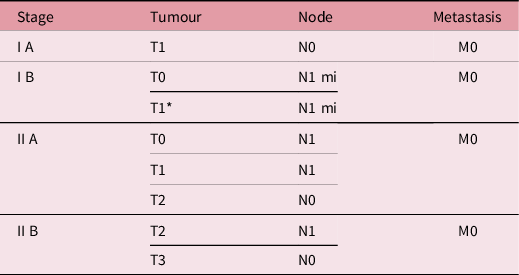
• Breast cancer stages from I A to II B in accordance with AJCC 2017 Breast Cancer Classification, Reference Amin, Edge and Greene8 as seen in Table 1.
Table 1.Included stages of breast cancer in accordance with AJCC 2017 Breast Cancer Classification.

*T1 includes T1mic

Patient setup and treatment delivery
There were no restrictions on the patient age, height, weight and consequently body mass index. Patients were positioned supine using Monarch Overhead Arm Positioner (Civco Radiotherapy, IA USA),immobilisation and repositioning Reference Sundar9 device. The patient simulation CT and radiotherapy treatment were delivered in free breathing. Boost radiotherapy treatments were delivered with 3D-CRT photons. Reference Rajan, Sharma and Kumar10,Reference Kovacs, Hadjiev and Lakosi11 The boost was delivered with a dose of 9–12 Gy in 3–4 fractions. Reference Janssen, Glanzmann and Lang12
CBCT image acquisition
The IGRT system used to acquire CBCT was XVI Volume View System (XVI) mounted on Versa HD LINAC (Elekta Oncology Systems Crawley UK). Images were acquired just before treatment delivery and matched with reference planning CT using XVI software. Parameters of the CBCT protocol were as follows: 210° rotation angle (start angle 190°/100° right/left breast), S20 collimator and F1 filter, 100 kV, 400 total frames acquired, Nominal Scan dose 1.0 mGy and CTDIw 4.33 mGy. Gantry rotation plus scan time was 110 seconds for each CBCT acquisition. Reference Lastrucci13
CBCT image matching
XVI reconstructed a 3D volumetric image using low-dose projection images acquired by CBCT. XVI saved each 2D projection image and the gantry angle at which it was acquired. Then, the sequence of 2D projection images was used to reconstruct a 3D volumetric image of the anatomical volume. Within a negligible time following acquisition and reconstruction, the 3D image was available for review and registration on the XVI software (Release 5.0.4 b44).
The registration between the images of the CBCT and CT simulation was carried out by three different methods:
-
• Manual registration: CBCT images were manually adjusted to match the simulation CT images; this method was considered as the gold standard. This was a time-consuming and lengthy procedure. Reference Cao, Liu and Zhai14
-
• Clipbox automatic registration was based on definition of VOI with a solid box; only voxels inside selected volume were used for image registration. Reference Li, Harrison and Yu15 The dimensions of Clipbox were user-defined.
-
• Mask automatic registration uses a soft tissue volume, called Mask. Unlike Clipbox, Mask was used to identify the contour of a region of interest of irregular shapes, and the image registration happened only based on this selected contour. This Mask can be created from any structure contour present in CT simulation, with or without a margin, or can be painted manually on the CT simulation images using XVI software. Margins were user-defined, in all directions, to structure with range between 0 and 2 cm. Use of the Mask algorithm the registration was limited only to voxels inside the soft tissue volume selected with margin fixed by user.
CT simulation images, acquired with 3 mm slice thickness, were used to contour OaR and target volumes. CTV boost was created by surgical clips plus an expansion of 1 cm when more than one clips are present, 2 cm otherwise. According to 16 planning target volume (PTV), boost was created from CTV boost plus a further expansion of 1 cm in all directions. In this study, the Clipbox VOI was chosen to cover the breast quadrant containing surgical clips. The Mask was defined as PTV boost expanded by 1cm. 17
For this study, the algorithm used for automatic matching in both Clipbox and Mask methods was the grey value (T). This registration algorithm uses all the grey value voxel in the volume of registration to calculate the translational shifts. The algorithm used is a grey level ‘correlation ratio’ procedure.
The maximum tolerance limits for translational and rotational errors were fixed to 5 mm and 3°, respectively, in any direction. Patients with translational and rotational errors larger than tolerance values were not included in this study.
A total of 85 patients were chosen for this study. Patients were imaged daily with CBCT during boost breast radiotherapy treatment, and for each patient, three or four CBCTs were acquired. A total of 254 registrations were retrospectively performed using automatic registration to detect patient setup uncertainties. All CBCTs acquired were matched manually by three health professionals, two radiotherapists and one radiation oncologist.
The mean shift value obtained with manual registration performed by three health professionals was used as reference. Absolute values of the difference between automatic algorithm shift and reference values were collected for each enrolled patient considering the three different spatial directions. In particular, δmi refers to the difference between the Mask algorithm along spatial direction I (x, y and z) and reference registration, and δci refers to the difference between the Clipbox algorithm and reference registration. Shift magnitude defined as the Euclidean module of shifts along the three spatial directions was also calculated and labelled as δm and δc. BMI, age and breast boost quadrant were recorded for each patient.
Statistical analysis
Normality of analysed data was checked for δmi and δci using both quantile–quantile plot (Q–Q plot, qualitative method) and Kolmogorov–Smirnov (K–S) test (quantitative method with p-value<0.01). Reference Ghasemi and Zahediasl18 Magnitude (δm and δc) was distributed according to Rice probability distribution function. Considering a large number of samples, the magnitude can be approximated with normal distribution. Difference between δm and δc was performed using a two tails t-test; the confidence level to reject the null hypothesis was set to p-value < 0.05.
Results
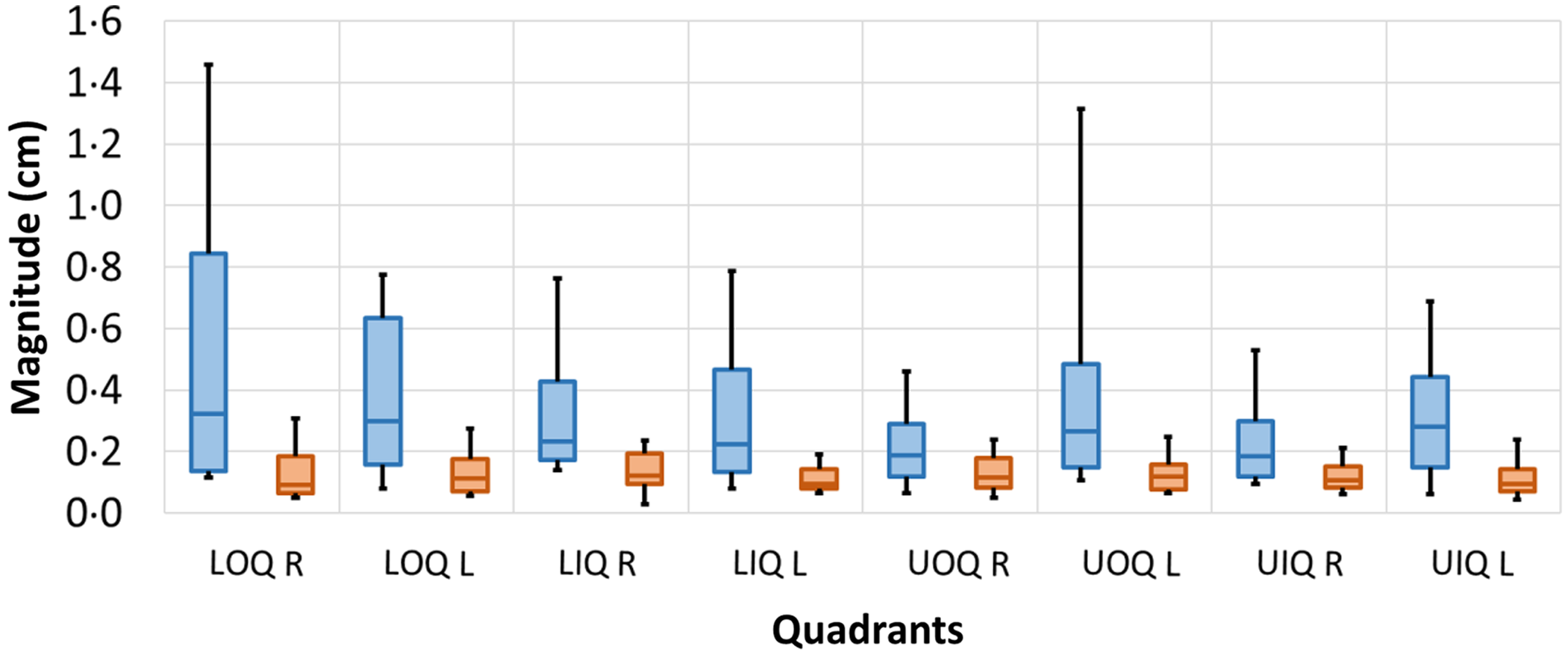
Data analysis showed a significant difference in δm and δc. In particular, Figure 1 shows a box plot comparing shift magnitude of 8 quadrants, defined as upper outer, upper inner, lower outer, and lower inner by two perpendicular planes intersected at the nipple for both left and right breast.
Box plot comparing δm (blue box) and δc (orange box) for each quadrant of both the breasts. Median is included in the box; whiskers represent minimal and maximal distribution value of datasets, and boxes represent first and third.

In all considered sites, the differences of Mask were lower than Clipbox; in particular, t-test showed a significant difference (p<0.05). No significant differences among different sites were detected. Overall statistic t-test showed a high difference between Mask and Clipbox, in particular mean δm = (1.3 ± 0.1) mm and δc = (3.3 ± 1.2) mm (p-value <0.0001). The registration time considering both the Mask and the Clipbox algorithm was around 10 seconds for all considered patients. Manual procedure registration consumes a median value of 100 seconds for each image set (range 60–150 seconds). This value was almost the same for each health professional involved in this study.
Discussion
Considering above reported results, the Mask algorithm performed in a very similar way with respect to the gold standard alignment (i.e., manual registration). In general, the Clipbox algorithm showed larger differences with manual registration: this suggests that it was not the optimal choice for patient setup verification when considering boost breast treatment; instead, the Mask algorithm should be considered a reasonable alternative to manual registration as the differences between these two procedures were of the order of 1 mm or less. Correlation of BMI and age with δm and δc was also tested, and no significant results were obtained. Moreover, automatic registration avoids intra-operator differences and guarantees a more standardised result. The smallest time need to perform imaging alignment between CBCT and Planning CT using the Mask algorithm and its high confidence performance allows more accurate breast boost treatments of the patients avoiding setup errors.
Conclusion
A total of 254 CBCT of boost breast radiotherapy treatments have been included in the present study. For each acquisition, manual registration was compared with automatic registration performed with two different algorithms: Clipbox and Mask. The former was based on a VOI user-defined and the latter on an anatomical soft tissue volume. In all considered anatomical breast sites, the Mask algorithm showed accuracy in the order of 1 mm with respect to manual registration, a considerable millimeter accuracy about a factor three smaller than the Clipbox algorithm (p-value < 0.0001).
Automatic registration algorithms were less time-consuming than manual registration and avoided inter-operator dependence of obtained results. These results suggest that the Mask algorithm may be the optimal choice for patient setup verification in clinical practice for breast boost treatment in 3D-CRT.
Ethics Approval
The authors assert that all procedures contributing to this work comply with the ethical standards of the Azienda USL Toscana Centro, Florence—Italy, and relevant national guidelines on human experimentation and with the Helsinki Declaration of 1975, as revised in 2008, and have been approved by The Ethical Committee for Clinical Studies of the Central Tuscany Region (Protocol Number: 21615_OSS).