Introduction
Over the past two decades, the Chinese automobile industry has grown dramatically, fueled largely by massive foreign investment through joint ventures. American Motor Corporation/Chrysler and Volkswagen were the pioneers in 1983 and 1984, respectively, followed by major new investments by, among others, Citroen, Honda, Toyota, and General Motors through the 1990s. Production increased tenfold in fifteen years, from 0.7 million units in 1991 to 7.28 million in 2006, making China the third largest vehicle producer and the second largest automobile seller in the world.
The Chinese automobile industry has not only experienced rapid growth, but also radical changes in the organization of production. Foreign firms have had a major impact on the organization of production by importing Taylorist “scientific management,” the cost-cutting practices of Japanese lean production, and related principles for maximizing profits to the workplace. Moreover, the Chinese government policy since the mid-1990s has promoted a leaning-out of the industry to bring labor productivity in line with the standards set by “international market rule.” We thus see an overall decline in employment due to the fact that growth in production and employment at some auto plants has gone hand in hand with massive layoffs from many state-owned automobile enterprises. As a result, while auto output increased from 1.6 million to 7.28 million vehicles from 1997 to 2006, the number of employees in the auto sector actually declined from 2 million to 1.65 million over the same period.Footnote 2 These radical changes can be expected to have a significant impact on labor-management relations in the Chinese automobile industry.
Intriguingly, despite such mass layoffs and radical changes at the workplace, China's major automobile enterprises have so far been able to keep on expanding rapidly without experiencing significant labor unrest, unlike what happened in other cases of rapid expansion of the automobile industry, such as in Brazil and South Korea.Footnote 3 The relative lack of open protest among the Chinese autoworkers is especially puzzling given that workers in many other industries in China have been participating in strikes and demonstrations in increasing numbers and with increasing frequency in recent years.Footnote 4 Why have Chinese autoworkers kept relatively quiet so far? What are labor relations in the Chinese automobile industry like? How are they likely to unfold in the coming decade?
This article seeks to address these questions through intense case studies of seven major automobile assembly enterprises in six cities in China.Footnote 5 In the second section, the paper depicts the everyday lives of Chinese autoworkers on production lines, looking at their working conditions, wages, and employment situations, including workers' labor contract terms, local labor market conditions and labor turnover rates, and interactions between workers and managers as well as between different workers' groups. In the third section, two versions of labor control regimes, “lean-and-dual” and “lean-and-mean,” are depicted and compared. The fourth section explores the respective roles played by management staff, factory unions, and party factory committees in building hegemony at the enterprise level. The fifth section highlights the interventionist roles of the Chinese central and local governments on regulating labor relations at the major automobile enterprises. The final section discusses the potentials and limits of Chinese autoworkers' bargaining power and the likely roles that Chinese autoworkers might play in the evolution of labor relations under the competitive dynamics within the world automobile industry.
Changing Labor Relations in Postreform China
Substantial attention has been given to the changing labor relations in China since its market reform.Footnote 6 There are two main approaches in this field. One takes off from Andrew Walder's concept of neotraditionalism.Footnote 7 Walder's classic treatise on labor relations under the danwei system, the Chinese work unit, and communist neotraditionalism cogently described a system of organized dependency. To Walder, it is this “organized dependency” of Chinese workers on management, as well as the active co-optation of the activists among workers, that led to an atomized and nonmilitant labor force in prereform China and accounted for the lack of militancy of Chinese workers under the danwei system.
It has been generally acknowledged, however, that China's market reform has drastically eroded this work unit system, the institutional foundation for neotraditionalism, and has radically altered the relationship between the enterprise and its employees.Footnote 8 For one thing, lifetime employment is being replaced by short-term labor contracts, and enterprises are systematically shedding work unit responsibilities, attempting to make the payment of cash wages their only obligation to employees. Correspondingly, managerial autonomy from the state and control over production and employment has significantly increased, vis-à-vis an even weaker Chinese labor force relative to management power under the market reform.
The second approach builds on Michael Burawoy's notion of “factory regime.”Footnote 9 According to Burawoy, there are two general types of factory regimes: despotic and hegemonic. Under a despotic factory regime, workers are bereft of any other means of livelihood (free to work or free to starve) and lack the ability to resist arbitrary management coercion effectively, especially in the absence of collective forms of organization. Under a hegemonic factory regime, workers' dependence on capital is reduced by state social insurance and by state labor legislation facilitating resistance to arbitrary coercion. In such regimes consent prevails, though this does not mean coercion does not exist. Burawoy also noted the emergence of hegemonic despotism under which labor's vulnerability to capital's national and international mobility leads to a new despotism built on the foundations of the hegemonic regime.Footnote 10 However, Burawoy's notion of “factory regimes” was mainly based on his studies of Western and Eastern European factories, and it is not known to what extent the concepts can be applied to Chinese and other Asian factories.
In his study of Asian factories, Nichols developed Burawoy's concept of hegemonic despotism. Under this regime, according to Nichols, workers face the loss of their jobs, not as individuals but as a result of threats to the viability of the firm. Management turns the hegemonic regime against workers, relying on its mechanisms for coordinating interests to command consent to sacrifice. In other words, where laborers used to be granted concessions on the basis of the expansion of profits, they are now granted concessions on the basis of the relative profitability of one capitalist vis-à-vis another.Footnote 11
Scholars agree that factory regimes in contemporary China have been largely reshaped, but they come up with different characterizations of the current factory regimes. One argument states that economic reform without political change only creates conditions for a despotic factory regime. Workers have been deprived of their political leverage and economic privilege and are left with nothing but grievances and discontent.Footnote 12 Ching Kwan Lee argues that a transition from “organized dependence” to “disorganized despotism” happened in the reform era due to the new “factory director (manager) responsibility system,”Footnote 13 an oversupplied labor market, and the state's failure to protect the vulnerable in the marketplace.Footnote 14 To Lee, it is the Chinese state that plays the key role in demoralizing and containing collective labor activism and thus leaves a slim chance of an effective, large-scale labor movement in China. These studies, however, have been based either on field research in small and medium-scale firms in southeastern coastal China or on industries that are mainly labor intensive, low-tech, and export oriented.Footnote 15
Gregory Chin, in contrast, found that a “hegemonic” factory regime exists in two model auto joint ventures (JVs) in northern China. According to Chin, the “hegemonic regime” was built on the material benefits and privileges autoworkers enjoyed as primary sector workers, such as higher wages; relatively generous benefits; a more regularized system of hiring, firing, and promotions; and a relatively better working environment. These material benefits and privileges constitute the basis of workers' consent to management and the hegemonic labor relations inside the factories. That is precisely because large model JVs need a highly skilled and stable workforce, which requires a more sophisticated regime of labor control to get workers to consent to their own subordination than those used in more “despotic” regimes of labor control. Therefore, to Chin, the lack of labor militancy among Chinese autoworkers can be attributed to a more subtle and sustainable regime of labor control for a small part of the primary sector labor force.Footnote 16
Chin's study, however, was limited to one particular primary type of firm—large joint ventures in northern China. Moreover, he did not pay much attention to the growing use of temporary workers on auto assembly lines or to the effort by the major automobile assembly firms to outsource operations previously conducted in-house. Indeed, my empirical research found a much more complicated picture of factory regimes within the major automobile plants in China, which I will turn to in detail in the following section.
Living on the Line: Lean Production in the Chinese Automobile Plants
In spite of the phenomenal expansion and rapid rise of the Chinese auto industry into the world's top three auto producers in the last decade, there is surprisingly little attention paid to Chinese autoworkers. We know little about their working conditions, wages, and employment situations, although everyone seems to know that Chinese autoworkers earn much higher wages than other manufacturing workers. The best way to find out more about Chinese autoworkers is to go into the factories and examine their daily working lives there. Luckily, I was able to gain access to seven auto assembly plants in China and spent ten months doing participant observation and conducting in-depth interviews with production workers, managers, and union staff. The first-hand information collected from the shop floor provides a solid basis for the analysis of labor relations in the Chinese automobile industry.
I found that the principles of Fordist mass production, e.g., assembly line production, intense work pace, and heavy workload, have been generalized at the major Chinese auto assembly firms. Meanwhile, practices of lean production,Footnote 17 known as the Toyota production system, such as just-in-time (JIT), quality circles, workers' participant program, and teamwork, have been widely adopted at the major Chinese auto firms as well. Chinese management frequently referred to the emergent need to practice lean production to improve product quality, cut costs, and increase flexibility for the company to survive in the intensified domestic and international market.
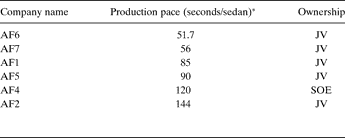
Table 1 shows the production pace at the selected auto firms based on my fieldwork. The production paces are quite intense. Even young workers interviewed did not think they would be able to sustain such a heavy workload at this pace when they reached their forties.Footnote 18
Production Pace at the Selected Auto Firms in China (2006)
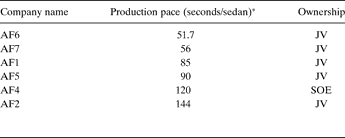
Note: *Production pace refers to the time (seconds) needed to assemble a sedan unit. The original data for production pace were collected by the author from interviews with managers at the selected auto firms in 2006 and 2007.
Working hours at automobile factories are usually long, and compulsory overtime is common. Production lines usually operate on two shifts of eight or ten hours each, except for those machine maintenance workers and repairmen who work three shifts of eight hours each. During the peak season, many plants run two shifts of twelve hours each. That makes most workers feel exhausted. “It is common to work twelve hours a day here, seven days a week. You have no family life. No, you have no life,” complained a formal contract worker at one of the auto factories (AF4). Workers also spoke bitterly about the mandatory overtime that management could impose on them without advance notice. “I never went to work there any day knowing I would be off at a certain time. The line ran until the daily production tasks were made. But everyone knows the quota can never be made within the regular working hours. Then the managers will tell you, today's off time is 7 p.m., simple as that,” recalled a student trainee who had worked on a line of gear boxes at AF4 for nine months. The long working hours and compulsory overtime disrupted the worker's daily life, both physiologically and socially.
To be sure, the Chinese Labor Law stipulates that if an employee's actual working time is more than the statutory standard working time of forty hours per week and 2008 hours per year, the excess will be regarded as extended working time, and overtime (150%) should be paid (Item 1, Article 44); if overtime is worked on a statutory holiday, the salary paid should be 300 percent (Item 3, Article 44). The statutory limitation of total working time (including overtime) is forty-eight hours per week. However, in my fieldwork, I found most Chinese automakers had adopted a comprehensively calculated work time system by taking one year as the calculated period for overtime. That means if an employee's actual working time is no more than 2008 hours within a one-year period, even though his/her actual working time on certain days (or weeks, or months, or seasons) is more than the statutory standard working time, the excess will not be regarded as overtime. Due to the fluctuating demands and production in the Chinese automobile industry, workers find it hard to get paid for their excessive overtime during peak seasons because the company can always find ways to balance a worker's actual working time between peak seasons and low seasons within the one-year period and make sure that almost no one can exceed the limit of 2008 hours per year.Footnote 19
While workers generally dislike the physical aspect of their jobs and the monotonous nature of the long working hours, they find it virtually impossible to make any changes to the established moving assembly lines or to the relentless pressure to produce as rapidly as possible. But workers are extremely critical both of the company's overall policies and practices and of their immediate relations with first-line supervisors. The most common complaints from workers were about the military-style regimentation and inhuman treatment: “Here you are just a machine, a piece of equipment. … They don't look at you as an individual human being.”Footnote 20
Working conditions are generally good at the major automobile assembly plants. Workshops are clean and production lines are new and highly automated. Flexible installment devices are used to help workers choose comfortable work postures. For example, at AF7 workers can assemble the chassis as they sit comfortably on adjustable mobile stations. Nonetheless, there are still particular parts of automobile production that are dirty, strenuous, and damaging to workers' physical health. Workers at body shops, the most unfavorable place where car bodies are welded together, for example, often complained about the bad air quality and the noise that damaged their hearing.
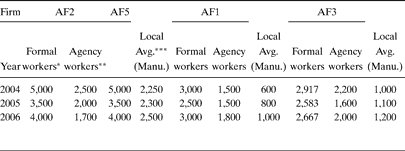
Chinese autoworkers, especially those at the major auto assembly firms, are known to enjoy high wages and generous social benefits, which makes them an envied group by other manufacturing workers. Chin argued that high wages are one of the main foundations for the “hegemonic consent” between management and autoworkers.Footnote 21 However, my interviews with autoworkers have indicated that autoworkers' wages have been declining over the past three years. Meanwhile the average wages of manufacturing workers have increased. As a result, even though autoworkers' wages are still above the average level of manufacturing workers as a whole, the difference between the two groups has decreased. In fact, even those autoworkers whose wages have kept on rising felt they were underpaid, given the intense work pace, heavy workload, and excessive overtime associated with their daily working lives. We can see more clearly the general trend of autoworkers' monthly wages compared to those of other manufacturing workers from Table 2.
Comparisons of Average Wages between Autoworkers and Other Manufacturing WorkersFootnote 22 (RMB/month)
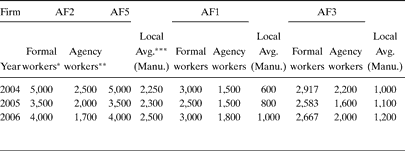
Note: *Formal workers are employees of the auto firms with regular labor contracts. **Agency workers are hired through labor service agencies, and they sign labor contracts with the agencies. Agency workers are then sent by the labor agencies to work at an auto plant when the plant needs more hands and can be returned to the agencies when the plant does not need them. See the following sections for the detailed discussions on labor force dualism and the differences between formal and temporary workers. ***The average wages of local manufacturing workers are calculated based on the median value of interviewees' estimations.
Workers were more indignant about the enlarged income difference between management staff and workers. For example, two older workers at AF3 complained about the cap on workers' wages whereas managers' wages were left open. Position wages at AF3 are divided into ten levels and thirty-six grades with the highest being ten times the lowest. Moreover, since the bonus wages are calculated based on position wages, the total income difference between managers and workers could be even larger.
In sum, scientific management, lean production, and related principles for maximizing profits have become generalized practice in major auto enterprises in China. Moreover, the grueling nature of production work in the auto industry has remained largely the same as in traditional Fordist mass production. There are growing grievances among Chinese autoworkers about the tedium and intensity of the work, the arbitrary exercise of managerial authority, and the declining real wages.
Lean-and-Dual vs. Lean-and-Mean: Labor Controls in the Chinese Automobile Plants
In spite of the generalization of lean production practices to maximize profits and to minimize (labor) costs, two different regimes of labor control have emerged at the major Chinese auto assemblies corresponding to the distinction that Silver has made between “lean-and-dual” and “lean-and-mean.”Footnote 23 The lean-and-dual model can be derived from the original “Toyotist” model, which offers employment security to a core labor force in exchange for cooperation but at the same time creates a large buffer of less privileged workers without the same rights and benefits. The lean-and-mean model came from the US and Western European automobile firms that emulated the cost-cutting measures of Japanese lean production without the related employment policies.
At the major Chinese automobile firms, I found, on the one hand, that some firms establish the lean-and-dual version of labor control by hiring both formal contract workers and temporary agency workers on production lines. Hegemonic relations were established between management and formal workers based on high wages, generous social benefits, better working conditions, and relatively secure employment of formal workers. However, despotic labor control characterizes the conditions for agency workers who have low wages and high turnover rates. On the other hand, I found that some firms apply generalized despotic labor control to their entire workforces by pursuing a low-wage, high-turnover strategy of mass production without guarantees of job security. This can be identified as the lean-and-mean version of labor control. The crucial difference between lean-and-dual and lean-and-mean models of labor control, as this paper will argue, is whether an employer adopts labor force dualism and to what extent the employer offers job security to its core labor force.
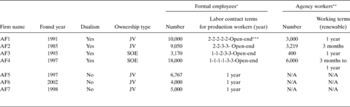
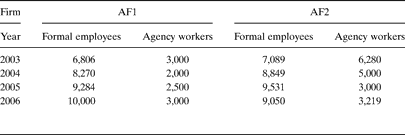
As we can see from Table 3, AF2 in 2006 had a workforce composed of approximately 9,000 formal employees (zhengshi gong) and around 3,200 agency workers (laowu gong), which accounted for nearly half of the total population of its production workers. During the peak time of production in 2003, the company hired over 6,000 agency workers on assembly lines, accounting for sixty-six percent of the total production workers at that time. AF2 started hiring agency workers on production lines in 1992 through local labor service agencies. Likewise, AF1 had been using agency workers since it began production in 1996. It was estimated that around fifty percent of the production workers at AF1 were agency workers in 2003. Those agency workers were mainly from the nearby suburbs or countryside and were in their early twenties with an average of nine to twelve years of education.
Comparisons of Labor Force Dualism and Labor Contract Terms of Production Workers at the Selected Auto Firms (2006)Footnote 24

Note: *Formal employees are made up by production workers, technical and managerial personnel, and other auxiliary production staff. The percentage of production workers within the total population of formal employees ranges between fifty percent and eighty percent at the selected auto firms. There has been a decline of the percentage of formal production workers in recent years due to the growing use of agency workers in production. **Agency workers are hired through labor service agencies and sign labor contracts with the agencies. They are sent to work at auto plants by the agencies under certain short renewable terms. ***According to the Labor Law, employees can negotiate an open-end contract with their employers after ten years of consecutive service for the same employer, which means that employees can have guaranteed employment until they reach retirement age.
The agency workers first sign labor contracts with a labor service agency and are then sent by the agency to automobile plants to work on assembly lines for short terms ranging from three months to a year. Although their working terms at the auto plants can be renewed, agency workers are subject to being “returned” to the labor service agency without any compensation when the auto companies do not need them—simply because agency workers do not have legal labor contracts with the auto plants for whom they actually work.

Agency workers usually get one-half to two-thirds of the payment received by formal workers for the same work, and they are not eligible for the benefits offered by the auto plants to their formal employees.Footnote 25 It was not until recently that agency workers were allowed to join the factory unions where they work. According to the management staff at AF2, for what they pay a formal worker for one year with all-included benefits, they can hire four agency workers. Firms can cut labor costs substantially by using agency workers on production lines instead of hiring formal workers, especially given that many assembly-line jobs are easy to learn and do not require much training.
By contrast, the formal workers at AF2 enjoy material benefits and privileges as primary-sector workers: higher wages; relatively generous benefits; more regularized systems of hiring, firing, and promotions; and a relatively better working environment. These material benefits and privileges constitute the basis of formal workers' consent to management and the hegemonic labor relations, as Chin described in China's “model joint-ventures.”Footnote 26
Among those adopting the lean-and-dual version of labor control, AF1, AF2, and AF3 were built in the 1980s and early 1990s and have a large number of “old” workers in their thirties or forties with open-end labor contracts.Footnote 27 By adopting labor force dualism—by adjusting the number of agency workers, usually at unskilled positions, in response to the fluctuating domestic car market in China—the automobile companies can avoid laying off their formal workers while still being able to lower labor costs and increase flexibility.
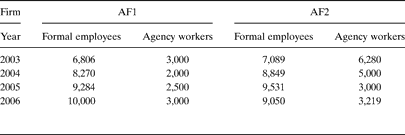
However, some negative effects of using a dual labor force have emerged with the growing use of agency workers on production lines. The unequal treatment between formal and agency workers and the feelings of injustice and resentment among agency workers raise the issue of labor control. Management has encountered increasing sabotage, absenteeism, and walk-outs by agency workers with clear demands for wage raises, benefits equivalent to those of formal workers, and equal treatment. As a result, those lean-and-dual firms are becoming more cautious in hiring agency workers in direct production. (See Table 4) Some companies set the “fifteen percent rule” for hiring agency workers, which means the number of agency workers should not exceed fifteen percent of the total production workforce. In addition, the positions open to agency workers are strictly limited to those unskilled positions that could be easily replaced.
Changes of Numbers of Formal and Agency Workers at the Selected Auto Firms
Compared to AF1 and AF2, the lean-and-mean auto firms are relatively newly built with a workforce in their early twenties who come from the cities and suburbs where the companies are located. The average seniority of the workforce at AF5 and AF6, for example, is around two years. Most workers are young men who have just graduated from technical middle or high schools where they learned simple skills like welding and punch press operation. Lean-and-mean firms do not use agency workers in their direct production. Instead, the firms sign one-year renewable contracts with all of their production workers.
While companies have found it economically rational to place a heavier emphasis on competitive wages and a replaceable young workforce in China in accordance with the traditional Fordist techniques,Footnote 28 management nevertheless realizes that the best way to reduce costs and increase productivity in the long run is to gain workers' cooperation; otherwise, high labor turnover disrupts quality circles and other lean production techniques. However, it is very hard to gain much workplace commitment and loyalty from the production workers without the promise of job security. For those companies in a good position to offer their workforce more generous labor contracts, such as AF5 and AF6, management can ease the confrontation by offering workers improved wages, better working conditions and more workplace autonomy. But if workers' wages start declining, as they did at AF5, there is an immediate rise in worker protest and sabotage.Footnote 29 Thus, both versions of lean production have contradictions and limits.
So what are the possible trends and the implications of the hybrid labor relations in the Chinese automobile industry? A comparison between China's and Japan's dynamics of labor unrest and labor force dualism is instructive. As Beverly Silver has noted, in order to cope with the constraints imposed by postwar waves of labor militancy as well as financial constraints, Japanese automobile producers established a multilayered subcontracting system that allowed them to guarantee employment to (and establish cooperative relations with) a core labor force, while at the same time obtaining low-cost inputs and flexibility from the lower rungs of the supply network. Within the upper-tier firms, a distinction was introduced between permanent and “temporary” workers, with the former guaranteed lifetime employment. This system of subcontracting and labor force dualism allowed Toyota to increase its output fivefold while only increasing its workforce by fifteen percent between 1952 and 1957. More importantly, it allowed Toyota and other auto assemblers to avoid layoffs (and the confrontations with militant workers that layoffs provoked). Thus, labor market dualism combined with employment security for a core labor force is key to explaining the “hegemonic consent” within the Japanese automobile industry and the fact that its great postwar automobile industry expansion—unlike all other cases of rapid expansion—did not lead to a major wave of labor militancy.Footnote 30 Does such dualism in the Chinese automobile industry mean that the Chinese experience will end up looking more like the Japanese anomaly?
To answer that question, we need to examine the nature of this dualism at Chinese auto firms and the extent to which formal workers enjoy true employment security and real hegemonic relations with management. As seen in Table 3, among the four lean-and-dual auto firms, there is much variation in their formal (core) workers' contract terms and employment security. The prospects of guarantees of employment security for a core labor force are greatest at AF1 and AF2. Newly hired (non-temporary) production workers sign a two-year contract with the company as formal workers. After that, they sign another two-year contract and then two three-year contracts (totaling ten years) after which they can have guaranteed employment until they reach their retirement age.Footnote 31
At AF3, on the other hand, all workers receive only one-year renewable contracts. While workers' contracts have generally been renewed annually (at least since the major downsizing in the year 2000), given that it is a state-owned enterprise (SOE) currently seeking a foreign partner, the factory is probably not in any position to make credible promises of job security.Footnote 32
Although AF4 has a dual labor force, it is closer to the lean-and-mean model with very limited job security for its formal workers (one-year renewable contracts for the first four years). As one of the fastest growing state-owned automakers in China, AF4 targets the low-end market. Thus the “low price” strategy drives the company aggressively to reduce labor costs. My interviews at AF4 revealed that both temporary and formal workers resented the low wages, heavy workload, long working hours, and excessive unpaid overtime.Footnote 33 In this regard, AF4 is similar to those firms in the labor intensive sectors, where intense exploitation and harsh working conditions are more common.
Moreover, AF4 stopped hiring formal workers on assembly lines in 2004. Instead, all the newly hired line workers are temporary workers with one-year renewable contracts. Additionally, the company receives a large number of student trainees from high/middle technical schools all over the country on a yearly basis. The student trainees are even cheaper than temporary workers because they are not considered full-time employees even though they do indeed work full-time. It was estimated that nearly half of the line workers at AF4 were student trainees in March 2007, while among them over one-third quit each year. If we count the student trainees at AF4 as temporary workers, the portion of temporary workers can reach two thirds of the total production workforce.
Nevertheless, the buffer provided by a large and demarcated temporary workforce and the more competitive positions allow AF1 and AF2 to provide their formal workers with greater job security than those at AF3 and AF4. However, given China's oversupplied labor markets and the relatively low-skill jobs on automobile assembly lines—which indicate that auto firms can easily replace their line workers with young and cheap temporary workers—the credibility of the promise of employment security to formal workers becomes less convincing.Footnote 34 Moreover, China's entry into the World Trade Organization (WTO) (and the potential for increased competition from automobile imports that this entry entails) is widely expected to put additional pressure on all automobile enterprises and thus to lead to still more downsizing.
How far the current “hegemonic consent” among formal autoworkers can be maintained is hard to determine. It seems that labor relations in the Chinese automobile industry are moving toward the lean-and-mean model with generalized lean production and declining job security to all the workers. But why, then, have Chinese autoworkers kept quiet and avoided open protest so far? Can we expect the emergence of a strong, independent autoworkers' movement in China during the coming decades?Footnote 35
Building Hegemonic Consent: The Roles of Management, Factory Unions, and Party Factory Committees
So far, the Chinese state has been able to maintain overall social stability in spite of intensified labor discontent and open protest. Various studies have proposed explanations for the state's success in “hegemony building” that emphasize the roles of management staff, factory unions, and factory party committees in legitimizing the new core values of state and market reform.Footnote 36
In SOEs, managers traditionally had, for the most part, moved up into the ranks of management from positions as workers on the shop floor. This was the case at AF3 (a state-owned auto factory built in the late 1960s) for those who had made it into management positions before the 1990s.Footnote 37 This is also the case at some joint ventures since many Chinese managers are assigned and evaluated by their Chinese parent companies. They are thus affected by their own shop-floor experiences and are easily empathetic toward workers.
Moreover, Chinese managers are responsible not only for production and financial performance, but also for taking care of their workers and nurturing people, as demonstrated in both Walder's studies of Chinese factories and managers in the 1980s and in Xiaodan Zhang's more recent work on labor relations at three joint ventures in Shanghai.Footnote 38 According to these studies, if managers are not judged well by their subordinates, the resulting lack of harmony can curb the performance of the firm and damage the managers' careers. Therefore, there are pressures from lower in the ranks that constrain a manager's actions. In particular, I found that team leaders play very important roles as both organizers of daily production and mediators of conflicts between workers and “upstairs managers.” Most team leaders I interviewed worked their way up from the shop floor. They were, in general, responsible for and kind to their team members and were viewed as peers by workers. Their experience had contributed to their “leadership skills” for dealing effectively with resentments and complaints among workers. In general, after more than two decades of reforms in SOEs, there are still socialist legacies in the Chinese management styles within factories, such as “heart-to-heart talk” (tanxin), “thought work” (sixiang gongzuo), and group studies, which prove effective in controlling workers and minimizing direct conflicts and collective actions from below.
The factory unions and the party factory committees play very important roles in preventing and mediating conflicts between workers and managers at the selected automobile firms. Trade unions in socialist states are supposed to fulfill a dual function: to deliver the state instructions from the top to workers and to mobilize workers in production while submitting the demands of the workers to the top in an effort to protect workers' welfare and interests. However, as has been noted, this “classical dualism” is self-contradictory.Footnote 39
China's market reform has changed labor relations dramatically, making the division between management staff and workers more apparent. Especially with the emergence of foreign investment and private enterprises in China, the union's roles and stands have become more ambiguous. In the early stage of the reform, there were some doubts about whether trade unions were in fact effective organizations for representing workers' interests. In the 1990s, some began to argue that the trade unions had become solely social-function organizations rather than interest-representing ones.Footnote 40
The factory union staff I interviewed at the auto firms generally accepted the classical dual roles of Chinese trade unions: the unions under the leadership of the Chinese Communist Party (CCP) should first assist management to mobilize workers to increase productivity and profits of the enterprise, and it should at the same time represent and protect workers' interests. They emphasized the shared common interests in promoting enterprises' profits between managers and workers. When asked how the union would react if the two roles were not concordant with each other, the union leaders responded that this was very rarely the case. This inability or reluctance to recognize the existence of conflicts of interest strongly suggests that trade union officials are not effective in dealing with workers' grievances and protecting workers' rights.
At the same time, workers rarely see the factory union as their own organization to represent and protect their interests. In the interviews, workers talked about the factory unions distributing gifts for holidays, giving them birthday presents, and organizing some cultural and entertainment activities. However, workers indicated that they would rather turn to their team leaders or supervisors than to the factory union if they have disputes (which they would by all means try to avoid) with the company. Some workers expressed their wish to have a “true union” of their own to represent their interests sincerely and to be able to deal with their grievances effectively. Most workers, however, were skeptical of the possibility of having a “true union” of their own in the near future.Footnote 41
Considering the existing union structure in China in which a union branch at enterprise level is both financially and politically dependent on the state and the enterprise's administration, it is hard to imagine how a Chinese factory union could transform itself into an effective representative of workers. If the Chinese unions do not detach themselves from the establishment and if their claim of being a representative of the workers' interests becomes empty talk, then their very survival will be at stake. However, given the still capable control of the Chinese Party-State, true independent trade unions may not come for a long time. The new Labor Contract Law, largely a response to the rising labor discontent, grants new rights and more powers to Chinese labor unions and workers. It is possible that the Chinese labor unions may become more active in helping individual workers use the Law, if only to counter the threat that they will be swept aside if they don't become more responsive. At the same time they will continue to help mitigate and prevent workers' collective militant actions.
Similarly, the factory party committees have been effective in building and maintaining “hegemonic consent” between workers and management. During the enterprise reform and downsizing at AF3 in 2000, for example, the company managed to reduce the total number of employees from over 4,600 to about 3,000 without overt labor unrest. One of the important reasons this was possible was that management relied on factory party committees and the factory union, which in turn relied on the accumulated good will and political commitment of older workers under the company's “old tradition” of hard work and dedication in the Mao era. This approach was used to convince those who were to be laid off as “redundant workers” that the reform was in the collective interest and that they should therefore step aside without making a major fuss.Footnote 42 What should be noted is that the “old traditions” established by the factory party committees through ideological instruction and mass mobilization during the Mao era have now become both a tool of management's labor control and the workers' “soft weapon” to resist the harsher rules of the market economy.
For many automobile joint ventures, the factory party committees play an even more important role in assisting management through the transfer of ideological control under the market economy. For example, when AF2 was set up in the 1980s, the foreign partner first opposed the establishment of factory party committees at the company, but it quickly realized the important role of the factory party committees in mobilizing workers to promote production. Soon it not only welcomed the establishment of factory party committees at AF2, but also assisted in their development.Footnote 43
Thus the Chinese Party-State and the dependent factory unions are still capable of mediating conflicts and containing workers' articulation of grievances. To the extent that the persisting socialist institutions are still able to cushion the increasing worker dissatisfaction in the face of lean regimes of labor control under the market economy and globalization, we need to be cautious about predicting any strong, independent autoworkers' movements in China in the near future.
The Interventionist Role of the Chinese Central and Local Governments
The Chinese automobile industry has always been the priority of both the Chinese central and local governments. It was designed as one of the country's “pillar industries” in the Eighth and Ninth Five-Year Plans (1991–1996, 1996–2000) and has been redeclared as a “leading industry” under the Tenth Five-Year Plan (2001–2005). Chin's study shows that the Chinese central and local governments have been more interventionist in monitoring industrial relations in automobile enterprises, especially in those large model JVs, given their importance in national and local economies. The strong government intervention contributes significantly to the “hegemonic” character of labor control in the automobile industry. In contrast, as some other studies show, one of the main factors that accounts for the persistence of the despotic labor control in many labor-intensive and export-oriented industries in the special economic and export processing zones is that many Chinese (local) authorities have been reluctant to enforce labor and social insurance legislation.Footnote 44
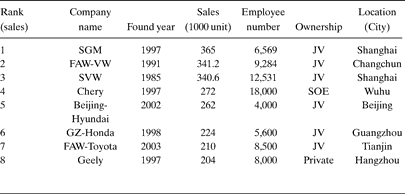
Over the past two decades, Chinese government policy has favored the creation of larger automobile production units as well as the concentration of production in specific geographical areas, especially in coastal cities. This has led to geographically uneven development and distribution of the automobile industry. Table 5 shows the locations of the top eight passenger-car makers in China in terms of market sales.
Main Statistics of the Top Eight Passenger Automakers in China (2006)Footnote 45
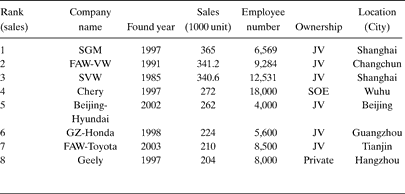
Meanwhile, the desire of local governments to attract investment and to develop their local automobile sectors has led to strong regional protectionism.Footnote 46 This intensifies the post-reform competition among local governments to attract new investments, typically bent to investors' demands. This regional competition also brings our attention to the issue of domestic labor market competition and its undermining effects on Chinese workers' solidarity. According to a manager who had worked at two production bases of AF5 (one in Shanghai and the other in a smaller city) workers in the smaller city were considered to be more hardworking and obedient than those in Shanghai, and they were also willing to work for significantly lower wages.Footnote 47 The allegedly cheap and meek work force is probably an important reason why AF5 aggressively expanded its production base in this new location.
As the hypermobility of capital creates competition among workers of different countries and regions, how should unions and workers react to these new challenges and protect themselves? What will the future of Chinese autoworkers be?
The Potentials and Limits of Chinese Autoworkers
Silver argues that the scale and concentration of automobile production in the twentieth century repeatedly created automobile labor forces with strong “workplace bargaining power” due to their strategic position within an increasingly complex technical division of labor.Footnote 48 The increased scale and concentration of automobile production in China during the past decade has also resulted in a large number of Chinese autoworkers being concentrated in enormous plants in certain areas (see Table 5). In Changchun alone approximately 100,000 autoworkers are employed by the FAW Auto Group in its various auto factories. The generalized Fordist mass production and the widely adopted cost-cutting practice of lean production, such as just-in-time delivery and quality circles, have indeed increased the vulnerability of capital to disruptions in the flow of production and increased the potentialFootnote 49 workplace bargaining power of Chinese autoworkers.
For example, when over eighty student trainees at the power engine shop of AF4 suddenly walked out during a morning shift, several assembly lines had to stop for half a day before management was able to find and transfer enough hands from other workshops to get the lines running again.Footnote 50
The same assembly line production, however, homogenizes and deskills workers and makes it preferable to draw on latent reserve armies of labor with little or no industrial experience. Basic training for most assembly line positions can be carried out in a matter of days or weeks. The relatively high wages paid in the auto industry attract a wide range of candidates. The seamless replacement of production workers on automobile assembly lines and a large supply of newly proletarianized labor, including rural migrant workers with little or no industrial experience, suggest that the marketplace bargaining power of Chinese autoworkers is quite weak.
Moreover, to the extent that the current lean-and-dual model exists, the use of labor force dualism continues to undermine the structural foundations of solidarity between formal and temporary workers. From my interviews and observations on the shop floor, formal workers have mixed views on agency workers. Some formal workers expressed their sympathy for temporary workers, and their belief that everyone should be treated equally on the production lines. But some formal workers mentioned that agency workers had poor education and “bad manners” and that they would rather not have any contact with temporary workers after work. Management staff and some “old” workers with open-end contracts tended to believe that agency workers should feel lucky just to have such well-paid jobs, given their low qualifications and the oversupplied labor markets, even though they were paid much less than formal workers.
On the other hand, agency workers felt a lack of support from formal workers and a sense of disempowerment on the shop floor. They complained about how they had to shoulder a greater work burden while being denied equal access to workplace resources. Some mentioned how resentful they felt about being criticized harshly by formal workers for making a small mistake. Chinese workers have been divided by different terms of labor contracts, education and skill levels, seniority, rural-urban household registration, and geographic region. In addition, as mentioned earlier, the Chinese Party-State and the dependent factory labor unions are still capable in mediating conflicts and manipulating workers' articulation of grievances, indicating a weak associational power of Chinese workers.
Finally, regarding the Chinese autoworkers' bargaining power, it is important to consider the conditions faced by autoworkers today at the late stage of the “product cycle” of the world automobile industry, i.e., the intense worldwide competition and overcapacity faced by the industry and its workers. Late developers, such as China, may experience the social contradictions of capitalist development without the benefits that might allow them to deal with those social contradictions successfully.Footnote 51
Moreover, China's WTO entry is widely expected to put additional pressure on all the country's automobile enterprises. The drive to increase productivity will coincide with the reduction of privileges and protections of formal workers and a homogenization of conditions among autoworkers, with the despotic factory regime becoming generalized. As such, there is good reason to expect that the dynamic of labor-capital relations in the Chinese automobile industry will move toward a lean-and-mean model. In this case, formal and temporary workers will share similar grievances and will be likely to forge solidarity despite the differences in their social origins.
While the evidence may lead to a pessimistic view on the future of Chinese autoworkers, it is very important to remember that the “idea of power” itself has been an important source of workers' power.Footnote 52 As incisively stressed by Silver, “Mobilizations over the past century have been fueled by the belief that workers do indeed have power and, moreover, that their power can be used to effectively transform their conditions of work and life for the better. What globalization has done more than anything else is to ‘puncture this century-old belief in worker power’ and to create a discursive environment that has dramatically deflated popular political morale and the willingness to struggle for change. Such shifts in workers' beliefs partly mirror shifts in structural and associational bargaining power but, no doubt, also play a role of their own in dynamics of labor movements.”Footnote 53
Thus, there is an urgent need to confront neoliberal ideology and to raise workers' recognition of their own bargaining power. Some recent studies have suggested the tendency and potential of Chinese workers to join with other social groups in struggles to demand greater inclusion in public life “with claims for workers as citizens with legal rights.”Footnote 54 This may open the opportunity for further collective mobilization of Chinese autoworkers even in the face of formidable political barriers.Footnote 55