Introduction
Aging is commonly found to be associated with diminished performance on tasks purportedly measuring executive functioning or cognitive control (e.g., Keys & White, Reference Keys and White2000). Little is known, however, about the underlying cognitive processes that mediate this diminished performance. Next to executive processes, such as the capacity to display behavioral flexibility and working memory, many executive function tests, such as card-sorting tasks [e.g., the Wisconsin Card Sorting Test (WCST) and its variants] tap episodic memory as they also require learning and memorization of rules. Hence, a deficit in memory may negatively influence the performance on executive tests. In agreement with this suggestion, Giovagnoli (Reference Giovagnoli2001) observed a decline in WCST performance in epilepsy patients with left hippocampal sclerosis, and suggested that this may be the result of deficits in the initial learning and memorization of rules. Episodic memory has similarly been implicated in a computational model of set switching, and may be crucial for memorizing task codes representing the rule (Altmann & Gray, Reference Altmann and Gray2008). A handful of studies have additionally shown that episodic memory predicts performance on executive functioning tasks in older people. For example, a correlational study revealed that episodic memory in older people with vascular risk factors uniquely predicts the performance on the Trail Making Task (Oosterman et al., Reference Oosterman, Vogels, van Harten, Gouw, Poggesi, Scheltens and Scherder2010). Similarly, a strong association between episodic memory impairment and impaired performance on executive function tasks was reported in Alzheimer patients (Baudic et al., Reference Baudic, Barba, Thibaudet, Smagghe, Remy and Traykov2006). Recent studies also indicate that the medial temporal lobes, brain regions that are crucially involved in episodic memory performance, also are important for executive function performance. Such results have been found in healthy young participants (Takahashi et al., Reference Takahashi, Kato, Hayashi, Okubo, Takano, Ito and Suhara2007, Reference Takahashi, Kato, Takano, Arakawa, Okumura, Otsuka and Suhara2008), and in normal (Oosterman et al., Reference Oosterman, Vogels, van Harten, Gouw, Scheltens, Weinstein and Scherder2008, Reference Oosterman, Vogels, van Harten, Gouw, Poggesi, Scheltens and Scherder2010) and pathological (Bastos-Leite et al., Reference Bastos-Leite, van der Flier, van Straaten, Staekenborg, Scheltens and Barkhof2007; Nagata et al., Reference Nagata, Shinagawa, Ochiai, Aoki, Kasahara, Nukariya and Nakayama2011; Oosterman, Oosterveld, Olde-Rikkert, Claassen, & Kessels, Reference Oosterman, Oosterveld, Olde-Rikkert, Claassen and Kessels2012) aging.
These studies all suggest that episodic memory is involved in tasks that were specifically designed to tap executive functioning. However, these previous studies are limited in being fully based on correlational results and between-task comparisons. The present study therefore further investigated the hypothesis that age-related decrements in associative learning and memory predict a substantial part of the age-related decline in executive function performance. To disentangle the contribution of episodic memory and executive control processes to executive function task performance, a rule induction task was developed in which we established different conditions varying in episodic memory and executive function load. It was expected that older adults would perform worse than young adults on this task, not only at a high level of complexity that presumably requires both episodic and executive control processes, but also at an easier level of rule induction performance, which solely relies on episodic memory. This would then suggest that the age-related decline in rule induction performance is indeed partly due to episodic memory difficulties. In addition, neuropsychological tests of memory and executive function were administered to substantiate the involvement of these functions in the different conditions of the rule induction task. Here, we distinguished between verbal and visual episodic memory, working memory, inhibition, flexibility, and switching, with the latter four functions representing different aspects of executive functioning.
Methods
Participants
Twenty-six younger (aged 19–35 years) and 27 community-dwelling older participants (aged 50–91 years) were included in the present study. Participants were recruited via the network of the researcher (i.e., acquaintances, family members). Exclusion criteria for all participants were neurodegenerative disorders (e.g., dementia, Parkinson's disease), history of severe psychiatric diseases (e.g., current severe depression, schizophrenia), and neurological disorders (e.g., stroke, multiple sclerosis) (self-report questionnaire). In addition, all older participants completed the Mini Mental State Examination (Folstein, Folstein, & McHugh, Reference Folstein, Folstein and McHugh1975) to exclude potential severe cognitive decline (all obtained a score of 26 or higher). The study was conducted in accordance with the Helsinki Declaration.
Educational level was measured with a 7-point ordinal rating scale in accordance with the Dutch educational system, ranging from less than primary education (level 1) to university degree (level 7). These ordinal scores equal approximately the following number of years of education as used in the United States (Bouma, Mulder, Lindeboom & Schmand, Reference Bouma, Mulder, Lindeboom and Schmand2012, p. 19): Level 1, incomplete primary education: 1–5 years; Level 2, primary education: 6 years; Level 3, incomplete lower secondary education: 7–8 years; Level 4, lower general secondary education: 7–9 years; Level 5, vocational education: 7–10 years; Level 6, higher general secondary/higher vocational/pre-university education: 7–16 years; Level 7, academic degree: 17–20 years.
Rule Induction Task
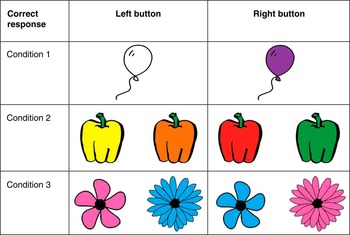
In the employed rule induction task, participants had to induce the rules enabling them to respond correctly to different stimuli, based on accuracy feedback. Three conditions were included (see Figure 1). Condition 1 consisted of a simple two-rule learning task, in which a single feature was indicative of the response. For example, participants had to learn that a white balloon indicated pressing the left button, whereas a purple balloon indicated pressing the right button. In this baseline condition, only two exemplars of the “color” feature had to be acquired and memorized and coupled to a specific response. Therefore, the task complexity was low, with performance reflecting mainly basic associative learning and (episodic) memory processes and requiring the memorization of only two rules. In Condition 2, the number of rules was increased in that four simple rules had to be acquired and memorized (e.g., a single shape presented in four different colors: respond left to yellow and orange peppers, respond right to red and green peppers). These rules can still be assumed to have a low complexity, since they are based on the coupling of exemplars of a single feature to a response. The number of exemplars that have to be memorized (four) is increased compared to the baseline condition (two), thereby increasing episodic memory load (see also Maes & Eling, Reference Maes and Eling2007). Finally, Condition 3 increased complexity by requiring biconditional learning. A specific combination of exemplars of different features had to be learned to respond correctly, rather than learning single stimulus-response associations. Such biconditional tasks are known to engage prefrontal cortex processes (Haddon & Killcross, Reference Haddon and Killcross2006). For example, when a small flower was presented in blue, the left button should be pressed, whereas the right button was correct when a large flower was presented in blue. The opposite keys corresponded to these flowers being presented in pink; this time, the right button was correct when the small flower was presented and the left button should be pressed in response to the large flower. Therefore, neither exemplar of the features “shape” nor “color” in itself is sufficient to indicate the correct response, but it is the unique conjunction of exemplars from the two features that defines the correct response.
An illustration of the simple two-rule condition (first row), the four-rule condition in which responses were based on a single feature (e.g., color, second row) and the more complex condition requiring bi-conditional learning (third row). Performance is expressed as the number of trials needed to complete a condition. Eight consecutive correct answers were needed; if a participant failed to complete a condition, the maximum number of trials was recorded (50 for Condition 1 and 100 for Conditions 2 and 3).

Compared to Condition 1, episodic memory load was increased in Condition 2, since more exemplars and rules had to be memorized. A disproportionate age-related performance decline was therefore expected in Condition 2 compared to Condition 1. Also, strong correlations between episodic memory performance and performance on Conditions 1 and 2 were expected. The crucial difference between Conditions 2 and 3 is their complexity. In both conditions, the participant had to learn and memorize four stimulus-response associations (either four colors in Condition 2, or four combinations of two colors and two shapes in Condition 3), resulting in four rules in both conditions. The complexity of the rule was, however, increased, since it was based on a unique combination of features. Condition 3 should theoretically recruit both episodic memory and executive function processes, a claim which was empirically evaluated by correlational analysis using the performance on standard neuropsychological tests. Because of the proposed additional involvement of executive function in Condition 3, we expected the largest difference between the young and older participants to become evident in this condition. Finally, hierarchical regression analyses (see below) were used to address our primary research question, whether episodic memory performance indeed significantly contributes to the expected age-related difference in Condition 3 performance.
Procedure
Participants were instructed to respond to a stimulus presented on a computer screen by pressing either a left or a right button on the keyboard. They were instructed that certain rules determined which key should be pressed in response to each stimulus, but that they had to induce these rules based on feedback they received following each response.
Each condition terminated after eight consecutive correct trials or if the maximum number of trials was reached (50 for Condition 1 and 100 for Conditions 2 and 3). The total number of trials needed to complete a condition was used as outcome variable; the maximum number of trials (50 for Condition 1 and 100 for Conditions 2 and 3) was recorded in case a condition was not successfully completed. Since the first two conditions consisted of a single stimulus feature only (e.g., color) and the third condition of two features (color and shape), two task versions were created. One version used color as the feature in Conditions 1 and 2 and the other version used shape as the feature. In both tasks, the third condition consisted of the same color-shape combinations. Participants were pseudo-randomly assigned to the different task versions, with task version being counterbalanced across the two age groups.
Neuropsychological Tests
Next to the rule induction task, participants completed the immediate and delayed recall measures of the Rey Auditory Verbal Learning Test (RAVLT; Van der Elst, Van Boxtel, Van Breukelen, & Jolles Reference Van der Elst, van Boxtel, van Breukelen and Jolles2005) and the Visual Paired Associates (VPA) test of the Wechsler Memory Scale – Revised (WMS-R; Wechsler, 1987) to measure verbal and visual episodic memory respectively. Working memory was assessed with the Letter-Number Sequencing (LNS) task of the Wechsler Adult Intelligence Scale III (WAIS-III; Wechsler, Reference Wechsler2000), switching with the Modified Card Sorting Test (MCST, categories and total errors: Nelson, Reference Nelson1976), flexibility with the TMT-B (Bowie & Harvey, Reference Bowie and Harvey2006: using the ratio score TMT-B/TMT-A), and inhibition using the Stroop Color/Word (C/W) card (Van der Elst, Van Boxtel, Van Breukelen, & Jolles Reference Van der Elst, Van Boxtel, Van Breukelen and Jolles2006: using the interference score Stroop C/W divided by Stroop Color card). With regard to the TMT-B and Stroop C/W tasks, proportion scores were used since these provide more pure measures of executive function processes (Oosterman et al., Reference Oosterman, Vogels, van Harten, Gouw, Poggesi, Scheltens and Scherder2010; Stuss, Bisschop, et al., Reference Stuss, Bisschop, Alexander, Levine, Katz and Izukawa2001; Stuss, Floden, Alexander, Levine, Katz, Reference Stuss, Floden, Alexander, Levine and Katz2001). All tasks were administered in a fixed order: MMSE, RAVLT-immediate recall, MCST, RAVLT-delayed recall, VPA-immediate recall, TMT, Stroop, LNS, VPA-delayed recall, and the rule induction task.
Statistical Analysis
To examine whether an effect of task version was present, we performed a repeated-measures analysis of variance (ANOVA) with the number of trials to complete the task condition as dependent variable, Condition (1–3) as within-subject factor and Task Version as between-subject factor. Because of distribution differences between the age groups, nonparametric Mann-Whitney U tests were used to test for potential age differences in the three conditions of the rule induction test. To examine whether an increase in memory load (i.e., from Condition 1 to Condition 2) and an increase in executive function load (i.e., from Condition 2 to Condition 3) indeed induced a disproportionate age-related decline in task performance, difference scores (Condition 2 minus 1, Condition 3 minus 2) were calculated and age effects were examined using Mann-Whitney U tests.
To examine the relationship between the rule induction task and the neuropsychological tests, the following steps were taken. First, cognitive domain scores were calculated for some neuropsychological tests to reduce the number of outcome variables. To accomplish this, scores were transformed to standardized Z-scores based on the average performance of the younger age group. Next, these standardized scores were unified into domain scores, which consisted of a verbal episodic memory domain (composed of the immediate and delayed recall measures of the RAVLT test), a visual episodic memory domain (composed of the immediate and delayed recall measures of the VPA test), and a switching score (composed of MCST categories and errors). For working memory, flexibility, and inhibition, the single test results were used for the analyses. Spearman correlations between the performance on these tasks and the rule induction conditions were calculated. Identified significant correlations were subsequently subjected to stepwise regression analysis to determine the unique contribution of the neuropsychological test performances to rule induction performance. Since immediate and delayed memory indices were included in the same domain (e.g., immediate and delayed RAVLT performance for the verbal memory domain), and it is known that immediate and delayed memory constitute partially separable processes dependent on different neural correlates (Neuner et al., Reference Neuner, Stöcker, Kellermann, Kircher, Zilles, Schneider and Shah2007), additional analyses were performed in which the rule induction conditions were correlated with immediate memory and delayed memory performance of each task separately.
Finally, (hierarchical) regression analyses were used to determine the extent to which the different cognitive functions mediate the age-related decline in rule induction performance. First, the proportion of variance explained in rule induction performance was analyzed with regression analyses in which age group was the only predictor. These analyses were next compared to the outcomes of hierarchical regression analyses in which those neuropsychological scores that significantly predicted performance on the rule induction task were entered before entering age group as a predictor variable. With these analyses, one can directly estimate the proportion of variance accounted for by age that is due to the decline in episodic memory and executive function performance. This was accomplished with the following formula: (R 2 age−ΔR 2 age)/R 2 age, in which R 2 age represents the proportion of variance accounted for by age, and ΔR 2 age represents the addition of age after controlling for the respective neuropsychological score(s). For these analyses, if necessary, data were normalized using the minimum amount of transformation (Osborne, Reference Osborne2002) that provided a good fit of the data [square root, logarithmic, or rank-based inverse normal transformation (Blom transformation)]. Analyses with regard to age effects and neuropsychological predictors were performed one-tailed, alpha was set at 0.05 for all analyses.
Results
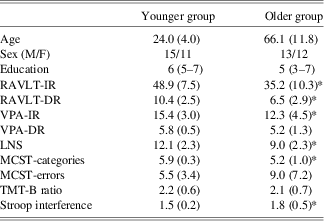
Significant group differences with regard to the neuropsychological test scores were present for all test variables except the VPA-delayed recall, the MCST-errors and the TMT-B ratio score (see Table 1). Two older participants failed to complete even the most simple two-rule condition of the task; these participants were therefore excluded from the subsequent analyses. Inspection revealed that these participants had a high to very high age (79 and 91, respectively), average levels of education (scores 4 and 5 on a scale of 1–7, reflecting completed general and pre-vocational secondary education, respectively) and normal levels of general cognitive functioning (MMSE of 28 for both participants). One older participant failed to complete Condition 2, and 4 older participants failed to complete Condition 3; in these instances, the maximum number of trials (100) was recorded as score. Characteristics of the participants are presented in Table 1. No significant group differences in education (U = 246.0; z = −1.59; p = .11) or sex distribution (χ2(1) = 0.17; p = .68) were present. ANOVA did not reveal a main (F(1,49) = 0.21; p = .65, ηp 2 = 0.00) or interaction (Greenhouse-Geisser adjustment: F(1.47,72.21)=1.98; p = .16; ηp 2 = 0.04) effect with respect to task version, indicating that task version did not affect performance.
Characteristics of the younger and older participants

Note. *Level of significance was set at p < .01 to correct for multiple tests. Means (standard deviations) are reported for age and the neuropsychological test scores of the different groups. Frequencies are reported for sex distribution, education represents median score (range). The t-tests were performed to compare neuropsychological test performance between the different groups.
DR = delayed recall; IR = immediate recall; LNS = Letter-Number Sequencing; MCST = Modified Card Sorting Test; RAVLT = Rey Auditory Verbal Learning Test; TMT-B ratio = Trail Making Test B/A; VPA = Visual Paired Associates.
Age Effects
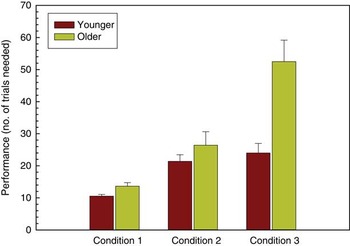
Results of the rule induction test are presented in Figure 2. Mann-Whitney U test revealed that age differences were already present for the easiest rule induction task condition (U = 434.0; z = 2.08; p = .02), the two-rule Condition 1. Younger participants needed fewer trials to induce the rule than older adults. The age groups did not differ with respect to the number of trials needed to solve Condition 2 (U = 342.0; z = 0.32; p = .37). Finally, the third condition, which requires biconditional learning, revealed a significant effect of age (U = 485.50; z = 3.03; p < .01), indicating that fewer trials were needed by the younger participants.
Performance of the younger and older participants on the rule induction task. Condition 1 reflects the simple two-rule learning condition, Condition 2 the 4-rule learning condition and Condition 3 the bi-conditional learning condition. Performance represents the number of trials needed to complete a rule and is expressed as means (±SE).

With regard to the difference scores, the two age groups did not differ on the Condition 2 - Condition 1 score (U = 307.0; z = −0.34; p = .37) whereas they did on the Condition 3 - Condition 2 difference score (U = 467.5; z = 2.69; p < .01).
Neuropsychological Correlates
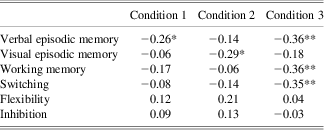
Spearman correlations (see Table 2) revealed that verbal memory was the only correlate of Condition 1. Visual episodic memory correlated with Condition 2 performance, whereas working memory, verbal episodic memory and switching correlated with Condition 3. In all instances did an increase in neuropsychological test performance relate to a decrease in the number of trials needed to induce the rule. There was no obvious difference in the correlations of the immediate and delayed memory indices with the different conditions (data not shown); therefore, the visual and verbal memory domains were used for the subsequent analyses.
Correlations between the rule induction conditions and the neuropsychological scores

Note. A higher score represents better performance with the exception of the three conditions of the rule induction test, the flexibility and the inhibition score.
*p < .05.
**p < .01.
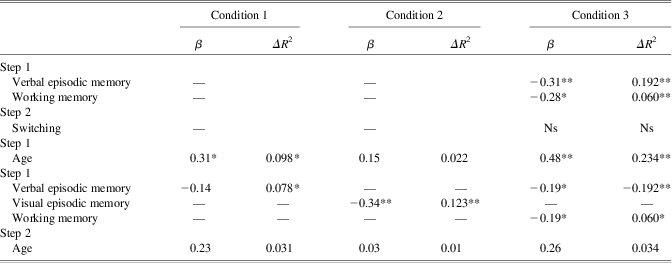
To determine the unique contribution of the neuropsychological test scores to the performance in the rule-induction conditions, multiple regression analysis (see Table 3) was performed for Condition 3 (not Condition 1 and 2, since only a single significant neuropsychological correlate was observed for these conditions). First, verbal episodic and working memory were examined concurrently with a stepwise selection method, since both were similarly associated with task performance, followed by switching. This analysis revealed that verbal episodic memory was first included in the model, followed by working memory. After these memory variables were included, the contribution of switching to the model was no longer significant.
Predictive value of age and the neuropsychological test scores for the rule induction conditions

Note. In the upper part, results from a stepwise hierarchical multiple linear regression analysis for Condition 3 are presented. In the lower part, main effects of age are presented together with hierarchical analyses in which neuropsychological predictors were entered prior to entering age. Beta values represent beta's of the final model.
*p < .05.
**p < .01.
Next, we tested to which extent these neuropsychological measures mediate the age-related variance in rule induction performance (see Table 3). Main effects of age group were analyzed first. Age group explained 9.8% (p = .01) of the variance in the Condition 1 score, 2.2% (p = .15) of the variance in the Condition 2 score, and 23.4% (p < .01) of the variance in Condition 3. Repeating the analysis for Condition 1 while first including verbal episodic memory revealed that the contribution of age group was no longer significant (ΔR 2 = 0.031; p = .10). This indicates that verbal episodic memory explains 68.4% of the age-related variance in Condition 1 performance. With regard to Condition 2, controlling for visual episodic memory reduced the proportion variance accounted for by age to 0.1% (p = .41), indicating that visual episodic memory accounts for 95.5% of the age-related variance in Condition 2 performance. Hierarchical regression analyses with number of trials in Condition 3 as dependent variable and verbal episodic and working memory as initial predictors indicated that, after including these neuropsychological scores, the contribution of age group was no longer significant (ΔR 2 = 0.034; p = .07). This analysis reveals that verbal episodic and working memory together account for approximately 85.5% of the age-related variance in Condition 3 performance.
Discussion
The main aim of this study was to examine whether the age-related decline in executive function performance is partially the result of a decline in episodic memory performance. For this, we used a rule induction task in which we varied the involvement of episodic memory and executive function processes. Several findings support the notion that diminished episodic memory may indeed—at least partially—underlie impaired performance on executive function tasks at an older age. First, age differences were present for the simplest two-rule condition, which requires simple associative, stimulus-response learning. The involvement of episodic memory in this condition was substantiated by a subsequent correlational analysis, which revealed a significant relationship between this condition and verbal episodic memory, but not other cognitive functions. Also, the older group performed significantly worse on the third, most complex condition of the rule induction task, and episodic memory proved to be an important independent predictor of performance in that condition. Finally, hierarchical regression analyses confirmed that controlling for episodic memory removed nearly all of the age-related variance in Condition 1 and 2 performance, whereas the combination of episodic and working memory removed most of the age-related variance in Condition 3 performance. With regard to this latter finding, inspection of the beta-weights indicates that episodic memory was a slightly stronger correlate of Condition 3 performance compared to working memory, supporting the importance of this function in rule induction tasks. Nonetheless, it is important to realize that Condition 3, which presumably requires both episodic memory and executive function, revealed by far the strongest age-related decline in performance. Apparently, an increase in complexity, together with a presumed increase in prefrontal control processes, is most sensitive to the effects of aging. Whether this indicates that prefrontal control processes are indeed the most vulnerable to the effects of aging, or whether this is still partly due to the increased involvement of episodic memory processes in this condition, remains to be determined. The fact that verbal episodic memory was the strongest predictor of Condition 3 performance, accounting for over 19% of performance (after which working memory added another 6%), still supports the idea that episodic memory is crucial for intact executive function performance. More specifically, the contribution of verbal episodic memory to rule induction performance was increased in Condition 3 (19.2%) compared to Condition 1 (7.8%). Taken together, the present study suggests that an important part of the age-related decline in rule induction performance may be a direct result of a decline in more “basic” learning and memorization abilities, thereby supporting the idea that a decline in episodic memory reduces executive function performance at an older age.
The involvement of working memory in Condition 3 can be explained by assuming that this condition places the heaviest demands on updating, one of the crucial functions of working memory (Miyake et al., Reference Miyake, Friedman, Emerson, Witzki, Howerter and Wager2000). Effectively, this condition requires participants to keep track of the previous encountered combination of features and to actively couple that combination to the correct response. Moreover, as attention for neither feature alone is sufficient for solving this task condition, at least in the earlier stages of the learning process participants presumably frequently switch between the two dimensions. Error-induced switching in tasks that are conceptually similar to our task have indeed been shown to implicate prefrontal-associated working memory performance (e.g., Konishi et al., Reference Konishi, Kawazu, Uchida, Kikyo, Asakura and Miyashita1999).
An important question is whether the current findings are task-specific, or whether episodic memory is generally involved in executive task performance. The current results only support the former conclusion. However, previous studies have provided indirect evidence for a more general association between episodic memory and executive functions in that hippocampal functioning and integrity has been associated with executive task performance. Takahashi et al. (Reference Takahashi, Kato, Hayashi, Okubo, Takano, Ito and Suhara2007, Reference Takahashi, Kato, Takano, Arakawa, Okumura, Otsuka and Suhara2008) examined dopamine D2 receptor binding in the hippocampus in healthy young male participants and found a direct association between this binding potential and executive task performance. In addition, hippocampal atrophy has been associated with impaired performance on a wide range of executive function tests in non-demented as well as pathological aging (Bastos-Leite et al., Reference Bastos-Leite, van der Flier, van Straaten, Staekenborg, Scheltens and Barkhof2007; Nagata et al., Reference Nagata, Shinagawa, Ochiai, Aoki, Kasahara, Nukariya and Nakayama2011; Oosterman et al., Reference Oosterman, Vogels, van Harten, Gouw, Scheltens, Weinstein and Scherder2008, Reference Oosterman, Vogels, van Harten, Gouw, Poggesi, Scheltens and Scherder2010, Reference Oosterman, Vogels, van Harten, Gouw, Poggesi, Scheltens and Scherder2012). However, it remains to be determined whether it is merely the integrity of fronto-posterior networks that underlies these associations (Collette, Van der Linden, Delrue, & Salmon, Reference Collette, Van der Linden, Delrue and Salmon2002) or whether a unique involvement of episodic memory in executive task performance is present. Nonetheless, the complex and heterogeneous nature of executive functions by definition indicates that these functions reflect an integration of multiple processes, one of which may be episodic memory.
In general, a decline in executive function has been one of the most consistent reported findings in the aging literature, and has often been ascribed to reduced prefrontal cortex functioning and integrity (Head, Kennedy, Rodrigue, & Raz, Reference Head, Kennedy, Rodrigue and Raz2009; Head, Rodrigue, Kennedy, & Raz, Reference Head, Rodrigue, Kennedy and Raz2008; Keys & White, Reference Keys and White2000; Salthouse, Reference Salthouse2009, Reference Salthouse2011). Moreover, executive functions have been identified as a key correlate of intact instrumental activities of daily living (IADL; Johnson, Lui, & Yaffe, Reference Johnson, Lui and Yaffe2007; Vaughan & Giovanello, Reference Vaughan and Giovanello2010) and may even predict future functional decline (Cahn-Weiner et al., Reference Cahn-Weiner, Farias, Julian, Harvey, Kramer, Reed and Chui2007; Johnson, Lui, & Yaffe, Reference Johnson, Lui and Yaffe2007). One very important implication of the current findings is that episodic memory may mediate part of these observations. The importance of episodic memory in functions such as IADL has been suggested by some previous studies (Cahn-Weiner et al., Reference Cahn-Weiner, Farias, Julian, Harvey, Kramer, Reed and Chui2007; Koehler et al., Reference Koehler, Kliegel, Wiese, Bickel, Kaduszkiewicz, van den Bussche and Pentzek2011), although it remains to be determined whether episodic memory performance is useful in predicting future functional decline (Cahn-Weiner et al., Reference Cahn-Weiner, Farias, Julian, Harvey, Kramer, Reed and Chui2007). Future studies should focus on the role of episodic memory in the executive function-decline in aging, together with a possible impact on IADL in pathological aging. From a clinical perspective, the current findings suggest that caution is required when interpreting neuropsychological test performance of patients characterized by memory disturbances, such as Alzheimer's disease patients. In these patients, executive function deficits, including problems with rule induction tasks such as the WCST, have frequently been reported (e.g., Chen et al., Reference Chen, Chen, Cheng, Hua, Liu and Chiu2009; Paolo, Axelrod, Tröster, Blackwell, & Koller, Reference Paolo, Axelrod, Tröster, Blackwell and Koller1996), but the present findings indicate that such patterns of results may partially be due to diminished episodic memory.
A point that deserves consideration is that no age differences were present for the second condition, which also might have contributed to the absence of an age effect for the score reflecting the difference between Conditions 1 and 2. A priori we hypothesized these two outcome variables to be very sensitive to the effects of age. Age effects were present for the other two conditions, indicating that functional differences may be present between Condition 2 on the one hand and Conditions 1 and 3 on the other. The neuropsychological correlates support this possibility: whereas Condition 2 correlated with visual, but not verbal, episodic memory, the other two conditions were associated with verbal, but not visual, episodic memory. This finding could indicate that visual episodic memory is not particularly sensitive to the effects of age (Fjell et al., Reference Fjell, Walhovd, Reinvang, Lundervold, Dale, Quinn and Fischl2005; Sekuler, Kahana, McLaughlin, Golomb, & Wingfield, Reference Sekuler, Kahana, McLaughlin, Golomb and Wingfield2005), as evident in the intact Condition 2 performance of older adults together with the finding that the older adults did not perform worse on the VPA delayed recall task compared to the younger participants. Nonetheless, other studies have shown age-related declines in visual memory (Naveh-Benjamin & Craik, Reference Naveh-Benjamin and Craik1995; Naveh-Benjamin, Hussain, Guez, & Bar-On, Reference Naveh-Benjamin, Hussain, Guez and Bar-On2003), indicating that further research on this topic is warranted. Possibly, the visual nature of the neuropsychological tests and of Condition 2, was less demanding compared to the verbal demands of Conditions 1 and 3. This issue needs to be examined in future studies in which the complexity of the stimuli to be remembered is systematically increased, together with the extent to which age effects become present at increasing levels of complexity.
An alternative interpretation is that older participants needed more time to acquire the cognitive set associated with the task than the younger participants. This could explain why the age differences that were present on Condition 1 did not persist onto Condition 2. One way to circumvent potential side effects of difficulty to acquire cognitive set is to randomize or counterbalance the order of administration of the task conditions, which we did not do in our study. However, an account of the age difference in Condition 1 solely in terms of a difference in set formation is at odds with the finding that controlling for episodic memory removed the age group differences on Condition 1. Apparently, the age difference in Condition 1 performance reflects some influence of episodic memory, not merely task familiarity. In addition, a significant age effect was found for the difference score Condition 3-2, but not for the difference score Condition 2-1. This is in agreement with the notion that Condition 3 requires two distinct cognitive processes for successful performance, namely episodic and working memory, and that both processes are susceptible to the effects of aging.
Some limitations of the present study need to be addressed. First of all, the interpretation of neuropsychological predictors of rule induction performance is based on correlational analyses. Next to the fact that most correlations were of moderate magnitude, no causal relationships can be derived from such data. In addition, it is possible that the extent to which neuropsychological test scores accounted for the age-related variance in rule induction performance actually reflects the involvement of an underlying, unmeasured, third factor. We cannot rule out this possibility, but the fact that the neuropsychological scores accounted for the vast majority of the age-related variance in rule induction performance does indicate some unique involvement of episodic and working memory processes in our rule induction task. Related to this issue, both the rule induction conditions and the most important neuropsychological correlates rely on verbal processes. The significant association between performance on the neuropsychological tests and performance in the rule induction conditions (with the exception of Condition 2) might therefore merely reflect a difference in the participants’ verbal capacities. Nonetheless, such an explanation cannot account for the fact that both verbal episodic and working memory independently contributed to Condition 3 performance nor for the fact that these two neuropsychological functions accounted for most of the age-related variance in Condition 3 performance.
Also, participants (both younger and older ones) consisted of relatives and acquaintances of the researcher, which limits generalizability of the results to the general population. Similarly, since the researcher was familiar to the participants, we cannot rule out that demand characteristics (e.g., comply with the experimenter's expectations) have influenced the results. Finally, probably the best way to address episodic memory involvement in the rule induction task is by testing delayed recall of the specific rules of each condition. Since this was not accomplished in the present study, the results should be interpreted with these limitations in mind.
To summarize, this study provides evidence that part of the age-related decline in simple and complex rule induction performance may be the direct result of a decline in episodic memory. Further studies are needed that examine the extent to which episodic memory is involved in other executive functions as well.
Acknowledgments
We thank four anonymous reviewers, whose comments helped us to significantly improve the article. R.P.C.K. was funded by a VIDI innovational grant from the Netherlands Organization for Scientific Research (NWO, no. 452-08-005). This research received no other specific grant from any funding agency, commercial or not-for-profit sectors. There are no conflicts of interest.