This paper analyzes the evolution of the French sovereign debt in the ten years following Napoleon's defeat at Waterloo. At the end of 1815, incentives for an investor to buy French sovereign bonds were low as France's prospects looked terrible. Following Waterloo, France lost 5,000 square km of territory as it was returned to its 1790 borders, it also agreed to pay 700 million francs as war reparations and to shoulder the occupation costs of the coalition's 150,000 men. At the time, the track record of French public finance was also terrible. Not surprisingly, the yield on traded debt jumped to 8.6 percent in 1815, whereas comparable yields on British consols did not even reach 5 percent.
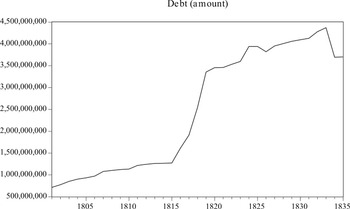
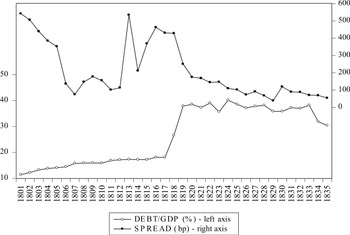
One might have thus expected France to have had trouble issuing debt and, if it did manage to do so, to have had to pay dramatically high interest rates to compensate bondholders for their risks. Yet this was not the case: as shown in Figures 1 and 2, between 1815 and 1825 France managed to issue so many bonds that its debt increased threefold (Figure 1), while at the same time the yield on public bonds fell. Bondholders’ confidence increased so much that by 1825 the spread between the French and British sovereign bonds was only 1 percent. In terms of Debt/GDP (gross domestic product) the figures rose from 10 percent to about 40 percent (Figure 2). Even if such percentages may look small nowadays, with the structure of taxation existing at the time this represented a serious burden. This is especially true if one takes as comparison point taxation during the Ancien Régime when the fragmented fiscal system limited tax collection and hence government revenues (Hoffman and Rosenthal Reference Hoffman, Rosenthal, Droback and Nye1997). If one looks at the evolution over the whole nineteenth century (Figure 2), the spread following Waterloo stands out as extremely large.Footnote 1
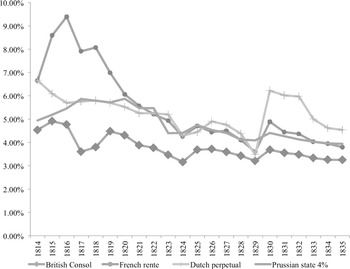
The evolution of the French yields is also striking if one compares France with other countries such as Prussia or The Netherlands (Figure 3). At the end of 1814, French and Dutch yields were similar but then the two series diverged as the price of the French bond dramatically dropped. It would take until 1821 for French yields to come back to a value close to the Dutch and Prussian ones.
This paper aims to understand how France resurrected its public finances after Waterloo. Only a firm commitment to honor its debt could have led investors to revise their vision of French public finance. The establishment of a Constitutional Monarchy in 1815 was not enough to reassure the market as French yields increased up until the beginning of 1817. We argue that two elements, the Coalition's threat not to leave France and the improvement of institutions (most notably the defense of the Constitutional Monarchy) explain the reversal in investors’ perceptionof French public finances. Both of these, we argue, had their source in an arrangement brokered by the Duke of Wellington that simultaneously furnished France with needed resources through the Baring loan and induced France to shore up its public finance institutions.
The system devised by the Duke of Wellington rendered the reimbursement incentive compatible for almost all parties. Twice restored Louis XVIII knew that he depended on the Allies’ goodwill to remain in power. He also knew that foreign troops were unpopular in France and that an early departure would be welcomed by the population. Improving French credit was thus crucial for him. The Allies in general were eager to get their dues. Forced to pay the reparations, France had to improve its credit and thus act in investors’ interest. By doing so, and thanks to the impetus provided by Baring, France managed gradually to regain a good reputation. New institutions guaranteeing repayment were created and the French government adopted a credible position when it stressed the priority given to debt reimbursement. Changes in yields show that markets understood that the Constitutional Monarchy was a form of government more likely to repay the debts than an Absolutist regime. Therefore spreads with the British consols increased whenever the Ultras (ultra-royalists who wanted to return to pre-1789 France) came to power. Paradoxically, Waterloo, by imposing reforms and a credible commitment to honor its debt, led to an improvement in French public finances.
French Public Debt, 1801–1835

The focus on the military and institutional explanations is however only legitimate if alternative explanations are first ruled out. The peace dividend or the improvement in French fiscal capacity could indeed explain investors’ positive view regarding the future of French public finances. The peace dividend is hard to gauge. On the basis of the values computed by Mark Dincecco (Reference Mark2011), both expenditures and revenues increased if one compares the last years before Waterloo (1810–1814) with the Restoration (1816–1820). Expenditures increased however much more than revenues. For the revenues to increase, tax collection must have improved as the French territory had been carved following the Paris Peace Treaty. As for changes in expenditures, they may partially be attributed to the war reparations. All belligerents were likely to benefit from peace. However, with the exception of The Netherlands, the yields of the Allies’ sovereign bonds did not experience a downward trend following the signature of the Paris Peace Treaty (Figure 3). To the contrary, Prussian and French yields increased. As for the British yields, they declined by a few basis points following the signature of the Treaty. The decline is however small in comparison to the overall spread between the French perpetual bond, the rente, and the British consol, suggesting that the Peace dividend had a marginal effect at most.
The French Debt-to-GDP Ratio and the French 5 Percent rente – British 3 Percent Consol Spread: Comparative Evolution, 1801–1835

Evolution of British, Dutch, French and Prussian Long Term Sovereign Bond Yields (31 December of Each Year)

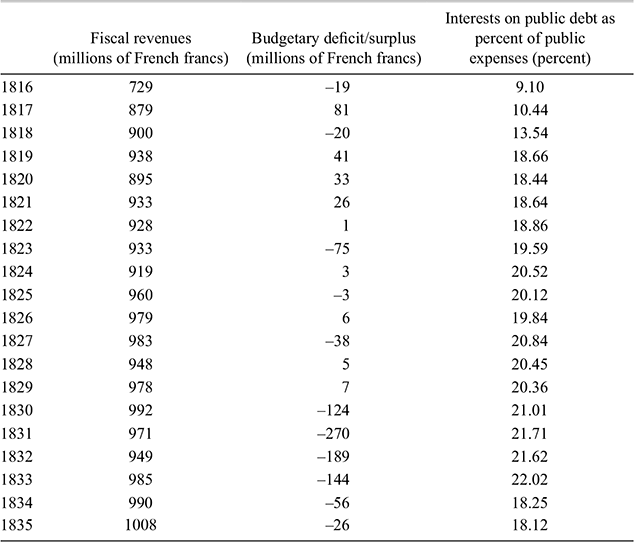
Improvement in fiscal capacity is another good candidate to explain the changes in yields. Only an important improvement in fiscal capacity could account for the dramatic decrease in the French yields. There is however no evidence of a large shockfor the period under consideration, the main improvement in terms of French fiscal revenues had occurred during the French Revolution. Indeed, following the fiscal centralization of 1790 revenues almost doubled (Dincecco Reference Mark2011, p. 52). By contrast, in the decades following the Napoleonic era, they levelled out. For example, revenues in 1820 were lower than for 1813–1814 (303,178,000 gold grams to be compared with an average of 371,445,000, Dincecco Reference Mark2011). It was only in 1840 that fiscal revenues experienced a new upward movement. As for the deficit, it remained more or less constant after 1815 alternating small surpluses with small losses (Dincecco Reference Mark2011) (see also Table 1). This is in sharp contrast with the previous period (1810–1814) when the budget was systematically in surplus.
The Evolution of Public Revenues and Expenditures between 1816 and 1835

Source:
Mitchell (1980) and Vaslin (Reference Vaslin1999).
SOVEREIGN DEBT, INSTITUTIONS, AND MILITARY THREAT
The yields on sovereign bonds are commonly used to assess the creditworthiness of a state. To take into account general market movements, the spread with a benchmark considered as a risk free asset is usually analyzed to determine the credit risk of sovereigns. Whereas for corporations financial elements are the main drivers of reimbursement, in the case of sovereigns, political elements may motivate a default. As financial assets, this dual risk renders sovereign bonds unique. For a sovereign, creditworthiness is therefore a function of the state of its public finances and of its government's willingness to repay its debt. The literature has emphasized several reasons which could explain why states eventually repay their debt (Oosterlinck Reference Oosterlinck2013). The willingness to maintain a good reputation is often presented as the key to understanding states’ good behavior (see for example, Eaton and Gersovitz Reference Eaton and Gersovitz1981; Bulow and Rogoff Reference Bulow and Rogoff1989). In the nineteenth century, sovereign bonds were not only financial instruments; they had often a role to play in international relations. Several papers stress that diplomacy and the relationship between borrower and lender had an impact on bond issues and prices (Feis Reference Feis1930; Ivanov and Tooze 2011; Oosterlinck and Ureche-Rangau 2012). Two other elements, military interventions and improvement in institutions, have been associated with a higher likelihood of reimbursement. Since these two points are central in the analysis, they are further developed hereafter.
Historically, bondholders could not depend on their military to enforce their claims abroad. Great-Britain refused most of the time to intervene (Platt 1968; Lipson 1989). Although French and German governments seemed to be more willing to support their bondholders, Barry Eichengreen and Richard Portes (1989) suggest causality may have been reversed. According to them, military actions were mostly driven by strategic or geopolitical considerations. For a long time, military sanctions were viewed as rare and isolated episodes (Lindert and Morton 1989; Lipson 1989). Kris Mitchener and Marc Weidenmier (2010) have challenged this view. They show that supersanctions (military interventions or political control applied following a debt default) were commonly used during the gold standard period. Sanctions differed from one case to the other and, as pointed out by Edwin M. Borchard (Reference Borchard1913), military interventions were limited to weak states. The French case following Waterloo differs dramatically from the cases traditionally mentioned in the literature. Indeed, France was occupied to guarantee it would pay reparations. Payment of the reparations and of the bonds used to finance these would lead to a reduction in military pressure. Furthermore, even though France had lost the war, its fiscal capacity was much higher than the capacity of the developing countries usually analyzed in the supersanction literature.
Another strand of the literature has attempted to determine to which extent good institutions could increase the probability of reimbursement. As pointed out by Douglas C. North and Barry R. Weingast (Reference Eichengreen, RichardPortes, Eichengreen and Lindert1989), having good rules is not sufficient if a sovereign can easily overthrow these rules. The conjunction of adequate rules and credible commitment is thus required. North and Weingast (Reference North and Weingast1989) argue that the constitutional changes following the Glorious Revolution dramatically altered the balance of power between the British Parliament and the Crown of England. By imposing limits on the power of the Crown, the new institutions protected property rights and reduced the likelihood that the state would renege on its obligations. North and Weingast (Reference North and Weingast1989) attribute the decline of the long-term borrowing rate (from 14 percent in 1693 to 3 percent in 1739) to these institutional changes. Nathan Sussman and Yishay Yafeh (Reference Kaplan2006) have reassessed the case of the Glorious Revolution. They find that new institutions did not immediately lead to a lower cost of government borrowing. They conclude that the rewards from institutional reforms take a long time to materialize. For the same historical episode, Gary W. Cox (Reference Cox2011) has stressed the importance of ministerial responsibility. Other elements certainly play a role in the development of public finance, and institutions are only part of the explanation. Sound institutions and a credible commitment are necessary but not sufficient conditions to see interest rates decline and public debt grow (Dincecco Reference Dincecco2009; Gelderblom and Jonker Reference Gelderblom and Jonker2011).
Sound institutions and credible commitment may emerge in different settings. In the seventeenth century's Dutch case, changes were gradual (Gelderblom and Jonker Reference Gelderblom and Jonker2011) whereas for the English case in 1688, it was the Glorious Revolution which brought about the changes (North and Weingast Reference North and Weingast1989). In both cases however, the changes were the result of endogenous evolutions. Following the Glorious Revolution, the institutional changes were nevertheless not enough to guarantee reimbursement. Indeed, as stressed by David Stasavage (Reference Stasavage2007) if political parties in power favored default, then one could question the credibility of the commitment. The French case following Waterloo provides additional insights regarding the impact of institutions on sovereign credit. The Napoleonic episode and the defeat led to the creation of new institutions. Furthermore, the context of the Restoration allows analyzing the role of politics and institutions with regard to debt reimbursement.
HISTORICAL CONTEXT
From 1790 to 1815, France was almost always in a state of war. The War of the Sixth Coalition (1812–1814) began when Russia refused to apply the continental blockade, the system devised by Napoleon to attack Great Britain's economy. Napoleon invaded Russia in June 1812 to force the Tsar back into compliance. The disastrous Russian campaign was followed by the loss of Germany in 1813. Napoleon abdicated on 6 April 1814 and was exiled to Elba. Eventually, the members of the coalition restored the throne of France to Louis XVIII. The First Treaty of Paris signed on 30 May 1814 was incredibly soft on France. Article 2 of the Treaty defined the borders of France as the ones existing on 1 January 1792. Article 18 declared a reciprocal waiver on all claims related to war. The coalition, however, imposed a constitutional monarchy on France. This represented a clear break with the Ancien Régime as many rights granted during the revolutionary and Napoleonic episodes were confirmed. Amongst others, the Charter (the new French constitution) guaranteed the public debt, equality before the law, due process, and protection of private property.
The Charter provided a radical departure from the Ancien Régime. Even if in theory the King was the only one allowed to suggest laws, in practice, the legislative power (represented by two Chambers, the Chambre des Pairs, with members appointed by the King for life or in an hereditary manner, and the Chambre des Députés, elected for five years by the “wealthy”) gained a greater say than ever before (Aglan Reference Aglan, Margairaz and Verheyde2006). The design of the electoral system led to an alignment of interest between electors and bondholders. Only citizens older than 30 years and paying a yearly amount of 300 FF (French francs) as direct contribution were allowed to vote. In practice, the approximately 100,000 citizens fulfilling this condition were from the wealthiest class. They were thus more likely to hold rentes. According to Pierre Larousse (Reference Larousse1869)Footnote 2 not only were almost all members of the Chambres des Pairs holding rente s, they also represented the main holders. Furthermore the rentes’ smallest denomination was of 50 FF of interest; an amount so high that it would have excluded most of the population at the time. The French case differs somewhat from the one discussed byStasavage (Reference Stasavage2007). In France, even the Ultras, known to be landholders, were willing to reimburse the debt, but they also wanted to compensate Emigrés aristocrats for the wealth they lost when they fled France during the Revolution. For the Ultras, in fact, compensating the Ancien Régime elite was probably more important than respecting the rights of French rentes holders.
This resolution of the Revolution collapsed in 1815 when Napoleon escaped from his exile in Elba. French troops joined the Emperor and Louis XVIII fled France again. To prevent a resurrection of an Empire ruled by Napoleon, the coalition sent troops to stop the French advance. Following his defeat at Waterloo on 18 June 1815, Napoleon lost the confidence of the chambers and was forced to abdicate for a second time on 22 June 1815. He was then sent to St. Helena, never to return.
The Allied restored the throne to Louis XVIII. Whereas the First Treaty of Paris had been quite favorable for France, the Second Treaty of Paris, signed on 20 November 1815 took a much harder stance. Whereas the First Treaty mentioned a just repartition of power, the Second Treaty emphasized the need to provide fair compensations for the past and solid guarantees for the future. Article one set the borders of France back to those of 1 January 1790. Article 4 fixed the war indemnity at FF 700 million. Article 5 imposed the presence of an Army of occupation (geographically stretched from Calais to the Swiss border). France would pay for the 150,000 men occupation Army as long as it would stay (between three and five years). An additional convention detailed the mode of payment of the war indemnity.
The Treaty's costs were extremely high. Eugene N. White (Reference White2001) estimates the overall payment made by France over the years at FF 1,863.5 million. To comply with the Treaty, France had to find funds. The budget was still burdened by unknown but large arrears inherited from the Empire and by the claims made by the Emigrés (White Reference White2001;Gontard 2000, p. 137). Repudiating the debt from the previous regime was hardly feasible for several reasons. First, it would have ruined the rentiers. Second, it would have given a bad signal to the markets at a time when the state knew it needed credit as it was impossible to cover reparations by relying on tax increases.Footnote 3 Eventually, repudiating the debts would have been inconsistent with the pledge to honor public debts made in the Charter a few months before. Therefore, an order dated 28 July 1815 explicitly recognized the debt from the Empire (Kang Reference Kang and Pierre-CyrilleHautcoeur2007).
On the political side, the situation was complex. From the first day the new legislature took office, in August 1815, the political climate was tense. Nicknamed the “Chambre introuvable” (the Unobtainable Chamber), because the king himself could not have wished for more royalist deputies, the Chamber was dominated by the Ultras. They attacked fiercely the law of finance presented on 28 April 1816 (Colling Reference Colling1949, p. 188). The Ultras were especially opposed to the sale of lands confiscated from the Church to pay for Napoleon's arrears (Boiteau Reference Boiteau1866, p. 158). Credit was however needed to pay for the reparations. Since no French banking house was willing to take the risk to subscribe substantial amounts of French bonds, the only option to raise funds was to convince foreigners to lend (Pasquier1893–95). Negotiations with Hope and Baring started in May 1816, at difficult times, as the French government faced food shortages, pressure from the Allies, and a strong opposition from the Ultras (Bruguière Reference Bruguière1977). The extreme position of the Ultras prompted Alexander Baring to stop the negotiations with the Chambre introuvable since he viewed their position on finance as crazy.Footnote 4
Alexander Baring's decision to stop the negotiations went against the Allies’ interest. Indeed, foreign governments had a strong incentive to support a loan if they wanted the war indemnity paid (Boiteau Reference Boiteau1866, p. 165). The correspondence of the Duke of Wellington with Alexander Baring shows just how involved he became to make sure the loan would be forthcoming (Wellington 1864, 1865). The Duke of Wellington also worked to persuade the members of the coalition that they should agree to the loan (Longford Reference Longford1972). He was convinced that without foreign funds France would be “aground” (Wellington 1864, p. 564). He was also very much concerned by the eventuality of lacking resources to feed his troops and had previously threatened to refuse fighting during the Peninsular war if funds were not provided (Kaplan Reference Kaplan2006). Faced witha political impasse, and under pressure from Wellington and the Allies, Louis XVIII dissolved the Chamber on 5 September 1816 (Wellington 1864; Bruguière Reference Bruguière1977). In his declaration, the King stressed the fundamental character of the Charter as guarantor of the country's peace. Francis Démier (Reference Francis2012, p. 238) argues that the dissolution of the Chamber was a necessity to consolidate French credit. These political troubles had however made a victim: France missed the November installment.Footnote 5 The Allies refused to diminish the burden of the war indemnities and instead put more pressure on France by increasing the number of occupation troops (White Reference White2001). The newly elected chamber was composed mostly by moderate royalists and as a result the negotiations with the foreign bankers resumed.
Already in August 1816, rumors that a prestigious banking house was negotiating with the French government had a positive impact on the prices of the rentes (Gontard 2000, p.144). In fact, both the Rothschilds and Baring were competing to float the loan since they believed the business would be very lucrative. The bidding lasted several months and was eventually won by Baring (Kaplan Reference Kaplan2006).Footnote 6 According to Herbert H. Kaplan (Reference Kaplan2006, p. 155), this area of international finance was still unfamiliar to the Rothschilds, an element which may explain the preference given to Baring. On 9 February 1817 Baring and Hope received a green light from the Allies for their proposal which granted the bankers a 2.5 percent commission (Ferguson Reference Ferguson1999, p. 114). During the nineteenth century, and as shown by Marc Flandreau and Juan H. Flores (Reference Flandreau and Flores2010), the quality of the underwriter played a major role in markets’ risk assessment. Baring was one of the major underwriters at the time. Its influence was such that the Duke de Richelieu went as far as to say that Baring was one of the six main powers in Europe jointly with Britain, France, Austria-Hungary, Russia, and Prussia (Ahamed Reference Ahamed2010). At the time, the French finance Minister, Corvetto, presented the loan as a victory for the French government which had managed to get the confidence of the “first name in European business” (Gontard Reference Gontard2000, p. 145). Four French bankers issued, in total, a quarter of the loan: Greffulhe, Hottinguer, Baguenault, and Laffitte (Gille Reference Bertrand1965, p. 62).
The first installment of the loan, representing a capital of 100 million francs, was issued on 10 February 1817, and the occupation army was reduced by 30,000 men (Colling Reference Colling1949, p. 191). A clause allowed Baring to issue an additional 100 million within four months but with a lower interest rate. By April 1817 the loan was almost fully subscribed, with about 60 percent bought in France, the remainder being sold in London and Amsterdam. Even if the terms of the loan were extremely costly for France, its successful flotation and the signal given by Hope and Baring had a positive impact on the price of the French rentes (Kang Reference Kang and Pierre-CyrilleHautcoeur2007). On 11 March, Baring agreed to float an additional 100 million francs, and on 22 July another 115.2 million (White Reference White2001). Baring and Hope remained the leading bank. The four French bankers issued this time one-half of the loan (Gille Reference Bertrand1965, p. 63). The increase in the price of the rente enabled the French government to secure better terms (Kang Reference Kang and Pierre-CyrilleHautcoeur2007). Since the loans were necessary for reparations to be paid, many problems related to the various claims of the Allies had to be dealt with. By the end of 1817, the Duke of Wellington had become the sole arbitrator regarding the claims (Longford Reference Longford1972). The concentration of power in the hands of just one man certainly played an important role in the final execution of the Treaty. By comparison, disputes amongst the Allies following World War I explain part of the failure to “make the Germans pay” even though the amounts requested were not the highest observed in history.Footnote 7
The gains made by Baring didn't go unnoticed. The Ultras accused the government of having granted huge benefits to foreign bankers at the expense of the French state. These accusations and the success of the previous issues were such that in 1818, France decided to give a priority to its citizens for one of the two loans it planned to issue. The first loan targeted the rich since it imposed buying a minimum amount of 5,000 FF of rentes (Kang Reference Kang and Pierre-CyrilleHautcoeur2007). It was quickly oversubscribed leaving nothing for foreign investors. The second loan was underwritten by Baring but with a fraction guaranteed for French bankers (Gontard Reference Gontard2000, p. 151). This deal was criticized by the French opposition. To answer these critiques, Corvetto stressed that the proceeds would be used to hasten the liberation of the territory. Indeed, in the spring of 1818 France still remained partially occupied. The Allies intended to stay long enough to guarantee the execution of the Second Treaty of Paris and to thwart any revolutionary attempt (Longford Reference Longford1972). Many accounts suggest that the occupying forces’ exploitative behavior made them hated by the local population (Wellington 1864, 1865; Longford Reference Longford1972). The Prime Minister, the Duke de Richelieu, began negotiations with the Tsar Alexander and Wellington to find a way to remove foreign soldiers from France and reach a final settlement. In February 1818, a first agreement was reached and 20 percent of the Allied troops were to leave on April 1. When they did, the price of the rente barely moved. In September of 1818, at the Congress of Aix-la-Chapelle, a final peace settlement was agreed upon. As a result of the negotiations, France's outstanding liabilities were reduced from 280 Million FF to 265 million FF (White Reference White2001; Kang Reference Kang and Pierre-CyrilleHautcoeur2007). These were to be settled over a few months in two ways: Baringwould pay 165 million FF in the form of bills of exchange and the Allies would accept 100 million FF in French rentes at the current market price (75.57 FF) of 5 October 1818 (Boiteau Reference Boiteau1866, p. 171). On 9 October 1818 the convention detailing the departure of the foreign troops was signed (Nervo 1865, pp. 317–18).
The troops departed as planned in October 1818 leading to a sharp drop in the price of the rentes. To limit the fall, the Minister of Finance, Corvetto, dedicated 40 million FF to buy back rentes on the market. Despite this measure, the price of the rente kept on falling. This forced a new round of discussion with the Allies, which ended up on 19 November (Nervo 1865, p. 319). Maurice Gontard (Reference Gontard2000, p. 153) attributes this decline to sell orders coming from England where people feared that France would experience troubles following the departure of the troops. One interpretation is that the departure of the army of occupation meant that the implicit guarantee of French bonds was vanishing. This was certainly Alexander Baring's view. In February 1818, he asked the Duke of Wellington whether it would be possible, as expressed by Elisabeth Longford (Reference Longford1972, p. 76), to “persuade the Allies to safeguard his loan by occupying France for a further period.” The Earl of Liverpool, the British Prime Minister, shared Baring's concerns. In a letter addressed to the Duke of Wellington he mentioned that he was “strongly inclined to think that we shall find it [the appetite for French stock] grow weaker every day as the period for the evacuation of France by the Allied armies approaches” (Wellington 1865, p. 268). In November 1818, the Allies, considering that it was in their interest to support the price of the rentes, gave an 18-month moratorium to repay (Gontard Reference Gontard2000, p. 155). This agreement reassured the markets and de facto stopped the fall of the rente.
The following years (1819–1821) were not marked by any major innovation or change (Boiteau Reference Boiteau1866, p. 173). In October 1822, representatives of Austria, France, Prussia, Russia, and the United Kingdom met in Verona notably to discuss how to deal with Ferdinand VII of Spain's increasingly tenuous hold on his throne. As a result of the Congress of Verona, French troops entered Spain in April 1823. Following the French victory at Trocadero on 31 August 1823 Ferdinand VII was returned the throne. The French intervention marked its come back in the concert of the Great Powers. The quick military victory was also positively perceived on the stock exchange (Colling Reference Colling1949, p. 199).
On 23 March 1824 in a speech to open the Chambers, Louis XVIII stressed the need to “mend the last wounds from the revolution.” Louis XVIII's policies had left many Ultras frustrated. They considered that little had been done to address their rightful claims to compensation from the Revolution. The elections of February 1824 had led to such a landslide victory for the Ultras that the Chamber had been nicknamed the Chambreretrouvée in reference to the Chambre introuvable. The Ultras thus had to be placated, and de Villèle, the Président du Conseil, devised a simple scheme where he would use the proceeds from a conversionFootnote 8 of the debt to pay for the compensations. The conversion and the compensation were thus clearly linked (Vührer Reference Vührer1886, pp. 109–10). The Chamber of deputies voted in favor of the law despite strong opposition from the street and the bourgeoisie (Vührer Reference Vührer1886, pp. 177–78) but the Chambre des Pairs rejected the law. This setback did not alter deVillèle conviction that a conversion was possible. Less than a year later, he proposed a new voluntary conversion scheme. This new project passed in both Chambers. On 27 April 1825 a law setting aside 1 billion FF for the Emigrés was voted, followed four days later by the conversion law. For de Villèle, the compensation of the Emigrés was meant to “close the revolutionary era” (Démier Reference Francis2012, p. 717).
FINANCIAL INNOVATIONS, PUBLIC FINANCES, AND INSTITUTIONS
The most important institutional change that followed Waterloo was Louis XVIII's reaffirmation of the Charter and the rights it protected. The Charter explicitly guaranteed public debt, but in 1815 French investors were unlikely to believe words. Indeed, all the constitutions of the preceding governments had pledged to honor the public debt.Footnote 9 Despite this pledge, part of the debt's value had disappeared following the hyperinflation of 1795 and France had defaulted in 1797 (Aglan Reference Aglan, Margairaz and Verheyde2006). As a result, the French state suffered from a bad reputation. To overcome its bad reputation, the French government had to show it would respect creditors’ rights, and thus create institutions to guarantee reimbursement.
In the five years between 1814 and 1819, the parliament gradually managed to get the control of public finance while at the same time improving transparency (Aglan Reference Aglan, Margairaz and Verheyde2006). After 1814, budgets were developed with double-entry bookkeeping. The Law of 28 April 1816 dramatically revised the structure of the state finance by regulating the Budget, the Treasury, the Brokers association (Chambre Syndicale des agents de change), the Caissed' amortissement (Sinking Fund), and the Caisse des Depôts. After 1817, the chambers voted appropriations for each ministry, increasing transparency and accountability. The law of 25 March 1817 required ministers to present the expenses made during the previous fiscal year. The law of 16 May 1818 increased control of parliament over expenses. Eventually, collection of taxes was improved during the Restoration. Tax revenues became more centralized and better accounting methods were implemented (Kang Reference Kang and Pierre-CyrilleHautcoeur2007).
At the time, sinking funds to amortize the debt were viewed as important guarantees of the state's good faith. Although French governments had initiated sinking funds in the past, they had amortized nearly no debt.Footnote 10 For a new fund to work, it would have to have sizeable amounts at its disposal, and these resources would have to be used for amortization. In July 1814, the Baron Louis presented the situation of French public finances at the Chamber of Deputies and proposed to resume the amortization of the public debt (Vührer Reference Vührer1886, p. 101). Corvetto, the finance minister, then proposed to create a new sinking fund in December 1815 (Vührer Reference Vührer1886, p. 102). He stressed the need to protect amortization funds from any arbitrary enterprise and to break with the bad practices of the past.Footnote 11 The Chamber voted nearly unanimously to create the Caissed' amortissement on 27 March 1816 (Vührer Reference Vührer1886, p. 105). The Caisse received a yearly budget of 14 million (increased to 40 million in 1817). Under the Restoration, the Caissed' amortissement served mostly to buy back debt and played a major role on the stock exchange (Kang Reference Kang and Pierre-CyrilleHautcoeur2007). Systematic buy orders automatically led to price increases. They also had a psychological impact: investors could see that the state was serious about extinguishing its debt.
Institutions alone were however unlikely to restore the state's credit. Napoleon had long solved his public deficits by letting short term debt accumulate (essentially allowing arrears to pile up). The government of Louis XVIII showed its good faith by the payment of the arrears (laws of 28 April 1816 and 25 March 1817). The Crown agreed to settle the arrears by issuing notes exchangeable for rentes in five installments beginning on 1 January 1821 (White Reference White2001). When the first installment became due, the government honored its word by issuing a loan to cover the expenses (Nervo 1865, p. XVI). By doing so, the government signaled its willingness to treat the arrears inherited from the Napoleonic episode as any other public debt.
DATA AND METHODOLOGY
In order to perform our empirical analysis we built up a hand collected original database. It consists of the weekly (Friday) bond market prices published by the MoniteurUniversel for the 5 percent French rente and the 3 percent English consol on the time period stretching from 7 July 1815 to 13 January 1826. On exchange holidays we generally use the last quoted price; for the coupon payment period, either the “reduced” consol price or the price obtained from a linear interpolation based on the prices of other consols is used. The yield to maturity of each bond was computed on the basis of this data as well as the spread between the French and British yields.Footnote 12
Investors faced conversion risk, because the governments could chose to reimburse their debt at will.Footnote 13 In 1815, in England, different issues had different coupon payments and those with the highest nominal rates were the most likely to be converted. To avoid potential bias, we use the consol with the lowest coupon (the 3 percent). The 3 percent consol also has the advantage that it was the most traded sovereign bond on the London stock market, thus, a highly liquid asset. For the French market, the solution was less obvious as there was only one sovereign bond traded over the period under study, the 5 percent rente. To address the conversion issue, as a robustness check, we computed an implied option price based on the Fischer Black and Myron Scholes (Reference Black and Scholes1973) formula and derived the price of a non-convertible rente as the sum of the price of the convertible rente and the option price.Footnote 14 Results, not reported, using this modified yield are the same as when we neglect conversion risk.
The objective of our empirical analysis is to explain the dramatic decline in the spread between the rente and the consol. Since the effect of institutional reforms diffuses slowly, we first look for trend-setting changes in the evolution of the spread.Footnote 15 We rely on a “structural breaks” approach to identify potential breaks. We then evaluate the impact of several other potential variables that might be relevant to better understand the evolution of the spread.
To account for the presence of long lasting structural breaks we use the Pierre Perron (Reference Perron1989) methodology amended by Junsoo Lee and Mark C. Strazicich (Reference Lee and Strazicich2003). The approach devised by Lee and Strazicich (Reference Lee and Strazicich2003) allows the series to be non-stationary with breaks and is therefore the one we favor. More specifically, we estimate the following general model:

where y t represents the dependent variable, in our case the spread, zt is the vector of covariates, ut is the error term at time t, and et iid N(0, σFootnote 2 ). In the “crash” model, the two shifts in the level are described by zt = [1,t,D 1,t ,D 2,t ] with D j,t = 1 for t ≥ T Bj + 1, j = 1, 2 and 0 otherwise. T Bj accounts for the unknown time period where the break occurs. In the “changing growth” model, zt = [1,t,DT 1,t ,DT 2,t ] where DTj,t = t − TBj for t ≥ TBj + 1, j = 1,2 and 0 otherwise. Finally, the last model includes two changes in level and trend described by zt = [1,t,D 1t ,D 2,t ,DT 1,t ,DT 2,t ].Footnote 16
The main advantage of the structural method is that breaks are determined endogenously, hence it allows us to quantify market movements without imposing our views of the important events (ex-post bias). Financial market data are highly informative for assessing the perceived importance of given events when they happened, because market operators have to accord their investment with their beliefs (Frey and Waldenström Reference Frey and Waldenström2007; Oosterlinck and Ureche-Rangau Reference Oosterlinck and Ureche-Rangau2012). However, this approach also presents some limits, namely a risk of “over-interpretation” (econometrically determined break for which one seeks a historical reason at any costs) and a risk of omission, particularly in the presence of simultaneous events producing opposite effects.
In order to refine our inferences about the response of the spread to the enactment of several laws with direct link to public debt management as well as to decisions leading to an enhancement of their credibility, we examine the effects of these factors on the spread in a multivariate framework. All equations that include dummies as proxies for the dates when the chosen events took place are estimated by ordinary least squares (OLS) with robust standard errors. The advantage of this approach is that there is no risk of over-interpretation, as the events are chosen for a specific reason. However, the reverse is that by doing so, there is potential ex-post bias (choosing events that are nowadays considered as major by most historians while they were perceived as minor at the time they arrived).
EMPIRICAL EVIDENCE
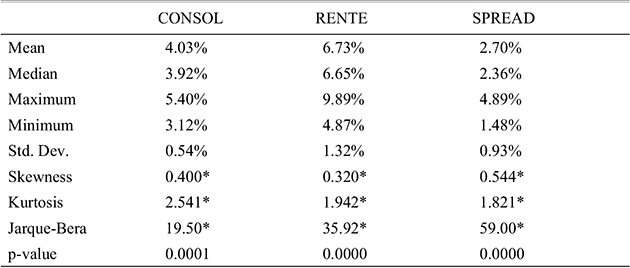
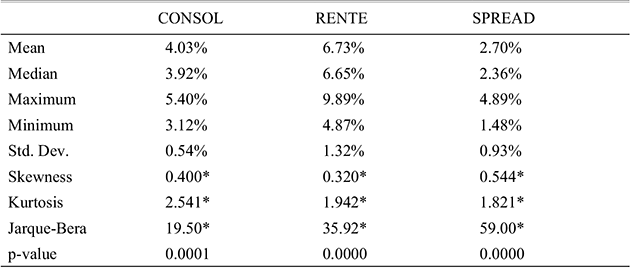
Table 2 provides descriptive statistics for both French and British yields, and their spread. The yields of the French rente are always higher than those of the British consol (by 2.7 percent on average); they are also more volatile. The French yield culminates at almost 10 percent, which is twice as high as the maximum British yield. The yields and the spread are non-Gaussian, more specifically platykurtic and positively skewed (significantly in the case of the British consol).
We also check for the stationarity of our series, by performing the Augmented Dickey-Fuller (ADF) test (see Table 3). The spread, our variable of interest, is stationary when we take into account an intercept and a trend.Footnote 17
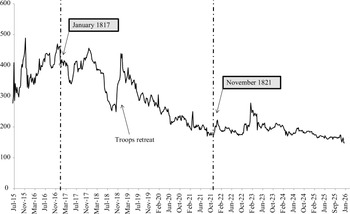
We use the Lee and Strazicich (Reference Lee and Strazicich2003) approach for structural changes with two unknown break dates, because it does not require stationarity. We opt for the more general model including changes in both the level and the trend following Perron (Reference Perron1989) who suggests using this specification for financial data. The number of lagged terms is chosen based on Serena Ng and Pierre Perron (Reference Ng and PierrePerron1995). The breaks are then identified where the two-break Lagrange Multiplier (LM)-statistic reaches its minimum. Our results show that the LM-statistic is minimized for two breaks on 17 January 1817 and 23 November 1821 with a statistical value of −5.0343 (relative to the 5 percent critical value equal to −5.286). The null hypothesis is thus accepted: the series has a unit root with two structural breaks. Figure 4 provides a graphical snapshot of the evolution of the spread.
Given the two breaks, the spread series is composed of three sub-periods.Footnote 18 In a first period (July 1815–January 1817), the spreads follow an increasing trend largely driven by a surge in the discount for French rentes suggesting that during this period the investors were becoming more pessimistic about France's ability to repay its debts. The spread evolution indicates that the establishment of a constitutional monarchy was not enough to guarantee good debt service. It may also indicate that investors believed that the Charter would be short-lived and the Ultras would restore an absolutist rule. This trend changes dramatically after the first break. Indeed, from January 1817 to November 1821, the spread fell from approximately 400 basis points to 200. The third period (November 1821–January 1826) is characterized by a slackening in the decline of the trend. This might reflect the fact that the spread between British and French yields had already reached low figures. Indeed, at the end of the period, the spread was about 100 basis points leaving little room for further decline.
Descriptive Statistics of the French rente, British Consol and the Spread
* Stands for significance at the 5percent conventional risk level.
Source:
Moniteur Universel and authors’ computation.
BREAK ONE: 17 JANUARY 1817 — THE BARING LOAN
The most probable candidate for the break is the issue of the Baring and Hope & Company loan. It would be difficult to overstate the importance of this loan for French public finances. Following the dissolution of the Chambre introuvable in September 1816, negotiations between France and Baring resumed. Between 8 and 11 January 1817, the prices of the rente jumped from 57.75 FF to 61 FF following rumors that a loan with foreign bankers was almost finalized (Gontard Reference Gontard2000, p. 145). The negotiations were closely followed on the Paris Bourse leading to speculation on French rentes (Gontard Reference Gontard2000, p. 145). Eventually, an agreement was reached on 10 February 1817. The agreement was attacked by the Ultras who did not want France to depend on foreign bankers (Laffitte, Reference Laffitte1824).
The loan was important in many respects. Indeed, it allowed France to pay the first installment of the war indemnity. This payment was linked to the withdrawal of 30,000 troops from the country. It is hard to assess all the consequences of a default on the reparations payment but is likely that the Allies would have increased military pressure on France as they had done before. One may even wonder if the default would not have led to a questioning of the Restoration as a whole. In any case, it is probably safe to assume that France would have ended up weakened and that political stability would have been jeopardized. The loan was also crucial for another reason: British and Dutch bankers were now exposed to the risk of a French default. The interests of the Allies were thus aligned with the French ones. In particular, henceforth, a French default would have harmed British investors (Pasquier 1835–95; Gontard Reference Gontard2000). This element had indeed led many to criticize Baring who was accused of having Great Britain subsidize France (Gontard Reference Gontard2000, p. 146). However, the Lord of the Exchequer noted in a House of Commons speech the government thought the loan “might be beneficial to Europe and to this country in particular, by contributing to the stability of France” (Hansard [Parliamentary Debates] Reference C.1817, p. 931). In turn, Baring's willingness to underwrite a loan to France rested on two elements. First, the new government was more open to negotiations than the Chambre introuvable. Second, even if there was officially no British guarantee for the loan (Hansard [Parliamentary Debates] Reference C.1817, p. 931), the presence of British troops in France reassured Baring. The venture was thus risky but there were many implicit guarantees for Baring. Eventually, and even if this element is of less importance, the loan lifted the Paris stock exchange from its apathy (Colling Reference Colling1949, p. 192). With a more active market, the government could expect a decline in interest rates for future issues of the rente.
ADF Unit Root Test on the French rente, British Consol and Their Spread
*Stands for significance at the 5percent conventional risk level.
Source:
Moniteur Universel and authors’ computation.
BREAK TWO: 23 NOVEMBER 1821 —THE ULTRAS COME BACK
The second structural change is observed at the end of 1821 and may be attributed to the end of the government headed by the Duke de Richelieu and its replacement by the Count de Villèle, the leader of the Ultra faction. The election in October 1821 brought a significant increase in the number of seats held by the Ultras. The following ensuing years coincided with a radicalization in terms of politics. De Villèle was gradually forced to grant more and more important positions to Ultras and to question the freedoms granted by the Charter (Démier Reference Francis2012, p. 695). The international situation provided another sign of this radicalization. In 1820, Ferdinand VII of Spain had been forced to accept a constitution close to the one prevailing in Great Britain (de Waresquiel Reference Waresquiel2006, p. 551). Gradually, the Cortes (Parliament) managed to limit the King's prerogatives. In 1822 however, a Royalist insurrection began in the North of Spain. European governments were divided regarding the course of action to follow: Great Britain was siding with the Cortes whereas the more absolutist regimes (Austria, Prussia, and Russia) were pleading for the restoration of Ferdinand VII. In France, the need to support Ferdinand VII and send troops to Spain divided the opinion. By agreeing to launch the Expéditiond' Espagne, the French Ultras showed their desire to limit parliamentary power. Despite this radicalization, the spread experienced only a short-lived increase. The extraordinary credits voted in order to sustain the war expenses probably contributed to the change in the spread. The risk of changes in the parliament's power and in institutions was probably not very important for the holders of rentes as the spread came down as soon as the Expéditiond'Espagne was over. In 1824, Louis XVIII died. The new government under King Charles X enacted laws to reimburse the Emigrés. Gradually, Charles X attempted to restore all the ostentation of the Ancien Régime.
The Evolution of the Weekly Spread (in Basis Points) between the French Yield and the British Consol between July 1815 and January 1826

Overall, it seems that France's return on the international capital markets in 1817 and the European political and diplomatic context in 1821 led to a significant change in the evolution of the spread. The first break suggests that the loan extended by Baring, the main underwriter at the time, changed the market's perception regarding French credit risk. The fact that Baring refused to deal with the Ultras signals the importance he gave to the constitutional charter. Eventually, his reliance on the Allied troops to guarantee repayment is further evidence of the role played by the occupation on the ability to borrow. The second break confirms the importance given by markets to the respect of the Charter. The insistence that Emigrés should be compensated coupled with a likely come back of the Ultras at the head of the government stopped the decline in the spreads. Indeed, both elements indicated an increased likelihood that the Charter would be questioned.
Our next task is to evaluate the short term effect on the spread of several events which we believe may have had an impact. To do so, we proxy the dates for which there is an a priori by dummies and run multivariate regressions on the three sub periods delimitated by our two structural breaks.Footnote 19 More specifically, the general equation for all the estimated models is:

where yt is the spread in t, y t − p are lagged values of the spread (p = 1, 2…, n)Footnote 20 and Dk are dummy variables that take the value of 1 for the month following an event and 0 otherwise. The different coefficients are estimated by OLS with robust standard errors.
Table 4 provides the list of dummies chosen on each sub period. Our choice is based on historical evidence (Vaslin Reference Vaslin1999; White Reference White2001). Most of these dates were already mentioned in the description of the historical context. To these, we add three additional events that could have influenced the credibility of the French government. The first one is the payment of debt arrears by the Banque de France. Although initially introduced in 1800, it only lasted for four years and the practice did not become standard until June 1817, when the minister of finance designated the bank to make the payment of the 5 percent rente within “normal” delays. We also decided to include the budgetary order of 14 September 1822 regarding the liquidation of public expenses with in nine months of the end of the fiscal year and the financial account order of 10 December 1823 (Vaslin Reference Vaslin1999). These laws were meant to guarantee the principles of unity, integrity, specialization, and periodicity of the public budget.
Midwest Banks Near Transportation Networks at Date of Entry
Notes:
The table presents the percentage of entering banks that were within the defined distance from a transportation network. Banks are sorted into the different decade groups based on their year of entry. Distances are straightline distances from points to polylines calculated by GIS.
Source:
Vaslin (Reference Vaslin1999) and White (Reference White2001).
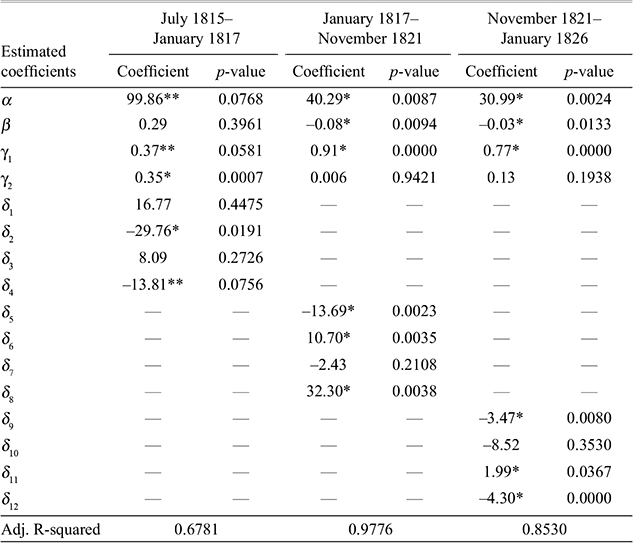
Table 5 provides the results of our multivariate regressions. Several events seem to have had an impact on the spread. During the first sub period, the first payment of debt arrears by the Banque de France and the dissolution of the Chambre introuvable were clearly perceived as good news by the markets leading respectively to a decline of about 30 and 14 basis points. This concords with the views of historians like Démier (Reference Francis2012, p. 239) who notes “the news of the dissolution was received positively by a majority. The Allied governments expressed their satisfaction, the Duke de Richelieu was acclaimed at the Opera and the rente immediately experienced a 3 FF price increase.” The dissolution of the chamber was important because it represented a condemnation of the extreme policy advocated by the Ultras. The creation of the Caisse d'amortissement has no impact on the spread, perhaps because investors needed time to assess the government's willingness to respect its objectives.
Events and Impact on the Spread

*/** Stand for significance at the 5 percent and 10 percent conventional risk levels, respectively.
Source:
Authors’ computation.
During the second sub period, following the success of the 1817 French public loan, the spread is characterized by a significant declining trend. However, two events seem to have broken this declining pattern, at least temporarily. First, the second intervention of the Bank the France to ensure the payment of interest on the debt led to an increase of the spread, perhaps because the public took it as a signal of financial difficulties. Second, the departure of foreign troops in November 1818 increased the spread by more than 30 basis points. Indeed, the declining trend of the spread brutally stopped when the troops left and even experienced a sharp and short-lived upward movement (Figure 4). This change in the pattern may be linked to fears that the departure of foreign troops would remove the implicit guarantee provided by their presence and thus prompted many foreigners to sell their holdings of French rente, driving prices down and leading to a spike in the spread.
The last period starting in November 1821 is roughly stable. The decline in the spread eventually stopped and the different events under study do not seem to have influenced much its evolution. Three dummies are statistically significant but their impact is less than five basis points and in two cases (financial account order and re-election of the Ultras) the sign is counterintuitive. The dummy for the outbreak of the war with Spain (Expéditiond'Espagne) does not have a significant coefficient.
CONCLUSION
Following Waterloo, France was in a terrible situation. Public finances were in shambles and whereas victors had been inclined to show mercy in 1814, following the episode of the 100 days they imposed harsh terms to defeated France. Despite all this, in the ten years between 1815 and 1825 France used financial markets with great success, it increased its outstanding debt three fold and reduced the premium it had to pay investors over British debtfrom more than 400 basis points to a meagre 100 basis point. How did France manage to regain its credibility?
The analysis shows that the main institutional change, the creation of a constitutional monarchy, was not in itself sufficient to reassure the markets as spreads increase after the new constitution was enacted. This observation is in line with the results of Sussman and Yafeh (Reference Sussman2006) as well as Dincecco (Reference Dincecco2009) and Oscar Gelderblom and Joost Jonker (Reference Gelderblom and Jonker2011). Our empirical investigation highlights the importance of the Baring and Hope loan. Indeed, the spread only began to fall after that loan was negotiated. The loan in itself was crucial as it allowed France to pay the first part of the reparations it owed under the Second Treaty of Paris. It was also important, we argue, because by granting the loan, a major underwriter was signalling its faith in France's prospects. But beyond the money, the manner in which the loan was extended and the setting created by the Second Treaty of Paris reassured the markets. The Second Treaty of Paris insured that all actors had an incentive to see France pay its debt. In particular, Louis XVIII had good reasons to please the Allies who had twice restored him to the throne. In France, all political parties understood that France had to improve its credit to borrow but the Ultras placed compensating the Emigrés and re-establishing the Ancien Régime first. When the Ultras refused to vote the 1816 budget, the country ended in a political impasse. The Allies’ pressure helped resolve the impasse. The Duke of Wellington pressured Louis XVIII to dissolve the Chamber while Baring conditioned his loan to the eviction of the Ultras. The troops stationed in France allowed the Allies to force a political change and replace the Ultras by a government able to reassure the market.
This article suggests that the French case provides an interesting comparison point with the British one following the Glorious Revolution. Stasavage (Reference Stasavage2007) has argued that for sovereign debt the credibility provided by institutions is conditional on the political willingness to repay. Credibility can only be increased if there is a majority willing to honor the debt. In the French case, the Ultras were willing to lose credibility to compensate the Church and the Emigrés. In this respect the constitutional monarchy did indeed not improve credibility. It was actually pressure from outside which led to a change in government and the arrival of an executive whose main priority was the improvement of the credit of the state. The rights derived from the constitutional monarchy were however valued by the markets, with spreads increasing whenever its existence was threatened. The desire to faithfully pay all former debts improved the spreads on the short term. Institutions such as the creation of the Caisse d'Amortissement do not seem to have induced a major change, at least at their creation. This might be due to the fact that many sinking funds had been created by previous regimes and had systematically been used to other means than the debt amortization. Even though the impact of the new institutions is in some case small, the 100 days and Waterloo forced the people in charge of French finances to implement laws and institutions leading to the creation of a real credit system (Margairaz Reference Aglan, Margairaz and Verheyde2006).
In contrast to the cases discussed by Mitchener and Weidenmier (Reference Mitchener and Weidenmier2005, Reference Mitchener and Weidenmier2010), the military intervention in France took place before default. The threat was thus not to invade France but to refuse to liberate the country. This situation rendered the threat obviously credible. The French case also shows that, historically, military interventions to guarantee reimbursement were not only carried out against weak states. The French fiscal capacity was much higher than for any of the states supersanctioned during the gold standard. However, the element which distinguishes the most the French case from the cases discussed in the literature is the fact that the occupation of the country actually acted as an incentive for foreign bankers to lend. The imposition of an Army of occupation convinced markets that default was not an option. Paradoxically, the French case shows that the occupation reassured potential lenders and actually helped convince Baring to lend to France. Indeed, Alexander Baring, the main foreign banker involved in lending to France considered in 1818 that occupying France was safeguarding its loan (Longford Reference Longford1972). Whereas previous attempts to improve French public finances had proved unsuccessful, the pressure set by the defeat and the Army of occupation forced the government to act in such a way as to recover its credibility. The Baring and Hope loan reversed the course of the spread.