

The growing trend for children to be diagnosed with autism spectrum disorder (ASD) has been accompanied by increasingly large enrolments in their neighbourhood classrooms. This is the context in which the current review is written. The lack of consensus regarding how best to fund their inclusion is possibly related to the heterogeneity of the population on the autism spectrum disorder (ASD), who often present with wideranging instructional and behavioural challenges. A key purpose of the current review is therefore to examine how best to fund the inclusion of students with ASD in order to improve their opportunities to receive appropriate levels of quality education.
In this narrative review, we examined a variety of international funding models that have been used in an attempt to create best practices for supporting students with ASD within inclusive classrooms. We opted for a narrative approach, as it is best used to summarise different primary studies from which conclusions may be drawn into a holistic interpretation, may include publications other than those in peer-reviewed journals (government documents and conference proceedings), and is best suited for comprehensive topics as they pull many pieces of information together into a readable format (Baumeister & Leary, Reference Baumeister and Leary1997). This narrative review fits into the ‘overview’ category as defined by Green, Johnson, and Adams (Reference Green, Johnson and Adams2006). In contrast, systematic reviews are best suited for focused topics and for making clinical decisions (Cronin, Ryan, & Coughlan, Reference Cronin, Ryan and Coughlan2008). The review included 22 documents published between the years 2003 and 2015. We anticipated that the findings of the review would be relevant to policymakers, researchers, and school leaders in a range of countries who are looking for effective ways to fund inclusive education for students with ASD. Findings from the current review were used by the Victorian Government Department of Education and Training (2016) in their ‘Review of the Program for Students with Disabilities’.
For the purposes of this review, inclusive education is defined first as a process that facilitates the attendance of a student with a disability at the same school as another peer without disability of the same age, and second as an environment that allows the student to participate in activities on an equal basis, where they can potentially develop academically and socially to the best of their ability and be accepted by the regular school community. Quality inclusive practices necessitate that teachers also are supported in such a way that the manner in which they organise learning in their classroom enables those students with ASD to experience the same opportunities to develop as their peers. How best to fund such accommodations is a matter of concern to most educational institutions, ranging from government to local educational authorities.
ASD itself is defined as a pervasive lifelong developmental disability with neurodevelopmental origins causing significant social and communication skill problems (Australian Advisory Board on Autism Spectrum Disorders, 2011; http://www.autismnz.org.nz/). Although the definition covers a wide spectrum of individual needs, requiring an understanding that each child is different, there are some generic characteristics that are critical to understand when providing support for students identified to be on the spectrum.
There is a need for educational services to be evidence based, flexible, and outcome focused for students with ASD (National Autism Center, 2009). The approach considered most appropriate for supporting such individuals is a student-centred approach that considers a broad range of behaviours. The following practices, extrapolated from the literature (Australian Advisory Board on Autism Spectrum Disorders, 2010; Iovannone, Dunlap, Huber, & Kincaid, Reference Iovannone, Dunlap, Huber and Kincaid2003; National Autism Center, 2009), are linked to positive outcomes for students with ASD:
1. Providing a range of placement and support options, with the progress of students being regularly assessed;
2. Support of well-trained and knowledgeable staff;
3. A systematic and flexible multifaceted approach to instruction within well organised learning environments that accounts for ecological and social factors and provides predictable routines;
4. Support systems that allow students to successfully navigate transitions;
5. A multidisciplinary, collaborative approach involving parents and professionals (e.g., behaviour analysts, speech pathologists, occupational therapists, and psychologists);
6. A curriculum for those students with ASD that addresses their social, communication, learning, and sensory issues integrated within the regular curriculum;
7. Individual tailored interventions based on comprehensive assessments addressing individual students’ strengths and needs;
8. Therapeutic interventions that include socio-emotional support and social skills programs, both in and out of school; and
9. The implementation of a positive behaviour support program.
It has been recommended that a funding model should address the current and future expectations of those students with ASD and should aim to reduce performance differences between schools while also increasing the progress of all students at each stage of schooling. Lamb and Teese (Reference Lamb and Teese2012) suggest that the first approach should be one of horizontal efficiency that focuses on minimising the gap between schools above that of just achieving national minimum standards. The second approach is one of vertical efficiency that would ensure that all students make good progress across all stages of their school career. Germane to these practices being operationalised is a relevant funding model to facilitate this. Accordingly, in this review we examined how students on the autism spectrum are currently funded within inclusive school settings in an attempt to identify best practice models to facilitate a quality inclusive education program for school students with ASD.
In order to identify published articles for this review, electronic databases (ERIC, PsycINFO, and Google Scholar) were purposely searched using keywords such as ‘autism’, ‘inclusive education’, and ‘funding models’; ‘ASD’, ‘inclusive education’, and ‘funding models’. Our main objective in this paper was to review various funding models and develop key principles that need to be taken into consideration when planning and resourcing the inclusion of students with ASD. We therefore also sought articles that reported effective practices for teaching students with ASD. A final decision about the relevance of each publication was determined by all three authors reading each abstract independently and then discussing discrepancies in ratings. Discrepancies were discussed and clarified between the raters until consensus was achieved.
We also included policy documents that were available in the public domain and relevant to the review. Abstracts of all identified articles were read to determine the eligibility of the identified article for inclusion in the review. It became clear that the majority of the articles identified in the process did not specifically describe funding of students with ASD. Instead, most articles described funding for students with a range of disabilities. This is not a surprising finding considering most jurisdictions, nationally and internationally, do not fund the education of students with ASD differently, compared to students with other disabilities. We made every possible attempt to identify and report information that would be useful to determine how best practices were described as they related to funding for the education of students with ASD. We also checked the references of all identified included articles to identify additional articles for the review.
International Funding Models for Students With ASD
When reviewing funding models, in most instances our approach was focused on the identification of a disability and then the level of need rather than category of disability per se. In many instances, students with ASD were supported either within general funding models, if their needs were mild, or by additional funding, if needs were high. A major report undertaken by the Australian Research Alliance for Children and Youth (ARACY) noted that all Australian states and territories had already established structures for supporting students with a disability (Forlin, Chambers, Loreman, Deppeler, & Sharma, Reference Forlin, Chambers, Loreman, Deppeler and Sharma2013), although these were not specifically differentiated for students with ASD.
In this review, therefore, we have considered funding models that incorporated support for learners with ASD as part of general funding approaches along with specific support allocated according to the identification of a disability and level of need.
We have formed the opinion that particular approaches to funding have influenced the provision of students with special educational needs. However, although strict qualification criteria via categorisation at a systemic level aimed to ensure equality of provision, this did not necessarily allow for contextual or social strata group differences or urban versus rural needs to be taken into consideration. Indeed, the continued uses of categorical systems for resource allocation, which run counter to philosophies of inclusive education, remain controversial (Banks & McCoy, Reference Banks and McCoy2011). Regardless, funding schools in a more generalised manner, without increased accountability, has not automatically ensured appropriate support for all learners. This finding is of relevance in Australia where there are noticeable patterns of socioeconomic and Indigenous disadvantage in school performance at both intra- and interstate levels (Lamb & Teese, Reference Lamb and Teese2012).
Interestingly, over the past decade, across most developed countries, the allocation of funding to support students with additional learning needs has been increasing. Indeed, most countries are spending between 12% and 20% of their education budget on resources for special education, based on a variety of funding models; however, this remains in flux (Banks et al., Reference Banks, Frawley and McCoy2015).
A review of the international literature (2007) on studies of funding models for special education (Ferrier, Long, Moore, Sharpley, & Sigafoos, Reference Ferrier, Long, Moore, Sharpley and Sigafoos2007) identified four significant aspects of these models:
1. Funding for students with disability is dominated by a model where funding is provided to accommodate the needs of students (e.g., curricula, environment, assessment, instruction).
2. Funding models emphasise due process, procedural adherence, and fiscal accountability rather than focusing on student learning outcomes.
3. The assessment of the intensity of support needed determines the level of funding.
4. Funding models are typically two dimensional: either funding is allocated directly to parents, schools, or districts, or it is based on categories of disability or estimates of the proportion of students with a disability in the population.
Most countries, however, appear to be moving from a national or district funding model, whereby all funds are allocated on a categorical basis, to a more devolved system (e.g., in Sweden and Greece; Riddell, Tisdall, Kane, & Mulderrig, Reference Riddell, Tisdall, Kane and Mulderrig2006). This less centralised school-based approach has the aims of allowing for local decision-making regarding the use of funds to enable attention to be given to the individual needs of students within local contexts.
Although a school-based funding model enables increased autonomy, its functioning is based on principals having a clear understanding of inclusive education and delivering national or state objectives to meet the needs of all learners (Banks et al., Reference Banks, Frawley and McCoy2015). Delegating funds to schools for decision-making, rather than to individuals, however, does not always guarantee that the funds will be used to support inclusive educational practices (Riddell et al., Reference Riddell, Tisdall, Kane and Mulderrig2006).
Indeed, according to Williams, Lamb, Norwich, and Peterson (Reference Williams, Lamb, Norwich and Peterson2009), there is insufficient clarity about what exactly is to be delivered. Consequently, these models may require appropriate levels of monitoring to ensure that students with special needs are the principal beneficiaries of the funding and that their learning outcomes do actually improve.
In many systems, funding to schools is utilised to employ education assistants to meet the needs of individual students. Significantly, even though education assistants have a long history supporting children with special needs, a large-scale 5-year study of more than 20,000 teachers and support staff in primary, secondary, and special schools in England and Wales showed that those pupils supported by education assistants made less progress on average than those students of similar ability who do not receive such assistance (Blatchford, Reference Blatchford2009). In summary, the more support they received the less progress they made, leading to the conclusion that education assistants, while making teachers’ jobs more productive, did not lead to pupils making better progress in English, maths, or reading (Blatchford, Reference Blatchford2009). These findings, however, should not detract from the significant contribution that education assistants make when used appropriately (Blatchford, Reference Blatchford2009). Perhaps the misuse and overuse of education assistants as an inclusive education resource needs to be seen in the light of a broader systemic problem (Giangreco, Reference Giangreco2010).
Many systems continue to consider the category of disability when allocating funding but increasingly take into account level of educational need (e.g., Belgium; Lebeer et al., Reference Lebeer, Struyf, De Maeyer, Wilssens, Timbremont, Denys and Vandeveire2010). An example of this is in New Zealand where there are two levels of funding. Funding is distributed to all schools through an operations grant to provide for all the students in their schools along with a further Special Education Grant (SEG) according to how many students each school has that require additional support and the school’s decile ranking (Chatfield, Reference Chatfield1999). In New Zealand, a school’s decile measures the extent to which the school’s students live in low socioeconomic or poorer communities. Decile 1 schools are the 10% of schools with the highest proportion of students from low socioeconomic communities and Decile 10 schools are the 10% of schools with the lowest proportion of students from these communities.
The SEG is provided as additional in-class support for students likely to be having difficulties with learning but without needs high enough to receive support through the Ongoing Resourcing Scheme (ORS). The SEG funding, therefore, is used to support learners with moderate support needs, including those with learning disabilities, mild ASD, attention-deficit/hyperactivity disorder, or other similar conditions (Chatfield, Reference Chatfield1999). Use of the SEG is determined by the school and may include resources and materials, professional learning programs for teachers relevant to teaching students with special education needs, extra services involving specialist advice, or providing training seminars by psychologists, behaviour consultants, and physiotherapists, and teacher aide time (Chatfield, Reference Chatfield1999.)
For students with high/very high levels of need, an additional four programs are available to provide support. These are all competitive and categorically based on input funding and are for individual students. These include the ORS, communication service, severe and challenging behaviour service, and the school high health needs fund. In addition to the grants, New Zealand schools can access itinerant resource teachers for assistance supporting students with learning, behavioural, sensory, and physical disabilities.
A similar funding model is applied in Alberta, Canada, where governance of education of students with disability rests entirely with provincial governments rather than the federal government (Jahnukainen, Reference Jahnukainen2011). In Alberta, students meeting the criteria of having one of 17 disabling conditions (locally referred to as ‘codes’) establishes special educational needs. These conditions then fit into two major categories of ‘severe’ or ‘mild to moderate’ disabilities. Only four disabling conditions are included in the ‘severe’ category. These are severe cognitive disability, clinical conditions that require constant supervision to ensure their safety (e.g., social-emotional disorders), physical and neurological conditions that require extensive learning modifications and/or personal care, and a combination of two or more of the above conditions. The remaining 13 disabling conditions are categorised as mild to moderate codes (e.g., learning disability). Students with ASD (depending on their needs) can fall into either category.
The distinction between the two categories is vital as it determines the level of funding a student will receive (Jahnukainen, Reference Jahnukainen2011). All students classified under the mild to moderate categories are funded through ‘base instructional funding’ that all schools receive. This funding is provided to school boards irrespective of whether or not students have identified additional needs. School boards receive the base instructional funding depending on the number of students enrolled (this type of funding is sometimes referred to as census funding). School boards then allocate these funds to meet the learning needs of students in the mild to moderate disability category. School boards then receive approximately three times the general special education funding if the student is classified as having a severe condition. The funding is allocated to address the learning needs of an individual student unlike the ‘base instructional funding’. In Finland, however, in more recent years, they have reformed their funding, and schools now get base funding only, with no extra funding attached to an individual student. This is a significant shift from a combination of bounty and base funding to base funding only.
A review of the Alberta funding system in 2008 found that the complex coding system required undertaking expensive assessment procedures to determine eligibility to receive the necessary services, which in turn placed significant pressure on the system. As a result, students who had genuine needs had to wait for support as the model required a determination for eligibility to receive services. Conversely, Finland, with its recent funding system change, was more ‘cost effective’ and offered special education support to many students, who in Alberta would need to wait for specialised assessments to be completed without a guarantee of being eligible for the support deemed necessary in the severe special education categories (Jahnukainen, Reference Jahnukainen2011, p. 497). So far it seems that the Finnish model with its focus on prevention and outcomes has provided some evidence that the gap between high achievers and low achievers has decreased (Jahnukainen, Reference Jahnukainen2011).
Types of Funding Models
After reviewing the impact of different funding models on improved student learning outcomes, it was clear that there had been very limited research that was evidence based. A major review of the literature undertaken by Sigafoos et al. (Reference Sigafoos, Moore, Brown, Green, O’Reilly and Lancioni2010) was only able to identify 10 studies that had investigated the outcome of five broadly different funding models. Sigafoos et al. (Reference Sigafoos, Moore, Brown, Green, O’Reilly and Lancioni2010) concluded that these studies relied on limited data such as surveys, analysis of existing data sources, or qualitative analysis of the funding models. Such information provided stakeholder perceptions and enrolment trends but were limited in their ability to measure the actual impact of the funding reform on student outcomes. The Sigafoos et al. (Reference Sigafoos, Moore, Brown, Green, O’Reilly and Lancioni2010) review revealed three kinds of funding models prevalent across different international contexts. They are input, throughput, or output funding and are described in the following sections.
Input Funding
Input funding, also known as demand-driven or categorical funding, is based on allocating individual funding to students based on the severity of a student’s needs (Ferrier, Long, Moore, Sharpley, & Sigafoos, Reference Ferrier, Long, Moore, Sharpley and Sigafoos2007). Input funding has been criticised by a number of authors, as the funding requires identifying a pathology, through assessment, which appears to run counter to the philosophy of inclusive education (e.g., Pijl, Reference Pijl and Florian2014; Shaddock, MacDonald, Hook, Giorcelli, & Arthur-Kelly, Reference Shaddock, MacDonald, Hook, Giorcelli and Arthur-Kelly2009). Nevertheless, this model is still favoured by many countries and appears to be preferred when students with high and profound needs, including those with ASD, require extensive and intensive direct support, as it allows for funding to be directed to the individual rather than to the school. Examples of an input approach include the voucher system in Holland, termed a ‘back-pack’ model in which funding follows a child if they move schools (Pijl & Veneman, Reference Pijl and Veneman2005). A similar approach in the United Kingdom uses budgets linked to a child, allowing parents greater control, it is thought, over resourcing for their child (Lamb, Reference Lamb2009). In Australia, the newly introduced National Disability Insurance Scheme (NDIS) is also based on input funding determined by each individual’s level of need (see https://www.ndis.gov.au/). This model is currently being rolled out across all states and territories; thus it remains to be seen as to the effectiveness of it in the long term. It is important to note that the NDIS is not intended to fund educational programs.
Throughput Funding
In contrast, the throughput or base funding model provides funding through block grants allocated directly to local authorities, districts, or schools. It is often census-based, with funding allocated according to weighted characteristics. Although throughput funding places less emphasis on a child’s individual needs and attempts to avoid labelling, it places greater responsibility on local authorities, districts, or schools. Pijl (Reference Pijl and Florian2014) acknowledged several advantages of the throughput model. First, Pijl proposed that an advantage of the throughput model was that it allowed schools and local authorities to decide for themselves how best to use allocated funding, creating more flexibility in using the budget. Local authorities, districts, or schools were also less prone to engage in strategic behaviour to over-identify disability. Finally, the throughput model also appeared to facilitate inclusiveness. Banks et al. (Reference Banks, Frawley and McCoy2015), however, has argued that throughput funding could potentially lead to inaction as the funds are allocated regardless of any accountability for student outcomes.
Interestingly, some countries have adopted a combined input and throughput approach. For example, Sweden mainly utilises a throughput model for students with mild to moderate support needs and an input approach for students with high support needs that may see them, in some instances, educated in special schools.
Output Funding
The output (or outcome) model has tended to be overlooked by organisations when determining how to fund students with additional learning needs. It does seem vital that the intention of additional funding should ultimately be linked to improved student learning. By focusing on quality outputs, it has been proposed that special education can be more effectively aligned with the current accountability agenda applied to students without special educational needs (Shaddock et al., Reference Shaddock, MacDonald, Hook, Giorcelli and Arthur-Kelly2009). Indeed, to ensure greater accountability for funding, more education systems are now moving towards a model of measuring student progress or outcomes as a means of assessing the impact of funding reforms (Banks et al., Reference Banks, Frawley and McCoy2015). Typically, individual education plans are used to monitor outcomes. Alternatively, some systems are using national testing to identify schools where achievement is in the lowest 10% and then automatically allocating additional funds to support these learners. In this way, students with ASD with mild support needs in literacy and or numeracy would be able to receive support.
This output approach is also in place in the United Kingdom where their new Special Educational Needs and Disability Code of Practice (Department for Education and Department for Health, personal communication, July 1, 2015) provides a greater emphasis on accountability for funding use. Although it still proposes a combination funding model using both input and throughput funding approaches determined by a local funding formula, this is linked more closely to measures of outputs. Similarly, a new model proposed for Ireland (National Council for Special Education, 2014) adopts this approach. Ireland’s projected funding model involves an output model together with a throughput component that allows schools greater autonomy while still retaining a process of increased accountability for student learning by monitoring and evaluating outcomes.
The output funding model, however, relies heavily on schools ‘doing the right thing’ by appropriately managing resources to ensure that students with special educational needs are in fact targeted to receive suitable support. Attempting to address the issue of accountability, Smith and Douglas (Reference Smith and Douglas2014) have proposed that school output measures should include standardised testing, in addition to profiling, although the risk with this approach is the potential disenfranchisement of schools to achieve and to retain funding.
Discussion and Key Considerations
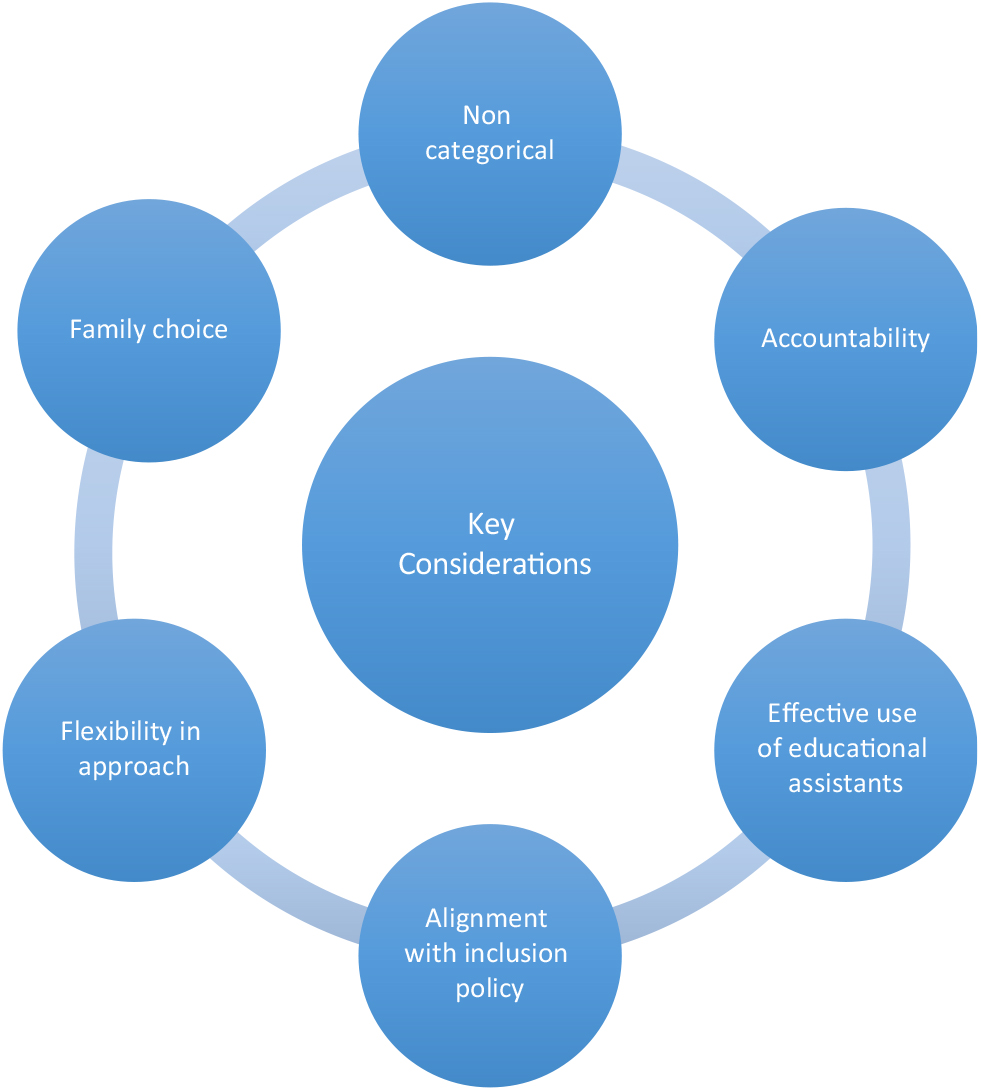
Examining the findings from the present review has indicated that, despite the good intentions of policymakers and departments of education, sometimes the way the education of students with ASD is resourced may lead to tension and create wider gaps between policy and practice (Lamb & Teese, Reference Lamb and Teese2012; Pijl, Reference Pijl and Florian2014; Riddell et al., Reference Riddell, Tisdall, Kane and Mulderrig2006). It seems, then, that how the education of students with ASD is funded will determine if inclusive education policies are implemented as they were intended. Research on how best to achieve inclusive education for all (e.g., Ferguson, Reference Ferguson2008; Jackson, Ryndak, & Billingsley, Reference Jackson, Ryndak and Billingsley2000; Kugelmass, Reference Kugelmass2004; Mitchell, Reference Mitchell2015) along with lessons learnt from various countries should guide the development of better funding models for the education of students with ASD. We have identified six considerations emanating from this review (see Figure 1).
Key considerations to guide funding education of students with ASD. Adapted from Contemporary models of funding inclusive education for students with autism spectrum disorder by U. Sharma, C. Forlin, & B. Furlonger, 2015, Melbourne, Australia: Department of Education and Training. Copyright 2015 by the Department of Education and Training.

Consideration 1: Non-Categorical Funding Models
One of the key findings that has emerged from this review is a need to have funding models that take account of the learning needs and adjustment requirements of individual students (e.g., Banks & McCoy, Reference Banks and McCoy2011; Shaddock et al., Reference Shaddock, MacDonald, Hook, Giorcelli and Arthur-Kelly2009). It is clear that there has been a shift away from ‘diagnoses’ towards careful assessment of the interaction between the student and the environment. This change has the potential to reduce the incidence of labelling and reduce or eliminate the cost of assessments to determine eligibility and level of funding. When allocating funding using input funding models, there has been a tendency for assessors to inflate the amount of support that is required in order to obtain more funding. Clear, succinct, and well-articulated funding models are therefore needed to ensure that funding claims are not inflated but, rather, accurately reflect a student’s needs.
Consideration 2: Accountability
As it is now accepted that accountability should be integrated when funding schools, there is also a need to inform the funding agency about how the funds provided to a school (a) improved the academic and social outcomes of both individually funded students with disability and students without disability, and (b) assisted the teachers and administrators in more effectively implementing inclusive practices. Often schools ask for additional funds to support the inclusion of a student with ASD. Significantly though, schools are rarely asked to report how additional funding impacted on the learning of funded students and the school’s inclusive practices. It is important to note that, although difficult, incorporating accountability in practice is essential to ensure appropriate outcomes are achieved for targeted individuals (Ferrier et al., Reference Ferrier, Long, Moore, Sharpley and Sigafoos2007; Lamb & Teese, Reference Lamb and Teese2012; Smith & Douglas, Reference Smith and Douglas2014; Williams et al., Reference Williams, Lamb, Norwich and Peterson2009). For example, an important issue is whether schools are disadvantaged by the removal of additional funding because they are assessed as having improved the students’ performance or rewarded for poor performance by increased funding made available if students’ performance deteriorates. Sodha and Margo (Reference Sodha and Margo2010) recommend that schools should be granted more responsibility for the learning of all students, including those with additional needs, based on the assumption that the more responsibility schools have for the education of all learners, the better they become in facilitating inclusive education. Sodha and Margo, however, cautioned that ongoing monitoring actions, both internal and external to schools, are required to ensure that schools continue to maintain the gains.
Consideration 3: Effective Use of Education Assistants
Historically, the widespread use of education assistants as support personal for those students with ASD has been a common practice (Blatchford, Reference Blatchford2009). However, although education assistants can play an important role in the successful implementation of inclusive education programs for students with ASD, they are, unfortunately, the least qualified to provide the concentrated support needed to help students with the most complex needs (Giangreco, Reference Giangreco2010). If schools are to continue using funding to employ nonqualified assistants, then more attention will be needed to adequately prepare education assistants to support students with ASD.
It is therefore important that education assistants be allowed to access adequate training to perform their roles in supporting the inclusion of students with ASD. Extra training alone, however, will not by itself address the systemic changes required to rectify the inherent inequities ‘where the more challenging the learning characteristics of the student, the more likely he or she is to receive instruction from teacher assistants rather than teachers’ (Giangreco, Reference Giangreco2010, p. 344).
Consideration 4: Alignment of Funding Models to Inclusive Education Policy
Across all of the jurisdictions that we reviewed, there was no single method for the support of students with ASD (Forlin et al., Reference Forlin, Chambers, Loreman, Deppeler and Sharma2013). What was evident was that the movement towards inclusive education remains internationally strong and that regular schools are increasingly required to provide support for learners who would have previously been educated in segregated facilities (Banks et al., Reference Banks, Frawley and McCoy2015; Ferrier et al., Reference Ferrier, Long, Moore, Sharpley and Sigafoos2007). Without such additional support through appropriate funding mechanisms, it would not be possible for schools to provide the degree of support required by students with ASD that, in turn, would allow students with ASD access to the regular curriculum. Unfortunately, sometimes the manner in which the education of students with ASD is funded goes against inclusion policies and philosophy (Banks & McCoy, Reference Banks and McCoy2011). For example, in some jurisdictions more funds were made available to support students with ASD in segregated settings (Forlin et al., Reference Forlin, Chambers, Loreman, Deppeler and Sharma2013), incentivising the placement of students with ASD in segregated rather than inclusive settings.
Consideration 5: Flexibility in Approach
Employing specialised and comprehensive multifaceted approaches (Batten, Corbett, Rosenblatt, Withers, & Yuille, Reference Batten, Corbett, Rosenblatt, Withers and Yuille2006) within a flexible continuum of service provision (Shearer, Reference Shearer2010) would seem most appropriate to underpin any decisions regarding the funding of support for students with ASD. Alternative placements in some systems could include ASD special schools, small support or satellite classes within regular schools staffed by ASD-specialist teachers, and ASD-specific itinerant teacher services. Although there is a strong international move away from placement in segregated settings for students with ASD, it is clear there remains a preference for some withdrawal/intensive programs for some students with ASD if they can cope with the regular curriculum and if their social and behavioural issues are addressed. Importantly, if inclusive education is the primary goal, then how such placements can lead to successful inclusion needs to be considered from the beginning and planned carefully.
Consideration 6: Family Choice
Family choice has become of key importance when decisions are made regarding school placement for students with ASD. The Australian Advisory Board on Autism Spectrum Disorders (2010) continues to emphasise the importance of parental choice when selecting a school for their child to attend. They assert that ‘provisions available to parents of a child with an ASD should be equal to the choices available to parents of students without a disability. Accordingly funding mechanisms across the government and non-government sectors should support such availability of choice and student need’ (p. 3). The system, they argue, should support parents not only in making choices but in also making informed choices; for example, more detail about the pros and cons of making any particular decision about their child. The gradual introduction of the NDIS across Australia is aimed to provide much greater family choice in decision-making regarding the use of funding allocated to individual children. Close monitoring of family choice outcomes is important to ensure that the NDIS achieves this aim and also provides sufficient funding to allow effective support for children with ASD.
Conclusions
In this paper, we reviewed various funding models and identified six key considerations that are likely to impact how inclusive education of students with ASD is funded. It is clear from this review that education of students with ASD could be funded through various models. Each model has its strengths and weaknesses. Policymakers and school leaders may find it useful to carefully review the key considerations and then decide how best inclusive education can be funded within their own context. The question that should guide funding and resourcing of inclusive education is what impact the funding would have in providing high-quality education to all students, not just students with ASD. It is important to remember that effective education of students with ASD requires that equal attention is paid to how well educators and schools are supported in providing high-quality education to all children. It also requires appropriate professional learning to ensure that all stakeholders are aware of what is required to monitor the effective implementation of funding models and that they are accountable for the outcomes achieved. This will require funding for upskilling teachers, education assistants, and paraprofessional staff involved at all levels. It seems we need to shift our thinking from ‘how much funding is available’ to ‘how best the existing funds are used’ if we genuinely care about creating inclusive classrooms and communities.
Acknowledgements
This paper is largely based on a review report, which was commissioned by the Department of Education and Training for the State of Victoria. Sharma, U., Forlin, C., & Furlonger, B. (2015). Contemporary models of funding inclusive education for students with autism spectrum disorder. Melbourne, Australia: State of Victoria (Department of Education and Training).