Introduction
Since the first description of autoimmune sensorineural hearing loss in 1979 by McCabe, many studies have investigated hearing in patients with autoimmune diseases, such as rheumatoid arthritis, ankylosing spondylitis, Behçet's disease, Sjögren's syndrome, polyarteritis nodosa and systemic lupus erythematosus (SLE).Reference McCabe1–Reference Kastanioudakis, Ziavra, Voulgari, Exarchakos, Skevas and Drosos9
Systemic lupus erythematosus is a chronic, multisystem, autoimmune disorder characterised by production of autoantibodies and tissue deposition of immune complexes.Reference Sestak, Nath and Harley10 Inner ear involvement and sensorineural hearing loss (SNHL) have been widely reported in patients with autoimmune diseases such as SLE, in clinical, audiological and histopathological studies.Reference Karatas, Onat, Durucu, Baglam, Kanlikama and Altunoren8, Reference Kastanioudakis, Ziavra, Voulgari, Exarchakos, Skevas and Drosos9, Reference Fukushima, Fukushima, Cureoglu, Schachern and Paparella11–Reference Yoon, Paparella and Schachern15 Many studies have found an association between SLE and SNHL, and several temporal bone histopathological studies have identified inner ear damage in patients with SLE.Reference Fukushima, Fukushima, Cureoglu, Schachern and Paparella11–Reference Yoon, Paparella and Schachern15 The findings of audiometric studies have been inadequate to explain the origins of such hearing loss. Thus far, the mechanism of hearing loss in patients with SLE has not been further clarified.
The current study aimed to investigate the objective hearing status and outer hair cell function in patients with SLE, using audiometry, distortion product otoacoustic emissions (OAEs) and transient evoked OAEs.
Materials and methods
Patients
The study included 26 randomly selected patients with SLE (52 ears) who were diagnosed and treated in our hospital's rheumatology clinic, and 30 healthy control subjects (60 ears). Informed consent was obtained from all participants.
Disease activity was evaluated using the SLE Disease Activity Index.Reference Gladman, Urowitz, Kagal and Hallett16 Detailed information was obtained about possible aetiological factors leading to hearing loss (i.e. perforated tympanic membrane, ear surgery, cranial trauma, ototoxic drugs, noise exposure, Ménière's disease and metabolic diseases). No patients had a history of any of these factors.
Patients with any of the following were excluded from the study: (1) otoscopic evidence of a perforated tympanic membrane or other middle-ear pathology; (2) a ‘flat’ tympanogram, or absence of acoustic reflexes at 1 kHz with contralateral stimulation; (3) an air–bone gap of ≥5 dB at any frequency; (4) a sensorineural hearing loss more than 60 dB on audiologic evaluation; (5) DPOAE responses overlapping with noise floor.
Audiometry
The initial hearing examination included otoscopy, tympanography and complete audiological evaluation, including pure tone air- and bone-conduction audiometry and speech audiometry. Pure tone audiometry was performed at 250 and 500 Hz and at 1, 2, 4, 6, 8, 10, 12, 14 and 16 kHz, using an AC-40 diagnostic audiometer (Interacoustic, Denmark) in a sound-treated cabin. Normal middle-ear function was defined by immitance and acoustic reflex results using an Interacoustic AZ 26 clinical impedance meter.
The study included patients and controls with normal peak compliance, peak pressure, gradient, ear canal volume and acoustic reflexes, obtained by immitance measures, as defined by the American Speech Language and Hearing Association.17, 18
Otoacoustic emission testing
Both distortion product and transient evoked OAEs were measured using Bio-logic System equipment (Audx Scout Sport; Bio-logic Systems, Chicago, Illinois, USA) with Scout Acoustic Emissions System (version 3.45.00) software installed on the computer (which used a 2 GHz Pentium IV processor). Subjects were seated in a sound-proof room and asked to remain as quiet as possible during the test. Once the probe was placed with a good seal in the ear canal, the level of the two frequencies was set according to our protocol. Equilevel primary tones f1 and f2 was fixed at f1/f2 = 1.22, and f2 frequencies ranged from 750 Hz to 8 kHz; stimulus intensities used for recording distortion product OAEs were 65 dB for F1 and 55 dB for F2. The following protocol was selected for transient evoked OAE testing. Ear canal response monitoring was observed to check the fitting of the probe. The recording bandwidth was set between 1 and 4 kHz, with a repetition rate of 40. Stimulus and stimulus intensity was 80±4 dB. The test was stopped after a maximum of 2000 samples.
Statistical analysis
Statistical analyses were performed using the Statistical Package for the Social Sciences version 13.0 for Windows software. A p value of <0.05 was considered significant. Independent samples t testing was performed for overall comparisons of the groups (i.e. patients with SLE versus controls). The Mann–Whitney U test was used to compare the ages of patients and controls. The chi-square test was used to compare the genders of patients and controls. Pearson correlation analysis was used to investigate the relationship between quantitative variables.
Results
The mean age of patients with SLE was 36.3 (range 23–58) years; three were male and 23 were female. The mean age of the control group was 36.4 (range 26–55) years; two were male and 28 were female. Otoscopic examination was normal in all participants. There was no statistically significant difference between the ages and genders of the patient and control groups (p > 0.05).
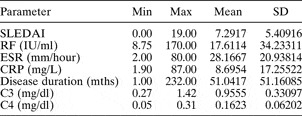
The clinical features of the SLE patients are shown in Table I. No correlation was found between these disease parameters and distortion product OAE or transient evoked OAE findings. Twenty-one SLE patients were treated with quinine and prednisolone, and eight with azothioprine. There was no significant difference between the distortion product OAE and transient evoked OAE findings, comparing SLE patients taking and not taking medication (p > 0.05).
Clinical features of SLE patients

SLE = systemic lupus erythematosus; min = minimum; max = maximum; SD = standard deviation; SLEDAI = SLE Disease Activity Index; RF = rheumatoid factor, ESR = erythrocyte sedimentation rate; CRP = C-reactive protein; C3 = Complement 3; C4 = Complement 4
Normal results for peak compliance, peak pressure, gradient, ear canal volume and acoustic reflexes were obtained by immitance measures in all patients and controls.
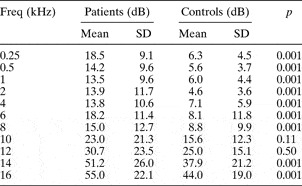
The pure tone audiometry results for patients and controls are shown in Table II. The pure tone thresholds of patients and controls were significantly different at 250 and 500 Hz and at 1, 2, 10 and 12 kHz (p < 0.05).
Pure tone audiometry results

Freq = frequency; SD = standard deviation
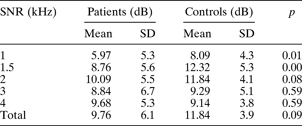
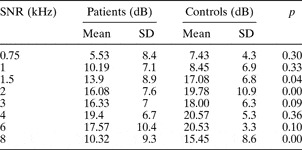
The transient evoked OAE and distortion product OAE findings for patients and controls are shown in Tables III and IV. There was no statistically significant difference between the levels of noise floor, comparing patients and controls (p > 0.05). The distortion product OAE signal responses were significantly different only at 750 Hz, while the distortion product OAE signal–noise ratios were significantly different at 750 Hz and 6 kHz (p < 0.05), comparing patients and controls. The transient evoked OAE signal–noise ratio was significantly different at 2 and 3 kHz, comparing patients and controls (p < 0.05). The transient evoked OAE total signal–noise ratios of the patients and controls were also significantly different (p < 0.05).
Transient evoked OAE results
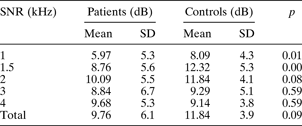
OAE = otoacoustic emission; SNR = signal–noise ratio; SD = standard deviation
distortion product OAE results

OAE = otoacoustic emission; SNR = signal–noise ratio; SD = standard deviation
Discussion
Systemic lupus erythematosus is the prototypical autoimmune disease and is characterised by immune-mediated inflammation in multiple organ systems.Reference Sestak, Nath and Harley10 Immunological disturbances have been recognised to be associated with many causes of auditory dysfunction.Reference Stephens, Luxon and Hinchcliffe19 Some autoimmune diseases can cause SNHL, such as rheumatoid arthritis, ankylosing spondylitis, Behçet's disease, Sjögren's syndrome, polyarteritis nodosa and systemic lupus erythematosus.Reference Halligan, Bauch, Brey, Achenbach, Bamlet and McDonald2–Reference Kastanioudakis, Ziavra, Voulgari, Exarchakos, Skevas and Drosos9
As with other autoimmune diseases, there have been reports of SNHL in patients with SLE.Reference Karatas, Onat, Durucu, Baglam, Kanlikama and Altunoren8, Reference Kastanioudakis, Ziavra, Voulgari, Exarchakos, Skevas and Drosos9, Reference Andonopoulos, Naxakis, Goumas and Lygatsikas20–Reference Keithley, Chen and Linthicum23 In addition, several studies have reported aberrant temporal bone histopathological findings in SLE patients, namely, damage to the cochlea and other inner ear structures.Reference Fukushima, Fukushima, Cureoglu, Schachern and Paparella11–Reference Yoon, Paparella and Schachern15
In their temporal bone histopathological study of a patient with SLE, Fukushima et al. reported that the cochlea, vestibule, semicircular canals and vestibular aqueduct were filled with dense fibrous tissue and new bone formation.Reference Fukushima, Fukushima, Cureoglu, Schachern and Paparella11 Sone et al. reported that the temporal bones of patients with SLE showed fibrous tissue, new bone formation replacing the entire cochlea, narrowed endolymphatic duct with fibrous proliferation, and cochlear hydrops.Reference Sone, Schachern, Paparella and Morizono12 Gussen described the temporal bone of a patient with polyarteritis nodosa, which showed perivascular infiltration of the labyrinthine artery, as well as fibrosis, bone formation and hydropic changes in the cochlea.Reference Gussen13
In these three studies, and others involving temporal bone histopathological examination in patients with SLE, the common findings were fibrous tissue, new bone formation and hydropic changes in the cochlea, and these patients had otological symptoms and sensorineural hearing loss. These findings are similar to labyrinthitis ossificans. The altered inner ear structures observed in temporal bone histopathological studies can be considered evidence of an association between hearing loss and SLE. However, these changes are not specific for SLE, and can also be observed after infectious labyrinthitis. The most commonly cited cause of labyrinthitis ossificans is viral or bacterial labyrinthitis.Reference Keithley, Chen and Linthicum23
• Systemic lupus erythematosus (SLE) is a chronic, multisystem, autoimmune disorder characterised by production of autoantibodies and tissue deposition of immune complexes
• Inner ear involvement and sensorineural hearing loss (SNHL) have been widely reported in autoimmune diseases such as SLE
• This study aimed to investigate hearing loss and cochlear function in patients with SLE, using audiology, distortion product otoacoustic emissions (OAEs), and transient evoked OAEs
• Low frequency SNHL seems to occur in SLE, and may be related to endolymphatic hydrops
Indeed, patients with SLE have a predilection for infection.Reference Petri24 Sone et al. reported that three of their seven SLE patients died of sepsis; furthermore, one patient had a clinical history of acute otitis media and ear discharge, and there was a history of gentamicin usage in two patients and furosemide usage in five patients.Reference Sone, Schachern, Paparella and Morizono12 Although new bone formation in the temporal bone is often associated with an infectious process, it may occur in advanced otosclerosis, trauma, tumours and autoimmune inner ear disease, and can lead to fibrosis and osteoneogenesis.Reference Keithley, Chen and Linthicum23 The cause of the inner ear changes observed in temporal bone histopathological studies of SLE patients is not clear, and infective agents or factors other than SLE cannot been excluded.
Conclusion
Our results do not completely agree with those of previous temporal bone histopathological studies of patients with SLE. However, our distortion product OAE, transient evoked OAE and audiology results do support a general clinical picture of low frequency hearing loss in such patients. These results may be related to endolymphatic and cochlear hydrops, and we suggest the use of electrocochleography for clarification of this subject in future studies.