I. The Ideological Din of Contemporary Liberal Theory
In the eyes of some, the ideological age of the late nineteenth and early twentieth centuries gave way in the later part of the twentieth century to a post-ideological age.Footnote 1 We have witnessed a widespread convergence on fundamental rights of the person, democratic governance, and the ineliminable role of markets and private enterprise in securing economic prosperity. The great ideological wars of the late nineteenth and early twentieth centuries between liberal capitalism, communism, and fascism—a worldwide clash of diametrically opposed forms of social, economic, and political life—were resolved by the victory of some broad, though thin, consensus on liberal capitalism.Footnote 2
Ideology, however, was not destroyed, though it is, mercifully, generally now much less deadly. Our chief ideological battleground today is “social” or “distributive” justice—which Bertrand de Jouvenel described as the “obsession of our time.”Footnote 3 Certainly it is the obsession of contemporary liberal political philosophy. The “welcome return” to “substantive political philosophy” that John Rawls's A Theory of Justice was said to heraldFootnote 4 has resulted in forty years of proposals seeking to show that philosophical reflection leads to the demonstrable truth of almost every and any conceivable view of the justice of markets and the distribution of resources (or welfare, or opportunities). Select any view—from the justice of unregulated capitalist markets to the most extreme forms of egalitarianism—and one will find that some philosophers have proclaimed that rational reflection uniquely leads to its justice,Footnote 5 though few convince many of their colleagues, much less what used to be called “the educated public.” This is not merely a case of theoretical disorder, as one might expect during a Kuhnian revolutionary epoch in science, in which the dominant paradigm has broken down and no new one has replaced it.Footnote 6 It is, I believe, a sort of ideological (or, at best, utopian) thinking masquerading as philosophizing. Captivated by their personal moral visions of a better world, political philosophers construct elaborate arguments and frameworks to demonstrate that their own highly disputable convictions are the dictates of impartial reason (and that their colleagues down the hall advocate deep injustice).
If philosophical reflection on the relation between liberalism and capitalism is not simply to add to this ideological din, we must pause and think about political philosophy's range of competency. Political philosophers have their own moral and political convictions; the question is to what extent these are properly expressed in their political philosophy—their view of the just state, or the grounds and limits of the authority of the state. If a political philosopher is convinced by the moral case for Robert Nozick's historical entitlement theory, Joseph Raz's perfectionist morality, or Ronald Dworkin's egalitarianism,Footnote 7 does this mean that she must demand that a just or authoritative state be libertarian, or perfectionist, or egalitarian? If she is a committed libertarian, must she hold that a nonlibertarian state is unjust and nonauthoritative (or perhaps unjust and yet still authoritative)?Footnote 8 We might ask: Is the private conscience of the philosopher (or anyone else) authoritative over what public morality and the law must be?
My concern in this essay is to better understand the task of the political philosopher while analyzing the place of property rules in a liberal order. I begin by arguing that two dominant approaches to political philosophy (examined in Sections II and III) obscure the fundamental questions about the justification of property; if we succumb to their moral visions, the result will almost inevitably be a contribution to the ideological din surrounding property and justice. Sections IV and V then explore a third view, which is central to the thought of philosophers as diverse as T. H. Green, Kurt Baier, and F. A. Hayek. With this view, which stresses the social reality of moral rules, we finally begin to understand the moral status of private property in a liberal order—when it is part of the “true” moral order, and when it is subject to philosophical criticism and proposals for revision.
II. The Public Authority of Private Conscience
A. The Social Authority of Private Conscience thesis
Let us begin by exploring a view that, though I think it is ultimately mistaken, is nevertheless attractive. It commences with a real insight: when a person's action falls under social morality—that part of morality which concerns claims on others about what they must and must not do—it is no longer simply her business what she does, it becomes everyone's business.Footnote 9 We do not say that a person who violates the rules of morality is simply foolish or self-destructive: we accuse, reprove, and blame, we are indignant, and we may well punish.Footnote 10 We not only insist that what she does is our business, we insist that she must do as we demand. In a way, we claim authority over her, a standing to direct her action according to our understanding of the rules, and we hold her accountable for failing to obey.Footnote 11 Suppose you make a moral demand of another and she replies, “Well, that is what you think morality requires, but who are you to tell me what is morally required of me?” You are not apt to back down. When another denies your claim, at least sometimes you must reply that, having employed your reasoning as well as you can, your interpretation must not only hold for you, but for her: she must do as you demand of her. If you always refuse to uphold your moral demand in the face of disagreement, you are not advancing a moral demand at all, but simply offering an interpretation of morality for consideration by others (as one might offer a philosophical view at a philosophy conference). We thus seem to be committed to a rather startling thesis: Your own deliberations about the requirements of social morality justify you in claiming an authority to direct the lives of others as your interpretation dictates.
B. The priority of the moral to the political
Given the social authority of private conscience thesis, suppose we take the reasonable view that the state should conform to moral demands and requirements. You have reasoned as well as you can about the demands of social morality, and you have concluded, say, that resources should be distributed equally (or that only libertarian property rights are morally justified). Other reasonable moral agents disagree with you, but it seems that you cannot allow that to be a decisive objection. As Steven Wall, a contemporary political philosopher, says, “The model citizen believes that political justification should proceed from premises that are sound. Sound premises are not always uncontroversial.”Footnote 12 Suppose that you have thought as hard as you can about the demands of morality, and have provided others with the best arguments you can devise upholding your interpretation. Just as one need not—indeed cannot always—withdraw a moral demand just because someone dissents, so you need not withdraw a demand for political action just because other, quite reasonable, people cannot grasp your moral justification. “[I]f people have sound political views and if they have good reasons for believing that they are sound, then they do not necessarily act wrongly if they impose them on others. The fact that some may reasonably reject their views does not in itself show that they should not enforce them.”Footnote 13
Thus, we appear to move seamlessly from the moral authority of private conscience over others to its political authority. You demand that the state institute the egalitarian (or libertarian) regime because you are convinced of its justice. At least this follows if we accept the thesis of the priority of the moral to the political. Once one has determined that one is justified in believing a conclusion about morality, this grounds a justified demand that political action accords with one's moral demands. We might distinguish two versions of this thesis:
The Sanctity of Conscience: An act of a political authority is morally acceptable to Alf only if it conforms to Alf's private conscience about the requirements of morality.
The Social Authority of Private Conscience: In addition to the Sanctity of Conscience, the fact that a political proposal conforms to Alf's private conscience is sufficient justification for him to morally demand that it be instituted by political authority.
The Sanctity of Conscience thesis claims that no act of political authority can be morally acceptable to Alf if it violates his private conscience—his own understanding of the requirements of morality. If a law seeks an egalitarian redistribution, but Alf believes that only strong libertarian property rights are morally justified, he must deny the moral authority of such a law. The Social Authority of Private Conscience thesis claims not only that moral conscience exercises a veto over the moral acceptability of laws, but that Alf is always justified in morally demanding that the political authority enacts legislation required by his view of moral right and wrong. Alf thus takes his moral judgment as legislative. This appears to be antidemocratic. As a good democrat, Alf may insist that even if a piece of legislation is morally required, he will not demand that the political authority enact it unless it is also approved by the majority. But why is Alf a “good democrat?” Either (1) Alf believes that the democratic requirement is also a moral requirement, or (2) he does not. If (1), then Alf's commitment to democracy is simply part of his moral view (he is a good democrat because it is the moral thing), and so his stance is, after all, consistent with the Social Authority of Private Conscience thesis. His commitment to democracy only poses a challenge to the Social Authority of Private Conscience thesis if (2) is the case, but then we may wonder why Alf allows a nonmoral political commitment to stop him from insisting on what morality requires. Does politics trump moral right and wrong? Is not the democratic state wrong when it enacts what is immoral, or fails to enact what morality demands?
C. The sectarian nature of the view
I have tried to convey how compelling, at least on first inspection, is the private conscience's claim to public authority. Given two apparently compelling theses—the social authority of private conscience and the priority of the moral to the political—it looks as if we are forced to admit that a “model citizen” must insist that the enactments of political authority conform to his private conscience. Liberalism, however, was founded precisely on the denial of the claim of sectarian belief to authority over others. Although it is often claimed that liberalism arose out of Martin Luther's doctrine of the priesthood of all believers—and of course there is some truth in this—we must not forget that early Protestants were as committed as Roman Catholics to uniformity of religious belief and practice. If each was to interpret the Bible himself, there was still the expectation that these readings would largely agree. The priesthood of all believers was no excuse for idiosyncratic interpretations of scripture. And it was certainly no excuse for religious toleration. Having interpreted scripture, one then rightly could demand that others conform to one's convictions about God's will.Footnote 14 As religious pluralism took hold, sharply conflicting demands were pressed, each based on a different interpretation of God's will and nature. Liberals such as John Locke insisted that such private conscience had no public standing. The private judgment of each should rule his own life in religious matters. In controversies between churches about whose doctrine is true, “both sides [are] equal; nor is there any judge … upon earth, by whose sentence [the truth] can be determined.”Footnote 15
It will immediately be replied that this tale is about religious conviction, not moral belief. In fundamental respects, however, moral and religious beliefs are remarkably similar. The libertarian holds that it is obvious that we are self-owners; the left-libertarian holds that the world is owned by mankind in common; the “liberal egalitarian” has a “single political vision” uniting liberty, equality, and community.Footnote 16 Each bases his political claims on a “seeming” or an “intuition”—what manifestly seems true to the proponent of the view. As Christopher Eberle's sophisticated work in political epistemology has shown, these seemings or controversial intuitions are epistemically very similar to “God Manifestation Beliefs”—beliefs about the world formed on the basis of perceptions of God's will and characteristics.Footnote 17 The proponents of the various seemings—both religious and moralistic—can seek to show how they make sense of other features of our world, how important they are to us, and how they are consistent with the rest of our experience. Yet to others who do not have this “moral vision,” the conclusions are not justified, and the rejected principles do not help them make sense of their own world. As David Gauthier rightly stressed, claims to insight into non-natural moral properties and claims to religious insight are, in many ways, the same type of claim.Footnote 18
III. The Politicalization of Morality
A. Moral judgment, private reason, and disagreement in the social contract tradition
The social contract tradition always recognized that moral judgment is an exercise of private reason and, consequently, that widespread and intractable disputes about the claims of morality are inevitable. “All laws, written and unwritten,” Thomas Hobbes tells us,
have need of interpretation. The unwritten law of nature, though it be easy to such as without partiality and passion make use of their natural reason, and therefore leaves the violators thereof without excuse; yet considering there be very few, perhaps none, that in some cases are not blinded by self-love, or some other passion, it is now become of all laws the most obscure, and has consequently the greatest need of able interpreters.Footnote 19
Locke agrees: “though the Law of Nature be plain and intelligible to all rational Creatures; yet men being biassed by their Interest, as well as ignorant for want of studying it, are not apt to allow of it as a Law binding to them in the application of it to their particular Cases.”Footnote 20 And to Immanuel Kant, the root of conflict in the state of nature is that “individual men, nations and states can never be certain they are secure against violence from one another because each will have the right to do what seems just and good to him, entirely independently of the opinion of others.” Kant goes on to insist that justice is absent in the state of nature because each person relies on his own judgment, and thus “when there is a controversy concerning rights (jus controversum), no competent judge can be found to render a decision having the force of law.”Footnote 21 For Hobbes, Locke, and Kant, a social order in which real justice obtains necessitates that individuals abandon reliance on their private judgments of equity and justice.
It is instructive to contrast the solutions of Hobbes and Locke to the conflict of private, sectarian reasoning about morality. To Hobbes the problem is endemic to all reasoning. The exercise of our rationality is fallible: “no one man's reason, nor the reason of any one number of men, makes the certainty.”Footnote 22 Rational people aim at what Hobbes calls “right reason”—true rationality, which reveals the truth. However, because everyone's exercise of rationality is fallible, we often disagree about what is right reason; the private use of reason leads to disagreement and, thought Hobbes, conflict. Although in such controversies each person claims that the use of his own private reason is “right reason,” these claims only exacerbate the conflict: “when men that think themselves wiser than all others clamour and demand right reason for judge, yet seek no more but that things should be determined by no other men's reason but their own, it is … intolerable in the society of men.” Indeed, Hobbes insists that those who claim that their reason is obviously correct reason betray “their want of right reason by the claim they lay to it.”Footnote 23 Someone who insists that his reason is right reason, and so his reason should determine the resolution of disputes, is not only a danger to society, but, because he sees “every passion” of his as an expression of “right reason,” he is irrational: he demonstrates the lack of right reason by virtue of the claim he lays to it. On Hobbes's view, then, a stable and prosperous social life is only possible among individuals who acknowledge that their private judgment of the demands of reason cannot hold sway in their controversies with others; our very interest in a secure and peaceful social life instructs us to abandon reliance on our private judgment. Hobbes thus proposes that all disagreements in private reason—including disputes about religious doctrine and practice, as well as about equity and justice—are to be resolved by the sovereign, who is to serve as the sole voice of public reason.
Locke, in contrast, proposes to separate private disagreement about morality from private disagreement about religion. He writes: “I esteem it above all things necessary to distinguish exactly the business of civil government from that of religion, and to settle the just bounds that lie between the one and the other. If this be not done, there can be no end put to the controversies that will be always arising between those that have, or at least pretend to have, on the one side, a concernment for the interest of men's souls, and, on the other side, a care of the commonwealth.”Footnote 24 As we have seen, Locke argues that private judgment should rule in religious matters. For the magistrate to seek to regulate such matters would be simply an exercise of private, not public, reason: “as the private judgment of any particular person, if erroneous, does not exempt him from the obligation of law, so the private judgment … of the magistrate, does not give him any new right of imposing laws upon his subjects, which neither was in the constitution of the government granted him, nor ever was in the power of the people to grant.”Footnote 25 However—and here Locke largely concurs with Hobbes—except in the most extreme cases, “all private judgment of every particular Member [of the commonwealth]” must be excluded in determining the demands of morality.Footnote 26 It is the task of government to serve as the umpire and the voice of public reason about what morality requires. Once again the political order becomes the interpreter of the moral order regulating interpersonal actions.
B. The over-politicalization of moral authority and the validation of ideological politics
The social contract tradition thus represents a wide-ranging rejection of all sectarian claims to public authority. For Locke, private judgment concerning religion is stripped of all public authority over others, being confined to voluntary religious associations. Claims based on private judgment about morality also are without authority (at least over those who disagree): private judgment is “excluded” from public authority, and the state becomes the judge of social morality. Because Hobbes sees no stable way to insulate religious disputes from moral and political ones, he puts everything within the ambit of public authority.
Hobbes, Locke, and Kant trace the problem of social disorder to conflicting claims of private conscience about morality, and all see the solution to be the establishment of the state as the final umpire with respect to the demands of justice.Footnote 27 When applied to democracy, the social contract solution would seem to confirm the characterization of the democratic state as the battleground of competing ideologies (or, perhaps more charitably, sectarian views about social and political morality). To be sure, no private advocate of an ideology (or controversial moral vision) has any claim to social authority unless and until her vision is ratified by the democratic umpire, but we can suppose that each citizen (or citizen-philosopher) presses her own controversial, private judgment about the demands of justice, hoping that it is selected by the umpire, and so may emerge as the view with bona fide social authority.
Note that the social contract tradition ends up denying, or at least severely weakening, the intuitive claims we examined in Section II, claims which seemed to make the private moral conscience authoritative over the political. The Social Authority of Private Conscience thesis is straightforwardly rejected: such claims to authority are the source of social disorder. We should not suppose that the social contract tradition is restricted to solving the disorder resulting from differing distinctively political views: the root of the problem is conflicting private judgment about all authoritative claims on others, including moral ones. The thesis that the moral is prior to the political is, if not abandoned, seriously compromised. Although for Hobbes, Locke, and Kant the principles of natural law, equity, or justice obtain prior to the advent of political association, the state's role as definitive interpreter implies that, except (in the case of Locke) for extreme violations of morality,Footnote 28 a “model citizen” must deny both the Sanctity of Conscience thesis and the Social Authority of Private Conscience thesis.Footnote 29 That is, the model citizen will not first form a judgment about the demands of authoritative social morality and then employ this judgment to determine the state's authority: it is not until the judge or umpire has ruled that a claim with public authority arises. The model citizen may have his opinion about the matter, but will not deem it to have authority until the umpire has spoken.
Surely this cannot be the correct solution to the problem of sectarian claims to moral authority—at least not for a society of free individuals. Admittedly, in some cases moral disputes end up in the political arena; but the state is not generally the arbiter of social morality. In some version or other, our initial theses (the Sanctity of Conscience and the Social Authority of Private Conscience) must be sound. Individuals quite properly employ their own judgment to make demands on their fellows, and very often there is no supposition that the state need confirm the demand. If I believe it is wrong to employ child labor, I will demand that those who do so cease (the Social Authority of Private Conscience), and I am apt to condemn the state if it fails to halt the practice. Moreover, I shall almost certainly deny the authority of any law that requires me to participate in the practice (the priority of morality to the political is invoked here). This, though, seems to drive us right back to the first view, under which the sectarian claims of private conscience claim public authority. We appear to confront a dilemma: sectarian authority or the effective moral superiority of political authority. In the next section, focusing on property rights, I explore a conception of social morality that is neither resolutely individualistic nor statist; and in Section V, I show how this conception resolves our dilemma.
IV. Putting the Social Back into Social Morality (and Property)
A. Moral rules as social norms
The problem for the two views we have examined is essentially the same: they see nothing between the individual conscience and the authority of the state. Caught in this simple dichotomy, the first view grants authority to the private conscience. The second view (the social contract tradition) sees this as a threat to order, so when the demands of private conscience conflict, it holds that the state's decision is definitive. After his review of the classical social contract theories of Hobbes, Locke, and Rousseau, T. H. Green concluded that “they look only to the supreme coercive power on the one side and to individuals, to whom natural rights are ascribed, on the other,” and so “they leave out of sight the process by which men are clothed with rights and duties, and with senses of rights and duties, which are neither natural nor derived from the sovereign power.”Footnote 30
It is a mistake, then, to think of the state as an aggregation of individuals under a sovereign—equally so whether we suppose the individuals as such, or apart from what they derive from society, to possess natural rights [Locke], or suppose them to depend on the sovereign for the possession of rights [Hobbes]. A state presupposes other forms of community, with the rights that arise out of them, and only exists as sustaining, securing, and completing them. In order to make a state there must have been families of which the members recognized rights in each other (recognized in each other powers capable of direction by reference to a common good); there must further have been intercourse between families, or between tribes that have grown out of families, of which each in the same sense recognized rights in the other… .Footnote 31
Green's insight is that between the individual's private conscience and the public authority of the state lies the authority of social practices, including the rules of social morality. In recent moral and political philosophy, the importance of social norms and rules in ordering the moral life of a society has been most consistently stressed by Kurt Baier and F. A. Hayek. Throughout his long career, Baier insisted that the morality of a society is a social fact or, as he sometimes put it, a sort of social order constituted by systems of mores or rules.Footnote 32 Hayek, too, consistently stressed that it is the evolved moral rules of a society that order the actions of its members by aligning their expectations.Footnote 33 Two of Hayek's claims are especially important for our purposes: (1) moral rules arise through an evolutionary process, and (2) they arise “endogenously.”
This matching of the intentions and expectations that determine the actions of different individuals is the form in which order manifests itself in social life…. [The] … authoritarian connotation of the concept of order derives … from the belief that order can only be created by forces outside the systems (or “exogenously”). It does not apply to an equilibrium set up from within (or “endogenously”)… .Footnote 34
In their analyses of interpretive disagreements, Hobbes, Locke, and Kant all paid insufficient attention to our evolved ability to coordinate our actions on a common interpretation of norms. The tendency of our natural reason to produce divergent interpretations is countered by our tendency to converge on a common understanding of the norms that structure social life.
B. Primitive property rights as correlated strategies
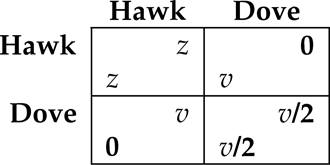
To see how such convergence may evolve, let us start with a simple model of the development of property rights. Basic property rights can be modeled as conventions in correlated equilibrium about the mutual recognition of individual jurisdictions. In the most primitive case of all, the jurisdictions can be understood simply as territorial, as in the classic Hawk-Dove game given in figure 1.Footnote 35
Generalized Hawk-Dove Game

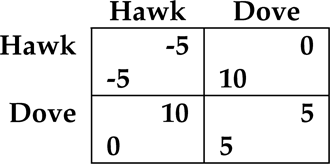
Suppose Hawks and Doves are types of individuals in the population. A Hawk always battles for a territory until either he is injured or his opponent retreats. A Dove engages in display battle: if he meets a Hawk, he quickly retreats without injury; if he meets another Dove, there is a .5 probability that he will retreat—in no case does he sustain injury. Let v be the value of the territory (and suppose it is positive), and w be the cost of injury from fighting over a territory (and suppose that w > v); then let z = (v − w)/2. Figure 2 provides a specific set of payoffs.
A Specific Hawk-Dove Game

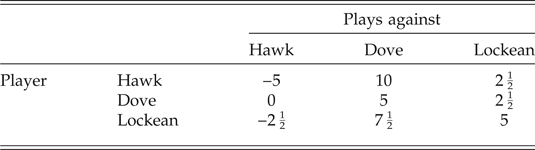
Let us view this as an evolutionary game. Players do not change strategies, but play their strategy against whomever they meet. Table 1 gives the expected payoffs of three different strategies when they meet each other.
Expected Payoffs
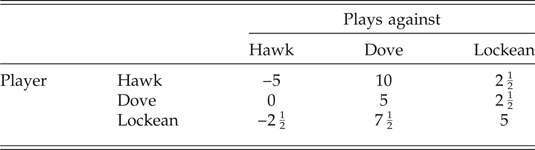
The expected payoff of a Hawk playing another Hawk is −5; the expected payoff of a Hawk meeting a Dove is 10; the expected payoff of a Dove meeting a Hawk is 0; and the expected payoff of a Dove meeting a Dove is 5. Though the players do not vary their strategies (and so they cannot make “moves” in the sense of traditional game theory), we can understand the population as “moving” in the sense that, if being a Hawk has a higher expected payoff than being a Dove, the population will move toward more Hawks and fewer Doves. In evolutionary terms, we can think of this as a replicator dynamic in which those strategies that tend to have higher average payoffs increase in the population and so displace lower-payoff strategies.Footnote 36 Thus, as the Hawks and Doves play each other repeatedly over long periods of time, the percentage of Hawks and Doves in the population from generation to generation will vary with how many points they gather in our Hawk/Dove game (points, let us say, indicate relative fitness). An evolutionarily stable strategy is one that cannot be invaded by a mutant strategy.Footnote 37 It is immediately obvious that neither all-Hawk nor all-Dove is an evolutionarily stable strategy. For a population of all Hawks, the average expected payoff of the population is −5; since a mutant Dove would have a payoff of 0, he would outperform the population average and increase. For a population of all Doves, the average population payoff is 5; a mutant Hawk would receive a payoff of 10, thus again outperforming the average of the Dove population. In the case of figure 2, an evolutionarily stable equilibrium would be a mixed population evenly split between Doves and Hawks. At that mix, the average Hawk and average Dove payoffs are the same (2 ½), and thus neither population can grow at the expense of the other.Footnote 38
Although this population mix is stable, it is an inefficient way to allocate property rights: our Hawks and Doves have arrived at a stable equilibrium, but this includes the cost of injury to warring Hawks.Footnote 39 (And remember that a population of peaceful Doves can always be invaded by Hawks.) Now suppose a new type of person arises, the Lockean. The Lockean acts aggressively to protect his territory, but is easily deterred from taking that of others. In short, the Lockean acts like a Hawk on his own territory and like a Dove on that of others. Suppose that our Lockean has half his encounters on his own territory, and half on that of others; the expected payoff of Lockeans interacting is 5; half the time a Lockean playing another Lockean will get 10, and half the time 0. Our Lockeans can invade pure Hawk or pure Dove populations, as well as our mixed population in equilibrium. Recall (table 1) that the average payoff of a Dove against a Dove is 5; but a Lockean playing a Dove will get 10 during the half of the time it is on its own territory (10 × ½ = 5) and will receive the Dove payoff during the half the time it is on another's territory (5 × ½ = 2 ½), for a total expected payoff of 7 ½, thus outperforming the Dove. In a population of all Hawks, the average payoff is −5; the Lockean will also receive the −5 payoff during the half of the time it is on its own territory, but will receive the 0 payoff when it is off its territory, giving it a total expected payoff against Hawks of −2 ½, again outperforming the Hawk population. And the Lockean population cannot be invaded by either Hawks or Doves.Footnote 40 Lockeanism is an evolutionarily stable strategy, and an efficient equilibrium.Footnote 41
Of course, the advantage of Lockeans depends on the costs and benefits of predation and defense; if preying on others is very easy and beneficial, Hawks may have an advantage. If preying is exceptionally difficult or yields small returns, Lockeans may have relatively little advantage over pure Doves. But societies filled with Hawks and Doves tend to reach inefficient equilibria over a wide range of values (concerning the variables in figure 1). If we add to our analysis competition between groups, societies of Lockeans overall have a distinct advantage. As Peter J. Richerson and Robert Boyd have demonstrated in an impressive body of work, cultural variation shows strong group selection processes.Footnote 42 Groups with fundamentally more efficient forms of organization tend to expand, and to be imitated by others. Within broad parameters, what Herbert Gintis calls the “property equilibrium”Footnote 43 is fundamental to social life, and over the long term, we can expect social convergence on some “Lockean” (in our broad sense) conception of property rights.
All this is fairly standard evolutionary game theory. Note, however, that we can redescribe “Hawks” as those who are assertive in their private judgments about the bounds of property rights, “Doves” as those who are deferential to the private judgments of others, and “Lockeans” as those who have achieved a common conception of the boundaries of property rights. Locke himself, perhaps, thought that the state of nature would be populated by Hawkish interpreters of the property convention: each individual asserts, and employs force to defend, his own view of property rights with a strong bias toward self-interest.Footnote 44 If Locke was right about this—if the state of nature would be a world of interpretive Hawks—then indeed they would be apt to abandon all private judgment and abide by the umpire (the state) to avoid destructive war (−5). The first view we considered (Section II), upholding the sovereign social authority of private conscience, also seems Hawkish, though these Hawks seem more peaceful (perhaps it is supposed that they live among Dove-like deferential interpreters who will do as they are told!). Over the long term, however, successful and efficient social orders would heavily favor our correlated Lockean interpreters, who are often able to converge on a common understanding of the bounds of property norms. The ability to think like others—or, following Cristina Bicchieri's analysis, the tendency to share “scripts” about the detailed actions called for by rules—would be favored over Hawkish interpreters, and there is good reason to think that this ability has indeed evolved in all human cultures.Footnote 45
C. Territory, resources, and jurisdictions
In the most primitive case, the property equilibrium divides territory.Footnote 46 We get closer to an adequate notion of property if we think of it as involving resources. Many of the fundamental conflicts among humans concern how those things that we can use to fulfill our needs, and that are required for production, are to be divided. However, while a focus on the division of resources rather than mere territoriality is a step toward a more adequate—a more human—conception of property, it is also easy to take a misstep here. Much current political philosophy, inspired by economic analysis, makes two claims about property rights:
(1) Property is about the division of resources.
(2) The property rights equilibrium is mutually beneficial.
From (1) and (2) it seems easy to infer:
(3) A property right in equilibrium over some resource must benefit others, and certainly must not be an overall cost.
In his original and insightful book The Right to Exploit, Gijs van Donselaar implicitly invokes this trinity of claims to argue against “parasitism,” and thus against fixed property rights in resources. Natural resources, van Donselaar argues, are scarce, and so we compete for them; property rights divide these resources, and if the property system is to be mutually beneficial, this division must work to the maximal advantage of society. Consequently, if someone appropriates a natural resource but does not employ it in a way that improves the lot of others (and of course, more strongly, if he employs it in a way that worsens their lot), his claim to the scarce resource cannot be justified through appeal to a mutually beneficial property equilibrium. Compared to the world in which the unproductive appropriator did not exist, others are worse off: he denies the use of the scarce resource to others by claiming property over it, but does nothing with it. It turns out that doing something useful with it is not enough to avoid the charge of being an exploiter: one must use it in the most efficient manner. The entrepreneur's
duty is not just to produce as efficiently as he can, but to produce at least as efficiently as any of his competitors would have done in his position (as far as that position is defined by control over resources). That implies that he may be required to produce more efficiently than he can. Where he fails to do so, he has no right to be in his position. Where he fails, his factor endowments ought to be adjusted.Footnote 47
As interpreted by van Donselaar, our trinity of claims makes each individual the steward of external resources over which he has property rights, a stewardship that requires the most efficient use for its continuance. Fixed rights in resources license parasitism.Footnote 48
Van Donselaar's case is grounded on efficiency: if the justification of property rights is a mutual benefit (qua efficiency), then only efficient users possess bona fide rights. As do most economists, van Donselaar equates two senses of efficiency or mutual benefit: (1) Pareto-superior changes that move us from distribution S 1 to a new distribution S 2, where in S 2 some have a higher level of preference satisfaction than in S 1, and no one has a lower level (no one is on a lower indifference curve in S 2 than in S 1 and at least one person is on a higher one); and (2) improvements in human welfare—at least one person's welfare is increased in the move from S 1 to S 2, and no one's is decreased. These, though, are quite distinct ideas, despite the unfortunate tendency of philosophers and economists alike to conflate them under the label “utility.”Footnote 49 The notion of welfare concerns whether, according to some standard, the life of humans is bettered or worsened. Now certainly in some basic cases there is wide convergence on judgments about welfare—it is generally agreed that bodily integrity, food, and health (for example) are of crucial importance to life, and that their absence diminishes one's welfare. However, for “increase in welfare” to serve as a general standard for judging social improvements and property rights, we need to do more than simply identify this and that element of welfare (absence of physical harm, security of person, financial and workplace security, intellectual life and enlightenment, job skills, pleasure, riches, sex, religiosity, excitement, contentment, and so on); we must also be able to rank these elements or, more adequately, construct a trade-off rate such that x amount of intellectual activity is equivalent to, say, y amount of financial security. There are always those who believe they have constructed such interpersonally valid metrics, but a characteristic of modern societies is that such metrics are highly controversial among people of good will who are competent to make judgments about these matters.
Given the dispute about the welfare interpretation of “utility,” we can appreciate the attraction of the other conception of “utility,” as a mathematical representation of the degree to which a preference ordering is satisfied. This conception is often employed in modern welfare economics.Footnote 50 It seems enticing: letting people “prefer” whatever they wish and order their preferences in any way they like, the aim of social policy should be the efficient satisfaction of these preferences (or, if there is thought to be some interpersonal metric, their overall maximization). Now in some domains of analysis, in which we make simplifying assumptions about the types of preferences held by individuals, this may lead to enlightening results, but it is markedly unsuitable as a general criterion of acceptable rules and norms. A person's preferences can range over just about anything, from preferences for food, to doing one's Kantian duty, to having a world free of Catholics.Footnote 51 Since at least the late Middle Ages, Western European society has been characterized not only by a great diversity of preferences, but by a great diversity of preferences that some hold dearly that others decry. Imagine the preference orderings of Ayn Rand and G. A. Cohen. If we accept the crux of van Donselaar's argument in the foregoing quotation,Footnote 52 Ayn Rand's holding of property in resources would be contingent upon her use raising, or certainly not lowering, the preference satisfaction of G. A. Cohen.Footnote 53
Once we understand preferences to be simply a ranking of options or states of affairs on the basis of one's values, ends, aims, and so on, the attraction of requiring that all uses of resources advance the preferences of all, or least do not set them back, evaporates. The use of my property is often important to me because it allows me to set back the satisfaction of your preferences. By opening my land to a Marxist summer camp, I set back the libertarian's key preferences: that is not simply a side-effect of my use of the land, it is the point of it. When a speaker uses the pulpit in a Catholic Church to denounce atheism, the point of the use of property is to set back atheistic preferences. The sense in which property rights are an efficient response to the problem of social life is much more general than the one van Donselaar (and, I think, Gauthier) has in mind. Property rights divide the social world into different jurisdictions. Over some questions Q, my choices constitute the definitive social choice; over other questions R, your choices are definitive for all. If we can coordinate on the boundaries of Q and R, we can go about our business without the destructive Hawk-Hawk interactions. By dividing social life into different jurisdictions, in which each person's values, ends, and goals hold sway, the mutual respect of these jurisdictions allows us to live together in partly cooperative, partly competitive arrangements with a minimum of conflict about whose values are to hold sway where. This, indeed, is the quintessential liberal response to the fact that our aims and values so often differ, and indeed conflict: the social recognition of spheres in which one's ends hold sway, and one may act on the basis of one's own values and interests.Footnote 54 This is the sense in which property rights are the foundation of a social order among people who fundamentally disagree in their aims and values, as opposed to a social order premised on the devotion of all to a collective project, be it the glory of Calvin's God, the spirit of the nation, or a fully egalitarian society. In a liberal order, each individual has a sphere in which her personal interests, religious convictions, or personal moral visions hold sway, and others respect those spheres and thus do not seek to impose their interests, convictions, and visions within them. A property rights equilibrium is a socially efficient solution to the problem of individuals living together in that mix of competition and cooperation that we call modern society—which helps explain why all contemporary social orders have tended to gravitate to the liberal solution.
D. From convention to a moral equilibrium
I have argued thus far that a “Lockean” property rights equilibrium, in the sense of a set of shared or joint individual strategies dividing society into various jurisdictions, is a critical part of an efficient solution to the problem of social order given differences in aims and interests. However, as David Schwab and Elinor Ostrom argue, there are compelling reasons to conclude that mere shared strategies are insufficient to sustain free-market transactions.Footnote 55 If we suppose that individuals are solely devoted to their own private ends, the development of market exchange—which depends on trust—is difficult to explain. As Hobbes so effectively showed, individuals who are solely devoted to their private ends will be sorely tempted to renege on “covenants”: if the other party performs first and so gives the second party what she wants, there seems to be no incentive for the second party to perform her part of the bargain.Footnote 56 Rather than exchanging, she will be tempted to snatch the goods and flee.Footnote 57 Given sufficiently narrow, self-interested utility functions, she may often do better by snatching: she gets the good without paying for it.
To some extent, reputational knowledge can mitigate this problem: if the person is known as a snatcher rather than an exchanger, exchangers will boycott her, thus giving her an incentive not to snatch in order to avoid future boycotts. However, the ability of reputational knowledge to constrain snatching behavior is surprisingly limited. Peter Vanderschraaf, employing dynamic game analysis, has shown how sensitive this reputational solution is to accurate common knowledge. In his model, Vanderschraaf takes account of the effects of false as well as true gossip: once we model information as gossip (true and false) and allow snatchers to adopt slightly more sophisticated strategies (such as only snatching half the time rather than always), Vanderschraaf shows that the snatchers can fare better than the exchangers “in a community that must rely upon private information or ‘gossip’ only to spread information.”Footnote 58 In a world of such imperfect information, Vanderschraaf concludes that “Rationality alone does not explain reciprocal cooperation.”Footnote 59
Natalie Henrich's ethnographic research among the Chaldeans also supports the limits of cooperation through reputation. The Chaldeans are a non-Arabic, Christian ethnic group with a population of approximately 100,000 that has emigrated from Iraq to the Detroit metropolitan area. Henrich's research indicates that intragroup cooperation is to a large extent sustained though reputational knowledge. As one subject reported:
Everyone knows which families are good or bad, and you just do business with people who come from good families—I go by family name. If I don't know someone, I call people and ask about his family. People just mention who they are and [if they have a good reputation], they get credit.Footnote 60
Because the Chaldeans have social networks in which almost everyone is heavily enmeshed (family businesses, clubs, organizations, and churches), and because they have “a fondness for gossip,” only a few calls are required to get information about the reputation of any potential participant in a business deal.Footnote 61 The costs of a bad reputation are quite severe. “Among Chaldeans, a person with a bad reputation is less likely to be given credit, to be hired, to be desired as a business partner, or to be lent money. People will also not want to date or marry a person with a bad reputation and if they do so people will gossip about them.”Footnote 62 The Chaldeans, then, are a case of a reasonably large group in which cooperation is to a large extent sustained by knowledge of reputations. Henrich and Henrich's analysis however, also displays a number of pathologies and inefficiencies of social cooperation sustained through reputational knowledge. For example, individuals spend a great deal of time establishing reputations; because it is important that a person establish a generalized reputation as a cooperator, there is a significant incentive to ratchet up one's reputation in public arenas with a show of cooperative behavior even with noncooperators; conflict arises because of competition among individuals within groups, and between groups, to claim credit for accomplishments to bolster reputations; individuals exploit opportunities to gain reputations without contributing; to have a reputation as a cooperator is not simply about one's past tendencies to engage in certain well-defined cooperator behavior, but is closer to having a reputation as a good group member, who conforms to the group's customs and norms; and those who are members of families with good reputations are treated as having good reputations, while those in families with historically bad reputations are treated as having bad reputations, even if they have no such individual history. Chaldean cooperation is focused on other Chaldeans: there is considerable distrust of out-group members. Chaldeans prefer to do business with co-ethnics, even at significant costs to themselves.Footnote 63 All these are significant costs to social cooperation through reputational knowledge. Overall, it is unclear to what extent such reputational knowledge actually can sustain cooperation within large groups without intense social networks conveying reliable information.Footnote 64
A large body of work indicates that extended market societies are only possible when the property equilibrium evolves into a moral equilibrium: individuals come to conceive of property and exchange rules as morally authoritative.Footnote 65 Participants largely refrain from cheating and exploiting others, not primarily because they are worried about their reputations, but because they believe it is wrong to violate rules that are generally followed by others. This last phrase is important: people tend to follow rules that are generally followed—they tend to ignore normative exhortations to follow rules when the exhortations are not backed up by actual general conformity.Footnote 66 A striking feature of market economies is a strong acceptance of a norm that requires that strangers be treated fairly. In a now-classic cross-cultural study, Joseph Henrich and Natalie Smith found that participants in market societies (the United States, Indonesia, and Israel) were much more likely to treat anonymous strangers fairly than were those in two small-scale societies—the Machiguenga of the Peruvian Amazon and the Mapuche of Southern Chile.Footnote 67 Henrich and Smith concluded:
In order to exist, modern, industrial, urban centers must have developed norms (behaviors and expectations) to deal effectively with anonymous transactions, and allow people to cooperate in a wide variety of contexts. Market societies are filled with opportunities to “cheat,” such that, if most people took advantage of these loopholes, our systems would rapidly crumble. We think that these systems persist because people share sets of re-enforcing norms about how to behave in different contexts, what is “fair” in different contexts, and what to punish…. The point is, large-scale, market-based societies could not function without well-coordinated norms for dealing with anonymous, one-shot, monetary interactions. However, there is no reason to expect other societies, where anonymous monetary transactions are recent and rare, to share such norms.Footnote 68
The Machiguenga, for example, “have little or no expectation of favorable treatment from anonymous persons, no sense of group fairness, and thus no reason to punish.”Footnote 69 Thus, the Machiguenga have not developed norms about cutting into waiting lines, a basic rule of fairness that unites market societies such as Chile, the United States, and India.Footnote 70 As the market order expands, groups adopt its norms of fairness.Footnote 71
V. The Basic Conditions for a Moral Equilibrium
A. The optimal eligible set
If the property equilibrium is to be a genuine moral equilibrium, it must be the case that the population can endorse the property norms as authoritative, so that an individual does not defect on them whenever he can “snatch rather than exchange” without being observed. As with almost all equilibrium solutions, this certainly does not mean that the norm must be judged “the best” by everyone. An equilibrium describes a set of actions that satisfies everyone's utility function—now understood in an extended sense to include devotion to norms as well as private endsFootnote 72—to the extent that each person ranks acting on the equilibrium as better than unilateral defection. When the property rights equilibrium is also a moral equilibrium, each person, drawing on her set of values and ends, affirms that the property norm is authoritative for her. That the norm requires exchanging rather than snatching, or requires that one treat strangers fairly in market transactions, is itself a strong reason to do so, and one would normally see oneself as having done wrong, and as properly liable to blame and rebuke, for failing to conform to it.
To help make the point more precise, suppose that each person has a well-informed and coherent “extended utility function,” which includes not only her private ends, but her values, normative intuitions, and so on.Footnote 73 For a property norm to be in universal moral equilibrium in a society, it must be such that each person, consulting her extended utility function, endorses the property norm as authoritative—a moral norm that she has reason to follow if others do so as well. Now suppose that, consulting her own extended utility function, each person i proposes a property right rule p i, which she believes is the rule that best satisfies her extended utility function. (This is basically what philosophers do when they argue for their preferred theory of property rights and distributive justice.) Assume further that each individual has made a proposal, and so we have a set of all proposals {p 1 … p n}. If there is any proposal in {p 1 … p n} that some well-informed person cannot accept as authoritative—if that were the property right convention, she would defect rather than comply when she could do so unobserved—it must be excluded from the set of acceptable property norms. It could not serve as a possible moral equilibrium. Let us also exclude any norm that is Pareto-dominated by another in the set: if, for everyone, p x is ranked better than p y, then we exclude p y from the final set. The set of remaining norms is the optimal eligible set of property norms: any norm in the set is preferred to the absence of a moral equilibrium, and none is dominated by any other.
B. Testing our moral property rights
As Baier stressed, the place to begin our moral thinking is with our existing social rules. Moral philosophy does not construct a system of morality de novo; a society's morality is a social fact that structures the actual interactions of its members. As we have seen, it is only when social norms are a social fact—when others are generally conforming to them—that a person tends to act on them. Mere moral exhortation is seldom effective in generating moral behavior. Given this, when we are confronted by an existing social norm the primary question for moral philosophy must be whether that norm is within the optimal eligible set. If our current property rights are within the optimal eligible set, they provide a bona fide moral equilibrium, and they can perform the social tasks that a property rights regime must perform, because they are seen by all as morally authoritative. The existence of an actual social rule that is generally followed by a society is entirely different from a fanciful construction of what rule would be fairer, or nicer, or better: only an existing rule can provide a moral structure for human society. If our existing property rules are within the optimal eligible set, we are fortunate enough to live in a moral order.
If we understand a rule of a true morality as one that is within the optimal eligible set, then we must agree with Baier that “[t]here is no a priori reason to assume that there is only one true morality. There are many moralities, and of these a large number may happen to pass the test which moralities must pass in order to be called true. It would, therefore, be better to speak of ‘a true morality’ or of ‘true moralities’ than ‘true morality’.”Footnote 74 If our existing property practice is within the optimal eligible set, each person has sufficient reason to affirm it as an authoritative moral norm: consulting only her own reasons (“extended utility function”), she sees that given that others are complying, she too has sufficient reason not only to comply, but to endorse the norm as authoritative. In that sense, each person freely complies: she freely accepts the norm as authoritative over her.
Reconsider now one of our troublesome theses (from Section II.B above). According to the Social Authority of Private Conscience thesis, each person consults her own private conscience and makes authoritative moral claims on others. This seems to be precisely the type of sectarian claim to authority that the liberal tradition has decried (see Section II.C). Now when a moral rule is within the optimal eligible set, each person has reason both to demand that others comply (it is, say, essential to the practice of property) and to accept this demand as authoritative over her, because the moral rule is in equilibrium. It might seem to some that if all endorse the moral equilibrium, there would be no reason why one must demand that others comply—all would freely do so. As Richerson and Boyd observe, though, “we are imperfect and often reluctant, though often very effective cooperators.”Footnote 75 We need authoritative moral rules because we are a complex combination of selfish and moral creatures: the moral system, we might say, has developed on top of an earlier selfish set of motivations.Footnote 76 In less psychological terms, we are often tempted to put aside our normative commitments and cheat, even when we accept that this violates a norm we have good reason to endorse and internalize. Thus, others must have authority to insist that we live up to our normative commitments, but if the norms are really in moral equilibrium, they are not making mere sectarian demands on us.
C. The priority of morality to politics
Recall our other troublesome thesis, the priority of morality to politics; consider for now simply the Sanctity of Conscience interpretation. This interpretation states that an act of a political authority is morally acceptable to Alf only if it conforms to Alf's private conscience about the requirements of morality. The thesis allows Alf to deny authority to any political act that violates his understanding of a moral norm. As we saw in Section III, the social contract tradition can be interpreted as something close to a renunciation of this thesis. I hope it is now clear that, insofar as the relevant moral norm is based on a moral equilibrium, it is not problematic, and indeed is essential to a liberal social order. That the political must be constrained by the moral is fundamental to any free society: the political must operate within the area of the morally acceptable. When citizens conclude that the state has legislated, or enacted policy, that violates our bona fide moral equilibrium, citizens are right to deny the legislation's authority. States are useful but precarious devices: unless those who operate them are constrained by moral norms, their use of coercion allows them to make almost any outcome a social (though not a moral) equilibrium.Footnote 77
Hobbes and Kant, and to a lesser degree Locke, thought that this was a recipe for social chaos; individuals would always use their private reason to interpret rules differently, and thus morality itself would become a source of conflict. Now, to be sure, sometimes we do disagree about morality (see below), but the driving force of social life is our ability to share very similar understandings of what is required of us. Just how we share these similar “scripts” is fundamental to understanding normative behavior,Footnote 78 but we certainly do; we are generally excellent at knowing what the moral rules require and at detecting cheaters.Footnote 79 The phenomenon of moral disagreement is real and must be dealt with, but it occurs around the periphery of great agreement. When the rules are in moral equilibrium, our private judgments have strong tendencies toward convergence.
D. Moral disequilibrium and disagreement: The role of the state
Of course, our moral rules may not be in equilibrium. That is, we may be outside the optimal eligible set, in which case aspects of our current social morality may be oppressive: we demand of some that they comply with rules they do not have sufficient reasons to endorse as normatively authoritative. Because the property equilibrium is so essential to social life, rules in moral disequilibrium may nevertheless exhibit considerable social stability. It is generally in our interests to comply with an unjust property system—especially one that is coercively enforced—rather than have no property system at all. Here concern with distributional issues is certainly appropriate: if some receive little private benefit from the system of property, we may well be skeptical that it can serve as a possible moral equilibrium. Fairness is crucial to our understanding of market and property relations. We must ask: What types of property rules are such that all individuals have normative reason to grant their authority? In our eagerness to give a definitive answer to this question, though, we must not forget that authoritative property rules are a tremendous social good, and that well-informed individuals would certainly not reject the authority of all rules except those which give them their preferred outcome. The range of possible moral equilibria is almost sure to be extensive, and our own social rules of property, imperfect as they are to philosophers, may well be within it.
Certainly a critical role of politics is to address oppression and deep unfairness when they occur. The great power of the political order is that it can move us from moral disequilibrium to a moral equilibrium (a property rule within the optimal eligible set). The great danger, as I said, is that it can effectively move us to any social equilibrium: it can move us from moral equilibrium into moral disequilibrium by using its coercive power to impose norms that some people have no good reason to endorse (or, we may say, norms that are not endorsed by their “extended utility function”). Just how we can use the state to move us toward, rather than away from, moral equilibrium, is the core question of liberal constitutionalism.
And, of course, the social contract theorists were right that sometimes we disagree about the moral rules. Often too—perhaps especially in the case of property rights, which must adjust to rapid technological and social changes—our moral equilibrium only provides a core understanding, which must be developed and expanded via the state. Patent protections, copyright laws, and property rights in financial instruments are obvious examples; we cannot wait for the evolution of social conventions. We come back to T. H. Green, who properly conceived of the state as the protector, sustainer, and developer of the social system of rights.Footnote 80
VI. Conclusion: Toward a Non-Ideological Political Philosophy
It may seem that, after all, this analysis does not really restrict the scope of ideological political philosophy—or, we might say, the political philosophy of utopian vision. On the account I have offered, the task of political philosophy is, first and foremost, to reflect on whether our moral rules (say, of property) are within the optimal eligible set: Is our society oppressive, or do everyone's normative reasons converge on endorsing the rules? Here, of course, there is great room for disagreement. But a non-ideological political philosophy is not to be confused with a bland political philosophy in which we all agree. The crucial point is that the proper perspective is not the sectarian perspective of a philosopher with elite access to the moral truth, but an analysis of what rules are objects of moral convergence by well-informed and good-willed individuals. If we do conclude that our rules are outside the optimal eligible set, then the philosopher may again don his beloved legislative hat, proposing rules that he believes would pass the justificatory test. There is, though, no supposition that the rule endorsed by the philosopher's personal vision is even in the optimal eligible set, and if it should be, it is almost certainly simply one of many rules in the set.
The scope of political philosophy, and even applied public policy advice, remains wide. But I believe it will be both a more modest, and a less ideologically strident, political philosophy. We will not insist that justice demands that our own, often rather idiosyncratic, theories be adopted. And we will not make a profession of criticizing pervasive “everyday” attitudes, such as the supposedly silly conviction of people that they have claims to their pretax incomes.Footnote 81 Many philosophers chafe under the actual moral rules of their society and are convinced that they can do better, and so construct complex and controversial “theories of justice” that, amazingly, they see as uniquely correct. Only by appreciating that morality is a social device, and not simply a report of their private intuitions and elaborate constructions, can philosophers become part of the solution, rather than the ideological pollution.