Introduction
There is a consensus that in some Latin American countries—mainly the Southern Cone—that the roots of the welfare state were established long ago. In fact, between 1870 and the first decades of the twentieth century, in the context of an ongoing process of consolidation of new nation-states, several countries planted the seeds of both government regulation and government social benefit and service provision.Footnote 1 During this period, a new approach regarding the role of the state in the provision of certain goods emerged, along with a growing bureaucracy. In fact, policies that shaped later developments in the regions’ welfare states were first established during this period.Footnote 2
Much of the literature on the origins of the welfare state in Latin America contends that early policy models adopted by several countries in the region at the beginning of the twentieth century were influenced by policies already adopted in Western Europe and the United States. Analyses of the creation of health policy and social insurance/pension systems frequently identify transnational policy diffusion and selective adaptation of social policies as the explanation for policy developments in countries as different as Uruguay, Mexico, Brazil, Costa Rica, Colombia, and Argentina.Footnote 3
While the argument that the transnational diffusion of ideas was important in shaping early welfare policies in the region is quite compelling, little evidence has been provided to support it. For example, little has been published about which particular ideas diffused and whether Latin American governments simply emulated these ideas uncritically or, instead, adapted them based on a consideration of how well the different ideas worked in the countries where they originated.
In this article we analyze how policy ideas already adopted in Europe—particularly in France—were taken into consideration for the design of Uruguay’s National Public Assistance (NPA), established in 1910.Footnote 4 The NPA law was a foundational event in Uruguay’s development of a system of state intervention in the regulation and provision of health services and welfare.Footnote 5 It is considered to have been a pioneering law for the time and for the region and is one of the reasons Uruguay is generally considered to have been the “first welfare state” in Latin America.Footnote 6
Some authors have contended that the design of the NPA law followed the secular and republican model instituted in France at the end of the nineteenth century, when France established the Assistance Publique. Footnote 7 In particular, some have argued that aspects of the NPA law were “self-consciously patterned on France’s Assistance Publique.” Footnote 8 These studies base their argument on the clear resemblance of the Uruguayan model to the French one, particularly regarding the extent of public assistance to the poor, the role of the state in the provision of health care (as opposed to charity-based provision) and the centralization of health-care services. This design was very similar to the one adopted during the French Revolution, which assigned local governments the responsibility for eradicating begging by providing public assistance.Footnote 9
However, these authors provide scarce evidence about how these features of the French system “traveled” to Uruguay, i.e., how these ideas were discussed, the subject(s) of the discussion, and how the features of the French system were processed and incorporated into Uruguay’s legislation. In sum, we still know little about how the social welfare ideas emanating from Europe were considered by the Uruguayan government and Congress when the latter developed the NPA legislation. In particular, no one to date has addressed the question of whether Uruguayan policymakers simply emulated the French model uncritically or instead critically assessed the successes and failures of existing welfare systems in the process of crafting the NPA law.
In this article we aim to remedy these gaps in our understanding. We analyze how the revolutionary ideas embodied in the European welfare-state models were discussed by the technicians and politicians who participated in the process that culminated in the approval of the NPA law. To do so, we explore the factors that motivated the creation of the commission that crafted the law. We also review available documentation on the drafting of the bill and the parliamentary debate that culminated in its approval.
By tracing this process, we shed light on the context that led to the incorporation of these social welfare ideas into the NPA law, testing whether this was a process of emulation or one of analysis and learning. Our findings further our understanding of how European social-welfare ideas were diffused and helped shape early social policies in Latin America.
The Diffusion of Ideas in the Development of the Welfare State in Latin America
The diffusion of ideas plays an important role in the scholarly work on social policy in Latin America. On one hand, a growing number of studies suggest that recent developments in social policy in Latin America can be partially explained by the diffusion of ideas. For example, in a study of the social-sector reform that occurred during the 1980s and 1990s, Weyland finds that policymakers applied the theory of bounded rationality based on coherent policy models, such as the Chilean pension privatization reform of 1981.Footnote 10 Other studies have also sought to explain the widespread adoption of conditional cash transfers (CCTs) and noncontributory pensions in the region in terms of diffusion mechanisms. Sugiyama, for example, argues that CCTs emerged by diffusion in the form of neighborhood effects.Footnote 11 Similarly, Osorio Gonnet shows that a regional epistemic community and domestic technical capacities were important aspects of the diffusion that took place in the adoption of CCTs.Footnote 12 In countries with high domestic capacities, with a professional bureaucracy and technical staff, the diffusion took the shape of a learning process. However, in countries with weak technical capacities, CCTs were simply emulated. On one hand, while these studies consider the diffusion of ideas as an important factor in explaining the convergence of recent welfare reforms and policy developments in the region, they consider only the last two or three decades and focus mostly on intraregional diffusion, overlooking the diffusion of ideas from developed countries outside Latin America to the region.Footnote 13
On the other hand, numerous case studies focused on early social policy developments in the region point to the transnational diffusion of ideas, mainly from Europe, as an important factor in explaining the particular design of social welfare programs in Latin America.Footnote 14 Martinez Franzoni and Sánchez-Ancochea, for example, explain the development of Costa Rica’s 1941 social insurance law in terms of a mechanism that involves, among other things, transnational diffusion.Footnote 15 They show that a small group of experts, most of them exposed to international ideas about and models of pension policies, managed to influence top decisionmakers who designed the main features of the pension system in Costa Rica. Most of these Costa Rican experts had studied in France and Belgium and were also familiar with the main international debates regarding social insurance at the time.Footnote 16 These authors show that, contrary to what other scholars have hypothesized for other countries in the region, the United Nations International Labor Organization had only a limited influence on the development of the social insurance policy in Costa Rica. They also show that some of the experts that played a key role in the process of adopting the new policy met Chilean experts involved in drafting the Chilean social law.Footnote 17
This example, however, is an exception in the literature. Most case studies that have examined the links between European and Latin American welfare policies have sought to prove the existence of diffusion: that is, they have posited diffusion as the explanation for convergence or similarity between the policies in different Latin American countries.Footnote 18 This contrasts with the scarce amount of scholarship focused on understanding how ideas traveled. Efforts to understand the diffusion process through which policy decisions in one context can be explained by policy choices and policy ideas in other contexts have been notably missing from studies of early welfare-state developments in the region.Footnote 19
Emulation and Learning as Diffusion Processes
Diffusion is gaining importance as a factor that explains policy change, but the meaning of policy diffusion is still a contested issue in the literature.Footnote 20 Diffusion has been referred to both as “the fact that at the end of the period all (or many) countries have adopted the policy” (diffusion as an outcome) or “the process that leads to the pattern of adoption” (diffusion as a process).Footnote 21
In this article, we consider diffusion as a process of horizontal interdependence between countries, and we focus on two different ways in which ideas from one context can explain policy choices in another.Footnote 22 First, we consider emulation (also sometimes termed “imitation” or “mimicry”). Emulation occurs when one government copies policies or ideas from another government but does not consider the consequences or success of the policy in the country where it originated. Emulation means “copying of another government’s policies without concern for those policies’ effects; thus, the extent of learning in these circumstances is merely the acknowledgment that a government that is perceived to be a leader has the policy and that the policy must, therefore, be something desirable.”Footnote 23 What matters in emulation is “the symbolic and socially constructed characteristics of policies” that constitute the normative environment that surrounds and constrains policymakers.Footnote 24
Second, we consider the processes of learning. Prior work shows that “governments learn from each other” in policy areas as varied as trade, health, and social security.Footnote 25 One country can learn from another about policy design and policy effectiveness, but also about the political opportunity to implement a policy or the political costs that others have already experienced.Footnote 26 Learning may also imply that governments make choices in the context of bounded rationality defined by knowledge shortcuts, sometimes receiving advice from policy advocates and entrepreneurs with international experience.Footnote 27 Learning is considered to have occurred when either policy decisions in one country are influenced by the consequences of similar policies in other countries or policy choices are made after considering other countries’ experience with similar ideas or policies in a relatively thorough way.Footnote 28
The National Public Assistance Law in the Development of Uruguay’s Welfare State
Uruguay is an emblematic case of the early development of welfare policies in the region.Footnote 29 In 1909, Uruguay had a bipartisan system comprising the Partido Colorado (in government) and the Partido Blanco. The two parties, both of which emerged in the years following independence (1830), initially were organizations formed around caudillos and charismatic leaders and later incorporated some programmatic features. At the beginning of the twentieth century century, José Batlle y Ordóñez (1856–1929) led a faction—the Batllismo—inside the Partido Colorado and became president for the first time in 1903. The Batllismo had a radical reformist agenda in the social, economic, and political realms. During the first decades of the twentieth century, the batllismo promoted social reforms, such as the eight-hour workday and divorce law, political reforms, such as universal suffrage and separation of church and state, and economic reforms, such as industrialization and nationalization of foreign-owned businesses.Footnote 30
At that time, Uruguay had strong links to the international discussion about how to organize health care and health policy. During those decades, an elite group of Uruguayan doctors participated in this discussion and also familiarized themselves with the experience of health services in several foreign countries. For several years prior to 1910, Uruguay’s experts from the national health authority (Consejo Nacional de Higiene) and from other key areas regularly participated—often at government expense—in international gatherings of health-care professionals. Footnote 31 International conferences regularly had Uruguayan representatives, who published their work and even served as references for other countries in the region.Footnote 32
This is the context in which the government promoted the National Public Assistance Law (law 3724, adopted in 1910). The law established for the first time the State’s responsibility to guarantee medical assistance to all those among the population who lacked the resources to purchase medical care in the private market. Footnote 33 It recognized the right of all individuals who were indigent or deprived of resources to “free assistance on behalf of the State” (Articles 1 and 2).Footnote 34 The law also included the revolutionary principle of Public Assistance, which put an end to the idea that health care for the poor should be based on charity, especially that provided by the Catholic Church. The law established that all charity-based hospitals and asylums in the country would be owned and managed by the State (Article 20). This meant that the government could expropriate property owned by the charity—which affected inheritance rights. Finally, the law created a centralized system of services, in a country where, until 1910, health care had been provided through unregulated private for-profit and nonprofit organizations.Footnote 35
The new institutional arrangement of the Public Health Assistance replaced the Charity Commission that was based in the capital (Montevideo) as well as the autonomous commissions—whose members included church authorities, high-society ladies, politicians and members of the economic elite—that managed local hospitals and asylums all over the country.
The process started at the beginning of 1908, when the government appointed a commission to be in charge of crafting a bill to be presented to Congress.Footnote 36 The commission included five physicians and two lawyers who worked intensively and produced a report.Footnote 37 The commission’s president, Dr. José L. Scosería, was Uruguay’s delegate to international health and welfare agencies and created in 1895 the first Experimental Hygiene Institute in America.Footnote 38 Dr. Luis Morquio, also a member of the commission, was a Professor of Pediatrics since 1896 at the Universidad de la República. He spent years training in France and, after returning to Uruguay, became a renowned expert in maternal and child health and the “most important interlocutor of French and Latin American pediatrics… . Although he maintained a permanent base in Montevideo, Morquio traveled frequently to Europe and other Latin American countries to lecture and work with colleagues.”Footnote 39
The report produced by the commission contained a diagnosis of the health situation in the country, covering three main aspects: (1) the high levels of maternal and infant morbidity and mortality; (2) the incidence of infectious diseases, which were the main cause of death in the country, together with violence; and (3) the high prevalence of chronic conditions such as syphilis and tuberculosis.Footnote 40 The report also provided the foundation for the draft bill. After being submitted to Congress on September 9, 1909, the project was discussed in the Constitutional Commission and went through an intense debate in the lower chamber. The law was approved on November 7, 1910, and its implementation began in the first months of 1911.
Method and Data
Our goal is to explore how the revolutionary idea of providing health assistance to the poor through a centralized public health-care system— in contrast to decentralized provision of charity-based health care—was processed and incorporated in the NPA law in Uruguay.
To achieve this goal, we carry out a congruence analysis. We test the congruence of our case with each of two hypotheses. The first hypothesis states that the resemblance of the NPA law to France’s Assistance Publique was the result of an emulation process. The second hypothesis states that the ideas present in France’s Assistance Publique were incorporated into Uruguay’s NPA law via a learning process.
Although we present these two hypotheses as rival accounts, we consider them coincident explanations that could both have contributed to the resemblance between Uruguay’s NPA law and France’s Assistance Publique, because certain aspects of the NPA law could have resulted from one process while other aspects could have resulted from the other process.Footnote 41
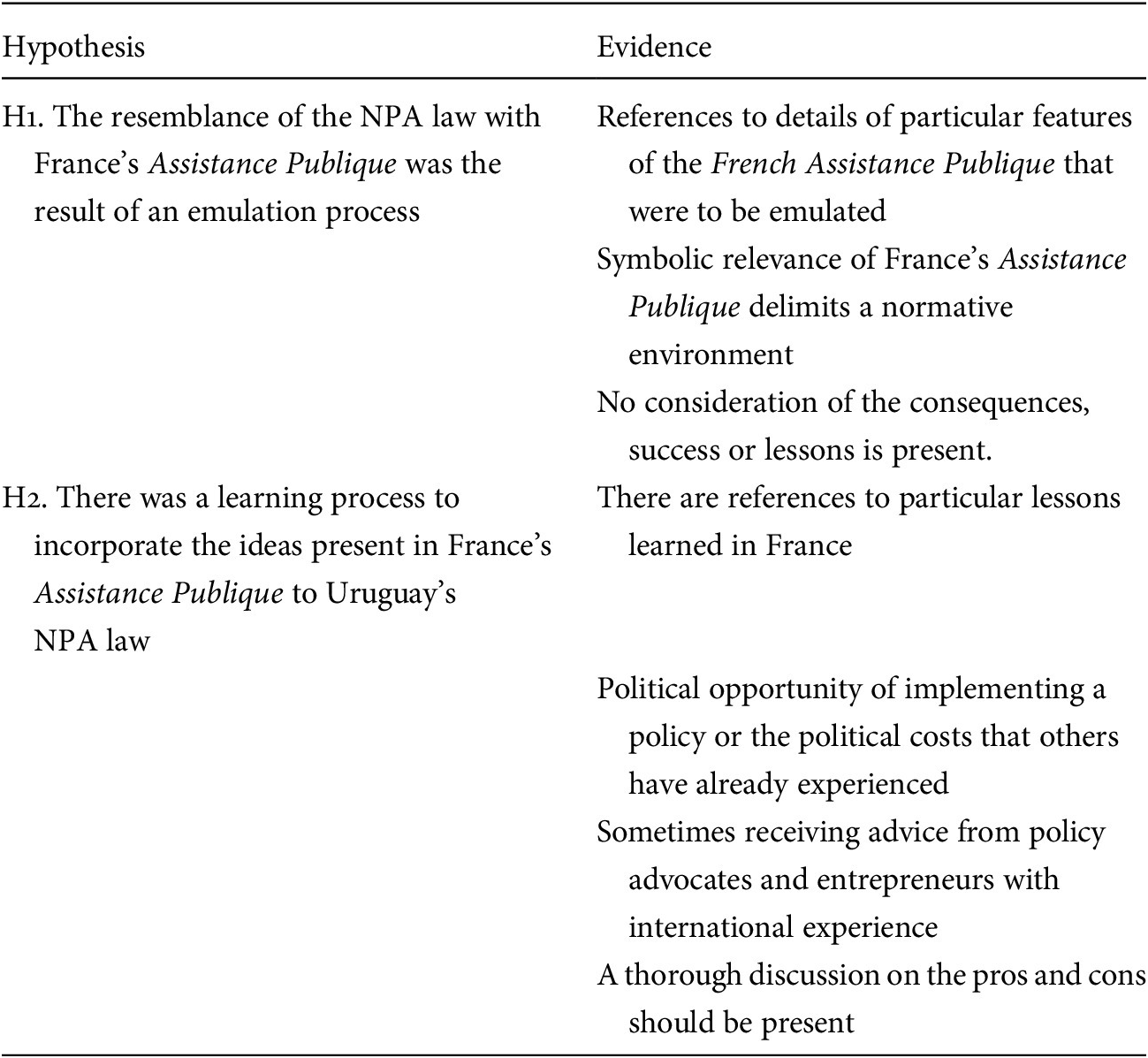
Although the definitions of learning and emulation are quite distinct, there is frequently overlap in the operationalization of the two concepts.Footnote 42 Therefore, prior to reviewing our source material, we established the evidence that would support each hypothesis. If an emulation process of diffusion occurred, there should be evidence of repeated references to the French case and to the Assistance Publique as the model to follow in health policy. Also, there should be no evidence of a thorough discussion of the consequences or successes of the French model or of lessons drawn from France’s experience.
In addition, we argue that for learning to be present, we should find evidence that those who crafted Uruguay’s NPA law took into consideration the positive and negative outcomes of health policy reforms in France and other countries (Table 1).Footnote 43
Hypothesized Indicative Evidence of Emulation (H1) and Learning (H2)

Source: Authors’ elaboration based on note Footnote 64.
To test both hypotheses, we reviewed the complete transcripts from the debate that took place in the Uruguayan Congress between June and November 1910. The Congressional transcripts provide interesting evidence regarding the content of the debate concerning the NPA law and inform our understanding of whether the diffusion process was one of emulation or of learning, and of which particular ideas diffused by means of each process. We also reviewed historical studies and other secondary sources to complement the evidence from the congressional transcripts and to inform our understanding of the context in which the debate took place.
Emulation and Learning in the Transnational Diffusion of Ideas Incorporated into Uruguay’s National Health Assistance Law (1910)
Public Health Care to the Indigent
The idea that the State should provide health care to the indigent was extensively discussed during the legislative process of crafting the NPA.
To defend the principle, the report sent to Congress mentioned this feature of the law as a notion endorsed by the International Congress of Health Assistance. The report also cited the work of the French expert Henry Monod to buttress its claim that providing health care to the indigent was the cornerstone of the reform projects promoted by France’s Higher Council for the Administration of Assistance.Footnote 44 According to Ashford, Monod was in charge of organizing public assistance in France and was the leader of social reform efforts, particularly regarding health care.Footnote 45
Citing Monod, the report stated that “public assistance should be organized in favor of poor children, the sick poor, the chronically poor old people who do not have sufficient resources. That is the importance of the formula that derives from the simple idea that if rights must be recognized for man and citizen, there is one that dominates all others, because without it, others are not (possible): the right to live. Malthus denies it, but the conscience of humanity affirms it.”Footnote 46
However, some opposed this idea. One of the main detractors was Joaquín de Salterain, a politician and physician from the Partido Colorado (although not part of the batllismo), who spent four years in Paris specializing in ophthalmology with a government scholarship. After returning to Uruguay, he “was a constituting member of the Consejo Nacional de Higiene, and in the mid-1890s he began to publish detailed analyses of Montevideo’s mortality statistics in Uruguayan medical journals as well as in French and British publications.”Footnote 47
During the debate in Congress, De Salterain critically referred to France as the model that was being followed, as ‘the country that has been most taken into account to make this law.”Footnote 48 He argued that what was established in the law was “very beautiful and, as everything beautiful, in practice, a bit platonic,” and that it was not enough ‘that republican France and monarchical England have done this or that [it is necessary] to study what we are.”Footnote 49
State Services Versus Philanthropic Providers
The most controversial feature of the bill was the nationalization of private institutions of medical assistance with the exception of those located in Montevideo. In article 18 the bill stated: “Hospitals and Departmental Asylums that have been founded or sustained with public resources or by popular subscriptions, or that have enjoyed tax exemptions, are declared public services; and the funds of these institutions will be transferred to the National Public Assistance.” This measure— which provoked an intense debate containing many references to the experience of other countries—was considered by the opposition as an attack by the State against private agents.
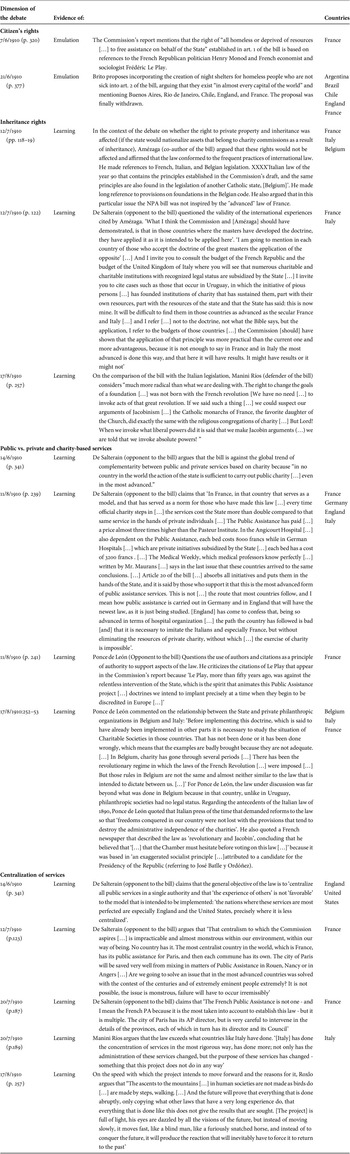
The main criticism of nationalization emphasized the absence of international precedents for a measure of this type. In fact, the opposition accused the project of being “too advanced.” It was argued that the law went beyond the limits established by the experiences of the reference countries (especially France). From that perspective, countries like Uruguay, small and less developed, ought to wonder why the most advanced nations had “not dared to do so much.” In this case, the international experience was for the opponents a blueprint that predicted possible trajectories and outcomes, while warning about threats. The policy alternatives that did not accord with the international experience were presented as adventurous initiatives and expressions of voluntarism. For Ponce De Leon, who opposed the bill, it was inadmissible to have “laws that France has not dared to sanction.”Footnote 50 Also, references were made to examples from Belgium, England or the United States to claim that the measure was a mistake (see Table 2).
Evidence of Emulation and Learning in the Parliamentary Debate of Uruguay’s NPA ill

Source: Authors’ elaboration based on diaries from Parliamentary Sessions (1910).
The debate focused on the need to respect inheritance and private property rights, as well as on the efficiency of spending on public or private management.
For some who opposed the bill the project was unacceptable because its defenders were not able to demonstrate that they were aligned with the “doctrines” collected in the European countries of reference. De Salterain put it clearly when he asked whether “in those countries where the masters have built their doctrine, they have applied it as it is intended to be applied here” and maintained that “this is what we think the members of the commission [informant] should have shown.”
De Salterain extensively cited data from previous experience in France, Belgium, Italy, England, and Denmark. From his point of view, the bill ignored the learning that those cases allowed. He also claimed that “the absorption of charitable services by the official power … may not yield results, as it has also been shown in the countries in which it has been applied with the rigor that is intended here.” He argued that international experience confirmed the inefficiency of public management and that this was a general phenomenon in “all countries where official charity wants to fight against private initiative charity.” For de Salterain, it was inadmissible that the proponents of the bill did not learn from the French case, where this measure “costs the State more … than twice the cost of this same service in the hands of private individuals.”Footnote 51
Italy and Belgium were also mentioned in the parliamentary debate.Footnote 52 Lawmakers compared the evolution of Italian public assistance with the project under discussion. For the promoters of the project, Italian legislation established the basis for expropriation of private charities, although it was never a model of “Jacobinism.” For the opponents of the law, Italy never expropriated the assets of private charities. Also, references to the evolution of Belgium’s public assistance policy were cited both by the promoters and opponents to the bill. During the debate, more than a dozen Belgian doctors, lawyers, and politicians were mentioned.
In addition, legislators who opposed the project highlighted Germany as a successful case of public assistance subsidized by the State but managed by private organizations. Denmark was mentioned as a country model with state subsidy of private institutions for the indigent. It was described as a rich and “perfectly organized” country. References to England were made by some congressmen opposed to the project, in all cases to describe it as a model of a public assistance system that was organized according to the principles of decentralization and encouragement of private public assistance institutions, features opposite to that of the French model. The discussion included explicit references to the reform process that the English public assistance system was undergoing at the time.Footnote 53 Also, De Salterain made a reference to the public assistance system of the United States as another example of a system based on private institutions.Footnote 54
Other opponents of the bill advocated learning from previous instances in which Uruguay was influenced by ideas and norms from abroad, particularly the influence of the French Revolution on Uruguay’s first constitution, approved in 1830. For Ponce De Leon, those who wrote the Constitution “knew that the French Convention of 1794 had voted an article very similar to the one that we want to vote now, declaring national property all those belonging to hospitals and charity hospices, [and because] they knew the disaster that was for the French charity the approval of that measure, they had a deeper respect for the property … they put in our Constitution, article 144, an article that declared that property was a sacred and inviolable right; sacred and inviolable were the special words that they put, to show the importance of what they wanted to say.”Footnote 55
The efficiency of public and private management was also discussed with many references to international experience. Opponents advocated the need to imitate certain aspects of the French model of Public Assistance. For De Salterain, the solution was to modify the project to do “what in all the countries of the world has been done, what is done in France … that the philanthropic organizations are subsidized by the State on a mandatory basis, not in a precarious way.” In his view, nationalization was a trend that had spread throughout Europe as a result of the French Revolution and had been reversing itself since the end of the nineteenth century. Proof of this was the public assistance debate that was unfolding in England: “The country that is studying this matter … England, begins by declaring that official assistance is absolutely insufficient to fulfill half of the social needs.”Footnote 56 In this vein, De Salterain advocated a more important role for private institutions: “These initiatives in all countries are encouraged … because the action of the state in no country of the world is enough to carry out public charity in any country, even in the most advanced countries.”Footnote 57
References to changes in policy orientations at the international level can also be observed in debates regarding the positions that proponents and opponents of the project attribute to some authors. For example, opponents reproached the ruling party that the commission drafting the bill justified the statist advance by using quotes from the French sociologist and economist Frédéric Le Play (1806–82), a moderate reformer, who at different stages of his life held positions close to socialism and liberal Catholicism. Promoters of the bill justified state interventionism with a quote from Le Play stating “there is no theory that can justify the abandonment of those who suffer,” while opponents cited the same author to challenge those who “are quick to ask for the protection of the State,” despite the fact that “far from justifying this kind of intervention, it has been demonstrated, on the contrary, that it is a danger,” contributing “by its invasive spirit” and “its revolutionary measures, to disorganize … the patronages.”Footnote 58
Centralized Public Health Care
Diffusion can also be observed in the debate concerning the degree of centralization vs. decentralization of the new State-administered health-care service. De Salterain claimed that when looking at other countries, it was important to consider England and the United States, “the nations where these services have been perfected … precisely where it is least centralized.”Footnote 59 A similar argument was made by Carlos Roxlo: “I also understand that this law would have been a good law if it did not have the worst of errors against it: it centralizes, and centralizes in such a way that it does not differentiate between the founding methods of hospitals, nor between the situation of Communes or Municipalities… . The general tendency of all societies of the world is not centralization, but, on the contrary, decentralization in certain matters, and this is one of the issues where we cannot be despotically centralized.”Footnote 60 Roxlo also claimed that “ascents to the mountains … , in human societies, are not done as birds do, in one fell swoop: they are made by steps, by walking; and here, with our way of wanting to go to centralization, we fly but we do not take steps; and the future will prove that everything that is done hastily, copying only what other legislatures that have a very long experience do, that everything that is done like this does not give the results that are sought. It is the error that I find … in the modality of the current spirit.”Footnote 61
Discussion
The evidence presented in the previous section sheds light on the hypothesis posited by previous scholars regarding the diffusion of ideas from France and the influence of the French Assistance Publique model on the design of Uruguay’s NPA law.
The debate in Congress reveals extensive knowledge of the French model both among the promoters and the opponents of the law.Footnote 62 Members of both the party in government and of the opposition party made numerous references to the experiences of other countries, presented as learning opportunities for the design of Public Assistance in Uruguay (Table 2). In particular, the incorporation of the principle of providing free publicly funded health care to the poor seems to have been the result of an emulation process.
Both sides recognized the influence of the French Public Assistance law and, to a lesser extent, the inspiration of Belgian and Italian legislation. However, the two sides viewed the nature of the influence differently. For the opponents, the NPA project was a bad copy of European legislation that transplanted the reference models without adapting them to Uruguayan society. For its promoters, the project collected lessons from international experience and was much more moderate than the European laws.
These differences can be seen in the discussion regarding the scope of the intervention and the state control proposed by the law. For the opponents, the project was socialist and confiscated private property and inheritance more than France or any of the countries referenced did. For the promoters, the law was based on events that took place well before the French Revolution, events that had no confiscatory purposes and did not promote secularization.Footnote 63
The opposition also accused the project’s promoters of being outdated regarding international trends in the organization of Public Assistance. According to them, countries such as England and Germany were reviewing their legislation to grant more power and responsibility to private charities at the same time that Uruguay was moving in the opposite direction. The same objection was made regarding the centralization that the opposition attributed to the project, i.e., creating a national institution with power over hospitals that before had operated autonomously in each city in the country. The opposition argued that the global trend, even in France, was toward decentralization.
In sum, the evidence reveals a rich and thorough discussion, reflecting features of a learning process of diffusion, which resulted in local adaptations and domestic developments. Most likely, the existence of an elite cadre of physicians with close connections to both the government and the opposition, many of whom had direct contact with policies from European countries and attended international conferences or other events at which health-care policy models were discussed, made learning possible.
Concluding Remarks
As with many other early social policies that emerged in Latin America in the first decades of the twentieth century, Uruguay’s National Public Assistance is frequently referred to as the product of a transnational diffusion of ideas from European countries, particularly France. The NPA has been described as “self-consciously patterned” on France’s Assistance Publique and its main features as having been inspired by the French model.
Beyond noting the clear resemblance between the Uruguayan and European policies, no previous studies have empirically explored the transnational diffusion hypothesis to determine whether this outcome was the result of simple emulation or, rather, the result of a learning process whereby the Uruguayan government considered the positive and negative outcomes the French model produced.
In this article, we have shown that the French model was not simply emulated. Rather, those who crafted the NPA law thoroughly analyzed the French model’s features and considered the main consequences of its adoption, suggesting that diffusion in this case was more a process of learning than of mimicry. We also have identified the ideas and issues around which the learning took place.
Our results shed light on the often-stated hypothesis that the shape that early welfare policies took in Latin America can be explained by a transnational diffusion process. In this sense, our findings contribute to the general discussion of the role played by transnational diffusion in shaping social policy in the region and further knowledge of the processes that led Latin American countries to adopt specific policy models when creating the pillars of their welfare states.