Introduction
Violence in psychiatric patients is a heterogeneous phenomenon with numerous causal pathways.Reference Volavka and Citrome1 A useful approach to an assessment of proximate causes is to observe the context of violent behavior and to interview the incident participants and witnesses. Using this approach, violence by psychiatric patients can be deconstructed into psychotic, impulsive, and predatory or planned subtypes. This categorization is consistent with Research Domain Criteria (RDoC) approach and has the advantages of being relatively simple to implement, having measurable reliability, and leading to different treatments.Reference Stahl2
Several groups have studied proximate causes of violent behavior in various groups of psychiatric patients. Patients’ aggressive response to provocation (impulsive aggression) was studied prospectively, using the Staff Observation Aggression Scale (SOAS),Reference Palmstierna and Wistedt3 on acute psychiatric admission wards.Reference Grassi, Peron and Marangoni4, Reference Nijman, Allertz and Merckelbach5 Aggressive response to provocation (impulsive aggression) was studied retrospectively in long-term hospitalized psychiatric patients, and the authors concluded that the most common type of assault was impulsive.Reference Quanbeck, McDermott and Lam6 Data from an influential study of violence by discharged psychiatric patientsReference Steadman, Mulvey and Monahan7 were analyzed to determine how often and how consistently patients who are at high risk for violence experience delusions or hallucinations just before violent incidents.Reference Skeem, Kennealy and Monahan8 In these patients, who were clinically stabilized and living in the community, psychosis preceded violent incidents “uncommonly and inconsistently.”Reference Skeem, Kennealy and Monahan8 Nolan et alReference Nolan, Czobor and Roy9 studied, prospectively, individual assaults among long-term psychotic inpatients in a research unit. The explicit purpose of that study was “to assess the extent to which psychosis, disordered impulse control, and planed aggression contribute to assaults among psychiatric inpatients.” For that purpose, these authors developed a semistructured interview to elicit reasons for assault from assailants and their victims.
In summary, proximate causes of violence by psychiatric patients were studied using convenient patient samples heterogeneous in diagnoses and disease stage, using different assessment methods and designs. The results showed that only 17% to 20% of assaults were directly attributed to positive symptoms, while staff–patient interactionsReference Papadopoulos, Ross and Stewart10 and disordered impulse control,Reference Stahl2, Reference Quanbeck, McDermott and Lam6–Reference Skeem, Kennealy and Monahan8 were considered to be the most frequent causes of aggressive behavior. The Nolan et al’s studyReference Nolan, Czobor and Roy9 was the only one that systematically addressed all three subtypes of violence proposed later by Stahl.Reference Stahl2 As far as we know, no study has examined acutely exacerbating psychotic patients’ perspectives regarding their violent behavior. The present study aims to examine proximate causes of violence in a sample of patients rigorously diagnosed with schizophrenia spectrum disorders, who were recently admitted to acute treatment psychiatric units. We applied and expanded the Nolan’s data acquisition method.
Methods
Participants
The participants consisted of violent patients that were at least 18 years old (average age 36.29; standard deviation [SD] = 11) admitted for acute hospitalization to two large psychiatric hospitals (the Psychiatric Hospital Bohnice in Prague and the Psychiatric hospital Dobřany in Dobřany), and to a university hospital (the Psychiatric Department of Charles University, First Faculty of Medicine in Prague). All facilities are in the Czech Republic, and the recruitment was dated from May 2017 to December 2019. Only violent patients diagnosed with schizophrenia, delusional disorder, acute polymorphic psychotic disorder, or schizoaffective disorder, based on the International Classification of Diseases, 10th Revision (ICD-10) classifications were invited to participate in this study. Only attacks with a total aggression score of more than four points on the Modified Overt Aggression Scale (MOAS)Reference Yudofsky, Silver and Jackson11 were included in the sample. The MOAS rates aggressive attacks into four categories: verbal aggression, aggression against objects, aggression against self, and aggression against other people. The inclusion criteria further included only the heteroaggressive type of behavior (aggression toward other people or toward property), while patients showing only autoaggressive and/or verbally aggressive behavior were not included. We used the Staff Observation Aggression Scale-Revised (SOAS-R)Reference Palmstierna and Wistedt3 to describe targets of violent behavior. A total of 395 patients were approached by the researchers, and 73% of patients agreed to participate. Reasons to decline participation included increased paranoia, fear of side effects of the study on the course of treatment, increased hostility, and anger related to their hospitalization. The total sample included N = 289 patients (178 men and 111 women). All participants were Caucasian and spoke Czech as their primary language.
Diagnoses
The Mini International Neuropsychiatric Interview (MINI)Reference Sheehan, Lecrubier and Sheehan12 was used to assess mental disorders among all participants. Diagnoses were determined by experienced psychiatrists. Interrater reliability of the MINI total score was tested (κ = 0.749). Furthermore, the treating psychiatrist or psychologist administered additional scales MOAS (κ = 0.623), SOAS (κ = 0.604), and the Nolan’s Assault Interview Checklist (κ = 0.572).
Clinical ratings of the attacks
The Assaults Interview ChecklistReference Nolan, Czobor and Roy9 was used for the clinical assessment of proximate causes of assaults perceived by patients and victims. It is a semistructured interview consisting of 11 items, beginning with open-ended questions intended to elicit the informant’s account of the events in a manner similar to Nolan’s study. Two raters from each site interviewed the patient and the victim and discussed the proximate causes until consensus was reached. Interviews were conducted within approximately three working days after the attack. The aggressive attacks conducted directly under the influence of hallucinations, delusions, or psychotic misinterpretations were classified as psychotic. When the attack was preceded by environmental events such as the patient being ordered to do something, his/her request was refused, or provocation by the victim occurred, the attack was labelled as impulsive. Sometimes, the environmental stimuli were presented also in attacks which were at least primarily evaluated as psychotic. In these cases, the decision that the attack had not been evaluated as impulsive was made, thanks to the consensus of two raters, who decided that the influence of hallucinations, delusions, or psychotic misinterpretation was obvious and stronger than the environmental stimulus. Attacks that were planned or that were executed for predatory gain were labeled as “planned.”
Therefore, the three main domains were psychotic, impulsive, and planned.
The instrument includes also three other symptoms—amnesia, remorse, and partial denial. These symptoms were revealed in all types of attacks; hence, they should not be considered as specific markers of one of the proximate causes in patients treated for acute exacerbation of psychosis. For that reason, the distribution of these items was not analyzed and included in this study and also because Nolan studyReference Nolan, Czobor and Roy9 had not found significant association between the presence of some of proximate causes and these three items. Examples of each type of specific attacks are available in the Nolan study.Reference Nolan, Czobor and Roy9
Ethics approval
The study was approved by the Ethics Committee of the First Faculty of Medicine, Charles University in Prague, and by the Ethics Committee of the collaborating hospitals. All individuals approached to participate in the study were given verbal and written details of the study and those who agreed signed consents to participate.
Results
Descriptive characteristics of the dataset
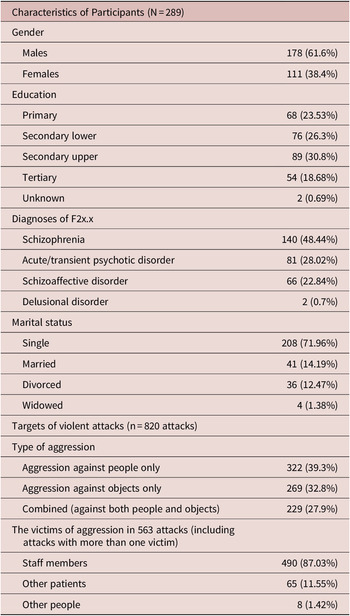
Each aggressive attack was evaluated separately. The study sample consisted of 289 patients (N) responsible for a total of 820 violent attacks (n), ranging from 1 to 28 aggressive attacks per patient (average 4.22 attacks per person). Men were responsible for 436 and women, for 384 aggressive attacks. Half of the patients (N = 154, 53.29%) were aggressive during the first day of their hospitalization (average 33rd day, median 5, mode 1). The average MOAS score was 9.17 (SD = 3.24). The majority of assaults involved several types of aggression (for example, the patient was verbally aggressive and aggressive toward another person at the same time). Nearly every aggressive attack was connected with verbal aggression (91.46%, n = 750). The descriptive characteristics of the dataset is provided in Table 1.
Statistical analysis
Analysis of the structure of aggressive attacks
The descriptive statistical analysis of the structure of aggressive attacks focused on the representation of the abovementioned three proximate causes—psychotic attacks, impulsive attacks, and planned attacks.
Proximate causes of violence
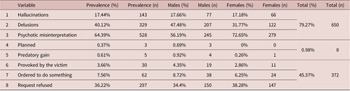
The prevalence of the three proximate causes in our sample is summarized in Table 2. The most (76.71%) of aggressive assaults were evaluated as psychotic attacks. Impulsive attacks appeared in 22.32% of all attacks. Planned attacks were presented rarely, in only 0.98% of all attacks.
Descriptive Characteristics of the Dataset used in the Analysis (Average Age 36.29; SD = 11).

A Chi-square (χ 2) test for independence (with Yates Continuity Correction) indicated no significant association between sex and psychotic proximate cause (taken as a binary variable: present/absent), χ 2 (1, n = 289) = 2.51, P = .11, π = 0.09; sex and impulsive, χ 2 (1, n = 289) = 0.61, P = .44, π = 0.36; sex and planned, χ 2 (1, n = 289) = 2.96, P = .09, π = 0.03.
Psychotic attacks
Results showed that at least one of the three monitored indicators of psychotic symptoms (including hallucinations, delusions, and/or psychotic misinterpretation) was present in 79.27% (n = 650) of aggressive attacks (see Table 3). The analysis of 820 violent incidents showed that 76.71% (n = 629) of incidents were evaluated as preceding only by psychotic symptoms (hallucinations, delusions, and/or psychotic misinterpretation).
The Prevalence of the Three Main Proximate Causes of Violence in 820 Violent Attacks and their Prevalence in Sexes.

Impulsive attacks
Symptoms of disordered impulse control (provoked by the victim, ordered to do something, request refused) were reported in 45.37% of all incidents (n = 372) (see Table 3). Aggressive attacks (n = 183) evaluated as relating only to disordered impulse control were reported in 22.32% of attacks (see Table 2).
The Prevalence of Nolan’s et alReference Nolan, Czobor and Roy9 Items in 820 Aggressive Attacks Perpetrated by 289 Patients with Psychosis and their Prevalence by Sex.
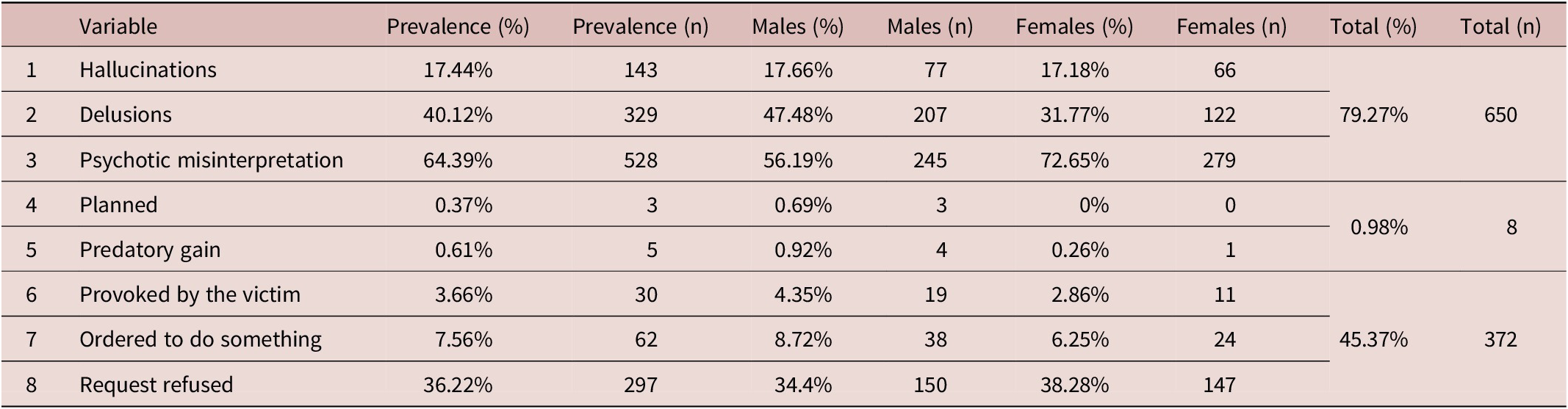
Total involves the presentation of at least one symptom in a single aggressive attack. n = number of attacks.
Planned attacks
Planned attacks were evaluated as the presence of planned attack or predatory gain as it was in the original study of Nolan et al.Reference Nolan, Czobor and Roy9 Moreover, these attacks were expected to be associated with the absence of remorse. In the studied sample, symptoms of planned aggression were presented only in 0.98% of all cases (n total = 8: predatory gain in n = 5, planned in n = 3). The absence of feelings of remorse in attacks evaluated as planned occurred in six out of eight attacks (75%) (see Table 2).
Discussion
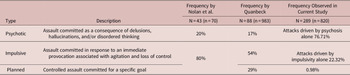
We found that the majority of attacks, 76.71%, were committed, completely or partially, under the influence of psychotic symptoms. These symptoms were reported as important causative factors for the development of aggression by many authorsReference Bo, Abu-Akel and Kongerslev13, Reference Coid, Ullrich and Kallis14 and staff members.Reference Yudofsky, Silver and Jackson11 Unlike the current study, several important reports concluded that only about 20% of violent attacks were driven by psychotic symptoms (see Table 4). Differences among patient samples studied could account for the differences in observations of the role of psychotic symptoms in eliciting violence. The current study focused on acutely psychotic, newly admitted patients, but Quanbeck et alReference Quanbeck, McDermott and Lam6 Skeem et al,Reference Skeem, Kennealy and Monahan8 and Nolan et alReference Nolan, Czobor and Roy9 reported data obtained from chronically violent patients where impulsivity and planned aggression were likely to play a more prominent role than psychosis.Reference Volavka and Citrome1, Reference Quanbeck, McDermott and Lam6 These studies were conducted in repeatedly violent psychiatric patients (inpatients who had committed three or more assaults over 1 year),Reference Quanbeck, McDermott and Lam6 patients from a unit dedicated to the care and study of aggressive patients,Reference Nolan, Czobor and Roy9 and in psychotic prisoners.Reference Taylor15 The current study included psychotic patients with a diagnosis of F2x.x, whereas, many other studies also included patients with affective (mood) disorders (F3x.x)Reference Skeem, Kennealy and Monahan8 and personality and cognitive disorders.Reference Quanbeck, McDermott and Lam6
Type of Aggression and its Frequency According to Quanbeck,Reference Quanbeck, McDermott and Lam6 Nolan et al,Reference Nolan, Czobor and Roy9 and Current Study.

Nolan et al classified the attacks as psychotic and nonpsychotic, whereas, Quanbeck et al Reference Quanbeck, McDermott and Lam6 and our study used the three-factor model according to Research Domain Criteria (RDoC) approach.
Abbreviations: N, denotes number of persons; n, number of attacks.
In our sample, 22.32% of attacks were evaluated as only impulsive and symptoms of disordered impulse control. Nearly all aggressive attacks (99.02%) were attributed to psychotic symptoms or impulsivity; planned attacks were almost absent in our sample (0.98%).
Based on the results of our analysis, psychotic symptoms and disordered impulse control symptoms were identified as the two primary proximate causes that were also deemed as the most important in the prevention of assaultive behaviors in psychotic patients.
However, a meta-analysis demonstrated that aggression rates did not significantly differ between post- and preservice contacts.Reference Winsper, Ganapathy and Marwaha16 These findings might be caused by the fact that deconstruction of violence and identification of specific triggers are still not common in clinical practice. Since each type of assault requires a different management, characterizing violent incidents is crucial in determining treatment interventions. While antipsychotics are essential for psychotic attacks, anxiolytics and psychotherapeutic treatment might be used for acute impulsive attacks.
Limitations
The primary limitation of this study stemmed from the sources of information about the aggressive assaults that were gathered from the patient and the staff members. There were often differences in the perception of aggression by these two groups. Congruent with the results of the study by Nolan et al,Reference Nolan, Shope and Citrome17 patients perceived interpersonal conflicts more often as the trigger of assaultive behaviors, while staff members perceived the manifestation of the psychotic disorder as the most common trigger.
Furthermore, the reliability and validity of patients’ self-report may have been compromised by temporary memory impairments caused by treatments using benzodiazepines or electroconvulsive therapy (ECT). Therefore, in addition to patients’ account of the events, evaluators also relied on information provided by staff members.
Other limitation lies in the core of psychotic disorders. Patients are often paranoid; they have limited trust in staff members or health care practitioners. Likewise, hallucinations and delusions can influence their willingness and ability to cooperate. Patients often take large amounts of psychopharmaceuticals that can cause increased fatigue and many other side effects that can lead to increased irritation and further lack of cooperation.
We labeled the occurrence of assault planning, predatory gain, and lack of remorse as “planned aggression.” These features, although important components of planned aggression, are by themselves insufficient for that diagnosis. A standard instrument, such as the Psychopathy Checklist (Screening Version) (PCL-SV)Reference Hart, Hare, Forth, Monahan and Steadman18 would have served that purpose.
In this study, the data were collected only from patients and staff members using semistructured interview, The Assault Interview Checklist. Other studiesReference Nolan, Czobor and Roy9 used for example also video records, which can help to detect all the attacks and decide about the primary proximate cause of assaultive behavior. Monitoring system in all admission wards in our study was extensive and included video surveillance but, because of legal issues, not video recording.
Future Directions
Future directions may focus on the applications of our findings for treatment. Our principal finding of the effects of psychosis and impulsivity on aggression in schizophrenia suggests that studies of agents targeting these phenomena are in order. Clozapine is the acknowledged gold standard of the antiaggressive treatment. Its antipsychotic effectiveness has recently been shown to increase by augmentation with aripiprazole.Reference Tiihonen, Taipale and Mehtälä19 Aripiprazole monotherapy is effective against hostility.Reference Volavka, Czobor and Citrome20 Thus, clozapine plus aripiprazole could be tested in schizophrenia patients showing psychotic and impulsive aggression. The outcome measures could be the number and severity of aggressive incidents and urgency, which is a tendency to rush (impulsive) action the context of strong affect.Reference Volavka, Czobor and Citrome20 Additional triggers of impulsive attacks should be further studied. Appropriate staff training directly targeting behavioral antecedent of impulsive violence such as requests or orders to do something (typically take medication) could not only decrease violence but also increase medication adherence. More complex psychotherapeutic programs have been shown to be effective in decreasing violence among patients with psychosis.Reference Yates, Kunz and Khan21
Acknowledgments
This work is supported by Ministry of Health Care of Czech Republic, Agency for Medical Research in Czech Republic, number of grant AZV 17–32445, SVV 260516 and Research Center of Charles University, program number 9, by the program Progres = C4 = 8D. Q 06/LF1 = 20.
Disclosures
Authors Jan Vevera, Andrea Nichtová, Kateřina Příhodová, Veronika Juríčková, Anna Klemsová, Marek Páv, Věra Strunzová, Tereza Příhodová, Marcela Nocárová, Eva Papoušková, Lucie Kališová has received grant from Ministry of Health Care of the Czech Republic, AZV 17–32445. Authors Jan Volavka and Petr Žižka have no conflicts of interest.