Introduction
The Machari fauna of Korea has been well known to paleontologists in yielding abundant invertebrate fossils of Cambrian age (Kobayashi, Reference Kobayashi1962). The Machari fauna denotes the macroinvertebrate fossil assemblage from the Machari Formation of the Yeongwol Group, Taebaeksan Basin, Korea, and comprises diverse trilobites of Cambrian Series 3 to Furongian, with some inarticulate brachiopods, monoplacophorans, gastropods, and hyoliths. It was partly introduced by Kobayashi (Reference Kobayashi1935) and later was comprehensively dealt with by him (Kobayashi, Reference Kobayashi1962). The Machari fauna has been intensively studied during the past two decades, with studies including taxonomic revision, biostratigraphy, and paleogeographic reconstructions (Lee and Choi, Reference Lee and Choi1994, Reference Lee and Choi1995, Reference Lee and Choi1996; Choi and Lee, Reference Choi and Lee1995; Hong et al., Reference Hong, Lee and Choi2003a, Reference Hong, Lee and Choi2003b; Choi et al., Reference Choi, Lee and Sheen2004, Reference Choi, Kim and Lee2008; Choi and Kim, Reference Choi and Kim2006). A total of ten trilobite biozones have been established in the Machari Formation, and in ascending order, comprise the Tonkinella, Lejopyge armata, Glyptagnostus stolidotus, G. reticulatus, Proceratopyge tenuis, Hancrania brevilimbata, Eugonocare longifrons, Eochuangia hana, Agnostotes orientalis, and Pseudoyuepingia asaphoides zones (Choi and Chough, Reference Choi and Chough2005).
First appearance data of agnostoid trilobite species offer precise reference points for high-resolution global correlation in the upper half of the Cambrian System. For instance, Ptychagnostus Jaekel, Reference Jaekel1909, includes such types of cosmopolitan species that occur in ascending order in the lower to middle interval of the traditional middle Cambrian (Robison, Reference Robison1982, Reference Robison1984): namely, Ptychagnostus praecurrens (Westergård, Reference Westergård1936), Ptychagnostus gibbus (Linnarsson, Reference Linnarsson1869), Ptychagnostus atavus (Tullberg, Reference Tullberg1880), and Ptychagnostus punctuosus (Angelin, Reference Angelin1851). Of these, P. atavus exhibits a global distribution, and consequently has been selected by the International Subcommission on Cambrian Stratigraphy to define the Global Stratotype Section and Point (GSSP) of the middle stage of the tripartite Cambrian Series 3, i.e., the Drumian Stage (Babcock et al., Reference Babcock, Robison, Rees, Peng and Saltzman2007).
In this study, we report, for the first time in eastern Asia, the successive occurrences of Ptychagnostus sinicus Lu, Reference Lu1957 and P. atavus from the lower part of the Machari Formation, in a newly discovered section in the western part of Yeongwol. This study also attempts to evaluate the species concept of P. sinicus and to reveal how it differs significantly from P. atavus.
General geology and fossil locality
The Taebaeksan Basin occupies the mid-eastern region of the Korean Peninsula and comprises the Cambrian-Ordovician Joseon Supergroup and the Carboniferous-Permian Pyeongan Supergroup, which are separated by a ~140-myr-long hiatus (Chough et al., Reference Chough, Kwon, Ree and Choi2000). The Joseon Supergroup is a mixed carbonate-siliciclastic succession of shallow marine origin and has been divided into the Taebaek, Yeongwol, Yongtan, Pyeongchang, and Mungyeong groups (Choi, Reference Choi1998; Choi and Chough, Reference Choi and Chough2005).
The Yeongwol Group is divided, in ascending order, into the Sambangsan, Machari, Wagok, Mungok, and Yeongheung formations (Yosimura, Reference Yosimura1940; Kobayashi, Reference Kobayashi1966; Choi, Reference Choi1998; Choi and Chough, Reference Choi and Chough2005). The lowermost Sambangsan Formation is composed exclusively of siliciclastic sediments, whereas the upper four formations are dominated by carbonates. The base of the Machari Formation comprises thick-bedded bioclastic grainstone/packstone beds that contain well-preserved middle Cambrian trilobites belonging to the genera Tonkinella, Olenoides, Dorypyge, and Peronopsis. These beds are succeeded by dark gray dolomitic limestone and black shale in the lower part of the formation. The middle part is characterized by laminated dark gray to black shale with occasional intercalations of thin dolomitic limestone layers and yields diverse trilobites of Furongian age (Lee and Choi, Reference Lee and Choi1994, Reference Lee and Choi1995, Reference Lee and Choi1996; Choi et al., Reference Choi, Lee and Sheen2004, Reference Choi, Kim and Lee2008). The upper part displays a conspicuous banded appearance, composed of alternating units of thin-bedded, light gray dolomitic limestone and black shale layers. The banded structure becomes obscure in the uppermost part of the formation and grades upward into massive dolostone of the overlying Wagok Formation. The lower and middle parts of the Machari Formation are richly fossiliferous, whereas the upper part is generally poorly fossiliferous.
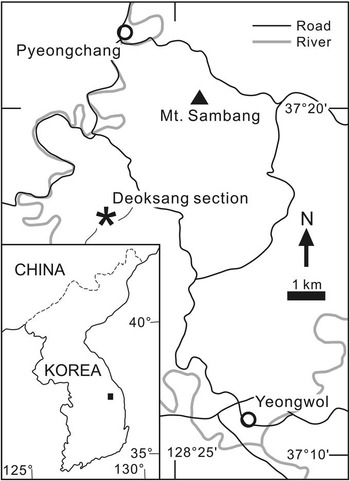
The newly discovered Deoksang section (37°16'50"N, 128°22'40"E), is located at a road cut about 13 km northwest from Yeongwol (Fig. 1) where the Sambangsan Formation and the lower part of the Machari Formation occur in superpositional order. The lowermost 10 m thick interval of the Machari Formation is particularly well exposed: the lower 6 m thick interval of massive bioclastic grainstone beds yields well-preserved trilobites of the Tonkinella Zone and the overlying 4 m thick interval is characterized by alternating units of dark gray wacke- to packstone and black shale. This upper interval yields well preserved trilobites belonging to Cambrian Stage 5 to the Paibian Stage. Ptychagnostus sinicus occurs at three fossil horizons, 6 m, 6.8 m, and 6.9 m above the base of the formation, whereas P. atavus is restricted to one fossil horizon 7.0 m above the base of the formation. Ptychagnostus sinicus is associated with Peronopsis taitzuhoensis Lu (Reference Lu1957) at the lowermost horizon, whereas P. atavus is associated with Yakutiana ovale (Yang, Reference Yang1982).
Locality map. An asterisk denotes the location of the Deoksang section from which the material for this study was collected. A small solid square in the inset indicates the approximate location of the fossil horizons.

Systematic paleontology
Morphological terms used herein are adopted from Whittington and Kelly (Reference Whittington and Kelly1997) and from Peng and Robison (Reference Peng and Robison2000). Specimens are stored at the Seoul National University in Korea with designated SNUP numbers.
Class Trilobita Walch, Reference Walch1771
Order Agnostida Salter, Reference Salter1864
Family Ptychagnostidae Kobayashi, Reference Kobayashi1939
Genus Ptychagnostus Jaekel, Reference Jaekel1909
Type species
Agnostus punctuosus Angelin, Reference Angelin1851 from the P. punctuosus Zone of the Alum Shale (Drumian), Sweden (by original designation). Official ruling on the conservation of accepted usage of A. punctuosus as the type species was given by the International Commission on Zoological Nomenclature, 1993.
Remarks
There are disparate views on the taxonomy of the genus Ptychagnostus and its relationship with other genera or subgenera that include Acidusus Öpik (Reference Öpik1979), Triplagnostus Howell (Reference Howell1935), Yakutiana Özdikmen (Reference Özdikmen2009) among others. Monophyly of these taxa had been rejected (Westrop et al., Reference Westrop, Ludvigsen and Kindle1996) or accepted (Laurie, Reference Laurie2008), presumably due to differences in morphological characters selected for analyses. A complete taxonomic assessment of Ptychagnostus is beyond the scope of this study, and a more broad definition of Ptychagnostus suggested by Peng and Robison (Reference Peng and Robison2000) is herein followed.
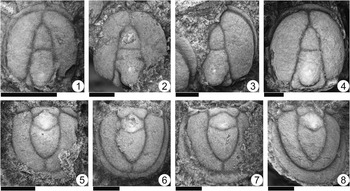
Ptychagnostus atavus (Tullberg, Reference Tullberg1880)
Ptychagnostus atavus (Tullberg, Reference Tullberg1880) from the lower part of the Machari Formation in the Deoksang section, Yeongwol, Korea. (1–4) cephala, SNUP6311–6314; (5–8) pygidia, SNUP6315–6318. All scale bars represent 1 mm.

1880 Agnostus atavus Tullberg, p. 14, pl. 1, figs. 1a–1d.
1880 Agnostus intermedius Tullberg, p. 17, pl. 1, figs. 4a–4b.
1909 Ptychagnostus atavus; Jaekel, p. 400.
1980Ptychagnostus intermedius; Ergaliev, p. 69–70, pl. 1, figs. 18–20.
1988 Acidusus atavus; Laurie, p. 180, fig. 5.
2000Ptychagnostus atavus; Peng and Robison, p. 69–70, fig. 52.
2006 Acidusus atavus; Fletcher, pl. 34, figs. 43, 44.
2007Ptychagnostus atavus; Ahlberg, Axheimer, and Robison, p. 710–713, figs. 2.1–2.12 (for additional synonymy).
2007 Ptychagnostus atavus; Babcock, Robison, Rees, Peng, and Saltzman, figs. 6B–6D, 7B.
2008Ptychagnostus atavus; Høyberget and Bruton, p. 49–50, pl. 7, figs. G–M.
2009Acidusus atavus; Weidner and Nielsen, p. 259–260, figs. 8A–8D, 10A, 10B.
2014Acidusus atavus; Weidner and Nielsen, p. 32–35, figs. 9, 10A–D, 11A–H, 12F–H.
Occurrence
Ten cephala and 22 pygidia from the horizon 7.0 m above the base of the Machari Formation at the Deoksang section.
Remarks
The first appearance datum of P. atavus defines the base of the Drumian Stage of Cambrian Series 3 (Babcock et al., Reference Babcock, Robison, Rees, Peng and Saltzman2007), and this species has been thoroughly treated by Peng and Robison (Reference Peng and Robison2000) and Ahlberg et al. (Reference Ahlberg, Axheimer and Robison2007).
Ptychagnostus atavus differs from other species of Ptychagnostus in lacking cephalic and pygidial spines and surface granules, and in having a hexagonal M2 on the pygidial axis. Although variations in the degree of scrobiculation on the genae have been known to range from smooth to moderately scrobiculate (Robison, Reference Robison1982, pl.1. figs. 1–9; 1984, fig. 11), all the specimens from the Deoksang section are uniformly smooth. In addition, the width of the pygidial border is variable.
Ptychagnostus sinicus Lu, Reference Lu1957
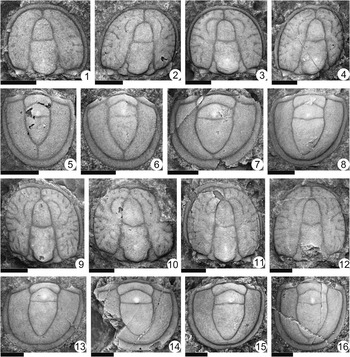
Ptychagnostus sinicus Lu, Reference Lu1957 from the lower part of the Machari Formation in the Deoksang section, Yeongwol, Korea. (1–4, 9–12) cephala, SNUP6319–6322, SNUP6327–6330; (5–8, 13–16) pygidia, SNUP6323–6326, SNUP6331–6334. All scale bars represent 1 mm.

1954Ptychagnostus richmondensis (Walcott); Palmer, p. 61–62, pl. 13, fig. 5 (part).
1957Ptychagnostus sinicus Lu, p. 259, pl. 137, figs. 17–19.
1965Ptychagnostus sinicus; Lu, Chang, Chu, Chien, and Hsiang, p. 37–38, pl. 3, figs. 16–18.
1979Ptychagnostus (Ptychagnostus) idmon Öpik, p. 95–96, pl. 43, figs. 5–8.
1979Ptychagnostus (Ptychagnostus) intermedius; Öpik, p. 95, pl. 41, fig. 8.
1979Ptychagnostus (Ptychagnostus) scarifatus Öpik, p. 96–97, pl. 44, figs. 1–5, pl. 58, fig. 2.
1979Ptychagnostus (Ptychagnostus) sp. aff. scarifatus Öpik, p. 97, pl. 44, fig. 6.
1980Ptychagnostus sinicus; Nan, p. 484, pl. 200, figs. 7, 8.
1980Ptychagnostus atavus; Ergaliev, P. 67–69, pl. 1, figs. 13–17.
1982Ptychagnostus intermedius; Robison, Reference Robison1982, p. 143–145, pl. 3, figs. 1–9.
1982Ptychagnostus intermedius; Rowell, Robison, and Strickland, p. 161–182.
non 1983 Ptychagnostus sinicus; Qiu, Lu, Zhu, Bi, Lin, Zhou, Zhang, Qian, Ju, Han, and Wei, p. 37, pl. 12, fig. 15 (?=P. atavus).
1984Ptychagnostus intermedius; Robison, p. 25–28, figs. 15.1–15.7.
1988Ptychagnostus intermedius; Lisogor, Rozov, and Rozova, p. 56–57, pl. 4, figs. 1–4.
1988Zeteagnostus scarifatus; Laurie, p. 178, figs. 4A–H.
1989Ptychagnostus sinicus; Sun, p. 76–77, pl. 4, figs. 9–21.
1994Ptychagnostus intermedius; Robison, p. 56–57, figs. 27.7, 27.8.
1996Ptychagnostus sinicus; Guo, Zan, and Luo, p. 50, pl. 1, figs. 1–6.
1999Ptychagnostus sinicus; Luo, pl. 7, figs. 1, 2.
2000Ptychagnostus intermedius; Peng and Robison, p. 80.
2007Ptychagnostus sinicus; Ahlberg, Axheimer, and Robison, p. 712.
2007Ptychagnostus intermedius; Bordonaro and Banchig, figs. 2N–P.
2008Ptychagnostus intermedius; Bordonaro, Banchig, Pratt, and Raviolo, p. 121, figs. 4N–P.
2012Ptychagnostus (Acidusus) sinicus; Yuan, Li, Mu, Lin, and Zhu, p. 62–63, pl. 4, figs. 1–16, pl. 5, figs. 1–4.
Types
A cephalon from the Tangshih Formation in Benxi, east-central Liaoning, North China (Lu, Reference Lu1957, pl. 137, fig. 17; re-illustrated by Lu et al., Reference Lu, Chang, Chu, Chien and Hsiang1965, pl. 3, fig. 16) has been selected as the lectotype by Yuan et al. (Reference Yuan, Li, Mu, Lin and Zhu2012, p. 63).
Diagnosis
A species of Ptychagnostus with pentagonal pygidial M2, smooth acrolobe surfaces without pustules or granules, and no border spines on the cephalon or pygidium.
Occurrence
Eighty-two cephala and more than one hundred pygidia were collected from three horizons, 6.0 m, 6.8 m, and 6.9 m above the base of the Machari Formation in the Deoksang section. Aside from the type locality in east-central Liaoning, occurrences in North China include the Bailiella Zone (Nan, Reference Nan1980; Sun, Reference Sun1989) and the Crepicephalina Zone (Guo et al., Reference Guo, Zan and Luo1996) of the Hsuchuang Formation, southern Liaoning, and the upper Tonkinella flabelliformis–Poriagraulos nanus Zone and the lower Bailiella lantenoisi Zone of the Changhsia Formation, central Shandong (Yuan et al., Reference Yuan, Li, Mu, Lin and Zhu2012). This species has also been known to occur in the P. intermedius Zone in the Kyrshabakty section of Malyi Karatau, Kazakhstan (Ergaliev, Reference Ergaliev1980; Lisogor et al., Reference Lisogor, Rozov and Rozova1988; Ergaliev et al., Reference Ergaliev, Zhemchuzhnikov, Ergaliev, Popov, Ghobadi Pour and Bassett2008); P. atavus and Euagnostus opimus zones of the Inca Formation, Queensland, Australia (Öpik, Reference Öpik1979); P. gibbus Zone of the Wheeler Formation and coeval formations in Utah and Nevada, USA (Palmer, Reference Palmer1954; Robison, Reference Robison1982; Babcock et al., Reference Babcock, Robison, Rees, Peng and Saltzman2007); the Henson Gletscher Formation, northern Greenland (Robison, Reference Robison1984, Reference Robison1994); and the Alojamiento Formation, Precordillera, Argentina (Bordonaro and Banchig, Reference Bordonaro and Banchig2007).
Description
Cephalon semielliptical, with narrow border and border furrow, without posterolateral spines. Acrolobe unconstricted; genal field scrobiculate, with a pair of crescent-shaped furrows opposite anteroglabella, without pustules or granules; median preglabellar furrow well developed. Glabella about four-fifths of cephalic length; anteroglabella about two-fifths of glabellar length, subtriangular in outline; F3 posteriorly curved medially; posteroglabella tapering forward, constricted near F3; F2 weakly impressed near axial furrow; axial glabellar node, small, circular, positioned posterior to M2 mid-length. Basal lobe elongate, weakly divided.
Pygidium semielliptical, with moderately broad border and narrow border furrow, without posterolateral spines. Acrolobe unconstricted; pleural field smooth, without pustules or granules; postaxial median furrow moderately to weakly developed. Axis about one-third of pygidial width, constricted across M2, with maximum width at anterior quarter of posteroaxial length; anteroaxis about two-fifths of axial length; M1 arched, of even length (sag., exsag.) or slightly shorter medially; F1 anteriorly curved, of even depth or slightly shallower medially; M2 pentagonal in outline; median tubercle small, circular, positioned near F2; F2 straight to slightly flexed toward posterior; posteroaxis with pointed to rounded posterior end.
Remarks
Ptychagnostus sinicus and P. atavus differ from all other species of the genus in having smooth acrolobe surfaces without pustules or granules and in lacking border spines on the cephalon and pygidium. However, it has been difficult to differentiate the two species, because P. atavus has been known to display a wide range of variation in morphological characters such as scrobiculation of the genal region, whether arcuate scrobicules are present opposite anteroglabella, position of the median node on glabellar M2, and relative width of the pygidial border (Robison, Reference Robison1982; Ahlberg et al., Reference Ahlberg, Axheimer and Robison2007).
Morphological variation in the pygidial F2 of P. atavus has been responsible for the taxonomic confusion of the species with other species including P. intermedius, P. sinicus, and P. affinis (Brøgger, Reference Brøgger1878). Ptychagnostus atavus and P. intermedius were established by Tullberg in 1880 among the collections from the P. atavus Zone of the Alum Shale in the Andrarum area of southern Sweden. Tullberg (Reference Tullberg1880) differentiated the two species based on the difference in the course of the pygidial F2 furrow. As is clear from the plates of Tullberg (Reference Tullberg1880) and illustrations of Tullberg’s syntypes by Westergård (Reference Westergård1946), P. atavus possesses a V-shaped F2 furrow, whereas F2 furrow of P. intermedius is more or less straight. Accordingly, Ptychagnostus species with comparatively straight F2 documented subsequently in Laurentia, Australia, Kazakhstan, and Argentina were referred to as P. intermedius. However, re-examination of Tullberg’s original collections by Ahlberg et al. (Reference Ahlberg, Axheimer and Robison2007) revealed that the degree of flexure of the F2 furrow in specimens assigned to P. intermedius is well within the range of variation of P. atavus. Tullberg’s hand-drawn figures of P. intermedius did not show the true degree of the curvature, and re-illustration of the original collections by Westergård (Reference Westergård1946) widely referenced by subsequent researchers were found to be retouched to emphasize the straightness of the F2 furrow (Ahlberg et al., Reference Ahlberg, Axheimer and Robison2007, p. 712). In addition, original materials of P. atavus and P. intermedius by Tullberg (Reference Tullberg1880) were collected from the P. atavus Zone (Ahlberg et al., Reference Ahlberg, Axheimer and Robison2007), whereas non-Baltic specimens assigned previously to P. intermedius all occur in zones equivalent to the P. gibbus Zone that lies immediately below the P. atavus Zone. The relatively less known species, P. sinicus, was established by Lu in 1957 from the Bailiella Zone (approximately equivalent to the P. gibbus Zone) of the Tangshih Formation of Liaoning, China. It is characterized by a straight F2 furrow on the pygidium and hence non-Baltic specimens that were previously assigned to P. intermedius should be reassigned to P. sinicus.
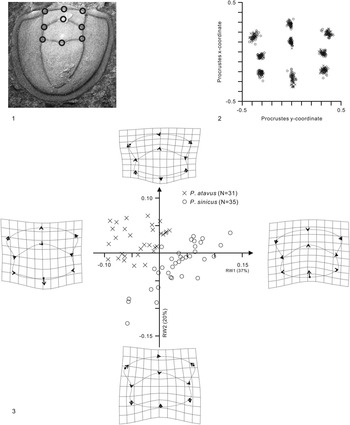
Landmark-based geometric morphometrics were used to test the significance of shape differences between P. atavus and P. sinicus. Nine landmarks were selected on the M1 and M2 of the pygidium that correspond to right/left, antero-/postero-lateral corners and three axial points of M1 and M2 (Fig. 4.1). A total of 66 specimens were digitized using the NIH ImageJ software (Abràmoff et al., Reference Abràmoff, Magalhães and Ram2004) and all analytical processes were performed with the IMP software series (Sheets, Reference Sheets2012): three specimens of P. atavus and 13 specimens of P. sinicus from the Deoksang section, and 28 specimens of P. atavus and 22 specimens of P. sinicus from illustrations of previous studies (see Supplementary Data 1). Superimposition of the mid-point landmark of the F2 furrow displays the visual difference between the two species (Fig. 4.2). Regressions of partial Procrustes distance against the natural logarithm of the centroid size for both species did not identify any significant shape changes with size increase, and suggest that shape variations present in the dataset is not due to ontogeny. The amount of shape deviation for each specimen can be quantified by assessing the displacement vectors of landmarks from the reference form (in this case, the consensus of all configurations in a partial Procrustes superimposition). Following the thin-plate spline method, the deviation matrix of all specimens are first decomposed into mathematically independent styles of deformation (warps) and its contribution to each deformation (warp scores), and then the principal component analysis is performed on the warp scores to examine the structure of the shape variations present in a dataset (Webster and Sheets, Reference Webster and Sheets2010). Results (Fig. 4.3) show that the first and second principal components (termed relative warps) account for 37% and 20% of the total shape variance, respectively, and that the two species are significantly different with the degree of flexure of the pygidial F2 furrow being the major component in the morphological variations, and with abaxial-widening and posteriorly-arching of the anterolateral regions of the pygidial M1 being the second component. Although variations in the pygidial F2 furrow of the two species overlap (Fig. 4.2), the two species are clearly differentiated when the information on the shape of anterolateral regions of the pygidial M1 (Fig. 4.3) is considered.
Landmark data analyses employing 31 pygidia of Ptychagnostus atavus (Tullberg, Reference Tullberg1880) and 35 pygidia of Ptychagnostus sinicus Lu, Reference Lu1957. (1) location of nine landmarks recorded from each pygidium at dorsal view; (2) partial Procrustes superimposition of 66 specimens; (3) bivariate plot of the specimens on the first two relative warps RW1 and RW2 from the principal component analysis of warp scores; RW1 and RW2 explain 37% and 20% of the total shape variance, respectively; thin-plate spline deformation grids depict shape variation along each relative warp; and arrows on landmarks of thin-plate spline deformation grids express relative displacements (Zelditch et al., Reference Zelditch, Swiderski, Sheets and Fink2004).

In summary, P. atavus and P. sinicus can be distinguished on the basis of the shape of M1 and the course of pygidial F2 furrow in association with the median tubercle on the pygidial M2: P. atavus has a broadly-arching M1, a chevron-shaped pygidial F2, and a prominent median tubercle that medially flexes the posterior margin of M2, whereas P. sinicus is characterized by having a relatively narrow M1, a transverse pygidial F2, and a weakly developed tubercle on M2.
Biostratigraphic significance
Ptychagnostus sinicus and P. atavus occur successively and do not overlap in their stratigraphic distribution in the Deoksang section. Such occurrences have also been documented in Kazakhstan (Ergaliev, Reference Ergaliev1980; Ergaliev et al., Reference Ergaliev, Zhemchuzhnikov, Ergaliev, Popov, Ghobadi Pour and Bassett2008) and North America (Robison, Reference Robison1982; Babcock et al., Reference Babcock, Robison, Rees, Peng and Saltzman2007). However, in Kazakhstan and North America P. sinicus has been known to occur in association with P. gibbus. The co-occurrence of P. sinicus and P. gibbus has also been reported in Australia (Öpik, Reference Öpik1979) and Greenland (Robison, Reference Robison1984, Reference Robison1994). In Australia, Öpik (Reference Öpik1979) reported the occurrences of Ptychagnostus from the Inca Formation of the Georgina Basin in which one locality (M208) yielded P. sinicus, P. gibbus, and P. atavus, whereas three localities (M149, M170, and M176) produced P. sinicus and P. gibbus.
In North America, P. sinicus and P. gibbus first appeared in the P. gibbus Zone (Robison, Reference Robison1982, Reference Robison1984; Babcock et al., Reference Babcock, Robison, Rees, Peng and Saltzman2007): P. sinicus is restricted to the P. gibbus Zone, while P. gibbus is extendeds into the overlying P. atavus Zone. In North China, P. sinicus occurs in the Tonkinella flabelliformis-Poriagraulos nanus and Bailiella lantenoisi zones in Shandong province, both of which can be correlated with the P. gibbus Zone of South China (Yuan et al., Reference Yuan, Li, Mu, Lin and Zhu2012). Therefore, it can be concluded that the stratigraphic occurrences of P. sinicus appear to be restricted within an age equivalent to the P. gibbus Zone and can be used as a guide fossil for intercontinental correlation. In Korea, the boundary between the Cambrian Stage 5 and the Drumian Stage can be confidently drawn at the P. atavus-yielding horizon, 7 m above the base of the Machari Formation at the Deoksang section.
Acknowledgments
We are grateful to John Laurie, Steve Westrop, and an anonymous reviewer for their constructive suggestions and linguistic corrections. Thanks are extended to Sangmin Lee, Seung-bae Lee, Jusun Woo, Tae-yoon Park, Ji-hoon Kihm, Dong Yeong No, and Seungyun Kim for discussions during this work and for their help in the field. Xuejian Zhu and Yang Zhang helped us providing with references. This work was supported by a grant (Grant No. 2011–0013164) from the National Research Foundation of Korea. This paper is a contribution of the BK21 Project of the School of Earth and Environmental Sciences, Seoul National University.
Supplemental data
Supplemental data deposited in Dryad data package: http://dx.doi.org/10.5061/dryad.j0fc6