The historical accounts examined in this article come from a period described as an era of historical enlightenment among the Ottomans. These histories, which narrated the history of the empire from its very beginning, were the earliest of their kind in terms of constructing and legitimizing an Ottoman identity. They also provide evidence of an emerging historical self-consciousness among the Ottomans. Currently, scholars view this literature as the product of the Ottoman state, and suggest that the emergence of Ottoman self-consciousness was a centralized and state-conducted phenomenon. This article argues that the same literature can be interpreted as the effort of independent authors, meaning that the emergence of Ottoman historical self-consciousness may have been a collective act of the Ottoman educated class rather than the state. Modern scholars of Ottoman history commonly describe the emergence of history writing among the Ottomans as a phenomenon initiated and conducted by the Ottoman state. This was particularly so in the case of the unprecedented growth in the number of Ottoman history books composed during the reign of Bayezid II. Following the lead of earlier research conducted by Halil İnalcık, scholars have suggested that in the aftermath of the Kilia and Akkerman victories (1484), Bayezid II propagated a new Ottoman ideology by commissioning Ottoman history books to be written for this purpose.
This article questions the premises of İnalcık's thesis and argues that there is insufficient evidence to suggest that Bayezid II orchestrated the late fifteenth-century upsurge in history production. First, a survey of the literature in question suggests that the Kilia and Akkerman victories were not wholly relevant. Second, the majority of historians who wrote during Bayezid II's reign were not commissioned by the state, nor did they act as ideological spokespeople for the state. Third, the historiography of Bayezid I's reign (1389–1402), and in particular the narratives of corruption among judges during his reign, which İnalcık uses to argue his views, confirms that late fifteenth-century Ottoman historians composed independent narratives.
State-centred interpretations of Bayezid II era Ottoman historiography and their limits
The earliest surviving text that can be described as an Ottoman history was written by Ahmedi, (d. 1413).Footnote 2 In around the mid-fifteenth century, two other versions of Ottoman histories appeared, composed by Şükrullah (b. 1388) and Enveri (c. 1466).Footnote 3 Finally, at some point between 1470 and 1480 there emerged the Anonymous Histories.Footnote 4 In terms of their depiction of the Ottoman past, these texts contain three distinct traditions. Ahmedi and Şükrullah's narratives were closely related, and were previously analysed by Victor L. Ménage, who explained that both authors relied on a similar or the same source(s),Footnote 5 and their works were eulogistic and ruler-oriented. In contrast, Enveri's work represented a history of the Ottomans composed from an outsider's point of view,Footnote 6 and the Anonymous Histories were populist texts mainly influenced by the Turkic oral culture of the Ottoman/Anatolian frontier.Footnote 7
Within this body of literature, the Anonymous Histories also qualify as the earliest comprehensive Ottoman history books: that is, they were considerably longer, more detailed and inclusive of both the non-elites and the elites in their recitation of the Ottoman past. A good example of this is the way in which they told of corruption among the judges of the Bayezid I (r. 1389–1402) era, which will be discussed at length below. The details of this subject were mentioned only in passing by Ahmedi and Şükrullah, and completely ignored by Enveri; in contrast, the Anonymous Histories gave to the same subject no fewer than five folios.Footnote 8
Towards the end of the fifteenth century, new Ottoman historians and histories started to emerge. The number of Ottoman history books composed during this period dwarfed the earlier Ottoman historiography. Seven texts that qualified as Ottoman histories survive from the reign of Mehmed II (r. 1451–81). From Bayezid II's reign there were nearly two dozen. These new historians emphasized their own identities, combined the earlier sources with a tone of authority, highlighted the differences of opinion between their sources and re-arranged the sequence of the events to eliminate chronological confusion. In short, they strove to compose more comprehensive texts. The two most studied examples of such historians are Aşıkpaşazade (1400/01–1494?) and Neşri,Footnote 9 who both wrote with vigour and who revised what they deemed to be the shortcomings of previous Ottoman histories.Footnote 10 Others, and lesser-known historians such as Al'KoneviFootnote 11 and Kemal,Footnote 12 also criticize the previous era of historiography.Footnote 13
The emergence of historians such Aşıkpaşazade, Neşri, Al'Konevi and Kemal suggests that the late fifteenth century was a period of enlightenment in Ottoman historical consciousness. Most modern scholars argue that this enlightenment was due to Bayezid II's ideological interest in history books and his extensive patronage of historians. For example, Mehmed İpşirli, described the reign of Bayezid II as “the golden age of Ottoman historiography” and argued that, with the involvement of the sultan, the palace-sponsored literary elite started a new era in Ottoman historiography.Footnote 14 Similarly, Necdet Öztürk stated that while Ottoman historiography began during the reign of Mehmed II, it was “systematized” during the era of Bayezid II.Footnote 15 Gabriel Piterberg writes that: “Although periodization is unavoidably somewhat arbitrary, it might be suggested that the reign of Bayezid II, especially the late 1480s, marked a turning point in the history of Ottoman historiography… . When he returned to the capital in 1484, Bayezid II launched his historiographical project”, a claim he supported with a reference to Cemal Kafadar's work.Footnote 16 Kafadar, along with Heath Lowry, has argued that Bayezid II conducted a project in historiography in the aftermath of the 1484 Kilia and Akkerman victories. Kafadar writes: “After the elimination of Cem's challenge and re-privatization of the lands … [and] upon his return from that campaign in 888/1484 … [Bayezid II] ordered the recording of what thus far had been mostly oral traditions about the founding fathers”.Footnote 17 Lowry, by contrast, with reference to the same campaigns, points specifically to the use of the term gaza, arguing that it means “raid”, and was addressed to those Christian allies by way of an invitation to co-operate for plunder, a separate concept from jihad, which was used to invite Muslims to the same alliance in the name of religion, and offered proof of Bayezid II's construction of a new ideology with genuine emphasis on details.Footnote 18
The common consensus outlined above represents Bayezid II as an attentive Muslim ruler who gave a decisive new direction to Ottoman state ideology in the aftermath of the Kilia and Akkerman victories, and used history books for this purpose. This thesis originated from the earlier work of Halil İnalcık. Combining his research on Ottoman historiography and the Kilia and Akkerman victories, İnalcık was the first historian to point to the possible significance of these victories in terms of a shift in Ottoman ideology.Footnote 19 In 1964, in an essay dedicated to the emergence of Ottoman historiography, he wrote, “[the] unusual activity in producing compilations on the general history of the Ottomans” was caused by Bayezid II's “desire to see such works written” and the ulema's response to it.Footnote 20 Bayezid II, İnalcık argued, “wanted to use this means for shaping public opinion in his favor”.Footnote 21 In return, the ulema composed history books to communicate Bayezid II's ideology to the wider masses.Footnote 22
İnalcık's evidence for this hypothesis is threefold: first, historians Al'Konevi, Aşıkpaşazade,Footnote 23 Kıvami,Footnote 24 Tursun Bey,Footnote 25 Sarıca Kemal,Footnote 26 Ruhi,Footnote 27 Neşri and the Anonymous Histories all ended their accounts with the Kilia and Akkerman victories, which, he writes, could not be explained as a mere “coincidence”.Footnote 28 Second, a number of these historians claimed that the sultan ordered them to compose their works. Third, historians Aşıkpaşazade and Neşri made alterations to their sources, particularly in the context of the corruption of the Ottoman kadıs (judges) of Bayezid I's reign, which suggests that they were ideologically motivated and trying to satisfy Bayezid II's desires.Footnote 29 Therefore, İnalcık concluded, the increase in Ottoman historiography during the late fifteenth century represented a palace-orchestrated ideological phenomenon.Footnote 30
İnalcık's argument represents the emergence of Ottoman historical consciousness and identity as a centralized and state-sponsored act, as well as portraying Ottoman historians as submissive courtiers of a powerful ruler. Furthermore, it dismisses the possibility that some Ottoman historians of this period may have written their books to criticize the Ottoman state. The following pages will critically analyse the three premises mentioned above.
1. The relevance of the 888/1484 Kilia and Akkerman victories to late fifteenth-century Ottoman historiography
Despite İnalcık's contention to the contrary, the Anonymous Histories, Tursun Bey and Aşıkpaşazade's works did not close their pages with the Kilia and Akkerman victories.Footnote 31 Surviving copies of the Anonymous Histories have a variety of end dates. One version, the Vienna Anonymous, terminates in 880/1472;Footnote 32 and four other copies closing with approximately the same date exist in collections located in Berlin, Konya and Istanbul.Footnote 33 Two others in the Türk Tarih Kurumu collections terminate in 878/1473–74 and 886/1481–82 respectively.Footnote 34 Moreover, the Anonymous Histories which İnalcık used, commonly known as the Giese Anonymous and the Topkapı Anonymous, bear more than one colophon, the earliest one being 896/1491.Footnote 35 It should be noted that the Anonymous Histories do not make any celebratory remarks regarding the Kilia and Akkerman victories; the event is only mentioned in passing.Footnote 36 That being said, certain insertions made to the Anonymous Histories prove that at least some of them were revised copies dating from Bayezid II's era.Footnote 37 However, these insertions are not sufficient to qualify them as texts specifically composed for Bayezid II. The Anonymous Histories are best interpreted as continuously updated versions of a narrative that preceded Bayezid II's reign.
Similarly, Tursun Bey and Aşıkpaşazade did not end their works with the Kilia and Akkerman victories. Aşıkpaşazade wrote several versions of his Tevarihi Ali Osman, from 886/1482 onwards, possibly up until 910/1505. His work bore no evidence of being initiated or composed in response to Bayezid II's wishes in the aftermath of the Kilia and Akkerman victories.Footnote 38 Tursun Bey's work, on the other hand, had the end date of 893/1488.Footnote 39
It is also imperative to reconsider why some historians closed their histories with the Kilia and Akkerman victories. One possibility is to avoid dwelling on the Mamluk and Ottoman confrontation (889/1485–901/1495). Ottoman historians disliked writing about military conflicts with other Muslim powers because they could not justify them on religious grounds or praise them in the name of Ottoman religious imperialism. Kıvami completed his work in 892/1487, Neşri composed his work from 895/1490 and continued to do so until 917/1512,Footnote 40 and Kemal wrote until 895/1490.Footnote 41 These authors may have preferred to end their works with this less controversial and more recent Ottoman victory won against the infidel Christians, rather than dwelling on the history of a war which was still in progress and which presented theological complications.
2. Bayezid II's patronage of the historians whose works terminated with the Kilia and Akkerman victories
According to İnalcık, historians who closed their works with the Kilia and Akkerman victories were ordered by Bayezid II to compose such history books. However, among those who did so, only Ruhi states that he was ordered by Bayezid to compose a history book.Footnote 42 The others – Al'Konevi, Kıvami, Kemal and Neşri – gave a diverse set of reasons for writing history books. For example, Al'Konevi wrote that his book was ordered by Mehmed II, but completed during Bayezid II's reign;Footnote 43 Kemal complained that his work was a personal endeavour and that he was discriminated against by the palace;Footnote 44 Kıvami explains that Bayezid II suggested that he compose a history book and present it to Mehmed II, but by the time he had finished it, Mehmed II had passed away and Bayezid II was the new sultan;Footnote 45 and Tursun Bey stated that, facing poverty towards the end of his life, he composed his work in the hope of financial help from Bayezid II.Footnote 46
It should also be noted that a number of historians wrote books as gifts for Bayezid II: these belonged to the genre of fethnames, which took specific military victories or particular sultans as their subject. Tursun Bey's Tarihi Ebul Feth, Kıvami's Fethnamei Sultan Mehmed, Cafer Çelebi's Mahrusei İstanbul Fethnamesi, Safai's Fetihnamei İnebahtı ve Modon, Uzun Firdevsi's Kutbname and an anonymous Gazavatı Midilli all fell into this category and were composed as gifts for Bayezid II. Most of them bore Bayezid II's library seal, proving that they were accepted.Footnote 47 Yet none of these books took the Kilia and Akkerman victories as their main subject. No historian seems to have found the Kilia and Akkerman victories a winning subject for the sultan's taste, although today we have come to view this event as a celebrated turning point in Ottoman state ideology. Meanwhile, the Ottoman campaigns and victories in the Aegean during the late 1490s seem to have received at least three fethnames.Footnote 48
3. Corruption among judges during Bayezid I's reign, its later narratives
İnalcık argued that the list of historians he provided constituted a uniform group of educated elite, the Ottoman ulema, and they composed history books as part of Bayezid II's ideological project to construct a particular version of Ottoman identity. In its origins, this conclusion was the result of İnalcık's reinterpretation of Victor Ménage's earlier research.Footnote 49 Previously, Ménage had argued that in order to avoid offending the Ottoman ulema, historians such as Al'Konevi and Neşri may have altered the information they found in their sources. His research pointed to the fact that Al'Konevi used Şükrullah as his source but deviated from the latter's narrative, first by inserting a eulogistic passage polishing the image of a leading family of Ottoman bureaucrats, namely the Çandarlı family, then erasing a section which criticized the same family. At the time when Al'Konevi wrote his book, the Çandarlı family was highly influential. Ménage also observed that Al'Konevi's alterations were in some respects similar to those made by Neşri. Which, he suggested, might have been caused by an overall desire to seek “a patron in Bayezid II with whom Ibrāhīm, the last distinguished member of the Çandarlı family, was in high favor”.Footnote 50 Thus, Ménage argued, such additions to and deletions from the sources bore the possibility of trying to accommodate personal or political preferences and should be read as such. İnalcık built on Ménage's observations and proposed a general theory of censorship. He wrote that members of the Bayezid II era ulema wrote histories that tried to polish their own image and, along with Al'Konevi and Neşri, Aşıkpaşazade also altered the information he found in the sources for similar purposes. He was convinced that these alterations, along with those made by others, indicated the ulema's general willingness to assist Bayezid II.Footnote 51
However, an overall reading of the sources shows that the so-called ideological alterations by Aşıkpaşazade and Neşri do not exist in the suggested context. Only Al'Konevi erased the offensive remarks regarding the ulema and whitewashed the Çandarlı family name. The works of Aşıkpaşazade and Neşri contain open criticism of the Çandarlı family and the ulema.
Corruption among judges during Bayezid I's reign was a sensitive subject for early Ottoman historians. Bayezid I's success during his early reign was followed by a rapid demise. His tragic death as a captive in the hands of Timur, attributed to suicide, was further followed by a civil war which threatened the Ottoman state with extinction. The eulogistic histories composed by authors like Ahmedi and Şükrullah, who witnessed the consequences of these events in person, collectively shied away from discussing them. In contrast, during the late fifteenth century, starting with the Anonymous Histories, Bayezid I's history was transformed into a prime example of what constituted a flawed ruler. The corruption among the judges was narrated in this context. Its discussion during Bayezid II's reign was a highly charged matter as well. Çandarlı İbrahim Paşa, the great son of Çandarlı Halil whose name was directly associated with the corruption during Bayezid I's reign, was the personal mentor of Bayezid II from 1468 onwards. In 1486 he became a vizier and, between 1498 and 1499, served as the Ottoman Grand Vizier, to be replaced only as a result of his death. During the final decades of the fifteenth century, denigrating his family name had serious implications.
Nevertheless, the story of the corrupt judges of Bayezid I was told, and it was told almost unanimously, within a larger discussion of the path of adala (justice) and Ottoman government. Fifteenth-century Ottoman historians reflected on adala extensively, and argued that it was an attribute of God, a divine virtue. Ahmedi wrote that pre-Islamic philosophers such as Aristotle considered adala to be an essential quality for a good ruler.Footnote 52 Tursun Bey relied on the teachings of Nasreddin Al-Tusi (d. 1274) and stated that adala distinguished human beings from other beasts.Footnote 53 Neşri argued extensively that the proper application of adala was a field of knowledge on its own, only to be attained through theological education.Footnote 54
For better or worse, adala became a central theme in all depictions of Bayezid I's rule. For example, describing the reign of Bayezid I, Ahmedi wrote:
Ahmedi also added that Bayezid I tried to repeat the model of Caliph Omar, a symbol of Islamic justice.Footnote 56 Şükrullah repeated Ahmedi's views word for word. He wrote:
Because his faith had no flaws, he relied on those knowledgeable people. He pitied the poor. He held existing lords high in his esteem. He showed respect towards zahid and true believers. He showed adala to people. When his religiosity and faith became known and famous, those knowledgeable ones came to his protection.Footnote 57
However, both Ahmedi and Şükrullah remained rather silent about the corruption during Bayezid I's reign. Ahmedi accepted that some kadıs started to take bribes from people and that Bayezid I had to discipline them. He wrote:
Şükrullah also acknowledged that Bayezid I had to investigate some of the kadıs, and upon discovering that they had committed crimes, “ordered them to give back what they took against the rule of sharia, taught them a lesson and fired those who had to be fired”.Footnote 59 Şükrullah also concluded that these events were followed by a period of great comfort and calm.Footnote 60
In contrast to Ahmedi and Şükrullah, the Anonymous Histories gave a comprehensive criticism of Bayezid I's ulema. They told the story within a carefully arranged discussion of Bayezid I's overall flawed character, along with references to his drinking habit, deviation from the path of jihad and abandonment of sharia in general. They argued that the ulema around him failed on all accounts.Footnote 61 In the past, they wrote, the ulema were able to make themselves heard by the rulers. Rulers used to be frightened of them and if they committed any sin, they avoided looking the ulema in the face. During Bayezid's rule the ulema were weak.Footnote 62 In fact, Topkapı Anonymous and Giese Anonymous also quoted a section from Ahmedi in this context. This section was originally intended by Ahmedi as a general criticism of corrupt men of letters, but now was transformed into a damning criticism of Ahmedi's generation. It read:
The Anonymous Histories also added that in the old days becoming a kadı was considered a burden, and it was a duty forced upon the fresh graduates of medrese (theological school). However, during Bayezid I's reign being a kadı was an asset due to the generous kickbacks one received. Young students worked with established scholars for a short period of time, performed some favours for their masters, and then became kadı while “not knowing how to read their own names”.Footnote 64 This began with the introduction of Persian and Karaman officers to the Ottoman court during the reign of Bayezid I. Viziers like Çandarlı Halil and Karamani Türk Rüstem were particularly involved. They introduced new accounting practices to the state and established a central reserve that encouraged the Ottoman government to hoard money, a practice equal to stealing from people and in contravention of the sharia.Footnote 65 Ali Paşa, who was Çandarlı Halil's son and who succeeded his father in office, recruited young boys to his court. These boys performed all kinds of favours for him, including sexual ones. In return they were appointed kadıs, and deviated from sharia regularly, ruining the prestige of the Ottoman state. They were a new generation of technocrats who meddled with the value of the Ottoman currency and eliminated the purchasing power of the common people. They even issued false fatvas (rulings) that were designed to suit their own interests, rather than follow sharia.Footnote 66
They took so many bribes that Bayezid I had to intervene. He imprisoned them in a house which he threatened to burn down. Ali Paşa hired Bayezid I's court clown Maskara Arab to save their lives. Maskara Arab played a joke on Bayezid I, brought him back to good humour, and saved them. In the end, they were all forgiven and received a pay rise so that they would stop taking bribes.Footnote 67 Even the controversial law that required people to pay a fee for kadıs' ruling was initiated in this context.Footnote 68
The Anonymous Histories were not sympathetic towards the Çandarlı family or the ulema. They represented them as central figures in the emergence of corruption in the Ottoman state. The corruption they described was not limited just to taking bribes and issuing fake fetvas either. They went so far as to point out faulty economic practices, inefficient education of bureaucrats, and these men's sexual misconduct. It is very unlikely that their narratives were composed to please Bayezid II and the Ottoman state in general.
Similarly, Aşıkpaşazade composed a damning criticism of the Çandarlı family and Bayezid I's ulema. He wrote that during the reigns of Orhan and Murad, the ulema stayed away from illegal possessions and sin in general, but their behaviour changed when Çandarlı Halil and Karamanlı Türk Rüstem became respected members of the Ottoman court and earned the title effendi (honourable sir). With these men, cheating became a general statecraft. They issued faulty rulings, corrupted the meaning of sharia, meddled with the value of the Ottoman currency and erased the fear of God from people's hearts.Footnote 69
Aşıkpaşazade in particular portrayed Çandarlı Halil's son Ali Paşa as a person who loved luxury and surrounded himself with people of the same persuasion. Bayezid I tried to punish this corruption, he wrote, but Ali Paşa used Maskara Arab to save face.Footnote 70 He wrote, “[T]he first person who caused Ottomans to sin and start practicing haram (unlawful things) was Ali Paşa, because many Arab and Persian scholars who knew how to cheat and play tricks used to keep him company”.Footnote 71 Therefore, Aşıkpaşazade's version of the events showed no signs of whitewashing the image of the ulema or the Çandarlı family.
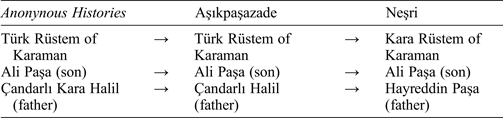
Neşri showed very little, and inconclusive, evidence of trying to clear the name of the Çandarlı family. His account opened with a full quotation from Ahmedi, which was cited previously and encapsulated the eulogistic version of the events.Footnote 72 He then extensively quoted Aşıkpaşazade's version with four specific alterations, or modifications. These modifications were: a) blaming the corruption among the judges on Rüstem Paşa; b) citing Rüstem Paşa's Karaman origin; c) citing the name of Ali Paşa and his father only in relation to the plot to save the lives of the judges; and d) changing the name of Ali Paşa's father from Halil to Hayreddin.Footnote 73 This last modification was particularly important because it was interpreted by İnalcık as an act of disguising the true identity of Çandarlı Halil Paşa.Footnote 74 However, if we follow the progression of the transformation of these names from one source to the next we observe other possibilities, as shown in Table 1.
The progression of names

It is clear from Table 1 that Ali Paşa was the culprit who organized a plot to save the lives of the judges in all versions of the story. Anyone who was familiar with the story could identify the personalities. The only thing that was missing from Neşri's version was a direct association of the name Çandarlı with the event, which could have been caused by a simple oversight or over-editing, or it may have been due to a discrepancy in his sources. It is important to note that he did not attempt to clear Ali Paşa's name. In fact, unlike the Anonymous Histories and Aşıkpaşazade, he also disclosed the value of the bribe Ali Paşa was willing to pay to the Maskara Arab upon succeeding: one thousand florins.Footnote 75
In conclusion, the ideological omissions İnalcık suggests do not exist in the suggested context, and the narratives of this episode do not bring together the Anonymous Histories, Al'Konevi, Aşıkpaşazade and Neşri as members of a uniform ulema. If anything, each narrative exposes significant distinctions between these writers. The Anonymous Histories were comfortable in naming those whom they saw as responsible for corruption in the Ottoman government; Aşıkpaşazade was willing to cite such claims he found in the Anonymous Histories; Neşri was either confused or reluctant, but could not refrain from blaming Çandarlı Ali Paşa; and only Al'Konevi erased the whole episode.
Conclusion
This article has sought to question our understanding of early Ottoman historiography and Bayezid II's role in its development. In particular, it questioned İnalcık's argument that Bayezid II conducted a historiographical project to initiate a new ideology at the aftermath of the 1484 Kilia and Akkerman victories and used history books to this end. Bayezid II had indeed acted as a patron to a number of historians but only towards the end of his reign. These historians were İdris Bitlisi (completed in 1503), Ruhi (completed in 1510–11), and Kemalpaşazade (completed in 1526). Ruhi's work was a reductive copy of the existing sources, being most similar to Şükrullah's history, but sharing common elements with the Anonymous Histories, Aşıkpaşazade and Neşri's works.Footnote 76 İdris Bitlisi's history was an extensive combination of Ruhi and Neşri's works.Footnote 77 Kemalpaşazade's work was completed long after Bayezid II's reign and brought together all that was related to Ottoman history, relying in particular on Neşri for the earlier material found in the Anonymous Histories.Footnote 78 In short, they all relied heavily on the Anonymous Histories, Aşıkpaşazade and Neşri.
Evidently, during Bayezid II's reign, a desire to achieve more comprehensive Ottoman histories emerged. Numerous historians were engaged in the construction of the Ottoman past and therefore the Ottoman identity. The textual momentum of this phenomenon appears to have started with the Anonymous Histories, and historians such as Aşıkpaşazade and Neşri. Therefore, the late fifteenth-century enlightenment in Ottoman historical self-consciousness was not the result of Bayezid II's desire to change the ideological trajectory of his empire, but involved the endeavour of a circle of authors. Whether the works of Bayezid II's historians represented an ideological transformation of its own remains a subject for further discussion. One thing is for certain: they followed in the footsteps of an Ottoman literary elite who had recently acknowledged the virtue of the Anonymous Histories.