The interwar period represented a major transition in the development of corporate finance in Britain. The weakly protected, retail investor, bond-centric world of pre-1913 was giving way to the more tightly regulated, institutional investor, equity-centric financial system characteristic of the second half of the twentieth century. Industry, too, was undergoing structural change. Prior to World War I, domestic firms were typically small in scale and were more than adequately financed from internal sources, family and friends.Footnote 2 Thereafter, opportunities to commercialise the technologies of the Second Industrial Revolution escalated the need for external finance. The banks were generally unwilling to provide long-term loans to industry for capital expenditure purposes.Footnote 3 Consequently, the interwar stock market now had a potentially vital role to play in providing long-term risk capital to industry.
The heavy losses suffered by investors in firms that went public in 1928Footnote 4 along with the Royal Mail scandal of 1931Footnote 5 have tended to adversely affect opinions on the interwar stock market. Equally, others have claimed that the LSE did a reasonable job in channelling finance into domestic industry.Footnote 6 Such blue-chip firms as Boots, Morris Motors, and Marks and Spencer began their lives as publicly quoted companies, and Ford Motor also listed its European business in this period. So which picture is correct?
Utilising a new sample of interwar initial public offerings (IPOs), I evaluate the effectiveness of the role played by the interwar stock market along two dimensions. Firstly, I consider the contribution made by IPOs to financing capital expenditure. Secondly, I examine the quality of IPOs, as measured by their chances of survival. Although we know that many of the IPOs of the late 1920s were poor investments, nothing is known about survival patterns in the following decade, when new issue activity rebounded.
The pecking order theory of corporate finance tells us that firms rely first and foremost on internal funds, then debt and lastly equity finance to fund their investment plans. Consistent with this theory, IPOs appear to have financed only a modest proportion of capital expenditure in the interwar years. More interestingly, the capital-hungry new manufacturing industries of electrical engineering, motor vehicles and aircraft, synthetic fibres and chemicals were unable to finance a materially greater share of their investment needs than were the traditional manufacturing industries of shipbuilding, heavy engineering and textiles. Unfortunately, I am unable to say anything about further issues after a firm has gone public in this period due to unavailability of firm-level data. Nonetheless, observing IPOs can give us a guide as to overall corporate finance patterns since firms were on average selling a substantial portion of equity, almost two-thirds, at the point of going public.
One possible interpretation of this outcome makes use of the financial dependence hypothesis.Footnote 7 This states that the better is disclosure and investor protection in a given country, the easier it is for the new, risky, fast-growing industries most dependent upon external finance to fund their investments relative to the same industries in a country with weak protection. Here, I adapt this hypothesis to argue that financial dependence varies across time as well as across countries. Accordingly, the interwar stock market afforded public investors little or no protection and as a result held back the most ‘financially dependent’ firms, namely, the risky new industrial firms, in their efforts to raise equity finance. In comparison, the well-regulated modern stock market of today allows these firms to access the equity finance they need more easily and in greater amounts.
The other main finding of this article is the dramatic improvement in the survival of IPOs in the 1930s. Undoubtedly, the more favourable business conditions of mid-1930s' Britain contributed to this outcome. Nevertheless, this better survival record can also be attributed to improved quality of IPOs due to evidence of a more rigorous screening of applications by the LSE.
In the next section, I describe two of the major challenges confronting the LSE in serving the needs of interwar British firms. There then follows a description of my IPO data set and the types of firms that went public. The main two sections of the article then present evidence on the importance of equity IPO finance across industry, and on the survival record of IPOs across the whole of the interwar period.
I
The interwar stock market pursued dual and competing objectives. On the one hand, it aimed to expand its trading activities by attracting new listings as it had done throughout the nineteenth century.Footnote 8 On the other, it was becoming increasingly aware of the need to protect both its own reputation and the public investor from unscrupulous promoters of fraudulent investment schemes.Footnote 9 The quality of company disclosure, the protection of minority investors, and the extent of reputable bank involvement in underwriting, were all inadequate.Footnote 10 The 1929 Companies Act only very modestly remedied this position. Had this legislation been introduced any earlier, it is unlikely that the much publicised Royal Mail scandal would have been prevented.Footnote 11 Any substantial improvement in company accounts had to await the passage of the 1948 Companies Act.Footnote 12 So, too, did any strengthening of the rights of minority investors.Footnote 13
Unwary investors were no better served by the various banks, brokers and finance houses sponsoring new issues. They proved poor substitutes for weak regulation. Summing up the position in 1931, the Macmillan Committee was damning in its judgment: ‘the public is usually not guided by any institution whose name and reputation it knows’.Footnote 14 The most reputable banks, as defined by membership of the prestigious Accepting Houses Committee, only underwrote a handful of interwar IPOs.Footnote 15 The merchant banks did use affiliate companies to begin underwriting industrial firms in the 1930s, but they did not carry the parent company's name and, as such, could not have fully reassured the public investor.Footnote 16 Only after World War II did the equity underwriting market become organised with the reputable merchant banks in the vanguard.Footnote 17
Complementary to company legislation, the LSE regulated the behaviour both of its members and of listed companies through its Rules and Regulations of the Stock Exchange (Rules). These rules dealt only with those firms seeking an Official Quotation up until World War I. Brokers made a market in the shares without recording and publishing any prices, and only in 1915 did the LSE begin publication of a Supplementary List of the prices of those securities without an Official Quotation.Footnote 18 Thereafter, the vast majority of firms first went public on the Supplementary List. Listing requirements were extremely modest. The ‘two-thirds rule’, requiring any security for which a quotation was applied to have at least two-thirds of its outstanding shares in public hands in order to counter price manipulation, and the most demanding of requirements, only applied to Official Listed firms. Since minimal demands were placed upon them, it was no surprise when the 1928 new issues subsequently proved such poor investments.Footnote 19
A second major theme of this period was the structural shift in British industry, driven by the technologies of the Second Industrial Revolution. The scientific advances of the combustion engine, electricity and chemicals were the most important technologies of the early twentieth century.Footnote 20 Further significant developments occurred in such new areas as rubber tyres and synthetic fibres. Radio was perhaps the most tangible embodiment of this new industrial world and rapidly developed as a mass consumer product.Footnote 21
US firms with newly established research laboratories were the driving force behind the commercialisation of these new technologies and pulled British industry along in their wake.Footnote 22 O'Sullivan has provided detailed case studies of how the US stock markets financed three new industries, motor vehicles, aircraft, and radio in the 1920s.Footnote 23 Whereas the stock market funded new entrants in aircraft and radio, the emphasis was placed on extending finance to new firms promoting industry consolidation in the case of motor vehicles. Although no explicit estimate of the aggregate contribution of equity finance to capital expenditure in these industries in the 1920s is provided, the overall sense of the analysis is that it was marginal.
New manufacturing industries, despite being considerably more modest in scale, were similarly important to the British economy. Their contribution to overall growth in British manufacturing output was almost 30 per cent between 1924 and 1937, and over 40 per cent in the immediate post-war period.Footnote 24 Some authors claimed that these industries exhibited higher productivity growth than the rest of manufacturing and were decisively important in the strong economic performance of the 1930s.Footnote 25 This hypothesis has, however, been successfully challenged.Footnote 26 Notwithstanding the fact that productivity growth in these industries did not grow any faster, the capital investment undertaken by motor vehicle, synthetic fibre, rubber (tyre) and electrical engineering firms was substantial, and they doubled their fixed asset base between 1920 and 1938.Footnote 27 Investment in shipbuilding and heavy engineering and in textiles was extremely modest by comparison.
Of course, motor vehicle manufacturers had first listed their shares in the mid 1890s.Footnote 28 The question arises as to the extent to which interwar new listings reflected this industrial structural shift. The next section describes the data set and then attempts to answer this question.
II
Previous new issue studies have concentrated on either one or two years, or a single industry, and, as a result, have given us only an incomplete picture of this activity.Footnote 29 The data presented here allow us a unique look at corporate finance activity across a range of different industries during the whole of the interwar period. The strong rebound in IPO activity in London beginning in 1934 was not generally experienced in any of the other major stock markets, certainly not in the US. Furthermore, this sample includes the very type of risky industrial and commercial firm absent from Edelstein's (1982) study of the late Victorian stock market.Footnote 30 As the discussion in the previous section implied, before the introduction of the Supplementary List in 1915, listed firms on the LSE would only have appeared in Edelstein's data set when given an Official Quotation.
By the end of World War I all firms were required to advertise a prospectus, or advertisement, of an IPO in a national newspaper. The data set, drawn from The Times Book of Prospectuses, consists of 1,406 firms going public on the LSE with an issue or placing of shares or debentures.Footnote 31 The details of each issue were cross-checked against the Stock Exchange Official Intelligence and the Stock Exchange Year Books (Year Books).Footnote 32 As well as IPOs, firms undertook further issues, or seasoned equity offerings (SEOs), many of which were made directly to shareholders without a prospectus. For example, Ford Motor, having gone public in December 1928, successfully completed a further issue of £6 m ordinary shares to its existing shareholders in 1931 without publishing a prospectus.Footnote 33The Economist published aggregate estimates of SEO activity, but without any industry breakdown. Therefore, I concentrate my analysis on IPOs.
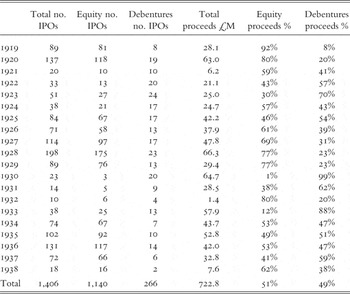
The annual time series of the number of firms going public and the gross proceeds raised in the sample are summarised in Table 1. In the interwar years, there were more than four times as many equity issues, both ordinary and preference shares (1,140), as debenture issues (266). Firms raised almost equal amounts of money through both, reflecting the much larger size of debenture issues. Debentures were issued by large, well-capitalised firms rich in pledgable assets. As a result, virtually all firms going public by issuing debentures survived, even those of the 1920s. Hereafter, I focus on firms going public by issuing either ordinary or preference shares. Institutional investor appetite for the higher risk and rewards offered by ordinary shares was growing.Footnote 34 Two-fifths of equity IPO proceeds were raised from ordinary shares alone. However, the composition of this sample suggests that preference shares were still very much in competition with ordinary shares for investor wallets since more than half of IPO proceeds involved the issue of a preference share, sometimes in combination with an ordinary share.
Total IPO volume and gross proceeds

Note: Proceeds are the number of shares offered to investors multiplied by the offer price and are stated in current prices. Totals may differ due to rounding.
Total equity IPO proceeds, gross of fees, were £723 m in current prices.Footnote 35 Both IPO proceeds and IPO volume display pronounced cyclicality. The surge of issues in 1919 and 1920, which greeted the ending of the new issue moratorium during World War I, was followed by a collapse in activity in 1921 and 1922, reflecting the depth of the economic recession.Footnote 36 Firms again rushed to go public in 1927, 1928 and the first half of 1929. The early years of the next decade were marked by a second collapse in activity in the wake of a 40 per cent fall in London share prices and the widespread turmoil enveloping international capital and foreign exchange markets. The mid 1930s then witnessed a marked IPO recovery in sharp contrast to activity on a Wall Street badly affected by the Great Depression for the rest of the decade.Footnote 37 The interwar years are, therefore, defined by intense bursts of equity IPO activity (1919–20, 1927–9 and 1934–8), interspersed with lulls (1921–6 and 1930–3). I adopt this periodisation in the rest of the article.
Each IPO typically disclosed the following information to investors in the prospectus: the type of security being issued, the numbers of shares outstanding and offered to investors, their voting rights, the age of the firm (AGE), the nature of its business and geographic location, the number of years of past profits (PROFITS), whether the accounts were audited or valued by a third party (AUDIT), whether or not the issue was underwritten by a third party (UW), and the cash proceeds raised by the company itself (NEWMONEY), as opposed to those raised by selling shareholders. Firm size (MKTCAP) is estimated as the total number of shares outstanding post-IPO evaluated at the offer price.Footnote 38 Firm age was estimated from the date of establishment of the business. Appendix 1 lists all the variables and their definitions.
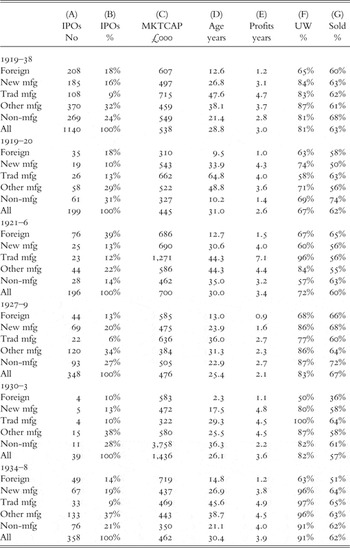
The characteristics of the 1,140 IPOs between 1919 and 1938 are summarised in Table 2. There were 208 foreign IPOs, two-thirds of which were natural resource firms engaged in either non-ferrous metal mining, tea, coffee or rubber plantations, or oil exploration and development. Each of the remaining 932 domestic firms is allocated to an industry based on the 1948 UK Standard Industrial Classification. I then group these industries into sectors: new manufacturing, traditional manufacturing, other manufacturing, and non-manufacturing which comprises finance and property, retail and distribution, non-financial services, utilities and agriculture and fisheries (see Appendix 1).
Equity IPO characteristics 1919–38

Note: All values are equally weighted means in each period. See Appendix 1 for definitions. Market capitalisation (MKTCAP) includes both ordinary and preference shares and is stated at 1930 prices.
New manufacturing industries are defined by their research-intensity. In the absence of data on the distribution of research activity across British industries, I assume that Britain followed the US. According to Mowery and Rosenberg, chemicals, electrical engineering and electrical equipment, and rubber tyres were the most research-intensive industries during the interwar years, with automobiles and aircraft closing the gap on this group by 1939.Footnote 39 Whilst synthetic fibres, scientific instruments, and photographic equipment are not separately identified in their industry classification, I include these latter three industries given the technologies they embraced.Footnote 40 Traditional manufacturing industries are defined as coal mining, shipbuilding and heavy engineering, and textiles; other manufacturing covers mining, other than coal or metals, metal manufacturing, food, drink and tobacco, clothing, paper and printing, and leather products.
IPOs have a tendency to occur in waves, as investors become more familiar with a particular industry, or group of related industries, and firms, in turn, exploit such windows of opportunity. In the 1880s breweries dominated IPO activity; in the 1890s, it was the turn of bicycle firms. The interwar period exhibited the same pattern (Table 2, cols. A and B). The majority of new manufacturing IPOs were clustered into the late 1920s and the mid 930s, whilst foreign, mainly resource ventures, were concentrated in the years up to 1926. Traditional manufacturing IPOs, on the other hand, occurred evenly through the period, ignoring the early 1930s.
Firms going public were very small in size, the average market capitalisation fluctuating around half a million pounds (Table 2, col. C). This compares with a size at least ten times this figure necessary to qualify for membership of the largest 100 quoted firms on the LSE.Footnote 41 Along with firm size, firm age displayed no great change over the period (Table 2, col. D). New manufacturing firms were younger and smaller compared to the average IPO, but not dramatically so. Traditional manufacturing firms were a little older and larger. Prospectus disclosure generally improved, with the exception of foreign IPOs where disclosure was consistently poor. On average, more years of past profits (PROFITS), as well as an audited asset valuation statement (not shown), were included in the prospectus in the 1930s compared to the previous decade (Table 2, col. E).Footnote 42 There was also a steady upward trend in the proportion of IPOs underwritten by a third party (UW), although, as discussed above, this was no indication of the quality of underwriting (Table 2, col. F).
Finally, firms sold a substantial proportion of their equity at IPO, on average almost two-thirds (Table 2, col. G). It was not the case that they sold a small amount of stock into the market and then followed up with a large further issue once public.
Summarising the main features of interwar IPOs, activity tended to cluster both across time and industry, after 1929 firms were no less risky, as proxied by their size or age, and the quantity of disclosure improved, but the content did not.
III
Firms, in general, decide to go public in order to raise long-term finance, to make acquisitions, and to allow entrepreneurs and family owners the opportunity to exit their investments. Prospectuses following the 1929 Companies Act did give investors a reasonably clear idea of what management intended to do with issue proceeds. Before that date, even understanding whether the firm or selling shareholders received the issue proceeds, let alone how the company intended to use them, often required careful scrutiny of a prospectus. Investors particularly needed to be aware of managers and other insiders ‘converting’ their established firm into a newly listed firm of virtually the same name. The latter issued new shares for cash, which was in turn used to acquire the established firm. Although, superficially, the IPO appeared to raise cash for the company, it ended up in the pockets of the insiders.
There were three contemporary statistical sources on new issues, The Economist, the Bank of England and the Midland Bank, of which the latter was the most informative on the subject of new money raised.Footnote 43 However, even this series failed to exclude ‘conversions’, as defined above, from their estimates. Consequently, new money raised was overestimated. Henderson corrected for this problem, and constructed his own estimates for the years 1927 and 1936. Adopting a similar approach, I have estimated new money raised from IPOs for all the interwar years. New money is defined as proceeds raised for capital expenditure, general purposes and working capital needs, after meeting issue expenses, and excluding repayment of long-term debt.Footnote 44 Going public to meet ‘general purposes’ and ‘working capital’ needs, most probably, indicated an unwillingness to disclose more detailed investment plans for fear of making their competitors aware of them.
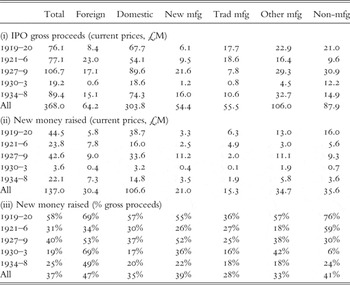
In total, new money for investment by both domestic and foreign firms in all industries accounted for 37 per cent of the £369 m of IPO proceeds (Table 3). The average firm was able to raise around £125,000 of new money on going public. Such a figure implies that the majority of firms in this sample were not affected by the ‘Macmillan gap’, the alleged inability of the stock market to provide long-term risk capital in amounts up to £200,000 or more.Footnote 45 Of course it is impossible to say anything about the true extent of any gap from the data presented here since we can only observe those firms actually going public and cannot observe the unsatisfied demand for equity finance among those small firms that did not.
Equity IPO proceeds and new money by sector

Note: Domestic manufacturing is broken down into new manufacturing (New mfg), traditional manufacturing (Trad mfg), and other manufacturing (Other mfg) sectors. See Appendix 1 for sector definitions. Totals may differ due to rounding.
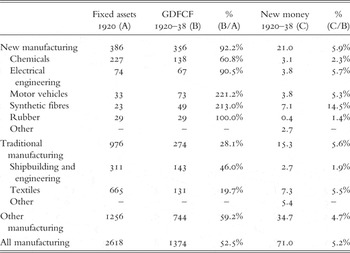
What contribution did IPOs make to financing capital expenditure in domestic manufacturing? Feinstein put gross domestic fixed capital formation (GDFCF) at £1,374 m between 1920 and 1930 and according to my estimates, therefore, IPOs raised new money (£71 m) equivalent to 5.2 per cent of this amount (Table 4). The comparable figure for the period 1911–13 was less than 3 per cent of real domestic investment.Footnote 46 As to the position post-World War II, there are no estimates of new money raised from IPOs alone in Britain.
Hence, the interwar financing contribution from IPOs was of marginal significance and entirely consistent with the ‘pecking order’ theory of modern finance, which states that a firm will first resort to using internal funds, then bank loans, and finally external sources. This estimate is, of course, biased downwards by an inability to track SEOs at a firm-level and the amount of new money raised from this source in the interwar period.
We can, however, say something about the aggregate picture of SEO activity. The Midland Bank series has the virtue of distinguishing between equity and debt new issues and covers the whole interwar period. Equity new issues, both IPOs and SEOs by domestic and foreign firms, totalled £1,722 m from 1919 to 1938.Footnote 47 This compares with our IPO proceeds estimate of £368 m in the same period. Unfortunately, there is no breakdown of the Midland Bank figures between IPOs and SEOs, and, as argued above, the new money component is overestimated. Clearly and not surprisingly, there was a substantial level of interwar SEO activity which would merit careful analysis but which is beyond the scope of this article.
One study estimated that for two representative interwar years around three-quarters of SEO proceeds represented new money.Footnote 48 According to a slightly later study, the electrical engineering and motor vehicles industries raised 20 per cent and 17 per cent of their increase in net assets between 1949 and 1953, respectively, from IPOs and SEOs together; textiles, on the other hand, raised only 6 per cent.Footnote 49 Towards the end of the twentieth century, firms in Britain financed none of their capital investment at all through equity issues due to increased acquisition activity and the increased popularity of share repurchases.Footnote 50
We can now turn to the more interesting question of how IPO financing varied across industry. New manufacturing firms raised more new money (£21 m) than did traditional manufacturing IPOs (£15.3 m). The bulk of the new manufacturing total occurred in the 1920s, with artificial silk firms particularly prominent. As a proportion of their capital expenditure (GDFCF), new manufacturing firms financed 5.9 per cent from IPOs, but this figure only modestly exceeded the 5.6 per cent share for traditional manufacturing industries, and that of 4.7 per cent for other manufacturing industries (Table 4).Footnote 51 Even the largest user of equity finance among the new industrial IPOs, synthetic fibres, still raised 85 per cent of its investment needs from internal funds and other sources.
New money raised as % gross domestic fixed capital formation

Notes: All values stated at 1930 prices. Fixed assets and gross domestic fixed capital formation (GDFCF) are from Feinstein, Domestic Capital Formation, ch. 3, p. 45, table 3.33. New money raised by motor vehicles includes aircraft IPOs since some firms, particularly parts manufacturing firms, participated in both markets. Coal mining for which fixed asset and GDFCF figures were not available is included in other traditional manufacturing.
Why were new manufacturing firms which were investing substantial sums in expanding their businesses not able to raise relatively more from IPOs? One possibility is that these firms raised substantially more equity finance in the years following their listing relative to the rest of manufacturing. I have checked the subsequent financing behaviour over the ten years post-IPO for the 185 new manufacturing and the 108 traditional manufacturing firms in the sample, and this is not the case.
The financial dependence hypothesis outlined above offers an alternative explanation for this result. Poor disclosure, inadequate investor protection, and unreliable sponsors penalised exactly those firms most dependent upon external equity finance, namely, in the new manufacturing industrial firms. This is the type of firm that Kennedy argued were victims of failure in late Victorian capital markets, with one important difference.Footnote 52 By the interwar period, the scale of the investment opportunities and the financing requirements facing the new manufacturing industries had increased considerably. As a result any capital market inadequacies may have been more critical, leaving some of these firms capital-constrained.
IV
Lastly, we turn our attention to the quality of firms going public. Inadequate investor protection and unreliable underwriting boosted the chances of weak firms achieving a listing, undetected by investors. This proved only too true in the case of the 1928 cohort.Footnote 53 The anonymous author concluded that the value of this portfolio of 283 new issues of ordinary shares, preference shares and debentures floated in 1928 had depreciated by 41 per cent up to May 1931. A revised estimate of performance of the same portfolio over the period to April 1933 put its losses at 47 per cent. Whilst IPOs by established firms, as well as firms disclosing a profits record, performed better than the overall market, investors in new ventures and new firms failing to disclose past profits lost virtually all their money.
Given the extremely heavy data requirements of estimating long-run IPO performance for the entire sample, I choose a simpler measure of the quality of firms allowed onto the interwar stock market, namely, firm survival after the IPO. I define the survival rate as the proportion of all IPOs which survive over the subsequent five (or ten) years, where acquisitions and liquidations are excluded from both the denominator and the numerator. In the vast majority of cases, the Year Books revealed whether the firm had failed, been acquired, or was still trading as a going concern. The Stock Exchange Daily Official List (SEDOL) and The Times confirmed whether the shares were still quoted in the relatively few cases where the Year Books were silent. An IPO failure is correspondingly defined as any firm subsequently delisted from the LSE by the fifth or the tenth anniversary of going public due to being wound up, placed in receivership, or struck off the company register, and where shareholders received nothing in compensation.
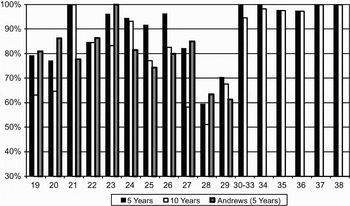
Andrews constructed a sample of newly registered companies between 1919 and 1934 by stratification and analysed their survival pattern.Footnote 54 The sample included a multitude of small private firms as well as listed firms and therefore, slightly differently to this study, failure was defined as a firm being wound up, or being struck off the Companies Register, rather than being delisted from the stock exchange. Barely three out of five firms registering in 1928 and 1929 survived over the following five years. Concentrating on five-year survival rates means that Andrews's sample effectively runs out in 1929.
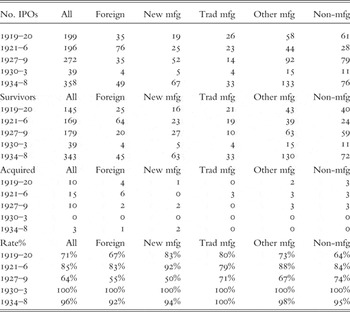
In the following analysis, I cover all 1,140 equity IPOs over the whole of the interwar period. The survival rates over both five- and ten-year periods following IPO are grouped by annual cohort, according to the year in which they went public between 1919 and 1938. The results are graphed in Figure 1. IPOs launched in 1919–20 and 1927–9 were particularly prone to failure. Ten-year survival rates were only a little above 60 per cent in 1919–20, and fell to 50 per cent in 1928. New industrial IPOs, in particular, fared worse than the rest of manufacturing in the late 1920s (Table 5), the five-year survival rate plunging to 50 per cent. Yet, after the disasters of the late 1920s, when IPO activity recovered in the mid 1930s, there was a dramatic improvement in firm survival (Figure 1 and Table 5). This improvement was distributed across all sectors since all but 6 of the 397 IPOs survived (not disclosed).
IPO survival rates

Five-year survival rates by industry

Notes: ‘Survivors’ represents the number of firms still quoted on the LSE on the fifth anniversary of IPO. Rate (%) is the number of surviving firms divided by the total number of IPOs, deducting those firms liquidated, and acquired for value from both the numerator and the denominator (see text). There were only seven firms liquidated and this panel has been excluded. For industry definitions see Appendix 1.
What might account for such a marked turn-around in IPO survival? Certainly, industry was helped by the relatively modest economic downturn of the early 1930s and the subsequent strong economic recovery of the 1930s, built on the foundations of a ‘cheap money’ policy.Footnote 55 British experience was different to that of the US. GDP at constant prices declined only 6 per cent between 1929 and 1931, far less severe than the 18 per cent decline during 1920–1.Footnote 56 Similarly, the peak-to-trough drop in The Economist Index of Business Activity between in 1930–2 was only half the large 35 per cent fall experienced in 1920–1.Footnote 57 Conditions facing firms going public in the early 1920s were, therefore, probably the most testing of any in the interwar years.
In addition to an improved economic backdrop, there were three other developments which may have favourably influenced the survival prospects of domestic manufacturing firms in the 1930s, namely, tariff protection, collusion and rearmament spending.
The British government's embrace of tariff protection in 1932 led to ad valorem duties on most manufacturing imports ranging between 10 per cent and 20 per cent, with effective rates of protection much higher.Footnote 58 It is, though, far from clear that tariffs had any substantial impact on resource flows between industries, and therefore on firm survival. The considerable variability in effective rates of tariff protection across industry did not influence industrial performance. For example, the two sectors which made the greatest contribution to the economic recovery of 1932–7, construction and iron and steel, suffered the lowest rates of protection.Footnote 59 Furthermore, contrary to expectations, the decline in imports in the newly protected industries was less than that in the imports of other industries.Footnote 60
Did cartels make a difference to survival? The consensus view is that collusion was on the rise in the interwar years.Footnote 61 As much as 30 per cent of the output of manufacturing industry was controlled by cartels in the 1930s.Footnote 62 Whilst this was an increase on the previous decade, we have no clear measure of the degree of the rise. At one extreme, cement manufacturing experienced unbridled competition in the 1920s prior to engaging in collusion in 1934; at the other, the domestic electric lamp industry was controlled by a trade association across the entire interwar period.Footnote 63 Hence, it is difficult to calibrate the effects of cartel formation on firm survival.
Government spending on rearmament would have benefited aircraft and motor vehicle manufacturing firms. Nonetheless, out of almost 400 firms floated in the 1930s, only 24 and 9 firms, respectively, were engaged in these two industries. Such expenditure could only have had a modest direct impact on overall survival rates in the 1930s; any indirect benefits to manufacturing would have been more diffuse.
What other factors might have played a role in this improvement? As we saw above when discussing the types of firm that went public, IPOs were not becoming noticeably less risky following the 1928 boom. Similarly, certification of issues by reputable underwriters improved only very modestly through the 1930s. Some new underwriters such as the (subsequently) highly regarded Cheviot Trust were established in this decade.Footnote 64 The difficulty for any uninformed investor was how to trust such new names. The most prestigious merchant banks remained reluctant to underwrite industrial share IPOs, as pointed out above. Finally, investors duped by unscrupulous directors and company promoters were provided with little or no prospect of redress through the courts.Footnote 65 All this left investors in IPOs vulnerable to the next IPO fad around the corner.
In contrast to the foregoing, improvements were taking place at the LSE itself. Heeding the advice of the Macmillan Committee in 1931, ‘that you cannot prevent a fool from his folly is no reason why you cannot give a prudent man guidance’, the LSE took more of an interest in listing applications.Footnote 66 In 1934, its Rules were amended to require the disclosure of the last balance sheet, the last profit and loss account, and a working capital statement. The Committee also chose to provide ‘guidance’ on the wording of its Rules, and warned the market on a number of occasions in the early to mid 1930s that it would, in future, scrutinise applications more closely. Certain types of application were to be subject to increased scrutiny: those from subsidiaries the parent of which had yet to publish a set of accounts, from companies where IPO preliminary expenses constituted an unduly large proportion of its issued capital, and from companies whose major asset was a patent.Footnote 67
An example of a firm falling foul of this tougher scrutiny was Silver and Steelcrafts. Its application for permission to deal in the preference and ordinary shares, offered to investors in November 1935, was rejected the following month. The Committee was dissatisfied with the content of the accountant's report included in the prospectus and subsequently instigated and cooperated with an inquiry by the professional accountancy body, the ICAEW.Footnote 68 This was not an isolated instance. The minutes of the LSE Committee for General Purposes indicate a steady increase in the number of applications which were rejected after 1929.Footnote 69 No applications were rejected prior to 1927. As a proportion of the number of equity IPOs, the rejection rate then rose from 2 per cent in 1927–9 to 7 per cent in 1934–8.Footnote 70 The LSE opted for greater self-regulation of IPO applications in an attempt to offer some degree of protection to the investing public and to exclude the worst instances of abuse.
The years immediately following World War II then witnessed a drastic tightening of listing rules. Henceforth, any firm seeking a listing had to disclose a minimum record of ten years' profits.Footnote 71 In 1956, the LSE provided guidance to the effect that applications from established firms would be preferred to those from start-up firms.Footnote 72 The consequences were clearly seen in a doubling of the average age of firms going public to in excess of fifty years.Footnote 73 As a result, virtually all firms that floated in the ten years after 1945 survived. However, this better survival record was bought at the considerable cost of denying younger firms early access to the stock market. A substantial number of start-up firms had gone public in the interwar years, but only one did so between 1945 and 1979.Footnote 74 The LSE had become extremely conservative in the provision of equity risk capital.
V
IPO activity on the LSE whilst volatile was substantial in the interwar years, and, in contrast to other major stock markets around the world, recovered strongly in the mid 1930s. Interwar firms financed a material but modest portion of capital expenditure at IPO consistent with the pecking order theory of corporate finance. New manufacturing industries were unable to finance proportionately more of their investments than the rest of manufacturing industry from IPOs. Following the financial dependence hypothesis of Rajan and Zingales, one possible explanation for this finding is that inadequate protection dissuaded investors from committing more funds to such risky industries.
The poor survival experience of IPOs launched on unsuspecting investors in the early and late 1920s provided further proof of weak investor protection. Yet, this study shows that IPO survival was much improved in the 1930s. There were several factors contributing to this outcome, including the more careful scrutiny of listing applications by the LSE after 1929. A better balance between the desire to grow by attracting new listings and the need to protect investors, and its own reputation, was achieved in the 1930s. Subsequently, LSE regulation became too robust and heavy-handed to the detriment of young, entrepreneurial firms. Ultimately, despite its best efforts, the interwar stock market may have been better equipped to finance and trade more mature and traditional firms than very early-stage and technology firms, which required the special skills of venture capital investors, not to appear on the British financial scene until the 1980s.
Appendix 1. Variable definitions