Introduction
The specificity of insect pheromones and the strong responses that they elicit on insects has made them a cornerstone tool in pest management practices, especially for the hundreds of moth species, which sex pheromones have been identified and are used in mating disruption and population monitoring (Witzgall et al., Reference Witzgall, Kirsch and Cork2010). Mating disruption reduces the efficiency of pheromone to monitor pest populations, and so newer attractants are needed to monitor populations under mating disruption conditions (Knight et al., Reference Knight, Cichon, Lago, Fuentes-Contreras, Barros-Parada, Hull, Krawczyk, Zoller, Hansen, Hilton and Basoalto2014). Plants emit up to 10% of their assimilated carbon into the atmosphere as volatile organic compounds of which there are about 30,000 different molecules, including hydrocarbons, alcohols, aldehydes, esters, carboxylic acids and terpenoids (Peñuelas & Llusià, Reference Peñuelas and Llusià2004). Phytophagous insects exploit these cues to locate and select their host plants (Bruce et al., Reference Bruce, Wadhams and Woodcock2005), and therefore plant volatiles offer an alternative class of attractants to monitor insect populations (Rodriguez-Saona & Stelinski, Reference Rodriguez-Saona, Stelinski, Peshin and Dhawan2009; Szendrei & Rodriguez-Saona, Reference Szendrei and Rodriguez-Saona2010). The ubiquitous background of plant odors affects pheromone perception (Reinecke & Hilker, Reference Reinecke, Hilker, Voelckel and Jander2014). When the interaction is synergistic, i.e. when the response to the pheromone–plant mixture is larger than to pheromone or plant individually, it could have practical implications in pest control (Landolt & Phillips, Reference Landolt and Phillips1997; Szendrei & Rodriguez-Saona, Reference Szendrei and Rodriguez-Saona2010). The study of the mechanisms of detection of, and response to, pheromone–plant mixtures has, thus, practical implications (Deisig et al., Reference Deisig, Dupuy, Anton and Renou2014).
Moths are a suitable model to study the response of insects to pheromone–plant mixtures because many moth species are phytophagous pests that rely on sex pheromone to find mates and are controlled with mating disruption (Witzgall et al., Reference Witzgall, Kirsch and Cork2010). Under field conditions host-plant volatiles have been shown to synergize male response to sex pheromone in several moth species (Stockel & Boidron, Reference Stockel and Boidron1981; Dickens et al., Reference Dickens, Smith and Light1993; Light et al., Reference Light, Flath, Buttery, Zalom, Rice, Dickens and Jang1993; Deng et al., Reference Deng, Wei, Huang and Du2004; Knight et al., Reference Knight, Light and Chebny2012; Li et al., Reference Li, Zhu and Qin2012), while in some other species there is both synergism and inhibition (Yu et al., Reference Yu, Feng, Zhang and Xu2015), and in others there is just inhibition (Meagher, Reference Meagher2001), or no effect (Kvedaras et al., Reference Kvedaras, Del Socorro and Gregg2007). Under laboratory wind tunnel conditions pheromone–plant synergism is also the dominant pattern, appearing in several species (Meagher & Mitchell, Reference Meagher and Mitchell1998; Xiao et al., Reference Xiao, Gregg, Hu, Yang and Zhang2002; Deng et al., Reference Deng, Wei, Huang and Du2004; Schmidt-Büsser et al., Reference Schmidt-Büsser, Von Arx and Guerin2009; Barrozo et al., Reference Barrozo, Gadenne and Anton2010; Varela et al., Reference Varela, Avilla, Anton and Gemeno2011; Schmera & Guerin, Reference Schmera and Guerin2012; Von Arx et al., Reference Von Arx, Schmidt-Büsser and Guerin2012), whereas some species are inhibited (Kramer, Reference Kramer1992; Party et al., Reference Party, Hanot, Büsser, Rochat and Renou2013). Often the effect of the plant stimulus is tested using the optimal pheromone blend, that is, a blend containing an optimal ratio of compounds and loaded at the optimal attractant dose (Deisig et al., Reference Deisig, Dupuy, Anton and Renou2014). Comparatively fewer studies have explored whether plant volatiles enhance the response of male moths to suboptimal high-pheromone doses (Schmidt-Büsser et al., Reference Schmidt-Büsser, Von Arx and Guerin2009), and none, as far as we know, to pheromone blends with suboptimal ratio of components in the blend.
In this study, we explore the effect of plant volatiles on different configurations of the pheromone blend of Grapholita molesta (Busck). This species is a serious pest of peach and apple worldwide, and synthetic sex pheromone is used to control it (Rothschild & Vickers, Reference Rothschild, Vickers, Van der Geest and Evenhus1991; Witzgall et al., Reference Witzgall, Kirsch and Cork2010; Kong et al., Reference Kong, Li, Fan, Li and Ma2014). Females emit a three-component pheromone blend composed of (Z)-8-dodecenyl acetate (Z8-12:Ac), (E)-8 dodecenyl acetate (E8-12:Ac) and (Z)-8 dodecenyl alcohol (Z8-12:OH) in a 100:6:10 ratio, respectively (Roelofs et al., Reference Roelofs, Comeau and Selle1969; Cardé et al., Reference Cardé, Baker and Cardé1979). Departures from the optimal ratio of the two isomers of the acetate, or too high or low concentrations of the optimal blend ratio, result in fewer males responding (Baker & Carde, Reference Baker and Carde1979; Baker et al., Reference Baker, Meyer and Roelofs1981; Varela et al., Reference Varela, Avilla, Anton and Gemeno2011; Knight et al., Reference Knight, Barros-Parada, Bosch, Escudero-Colomar, Fuentes-Contreras, Hernández-Sánchez, Yung, Kim, Kovanci, Levi, Lo, Molinari, Valls and Gemeno2015). In a previous study, we have shown that a synthetic volatile blend from peach shoots that attracts mated females under laboratory conditions (Piñero & Dorn, Reference Piñero and Dorn2007), also enhances the response of males in the wind tunnel to a suboptimal low-concentration of an optimal-configuration pheromone blend (Varela et al., Reference Varela, Avilla, Anton and Gemeno2011). It remains to be tested if the plant volatiles also enhance male response to a suboptimal high-concentration pheromone or to suboptimal unnatural-blend configurations.
Whereas a natural ratio of the two acetates is essential in pheromone attraction (Baker et al., Reference Baker, Meyer and Roelofs1981; Knight et al., Reference Knight, Barros-Parada, Bosch, Escudero-Colomar, Fuentes-Contreras, Hernández-Sánchez, Yung, Kim, Kovanci, Levi, Lo, Molinari, Valls and Gemeno2015), the role of the alcohol Z8-12:OH in the pheromone blend appears to be less crucial (Ammagarahalli & Gemeno, Reference Ammagarahalli and Gemeno2014; Knight et al., Reference Knight, Barros-Parada, Bosch, Escudero-Colomar, Fuentes-Contreras, Hernández-Sánchez, Yung, Kim, Kovanci, Levi, Lo, Molinari, Valls and Gemeno2015). Other alcohols have been described as having an effect on the pheromone response of G. molesta males. For example, dodecenol (12:OH), a component identified in pheromone gland extracts and volatile collections, affects the behavior of males when they are close to the pheromone source (Cardé et al., Reference Cardé, Baker and Roelofs1975a , Reference Cardé, Baker and Roelofs b , Reference Cardé, Baker and Cardé1979). Intriguingly, the alcohol pheromone component of Cydia pomonella L. [codlemone, (E,E)8, 10-12:OH] increases G. molesta male captures when mixed with the three-component pheromone blend (Evenden & McClaughlin, Reference Evenden and McClaughlin2005; Knight et al., Reference Knight, Cichon, Lago, Fuentes-Contreras, Barros-Parada, Hull, Krawczyk, Zoller, Hansen, Hilton and Basoalto2014). These observations prompted us to reinvestigate the role of alcohols in the pheromone system of G. molesta and to determine whether plant volatiles could return attraction to a blend lacking Z8-12:OH. We also tested whether the absence of Z8-12:OH from the pheromone blend could be restored with codlemone or 12:OH.
Materials and methods
Insects
The colony of G. molesta originated from a laboratory rearing established at Piacenza, Italy, with insects collected from peach orchards in that locality, and was maintained at the University of Lleida, Spain, since 2005. Larvae were reared on a semi-synthetic diet modified from Ivaldi-Sender (Reference Ivaldi-Sender1974) under a L16:D8 photoregime at 25 ± 1°C. Pupae were separated by sex and were placed in 4-liter polypropylene containers provided with a cotton ball soaked in 10% sugar water. Adults were separated daily and used when 2–4 days old.
Chemicals
Sex pheromone components of G. molesta, Z8-12:Ac, E8-12:Ac, Z8-12:OH, 12:OH and the major pheromone component of C. pomonella, codlemone, E,E-8, 10-12:OH, were purchased from Pherobank (Wageningen, The Netherlands) and they were shown to be >99% pure by GC-FID. Plant odorants were purchased from Sigma-Aldrich (Madrid, Spain, chemical purity, product and lot numbers in table 1). A stock solution of Z8-12:Ac, E8-12:Ac and Z8-12:OH in a 100:6:10 ratio, respectively, was prepared from the pure compounds, and dilutions were made in n-hexane as needed. The plant blend was prepared from pure compounds diluted in hexane with the same composition as reported by Varela et al. (Reference Varela, Avilla, Anton and Gemeno2011) (table 1), and it was diluted in n-hexane as needed. Further pheromone and pheromone:plant blends are described for each experiment.
List of plant odorants, commercial source and purity, and individual proportion in the plant blend.

Flight tunnel
The flight tunnel consisted of a 150 × 45 × 45 cm3 (length × height × width) glass cage with a solid white floor and a sliding door on one of the long-sides. A 30-cm-diameter fan at the upwind end of the tunnel, and a 20-cm-diameter exhaust vent at the downwind end created a 0.35 m s−1 wind flow of unfiltered room air through the tunnel that was vented outside of the building. Temperature inside of the tunnel was 23 ± 1°C. The flight tunnel was illuminated from above with fluorescent light bulbs producing 150 lux of white light. Tests were carried out during the last 3 h of the photophase and occasionally into the first hour of the scotophase, but in this case the daylight illumination was left on. Males were placed individually in 10-cm-long × 2-cm-diameter glass tubes, with perforated aluminum lids covering both openings. They were transferred to the flight tunnel room 30–60 min before the beginning of the test. Test odors were applied in 10 µl loads to 10 × 15 mm2 hexane-rinsed filter paper pieces (Whatman® No. 1, Sigma-Aldrich, Barcelona, Spain). The filter paper was held by a 30-mm alligator clip and was placed in a fume hood for 5–10 min to let dry before transferred to a 20 ml clean vial, where it remained until tested in the flight tunnel 5–180 min later. The glass vial containing the test odor was opened and closed inside the flight tunnel to minimize contamination of the flight tunnel room. The base of the alligator clip was inserted vertically in the slot of a 25-mm binder clip, itself fixed to a 70-mm diameter aluminum metal plate located on top of a 25-cm-tall metal-wire platform (0.5-cm-mesh). The filter paper's flat surface faced the wind flow to attain a sufficiently turbulent odor plume. Four to six males were flown to each filter paper treatment before changing the paper for another treatment. At the end of a test day a filter paper had been used with eight to ten males, so that filter papers were outside of the glass vial and exposed to the wind flow for a maximum of 30 min before being discarded. In a given day only one filter paper was used for each treatment. After placing the odor stimulus in the upwind platform the male cage was placed in the flight tunnel on top of a metal-wire platform similar to the one used for the odor source and 1.5 m downwind from it. The aluminum lids were opened and we recorded if the male took flight, started upwind oriented flight (zig-zagging upwind flight) or landed on the filter paper containing the stimulus source. Each male was given 2 min to respond. At the end of the day the interior of the flight tunnel was cleaned with ethanol and the exhaust fan was left on. All glass and metal utensils were thoroughly rinsed in acetone and oven-dried at 200°C. Treatment order was randomized. Due to the high total number of treatments (24 and 23, for experiments 2 and 3, respectively) it was necessary to alternate treatments in different days, or to make morning and afternoon runs in same day with insects trained under different photoperiods.
Effect of plant volatiles on the response to overdosed pheromone blends
We tested the response of males to 0.1 ng–3 µg pheromone doses and from this test a 2 µg concentration was chosen as the overdose treatment to be used in this experiment. The overdose pheromone was mixed with several doses of the plant blend at 1:0.0001 to 1:100 pheromone: plant ratios in decadic steps, and these treatments were tested in the wind tunnel together with the optimal pheromone concentration (100 ng), the overdose pheromone (2 µg) and the plant volatile alone (10 µg). In this experiment, in addition to counting the number of males flying, orienting and contacting the pheromone source, we also recorded whether the oriented males showed ‘arrested’ flight, which is a typical behavior displayed by male moths when they are exposed to high pheromone concentrations, and which consists on the male stopping for a few second in mid-air at a few cm from the odor source after having performed oriented flight (Kuenen & Baker, Reference Kuenen and Baker1982).
Effect of plant volatiles on the response to pheromone blends with suboptimal Z/E acetate isomer ratios
A stock solution with a 100:10 ratio (100:10 ng) of Z8-12:Ac and Z8-12:OH, respectively, was mixed with varying ratios of E8-12:Ac to make 0, 50, 100, 150 and 200% E-blends (percentage is with respect to the major pheromone component, Z8-12:Ac). Plant blend was added to these pheromone blends in ratios of 1:0, 1:1, 1:10 and 1:100 pheromone major compound:plant. As a control we tested the optimal E8-12:Ac ratio (6%). In addition we tested a low-concentration (1 ng) optimal-E8-12:Ac-ratio (6%) blend, and this blend with plant volatiles (1:1000 ratio, respectively) to check the attractiveness of the plant volatile blend as determined in a previous study using these same treatments (Varela et al., Reference Varela, Avilla, Anton and Gemeno2011).
Effect of alcohols and plant volatiles on the response to a pheromone blend lacking Z8-12:OH
A stock solution with a 100:6 ratio (100:6 ng) of Z8-12:Ac and E8-12:Ac, respectively, was mixed with varying ratios of Z8-12:OH, 12:OH, codlemone or the plant blend to make blends with a constant quantity of Z/E and 0, 3, 10, 30 and 100% of the alcohols, or 1:0.1 to 1:1000 pheromone: plant blend ratios, with respect to the major pheromone compound Z8-12:Ac in both cases. Because the synergistic effect of the plant blend occurred only at the lowest pheromone:plant ratio (1:0.1), we did further tests with lower pheromone:plant ratios (1:0.01 and 1:0.001). In addition, we explored the role of each plant blend ingredient on pheromone–plant synergism using the same ratio of the individual components as in the 1:0.1 pheromone:plant blend.
Statistical analyses
A generalized linear model (GLM) with a binomial family link in the package lme4 of R (R Development Core Team, 2015) was used to analyze the percentage of males responding in the wind tunnel. Behavioral categories (take flight, oriented flight, contact and arrested flight) were analyzed separately. Planned pairwise comparisons between treatment pairs were performed with the glht function of R using Tukey's alpha correction method. The data shown in the figures correspond with the predictions from the model. Raw data and R codes (with selected statistical outputs, including models and pairwise tests with their respective values, and tables with the observed data and the predicted values from the models) are provided at http://repositori.udl.cat/handle/10459.1/57659. Whenever the term ‘significant’ is used in the text, it means that the significance level is <0.05.
Results
Effect of plant volatiles on the response to overdosed pheromone blends
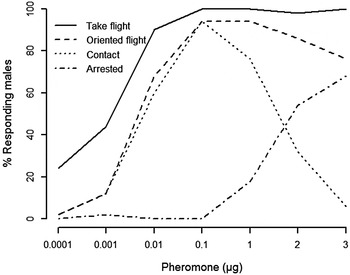
There was a gradual raise in the behavioral response of males to increasing amounts of pheromone blend from 0.001 to 0.1 µg (fig. 1). As the concentration increased further a progressively higher percentage of orienting males displayed arrested flight behavior close to the source, resulting in 30% contacts with 2 µg and almost no contacts with 3 µg. For the following test the 2 µg concentration was chosen as the overdose treatment, and 0.1 µg as the optimal dose.
Effect of pheromone quantity on the wind tunnel response of G. molesta males.

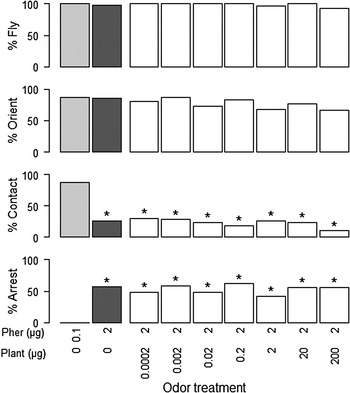
Plant blend alone stimulated 17% of the males to fly, but none oriented to or contacted the stimulus (data not shown). A total of 85% males oriented to the overdosed pheromone, but many also arrested, and so there was only a 27% of contacts to the overdosed pheromone, significantly less than to the optimal pheromone concentration, which had 87% contacts and no arrested flights (fig. 2). Addition of varying ratios of the plant blend to the overdosed pheromone did not reduce the number of arrested flights, and so it did not increase the number of contacts and did not help increase response with respect to the overdosed pheromone (fig. 2).
Effect of plant odor on the wind tunnel response of G. molesta males to overdosed sex pheromone. Males were exposed to an optimal pheromone dose (light gray bar, 0.1 µg), to an unnaturally high pheromone dose (dark gray bar, 2 µg) and to the overdosed pheromone mixed with varying amounts of a plant odor (white bars). Percentages of males responding (take flight, oriented flight, contact and arrested flight) are the predicted responses from the estimated parameters of general linear models (GLM). Asterisks indicate significant differences between the optimal sex pheromone dose and all other treatments by means of planned pair-wise comparisons using Tukey's test (P < 0.05). Pher: Pheromone, Plant: Plant odor

Effect of plant volatiles on the response to pheromone blends with suboptimal Z/E isomer ratios
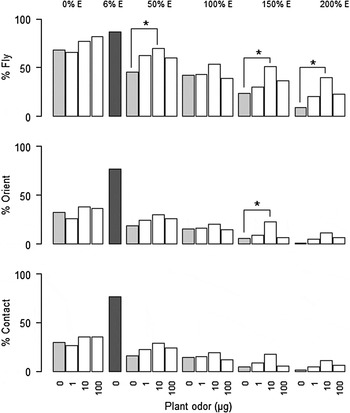
Neither hexane nor the plant blend alone attracted any males, but the plant blend significantly increased responses to an underdosed pheromone blend (12.13 and 47.42% contacts, respectively, P < 0.01), confirming the synergistic power of this blend. Unnaturally high or low ratios of E8-12:Ac resulted in significantly lower percentages of response, at any behavioral category, than the optimal 6% E-isomer ratio (fig. 3). Addition of the plant blend to the unnatural E-ratio blends increased the number of flights to the 50, 150 and 200% E-blends, and the number of oriented flights to the 150% E-blend with respect to the no-plant off-blend (fig. 3). All these synergistic effects were observed only at the 1:10 pheromone:plant ratio (10 µg of plant odor), but not at lower or higher ratios. A trend for increased contacts with the plant blends was observed, but these differences were not statistically significant.
Effect of plant odor on the wind tunnel response of G. molesta males to sex pheromone blends containing a constant 100:10 ratio of Z8-12:Ac to Z8-12:OH (100:10 ng, respectively), and (a) an optimal ratio of the minor component E8-12:Ac (6% relative to the major component, dark gray bar), or (b) suboptimal ratios of E8-12:Ac (0, 50, 100, 150 and 200%, light gray bars). The blends with suboptimal E8-12:Ac ratios were mixed with varying amounts of a plant odor (1:1, 1:10 and 1:100, major pheromone compound:plant odor respectively, white bars). Percentages of males responding (take flight, oriented flight and contact) are the predicted responses from the estimated parameters of general linear models (GLM). Asterisks indicate significant differences between each unbalanced E8-12:Ac ratio (light gray bars) and those blends with the plant odor (white bars) by means of pair-wise comparisons using Tukey's test (P < 0.05). The response to the optimal blend (dark gray bar) was significantly higher than to any of the unbalanced E-blends (light gray bars, P < 0.05).

Effect of alcohols and plant volatiles on the response to a pheromone blend lacking Z8-12:OH
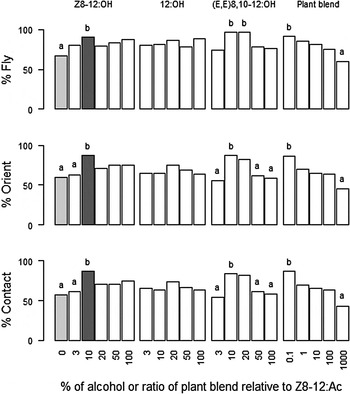
The addition of Z8-12:OH, 12:OH, codlemone and plant odors synergized male responses to an optimal Z/E blend-ratio pheromone that lacked Z8-12:OH, but the effect depended on the compound and concentration used (fig. 4). Z8-12:OH synergized all response categories at the 10% dose. Codlemone synergized take-flight at 10 and 20% doses and oriented flight and contact at the 10% dose, and the plant blend synergized all behavioral steps at the 1:0.1 ratio. Several of the other treatments increased male responses to levels not significantly different to the optimal blend, but in these treatments the response was not significantly different from the blend lacking alcohol either, so their synergistic effect was weaker than in the former treatments (e.g. Z8-12:OH at 20, 50 and 100%, all the 12:OH doses, and plant blend at the 1:1, 1:10 and 1:100 ratios; fig. 4). Finally, some treatments did not have any positive effect on male response (e.g. Z8-12:OH 3% orient and contact, codlemone 3, 50, 100% oriented and contact and pheromone:plant 1:1000 all behavioral categories; fig. 4).
Effect of alcohols (Z8-12:OH, 12:OH, E8, E10-12:OH) and plant odor on the wind tunnel response of G. molesta males to blends containing a constant 100:6 ratio of Z8-12:ac to E8-12:Ac (100:6 ng, respectively, light gray bar). The alcohols were added at 3, 10, 20, 50 and 100% relative to Z8-12:Ac, and the plant blend at 1:0.1 to 1:1000 major pheromone component:plant ratios. Percentages of males responding (take flight, oriented flight and contact) are the predicted responses from the estimated parameters of general linear models (GLM). Planned pair-wise comparisons used Tukey's test (P < 0.05) where ‘a’ indicates a significantly lower response than the optimal blend (10% Z8-12:OH, dark-gray bar), and ‘b’ indicates a significant higher response than the suboptimal blend (0% Z8-12:OH, light gray bar).

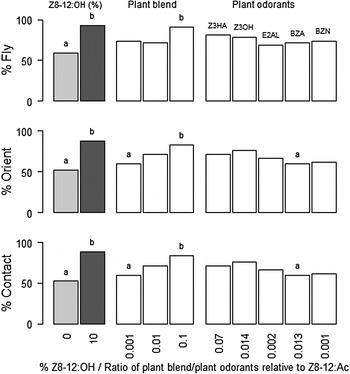
Because the synergistic effect of the plant blend occurred only at the lowest pheromone:plant ratio (1:0.1), we did further tests with still lower plant blend doses. In addition, because the plant blend is composed of several chemicals and one of them is an alcohol [(Z)-3-hexenol], we further explored the role of each plant blend ingredient on pheromone–plant synergism. Here, as in the previous test, the 0% Z8-12:OH blend performed worse than the optimal 10% Z8-12:OH blend, and the plant blend synergized at the 1:0.1 pheromone:plant ratio, however lower plant ratios had no, or only slight, synergistic effects (fig. 5). The individual compounds (except for benzaldehyde) synergized male responses, but their individual effect was not as strong as in a blend.
Effect of a plant odor blend and its individual components on the response of G. molesta males to blends containing a constant 100:6 ratio of Z8-12:Ac to E8-12:Ac (100:6 ng, respectively) and no Z8-12:OH (suboptimal blend, light gray bar), the acetate blend with a 10% Z8-12:OH (relative to Z8-12:Ac, optimal blend, dark gray bar), and the acetate blend with no alcohol and mixed with several ratios of the plant blend (1:0.001, 1:0.01 and 1:0.1, major pheromone component:plant, respectively), or with the individual plant ingredients in the same quantity as in the 1:0.1 pheromone:plant odor blend. Percentages of males responding (take flight, oriented flight and contact) are the predicted responses from the estimated parameters of general linear models (GLM). Planned pair-wise comparisons used Tukey's test (P < 0.05) where ‘a’ indicates a significantly lower response than the optimal blend (10% Z8-12:OH, dark gray bar), and ‘b’ indicates a significant higher response than the suboptimal blend (0% Z8-12:OH, light gray bar).

Discussion
Male G. molesta responses peaked at optimal pheromone concentrations and optimal ratios of the two acetate isomers, as reported in earlier studies (Baker et al., Reference Baker, Meyer and Roelofs1981; Linn & Roelofs, Reference Linn and Roelofs1983; Willis & Baker, Reference Willis and Baker1988; Knight et al., Reference Knight, Barros-Parada, Bosch, Escudero-Colomar, Fuentes-Contreras, Hernández-Sánchez, Yung, Kim, Kovanci, Levi, Lo, Molinari, Valls and Gemeno2015). We have shown previously that plant volatiles synergize male response to a below-optimal pheromone dose (Varela et al., Reference Varela, Avilla, Anton and Gemeno2011); however, in the present study we failed to observe plant synergism to an above-optimal pheromone dose. This could be explained by the different mechanisms by which low and high pheromone doses reduced response levels. With low doses the olfactory system is under-stimulated and therefore the stimulus arriving to the CNS is probably below the behavioral response threshold. Plant odors, which in our test did not stimulate male flight on their own, but that under natural conditions could indicate the presence of conspecific females (Landolt & Phillips, Reference Landolt and Phillips1997), may lower the behavioral response threshold to pheromone, and so increase responses to below optimal pheromone doses. With high stimulus doses, however, the olfactory system is sufficiently stimulated from the distance to arouse take flight and oriented flight, but males interrupt upwind progress (i.e. arrest) close to the odor source probably due to adaptation and/or saturation at the peripheral olfactory level (De Bruyne & Baker, Reference De Bruyne and Baker2008). Under these conditions the effect of the plant odor is probably negligible, given that the pheromone receptors are probably adapted and unable to transmit a proper pheromone stimulus to the brain, despite simultaneously processing an optimal plant signal. Schmidt-Büsser et al. (Reference Schmidt-Büsser, Von Arx and Guerin2009) report behavioral synergism to an overdosed pheromone blend in the tortricid Eupoecilia ambiguella Hübner, so at least in this species the plant blend can cancel out the effect of a high pheromone dose, but more studies are needed to determine if this happens in more species.
As the ratio of E8-12:Ac to Z8-12:Ac increased or decreased past the optimal 6% level, fewer males initiated flight or located the pheromone source in the wind tunnel. Mixing the plant blend with these suboptimal off-blends restored some of their attractiveness, but it did so mainly for the earlier stages of response (takeoff and oriented flight), and not for contact with the pheromone source. The relatively weak effect of plant odors helping males respond to or locate pheromone off-blends may stem from the strong selective pressure imposed by costly mating mistakes with species producing similar pheromone blends (Cardé & Haynes, Reference Cardé, Haynes, Cardé and Millar2004). Male response to a species-specific pheromone blend should not be strongly affected by the presence of plant volatiles in the environment because this would challenge pheromone communication. Functional partition of olfactory receptor neurons into pheromone and plant receptors protects the pheromone signal from undesirable interference by background stimuli, such as plant odors (Martin & Hildebrand, Reference Martin and Hildebrand2010). The response of the main pheromone receptor neurons of G. molesta (i.e. those tuned to Z8-12:Ac and E8-12:Ac) is highly specific to their specific ligands and relatively unaffected by the presence of plant volatiles in the blend, whereas these plant volatiles are sensed by other type of receptor neurons on the antenna which do not respond to pheromone stimuli (Ammagarahalli & Gemeno, Reference Ammagarahalli and Gemeno2014; Reference Ammagarahalli and Gemeno2015). The behavioral effect of plant stimuli on the response of G. molesta to pheromone blends is probably occurring at the central nervous system level, where the pheromone information sensed by pheromone receptor neurons is integrated with the plant information sensed by plant-specific receptor neurons in several moth species (Martin & Hildebrand, Reference Martin and Hildebrand2010).
There are, however, examples of plant volatiles affecting the sensitivity and response dynamics of pheromone olfactory neurons in other insect species, so the perception of pheromone and plant stimuli is not completely isolated in all species (De Bruyne & Baker, Reference De Bruyne and Baker2008; Deisig et al., Reference Deisig, Dupuy, Anton and Renou2014). In Heliothis zea (Boddie) linalool almost doubled spike frequency of pheromone neurons with respect to stimulation with pheromone alone (Ochieng et al., Reference Ochieng, Park and Baker2002). In several other species, the plant odor inhibits firing of pheromone ORNs. For example, in Agrotis ipsilon (Hufnagel) heptanal reduced responses from about 50 spikes s−1 with pheromone alone to about 5 spikes s−1 with the pheromone–plant blend (Deisig et al., Reference Deisig, Kropf, Vitecek, Pevergne, Rouyar, Sandoz, Lucas, Gadanne, Anton and Barrozo2012), and in Heliothis virescens (F.) linalool halved the spiking activity of Z11-16:Ac and Z11-16:Ald ORNs (Hillier & Vickers, Reference Hillier and Vickers2011). It has been argued that pheromone suppression by plant volatiles may improve pheromone pulse resolution, and thus potentially aid male orientation to pheromone-emitting females (Party et al., Reference Party, Hanot, Said, Rochat and Renou2009; Deisig et al., Reference Deisig, Dupuy, Anton and Renou2014); however, this prediction has not been confirmed under wind tunnel conditions (Badeke et al., Reference Badeke, Haverkamp, Hansson and Sachse2016).
Although the plant volatile blend did not restore male response to a high-concentration pheromone blend, and it did only partially compensate blends with offset ratios of the two main pheromone components, it did bring back a normal level of response to a pheromone blend lacking the minor component Z8-12:OH. The effect was not caused by any particular ingredient in the plant blend, not even the alcohol (Z)-3-hexenol, which constituted 13% of the plant blend, but to the plant blend as a whole. We have not found in the moth literature other reports where a missing minor sex pheromone ingredient was replaced by a plant odor, so we do not know how common this is in other species. The alcohols 12:OH and codlemone (the main ingredient of C. pomonella's sex pheromone) also restored male response to a Z8-12:OH-deficient pheromone blend, so the role of Z8-12:OH in the pheromone blend of G. molesta appears to be less rigid than that of the acetates. Support for the importance of Z8-12:OH arrives from studies showing that calling females release it (Baker et al., Reference Baker, Cardé and Miller1980), that males do not respond to a blend containing no Z8-12:OH, and that just a small percentage of the alcohol (1–3%) is needed to increase male attraction significantly (Baker & Carde, Reference Baker and Carde1979; Linn & Roelofs, Reference Linn and Roelofs1983). However, other studies show that Z8-12:OH is not necessary for attraction in the field (Roelofs & Carde, Reference Roelofs and Carde1974; Yang et al., Reference Yang, Jung, Han, Boo and Yiem2002), that its proportion in the blend can vary widely without affecting male response (Linn & Roelofs, Reference Linn and Roelofs1983), or that females do not release it (Lacey & Sanders, Reference Lacey and Sanders1992). Its presence in female glands is very variable, occurring in several world populations (Knight et al., Reference Knight, Cichon, Lago, Fuentes-Contreras, Barros-Parada, Hull, Krawczyk, Zoller, Hansen, Hilton and Basoalto2014), whereas little or no traces of Z8-12:OH are reported in others (Boo, Reference Boo1998; El-Sayed & Trimble, Reference El-Sayed and Trimble2002). The inconsistent performance of Z8-12:OH reported in the literature, and its ductility in being replaced by other alcohols from same or different species (i.e. C. pomonella), or even by plant odors, as shown in here, suggest that its role is not comparable with that of the two main ingredients, Z8-12:Ac and E8-12:Ac. As indicated earlier, these compounds are an essential part of the blend and must be present at a very specific ratio in order to elicit optimal levels of male response (Baker et al., Reference Baker, Meyer and Roelofs1981; Knight et al., Reference Knight, Barros-Parada, Bosch, Escudero-Colomar, Fuentes-Contreras, Hernández-Sánchez, Yung, Kim, Kovanci, Levi, Lo, Molinari, Valls and Gemeno2015). Field tests should be carried out to clarify, under natural conditions, the role of third ingredients in blends having the two main pheromone components (Z8-12:Ac and E8-12:Ac).
One final observation concerning the production of Z8-12:OH by G. molesta females is its possible implication in interspecific relationships. Closely-related species sharing similar pheromone blends, and therefore at risk of interspecific mating mistakes, may evolve olfactory signals designed to deter mutual attraction (Cardé & Haynes, Reference Cardé, Haynes, Cardé and Millar2004). Z8-12:OH inhibits males of two species that are closely related to, and that use a similar ratio of the Z/E-acetates as main pheromone ingredients, as G. molesta [i.e. Grapholita funebrana (Treitschke) (Guerin et al., Reference Guerin, Arn, Buser, Charmillot, Tóth and Sziráki1986) and Grapholita prunivora (Walsh) (Baker & Carde, Reference Baker and Carde1979)], so it is possible that the production and release of Z8-12:OH by G. molesta females may serve an interspecific avoidance function. In a similar fashion, two compounds in the pheromone glands of G. funebrana (Z8-14:Ac and Z10-14:Ac) do not play a role in attracting this species but they reduce captures of G. molesta (Guerin et al., Reference Guerin, Arn, Buser, Charmillot, Tóth and Sziráki1986).
Acknowledgements
BA was supported by a Ph.D. fellowship from MINECO Ministry of Spain, and CG by research Grant AGL2010-17486 from the same agency. PG visit to the UdL was supported by CNPq-Brasil program ‘Science without Borders’. LC visit to the Udl was supported by the School of Agriculture and Veterinary medicine, Alma Mater studiorum, Università di Bologna, as part of the project concerning the development of a Master thesis abroad.