1. INTRODUCTION
The phenomenon that financial services are proffered while bypassing traditional banking intermediaries is generally described as “financial disintermediation.”Footnote 1 Funding programmes, sponsored by core companies either with or without the co-operation of banks for core companies’ suppliers or distributors, is the so-called supply-chain financingFootnote 2 ; as supply-chain financing programmes can also be put in place without banks, this exemplifies a type of financial disintermediation.Footnote 3 Moreover, supply-chain financing has been evolving and will be more complex due to the rapid growth of financial technology (“FinTech”), which “refers to the use of technology to deliver financial solutions.”Footnote 4 For example, companies have already been able to raise funds in such innovative ways as equity-based crowdfunding.Footnote 5 The FinTech revolution disrupts the traditional type of financial products and services such as supply-chain financing by combining finance with technologyFootnote 6 ; in particular, this can be illustrated by online supply-chain financing, which has been a relatively novel funding channel for suppliers as SMEs to obtain loans as the FinTech revolution transforms traditional supply-chain financing, which used to be administered only by official banks, to an online model also used by electronic commerce platforms (“e-commerce platform”).Footnote 7 As such, the FinTech revolution would help improve financial access and universal inclusion.Footnote 8
For instance, Foxconn (Hon Hai Precision Industry Co., Ltd, also known as “Foxconn”) took advantage of FinTech to develop supply-chain financing in China recently. Foxconn, a Taiwan-based conglomerate, is Apple’s (Apple Inc., “Apple”) largest contract manufacturer with major factories in China.Footnote 9 In recent years, Foxconn has been trying to expand into more higher-margin business, such as financial services.Footnote 10 One of these financial services is providing loans to Foxconn’s tier-one suppliers. For example, one of the business units within the Foxconn group had a turnover of more than USD157 million in transactions since this financial-services unit was launched in 2014.Footnote 11 With a comparative advantage of the familiarity with the business statuses of its suppliers, Foxconn could leverage more areas of its supply chain from the starting point of online supply-chain financing.Footnote 12 Specifically, one of its business units (which will be called the “Foxconn e-commerce platform” in this article) is planning to provide financing programmes to the corporate users on this e-commerce platform themselves.Footnote 13 In addition, JD.com (“JD”), one of China’s largest e-commerce platform giants,Footnote 14 has been earlier developing the business of supply-chain financing via its online stores since 2012.Footnote 15 Up until the end of 2013, the cumulative turnover of the online supply-chain financing provided through co-operation between JD and commercial banks was close to USD1.2 billion.Footnote 16
In recent years, regulators have been faced with the challenge of how to regulate “sharing economy” such as the rise of Uber (Uber Technologies Inc., “Uber”).Footnote 17 Nonetheless, policy-makers appear to fail to create a new set of regulations or change the institutional philosophy and to recognize sharing economy as a different form of capitalism.Footnote 18 Likewise, the non-traditional online supply-chain financing is a different kind of FinTech market that should be regulated differently from traditional banking.Footnote 19 That is, online supply-chain financing, a subconcept under the idea of sharing economy as well as a new business model for suppliers as SMEs to raise funds, is a distinct type of business model of digital financial inclusion (like “finance-Uber” or “finance-Airbnb”),Footnote 20 which should be regulated in a different approach.Footnote 21 One of the insights from the following case-study of Foxconn’s online supply-chain financing would be that a new type of financial services is emerging with the FinTech revolution as Foxconn uses information technologies to achieve digital financial inclusion of SMEs.Footnote 22 Therefore, an alternative regulatory framework that is friendly to the FinTech newcomers is needed to strike an optimal balance between financial stability and access to financial services, both of which would be two significant goals of FinTech regulation.Footnote 23
Theoretically, financial regulators’ objectives include ensuring financial stability, prudential regulation, conduct and fairness, and competition and market development.Footnote 24 The institutional philosophy or regulatory attitude adaptive to such innovative FinTech-enabled financial services as online supply-chain financing would indeed be an important issue in the near future. In other words, with a view to promoting financial access and universal inclusion, making the adaptive regulatory response to the rapidly developing FinTech markets is of vital importance. In general, the methods for supervising the FinTech-based financial industry include a principles-based regulatory regime and a rules-based one.Footnote 25 From the perspective of regulatory humility, in the early stage of online supply-chain financing, a principles-based regulatory approach might be more adaptive to promoting online supply-chain financing; and, thanks to the development of FinTech markets, access to financial services will thus be advanced, albeit on the premise of not compromising financial stability and consumer interest. Therefore, with the rapid growth of such FinTech-based financial services as online supply-chain financing, how to construct a principles-based regulatory regime complemented with other well-designed regulatory techniques will be a challenging endeavour for regulators in the near future. Put simply, financial regulators should be humble and remove regulatory entry barriers with which FinTech firms are faced at their early stage. The increase of business models of digital financial inclusion would improve access to financial services by the underserved. Most importantly, the advancement of digital financial inclusion does not mean that we would compromise regulatory goals of consumer financial protection and prevention of potential systemic risks. Even if adopting a principles-based regulatory regime, we would strike an optimal balance among financial stability, consumer financial protection, and the improvement of financial access and inclusion.
This article is organized as follows. Section 2 gives a theoretical overview of the FinTech revolution, financial intermediation, shadow banking, and principles-based vs. rules-based regulatory regimes, to pave the way for analyzing how to regulate FinTech markets such as online supply-chain financing. Section 3 carry outs the case studies of JD’s and Foxconn’s online supply-chain financing to highlight emerging regulatory issues. Specifically, this article will study how financial inclusion could be improved by comparing these two different models of online supply-chain financing with the traditional supply-chain financing administered by commercial/dealer banks. This comparison would tell us that the financial inclusion achieved by the former might justify why we should allow for or encourage FinTech innovations. In terms of how a regulatory framework should be designed in this FinTech era, given that online supply-chain financing can be viewed as a type of financial disintermediation, JD and Foxconn would act as alternative financial intermediaries; hence, a principles-based regulatory regime might be more adaptive in the early stage of the FinTech markets. In Section 4, we further discuss the regulatory implications. We attempt to provide a conceptual framework on how laws and the institutional environment should rapidly respond to developments of the FinTech industry exemplified by online supply-chain financing. Specifically, if a jurisdiction shows interests in engaging in global regulatory competition for attracting FinTech start-ups, a risk-based proportionate regulation in principles-based approach should be adopted based on a shift in institutional philosophy or regulatory attitude to light-touch or humble regulation. On top of that, market-based regulatory mechanisms such as the regulatory sandbox as a necessary complement would be supportive to emerging business models of digital financial inclusion, especially in their early stage. Finally, we conclude.
2. THE FINTECH REVOLUTION AND ONLINE SUPPLY-CHAIN FINANCING
With the rapid growth in FinTech over the last few years, a new type of financial services or products provided through the Internet have appeared. In fact, the global financial crisis that started in 2008 could be a turning point, creating a new group of market participants applying technology to financial services or products.Footnote 26 In particular, online supply-chain financing was enabled by FinTech, which will be illustrated especially in the case-study of Foxconn.Footnote 27 In simple, an online e-commerce platform established with the help of FinTech performs a crucial part in allowing businesses to seek funds they needed more easily, thus helping to achieve financial access and inclusion. Concepts relevant to financial disintermediation will be discussed below to lay the foundation of examining issues on FinTech regulation.
2.1 Financial Disintermediation
2.1.1 The FinTech Revolution and Financial Disintermediation
The combination of financial services with information technology brings about the revolution of FinTech.Footnote 28 In particular, the FinTech revolution has become a main feature of financial market development in the emerging economies such as those in Asia Pacific.Footnote 29 Currently, the financial market is being changed owing to FinTech at least in these categories: (1) banking technology (such as data management, analytics, and security); (2) payments (such as payment solutions); (3) cyber currency (such as blockchain and Bitcoin); (4) business finance (such as peer-to-peer (“P2P”) business lending and crowdfunding); (5) consumer lending (such as P2P lending and robo advisers); (6) alternative cores (such as digital banks).Footnote 30 In China, the People’s Bank of China reported in 2014: “[T]here are six major categories of Internet finance: online payment (including mobile payment), P2P lending, non-P2P micro-lending, online fund distribution, financial institutions’ Internet platform, and crowdfunding”; among the six categories of Internet finance mentioned above, the most prominent types of financial business on the Internet include: first, online payment; second, financial products distribution; and, third, online financing, embracing P2P lending and supply-chain financing.Footnote 31 Specifically, major interests of online financing includes crowdfundingFootnote 32 ; P2P lending, which is a funding programme between credit-worthy borrowers and return-seeking lenders through online platforms; and online supply-chain financing or Internet-enabled SME loan, meaning that Internet companies serving as lenders grant loans to SMEs with which they have a business relationship.Footnote 33 Above all, online supply-chain financing or Internet-enabled business-to-business (“B2B”) loan as well as its legal implications are the focus in this article. The legal issues underlying FinTech-enabled supply-chain financing are worth being analyzed to rethink institutional philosophy or regulatory approaches. In concrete terms, the growth of the aforementioned non-traditional financial intermediaries, from “too-small-to-care” to “too-big-to-fail,” generates a direct challenge or conundrum in regulating financial innovations.Footnote 34 Therefore, the question of how the regulatory regimes should respond to FinTech innovations and thus be adjusted is of vital significance in this FinTech era.Footnote 35
With respect to the nature of online supply-chain financing, it can be viewed as a type of financial disintermediation in the first place, with JD and Foxconn acting as a rising financial intermediary instead.Footnote 36 Thanks to new information technology as well as market reforms, old markets of finance are being disrupted while new ones are being created.Footnote 37 Conventional financial intermediaries, such as commercial banks, have performed their core financial functions to make transactions more efficient and less risky; however, new financial intermediaries could effectuate these core purposes of financial intermediation more easily because of market developments and new technologies such as high-speed electronic communication networks used.Footnote 38 On the flip side, the fact that non-bank intermediaries (especially Foxconn, to be discussed in Section 3 below) operate without public-sector credit guarantees or central bank liquidity could be considered to be disintermediation or a kind of shadow banking.Footnote 39 To be sure, modern finance is faster, larger, more complex, more global, more interconnected, and less human, so that the emerging systemic risk of “too-linked-to-fail” will grow more challenging and pressing.Footnote 40 In short, new financial intermediation may in large part bring about the rise of shadow banking.Footnote 41
2.1.2 Online Supply-Chain Financing and Shadow Banking
In general, shadow banks are private lending companies not regulated by the government, and they lend money at a much higher interest rate; SME suppliers in China have difficulties in borrowing money, such that they will turn to friends, relatives, or even shadow banks for obtaining the loans they need.Footnote 42 Broadly defined, shadow banking or market-based financing can be viewed as “asset and maturity transformation by entities that are not regulated as banks”; shadow-banking activities, which are not well regulated, would erode the stability of the financial system.Footnote 43 Traditionally speaking, non-bank companies like Bear Stearns and Lehman Brothers that perform some banks’ functions are called shadow banks as well, usually relying on short-term debt significantly.Footnote 44 Financial institutions-oriented reforms such as the Dodd-Frank Act (The Dodd-Frank Wall Street Reform and Consumer Protection Act, “Dodd-Frank Act”) in the US indirectly regulated the shadow-banking sector in recent years.Footnote 45 More importantly, these shadow-banking activities require proportionate regulation to strike a balance between the promotion of FinTech developments and the reduction of emerging systemic risk that they possibly pose.Footnote 46
As discussed before, one of the fundamental characteristics of online supply-chain financing is financial disintermediation.Footnote 47 On top of that, financial disintermediation is often said to create the shadow-banking sector.Footnote 48 Online financing facilitated by FinTech firms, such as P2P lending and supply-chain financing, may be deemed as shadow banking or market-based credit intermediation.Footnote 49 For instance, the booming market of P2P lending is largely unregulated in China.Footnote 50 Consequently, as part of shadow banking, Internet finance in general and P2P lending in particular would reveal a regulatory vacuum, since a systemic risk to the formal banking sector would arise due to the lack of sufficient supervision and information disclosures.Footnote 51 It is thus necessary to design regulations over shadow banking to lower potential systemic risks caused by shadow banking to the whole financial market.Footnote 52 In the early stage of the FinTech revolution, should we have a parallel regulatory regime for both official banks and FinTech start-ups? From a high-level perspective to regulate FinTech innovations, as the FinTech revolution brought creativity to the financial market, regulators should strike a balance between promoting the creativity of FinTech markets and controlling systemic risks created by the largely unregulated shadow-banking system.Footnote 53 Specifically, when it comes to banking regulation, the size of a financial institution matters owing to its relevance for systemic risk, and scale can act as “a proxy of importance to the real economy.”Footnote 54 If a jurisdiction is about to promote the development of FinTech innovations, FinTech start-ups are unlikely to be regulated in the same way as official banks when their collapse would not destroy an important credit channel. Nevertheless, once FinTech companies as non-bank credit intermediaries could “themselves reach systemic size and scope quite independently of the commercial banking system ... their importance to the real economy will require their designation and supervision as systemically important institutions.”Footnote 55 Therefore, before FinTech firms reach the threshold of being “systemically important institutions,” we may consider taking a principles-based and risk-based proportionate approach to regulating online supply-chain financing.Footnote 56 Meanwhile, we may also adopt a more flexible institutional philosophy to fit in with this FinTech-enabled and emerging financial market.
2.2 FinTech Regulation: Towards a Principles-Based Regulatory Regime?
As disruptive technologies have developed at a faster pace than law, they raised the question of how law-makers or regulators should respond. For example, since the businesses of sharing economy such as Airbnb or Uber as online intermediaries turned more and more prosperous, corresponding regulatory response or constraints emerged to address regulatory debates such as those regarding public safety.Footnote 57 The questions concerning what, when, and how regulatory intervention should be made for these disruptive technologies would be crucial.Footnote 58 When it comes to FinTech-based industries such as online supply-chain financing, the issue about striking a balance between ensuring or promoting the development of technologies and lowering the systemic risk is pressing as well. In the early stage of the FinTech revolution, providing an adaptive regulatory framework would be helpful to promote it while preventing potential systemic risks before it goes too far beyond law. With FinTech developments, an adaptive regulatory framework would make innovative products or services effective and legitimate.Footnote 59 Therefore, in designing the regulatory regime for such innovative FinTech-enabled financial services as online supply-chain financing, regulators should rethink its regulatory basis or institutional philosophy especially in the context of global regulatory competition for attracting FinTech firms and markets.Footnote 60 In other words, from the perspective of both the FinTech-based industry and financial regulators, a change in regulatory attitude would be needed to address the issue of how FinTech-based products and services should be regulated.Footnote 61 What follows will further introduce two distinct types of regulatory regimes: a principles-based regulatory regime vs. a rules-based one. Furthermore, in order to map out an adaptive conceptual framework for governing online supply-chain financing, this article will delve into case studies of supply-chain financing in Section 3 and then propose the regulatory framework in Section 4.
A principles-based regime imposes more flexible compliance obligations.Footnote 62 Since the potential participants in FinTech industries are start-ups mostly, the principles-based approach may provide start-ups with the benefit of flexibility at their early stage; nonetheless, the higher cost of legal compliance associated with a rules-based approach would be balanced by being more attractive to investors given that regulatory clarity and legal predictability could be important for start-ups and investors.Footnote 63 Nevertheless, a “more principles-based” financial regulation (“MPBR”) might help more rapidly respond to the challenges arising from the complexity and innovativeness of modern financial markets.Footnote 64
When it comes to the principles-based regulatory regime, principles are used to create a framework to sketch out the regulatory goals and values, whilst “regulatees are left free to devise their own systems for serving such principles.”Footnote 65 This regulatory strategy, with its UK counterpart as “risk-based regulation,” has been adopted over the past two decades but somewhat fallen due to the financial crisis of 2007–09.Footnote 66 Still, the emergence of principles-based financial regulation is one of the most important regulatory developments; in nature, this regulatory strategy has been seen as “light-touch” regulation.Footnote 67 As previously discussed, principles-based regulation might be insufficient to assure regulatory clarity and certainty; however, a principles-based regulatory regime would incorporate principles in written rules to make regulated market participants not commanded to follow detailed instructions regulators give, while regulators would rely on the regulatees to invent methods of controlling risks themselves.Footnote 68 In addition, this kind of light-touch or humble regulation would help people make better decisions in a more effective way.Footnote 69
In contrast, a rules-based regime lays down clearer but more rigid, costly, and complex rules, thus more likely creating entry barriers to new competitors.Footnote 70 As just mentioned, even if a principles-based regulatory regime may not provide sufficient clarity and certainty as the rules-based regulatory regime does, a principles-based regulatory regime could be more dynamic and effective in keeping regulatory pace with the times.Footnote 71 The MPBR represents a shift in institutional philosophy from a historically predominant rules-based regulatory regime to a less prescriptive approach.Footnote 72 This move towards the more principles-based regulatory regime entails a construction of more high-level and broader principles.Footnote 73 Within this more principles-based regulatory regime, “rather than contemplating the wholesale abandonment of rules, MPBR envisions that rules and principles can play complementary re-enforcing roles.”Footnote 74
2.3 Summary
We have analyzed fundamentals of online supply-chain financing, revealing that the supply-chain financing capitalizing information technologies reflects the concepts of financial disintermediation and shadow banking in a sense. In addition, online supply-chain financing is a type of novel FinTech markets, distinct from traditional banking. Therefore, if a jurisdiction aims to support FinTech industries, such more flexible institutional philosophy as MPBR would be needed to respond rapidly to emerging FinTech developments.Footnote 75
Theoretically, as one of the emerging innovative financial services, the FinTech-enabled supply-chain financing may be more suitable to be regulated under a principles-based regulatory regime. In order to re-enforce the role of principles to govern online supply-chain financing, risk-based proportionate regulation would be preferred to a one-size-fits-all one.Footnote 76 Next, we will move to the empirical part below, namely the case studies on online supply-chain financing facilitated by JD and Foxconn, to examine whether principles-based regulation is adequate for regulating online supply-chain financing in the current era of FinTech from the perspective of market participants. Then, based on the integral perusing in Sections 2 and 3, we will in Section 4 propose a conceptual framework to govern online supply-chain financing in particular and that for FinTech regulation in general.
3. ONLINE SUPPLY-CHAIN FINANCING: CASE STUDIES
3.1 Data and Methods
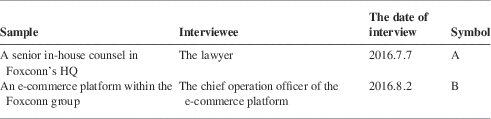
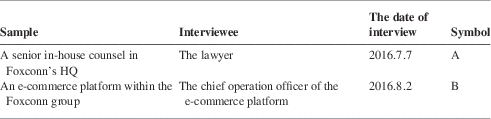
This article will examine the regulatory issues regarding online supply-chain financing through the cases of JD and Foxconn. In addition to tapping secondary sources to analyze these two cases, two in-depth interviews have been conducted to qualitatively examine some details of Foxconn’s online supply-chain financing in particular. Questions for these in-depth interviews are designed as semi-structured questions.Footnote 77 This article applies “purposive sampling” to choose the samples. This method relies on the thesis of the research and chooses the most relevant sample.Footnote 78 The data used in this article include two in-depth interviews conducted personally with the following interviewees: a senior in-house counsel of Foxconn’s headquarter (HQ) who is familiar with Foxconn’s FinTech businesses, as well as a chief operation officer of an e-commerce platform within the Foxconn group. Since the Foxconn group is one of the largest conglomerates in China, and is also expanding its business of online supply-chain financing, Foxconn’s case could be representative enough.Footnote 79 Meanwhile, the data collected from these interviews with the interviewees in the Foxconn group could provide reliable findings so as to analyze the business model of Foxconn’s online supply-chain financing, thus pushing us to reflect on the corresponding institutional philosophy appropriate for online supply-chain financing.Footnote 80 The aforementioned data and method are described in Table 1. As shown in Table 1, letters A and B correspond with each of the interviewees, since the data secured are confidential. In this article, the interview codes are in the form of “Xy,” where “X” is the capitalized symbol from A to B representing a specific interviewee, while “y” is the number for the interview questions and his/her answers for each of those questions. In the following parts, we will briefly introduce online supply-chain financing in China, and then examine JD’s case by reviewing the second-hand literature. Further, Foxconn’s case will be demonstrated by analyzing the data collected from second-hand and from in-depth interviews.
The data and method
Source: The Authors.
3.2 Online Supply-Chain Financing in China
3.2.1 The Status Quo
In China, 70% of individuals and 55% of SMEs could not obtain loans from banks.Footnote 81 Even though they could take out loans from banks, there would often be an interest rate set high together with a collateral loan, in addition to other requirements such as depositing savings in or buying financial products from those banks.Footnote 82 In other words, it is difficult for not a few SMEs to borrow money from traditional banks. Nonetheless, given that e-commerce platforms own the detailed financial and operational data of their suppliers, these platforms have a comparative advantage in providing the suppliers with such financial services as loans.Footnote 83 Further, through integrating online platforms with offline companies, a more robust B2B ecosystem as created by the Alibaba platform will emerge to offer a wide range of financial services and products.Footnote 84
Thanks to the development of information technology, traditional supply-chain financing administered by official banks has evolved and been upgraded to an online model. Specifically, several characteristics of the supply-chain financing capitalizing on the Internet are as follows: first, the operation of supply-chain financing will be faster; second, there will be a platform operating with a standard operation process; third, the trend that related industries along supply chains will integrate with each other becomes more obvious; and, fourth, the cost of credit will decrease by reducing requirements of collaterals, since online supply-chain financing can take advantage of online big data, hence addressing information asymmetry.Footnote 85
3.2.2 The Business Models of Online Supply-Chain Financing
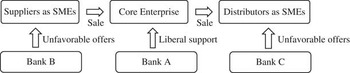
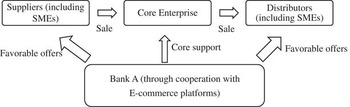
Three business models of emerging online supply-chain financing capitalizing on the Internet could be briefly summarized as follows: first, traditional offline supply-chain financing administered by dealer/commercial banks would go online; second, e-commerce platforms such as Alibaba provide the services of supply-chain financing on their online platforms; and, third, commercial banks would collaborate with e-commerce platforms to engage in supply-chain financing.Footnote 86 The first model is the so-called “Supply Chain Financing Web 2.0”; under this model, the traditional supply-chain financing carried out by commercial banks will go online where, however, neither original ways of processing are changed nor any affiliated e-commerce platform is created (whilst the information regarding funding, logistics, and business will integrate altogether through the banks’ online platforms).Footnote 87 The second model indicates that e-commerce enterprises will grant loans to sellers or buyers as SMEs via their own online platforms after getting licensed from financial regulators to do so.Footnote 88 And, under the third model, commercial banks will utilize their own funding to offer financial services to supply-chain participants via e-commerce platforms operated by themselves or by third-party platformsFootnote 89 ; this model can be exemplified by the following JD’s case.Footnote 90 Moreover, a shift in the relationship among the players in the supply-chain financing from the traditional model to the aforementioned third model could be illustrated as in Figures 1 and 2.
Traditional supply-chain financing Source: Cao & Qian, supra note 15, p. 52; Wen (Reference Wen2016), p. 4.

The online supply-chain financing where banks collaborate with e-commerce platforms Source: Cao & Qian, supra note 15, p. 52; Wen (Reference Wen2016), p. 5.

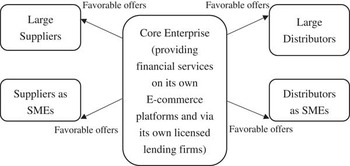
Furthermore, after core enterprises get licensed to perform supply-chain financing by themselves (viz. the second model mentioned above), the ecosystem of supply-chain financing will be closely linked, and suppliers and distributors as SMEs can be firmly supported via taking out loans from their core companies on e-commerce platforms which are operated by the core enterprises simultaneously. This ecosystem of online supply-chain financing enabled by the Internet is illustrated in Figure 3. This model will be further explained in the following Foxconn’s case.Footnote 91
The ecosystem of online supply-chain financing facilitated by core enterprises as e-commerce platforms Source: The Authors.

In this article below, the cases of JD’s and Foxconn’s online supply-chain financing are demonstrated individually, on the one hand, to exemplify different levels of financial disintermediation of online supply-chain financing where the Foxconn’s case stands for a higher level of financial disintermediation than that of JD in that Foxconn would create their own lending arms, rather than relying on the supply of financing from external banks, as shown in the JD’s case. On the other hand, these two cases are also compared to illustrate how FinTech innovations generated a distinct kind of online supply-chain financing, which would improve financial inclusion of SMEs that had been unbanked or underbanked in the context of traditional supply-chain financing administered by dealer/commercial banks.
3.3 The Case of JD’s Online Supply-Chain Financing
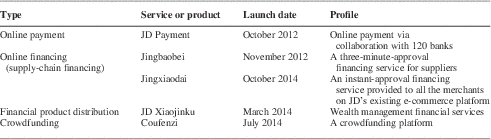
JD, as a core enterprise in its ecosystem, has been building up the business of supply-chain financing on its online e-commerce market-place since 2012.Footnote 92 In addition to short-term credit provided to its suppliers and distributors on its online retail platform, JD provided a variety of Internet-based financial products and services.Footnote 93 For example, in November 2012, JD launched “Jingbaobei” to provide its suppliers with instant-approval loans within three minutes.Footnote 94 In October 2014, JD launched “Jingxiaodai,” which promises instant-approval loans further to all the merchants, including suppliers as well, on its e-commerce platform.Footnote 95 In July 2013, JD established “JD Finance Group” (“JD Finance”), turning JD into an online financial service provider while doubling as an e-commerce platform player.Footnote 96 As Table 2 demonstrates, JD Finance’s current online financial services and products encompass online payment, supply-chain financing, P2P lending, and even crowdfunding. Among others, as in Figure 2 and the third model of online supply-chain financing discussed above,Footnote 97 JD collaborated with the Bank of China, a major commercial bank in China, to offer financial services to lenders on its e-commerce platform.Footnote 98
JD Finance’s Internet finance businesses
Source: Fung Business Intelligence Centre, supra note 31, at 5; Cao & Qian, supra note 15, p. 34.
3.4 The Case of Foxconn’s Online Supply-Chain Financing
3.4.1 The Business Model
Several business units within the Foxconn group facilitate supply-chain financing, even though their respective roles may be slightly different (B1, B4). Specifically, as a core enterprise in supply-chain financing, Foxconn would operate an e-commerce platform (A1, A2, B1). On this e-commerce platform, Foxconn acts as a core enterprise and a seller to sell suppliers’ products downstream to get profits (B3). In the near future, this e-commerce platform will also provide loans to suppliers, such that suppliers who need funding can ask for loans via this e-commerce platform (B4). When it comes to the model of supply-chain financing, “Foxconn has obtained business licenses from Chinese local governments to provide loans, factoring, financial guarantees and equipment leasing.”Footnote 99 Accordingly, as in Figure 3 and the second model of online supply-chain financing discussed above,Footnote 100 Foxconn created its own e-commerce platform, providing financial services to their suppliers via their own online platform after getting licensed from financial regulators to do so. This model differs from the third model used by JD which collaborated with the Bank of China to engage in online supply-chain financing.Footnote 101
Given that Foxconn know its suppliers’ business statuses as well as JD knows theirs, Foxconn’s e-commerce platform can leverage their business connections and then monitor their suppliers’ business statuses very well, thus lowering possible credit risks (B2). Specifically, the suppliers soliciting loans are all Foxconn’s existing suppliers, and the conditions for becoming Foxconn’s qualified suppliers are so strict that the default risk would be very low (A6, B5, B11). What’s more, another advantage for Foxconn (the core enterprise in their supply chain) to carry out supply-chain financing would be that it will make merchants as SMEs more willing to buy products through the e-commerce platform in that they can be offered better financing programmes (B8).
3.4.2 The Risks
The default rate or credit risk of supply-chain financing arranged on the e-commerce platform would be low because Foxconn can oversee financial statuses of its suppliers well (A6, B2, B5, B11, B21).Footnote 102 For instance, there was only one non-performing loan in the past years (B11). To be sure, the market participants in the ecosystem of supply-chain financing would be so closely linked that a systemic risk might take place if a huge number of defaults or non-performing loans take place (B14).
In order to reduce the potential systemic risk, laws or regulations would still play an important role notwithstanding large core enterprises such as Foxconn have audited their suppliers as borrowers carefully (B12, B 16, B20). Nevertheless, there is no doubt that laws or regulations governing online supply-chain financing should not be too stern (A13, B16, B17). In China, the e-commerce industry has turned quite prosperous. Therefore, if laws or regulations are too strict, it may be harmful to the development of the supply-chain financing operated by e-commerce platform players (A13, B17). In addition, self-regulation may be a feasible method for governing online supply-chain financing under an institutional framework of laissez-faire regulation (A13, A14, B18, B19).
3.5 Summary
Over previous few years, Internet finance has turned a hot topic in China.Footnote 103 Among the FinTech markets, we focus on online supply-chain financing. In particular, we study the cases of JD and Foxconn to analyze the financing programmes provided by core enterprises to its suppliers or merchants via their e-commerce platforms. Both JD and Foxconn operated their own e-commerce platforms first, and then they would arrange loans via their online platforms, even though, in JD’s case, it was the Bank of China that directly granted loans to lenders albeit through JD’s e-commerce platform. Thanks to the familiarity with their own suppliers or merchants, the credit risk of online supply-chain financing would be low. In contrast, without the co-operation with commercial banks, Foxconn not only would serve as a core enterprise in its supply chain, which procures or sells products; but it would also play an important role in the process of online supply-chain financing, by directly providing loans to its suppliers or distributors via its licensed lending companies. Compared to the JD’s case, where it was the commercial bank that supplied the financing, the Foxconn’s case might stand for a higher level of financial disintermediation in that it would create its own lending arms to act as a shadow bank granting loans to SMEs that had been underserved in the context of traditional supply-chain financing administered by dealer/commercial banks. Endeavours towards digital financial inclusion of the underserved could rationalize why we should allow for or encourage FinTech innovations exemplified by these two aforementioned business models of JD and Foxconn.Footnote 104
However, it seems that there is currently not an adequate regulatory regime over this Internet-based supply-chain financing to contain the potential systemic risk. In addition, from the perspective of the supply-chain financing participants, laws or regulations governing such an emerging FinTech business as online supply-chain financing should not be too rigorous, but these activities should not be totally free from regulation either (A13, A14, B16, B17, B18, B19). To promote the development of innovative FinTech markets whilst managing potential systemic risk with adaptive regulation, this article will propose a conceptual framework based on the institutional philosophy of light-touch or humble regulation below.
4. A CONCEPTUAL FRAMEWORK FOR REGULATING ONLINE SUPPLY-CHAIN FINANCING
As a commentator argues, to address the current issue that financial services remain expensive and inefficient, instead of the approach to a top-down structural change in regulation of incumbents which is subject to prohibitively high costs of political economy and co-ordination, “regulators should consider policies that promote low-leverage technologies and the entry of new firms.”Footnote 105 Therefore, in devising FinTech regulation to strike an optimal balance between fostering an access to financial services and maintaining financial stability, we should keep in mind how to facilitate new entry and more intense competition from FinTech start-ups in the age of the FinTech movement.Footnote 106
Following the previous discussions in Sections 2 and 3, we will propose a conceptual framework for regulating online supply-chain financing in this section. In Section 2, we tentatively concluded that a principles-based regulatory regime might be more adaptive to innovative FinTech businesses such as online supply-chain financing in the early stage of the FinTech revolution. A principles-based regulatory regime refers to the institutional philosophy of light-touch or humble regulation, and this regulatory attitude is the pith and substance of the conceptual framework we are going to promote. Along this line, normative implications including the adoption of the regulatory sandbox with a self-regulation approach to consumer protection will be drawn in this section to complement a shift in institutional philosophy to MPBR.
4.1 Regulatory Humility: A Principles-Based Strategy
As the business of Foxconn’s online supply-chain financing would unfold, what would be an adaptive regulatory framework to strike a balance between financial market stability and access to financial services advanced by FinTech innovations? We argue for a shift in institutional philosophy of financial regulation to light-tough or humble regulation especially in the early stage of the FinTech revolution. By regulatory humility or a light-touch approach, we mean the adoption of a principles-based regulatory strategy or MPBR, viz. “a proportionate risk-based approach.”Footnote 107 Therefore, we might tend to recognize the importance of embracing regulatory experimentation in a principles-based approach to FinTech regulation not least in the context of global regulatory competition for attracting FinTech firms and markets.Footnote 108 Reframing the institutional philosophy from a rules-focused perspective to MPBR would facilitate “a greater degree of openness and flexibility on the part of regulators” and “the incorporation of new knowledge or subsequent discoveries.”Footnote 109 In addition, under the conceptual framework constructed here, regulatory techniques in the future would be able to allow for new entrants of FinTech firms while appropriately supervising financial stability. In 2016, the “G20 High-Level Principles for Digital Financial Inclusion” (the “G20 Principles”) was announced to provide a basis for country action plans in regulating digital financial services. The perspective to promote competition in financial markets underlying our conceptual framework is aligned with that of the G20 Principles in that the G20 Principles advocate implementing a framework that should be “flexible enough to cover both new and existing service providers and product innovations” and promoting “market participation (including for new and foreign entrants).”Footnote 110 Accordingly, it may not be appropriate that the FinTech regulation is too strict in the early stage of FinTech firms; the spirit of FinTech regulation should embrace regulatory humility, namely risk-based proportionate MPBR.Footnote 111
Specifically, humble regulation indicates lessening unnecessary regulations, lowering transaction costs, and shifting the regulatory focus from ex ante restrictions to ex post remedies.Footnote 112 Given that the size or scale of a financial institution matters owing to its relevance for systemic risk, regulations governing online supply-chain financing in this FinTech era should take a more flexible regulatory approach, which is humble or light-touch regulation.Footnote 113 At least in the early stage of these emerging FinTech businesses, MPBR might be the cure. That is, given the complexity and innovation of modern financial markets, MPBR with the institutional philosophy of regulatory humility might overcome the challenges facing regulators.Footnote 114 In concrete terms, there are four elements of a more principles-based regulatory regime. First, outcome-oriented principles are principles designed to achieve regulatory outcomes rather than technical rules for regulated make participants to merely comply with.Footnote 115 Second, a philosophical shift in regulators’ and actors’ roles in achieving the regulatory goal would change regulators’ attitude to relax their reigns of regulation and to “leverage the accumulated expertise of ... regulated actors in vital areas such as risk management.”Footnote 116 Third, the success of MPBR turns on a targeted and proportionate enforcement of regulations and intensive supervision.Footnote 117 In particular, under the conceptual framework of regulatory humility, a proportionate governance without excessive regulation will help regulators regulate FinTech activities but not restrain their developments.Footnote 118
When it comes to the fourth element of MPBR, a great change in the relationship between regulators and the regulatees would facilitate a sophisticated dialogue, thus establishing “the driving force behind MPBR: generating, updating, and disseminating substantive and technological content on a dynamic basis in response to market and regulatory developments.”Footnote 119 Specifically,
[principles-based regulation (“PBR”)] also involves a continuing “regulatory conversation’ between regulators and regulatees regarding the meaning and application of the rules. Central to the success of PBR is, accordingly, trust in the competence and responsibility of the regulatees. According to the PBR optimists, this is a method of encouraging regulatees to think for themselves and assume responsible approaches. It fosters a move beyond mere box-ticking approaches to compliance towards higher levels of performance.Footnote 120
If a jurisdiction intends to lead the global regulatory competition for attracting FinTech firms, a principles-based strategy should be pursued with a shift in intuitional philosophy to light-touch or humble regulation; as a necessary complement, such market-based regulatory mechanisms as the regulatory sandbox discussed below would be supportive to such FinTech developments as online supply-chain financing.Footnote 121 In other words, as non-traditional FinTech firms could grow rapidly from “too-small-to-care” to “too-big-to-fail” or create the emerging systemic risk of “‘too linked to fail’ ... regardless of their value or size despite not being classified as systemically important financial institutions,”Footnote 122 to complement the principles-based and risk-based proportionate governance regime,Footnote 123 the regulatory sandbox adopted by the UK is worthwhile to be explored further below.
4.2 Regulatory Experimentation: The Regulatory Sandbox
On the one hand, the UK leading the adoption of the regulatory sandbox implies the horizontal experimentation across different jurisdictions that they are engaging in regulatory competition “naturally” by adjusting their financial regulation with a view to facilitating the establishment and operation of domestic and foreign FinTech firms.Footnote 124 This, on the other hand, suggests the vertical experimentation within given jurisdictions that “such experimentation is also important within a particular jurisdiction as it provides regulators with data on the real-world effects of a particular regulatory scheme in a comparable setting.”Footnote 125
Under MPBR, in order to appropriately regulate such FinTech innovations as online supply-chain financing, we might consider some soft powers or market-based regulatory approaches. Specifically, the UK Financial Conduct Authority (FCA) adopted the regulatory sandbox, permitting “financial innovation to be carried out in experimental ways within the parameters of regulatory approval and monitoring.”Footnote 126 Further, the regulatory sandbox is a “‘safe place’ in which businesses can test innovative products, services, business models and delivery mechanisms without immediately incurring all the normal regulatory consequences of engaging in the activity in question.”Footnote 127 The regulatory sandbox would signify that the FCA introduced a formal form of proportionate governance without excessive regulation, which is aligned with the spirit of MPBR.Footnote 128
Along this line, the aforementioned regulatory sandbox implemented by the FCA provides us with some important policy implications. Regardless of the detailed techniques of regulatory sandboxes, the institutional philosophy behind should be emphasized. Specifically, when the FCA investigated the feasibility of setting up this regulatory initiative, there were three key factors that it considered. In order to construct similar market-based governance mechanisms, we can refer to these three factors taken into consideration in regard to the UK regulatory sandbox. The first factor is barriers: the FCA would consider the regulatory barriers facing firms in testing an innovative idea and how they can be reduced and to what extent.Footnote 129 The second factor is safeguards for the operation of the sandbox; that is, the FCA would set safeguards “to ensure consumers and the financial system are appropriately protected during testing.”Footnote 130 The third factor is a legal framework: the FCA would consider what regulatory arrangements are imposed by EU legislation and “therefore are not within the gift of the FCA to change.”Footnote 131 Since the legal framework the FCA considered is to fit in with EU law limitations in particular, this factor would not be further discussed in this article below.Footnote 132
When it comes to the case-study of Foxconn’s online supply-chain financing, in deciding to develop the related business, Foxconn would prefer more flexible regulations rather than excessive ones if a government intends to support the development of online supply-chain financing operated by e-commerce platform players.Footnote 133 Accordingly, financial regulators should be humble and remove regulatory barriers with which FinTech firms are faced at their early stage; this is consistent with the first factor that the FCA took into account.Footnote 134
As for the second factor, in promoting FinTech developments, it is undoubtedly imperative to set safeguards to ensure consumer protection.Footnote 135 However, under our conceptual framework of humble regulation, we would suggest an informal self-regulation approach to consumer financial protection rather than one-size-fits-all formal legal rules as safeguards.Footnote 136 The self-regulation proposal for consumer financial protection in the early stage of the FinTech revolution are consistent with the spirit of regulatory sandboxes in that the sandbox would take a “wait-and-see” approach, which is “seen as more efficient to let a market self-regulate until it became worthy of regulators’ time” and that “[t]his approach can be cost-effective for regulators, and industry, as it experiment with initiatives until they become sufficiently important to attract regulatory scrutiny.”Footnote 137 More importantly, the G20 Principles “[e]ncourage providers of digital financial services to self-regulate to a higher standard than required under prevailing law (for example, through an enforceable, industry-based code of conduct).”Footnote 138 In addition, the findings from the Foxconn’s case-study that industry self-regulation should be emphasized is aligned with the aforementioned perspective of the G20 Principles to some extent.Footnote 139 In sum, the market-based regulatory sandbox framework might help lower the regulatory barriers that FinTech start-ups would encounter, therefore promoting FinTech innovations for improving digital financial inclusion, albeit on the premise of preserving financial stability and not compromising consumer protection; more importantly, this framework could be used to spur a process of transition to PBR or rather a change in regulatory attitude to MPBR.
4.3 Summary
This article seeks to construct a potential conceptual framework from a high-level perspective to regulate such FinTech innovations as online supply-chain financing. Given that supply-chain financing facilitated via online e-commerce platforms is a disruptive and innovative business model, one-size-fits-all financial regulation parallel to that for official banks might not be appropriate in its early stage. That is to say, in order to manage financial stability while promoting this emerging FinTech business, a more flexible regulatory regime should be adopted. A more principles-based regulatory regime reflects the pith of light touch and the institutional philosophy of humble regulation as well. Instead of the rules-based regulatory regime, MPBR represents a risk-based proportionate approach to online supply-chain financing without excessively restraining its developments. The regulatory techniques of PBR have been implemented by the FCA through the regulatory sandbox. As such, the regulatory sandbox provides adaptive mechanisms to relax relevant regulatory requirements over FinTech-based businesses and solutions, but MPBR, which represents a shift in institutional philosophy from a historically predominant rules-based regulatory regime to a less prescriptive approach, is the fundamental regulatory attitude to overcome looming challenges in FinTech markets. Indeed, after the global financial crisis, PBR has been criticized to some extent; however, since the modern financial market is characterized by its complexity and rapid changing, a prescriptive rules-based regulatory regime would not easily keep up with this market trend; MPBR would be more conducive to overcoming these FinTech-related challenges by generating more responsive and effective regulations.Footnote 140 Meanwhile, regulatory sandboxes will play a key role in putting the spur to a shift in regulatory attitude to MPBR.
5. CONCLUDING REMARKS
Since the FinTech revolution is disrupting the financial industry, modern financial activities have become more complicated and financial regulation requires a shift in institutional philosophy to respond rapidly to emerging developments. For example, the FinTech revolution transforms traditional supply-chain financing, which used to be administered only by official banks, to an online model also used by e-commerce platforms. In China, Foxconn has leveraged FinTech to expand its business into online supply-chain financing since 2015. Moreover, just as JD launched its business of online supply-chain financing, Foxconn would build its own niche to provide loans to its suppliers directly via online platforms with the benefit of its familiarity with their business statuses. Notwithstanding, what would be an adaptive regulatory regime for such innovative FinTech-enabled financial services as online supply-chain financing?
With a view to proposing a conceptual framework to regulate the FinTech industry at the early stage, we first examine the fundamentals of Internet-enabled supply-chain financing. In nature, as an innovative method for suppliers to get loans whilst bypassing traditional banks peculiar to Foxconn’s business model, online supply-chain financing reflects financial disintermediation or shadow banking to an extent where Foxconn acts as a new non-bank credit intermediary. Through the case studies of JD’s and Foxconn’s online supply-chain financing, we appear to find that market participants might also need an adequate level of public regulation to avoid potential systemic risk. Fintech regulation, however, should be proportionate and flexible at the early stage of the FinTech movement to ensure the development of Internet-enabled FinTech industries such as online supply-chain financing. Not examining detailed rules, this article offers a high-level conceptual framework for FinTech regulation to be designed in the near future. Under the conceptual framework of light-touch and humble regulation, a change in the regulatory attitude to MPBR would be needed to help promote online supply-chain financing in its early stage, rather than rigorous rules traditionally placed on large financial institutions. In other words, instead of a rules-based regulatory regime in a prescriptive approach, a more principles-based regulatory regime could nudge market participants towards the regulatory objectives. To complement MPBR, regulatory sandboxes led by the UK allowing for regulatory experimentation within a jurisdiction is worthwhile to be adopted on the one hand, so as to strike an optimal balance between financial stability and access to financial services advanced by disruptive innovations. On the other, regulatory sandboxes would be needed to spur a shift in institutional philosophy to a principles-based regulatory regime. To sum up, in the early stage of FinTech developments such as online supply-chain financing, if a jurisdiction shows its interest in engaging in global regulatory competition for attracting FinTech firms, even though financial regulation still performs an important part in supervising FinTech innovations to contain the emerging systemic risk of “too linked to fail,” a risk-based proportionate (viz. not one-size-fits-all) principles-based regulatory strategy would be conducive to the support of the FinTech start-ups, thus promoting innovative business models of digital financial inclusion, albeit on the premise of containing potential systemic risk and protecting consumer interest in the meantime.